Archive for the ‘Gods of Cinema’ Category

This is an old post by Pavan Jha. And since it’s Gulzarsaab’s birthday, we thought it would be nice to revisit it with the post. All thanks to @p1j who also runs the website GulzarOnline. Experience it NOW!
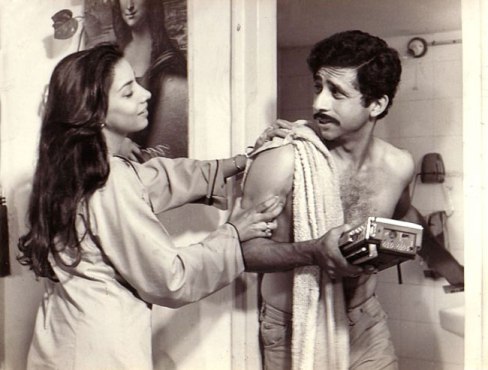
Libaas remains one of the most special Gulzar movie for me. Its an Unseen film for me, still I can feel the film like any other films that I have seen. I have read the film [It is based on a short story of Gulzar titled “Seema” published in Ravi Paar] and I have also “heard” the film [thru the songs and dialogues on cassettes]. It was almost as good as seeing the film…

The intensity of script and characters can be felt in the dialogues. Three main characters Sudhir [played by Naseeruddin Shah.. brilliant again as a Theater Director who puts work as the top priority and treat relationships as secondary], Seema [Shabana Azmi, the rebel wife of Naseer, She is more of a character for his director husband than a wife] and TK [Raj Babbar, an old friend of Naseer, [total contrast to Naseer’s character] who visits Naseer after a long time and woos Shabana. He is more of a bubbly and charming character].

The story starts with a theater group, which Naseer is struggling to setup. Shabana is Naseer’s wife and is also the leading lady in his production. The film starts on a lighter mood with a few funny moments with Utpal Dutt (dubbed by Johnny Lever after his death), Anu Kapoor and Naseer.

Utpal Dutt introduces the leading characters in the opening scene…

Drame me bhi miyaan-biwi ke role karate hain aur ghar pe bhi wahi..bore nahin ho jaate ek hi role karte karte”…

For Naseer, Theatre is life, much more than anything else..

Khana banana bhool jaaogi to bardasht kar loonga par apni line bhool jaaogi to kabhi maaf nahin karoonga..”..

Though Shabana behaves like a subordinate all the time, she has other demands too from the life.. One of the most important scene of the film speaks all….

Shabana (at home) : Main baal katwa loon.. chhote karwa loon, achhi lagoongi..

Naseer : to hayvadan ki padmini ka kya hoga, aur khamosh adalat ki leela bainare ka?

Shabana : Matlab Padmini aur Bainare mujh se jyada important hain..Mujh mein hamesha apne characters hi dekhte ho.. Kabhi mujhe bhi dekha hai?

Naseer : Are tumhare andar to saara jahaan dekhta hoon

Shabana : Dialogue mat bola karo har waqt.. tumhare liye to mujh se jyada theater important hai na.. I know if you have to choose between theater and me.. you would choose theater.

Naseer : Seema, theater sirf tumse hi nahin, mujhse bhi jyada important hai.. ham dono baad me aate hain, aur theater pahle

..an introduction to the characters completes with the entry of Raj Babbar, a businessman and an old friend of Naseer…

Shabana : Bada hi betakalluf dost tha aapka, is tarah to pahale kisi ko nahin dekha aapke saath…theater me to sab subordinates ki tarah behave karte hain

The story develops and restricts to the three main characters, their egos, the bondage and the break in relationships. The focus is on the character of Shabana.

Naseer : Ghar me rahti to ghar bore karta tha, theater me ho to theater bore karta hai.. Hamesha wahaan rahna chahti ho jahaan nahin ho, aur jahaan ho usase kabhi khush nahin ho.. You always want to be somewhere else, not where you are.. and you even don’t know where you want to be

Shabana stops doing theater and starts spending time with Raj Babbar..

Gulzar saab like a master craftsman draws parallels between the characters of his film and Mohan Rakesh’s Adhe Adhure using the play being prepared by Naseer and his theater group..

Also the scene where Naseer comes to know about the affair between Shabana and Raj Babbar, and he talks about it with Raj-Shabana is brilliantly handled.. (atleast it “sounds” so).. What happens next should be left undiscussed, hoping the film would release some day..

Music makes Libaas more special film.. It was the last film that Panchamda did with Gulzar saab… Also it was only the second and the last time Panchamda sang with Lata [for kya bura hai kya bhala]…Music of libaas is a kind of a sequel to Ijaazat. The album contains only 4 songs, all top class, including a superb Pancham composition “Sili Hawa Choo Gayee”, a typical gulzarish song, beautifully rendered by Lata. “Khamosh sa afsana” a duet by Suresh and Lata, “Phir kisi shaakh” is the next version of “Khali haath shaam aayee hai” in the mood and rendering, and “Kya bura hai kya bhala” is a lively group number [a bit of qawwali touch]…

Libaas was never released in theaters though it was shown in a International film festival of India in 1992.

Jitne bhi tay karte gaye, Badhte gaye ye faasle

Meelon se din chhod aaye, saalon si raat leke chale

We all hope it will see the light of the day.. some day… amen!

She used to be a teacher in an ICSE board school. But her kids were sent to another school where most Officers’ kids used to go. Her husband was a Chartered Accountant, and as most bongs like to flash their CA degree, he was no different. As kids, we always thought snob quotient was just for the Roys. And then one day her daughter lost an eye accidentally. A death in the family followed. She was no longer part of the Officers’ Wives club. Searching for answers, she found solace in my Granny’s words, whose life used to revolve around all the 33crore Hindu Gods. Some of them were family members too. She was searching for answers – why it happened to her daughter? She was the prettiest of them all, the mother always talked about her, a matter of pride. With an eye gone, it was a cruel joke on her beauty. And why that sudden death?

Ironically, the kids were inspired by Ramanand Sagar’s Ramayan and were trying the tricks with homemade bows and arrows when one of the arrow hit her eye. With kids and Gods, its difficult to put the blame on anyone. If only she was careful, it could have been averted. The thought never left her. Family member’s death disturbed her more. She was restless till the complete transformation happened. She found a Guru, sandalwood tilak followed and prayer beads inside a small bag became her constant companion.

As kids with curious minds, it was baffling to notice the change. Mr. R had mellowed down too. Grief does strange things to us. Add guilt to it, and it’s difficult to cope with. A friend of mine stays away from civilisation, in the jungles of Mcleodganj. It’s been more than two decades, he still holds himself responsible for his brother’s suicide. His conversation with his father is limited, as he was the one who in a moment of rage had pointed out that the culprit was my friend. It pierced the young heart and hasn’t left it since then. As he struggles with his writing, voluntary work for an NGO and relationship issues, most of his nights are spent drinking till wee hours of morning.

Arun Shourie took another extreme route. He explored religion scriptures, went to all the Godmen and spiritual Gurus to find the answer to his son’s suffering. Conclusion – suffering refutes religion. It’s all in his new book, Does He Knows A Mother’s Heart. Click here to read excerpts from the book. And click here to see a video interview of his where he explains his beliefs and thought process.

Terrence Malick’s Tree Of Life is all this and much more.

His fifth film in the last four decades or so. If you are familiar with his work, the elements are all there. The sun, green, nature, insects, birds, water, life, death, birth, suffering and those meditative voice-overs. I believe Malick started pondering over those existential questions in its entirety from The Thin Red Line. In a world where you have to map the plot points after every 20 pages for the Hollywood Studios to green light your film, it’s a brave new world that Malick has been able to create. And voice-overs that don’t follow any pattern or technique. With Tree Of Life, he goes to the extreme. If it was possible to attach a camera to your thoughts when you are coming to terms with the death of someone close to your heart, this film captures all that and puts it out on the big screen. Do you think or dream in a linear fashion? The camera attached to the thoughts floats in the universe as your mind ponders over everything possible, and Malick tells an intimate story of hate, grief, guilt and redemption in that background.

In one of the most brutally honest sequence that i have ever seen on the big screen, young Jack contemplates if he can kill his father with just a single trick. And he will be safe because his revenge will look like an accident. My heart skipped a beat there because i was worried about the old Jack then, guilt would have killed him so ruthlessly. Keep all the morality aside, think if you ever felt the same during your growing up years. And may be that’s why we had a chapter in our Moral Education book where a son plans to kill his father because he is frustrated with his constant jibes about his son’s work. As the son is about to enter the father’s room, he overhears the conversation between his mother and father, she is comparing the son to the Moon but the dad says, even Moon has some black spots, his son doesn’t have any. The son breaks down.  In Tree Of Life, the son becomes the father. The son starts hating the father but he slowly transforms into him. He starts with mimicking him, and then dictating the world around him, just like his father. In that honesty, lies the brilliance of story telling. We all hate our dads for some reason, and yet, we all end up becoming like him. With the kind of comfort that mothers pampers us with, mostly they make it happen.

Tree Of Life needs complete submission. Its a meditative piece by a yogi filmmaker which transcends every possible limit set by this medium. Just go with lil’ patience, you might get lost at many places, like I did, but just let it all flow. You will come back to Malick for sure. Don’t worry on that part. And even if you don’t, its good to be lost in your thoughts once in a while

With Jack, we float in his thoughts, his world, his world view, his guilt and finally some redemption which is pure consolation. Because we all eventually make peace with ourselves at some point, create a new world in our thoughts/dreams and make it comfortable for our soul. The soul-shuddhi needs time and space. Seems Malick too did the same with this film as this Guardian article points out that his brother, Larry, committed suicide in Spain while studying guitar under the teacher Andrés Segovia in 1968. Umesh Kulkrani did his with Vihir.

I’m struggling with mine. How long will my Mcleodganj friend take, am not sure. And you?


The wait is over. The Baap is here to kick all the ass! It stars Tony Leung and Zhang Ziyi. The Grandmasters is the biopic of Yip Man, the first martial artist to teach Wing Chun, the man who trained Bruce Lee and others. Leung plays Yip Man in the film.

Here it is..