Archive for the ‘bollywood’ Category

It’s always a great pleasure to hear the great directors. But it’s a pity that in our country we don’t have too many such events where one gets to hear the directors. And even if it happens, one hardly records the conversation.

At this year’s London Indian Film Festival, filmmaker Mani Ratnam was in conversation with director Peter Webber. And thankfully, they have recorded it too. So here’s the VOTD.

Kanu Behl’s Titli released few days ago. But we go busy with Mumbai Film Festival, and so haven’t been able to post anything on the absolutely brilliant debut feature of Kanu. The film premiered at Cannes last year.

Here’s Karan Singh Tyagi on Titli.

titli


Delhi has always struck me as a suffocating city. It has no harbor, it’s main river lies dangerously polluted, it boils in summer and it freezes in winter. To an outsider it is also a distrusting city; the city has watched me without interest many times – suggestive of some harshness in the people.

I experienced this same feeling visiting Delhi last week. At the airport, I placed my backpack in the dedicated common section in the restroom for cabin-bags. The restroom attendant immediately turned around and gave me a mocking smile, as if poking fun at my naivety and suggesting what a fool I was to blindly trust the safety of my bag in that common enclosure.

I had arranged for a private cab to take me to the city. I had not even settled in the cab when the driver started telling me that he was an expert in beating the parking system – stationing the car a few kilometers away and waiting for the phone call from the passenger to drive to the pick-up spot. We passed a signpost to Dadri. I was naturally reminded of the lynching incident, and expressed shock at what had taken place. Pat came the reply from the cab driver, “U.P. Sarkar itne paise deti hai ki ye log khud hi kar lete hain ye sab drama. Do aur hindu bhi mare, unhe to kuch nahin mila.”

There seemed something savage and gluttonous in the manner in which he shifted the discourse from a humane level to a transactional level. I was left wondering where these thoughts had come from, and what is the prism through which he was viewing the world, looking past empathy to power and money.

As we advanced, garbage was being burnt on an open spot along the NH-58 highway. White smoke was rising from the burning trash.

It reminded me of Kanu Behl’s “Titli”, a film that burns with an intensity not matched on screen in a long time. It smells of hazy smoke that rises from burnt trash in the dusty by-lanes of Delhi. The film internalizes my growing feelings about Delhi (and this country) and spits out something dangerous, something macabre, even.

On the surface, the movie is about Titli’s (Shashank Arora’s) attempts along with his wife (Shivani Raghuvanshi) to escape his family that engages in violent carjacking. But, underneath the film holds up a brutal mirror that shows an unflattering reflection of our hypocrisy, patriarchy, mistrust, rage and sorrow. What spoke to me the most was how brilliantly it handles the subject of patriarchy.

“Titli” places the four male protagonists along a continuum of misogyny, ranging from the father (Lalit Behl) who is extremely hegemonic to Titli who is consciously trying to find a sense of agency. Vikram (Ranvir Shorey) and Bavla (Amit Sial) occupy spots in the middle. Each male protagonist has much to tell us about who we are.

The father is so deeply entrenched in patriarchy that he doesn’t even realize it; his Zen-like presence in a world where violence happens around him every day is devilish. Vikram, supportive of entrenched patriarchy, knowingly and on occasions unknowingly, finds rhetorical ways to contort his patriarchal gaze into expressions of compassion and sadness. See him in scenes where he is dealing with his divorce or where he is thrashing Titli while simultaneously crying and imploring: “Parivar vale narak lagte hain tujhe?” – his is a world of wretched and labile emotions in a patriarchal universe.

Bavla’s position on this continuum is the most unique that while on one hand he displays gay leanings, on the other hand he is an unobtrusive participant in the terror perpetrated by his father and brother. In contrast, Titli is trying to actively seize control of his life, but he soon finds himself engaged in praxis of futility as he discovers that morality and conscience is the price for freedom.

Viewed from a certain perspective, the film is also a peerless portrayal of our hypocrisy – our classic ability to extricate a problem from its context and deal with it symbolically. The movie spends an excessive amount of time showing the male characters brushing their teeth and clearing their throat, as if these acts of personal hygiene allow the male leads to purge their sins and soul, thus making them cleaner humans. The symbolism should not be bewildering as this is happening in a country where millions gather at the ghats of the Sangam every year to purge themselves of all sins by taking a dip in the waters.

Symbolism aside, where the movie soars is in its representation of the construct of the family in India. It deftly depicts how an Indian family can be something of an unforgiving structure for many – one which dedicates itself to the art of the self-inflicted wound (there is also a gut-wrenching scene in the movie that involves a literal depiction of a self-inflicted wound), and which, knowingly or unknowingly, is committed to acts of cruelty against its own kind rather too often.

The portrait of India that emerges from this examination shows a country that is broken, in a fundamental, probably irreparable way. But, to completely mangle Wright Thompson’s beautiful lines on India, “Titli” is both the riddle and the solution. One must understand today’s India to understand “Titli”, but one must understand “Titli” to understand today’s India. They created each other. They are the same.

Karan Singh Tyagi

(The writer, currently based in Mumbai, is a graduate of the L.L.M. program at Harvard Law School. You can find him on twitter here: @karanstyagi)

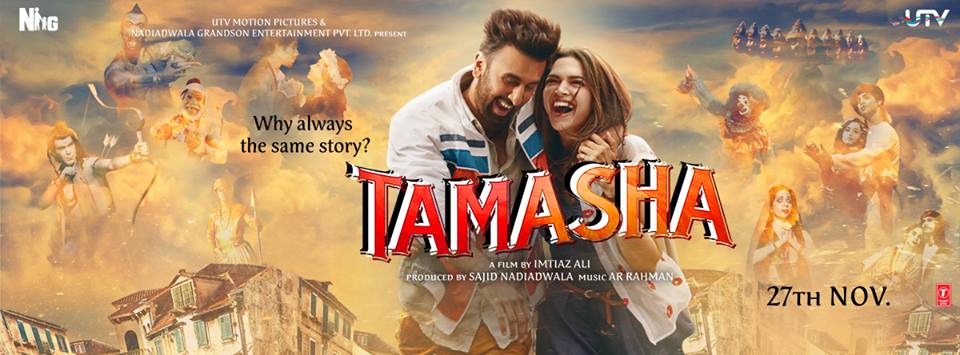
Tamasha

Matargashti is a song that is filled with fantastic sounds, although it sounds over the top a lot of times (especially when Mohit tries hard to reduce A R Rahman’s burden of polishing the song – in high notes), but the simple notes are Mr. Chauhan’s forte in the studio, and he rules it. Somehow I felt there was too much happening in the song and nothing new hit me.

Mika is always hungry, and he chews on words making it impossible for most of us to understand what he is trying to sing. Heer to badi sad hai is no exception. Rahman has composed this with a lot of love, and it shows. Irshad Kamil can be quite cheeky and in this song, it works like magic! Not saying Mika didn’t suit the song, but this song would have been so so good had Sonu Nigam, Nakash or Javed Ali would have loaned their voice.

Alka Yagnik sounds unlike herself when Tum saath ho begins, and you can’t help but think it is a slow tempo ‘Maahi ve’ beat that is embellishing the song, which is easily the best penned song of the album. Making Arijit sing in two different pitches (or tracks or whatever it is called) and keeping both in the song is a shot of genius because it doesn’t allow the Arijit fatigue to creep up. Good to have Alka Yagnik back. Sadhna Sargam in DLKH and Alka here, this is a good year for us 90s kids!

Wat wat wat wat – Shashwat Singh (not ‘Sashwat’ as iTunes would have us believe) kicks it, and my God, does he do a great job doing it! A somewhat street treatment to a Bhojpuri song filled with moans and exotic ‘la la’ at strategic places, this song is easily the ear-worm of the album, and don’t bother liking it because once you hear it, you will not be able to ‘un-play’ it in your head. I am sure it was a situational demand to do so but Arijit drags the song down and is no match for Shashwat. There is a vengeance mix of the song which is groovy and electric and has no Arijit Singh. Even ARR knew it would be great to let Shashwat have a go at it, alone. It is like ‘Wanna mash up’ in Bhojpuri and I LOVED Wanna mash up! Not to forget the excellent lyrics of the song – udat chidiya ke haldi ragad ke lagawat…WTF! Superb imagination!

Chali kahaniappears to be a stage song but it cannot hide under this fact for being awfully low on melody and cacophonous at places. We have enough examples of great stage songs and that is why this song is quite a put off especially coming from ARR. Sukhwinder shines but Haripriya and Haricharan have been given the worst lines (and tune) of the album so they made peace with it. The song  wanted to be an ‘Aao na’, skirtedsheher’ and ‘ishq bina’ but failed miserably at achieving anything even in between, and what is with that ‘Subhash-Ghai’s-sque-attempt-at-deafening-in-your-face-grand sound’ ? No, No, No!

Safarnama – Lucky Ali has always been a king of flat tunes which do not challenge the singer to go high. Nothing wrong with that. People have their niches. In this song, he tries again to step out of his comfort zone and am sure it needed a lot of ‘studio work’ to make it ‘better’. The song has a nice vibe to it mostly when he is humming or when that beautiful music arrangement is taking its toll without him singing. In other parts, the song is a torture.

Parade De La Bastille – is a magnificent piece which has shades of matargashti but with no vocal parts in it to spoil the song for you. The metal flute and other exotic instruments along with strings and accordion sit comfortably and request your senses to rest yourself in their lap, and perhaps sleep. I absolutely loved the way the tune ends. Hi A.R. Rahman!

Tu Koi aur haistarts with the all too familiar ARR style of luring your senses to give up everything and pay attention to what the Mozart from madras is whispering in your ears. Sadly, the song loses itself quite quickly in the murky overalls of a bad tune and ordinary words. This is the longest song of the album, and what can be worse than the fact that you literally wait for the song to end.

I am quite sure everyone will find their reason to like the album because they have to, just like some of them argue and tell me how great the music of ‘lekar hum deewana dil’ was. To me, the album comes across as being too self aware having great sense of occasion but terribly low on melody. There is too much indulgence, sometimes, in between, and at times, towards the end of songs. In a bid to keep the sound theatrical, I guess, the background music got merged into songs…which weighs you down and doesn’t let you soak into the music.

The album, from ARR standards is underwhelming and I think this thing toh  utter sad hai.

Rohwit

It’s known as the Noida Double Murder Case. And it’s easily one of the most talked about murder case in recent history. More so, because it happened in a middle class locality in Noida, a city adjoining to India’s capital.

Shazia Iqbal saw the film Talvar, which is based on the same case, and writes about the big picture that concerns all of us as a society, and as part of the system. And why a filmmaker’s bias is completely fine.

Guilty2

23rd May 2008.

‘Its starting now. Quick, come here’, my mother loudly screamed as soon as the press conference was about to start.

The Delhi police was making the big announcement of the perpetrators in the Noida double murder case in which the 14 year old Aarushi Talwar and Hemraj, the house help were brutally murdered a week ago. I almost didn’t hear my mother because of the noises ringing in my ears since two days. That morning when I left home for a meeting, the police van and the media outside the building opposite to mine seemed like the crime scene outside the Talwar society.

A day ago, Maria Susairaj, an aspiring actress had confessed to Malad Police that her fiancé, Emile Jerome had killed Neeraj Grover, a TV executive in a fit of rage when Jerome found Grover in Maria’s bed. Susairaj stayed in the building opposite to my house. On the night of May 7th, and the morning after, I had a party in my house and I was awake the whole night. After Susairaj’s confession and the gory details of cutting the body into 200 pieces and dressing up the crime scene, that story played in my head enough number of times to make me believe that I was there in that house that night and it all happened in front of me, and that I was a dumb mute spectator.

Neeraj Grover was close to the industry I worked in and we had common friends. His face haunted me, I hadn’t slept for a minute for over 48 hours. With all the drama that was happening outside the building, I didn’t want to step out. The media called the Neeraj Grover murder case as the face of changing India, the young India where relationships are fragile, infidelity is part of commitment and casual sex is no more a ‘man’ thing.

A week before this, the Noida double murder case made headlines as the murder involved a young teenage girl from an affluent family and an older servant who worked in the house. This did not happen 200 meters away from my house but the media made sure that it was very much part of my life. Everyone was talking about the murder and that press conference seemed like the episode from a popular TV soap in which the whole country freaked out when the main protagonist dies. Aarushi’s murder was presented like a high TRP whodunit thriller. Everyone wanted to know who killed her.

I went to the living room where my parents and sister were waiting for the press conference to start on the TV. IGP Gurdarshan Singh began the conference by calling Aarushi as Shruti.

‘How will he solve the murder, if he doesn’t even know the name of the kid’ my mother mused. And once wasn’t enough – Singh kept calling Aarushi as Shruti throughout the conference.

But that wasn’t the only eyebrow raising behaviour from him and his department. They claimed Rajesh Talwar killed his daughter in order to save his ‘honour’, gave details of Talwar’s extra marital affair, their involvement in wife swapping and the deplorable character assassination of a child who was murdered.

“Rubbish”, my father responded shocked, “They can’t find the killer and are making up these implausible stories. He is her father!” He couldn’t believe what was happening. Fathers don’t kill their children because of their affairs, he said. He was afraid this revelation could make every girl distrust her father. A silent tear rolled as I went back to my room.

None of what the IGP said made any sense. Last night when I watched Meghna Gulzar’s movie Talvar based on the case, I was glad it resonated with what I thought during that press conference. I just wanted to know the parents didn’t kill her. I wanted to know this young new ruthless India of frivolous relationships that people keep bringing up with every sensational murder case, is a farce. But, apparently, that India is very much prevalent and so is the antiquated patriarchal India where a police officer blames the Internet for ruining the cultural fabric of the country and 14 year olds having a boyfriend and ‘Sleep’-overs.

Lawyers ML Sharma and AP Singh became the face of this primitive regressive patriarchal India after the Brit docu India’s Daughter was released by BBC. It featured a man who believes he would gladly burn his daughter if she has premarital sex – how would he react to a society where girls tell their fathers about their boyfriends? People who believe that honor killing is right, they also assume that the society also harbors such beliefs. And the effort that the government took in banning India’s Daughter is not as half as much as the combined effort of the local police, the assigned CBI team and the courts took to convict the Talwars.

So what happens when such men raised with such regressive values try to understand a culture belonging to the modern upper class allegedly corrupted by the internet? Talvar.

What more can you say about a murder case where every minute detail has been public for 7 years now. Talvar, written by Vishal Bhardwaj and directed by Meghna Gulzar presents us those details and engages us, without any melodrama or manipulation, mildly tilting in the favour of Talwars. Of course some might use the latter point to brand the film as being biased. I’d like them to know that a film is a writer/ filmmaker’s point of view/opinion on what disturbs them long enough to get up and say something. And that’s why Talvar happened. And I am glad it did.

What can this movie talk about about that you haven’t already read in the papers, news, from the police, CBI officers, from your parents, next-door uncles? ‘Human reaction’, for one. In the last 20 minutes of the film, in a round table sequence that is a master class in writing, the CBI officer who acquitted the Talwars says no two humans can have a pre-conceived reaction to an incident, specially a ghastly cold blooded murder of their only child. The side that files the charge sheet against the parents questions their unemotional façade post the murder and during the trial. Nupur Talwar appeared on a TV show and didn’t cry while talking about her daughter’s death. What kind of a mother is she? In a society with history of rudaalis, where being loud is part of our culture, melodrama is not just for the TV sets but an inherent way to express our emotions specially when it comes to matter of death, how can a mother not cry? Everyone questioned. Every logical person went against the Talwars with this one question.

‘She looks numb. Seeing your kid’s dead body can do that’, said my mother. It takes empathy and humanity to realize that. No other human can reason or understand inner doings of another’s mind. So how can human reaction be even discussed as a generic emotional response?

Watching a dark and disturbing story can be difficult but watching a dark and disturbing story based on real people’s lives can be very painful, especially with the way most of us are attached to Aarushi’s case. Bhardwaj, however, with his straight-faced dry wit makes it easier for you to watch Talvar.

That way Talvar is more than a movie. It is an important film, about the sword of justice that claimed not two but four lives. One of the slain was a child accused of being involved with a man thrice her age. The men who publicly assassinated her character are the ones who are responsible for the law and judiciary in this country. This movie needs to be seen. For Aarushi. To open our eyes and discover a system that failed a child. And as the movie says, it’s up to you to decide what the truth is.

Shazia Iqbal

(To read previous posts by the same author, click here)

Guilty9

(Disclaimer – One of our editors is closely associated with ‘Talvar’)

The first look of Meghna Gulzar’s Talvar is out. Starring Irrfan Khan, Konkona Sen Sharma, Neeraj Kabi, Sohum Shah, Atul Kumar, and Gajraj Rao, the film has been written by Vishal Bhardwaj who has also given the music. It has Gulzar’s lyrics and has been shot by Pankaj Kumar.

Do check out the trailer.

The film is based on Aarushi Talwar murder case and looks at it from the point of investigation.

Talvar will have its world premiere at this year’s Toronto International Film Festival.

Irrfan

The Toronto International Film Festival has just announced its line-up for 2015. And here’s the good news – two Indian films, Meghna Gulzar’s Talvar and Leena Yadav’s Parched have been selected for World Premiere in ‘Special Presentations’ section.

Starring Irrfan Khan, Konkona Sensharma, Neeraj Kabi, Atul Kumar, Gajraj Rao, Sohum Shah and Tabu in a special appearance, the film is a gritty investigative drama about the Noida double murder case. With Gulzar’s lyrics, Vishal Bhardwaj’s music & screenplay, and cinematography by Pankaj Kumar (Haider, Ship Of Theseus), the thriller is a fictional dramatization of true life events revolving around Aarushi Talwar murder case investigation.

Leena Yadav’s Parched has Tannishtha Chatterjee in the lead role. The official page has one line description – In a rural Indian village, four ordinary women begin to throw off the traditions that hold them in servitude, in this inspirational drama.

(Disclosure – One of our editors is closely associated with Talvar)

Phantom Films Is Looking For Horror Stories

Posted: July 20, 2015 by moifightclub in bollywood, film, News
Tags: ,

11223492_1045243058838559_5735304794109612467_n

Phantom Films is looking for Horror stories. It shared the news on its FB/Twitter timeline.

Phantom is looking for stories, scripts, treatments or even scriptwriters in the horror genre – the scarier the better!

We’re not afraid, so you shouldn’t be either!

Send your scripts/ideas to: horror@phantoms.in

So all those who keep complaining about having not enough opportunities to break into bollywood, here you go.

Their FB page is here. Twitter handle is here.

Film Writers Association (FWA) recently did a workshop on “pitching your story”. Filmmaker Vikramaditya Motwane, screenwriter Shridhar Raghavan & Kamlesh Pandey, and producer Ram Mirchandani shared their ideas and experience about the process.

It’s great that FWA is finally taking some initiatives that will help the new writers. Just wish the video/audio was done professionally. And big thanks to the person who transcribed the entire video.

Watch the video or click here to read the transcript.

https://www.youtube.com/watch?v=q9LMw0moabQ


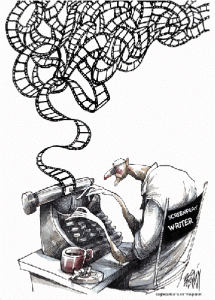
screenwriting-215x300This is for all those who keep complaining that it’s difficult being a writer in Bollywood, especially if you are a new one looking for a break. Trinity Pictures (under Eros International) is looking for full time writers. So here it goes.

Here’s screenwriter and mentor Shridhar Raghavan’s post on the same. He will be mentoring the writers for the same.

WHAT : Trinity Pictures headed by Ajit Thakur, the newly setup motion pictures division of Eros International, focusing primarily on Franchises, is looking to recruit full time writers for the Trinity Writers Room. The idea is to develop concepts, stories and scripts.

HOW : To apply you have to write a brief review of any two out of these three films – Badlapur, Ranjhanaa, Happy Ending.

Additionally, write a scene that you think could fit into any of the above films keeping in mind the spirit of he original. For example, say in Badlapur, you could think of an additional scene between Varun and Nawaz or between Varun and his wife or anything else – even a different ending. Imagine a scene that couldn’t make it to the film and was left out at the edit.

This is to clarify to those calling in and writing in who were confused.

LOCATION : It’s not restricted to Mumbai. Anyone from anywhere in the country can apply.

CONTACT : You can address queries and send submissions to Jahnabi.gogoi@erosintl.com.

DEADLINE : Friday, 12th June, 2015. But if it extends a day or two, no stress. The idea is to access as many writers as possible.

Cheers and happy writing.

tanu-weds-manu-returns_640x480_71428999782

I am sure there is an innate desire in all mainstream filmmakers to see their audience dance on one of the songs of their films. With Banno, Anand Rai has achieved that aim quite easily. Banno tera Swagger (Not Sweater) is a  cracker of a song which isnt just ‘dinchik-dinchik-boom-boom-*random-punjabi*-boom-boom’, the song is word rich, clever and that harmonium towards the end. Orgassssssssssssssm! We wondered here last year if the ‘ooper ooper ren de’ duo of Tanishk-Vayu would be able to match up to their own ‘high’ standards. Fair to say, they did and with aplomb.

It is in vogue to dislike Ankit tewari, more so because of the sameness of all of his tunes. Thankfully, with Krsna at the helm and the burden(?) of composing off his shoulder, Ankit doesn’t try too hard to over express the pain in Mat ja re. Terrific lyrics are a calming factor which generally isn’t the case with songs these days…उम्मीदों से है  घायल,उम्मीद पे  जिंदा है…आस भरी अरदास…I can go on and on. If you excuse the slight ‘oye raju’ like sound  of the song, you will not have much to complain here. Also, I loved the ‘Oye raju’ song.

Jyoti Nooran has successfully filled in the folksy yet सुरीली  place in bollywood, and almost all her songs do garner a lot of excitement. Ghani Bawri is easily likeable and Jyoti is in her top form like most times, so that is hardly a surprise. What surprised me no end was how well the remix of this song has been treated. Not a fan of CD filler रुपी  remixes in film albums, I was in for a huge surprise with this remix. Thoroughly enjoyable attempt and my favorite part remains the stanzas of the song. Superbly done!

Old style Jazz setting, a meandering piano and Anmoll Malik get along very well in Old school girl which has enjoyable lyrics. The jazz setting isn’t managed by परदेसी बैंड वाली कम्पनी लिमिटेड, still it sounds rich. The lyrics are cute. Talking of cute, the Haryanvi version of this song sung by Kalpana Gandharv easily impresses although it will work more in the film (if used). हम में से कुछ लोग है, जिनकी  first language अंग्रेजी नहीं है. ये गाना किसी ऐसे व्यक्ति से ही परिचय कराता है…पहले हरयाणवी में सोचो, फिर Translate it to english and then sing! To be honest, Kalpana’s singing isn’t very convincing (Haryanvi-shly I mean). Still her ‘Babby’ and ‘Telepone’ makes up for everything. Did I like both versions? Yes. Will I play it on the loop? Unlikely.

Move on – Perhaps the weakest song of the album, the song has a catchy hook but dies quickly because of that hook itself! The song sounds like a ‘Mehboob mere’ gone wrong. Normally a big fan of Sunidhi, this song refused to do anything that can make me play it  on the loop.

Dev Negi has an interesting voice which doesn’t put you off. In ‘Ho gaya hai pyar tumse’, he is given a simple tune to which he does full justice. May be it is just me, but I felt I am listening to a fresher version of ‘Kitne dafey’ by the time I made it to the Stanza of the song.

I cannot write enough good things about O Saathi mere, so I will keep it short. The layered composition, married to beautiful lyrics and decorated by the faithful singing by Sonu Nigam has makings of a classic. The tune of the song is creatively handled and very rarely we come across such experiments these days in Bollywood. Easily a song that will outlive the film. One of Sonu Nigam’s finest, ever!

This is an album that is ‘small town’ at heart but very urban in execution. Through the songs, we get closer to the narrative without being too serious about ‘How-much-trouble-the-musicians-are-taking-to-put-it-all-together’. The art is to keep it simple, silly!

A mix of fun, बवाल, दुःख, दर्द and romance, this one for keeps, just like its predecessor, and slightly younger! Now How often does that happen?

@rohwit