Archive for the ‘film’ Category

talaash

SPOILER  ALERT

My blood group is C+ve. And i don’t mean the Hindi cuss word that starts with “C”. Because there’s no other explanation for me getting so restless about films and going to bed peacefully only after i have chased all the possible “sources” to know what the films (or its spoilers) are about. Blame it on occupational hazard, or maybe am in this occupation because of the same blood group. Also, because for me, films are more about “how they happen” and not “what happens”.

Nothing to boast about but i knew about the so called big twist of Talaash almost a year back. Though i had my doubts about it but everything related to the film was pointing in the same direction. And a year is a long time to make peace with the “ghostly” fact. As the release date of Talaash was near, i was travelling out of country. Curious that i am, got in touch with a friend who was watching the film much before anyone else. I asked him if he can let me know as soon as he is done with it. He saw it, liked it, and said, he is not going to tell me the spoilers. I told him, i am going to tell him what i know, and he just has to say yes or no. I asked him about the big twist. He said, yes, but how do you know? Well, the first rule is you never reveal your sources. Aha, much relief after waiting for a year. I quickly tweeted that yes, yes, yes, it’s the same twist that we knew since a year back. At least the C+ souls like me will get a good night’s sleep finally.

I saw the film almost a week after its release. And i have concluded that if you know the twist, the film works in a much better way. And there are many reasons for it. First, the pitch. The makers tried to keep the per-release campaign quite low-key because of the fear that the twist might get out due to over-exposure. Everything pointed out that it’s a thriller or suspense drama. The font of the print campaign started becoming bigger with the countdown – TRUTH will be out in 5…4…3….2…1 day. You can’t blame anyone when everyone saw the same story in the promotions – a cop chasing the death of a film star. He has to crack the case. So what is the TRUTH? The big twist? Now, if the baggage comes down to the fact that Kareena is a ghost who guides Aamir Khan’s character to crack the case, it seems straight out of @OMGFacts, or evn LOL-Facts. It’s easy to dismiss it when you have invested so much in the case which looks so real, and with such great mood that creates the world around it and builds the prefect pace. Ghost? That’s a joke, that’s so flimsy! The writers could not think of anything else?

Now, imagine if the film was pitched to you as “supernatural drama”. You are prepared for it and it’s much to easy to accept it that way. But i think the writers of the film did set up the track of Rani Mukerjee quite well to give you a hint in which direction the film was heading. It wasn’t like a pop-up music video. I can’t say with full confidence but i think i would have still liked it if i had no clue about the twist.

Show me a man who was shattered by the unnatural death of a loved one, and has made peace with it without doing anything unnatural. Shit happens, and then we find our ways to cope with it. I am an atheist but  i have seen/heard/experienced things which are difficult to explain and impossible to believe. They remain unanswered and life goes on till another death comes knocking.

Also, when you don’t know the twist, you are waiting for the big revelation in the end. The problem is the fashion in which we have been conditioned to watch films – the theory of “end me kya hota hai?” But Talaash is much more than that. And you can focus on the rest, which is so gorgeous, once the twist is out of your way. In fact, that’s not even the film. It’s about a couple coming to terms with the loss of their kid. Both take different routes to trace that piece of peace. The murder case is purely incidental. But the sad part is you won’t waste you weekend to watch a couple coming to terms with the death of their loved ones. Will you? You need coke, corn and crap on screen for your weekend outing. So most probably they decided to hook you with that “murder mystery” pitch. And i must admit that’s it gives me a kind of sadistic pleasure to know that you have been cheated.

And in a good way, it also reminded me of an all time favourtive film of mine – Umesh Kulkarni’s Vihir. Because love, loss, death, water, wandering souls, and peace – the motifs are the same here. If you still haven’t seen it, WATCH IT!

Without any doubt, Talaash is one of the best directed films of the year. Mohanan’s photography with Sampath’s music creates such a compelling mood. The tone is set as soon as the credit roll begins with those invisible faces and characters that bollywood doesn’t give a fuck about even though they are at every signal in this city. Rani Mukerjee, Nawazuddin Siddiqui, Raj Kumar Yadav, Sheeba Chaddha, Aditi Vasudev and Subrat Datta – all of them are in top form here. You are hooked to it till the interval happens, and then Cinemax Versova killed the mood for me by playing commercials for at least 30minutes. Had to go out and shout at the manager to start the film post-interval.

Another criticism i have heard so far is that the film scratches the surface, and it doesn’t go any deep. Aha, i have always believed that it entirely depends on you – how you want to read the film. If you can’t scratch beyond the surface, don’t put the blame on the film and the filmmaker always. Instead click here and read the best piece on the film.

I might not be a fan of Aamir Khan but you have to appreciate the choices he makes. He believes in them and pulls it off. Compare it to the films of others A-list stars of Bollywood. What are they doing? What are the delivering? All the focus is on 100-crore these days. And when it’s so much easy to deliver that with cheap crap-corn-cola, why put so much effort and take a risk? Respect for that.

Also, am wondering if it’s high time to divide Excel’s films into Farhan Akhtar Films and Zoya Akhtar/Reema Kagti Films. Someone compared Kartik Calling Kartik to Talaash on twitter and said KCK was better. I tried hard to control my laughter. That film had much more baggage on its twist and it was a (chinese?) joke in the end. And, remember Game – their another venture in similar space? Don’t have words in my dictionary to describe that garbage. Not sure why, but i feel these films belong to Farhan Akhtar who has been on a downhill since his brilliant debut, Dil Chahta Hai. But the ladies are trying new things and pulling it off with so much ease – Honeymoon Travels Pvt. Ltd, Luck By Chance, Zindagi Na Milegi Dobara and now, Talaash. To quote another favourite dialogue of the year, Farhan Baba, tumse na hoga ab, rehne do. Bus acting hi kar lo.

(PS – Can we please nominate Aamir’s eyebrows for performance of the year? Though his moustache was vying hard for attention but my vote goes for the eyebrows.)

– Posted by @CilemaSnob

Talaash – Seeking the ‘real’

Posted: December 1, 2012 by fattiemama in cinema, film, Thoughts

Everyone’s seeking something. Identity, most often than not. Some find, some sink. Bollywood happens to be in some sort of a no-man’s land in that respect. Most of the time we don’t even know it’s looking…

download

What made me want to write this? Partly, a vague and naïve belief that our cinema can be saved. Especially by some who are in the very thick of commercial cinema’s circus ring. Not that it’s a bad thing, at all. But my expectations may be. And that brings me to lay them out and examine them. And with it, the reality out there, of our craven, exhilarating, diseased, infectious, addictive, inconsequential film world.

Talaash is a good film. It is tight, engaging, dramatic and emotionally expressive. It has a superb theme at the centre manifested in multiple strands connecting it. For what I think must be the first time in my cine-conscious life, I had a good word for Aamir. I had sat through an Aamir film without cringing at his non-performance and I loved him for that. But it bothered me big-time. Why do we insist on the surface so much? Why can’t we, for once, scrape out the skin and lay bare the soul of a story for absolute, complete and total consumption? What are we so scared of?

I kept getting distracted by the holes everywhere in the film that personify this superficial approach we take to things. Symptomatic of the entire sensibility of our hallowed Bollywood. And in so many ways representative of what the Excel world has come to embody.

Somewhere in the mid 2000s, Bollywood began to see beyond its general upper class fetish. It began to set its stories outside perfectly manicured sets of lavish bungalows, choosing instead, a milieu its audience lived in. You see, a few stark films had been received well and Bollywood’s herd mentality swooped in. With classic insecurity, it then mixed this trend with populism and dreamy stuff. Meanwhile, the so-called parallel camps that really wanted to break-free were busy choosing style over substance or let’s say form over hard-core story-telling. Garish, loud, escapist stuff always won hands down, and stars were always less available for anything with a remotely realistic setting, the story notwithstanding. After all, she is a whore no one cares for in Bollywood. Hence, when a film like Talaash comes out of the blue it’s a delicious prospect. Funny, how the traditional suddenly seems out of the ordinary just because it is on the verge of extinction.

From there began a worse kind of prositutionalising (if that’s a word) of the realist film. All you needed was your heroine in Fab India clothes, nude lipstick with lesser gloss and mascara-ed eyes without fake eyelashes, unclean-looking (‘looking’ only for that lived-in feel) houses, crowds made of junior artistes that rarely get work with Dharma and a little swearing. It didn’t matter if it was uttered with a convent-educated polish. It didn’t matter that none of it was convincing because it all looked so real. Looks after all is what Bollywood is all about, isn’t it?

And there and that’s why we are able to overlook Kareena speaking in perfectly correct Hindi and classy accent when playing a prostitute. We hardly notice when Rani playing a woman so heart-broken she couldn’t care about her appearance, flicks a strand of unkempt hair off her face like a diva would to avoid spoiling her painfully dressed-up hair. We pass by an entire police force that is so upright and intent on its job when the fact alone removes all doubt of the film being realistic. We gulp down a suitably grungy red light area if its characters are duly wearing garish, ill-matched clothes. Nothing strikes us as out of ordinary when the police-prostitute relationship comes with no disgust, no statement and completely without any hint of the dirtiest power plays that informs that world. Our eye-lids don’t bat when a prostitute is put in the care of a really nice woman running a rehab/NGO and chapter closed all hunky dory. And so on. It all appears properly realistic so what are we cribbing about?

Because appearances are not always deceptive. At times they are representative of what lies beneath.

Excel Entertainment that began with the era-defining Dil Chahta Hain, has made an admirable reputation for making films with strong content. (Except of course, the Don films but then when you have SRK who’d bother with content anyway. He himself doesn’t  anymore.) But why are they always so sanitised? Far-removed from going beneath the surface?

Why is glamour suitably replaced with just-about pretty when upper class and just-that-much scruffy for any of the stratas below? Why aren’t emotions all-consuming, why do characters who even when behaving ordinary seem affected and why do the stories, although full of lovely moments, keep us at a distance? It’s as if an invisible glass curtain has fallen in between. There seems a desperate reluctance to approach anything that is extreme, anything that isn’t middle-line. What began as a fresh perspective on story-telling seems to be fast developing into some sort of a middle-of-the-road voice that’s saying nothing new, happy to simply tone down the intensity of what both extremes have been doing for ages.

And so we have a dispassionate Rock On, a squeaky clean and naïve Lakshya, exotica pretending to be exploratory Zindagi Na Milegi Dobara, an underwhelming Karthik Calling Karthik, a neither flaky nor deep Honeymoon Travels and now a funnily packaged thriller Talaash that simply cannot make up its mind about its physical or emotional landscape.

I’ve really liked all these films (with the exception of Rock On, which I found extremely mediocre and too populist to have true merit.) because they have been well-told stories and refreshingly non-self-conscious. But through them all I have waited for a film from the Excel stables to max out its subject, take the juice out of it and compel me to go ah-a because their films do display a fresher approach. Luck By Chance is the only exception that takes a dangerously close look at its subject but its singularity as an example makes me regard it as one of those rare flashes of brilliance that talented people are capable of but some hardly show often. And Excel, despite its premeditated insistence on an extremely sanitized reality, has the potential to show that brilliance more often than it does. The other bigger reason I felt like writing this post.

images_1

There were so many things going for Talaash but this insistence on a safe distance from any sort of crudity called out the entire game. If not for Nawazuddin Siddique and Subrat Dutta, the carefully-cultivated setting would have been faker than those pretentious Fuji apples. I didn’t write it off, despite the finale which I’d have readily bought had the film only set it up right. It had a beautiful, somber mood, carried through faithfully, successfully smearing the narrative with a blanket of bleakness that served it so well. It stayed away from incorporating formulaic elements and actually went so far as to have three top stars shedding all their vanity to actually serve the film, an almost unheard of feat, leave alone unachievable. It had Aamir Khan get into the skin of a character for a change, for God’s sake! Yet, it stopped short of the brilliance it could have been.

The curious thing about it is that it’s out-of-the-box and extremely traditional at the same time. It mixes genres not in formulaic Bollywood style but to serve its own purpose. But having done that, it doesn’t create anything new. It is well-written, tight and engaging but stereotypical at more places than one, picking its people and places more out of tested territories than a kicking imagination. It is very well-directed yet unfinished…so many rough edges, so many moments where the lack of attention to detail shows through. And these become big holes in what informs an entire sensibility and ‘type’ of film Excel is fast becoming synonymous with. Despite an actively engaging two and half hours, these holes are all that remained with me.

Bollywood abounds in horror stories more horrifying than Ramsay films so I accept that it is probably impossible to make an honest film and still earn money. But I do need to ask, if compromises (artistic, intellectual or of mere effort) are absolutely necessary, can we find a way to do them so they don’t come in the way of pure-blood story-telling and some really memorable cinema that surely we are capable of? Or we aren’t?

Any answers?

Fatema Kagalwala

Ad film maker and FTII alumni Ravi Deshpande writes on Hansal Mehta’s Shahid and its journey so far. (Disclaimer – Hansal says he has been a guide and friend.)

“From reluctant jihadist to crusading lawyer, the life of Shahid Azmi was a remarkable one. Gunned down while defending accused Mumbai bomber Fahim Ansari, Azmi was transformed into an unlikely martyr. But Hansal Mehta’s new film is much more than a biopic; Shahid captures the zeitgeist of a generation.

Shahid’s story began in the slums of Govandi in eastern Mumbai amid violent riots between Hindus and Muslims. A young witness to injustice, Shahid fled his home to a jihadist camp deep in the mountains but, never a dedicated soldier, he deserted as a teenager and returned home — only to be imprisoned on terrorist charges. Tutored by older political prisoners, he resolves to fight injustice upon his release. Finding work in a law office, Shahid struggles against a system steeped in contradictions and hypocrisies, defending clients labelled “anti-nationalist,” “radicals” or “terrorists.”

Hansal Mehta’s Shahid is as much a testament to a remarkable life cut tragically short as it is a cathartic journey through a city filled it seems with equal measure grave injustice and great idealism.”

– Cameron Bailey, Artistic Director, Toronto International Film Festival.

Consider this : By the time he was gunned down, Shahid Azmi had at least 17 acquittals to his credit, a great benchmark for the small span of time he was an advocate.

So why am I writing about this film? Or rather, why am I compelled to write about the experience of this film? Because the film is as close to a real tale as I have seen. The real story of the film concluded with Shahid’s death but just 2 years ago. His strife is still fresh in our minds. It is a Mumbai tale that Mumbaites know. Difficult to satisfy a critical Mumbaite filmmaker’s mind with a Mumbai story.

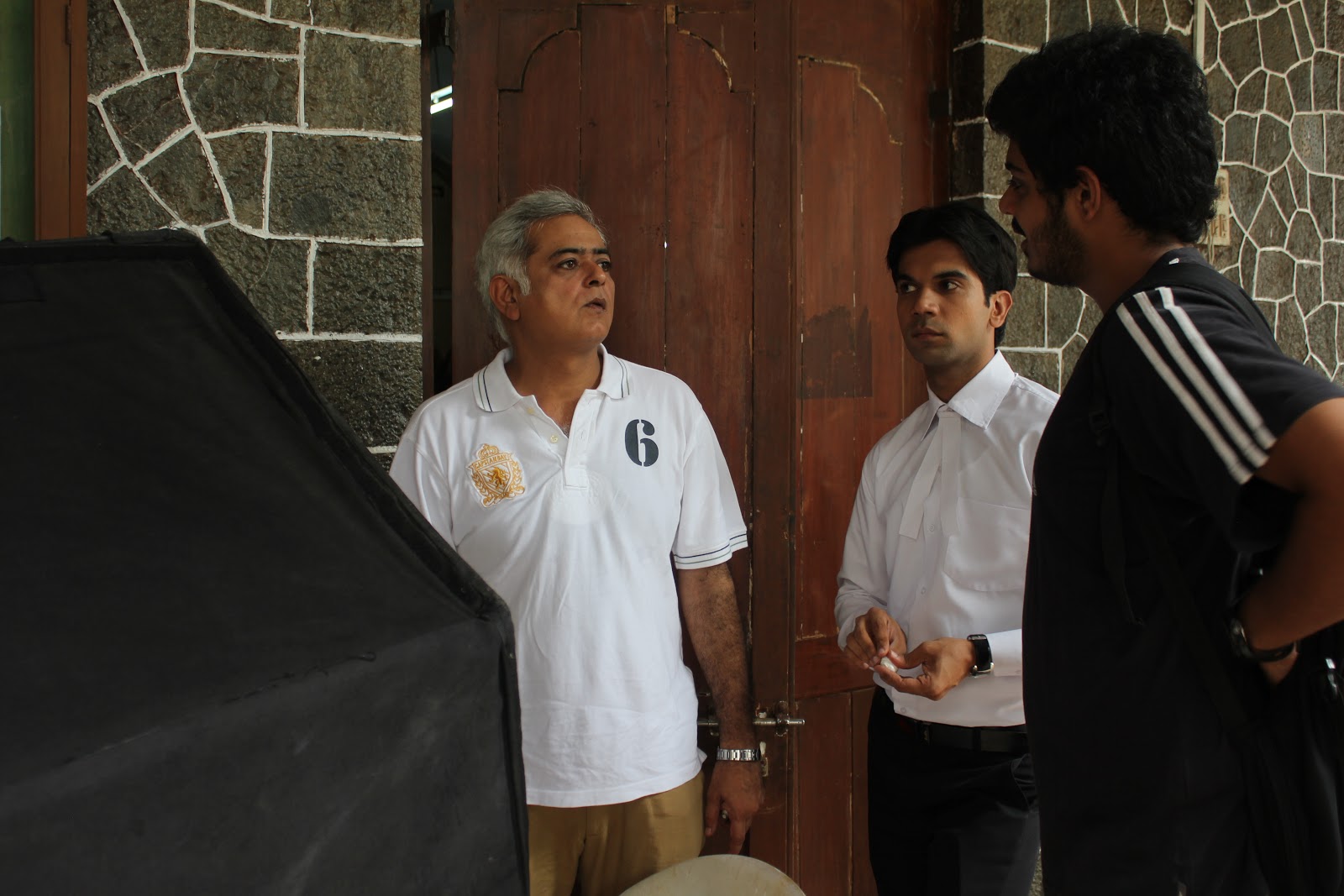
In the film, the protagonist is a young lad from the FTII stable of actors, Rajkumar Yadav. Leave aside the fact that the bloke does not age through the 2 decades that the narrative unfolds. This fact does not bother me and has not bothered others while watching his stunning underplayed performance. All the other characters (Casting Director Mukesh Chabra) move through the fabric of the film story with finesse (Prableen Sandhu, Mohd Zeeshan Ayyub, Baljinder Kaur, Tigmanshu Dhulia, Kay Kay Menon, Vipin Sharma, Shalini Vatsa, Vinod Rawat, Suvinder Pal, Pawan Kumar, Vivek Ghamande, Paritosh Sand, Prabal Panjabi, Yusuf Husain)

Their mannerisms and expressions are palpable, the interactions are humanly common stance, and the scenes make me angry, make me cry, make my blood rush through my temples, and sometimes make me smile, even squirm with discomfort.

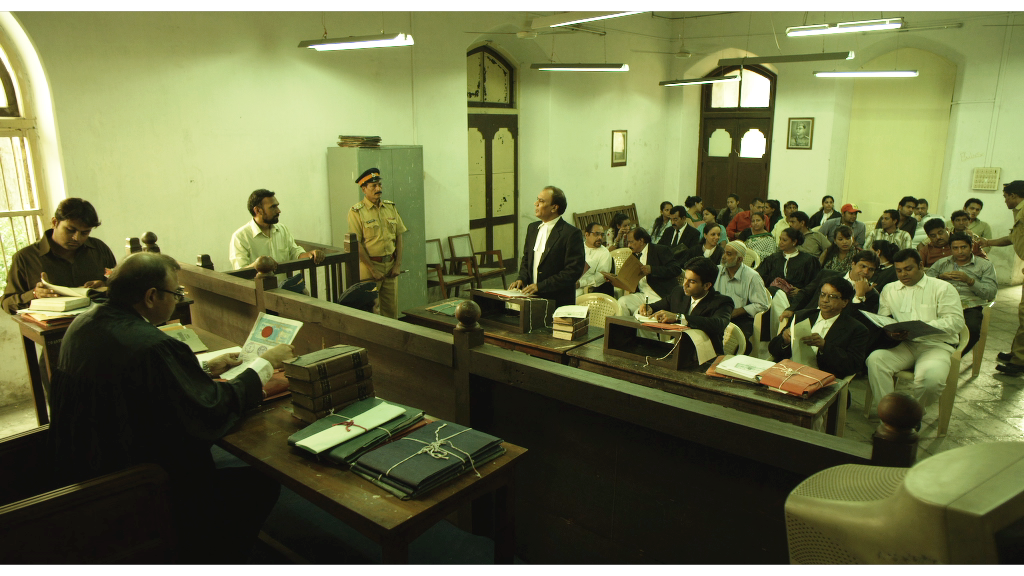
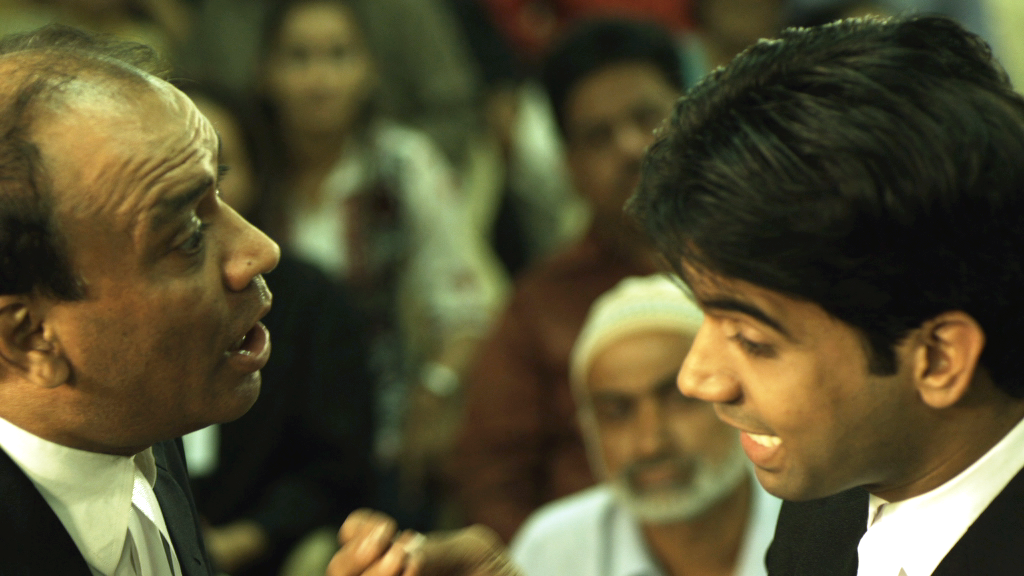
Hansal’s approach to acting as well as most things in the film has been organic in nature, and bereft of conventional method. Many scenes, even dialogues have often been reworked on location. It is a dangerous terrain for a Director to operate because an actor can easily bend a scene in a fashion that could alter the earlier intent. Hansal chose a difficult route to extract from artists what they felt was the most honest delivery. So in the court scene, when the judge too becomes argumentative with the advocates and the accused, the theatre split into laughter, or when the naked Shahid is tortured in the Lodhi Police Station Cell, the viewer in the next seat clenched his fists.

There are other reasons too why this impact is astounding. The Cell is lit by a single tube, and does not light up the protagonist in agony.


Consider this: The DOP (Anuj Dhawan) saw the location (A friend’s godown in Andheri) and said, “Perfect! Lets shoot!” And Hansal as a Director had the balls to do exactly that. Hence the spaces become volumes that the viewer can relate to and inhabit.

Consider this: Shahid’s house in the film is Shahid’s own house, and Shahid’s office in the film where he was shot dead, is in actuality Shahid’s office. A year after his murder, when they were shooting in her house, Shahid’s real mother asked to meet the actor. She just wanted to see him…for her, Shahid was still a part of her ‘present continuous’. Her other son, Khalid Azmi (Played by Vaibhav) has gone on record to say that the film is 95% close to the real story.

So Hansal’s choices, or democratically speaking the crew’s and the cast’s choices were nakedly honest. Hansal was able to guide them through to keep the story of Shahid alive and true. It is one thing to say, fine, I do not care that the actor’s face is not lit up in a scene, and yet another to accept that different digital cameras will land on the shoot on a regular basis.

Consider this: They get a RED MX camera one day, a Red One on another and the next day an Alexa. On some days all they had was a Canon 5D. Hansal and his DOP (Anuj Dhawan) have the guts and gumption to mount it and shoot, to make the most of the time available with the given location and the cast on roll call. What a nightmare for the DI artist and the post-production technical crew.

It looks like a film about the Muslims, for the Muslims, by the Muslims. However, there is not a single crewmember except the artist Arif and the Professor (Played by Mohd. Zeeshan Ayyub and Yusuf Husain respectively) who are muslims. Not the protagonist, neither the director, nor any of the artists, nor even the writers. And the film is about the plight of the Muslims in India. Or perhaps anywhere and everywhere in the world. Simple folk who are pious, righteous, and who wean through the hard struggle of life. Muslims who are wronged for the only reason – that they are Muslims.

And yet, the story could be of any community, as one never becomes conscious of the ‘religion’ in the story but is sensitized only to the situation and the events. Go see any other film about the Muslim community made with adequate or handsome funds and compare – which is the more engaging, which is more honest, which is the tougher film to make, which is bringing a truer story for the audience’s appetite in today’s time of the RTI, which has more layers, which sets you thinking, which churns your bowels, which makes you feel guilty, helpless, angry, which is the one not biased, which is the one that makes you more aware, more empowered, which is the one non-exploitative?

So there is no definite genre that the story can be pinned by. It is neither a courtroom dram, although the crucial scenes are set in courts, neither is it a romantic tragedy, although Shahid’s supportive wife leaves him and then he dies, nor is it a martyr heroic film, although Shahid ends his life as a martyr for a cause. In fact, it is all this and more, because Hansal does not steer it to a dramatic fictional tale but insists steadfastly to narrate the story of an individual with all the truisms intact.

Consider this: Shahid was supposed to be a well-funded film by a corporate production house with a star in place. Hansal and Sunil Bohra (Producer) chose the other route lest the shenanigans of the star system or the numbers game shackle them. And they embraced the hardship with a tougher stance of honesty to make a moving, compassionate film.

For any Director to touch and mould his material with a humanitarian approach is one of the most difficult directing tasks. Hansal has not just immersed himself with the material but internalized it, forgotten his leanings, left aside the grammar of filmmaking that he learnt through his earlier seven feature films, as well as rid himself of easy shooting or post production solutions.

Consider this: The editor Apurva Asrani also co-wrote the film. The earlier decision was to make a non-linear narrative as the world over, the traditional linear narrative is considered to be passé and not smart enough for today’s times. Apu is also known for drastic usage of NGs (No-good takes), jump cutting, and edgy editing styles. With the material in front of them, they both opted to be dumb but true to the material and formed a linear narrative! Apu’s edit does not leap out of the screen at you but lets you immerse yourself in the development of the story unhindered.

Consider this: A veteran artist has reservations because her role seems to be just 3 pages in the courtroom. So she decides nearly 8 hours before the shoot to decline. She has doubted the director because he has said that we will improvise the scene and the dialogues as we shoot. But that is the organic way that Hansal wanted to make the film by involving everyone concerned with the scenes.

Consider this: When the village in the hills threw up extras that were Hindus, the lead actor Raj Kumar Yadav had to train them stepwise (12 steps) on how to do Namaaz. The Director read numbers in order to get shots with movements in cohesion from the group. The sound recordist had but just one assistant for the schedule. That is brave for a film with live sound (Sound Recordist: Mandar Kulkarni).

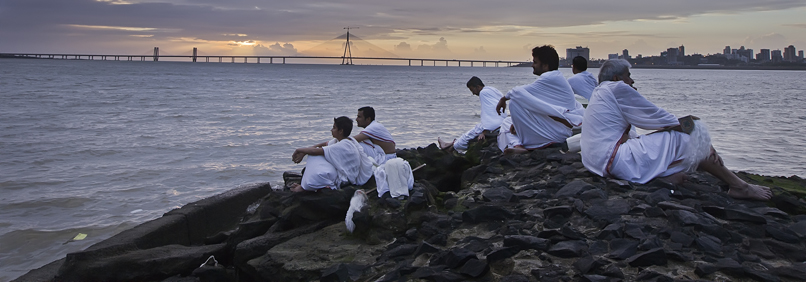
Although the temptation to turn voyeuristic is huge, Hansal’s camera does not try to barge close to the man who is in flames in the riot filled streets of 1993 Mumbai to sensationalize it, nor does it travel from sunset silhouettes to a frontal of the twosome’s faces up North in POK as they share a happy repartee moment, nor does it underline the most significant moment of Shahid’s assassination in the office with a close up or a long shot. Hansal and the DOP refrain from the usual temptations of over dramatizing the situation. The screenplay (Sameer Gautam Singh and Apurva Asrani), the Mise en scène, the acting, and the editing too blends the subtle manner of telling, aided by a music track that does not interfere with the realism. During the depiction of the love story, the dialogues are as matter of fact as can be, and so are the situations.

Hansal’s ingenious shot division helps us see to events in a seamless fashion. This Spartan style of filmmaking lends way to a new language that is close to real life, and not the crafted, arranged carefully kind of a story, spoon fed by loud, crass everything-to-be-said-through-dialogue and underlined by music. The proximity to the material increases manifold and the viewer relates to the unfolding of the story in a much more integral, much more organic manner. No wonder that audiences in Canada (At the Toronto Film Festival) and at the MAMI waited in long ques due to ‘word of mouth’ to see the film. And no wonder that Hansal has had standing ovations at both places.

Consider this: While Music was being discussed for the film, the sound Engineer was asked what ought to be the music. “Sparse, minimal, hardly there types”, he said. His diktat was followed. (Music: Karan Kulkarni)

Hansal’s directorial abilities were never questioned, and infact lauded several times (Dil Pe Mat le Yaar, Chhal, Jayate, etc.) Nor were his sensibilities (it was his own decision to stay away in ‘Wanvas’ at Lonawala for so many years). He meandered just about everywhere in the Mumbai Bollywood terrain of storytelling. This film has cemented his road. Hansal has to start walking on this path which will lead him to greater heights and us as viewers to greater experiences that he will invoke as a refined old-wine director.

I just hope that the film sees the light of the day and does not but just roam the festivals of discerning viewers across the globe. And hoping against hope that the authorities and political parties do not intervene with their typical horse blinds on release or before.


Consider this: Hansal and Sunil Bohra (Producer) have refrained from censoring the film and releasing it because they want audiences to see the film in this form; the more the better – wonder what will transpire at the censor board.

It is a significant film of our times about our times. There, I have said it.

(It was first posted on Ravi Deshpande’s blog here)

We have been covering the Mumbai Film Festival (MFF) extensively on our blog – reccos, reviews, day to day wraps and more. And now, here’s something different.

Sumit Purohit loves to sketch specific frames from his favourite films. And we are posting eight such sketches in this post. See if you can guess them, and if you can, do watch them. Those are his reccos from the recently concluded MFF. If you can’t figure them out, we will update the post with all the names later on. Over to him now.

Have been experimenting with this new mobile app which lets you sketch directly on mobile screen using fingers. It’s really quick and fun, so thought should try and sketch frames from some of the movies I enjoyed watching at MFF, 2012. If you haven’t already seen these films, then these must be on your must watch list.

This slideshow requires JavaScript.

(Hint – There are two Indian films)

And after you are done with the guessing part, click here to go to his FB page for more of his film sketches which he has now started printing on T-shirts too (pics on FB page). If you want to order T-shirts with any specific film frames painted on it, you can write to mailthinblackline@gmail.com.

There should be a film festival equivalent of  jet lag – let’s call it filmfest-lag, or just fest lag. Many of us were in the same state in the last seven days. Get up, forget the newspapers, run, catch the 10am show, one more show, quick lunch, another show, or squeeze in office hours in between ( for paapi pet-waale), run back for evening shows, stand in queues, do some jugaad, try to catch two more evening films, and if the body and mind survives, go out for dinner with your gang of usual suspects and return back home with a dead body to start the same cycle all over again the next morning. And if you are a film buff, there’s no other way to enjoy a film fest. This was a week in fast forward mode, at least that’s what it felt – the fastest week in this calendar year.

With the main venue being shifted to NCPA, we, the poor suburbanites, had to travel a lot. But the good part was Tata Theater’s 1100 seats. So once you reach there, one thing was for sure – you will get in. INOX started ticketing system to sort things out but it was more of a headache. We will try to cover the fuckups in a different post. The aim was to see four films everyday. But with so much traveling and paapi-pet responsibility, had to miss two days of the fest. Quick reviews/reccos of the films i saw in the last seven days.

After Lucia : A father and a daughter trying to come to terms with a tragedy in which both were involved. They start their life in a new place, both pretending to be strong but get into situations which go out of their control and ends on a very unsettling note – the baggage of guilt. It gets scary when you are not sure about right and wrong but take a drastic step to justify it. Brilliantly written, acted, and directed, the film starts randomly – a man leaves his car in the middle of the road and walks away. And slowly, over the next one hour you connect the dots. The last shot – a man with a deadpan face and…well, that will be spoiler…is going to stay with me for  long. Must Watch.

Beasts Of The Southern Wild : Aha, another father-daughter story. There is magic, there is fantasy and there’s harsh truth of life and survival. This one is quite an ambitious debut film which creates a terrific new world which is rarely explored on the big screen. A sense of community, that pull of your own land even when the physical “land” doesn’t exists, or it’s all submerged underwater, still you want to return – this one touches upon many interesting themes, see which one works for you. This is what you call a daring debut! Must Watch.

Throw Of Dice : This 1929 silent film was screened with live orchestra and it was my first time in such a screening. Though it was hard to see one musical instrument on-screen and hear the sound of something else, it was quite a unique experience. While the film was rated “Universal”, i kept on counting the number of smooches – three for sure. Where are we now?

Shahid : The first 40 mins or so of the film made me quite restless. All i saw was montage which looked disjointed, not sure where the story was going, and the background score was repetitive and loud. Maybe there was some problem with the projection too. But once it settles down, it flies and how! The best scenes of the film are without any background music – the court room and family scenes. Raj Kumar Yadav is there in almost every frame of the film and he makes you believe that he is Shahid Azmi. A top notch performance, he holds the film together, and am willing to bet my money on him. The strength of the film is the way Shahid is portrayed – it’s not black and white, sometimes you are with him, and sometimes you are not sure about him, his intention or his work. Welcome back, Mister Mehta!

Like Someone In Love : The film has been getting some cold reviews so far but i still took a chance. Early morning show, and a Japanese old man who is not sure what to do with a hooker. With a slow pace that i was prepared for, i was feeling so sleepy that i could have gone to bed with the old man too. I thought it’s better to walk out and get ready for the next one.

Miss Lovely : WOW! The film has brilliant written all over it and in every department. But it’s not an easy watch because Ashim uses the story/plot as merely a prop here. It’s documentation of a time, of a world that deserves much more attention, and it tries to slowly soak you into it, sometimes to the point of suffocation. Money, nudity, sex and exploitation in those smoke filled dingy rooms – it all looks so real that you can even get the stench. It’s indulgent. It’s cocky. It doesn’t want to follow the convention and ends with a brilliant sequence where blood is not scary. Get into this world if you are interested, otherwise don’t even walk in. Easily one of the best directed films in India in the last few years. Must Watch.

From Tuesday to Tuesday – A rape happens, someone sees it, that someone is into bodybuilding and he tries to sort out the lives around him – all in seven days. Just another film that you can easily skip.

Rust & Bone – Aha, this was disappointing. Or maybe i was expecting too much from it. Two lonely people find comfort in each other but their problems and priorities are different. Few sub-plots here and there which really doesn’t contribute much and it ends up saying or showing almost nothing new. On the other hand, this is what i call “cinema for gender equality” because both the male and female leads are hot and sexy and there is ample nudity – time for some good ol’ eye-gasm.

Shameless – A film on incest which sounds like another one on the same topic – Shame. And as Varun mentioned in his post, this was like prequel of Shame. If Shame was minimalistic in his approach with European sensibility and mostly about character sketches, Shameless was completely amreekan in its approach. If you have seen Shame, don’t bother.

The Wall – I knew what i was getting into – a women goes to a jungles and leads a lonely life surrounded by a dog, a cow and a cat. She writes her diary everyday and we get to hear her thoughts on daily life, death, company – philosophy through voice-over. That’s it. Yes, that’s it. Looking at the scenario here, i do wonder if the biggest achievement for these films is that they get made! We love to call it “meditative” genre and sometimes you feel like trying that. The film can also be described as vegetation porn – you either watch so much green onscreen to soothe you eyes or you turn vegetative watching all that for 2 hours. For me it was the former.

Kauwboy – A kid, his father, a jackdaw and a tragedy. Simple things, simple joys of childhood and an effort to simplify life – aha, if only it was all that simple. The director handles the kid and his story with so much empathy that you wonder if it was all written or he just handed the bird to the kid and started following him. Beautiful.

The Hunt – A teacher is accused of molestation by a kindergarten kid. We all know the truth but the kid doesn’t know or understand anything. So? The film started a debate on Twitter because few people thought it’s a simple story of prosecution. I felt that’s NOT the film, it’s about kids psychology, how it works and how the family can change things accordingly – it’s blood scary. Must Watch.

Paanch Adhyay – Film reviewer Pratim D Gupta makes his debut with this bengali film. Though the film has some nice moments and Pratim tries to play around with the structure as well, the film doesn’t really gel well. The second female lead has a squeaky voice which makes things worse and the love story with her feels weak and unconvincing. The songs create a good mood but too much use of the same tunes in background makes it look forced and jarring.

Electrcik Children : A Mormon teenager gets pregnant and thinks its because of a song she heard on a tape. And so begins the search for the singer who has sung the song. The premise actually sounds much more interesting than the film. This is more of a journey film rather than a destination one. And the journey seems short and fast because of the liberal dose of funny moments and dialogues.

Beyond The Hills : Another disappointment. But this one is again brilliantly directed. It slowly builds up a scary scenario as two teenage girls tries to find some comfort in their lives which is all about poverty, loneliness and strict rules of a Monastery. Problem is it takes too long to makes its point and keeps on moving in loop. This one needs patience. On a lighter note, it felt like Gossip Girls set in a monastery. Gir1 wants sex. Girl2 wants Jesus. Rest of the girls are having fun trying to figure out the drama.

Ship Of Theseus : Another desi, another true blue indie, and another WOW! Anand Gandhi’s debut feature is ambitious, assured, and tackles some heavy philosophy on life, death and moral dilemmas but without being pretentious. The first story feels weak compared to other two. It slowly unravels the three stories one by one but never bores you. Also, it’s remarkable that how without any known actor in its cast, it manages to pull it off so smoothly. The background music is unlike other desi stuff and is subtle and haunting. The “humane” factor at its core stays with you for long. Easily one of the best desi debut films. Must Watch.

Pune 52 : Was eagerly looking forward to it because of its trailer. But first things first – trailer is NOT the film. Liked it in bits and parts but as a whole it felt like two films trying to fit into one. It’s more about a married man who is detective rather than a detective who also has wife.  Girish Kulkarni and Sonali Kulkarni holds it together though some of the sequences are suddenly so abrupt and out of the blue. The makers are still working on the film.

Holy Motors – Popular opinion at the fest was that bizarre is the keyword here. But if you scratch the surface and connect the dots, it’s not that bizarre. The treatment makes it look so weird but it’s more of a symbolic representation of themes and thoughts which has been put together like a mixed media art installation. Or just google and read a bit, it will all make sense. It’s great fun till it lasted but don’t think it’s going to stay with me for long. This is cinema of audacity. Must Watch.

(PS – Wanted to start the fest with Sarah Polly’s Stories We Tell. Since that could not happen, i thought at least the header should have some bit of it.)

And what all you saw? Please do let us know your reviews/reccos in the comment section.

@CilemaSnob

To know more about Varun Grover and to read his Day 1 report, click here, and Day 2 report is here.

One thing I realized this time, thanks to the daily commute of roughly 4-hours to and from the festival venue. Watching a film festival is as much a measure  of your love for cinema as it is a test of your fitness. Running down the railway station stairs to catch Virar-Churchgate fast that is arriving in 1-minute, keeping your senses alert and combative till a seat is found in the crowded train (generally happens after initial 30-minutes of standing at the optimum place – somewhere in the middle of two rows so that you have double the probability of getting a seat), taking the 2-3 kilometer walks from Churchgate station to the venue, and of course keeping your legs folded and hands tied for the duration of the films. That’s why, people who look so enthusiastic on day 1 or 2 of the festival start dropping out by 3rd/4th day. Or start looking like one of the characters from depressing European cinema they are watching.

That’s why, if you don’t sleep mid-screening at least once, you aren’t doing a film festival right.

Digression done.

Shameless/2012/Filip Marczewski/Poland: 

Festival’s centerpiece film Michael Haneke’s ‘Amour’ was cancelled in the morning. Theories abound – they couldn’t find the password to open the disk (apparently, password is sent just one hour before the screening to avoid piracy etc.), the file format they sent was unreadable, that they had a special screening for Tina Ambani and friends the previous night and didn’t realize the password is valid for one screening only. (Thankfully, Amour is screening today afternoon finally.)

So in the slot emptied by ‘Amour’, we headed for ‘Shameless’. And why not? The trailer and synopsis made it read like a juicy piece on a sex-filled drama about a brother and sister. In many ways, it can be thought of as a prequel to Steve Mcqueen’s ‘Shame’, again about a brother and sister having problems due to their unusual sexual ‘conditions’. The ‘troubled place’ Carey Mulligan’s Sissy talks about but is never shown in the film could be imagined as vaguely similar to this. But that’s the only good I could extract out of this film with so many coincidences, thin sub-plots, and sexually charged but never lighting up  mood. Ending, in true European cinema fashion, was abrupt and frustrating. So was most of the film too.

The Taste of Money/2012/Sang-soo Im/South Korea

This reminded me, above all, of DD afternoon show ‘Swabhimaan’ (the one with Rohit Roy, Kittu Gidwani, Manoj Bajpayi et al). A family drama about rich, perverted, crazy for power and sex people. Had a few moments of brilliance, but overall was quite self-serious and  at places, hilariously ridiculous. The worst watch in this festival for me. P.S. – It was the kind of film where in an emotional scene, it starts raining heavily.

Sunrise/1927/F.W. Murnau/USA

Hadn’t seen any film by this master of silent cinema – Murnau, and thanks to this rare opportunity by MFF, I got to see one of his best. So much visual experimentation in a 1927 film, and so original humor and slice-of-life moments (the two toughest things to write in my opinion). And Liberty Cinema, with its red carpeted staircase and red-leather finish chairs in balcony was just the perfect venue for this chicken-soup of a film.

Kauwboy/2012/Boudewijn Koole/Netherlands: 

The last film of the day was an easy watch. Jojo finds a chick Jackdaw fallen out of its nest, carries it home and pets it, while his always-angry-and-cruel single-father learns to love his son over the course of the film. It was that simple a plot, told with lots of humor, emotion, music, and slice-of-life moments. Very little could have gone wrong with this, and very little did.

(Am tempted to add – It should do well in close-knit-family oriented territories of Central and Northern India. First weekend collections should be good. The Jackdaw bird does a satisfactory job but could have done better in emotional scenes. Music was as per the need, and editing was good, but another 10-minutes shorter and it would have crossed 20-crores in 1st weekend.)

DAY 4

Holy Motors/2012/Leos Carax/France-Germany:  

How does one begin writing about this film? A film that is trying to break every convention, burn every book, and shake every belief about cinema in particular and philosophy of life and living in general. It starts with a dream-like sequence of a man breaking a wall to enter the balcony of a cinema hall, where people are watching a film while a naked baby and huge bull-dogs parade the aisles. And from here on, it gets more bizarre. But it’s the variety of bizarre that keeps you completely engaged (I had donated my senses and soul to the film completely, within initial 15-minutes), asking you to stay alert and try piecing together the information, and in return giving you visuals and events of such ambition that your brain’s g-spot is constantly in a rub.

Though for the best experience, I’d suggest you go for it without reading ANYTHING about the film or its plot (as I did) because most of the reviews do give out the philosophical connotations the film is hinting at. And that means some of the awe of discovering it for the first time is gone.

It reminded me of many things, from Hindu mythology to  reptile-race-aliens based science-fiction to Freud’s ‘On Dreams’ to this short film to one of my all-time favorite films, Charlie Kaufman’s ‘Synecdoche, New York’ – another crazy, inventive journey into trying to point out the loopholes in the normal understanding of why/how we exist. And in spite of all this apparent depth, the film is never heavy. In fact, it’s comical at quite a few places, and musical at quite a few others. Will write a detailed piece after the fest is done, and after I’ve watched it one more time when it’s out online.

The Hunt/2012/Thomas Vinterberg/Denmark: 

Ideally, nothing should have been watched after the high of Holy Motors, but the greedy festival junkies we are, chucking a film as hyped as The Hunt would have been out of character. Going with the image of Scandinavian cinema, this one too had a cold and dark feel to it. A man, accused of a sex-offense by a kindergarten kid, faces the witch-hunt from a small hunting-crazy town of Denmark. The film gets heavier and intense as it proceeds, but in spite of all its finesse (in almost every department), it failed to impress me much. May be I was still in Holy Motors zone, or may be it worked on too predictable lines of persecution and silence – I found it quite a middling, safe attempt. The last section and the epilogue are terrific though. Good enough to redeem the depressing-frustrating middle.

Something in the Air/2012/Olivier Assayas/France:

Ghanta kuchh samajh nahin aaya. French version of ‘Hazaaron Khwahishein Aisi’. Set in 70′s France, featuring a group of students learning and unlearning the neo-communist movement. Bas itna hi samajh mein aaya. Rest of it was oppression-repression-dissolution-subaltern-minimalistic-bourgeoisie-mumbojumbovadapaav. Excellent production design, a couple of sex-scenes, and evocation of an era gone by were the only redeeming factors. I even stopped reading subtitles after the 1st hour and just spent time looking at the props and recreation of the 70′s France.

************************

To read Varun Grover’s blog, click here.

Going by ReviewGang‘s calculation, the average rating for Sachin Kundalkar’s Aiyyaa is a poor 4.5/10. But almost every reviewer mentioned it that Kundalkar explored many interesting things in the film which never came together. Also, everyone felt that it was too long. On twitter, the most common word used to describe the film was “bizzare”. That made me more curious to find out how “Gandha” became such a wakdaa. I still haven’t seen the film but surprisingly got a post in my inbox which was on similar lines. So over to Shvetal Vyas-Pare and her take on the film and its Marathi original Gandha.

– @cilemasnob

Aiyyaa is a difficult film to like. It can be easily dismissed as having no plot, dragging out one idea for too long and then jumping into a quick conclusion. The tone does not help either – it is neither entirely realistic nor entirely parodied. The actors seem to constantly shifting from subtle to over-the-top, which makes them irritating – both as characters and as actors. However, I’ve been thinking about the film. It hasn’t grown on me, nor will I claim that it is actually a wonderful film that has been misunderstood. I want to use this blog post to think through certain things that I found interesting about the film, and about my reactions to it.

The premise of any story can be outrageous, and it is up to individual viewers whether the story resonates with them or not. Logically, it is absurd to suppose that a wife would not know her husband in a different get-up (Rab Ne Bana Di Jodi) or that a man could pass off a concentration camp as a massive game (Life is Beautiful). I’ve heard people tear the former apart while waxing eloquent about the latter. I’m sure there are also people out there who love Rab Ne… and don’t mind its logical inconsistency. I’m not saying that the two films are at par with each other. The point I am trying to make is that both films accept seemingly outrageous premises as givens and go ahead with their narratives. As I strongly feel that films/books should be allowed to tell the stories they want to rather than those that seem more logical or natural to any individual viewer/reader, an outrageous premise rarely bothers me.

Aiyyaa too has a premise that seems illogical, that of a woman who is attracted to the way a man smells. Come to think of it, smell is difficult to convey on film. You have to rely on familiarity and on audience experience. Like all human experiences, smell is subjective. It is difficult to explain the power of the smell of the mud after the first rains in India to someone who’s never smelt it. It is easier to make films about colour, about touch, about sensation and Aiyyaa too brings in colours – yellow for Rani and blue for Prithvi – and uses them to play around with notions of smell. Perhaps they thought that colours would make smells more tangible. Aiyyaa also reminds one of the odour that one so completely takes for granted in India, showing public toilets and garbage lying open on the streets. Who in India has not scrunched one’s nose, and then passed on?

The other major motif of the film, intertwined with smell, is desire. Meenakshi desires Surya, and is somehow convinced that he is not the monster that everyone else thinks him to be. There is no logical reason behind this belief, and part of the disconnect you feel with her character is because of how illogical her behaviour is. Yet it is good to see the woman rather than the man as the desiring subject in Bollywood cinema, though of late this has become more common. Dreamum Wakeupum (and Ijjajat papad!) are pure genius on the part of Amitabh Bhattacharya. All those thrusting, pumping, heaving dance steps in all those Hindi films over the ages – they were all metaphorically sexual, and this song dispenses with the metaphor.

Another major problem area in the film is the ‘falling in love’ narrative. Meenakshi tries to speak to Surya often, but never actually gets to do so. Until one miraculous evening, wherein they talk, the mystery about him is solved, they confess their feelings, and get engaged to one another, all in the space of one evening. This is again something that induces impatience – how illogical can you get? Behind this impatience however is the assumption that other things that are shown in more realistic narratives are more ‘natural’, whereas they just have become more sedimented in our minds as ways of being in love, ways of performing romance.

Aiyyaa juxtaposes desire, as represented through smell, and the stifling nature of social life in India, as indicated through the odour of the garbage that haunts Meenakshi even in her dreams. The film finds some subtle moments here and there – walking around the clean, rose-garden terrace of a man whom Meenakshi does not find attractive does nothing for her. This garden of red roses must presumably smell great, and brings in notions of conventional romance, but she is entranced neither by the smell nor the appearance of this ideal space because this is not the man for her.

The Marathi original, Gandha, is actually a combination of 3 different stories, each dealing with the motif of smell, and the story that goes on to become Aiyyaa is crisper, told in half an hour. To stretch out the narrative, Aiyyaa adds a younger brother and a rival suitor to the mix, as well as making the boy Tamilian and putting Meenakshi through the task of learning a new language and a different culture. Not just that, the friend of the heroine becomes more bizarre.As ideas, all of them are interesting, though some translate well and some not so well.

Gandha is not as quirky as Aiyyaa and captures its particular Marathi milieu well. In many ways, it is less imaginative than Aiyyaa, perhaps because it is under less pressure in terms of time, and so is more straightforward in its storytelling. Amruta Subhash does an excellent job of conveying the vulnerability as well as the charm of the protagonist. Rani Mukherjee does a good job, but it is easier to understand and relate to Veena in Gandha than to Meenakshi in Aiyyaa.

What seems a small change in the script from the Marathi to the Hindi version brings to light one of the biggest silences of Bollywood cinema. In both versions, the hero is a painter by day and works at an incense factory by night. However, in the Marathi version he had done a diploma in repairing refrigerators and works at the factory to make money and pay for his art education. In the Hindi version the hero is the owner of the factory, left to him by his father, and works alongside his employees. A Bollywood hero cannot be a simple employee, he has to at least own the factory. After all, how could he think about romance otherwise? As if those who repair refrigerators do not have love stories of their own.

Ultimately, my reaction to Aiyyaa is as much about my expectations as about the film itself. I like films to stick to tones and genres. The realistic feel of a college library – the old computers, the library membership cards, the dust on the books – was good. The presence of an overtly sexualised librarian, however, was jarring – such a person would never exist in such a space. But do films have to necessarily be either realistic, or fantasy as accepted by Bollywood convention (i.e. either melodrama or a fantasy of excess, a la Karan Johar or Salman Khan), or totally bizarre? Can a film not be a little bit of each?

The attempt to make a film that is a little bit of each is jarring, but I think that it is a brave attempt. It would not have been that difficult to make Aiyyaa a bit more like Vicky Donor and English Vinglish: emphasise the Marathi – Tamil aspects of both families, show them as more lovable and less quirky, remove the bizarre, give the hero-heroine more conversations, show the heroine as the underdog who finally convinces her family that she has the right to choose her own life partner and so on. I do not think Anurag Kashyap and co. are stupid enough to have not thought of this alternative, safer option. It would have been an easier option to sell too, and that is often a big criterion that drives the way films get made. While I do not quite like the final product thatAiyyaa is, I do admire the fact that they made it their way – bizarre, quirky and idiosyncratic.

(PS – You can watch Gandha with English subtitles here)

(PS – A different version of the write-up was first posted on Shvetal Vyas-Pare’s blog)

To know more about Varun Grover and to read his Day 1 report, click here.

Disclaimer: I don’t think I’ve turned into that post-1990-born creature that thinks, reads, and writes only in English but since am short of time, decided to file this entry in English today. Not because I think (faster) in English, but because English typing is faster and as a related brain function, when you type faster, crisper words come to you. (Or so I think.)

Also, quick notes today. (‘Amour’ calls tomorrow morning.)

Ai Weiwei: Never Sorry/2012/Alison Klayman/USA:

– Behind the iron curtain, there is an artist struggling to retain his freedom, and in the process turns his protest into art, and curtain into an art-installation.

– A very ‘upbeat’ documentary (mainly ‘cos so many frames are full of his artistic creations, and his calm, about-to-smile face) about  a very angry but very optimistic man that took a few years in the making, and hence capturing Ai Weiwei at very crucial moments in China’s recent history. (The 2009 Earthquakes, Nobel for Liu Xiaobo, post-Olympic demolition of his studio over his criticism of Chinese government).

– Hope they put it out online for free distribution because that goes totally with the spirit of Ai Weiwei.

– After seeing this and Michael Moore’s ‘Bowling for Columbine’, I started loving India more. See both of these to know what words like freedom, liberty, human rights, angst, and censorship may mean in different contexts, countries, and times.

– Also, the best advertisement ever for Twitter. They should just sponsor it and show it to the world. Ai Weiwei uses twitter like Gandhi used Satyagraha, and to great results. “Don’t retreat. Retweet.”

– Can your cat open the latch door? If yes, are you fascinated by it?

The Bay/2012/Barry Levinson/USA: 

– Another ‘found footage’ film with elements of creature-based horror and zombie.

– Goes on for too long after having made the point.

– Not a fan of found footage genre anyway. Also the most difficult genre I guess. Stripped of visual grandness, technical finesse, and controlled-environment drama (and most of the background score), Cinema is tough to please.

– More creepy and gory than chilling.

Rust and Bone/2012/Jacques Audiard/France-Belgium

– 2nd watch hence less satisfying but still, so many terrific moments created and captured so well.

– Marion Cotillard is that rare female – thinking man’s sex symbol as well as non-thinking man’s sex symbol too. She’s in top form in this, and is on top too in one scene.

– Audiard’s previous one ‘A Prophet’ was more gritty, more abstract and complicated too, but this one is fairly straightforward, on the verge of feelgood, and dealing with a less complex world/character(s). So yes, slightly less ambitious, but never mind, he still makes high-cinema out of the material at hand. Some of the best romantic repartee in a world of non-romantics is here, and in a way, this could be called Audiard’s attempt at interpreting a ‘romance drama’.

– Just like in ‘Beasts of the Southern Wild’, lots of shadows and light-play, another subtle ‘homage’ to Malick may be?

Writer, observer, cynic – That’s how Varun Grover  defines himself in his twitter bio. If you have been following this blog for a long time, you obviously know him. If not, he’s the multi-talented man behind the terrific lyrics of Gangs Of Wasseypur and is also a well known stand-up comic.

Like last year, Varun is writing his Mumbai Film Festival diary this year too.

यह निरा रोमांटिक सा आइडिया है, डायरियाँ लिखना. और मैं अब ३० पार करने के बाद ख़ासा रोमांटिक रहा नहीं. पर डायरी लिखना समय को पकड़ने की एक कोशिश भी है, जो लोग ३० पार करने के बाद ज्यादा करने लगते हैं. तो यह वो वाली डायरी है जो खुद को भरोसा दिलाना चाहती है कि इसकी असली value आज नहीं, आज से ५० साल बाद होगी जब हम ना होंगे, जब कोई इसे मुड़ के खोलेगा और इसे antique वाली इज्ज़त देगा.

इस ब्लॉग पर आखिरी पोस्ट पिछले साल के मुम्बई फिल्म फेस्टिवल की डायरी से ही है. साल बीता, लोग बिगड़े, देश पर और गर्त चढ़ी, और फिल्म फेस्टिवल वापस आया. आज सुबह तक सोचा था इस साल डायरी नहीं लिखूँगा क्योंकि इस बार फेस्टिवल का venue घर से बहुत दूर है…आने जाने में ही हर रोज़ साढ़े तीन घंटे बर्बाद हो रहे हैं तो लिखने के लिए अलग से समय कैसे निकले? लेकिन अभी अभी बस, १० मिनट पहले सोचा, कि समय तो उतना धीरे चलता है जितना तेज़ आप टाइप कर सकें. तो सिर्फ कोशिश है….जो आज है, कल हो सकता है ना हो.

Stories We Tell/2012/Sarah Polley/Canada : कम से कम एक उम्र में सबको लगता है कि उनका परिवार weird है. जिनको बचपन में लगता है, उनको बड़े होकर नहीं लगता (क्योंकि शायद वो खुद वैसे हो जाते हैं), और जिनको बचपन में नहीं लगता, उनको बड़े होकर लगता है. Sarah Polley ने अपने बिखरे से (महा-weird) परिवार को जोड़ने की कोशिश की है, अपने परिवार के हर सदस्य को एक ही कहानी अपने अपने निजी point-of-view से सुनाने को कहकर. Documentary और drama का इतना शानदार मिश्रण मैंने पहले तो कभी नहीं देखा. Sarah Polley और उनके पिता Michael Polley (जिनकी आँखें बहुत उदास लेकिन आवाज़ बहुत खनक वाली है) एक साउंड-स्टूडियो में हैं जहां Michael Sarah की दी हुयी एक स्क्रिप्ट अपनी आवाज़ में रिकार्ड कर रहे हैं. कैमरा चल रहा है, माइकल जो कहानी कह रहे हैं वो बाप-बेटी दोनों की है. लेकिन माइकल भी उसे ऐसे कह रहे हैं जैसे वो किसी तीसरे की हो. लेकिन धीरे धीरे और किरदार जुड़ते हैं, सब Sarah को Sarah की ही कहानी सुनाते हैं (“मुझे वो भी बताओ जो मुझे पता है, और ऐसे बताओ जैसे मैंने कभी नहीं सुना”, Sarah शुरू में ही यह निर्देश देती है), और आगे बढ़ते बढ़ते फिल्म memories, love, और closure पर एक अद्भुत व्याख्यान बन जाती है.

Beasts of the Southern Wild/2012/Benh Zeitlin/USA: बहुत चर्चे थे इस फिल्म के. Cannes फिल्म फेस्टिवल में Camera d’Or के अलावा ३ और अवार्ड जीते हैं और Sundance में Grand Jury Prize जीता है. मतलब जैसे कोई नामी पहलवान रिंग में आता है, वैसे यह फिल्म जमशेद भाभा थियेटर में आई. और शुरू के पाँच मिनट में ही पूरा मुकाबला जीत लिया. शुद्ध पॉपुलर सिनेमा की आत्मा (uplifting, underdog story), उसपर art cinema की तकनीक का चोगा (imaginative, allegorical, भयानक sound design और music), और चोगे में Indie Cinema की छोटी-छोटी जेबें. पत्थर जैसे बाप और 6 साल की, खुद को प्राग-ऐतेहासिक जीव मानने वाली बेटी की कहानी (हालांकि बहुत देर में पता चला कि वो बेटी है, बेटा नहीं) – जो उनके छोटे से टापू पर आये तूफ़ान के बाद का struggle ऐसे दिखाती है जैसे कविता कह रही हो. अगर थियेटर वाले बत्तियां जल्दी नहीं जलाते तो मैं अंत में और देर तक रोता.

Throw of Dice/1929/Franz Austen/India-Germany: यह वाली सिर्फ इसलिए देखी क्योंकि Germany से एक Orchestra आया था जो इस silent फिल्म के साथ live music बजा रहा था. यह अनोखा अनुभव फिर कहाँ मिलेगा यह सोच कर हंसल मेहता की ‘शाहिद’ आज कुर्बान करनी पड़ी. और जितना सोचा था, उससे कहीं ज्यादा मज़ा आया. फिल्म अपने आप में बहुत सरल, और काफी मायनों में मसाला थी. जर्मन निर्देशक को हिन्दुस्तानी exotica बेचना था शायद…गाँव की गोरी बनी हिरोइन को अपने पल्लू का भी सहूर नहीं था (क्योंकि वो कोई एंग्लो-इन्डियन ऐक्ट्रेस थी), हाथी, सपेरे, आग खाने वाले कलाबाज़ वगैरह बड़ी देर तक कैमरे के आगे रहे,  राजा निरे ऐय्याश और प्रजा निरी stockholm complex की मारी. लेकिन असली खेल Orchestra का ही था. सिर्फ ८-१० तरह के trumpets, २ तरह के drums, और चिमटा-घंटी से उन्होंने जो समां बाँधा वो out-worldly था. एक तरह से फिल्म को कई जगहों पर reinterpret कर दिया उन्होंने. जहां सीन बहुत self-serious था, वहाँ orchestra ने ‘मेरे हाथों में नौ-नौ चूड़ियाँ हैं’ का एक version बजा कर परदे की कहानी को एक अलग layer दे दी.

और फिल्म ख़तम होने पर मिली तालियों से musicians इतने खुश हुए कि उन्होंने जाते-जाते एक ऐसी धमाल धुन बजाई कि १००० लोगों से भरा auditorium खड़े होकर साथ-साथ लगातार ताली बजाता रहा. पहले दिन का आखिरी अलौकिक राग!

*********

कल क्या देखना है?: Ai Wei-Wei पर एक documentary है, Jacques Audiard की Rust and Bone है (जिसमें खूब भीड़ होने की पूरी संभावना है), और Takeshi Kitano की कान में पेचकस घुसा के मारने वाली Outrage:Beyond है.

(This was first posted on Varun Grover’s blog.)

It’s a weird position to be in. And in India it’s almost like a joke because people instantly quote two names to get their points across – Khalid Mohamed and Samar Khan. Remember how Subhash Ghai reviewed Fiza? The precedent is bad but who said that we can’t change the future. So what happens when a film reviewer changes track and moves to the opposite side? Over to Pratim D Gupta, who has been reviewing films for The Telegraph for last few years and has now made his directorial debut with a bengali film titled Paanch Adhyay which has just released. The film stars Priyanshu Chatterjee, Dia Mirza and Soumitra Chatterjee.

This is so damn difficult to write. I have been staring at this empty word file on my Macbook screen for the last couple of hours. That’s like the time I usually take to write my film reviews every Friday.

Any more time and that page wouldn’t reach you the next day. But then every Friday I am your man at the movies. For this Friday, I am the man behind your movie. Perhaps the only way I can put this together is if I tell you about Paanch Adhyay in five chapters.

Chapter 1: The write of passage…

It was always all about cinema waala love. From Uttam Kumar’s cigarette smoke swirl in Nayak to Sanjay Dutt’s eyepatch in Khalnayak, from James Bond’s black tuxedo in every film to Govinda’s yellow pants in every film, I chewed and chomped anything that spelt cinema. So the three-figure JEE rank was dunked and I got into film studies. Soon the Rays and Ratnams had company in Kurosawa and Kieslowski, Tarkovsky and Tarantino.

The world was passing by at 24 frames per second. I had to jump cut. I chose to write myself into the script.

Watch movies, write about them, speak to the guys who make them and try and understand the craft a little more. So incredibly I was attending the best customised film school possible; where I could speak to A.R. Rahman about the core of his scores, discuss the finer nuances of acting with Irrfan Khan, debate shot lengths with Ashok Mehta or just discuss life in cinema and cinema in life with Farhan Akhtar.

One of my earliest on-set assignments was Pradeep Sarkar’s Parineeta shoot in Siliguri. And I remember the film’s leading man, who became Mr Bebo a couple of days back, telling me with a chuckle: “Making a film is like waging a war.” I didn’t fully understand it then. No one knows it better than me now.

Chapter 2: The man who almost made a movie…

I started writing a script in mid-2008 because a filmmaker friend from here liked the idea and promised that he would get me funding for it.

The script happened, the promise wasn’t kept.

I took the script to other producers; everyone shooed me away. Since it was lying ready, I made an English version of it and sent it to international screenwriting competitions. It got selected as one of six scripts at the Locarno International Film Festival and went on to become the first Indian project at the Independent Film Week in New York.

Still no funding came through.

Next a Mumbai-based producer committed to fund the film at Film Bazaar in Goa and even got a French co-producer. I happily got a cast and crew together — the very best talent from here in Calcutta. The pre-production started and locations were scouted. And then the man from Mumbai stopped taking my calls and replying to my mails. When I bumped into him at a social do, he promptly fled from the party.

I actually started believing that I would be remembered (laughed at, really) as that guy who came closest to making a movie but could never make one. You know how artistes love romancing the pain. The pleasure of putting your head down on a wet pillow every night.

Chapter 3: Traces of treason…

Of course at that same time there was something equally terrible happening on the personal front. Everything was shutting down around me. I thought to myself the only way out of this is to write a new script. Yes another very romantic way of looking at things — you got to do what you can do. A batsman has to bat his way back to form; a writer has to write.

That’s how Paanch Adhyay was born. It was called Resh then. Resh as in traces… traces of a relationship. I wanted to narrate what I was going through with a what-could-have-happened twist to the tale. I wanted to tell a love story like a thriller. And because I wanted to go berserk with the structure, I wanted to keep the story simple. Very, very simple.

I slit my veins onto the script. This time I was not writing to get the film made; I was writing to get a move on in life. Writing Resh felt gratifyingly cathartic. I finished the first draft and there it stayed saved in a folder on my lappie. It’s job was done. Or so I thought.

Chapter 4: Moment by moment…

I knew of Kaustuv Roy as a man who threw big parties even though I had never attended one. He called me one fine evening — I still remember I was in a taxi and passing by Park Street — and said: “I have heard about your scripts; why don’t you come and narrate me one?” Honestly, I was tired and I really didn’t want to go through that whole reading-your-heart-out-to-blank-faces ordeal one more time. I told him I would come over one day and forgot about it.

But I kept bumping into him and he kept pestering me about a narration. Just to get him off my back, I took a printout of the 60-odd pages of Resh and went and read it out in his freezing, smoke-filled office. I couldn’t wait to run out of that cold chimney when he said he was producing the film and calling it Paanch Adhyay after the five chapters the film was split into.

Eleven drafts, three Mumbai trips, four months later I embarked upon what has been the bestest year of my life. Composing the songs, shooting the film, editing it, dubbing it, re-editing it, scoring it, re-re-editing it, grading it, mixing it… every moment has been a blessing.

Watching Shantanuda (Moitra) walk out of the room and come back with the most moving piece of melody, watching Dia (Mirza) howl incessantly in the dubbing room to match the mood of the moment, watching Arghyada (Arghyakamal Mitra) slip in a prolonged shot of silence to create the most heartbreaking of effects…. The endless wait up till the Paanch Adhyay experience has all been worth it.

Chapter 5: A new chapter…

“You have not been nice to so many films and filmmakers; get ready to face the music!” Now, that has been the most “critical” concern from my friends, colleagues and well-wishers. Ironically in our jobs, we are remembered more for the gaali reviews than the glowing reviews.

Well, can I share a secret? From the moment those lights go off at the theatres, nothing else matters. It’s just you and the film. Hype, reputation, personal fondness, fanboyhood… everything’s dug deep into the popcorn tub. You know it when you like a film; you know it when you don’t. And you got to be honest about it. That’s all I have been. Always.

There’s a line Dia’s Ishita tells Priyanshu’s Arindam, who plays a filmmaker in Paanch Adhyay, in the film: “That you have been able to make the film the way you wanted to make it, isn’t that enough?” It’s enough for me. It’s enough for me that I could make this film the way I wanted to make it. With my friends, with like-minded artistes and technicians, with heart and soul. Nobody can take away that experience from me. Of course, you can take a happy song and make it better. Because by the time you are reading this, my baby has crawled out to a theatre near you.

Hope you enjoy the show. Pam param pam!

– This piece first appeared in The Telegraph.

– To know more about the film, click here for its Facebook page. And click here to watch its trailers and songs.

– The film will also have its screening at the ongoing Mumbai Film Festival on 23rd October. Venue – INOX, Time – 6pm.

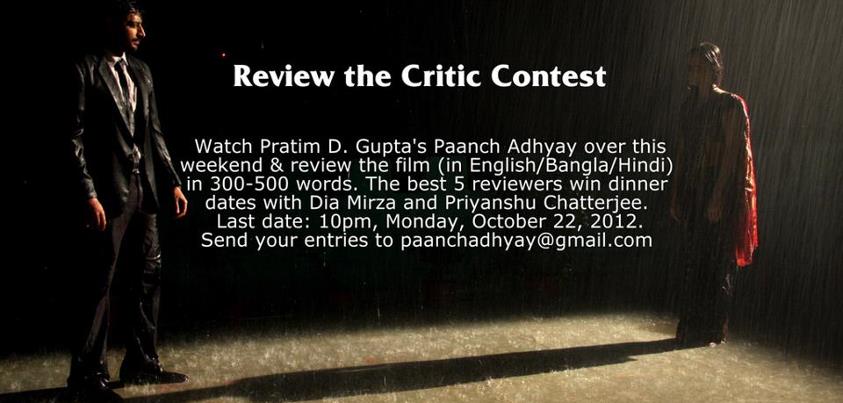
– The makers of the film are also having an interesting contest called “Review The Critic”. Deatils in the pic and on its FB page.