KAUFMAN - "Or cramming in sex, or car chases, or guns. Or characters learning profound life lessons. Or characters growing or characters changing or characters learning to like each other or characters overcoming obstacles to succeed in the end. Y'know ? Movie shit."
Kaufman is sweating like crazy now. Valerie is quiet for a moment - from "Adaptation".
We are all about CINEMA. That movie shit.
NOTHING is sacred.
NOBODY is spared.
Because we talk about films, dammit.
Not your sex life.
Films, fests, unsung, indies, undiscovered - all that and some fun. If you have dope on anything related to cinema or you would like to share something, do write to us at moifightclub@gmail.com.
The views, opinions, reviews, articles, or positions, expressed by the authors and those providing comments are theirs alone, and do not necessarily reflect the views, opinions, positions or strategies of ANY OF THE EMPLOYERS, FRIENDS, RELATIVES, PR agencies, Production houses, Media group and such third parties associated with the authors. The latter make no representations as to accuracy, completeness, currentness, suitability, or validity of any information on this site and will not be liable for any errors, omissions, or delays in this information or any losses, injuries, or damages arising from its display or use.
In short, if you have an issue with us or any post we've written, write to us at moifightclub@gmail.com
Kanu Behl’s Titli released few days ago. But we go busy with Mumbai Film Festival, and so haven’t been able to post anything on the absolutely brilliant debut feature of Kanu. The film premiered at Cannes last year.
Delhi has always struck me as a suffocating city. It has no harbor, it’s main river lies dangerously polluted, it boils in summer and it freezes in winter. To an outsider it is also a distrusting city; the city has watched me without interest many times – suggestive of some harshness in the people.
I experienced this same feeling visiting Delhi last week. At the airport, I placed my backpack in the dedicated common section in the restroom for cabin-bags. The restroom attendant immediately turned around and gave me a mocking smile, as if poking fun at my naivety and suggesting what a fool I was to blindly trust the safety of my bag in that common enclosure.
I had arranged for a private cab to take me to the city. I had not even settled in the cab when the driver started telling me that he was an expert in beating the parking system – stationing the car a few kilometers away and waiting for the phone call from the passenger to drive to the pick-up spot. We passed a signpost to Dadri. I was naturally reminded of the lynching incident, and expressed shock at what had taken place. Pat came the reply from the cab driver, “U.P. Sarkar itne paise deti hai ki ye log khud hi kar lete hain ye sab drama. Do aur hindu bhi mare, unhe to kuch nahin mila.”
There seemed something savage and gluttonous in the manner in which he shifted the discourse from a humane level to a transactional level. I was left wondering where these thoughts had come from, and what is the prism through which he was viewing the world, looking past empathy to power and money.
As we advanced, garbage was being burnt on an open spot along the NH-58 highway. White smoke was rising from the burning trash.
It reminded me of Kanu Behl’s “Titli”, a film that burns with an intensity not matched on screen in a long time. It smells of hazy smoke that rises from burnt trash in the dusty by-lanes of Delhi. The film internalizes my growing feelings about Delhi (and this country) and spits out something dangerous, something macabre, even.
On the surface, the movie is about Titli’s (Shashank Arora’s) attempts along with his wife (Shivani Raghuvanshi) to escape his family that engages in violent carjacking. But, underneath the film holds up a brutal mirror that shows an unflattering reflection of our hypocrisy, patriarchy, mistrust, rage and sorrow. What spoke to me the most was how brilliantly it handles the subject of patriarchy.
“Titli” places the four male protagonists along a continuum of misogyny, ranging from the father (Lalit Behl) who is extremely hegemonic to Titli who is consciously trying to find a sense of agency. Vikram (Ranvir Shorey) and Bavla (Amit Sial) occupy spots in the middle. Each male protagonist has much to tell us about who we are.
The father is so deeply entrenched in patriarchy that he doesn’t even realize it; his Zen-like presence in a world where violence happens around him every day is devilish. Vikram, supportive of entrenched patriarchy, knowingly and on occasions unknowingly, finds rhetorical ways to contort his patriarchal gaze into expressions of compassion and sadness. See him in scenes where he is dealing with his divorce or where he is thrashing Titli while simultaneously crying and imploring: “Parivar vale narak lagte hain tujhe?” – his is a world of wretched and labile emotions in a patriarchal universe.
Bavla’s position on this continuum is the most unique that while on one hand he displays gay leanings, on the other hand he is an unobtrusive participant in the terror perpetrated by his father and brother. In contrast, Titli is trying to actively seize control of his life, but he soon finds himself engaged in praxis of futility as he discovers that morality and conscience is the price for freedom.
Viewed from a certain perspective, the film is also a peerless portrayal of our hypocrisy – our classic ability to extricate a problem from its context and deal with it symbolically. The movie spends an excessive amount of time showing the male characters brushing their teeth and clearing their throat, as if these acts of personal hygiene allow the male leads to purge their sins and soul, thus making them cleaner humans. The symbolism should not be bewildering as this is happening in a country where millions gather at the ghats of the Sangam every year to purge themselves of all sins by taking a dip in the waters.
Symbolism aside, where the movie soars is in its representation of the construct of the family in India. It deftly depicts how an Indian family can be something of an unforgiving structure for many – one which dedicates itself to the art of the self-inflicted wound (there is also a gut-wrenching scene in the movie that involves a literal depiction of a self-inflicted wound), and which, knowingly or unknowingly, is committed to acts of cruelty against its own kind rather too often.
The portrait of India that emerges from this examination shows a country that is broken, in a fundamental, probably irreparable way. But, to completely mangle Wright Thompson’s beautiful lines on India, “Titli” is both the riddle and the solution. One must understand today’s India to understand “Titli”, but one must understand “Titli” to understand today’s India. They created each other. They are the same.
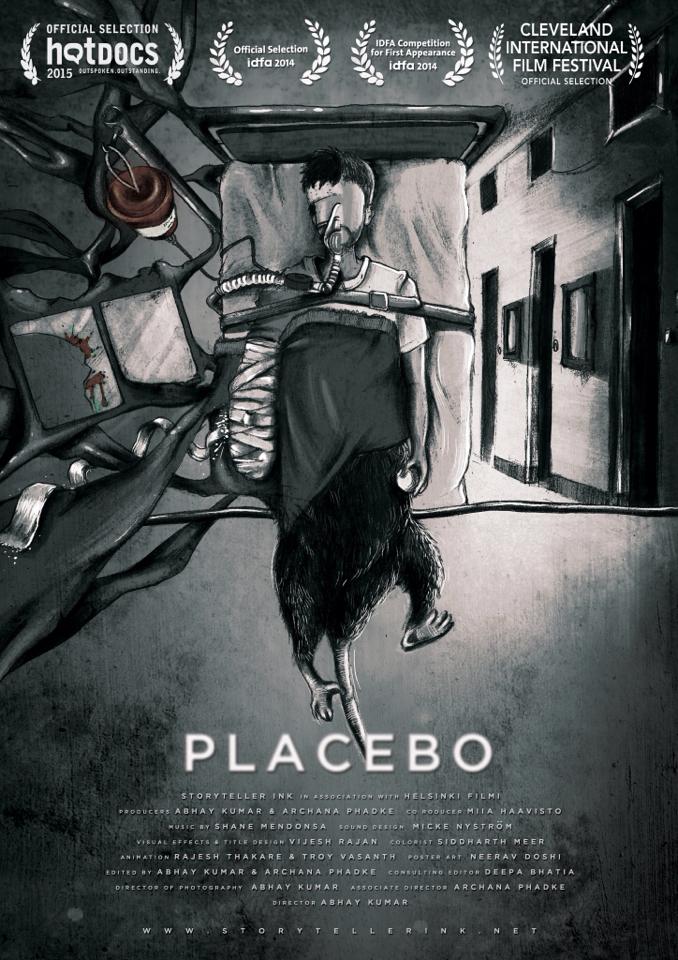
We have been tracking Abhay Kumar’s films for quite some time now. We had written about his short on the blog, and in earlier edition of MFF, when his another short was in Dimensions section, we had predicted his win too. Interestingly, this year he is back with a feature-lengh documentary, Placebo. And what a joy it is see a filmmaker making an impressive debut as he graduates from shorts to feature. One can easily spot some of the similar patterns in all his shorts and documentary.
And here’s Achyuth Sankar‘s review post on the film. This is his first post here.
We’ve all thought about the question, “What are the few things you absolutely cannot live without?”. For me, and all of them in equal importance (I’m not going to write the obvious things like food, water, air, etc), they are cinema, and a few really wonderful and beautiful people, some friends, some family. Cinema figures that high in my list, as it does in the lives of more than a few people I know.
At 6:30pm today, in a house full screening at MAMI, I gave 90 minutes of my life to that cherished thing which I can’t live without, cinema. It was a documentary called Placebo. It’s about the one of the most prestigious colleges in India (not any IIT, I’d rather not get into any more specifics), where the filmmaker’s brother is studying. The brother gets into a serious accident, and during his recovery, the filmmaker decides to stay in his brother’s hostel and document the lives being led there, in an attempt to understand what led to that accident (I won’t be referring to it as an accident any more, it was a self inflicted hurt, severe hurt). He follows the lives of four people in the said hostel, seemingly without any greater aim. Sometimes, a story chooses its storyteller, especially when it’s a story that needs to be told, and that is what happens to the documentarian here. The lives he begins to document shape up to be a small, but essential picture about the lives of students who have chosen the path of the elite by joining there. People are pressurized, or they’re not. Sometimes, they stumble into the doorstep of a revered institution with lofty dreams, but to many of them, simply making it there summarizes their dream. What does one do after that? What does one do when they have no idea where to go? What guidance does one get?
I was contemplating, while driving back home, why do most of the absolute greats of cinema talk about serious things like depression, disconnect, alienation, fear. Why not happiness? The question has come up many times before, but no answer till today. It is because.. when things are good, when we are happy, we are already ready to share. But when things are going down the shit hole, not even a handful of us can talk about it and admit “Hey, I’m fucked up and I need help”. That’s why it is so much more potent, when a film talks about things that nobody likes to, wants to or knows how to talk about. Suddenly, we feel a resonance within that isolated corner of our mind.
That’s what Placebo is.
That slight resonance, which reminds us of the importance of our own feelings. But more than that, it talks about something a lot more. It’s a documentary, with the filmmaker going to a college to understand why his brother hurt himself as badly. But a story that needs to be told chooses its own storyteller, and this college, and the stories of all the students who’ve lived there, chose this filmmaker. One shocking suicide after another, and it’s no longer just about a personal exploration, it’s about all of us. All of us who’ve studied, who’ve felt pressurized. All of us who, I dare say, can’t even begin to imagine the true extent of desperation, where the phrase “give up” doesn’t mean settle for lower grades or go to a less reputed institute. All of us who have been lost, at one point or the other, looking at the sea of people around us filled with genius, as we catch ourselves wondering “How the fuck am I going to make a mark in all of this?”.
There is one particular part in the film, where a character says something along the lines of “We are all isolated. You’re here talking to me, but I’m isolated inside and you’re isolated inside. My words aren’t my exact thoughts. But only I understand my isolation. You know the fucked up part? You think you understand, but you don’t.”
Placebo is truly a story that begs to be told. You can see it evolve in itself. The original intent of the filmmaker wasn’t to talk about student suicides or the casual indifference of college management or depression. It was merely an investigation, a very personal one at that. But as the story begins to tell itself through the storyteller, you won’t care about the change of course. Because the story needs to be told, and we all need to let it.
Romanticism aside, it took (in the filmmaker’s own words) a 1000 hours of handycam footage and constant questioning of intent to bring out this 90 minute long story. 1000 hours, vs 90 minutes. To look for that story which has revealed itself to you, and to do it justice, that’s no easy task. Because it’s not something you’ve concocted in your head, it’s all there. It’s all already there. The loss of aim, loss of hope and dreams, the crisis of faith and loss of ideals, the pressure, loneliness and depression that we students face. It’s all there. We don’t know how to talk about it. This film just showed us how to.
There was approximately a 3 minute standing ovation at the end of the film, followed by a Q&A session. In it, someone asked the filmmaker about how personal the subject was, and how he could keep filming while everything was so close, especially since his own brother was severely hurt. The filmmaker said that whether we like it or not, when we hold a camera, it will create a barrier. That’s the price one has to pay for the story. You’re in it, you’re affected by it, but you’re still separated by that invisible inch.
Abhay Kumar is that filmmaker, and he stayed in the hostel of that college for two whole years, filming as much as he could. He and his partner in crime (his own words, not mine), Archana Phadke then spent another year finding the needle in the haystack, and all the other needles too, in order to tell this hard hitting story. If there is one thing, and absolutely one thing I can learn from this, it’s “Get a camera and go make a fucking movie. It takes a lot of effort, but what’s stopping you?”
Abhay, you’re honestly one of the best filmmakers out there at the moment. I haven’t made a single piece of cinema, I don’t know how it’s done, I’m no authority. But films mean a lot to me, you’ve just made it mean more.
(PS – You can watch Abhay’s shorts here (Just That Sort Of A Day) and here (Life Is A Beach)
(Born in Trivandrum and having spent his last 8 years in Bombay, Achyuth discovered his love for cinema here, thanks to affordable unlimited internet plans. His pass times are blowing up all his savings on purchasing Blu Rays, going for a morning show at some PVR, or eating good food and having a cold Bud. He moonlights (or rather, daylights) as a final year Engineering student, with a severe love for Harley Davidson motorcycles. He fell in love with movies after watching Good Will Hunting. The only thing he loves as much as cinema is his Labrador, Cindy)
Coke Studio Pakistan remains Coke Studio Pakistan even when it isn’t quite Coke Studio Pakistan. This was evident in the last season when the studio got it wrong more times than it got it right, but still gave us some good melodies to weather the storm of life for few months. Strings were retained for Season 8, and right from the first promo that presented the artists line up, it appeared that the new producers have got it right. We have reviewed all episodes and you can find those reviews here. In this post I am listing down my 10 absolutely favorite songs from this season. Are these the only songs I liked? No, but in the interest of keeping the post shorter than a Sooraj Barjatya film, have cut down the numbers. You can click on the title of the song to watch the videos. In order of preference, here it goes.
10. Chiriyan da Chamba – Not so much for any breathtaking musical arrangement, the song makes it to the list for the simple reason of Anwar Maqsood’s recitation. It’s been a while since we heard a recitation in the studio. Suraiya Khanum kept the singing more or less simple.
9. Kinaray – Mekaal Hasan band made a heroic entry to the studio with Sayon but it is Kinaray that gets our vote for being the better of the two. The tonal structure was more or less similar to Pt. Ajoy Chakraborty’s rendition of the same qalaam which you can listen to here. Apart from Sharmishta’s beautiful singing, the back up trio was top class in the song, but then they have been like that throughout the season this time round.
8. Khari neem – Take an iconic classic like in this case, this iconic song by Mai Bhagi and put some flamenco influence coupled with killer violins and spot on singing, you have what is Coke Studio’s style of paying tribute with their unique signature on it. The flute by Sajid Ali just adds to the tempo of the song and sprays an image of a playful banter between two lovers. What a beauty!
7. Bewajah – After winning the Sur Khsetra, there couldn’t have been a better stage for Nabeel Shaukat ali to showcase his talent, and boy, did he grab that opportunity or what! The beauty of this song is that it reminds you a classic ghazal style treatment of antras but doesn’t bore you with a constant mellow mood. The pop treatment and that velvet voice of Nabeel package the entire song into what could be one of the most romantic songs of this year.
6. Ve Baneya – Fizza Javed and Mulazim Hussain is quite a unique combination to be featured in the same song. While both Fizza and Mulazim have excellent range, in this song it is Fizza who took the song to a completely different level by singing a banna-banni song(?). Mulazim was quietly paying tribute to Reshma by giving his version of this song. It’s been quite a while that the song is in public domain but it is difficult for me to control tears at every antra that Fizza sings. Be it those long alaaps or the way dholak (by Baber Ali khanna) changes the pace in the second line of the same. Truly beautiful stuff!
5. Hare hare baans – Having grown up listening to a lot of Pakistani songs, Shazia Manzoor was not an unfamiliar name. What took the anticipation level to unmanageable proportions was when we were shown that the Rizwan-Muazzam group would be teaming up with her. As a result, we got an awadhi song that again touches a genre which is always out there, but somehow the producers of today are busy ignoring it. Any music movement is judged with the variations of genre it touches. Coke Studio Pakistan wipes the floor with the ‘others-music-movements’ for this simple reason and they keep things melodious as well, just like this song. What a pleasure to hear Rizwan-Muazzam complimenting the ‘pitch and note perfect’ Shazia in their own powerful style, yet not compromising the feel of the song. How many songs like this can come to your mind in the recent times? There is a tuneful pain in the word babul that you have to hear to experience. (Not to forget the song touching the familiar raga pattern as piya tose naina lage rey between 5:25 to 5:31 mins)
4. Umran lagiyan – was a mix of Umran lagiyaan by Asad Amanat ali and the Chan chan chankan by Allah Ditta Lonaywala. The original songs have a momentous mounting already. It took the uber talented, clean voiced Ali Sethi to retain the emotion of the song as he crooned Umraan lagiyaan. Even if someone is made up of steel, they are likely to develop goosebumps thanks to the melodious yet intense beginning of the song by Ali Sethi. What’s more, Ali is gentle, suave and desi in equal measure throughout the song. It is songs like these that define the entire season of a program and this song did exactly that. Nabeel was good in his rendition of Chan chan chankan but the song belongs to Ali Sethi…Watch (Yes watch!) the way he brings the song back at 4:11 mins onwards and you will know what I mean.
3. Tajdar-e-Haram – It has become some sort of a fashion to dislike Atif Aslam. While I have always liked him, there are times when he goes overboard. In this song, however, he hits the bulls eye with the same ease with which you just blinked your eyes reading this sentence. Holding a cult classic like one holds a new born baby and delivering a soul stirring song that connects you to the powers that be is what Coke Studio does most often than not, and it works. The tune would have been a hoot for the houseband to keep up for the duration of the song and for that we cannot write enough good things. High point – Aao madine chalein..
2. Rockstar– Like Atif Aslam, Ali Zafar also got three songs in the season, and what’s more surprising is both the artists delivered their best in just one of those three songs. Rockstar is a song that either you will like or absolutely abhor. It came very close for me to label it as the song of the season. Lyrics full of pun (including a jibe at being allowed four marriages!), that desi detour in between, the mention of Kim Kardashian, the excellent back up vocals, that mild lullaby like whisper in between, Omran on Guitar, and so MUCH more! The song has too much going for it and I doubt if Ali can ever better this effort. I hope he proves me wrong tomorrow itself! Ho Socho Ghalib ne pehna ho designer se leke coat neela! WTF! Mind blown!
1. Sakal bann – If music programs cannot give the generation of today a reason to look up our traditional compositions which have stood the test of time, it is all quite pointless. Thankfully, Coke Studio has always excelled in this area. Rizwan-Muazzam group have given us a song that would have made Nusrat Fateh Ali Khan saab proud, and has surely put a smile on Rohail Hyatt’s face. The sheer power of the composition is so infectious, you would start head-banging. Tanveer Tafu, who can play burnt wood in his sleep apparently, took the song to a level that would remain unmatched throughout this season. Songs like these are the reward for lesser mortals to keep going with their messed up lives. The entire song is worth every second in gold but the way the song ends, it gives me goosebumps to even type about it here.
Aaj Jaane ki Zid – There are always people around who would be horrible singers but in their head, they would think they are Tansens. Nothing wrong with that. The trouble is when they start putting their ‘talent’ out to public at large. That’s a punishment. Every tom, dick, harry and sally has put her/his ‘tribute’ to this evergreen Nazm out in public domain and they are all quite pointless and some are downright embarrassing. Farida Khanum graced Coke Studio in an emotional 3:10 mins recreation of this ghazal. They have made a fascinating video of the song which you must not miss, Farida Khanum’s presence is undoubtedly the biggest thing to have happened to Coke Studio Pakistan and it left us all in tears.
I want to write about 9 more songs, the houseband, and a lot more but the post is already way too long. To sum up, about 19 songs out of 29 songs were top class, and some of them outdid the best work of artists so far across albums/genres. A thoroughly enjoyable Season comes to an end and should there be a season 9, the expectations would be sky high…Strings take a bow!
When there is no competition, you generally don’t get good products, because sooner or later, producers of those products would hallucinate and think they are Gods, and their consumers are insignificant. This theory fits perfectly when we think of film music in our country. If you don’t believe me, try to remind yourself of 5 film albums which you liked last year. Got my drift?
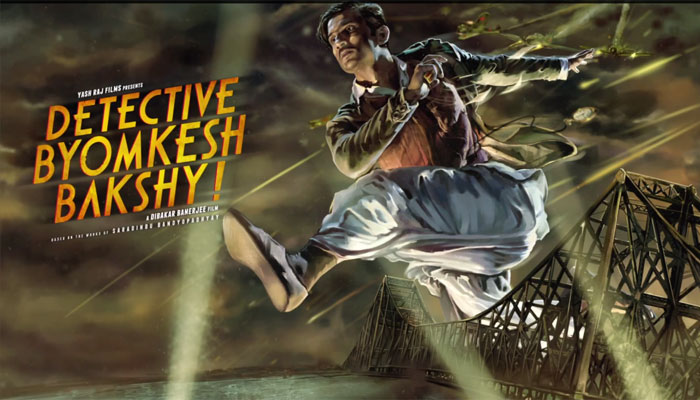
We live in times when everything should make money for the makers. Music has to be catchy enough for caller tune. Who cares if people forget about the music 3 days after the promos end! Last year, it was Haider, a music album that enveloped the feel of the film and not compromising with the melody in the process. The first quarter of this year has ended and Dibakar Banerjee has given us Detective Byomkesh Bakshy.
The album starts with immensely talented Madboy/Mink jiving on Calcutta kiss. I don’t know about you but I never thought we will witness such vibrancy and joie de vivre in a film song. The song kicks it and does a kick ass job at it. It has a deliciously flirtatious vibe, and my God, it is amazing! Saba Azad is a Goddess and I love the way she economizes her vocal spend on Hindi film songs. A wise man told me long time back that Sneha Khanwalkar might create good sound but she has a long way to go for making a melodious song that sticks in your head. Now I don’t know how they will use all songs in the film, but if used well, I challenge you to come out of the hall and not have ‘Bach ke bakshy…tu jhoootha hai makkaar‘ playing in your head. With this song, Sneha builds a villa on the already cemented spot that she occupies – one of the few, very few good musicians of our times whose songs will outlive us all and future generations will try unsuccessfully to find out the ‘formula’ behind the varied sounds she produced in her lifetime. I don’t know Sneha but I would love to know the questions she asks the maker when she is given the brief on the song that she has to make for a particular film. She gets it right every time!. Double pat to the lyricists of the song (Sneha and Dibakar, we are told)…whoever came up with beh gaya jo khoon uska kya blood type hai?!! The ‘bach ke bakshy tu jhootha hai makkar‘ has the same deadness to it, which some of us would remember experiencing when we heard kiley ka rahasya‘s title song.
I have always had a bone to pick with the non-film music scene in India, which has more often than not tried hard to bollywoodize itself to get validation (read recognition and money). The almost disgusting attempts at aping our innovative and rich neighbors’ music scene have failed because we try to put a bollywood touch to everything, and the sound gets hijacked. In comes ‘Byomkesh in love‘, and you feel not everything is wrong after all. The song has been fused well and in spite of English words in between, you will surely smile at the thumri-sque complaints of the singer asking her beloved to stay with the ‘other’ woman. The only other time it was done so beautifully was when Ram Sampath created this beautiful song. That was 13 years ago. In spite of somewhat average lyrics, what will arrest your attention in ‘jaanam’ is the tripping Synth arrangement in the song. Suryakant Sawhney does a great job at giving us a retro but not dated love song.
There was a time when to make your film song ‘hep’, you had to have a song from Suraj Jagan. It worked but not totally, may be because the songs always wanted mass acceptance from Bollywood music lovers who are overfed with silly items songs and template of rondu-rotlu songs. Thankfully ‘Life’s a bitch’ by Akshay De is NOT at all like that. The song doesn’t try to pander to ‘General population’ and keeps the death metal ( is it?) feel alive. Akshay de is angry and his rough (yet never out of tune) singing makes it up for a song which you will either love, like I do or hate! Nothing grey here. Chase in Chinatown marched passed all of us in the first trailer of the film. The music and the mood of this track is elevated a great deal by Vyshnav Balasubramaniam. The rap is rough and much like ‘life’s a bitch’ this might not be everyone’s cup of tea but the track is trippy and one that fits the stealthy title to the T. Yang Guang Lives – is a meandering track that has interesting sound to it. IJA has created this more like a background score with occasional commentary. Thanks to the superb pace of the entire O.S.T., this track might wear you out because it breaks off a lot in between. It won’t be wrong to conclude that the track is more a film piece than a song piece. That said, the track will give multiple orgasms to bass junkies.
Dibakar got 7 composers to make 7 songs. I am not the most vocal advocate of bringing hajaar composers in one O.S.T because I feel that the sound of the film gets compromised and doesn’t stay uniform. Thankfully, it is not the case here. For all we know, Dibakar would do a ‘kahaani’ and not include any song in the film. Even then, every note that you encounter in this album wraps itself around the feel of the film so well that it makes you want to see the film immediately!
We dont know what the film has in store for us. All we have got so far is just an eerie anticipation of something sinister which is about to unfold and the music just enhances that feeling. I cannot ask for anything more from an O.S.T..
Super like!
Let us know which song worked for you and which one didn’t.
So i watched NH10 at the 2:50 show at PVR Phoenix mills yesterday. The hall was almost 60% full. I was extremely excited about Navdeep Singh’s second directorial venture after Manorama Six Feet Under, so i armed myself with a large popcorn and coke, i munched my way through the national anthem and the anti tobacco campaign waiting with impatience and anticipation for the movie to begin.
A RED CENSOR CERTIFICATE set up the mood for what was to come.
Before everyone is up in arms about similarities with Eden Lake, the plot line is applied to a completely different context and therefore doesn’t account as plagiarism because artists are allowed to steal because “its not about where things are taken from, but where things are taken to” (Jim Jarmusch said it so you can take it up with him), From utopia to dystopia, Navdeep takes us for a creepy drive through Haryana, the experience of which we are unlikely to forget for a long time to come. All the moments are familiar yet original and the result is a stylish, contemporary and brilliant piece of storytelling.
Navdeep creates a mature modern Indian heroine that one can relate with and look up to.
Anushka’s look is fresh, dewy, her face does not look ducky and she has taken this role by the balls and performed the hell out of it. I have never been an Anushka fan per say, initially, put off by all her bubbly cockiness.
But i am a true blue convert now because she makes the rest of the lot of the leading ladies look childish, glossy and superfluous. With one bold stroke she has knocked Kangana down to number two in the list of brilliant mainstream female actors.
Anushka’s portrayal of Meera was so nuanced and balanced, and her descent into darkness was so effortless and easy that it is truly laudable. She was vulnerable yet steely, sensitive yet power packed. She is a heroine you are rooting for from the word GO. In comparison, her husband’s character makes me want to whack him a few times for being so silly and immature. I hated the villians, which means there were absolutely effective.
It is fantastic to see a film of this caliber coming from a “male director”. Especially in the wake of all the high brow debates , Navdeep sets an example with this work.
Now the people who are stereotyping and generalizing all Indian men, can shut up. The film entirely dealt with the idea of male gaze and yet there was no male gaze in the showing of the film at any point. There was respect for every character from its creators which is rare to find in a Hindi film.
The starkness of the rural urban divide, and the multiple manifestations of patriarchy are handled in an almost video game kind of manner.
Things get progressively harder and harder for Meera’s avatar, its almost like she takes on a virtual reality in the film, the banal is bizarre and things are just about hanging between real and surreal at all times. The moments are hellishly entertaining and suspenseful with just the right amount of comedy (mama-ji gets left behind!) which truly is a superb achievement in the Hindi film context.
I loved that there was minimal dialogue and great use of sound, all the information was relayed and never spoon fed and the images looked just right. Everything looked authentic and beautiful and dark- almost to a Hitchockian pitch.The added bonus was that the interval point came at the right time. The pace of the film was maintained with finesse through the second half and the film ended on the right pitch, without going into the “melodrama and maatam” over her husband’s death that could have followed.The loose reference to republic day where the cross-dressers are performing (to a homophobic audience), which is also Meera’s birthday in the story, and references to Ambedkar and the constitution, are interesting. Meera is a Salim Sinai kind of character. Everything revolves around her in a nationalistic kind of way, though i am glad that all this information is just there and wasn’t pressed further. I didn’t think it was a matter of convenience on the part of the director as some reviewers have put it, but cleverness, this is a great example of a pulp film, a true ode to anime and Amar Chitra Katha.
I was not a huge fan of the music, apparently it is a demand of the industry, but one could’ve totally done without it, or maybe something other than what was.
In the end, i was happy that she got to kill those bastards with relish, i am happy she mowed them with her own car and beat them with their own sticks. There was karmic retribution, tragedy, hope, albeit it was bleak and dark but real life is much worse. I was sucked into the zone, and i’m yet to shake it off.
My experience as an average film viewer was truly satisfying, and as a hopeful film maker, it was inspirational. The cast and crew deserve every accolade and more!
So what do you do when you get to know that there’s a screening of Libaas? Well, only a Gulzar fan can tell you the right answer. So over to Mohit Kataria who tells us what exactly he did.
Before you start:
Please don’t read this post as a film review post, it’s all about my personal experience with the movie Libaas and the way I got to watch it. I’ve never written any movie review before and I don’t think I even qualify for writing one (if there is any qualification criteria). You might also find it really biased as I’m a fan of Gulzar Saab and always wear a particular pair of admiration glasses while reading/watching/listening to any of his works.
Prologue
What do you do when you get any once-in-a-lifetime opportunity? You grab it with both the hands, right? That’s what I also did.
It all started with a Facebook post from a very dear friend and an ardent fan of Gulzar saab, Pavan Jha, that I came to know about Libaas getting screened in IFFI – 2014 in Goa on 22nd Of November. Then after a number of confusions, calculations and discussions later, I decided to go ahead and started making my travel plans. Then, I came to know about something called a delegate registration (I have already warned you about my credentials ), which was already into its “register-with-late-fee-phase”. Somehow got registered with some made up bio-data to prove that I was worthy enough to be a delegate there. I got an email mentioning that the confirmation will be done after some careful review of my bio-data. I waited impatiently for the whole day which was the last day for the registration, and by the end of the day, I got a confirmation mail asking me to pay to be a delegate. I followed the instructions and completed the formalities. Then it was time to book the tickets for travel. After doing some calculations, considering family, work, economics and time dynamics, I booked the flight from Bangalore, scheduled to reach Goa at 2 PM on the day of screening (22-Nov-14) (Libaas was scheduled for screening at 5:30 PM) and also booked first available flight from Goa the very next day (23-Nov-14). Needless to say, my only purpose of going through all this exercise was to witness something I really was waiting for ever since I started following and loving Gulzar Saab and his work – to get a chance to watch Libaas. And I never thought I would get an opportunity of a lifetime in this manner, to watch it with Gulzar Saab himself.
Experience
Before cutting through all the details of getting the passes (where Ashok Bindalji and IFFI organizers helped a lot), reaching the theater following Gulzar Saab, and finally settling down to watch Libaas, I would like to mention here that there were lots of people who wanted to get in and watch Libaas and the auditorium had a limited capacity of accommodating 280 people only. So one senior IFFI organizer (I won’t name him to get him into any trouble), took a call after consulting with Gulzar Saab and Vishal Bhardwaj, to allow people to sit in the gallery, on the floor, to stand on the gates, behind the last row and any other place wherever possible without making others uncomfortable. It got reminded me of the pre-multiplex era when it was a norm for any big movie. Isn’t it delightful to treat and watch the movie in the same manner we used to watch movies when it was actually made (in 1988)?
The stage was set by welcoming Gulzar Saab by the IFFI authorities, and then Vishal Bhardwaj presented the movie Libaas as the inauguration movie of retrospective: Gulzar. Vishal said that it’s an honor for him to present this movie, and spoke about how Gulzar Saab started his career as a poet and brought his poetry from paper to screen. Each of his movies are poetries on screen. He also briefly mentioned about the efforts at various levels that have gone in trying to get the movie released, including his personal efforts of 20 years which has gone in vain. Then he mentioned what it means to him personally, and for his whole family to be part of this historic event.
Gulzar Saab was visibly holding back his emotions, and he started on a lighter note saying, saying, “दोस्तो, मैं भी उतना ही curious हूँ फ़िल्म के लिए, जितने कि आप हैं. आप ने भी नहीं देखी फ़िल्म, मैंने भी नहीं देखी”, which rightly summed up the significance of the film. He was happy that the family and friends have come from all over to see this screening. You can listen to the whole discussion here. And then the magic started on screen. We were in for a very delightful treat for next couple of hours.
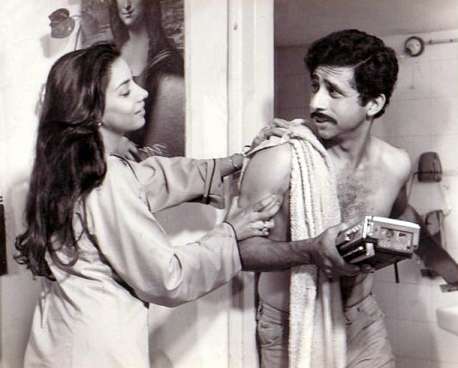
As you might know, the movie was completely based on Gulzar Saab’s own story Chaabiyaan which has also published later with the title Seema. There was wit, brilliance, intelligence and emotions written all over the movie. Each frame was flowing into the other one like the way water flows – at times like a river, sometimes like a silent lake and often like waterfall. It was a sheer pleasure to experience Gulzar Saab’s poetry for the next 137 minutes. The movie has four main characters – Sudhir Bhardwaj (a passionate theater director, played by Naseeruddin Shah), T.K. (a flamboyant businessman, played by Raj Babbar), Seema (an amazing actress who is also a not-so-happy wife, played by Shabana Azmi) and the theater which is the sutradhar which keeps tying all the running threads of the movie. It also has a handful of supporting cast who made their presence felt without shadowing the main leads. Not even a single character was out of place or not required. The story primarily deals with husband-wife relationship and a extra-marital affair, all in the backdrop of theater. While watching it, I could feel it was much ahead of its time (it was scheduled to be released in 1988), as was confirmed by Gulzar Saab in a post screening Q&A session that such things were happening at that time but were never shown in cinema. He dared to reflect what was part of society then.
Opening scene of the movie is in a theater, where Jamal Saheb (played by Utpal Dutt) is entering the theater while taking a look at the play being staged.
Utpal Dutt in Libaas
In the canteen, he is greeted by youngsters who are theater artists/aficionados and the scene establishes that Jamal Saheb is a great artist from the times gone by. He is not relevant anymore and is in a poor state. He has been replaced, so to say, by Sudhir, who is dominating the contemporary theater scene. In next few scenes, we come to know that for Sudhir, the first priority of his life is theater – the way he forces Seema to gargle every day in the morning, no matter what, and the way he keeps on talking about and enacting various scenes from his plays. One scene which nails it down clearly is when Seema asks Sudhir if she could get a hair-cut as she feels she would look prettier in short hair. To which he replies, if she gets the hair cut, what would happen to all the characters she is playing in theater, and starts quoting each of the characters from different plays. All the members of his theater group love and fear him in equal measure due to his strictness while doing the rehearsals. A couple of times when Seema forgets her lines during the rehearsals, he yells at her, and at home, he tells her,
“खाना बनाना भूल जाओगी तो बर्दाश्त कर लूँगा, dialogues भूल जाओगी तो कभी बर्दाश्त नहीं करूँगा.”
Phir Kisi Shaakh Ne Phenki Chaanv – Libaas
Seema is already strained, and wants a break from the monotony of Sudhir being so hard on her as he always thinking about one thing – theater. That’s when T.K. enters the scene and their home. He is informal and is such a close friend of Sudhir that even Seema feelss surprised as she had never seen Sudhir being so comfortable with anyone, including her. TK’s flamboyant style of talking and cheerful behavior attracts Seema, and he gets attracted to her beauty. They all meet a couple of times and then while one relationship starts forming, other one starts breaking. On one side, Sudhir is always busy with his play rehearsals and on the other hand, T.K., a well versed businessman is always ready to meet her and pay attention to her.
Her loneliness and boredom from theater adds fire to the fuel, and before even they realize, the relationship becomes complicated. The high-point of the movie is a scene which has brilliance of Gulzar Saab written all over it. It was Gulzar Saab’s craftsmanship that he handled such a burdened situation in such a subtle manner. The treatment of the characters, the dialogues of this one scene leaves us completely mesmerized and catches us unguarded. The scene is when Sudhir decides to confront T.K. and Seema about their relationship. Seema and T.K. enter the house after spending some good time together, and they find Sudhir at home. T.K. tries to cover up his embarrassment by telling Sudhir that he was asking about him from Seema as Sudhir was very busy, they were not able to meet.
T.K. – और किस ड्रामे में busy हो आजकल?
Sudhir – “अ..अ..म.. आजकल… अ… एक personal से नाटक में ज्यादा busy हूँ.”
“ह.. ह.. मतलब..?”
“नाटक तो दूसरे लोगों का है, मैं खा-म-खां बीच में फंस गया”
“अम.. कुछ समझा नहीं यार, वो कैसे?”
T.K., though embarrassed, is still trying to appear innocent even though he is guilty of cheating Sudhir.
“क्या है के हमारे यहाँ… हमारे यहाँ, वो हैं ना… मि. मुखर्जी”
He looks at Seema and starts building the story.
“मुखर्जी? कौन?”
Seema asks, to which Sudhir replies –
“तुम मिली हो उन से, शायद याद नहीं है… मि. मुखर्जी में याद रखने जैसा कुछ है या नहीं मालूम नहीं… लेकिन अपनी पत्नी की वजह से वो.. अक्सर याद रह जाते हैं लोगों को…. बड़ी talented… और talented से ज्यादा ख़ूबसूरत पत्नी है उन की. अब ज़ाहिर है कि लोग उन की तरफ़ तवज्जो देते हैं, attract होते हैं. और ये कम्बख़्त चीज़ ऎसी है कि आदमी हो या औरत, पाँव तले की ज़मीन खींच लेती है. आदमी सोचता है, इश्क ही में ज़िंदगी है, बाकी सब तो फ़न, आर्ट, talent, सब सजावट की चीज़ें हैं. बहरहाल, मि. मुखर्जी का problem है, उन की पत्नी… वो किसी के इश्क में पड़ गई हैं या कोई है जो उन के इश्क में पड़ गया है….”
Seema asks, “तो problem क्या है?”
To which Sudhir replies, point blank, still keeping it indirect,
“तुम्हें नज़र नहीं आता?”
“नहीं मतलब… समझ में आता है लेकिन दोनों अगर एक दूसरे को चाहते हैं तो…”
“नहीं, नहीं, नहीं, नहीं… तुम उस लड़की के problem को देख रही हो, मैं मि. मुखर्जी के problem की बात कर रहा हूँ”
“उनका क्या problem है?”
“क्यूँ? याने… उन का कुछ है ही नहीं?…
उन का problem ये है कि उन्हें मालूम हो गया है… और जान लेने के बाद शौहर यानि मि. मुखर्जी क्या करे उस पत्नी का? चुप रहे? देखता रहे? होने दे जो हो रहा है? मुश्किल तो ये है कि कोई भी शौहर जान लेने के बाद ये निगल नहीं सकता”
Now T.K. intervenes,
“आख़िर मुखर्जी चाहता क्या है?” “चाहता क्या है, वो छोड़ो, क्या करना चाहिए उसे?”
“अम..ज़ाहिर है अगर उन की पत्नी, उन के साथ नहीं रहना चाहती तो उन्हें कोई हक़ नहीं है कि वो उस के साथ ज़बरदस्ती करें. After all.. वो अपना अच्छा-बुरा समझ सकती है, ऎसी कोई बात नहीं है…”
“हाँ, समझना तो चाहिए, सिर्फ़ ये कि जिस से वो प्यार करती है, क्या सचमुच प्यार करती है? यूँ ही उन्स में तो नहीं पड़ गई? ख़ा-म-ख़ां का infatuation तो नहीं है, जिसे वो प्यार समझ बैठी है?”
“आख़िर शादी-शुदा औरत है, क्या इतना नहीं समझती? इतनी mature नहीं होगी के…”
And that’s when Gulzar Saab’s intelligence of handling the complicated situations comes in full form.
Sudhir interrupts Seema at this point and says it straight,
“इतनी mature हो तुम? इतना समझती हो कि जिस राह पे जा रही हो, जिस के साथ जा रही हो वो झूठ-मूठ का कोई ड्रामा तो नहीं कर रहा है?”
At this time T.K. tries to escape saying this is personal matter between husband and wife and he is an outsider.
Then, as a matter of fact, Sudhir tells him,
“बैठ जाओ T.K., तुम भी कोई बच्चे नहीं हो… बैठ जाओ… देखो T.K., इन रिश्तों में कानूनी, ग़ैर कानूनी कुछ नहीं होता. कानूनन कोई पत्नी नहीं बनती, कानूनन कोई शौहर नहीं होता.Law has nothing to do with it. हम ज़बरदस्ती इन रिश्तों पर कानूनी मोहरें लगाते रहते हैं. आज तक, कोई किसी आते को नहीं रोक सका और ना किसी जाते को थाम सका है. और मैं ये कैंसर ले कर नहीं घूम सकता…. तुम ने ठीक कहा, अगर सीमा मेरे साथ नहीं रहना चाहती तो मुझे कोई ज़बरदस्ती नहीं करनी चाहिए, मैं नहीं करूँगा, लेकिन मैं इसे रास्ते पर नहीं छोड़ सकता. मैं तुम्हारा फ़ैसला जानना चाह्ता हूँ, तुम दोनों का फ़ैसला जानना चाहता हूँ… अगर तुम दोनों flirt नहीं कर रहे हो, एक-दूसरे को धोखा नहीं दे रहे हो, सचमुच एक दूसरे को चाहते हो, तो हाथ पकड़ो और निकल जाओ इस घर से.”
Seeli Hawa Chhoo Gayi – Libaas
Even after Sudhir and Seema get separated and she remarries T.K., there is still an element of care and affection for each other.
T.K. and Seema are living happily, yet Seema is not able to forget her past so easily.
In one scene, where one evening she is sitting sad all alone on a yatch, T.K. comes and asks,
“क्या हुआ… सुधीर का ख़्याल आ गया?”
“हूं..”
“इसीलिए तो तुम्हें शादी के बाद यहाँ ले आया. जानता था, अगर वहाँ रहोगी तो अतीत याद आएगा. अतीत बुरा हो तो सीमा, आदमी गर्द की तरह झाड़ दे, ख़त्म कर दे, लेकिन सुधीर जैसा… मुझ पर अंधविश्वास था उसे. जो कुछ हुआ, मुझे उस का अफ़सोस नहीं, बिल्कुल नहीं, बस यही है कि अगर तुम किसी दोस्त के यहाँ ना होती ना…तो अच्छा होता, क्यूँकि तुम जहाँ भी होती, मैं यही करता, I love you. मैं तुम से प्यार करता. I love you Seema, I love you.”
[Edit Note : While Mohit has written the climax in his post, we are not going to reveal what happens in the end, as we expect more screenings of the film soon and expect you to watch it someday, somewhere. We leave you here with Ravi Shastri Quote : All Three Results Possible ]
And the end credits roll over with the song
“तुम से मिली जो ज़िंदगी, हम ने अभी बोई नहीं,
तेरे सिवा कोई ना था, तेरे सिवा कोई नहीं…”
…Leaving everyone in the theater completely spell bound.
Gulzar Saab got a standing ovation which refused to die down for the next few minutes.
Epilogue
It had Gulzar written all over it. Gulzar the writer, Gulzar the dialogue-writer, Gulzar the lyricist and Gulzar the director. It was like various Gulzar competing with each other and attaining the pinnacle of expressions. The music of R.D. Burman was also a highlight of the movie as the melodies are so soulful, the film would have been definitely incomplete without such lovely songs.
From story perspective, it is really difficult to say what was wrong or who was wrong or whether anyone was wrong at all? This is the power of a sensibly told story on screen. We all know that Gulzar Saab has great sense of expression when it comes to relationships. He is the one who has given the words to all the emotions we have gone through at various points in our different relationships. He is no different here as well. Gulzar Saab has also given various references of past work of theater artists who have explored the complexities of husband-wife relations – Leo Tostoy’s Anna Karenina, Vijay Tendulkar’s Khamosh adaalat jari hai, Mohan Rakesh’s Aadhe-adhure. The film, even though made some 26 years back, is still relevant and I believe due to the nature of human relationships, will be relevant even after 26 years.
There are so many situations in the movie which could have been exploited with melodramatic scenes but he kept them subtle, and trusted the intelligence of audience he was catering to. Like after re-marriage, one day when T.K. is gargling in the morning, all of a sudden she gets reminded of Sudhir, who was always after her for gargling. She gets in that groove for a moment that she actually calls out her old maid’s name “दुर्गा…” and then she realizes her mistake. And when she calls up their family doctor (played by A.K. Hangal) asking him to visit their home for T.K.’s cough and cold, she forgets to mention to the doctor about his new life and husband. The doctor habitually visits their old home and because Sudhir is also suffering from the cough at the same time, he doesn’t find it surprising that Seema called him up. Subtle ways to show that the bridges are not yet burnt completely. The central idea of the story keeps coming back again and again in multiple ways.
During the post-screening Q&A we came to know that the climax which was shown in the film was not his choice but the producers insisted upon him to change the climax.
He wanted to leave it a bit open ended, which he couldn’t do in this movie, hence he made Ijaazat, another masterpiece on husband-wife relationship which he ended the way he wanted it to be.
Nobody dared to ask the question, “अगर लिबास release हो जाती फिर भी क्या वो इजाज़त बनाते?” and I doubt if anyone who has watched Ijaazat would even dare to think it being non-existent from the filmology of Gulzar Saab. Nothing to compare but to give a flavor to the people who could not watch the screening of Libaas, in my opinion, it was at par (if not more) with Ijaazat in terms of exploration of relationships, writing, dialogues, songs, direction and music.
To sum it up, I would just say, no matter how many years the movie has spent in the laundry or dry-clean, this Libaas is still as crisp, clean and white as new.
(Mohit Kataria is an IT engineer by profession, writer & poet by passion, a Gulzar fan by heart. He is based in Bangalore and can be reached at [kataria dot mohit at gmail dot com] or [@hitm0 on twitter)
(Pics & Videos by Ashok Bindal [ajbindal at gmail dot com], a close associate of Gulzar saab, based in Mumbai)
Retrospective Inauguration Video via Ministry of I&B YouTube Channel]
Seen Haider yet? Naah? What are you doing? Go, book your tickets first. Coming back to the film, if Vishal Bhardwaj can get two Salmans, we aren’t far behind. We got two Haiders. One is his, other is ours. So here is our Haider on his Haider.
Our Haider Hussain Beig is a 23 year old filmmaker based out of Netherlands. When he’s not alienating close friends with painful film gyaan, he dabbles in Aerospace Engineering. You can check out his stuff here. This is first post here.
To read our previous post on the film, “Haider : Uncertain, Complex, Asymmetric…Because the screenplay is Kashmir”, click here.
Heavy handed exposition usually kills a film for me. It could be a tasteless voiceover or a redundant character painstakingly ear-fucking the audience with drab explanations of already convoluted plot-points. Which brings me to one of my favorite ‘did you catch that?’ Moments in the film. It occurs when Khurram is being led into an abandoned house and he notices ‘Yeh toh Kaul Saab ka ghar hai.’ Then a brief exchange ensues about the whereabouts of ‘Kaul Saab’, finally coming to the conclusion that he has ‘shifted’ to Bombay.
This was an in passing reference to the exodus of the Kashmiri Pandits from their homeland. It perfectly captures the nonchalance of the characters who, putting it crudely, have different issues to deal with now. And perhaps are still dealing with the brutal and horrific ousting of their Hindu neighbours as a mere migration to the big city. This is just one of the many examples of sheer brilliance in storytelling by someone who I would not have expected less of. Best of all, I didn’t feel like I was being explained a point of view or thrown facts at that I was supposed to ingest like a frustrated teenager in a History lesson. I knew most facts about the region and the socio-political situation already, and never once did I feel the need to internally sigh with a ‘pata hai bhai, gyan dena band karo‘. And trust me when I say I know a lot about Kashmir. Because unlike most of us, I have not been fed frustratingly conflicting facts from different sources of news, I have lived them in my own little way.
I was born in Delhi to a German mother and a Kashmiri father, who decided to name me Haider. It’s one of those unique ‘this-guy-is-definitely-a-Shia’ names. I guess like most things my father does, he wanted to be different. And I was happy with that. I personally don’t know any Haiders. Until late last year, when I heard Vishal Bhardwaj was making his third Shakespeare adaptation on Hamlet, called Haider. Same name, same spelling. Not Hyder, Heydar, or Haidar. HAIDER. F-U-C-K-ed-M-E.
Putting it simply, it’s unnerving to see your name in posters, on billboards, as a trending hashtags of some of my cinematic idols on the big screen. In the ticket line at the box office I turned around as a reflex to my name being called out by impatient ticket buyers. And let’s not get started with the jokes that only true friends and elementary school goers can come up with; ‘How does it feel to have Shahid Kapoor in you?’, or ‘Dude! You gave Hansal Mehta fulfilling sleepless nights!’.
What put me to a melancholic ease though, was the name being pronounced in a Kashmiri accent. It took me back to an angry grandmother yelling out ‘Huhder!’ at my mischief. It’s sad that it takes a great like VB to put in the careful attention to detail to make sure that stars make the proper effort into not caricaturizing the dialect. From Shahid Kapoor’s ‘Sirinagar’ to Shraddha Kapoor’s endearing ‘Luvved, Givved, Suckked, Fu..’. They were almost pitch perfect. And even if some may not agree, full points for the effort.
The dialogues, their delivery, and timing, were just a revelation. Blending in Shakespeare’s cunning words with the heavy backdrop of the ‘Kashmir Issue’. Nothing felt pedantic, heavy handed, apologetic, expositional, out of place, or forced. It was as it should have been. Nothing more, nothing less.
The supporting cast was mostly played by locals, and they were spot-fucking on. There was no need for windy character back stories. From Janus’ two faced Salman and Salman, to Khurram’s born-again militant henchman. They could all have separate films based on them and I would pay good money to watch those too. It’s heartening to see such a wide pool of talent scattered all across the country. WAKE THE FUCK UP, BOLLYWOOD!
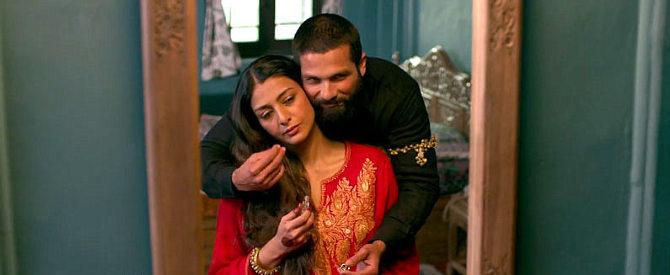
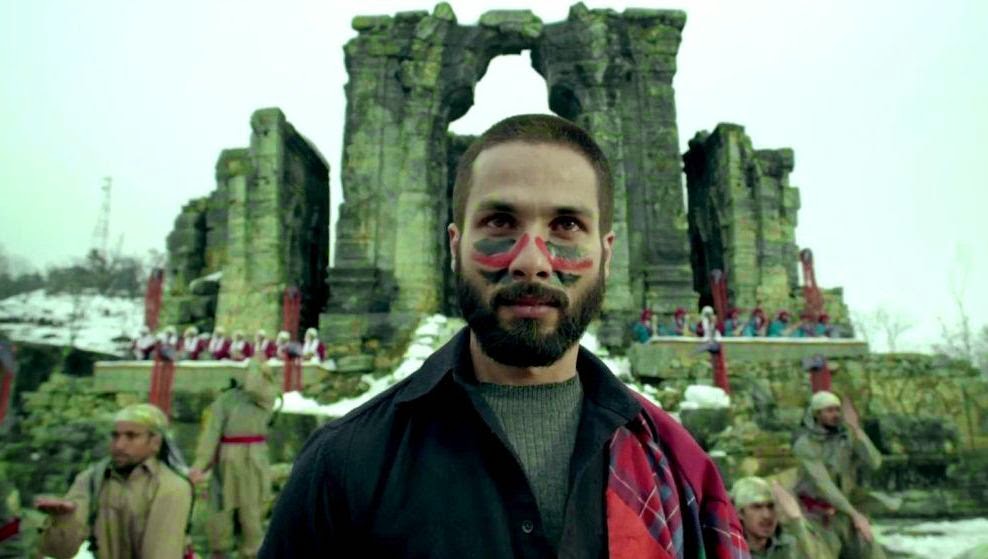
Shraddha Kapoor’s work was a welcome surprise. I wouldn’t say her performance was perfect, but three films in, she’s already giving her contemporaries a hard time. Aloof, innocent and gullible, Arshia was what I would call a perfect representation of Kashmir in the early parts of the militancy. It resonated, or was rather amplified by Tabu’s Ghazala, as a more worn out, mature, but also much more grey representation of Kashmir in the time the film is set in, the glorious mid-nineties. It seems like Tabu is the only actor that can play a self destructive feminine character in a Shakespearean tragedy to such seasoned perfection. And to Shahid Kapoor, all I want to say is, Ghanta-Ghar in Lal Chowk will never be the same for anyone again. They better fucking throw all the big (even if bogus) awards at him.
Never have I seen a film capture the reality of the situation so beautifully. Pankaj Kumar’s cinematography is a result of what would happen of each character we’re given a brush to paint out exactly what they see. Each frame was a representation of these personal works of art. It was almost akin to the wounded beauty of the valley. You are one of my heros. I was more excited about seeing your name attached to the film than VB’s. After Ship of Theseus, and now this, I can’t wait to see much much more work from you!
Finally, to the master himself. Vishal Bhardwaj. I might need a series of blog posts to talk about your work. And I’m sure, as I have also read, there is enough information, analysis, discourse and dissection of your work already. I’d rather not add to the pile. I’ll stick to what stuck out most for me, the score. I had listened to the songs that had come out in the run up to the release quite a lot. My favorite being, of course, Bismil. Though what really captured my entranced attention was the score. So, so, …. Fuck I’m out of adjectives that would do justice. I hope the score will be out soon. I know what music I’m going to write to now.
I have never lived for more than two months in Kashmir. Most of my upbringing has been in Delhi, though I have visited Kashmir every year of my life since I was born, most of those years being the most dangerous. I have only fond memories. I have never once seen a terrorist/mujahid/militant/freedom-fighter/jihadist. And it’s not like I lived in a cordoned off posh area. In fact my family lives in one of the rather impoverished Shia neighbourhoods in Srinagar. Though that is not to say, that the distant sound of gunshots and bomb explosions was not a common sound. In my own way, a part of my brain would register them as the sound of Diwali fire crackers, and things would be festive in my mind again. I’ve had the most tranquil moments of reflection on the banks of the Nigeen lake, on a grass patch between abandoned houseboats. I’ve cried my eyes out laughing with my cousins at the millionth viewing of Andaz Apna Apna on local cable channels. And don’t even get me started on wazwan. The closest I’ve come to ‘danger’ was a scooter ride back from football practice, dodging a hail of stones, swerving around burning tyres, and slyly detouring to my aunts house who lived nearby. I’ve always thought of that memory as a rather funny adventure. My worried wailing mother on the other hand, did not.
On the contrary, I’ve heard personal first hand accounts of friends, acquaintances and even close cousins (mostly young men), about the dangers they’ve had to endure. From both the militants and the army. Some accounts are so chilling that I’d rather not get into them, for your sake and mine. ‘Jab do haathi ladte hain, neeche ghaas hi kuchli jaati hai‘. It saddens me to see tasteless Anti-India graffiti vomited on ancient walls. Though their distrust and disdain for the AFSPA and conversely the Armed forces, is not without reason. There are bad apples everywhere, even in Kashmir. I recommend Ashwin Kumar’s two brilliant documentaries – Inshallah, Football and Inshallah, Kashmir. They will show you a side of the story the mainstream media conveniently redacts. I’m not an expert on the subject and I’m not foolish enough to think that I might even have something close to an answer. If anything, having a foot in both worlds, has given me a rather confusing point of view, so I usually stay out of Kashmir based bar-conversations. Plus, whenever anyone looks at me for an explanation, I conveniently say, ‘I don’t know bro, I’m German’. Which is why, I love this film too. I went in as an outsider, and actually learnt a few things I did not know. Thank you Basharat Peer, I’m no one to challenge a reputed journalist and writer who, by the way, happens to be from Kashmir.
Haider is by far the most realistic depiction of Kashmir I’ve seen on screen so far. That includes Aamir Bashir’s heartbreaking Harud.
It’s a perfect balance that knocks you out of your seat in a jolt of energy and then in an instant makes you slow-down and wonder. The only think I would have liked to see more of was a bit more on the exodus of the Kashmiri Pundits. Though, the film takes place in a time when the people have ‘gotten over’ it.
The first scene I ever wrote was of a conversation between two friends on the banks of the Nigeen Lake, my spot of tranquility, hiding from the world, sharing a cigarette, something I’ve done a countless number of times. Since then I’ve rewritten, thrown out, written again, and rewritten it again. I think it’s time to finally finish it. Thank you Vishal Bhardwaj.
To everyone out there still deciding, please watch this film. It’s the real ‘Bang Bang’. I really hope it releases in Kashmir. Last I heard, my local cinema in Hawal Chowk was still an army bunker.
It’d been a long time since I laughed out loud while reading a book. A really long time. But Diptakirti Chaudhuri’s latest book has just about managed that. I laughed, chuckled, and nodded my head several times in the midst of reading the book. “BollyBook – The Big Book of Hindi Movie Trivia” is Diptakirti’s third book, the first one being one on cricket, and the second being the precursor to BollyBook, “Kitnay Aadmi Thay” (KAT). It was a genre shifting Bollywood book in the sense that it did not chronicle the travails of film making or profile some specific stars, but it just focused on Bollywood trivia and did a fine job of that.
BollyBook is expected to release in October, 2014. The initial idea, as Diptakirti says on his blog (diptakirti.blogspot.in), was to pitch BB (indulge me as I acronymize the book titles) as a sequel to KAT, but then his publisher at Penguin suggested the idea of a combining the two as a comprehensive and definitive book rather than having a sequel. And thus, BB was reborn in a new avatar. Just like some Bollywood characters do, some would say.
With 19 sections and nearly 460 pages that are packed with interesting trivia and more, the book can definitely live up to the claim of being the definitive book of Bollywood trivia. Good, bad, funny, dark, all sorts of trivia make up this book. Written in his inimitable style, often sparkling with humour and wit, the book is a paean of sorts to Bollywood.
Today I may count myself a fan of filmmakers such as Scorscese, Linklater, or Fincher, but my first introduction to cinema came through the works of Manmohan Desai, Yash Chopra, and others. Back then, we didn’t have a VCR or DVD at home. There were no multiplexes. Going to the movies meant walking to the neighborhood theater, 15 minutes away from home, standing in queue for “first day first shows” or “matinee shows” for a 10 or 20-rupee ticket. Satellite (cable) TV was not yet introduced in my little town. Regular TV broadcast used to a mix of very old to medium old movies. Religious festivals often heralded special community-screenings in an open-air environment where a projectionist would “show” the picture on a vertically mounted white chaddar. Regardless of the venue or the medium, we watched in awe as those larger-than-life stories unfolded on the screen. Chitrahaar, the weekly programme showcasing hit Bollywood songs, was our reason for going “TGIF”! This, in essence, is what Diptakirti would call a pre-credit backstory compression (hint: see the book to understand what this term really means) to explain my fascination for Bollywood.
It doesn’t matter whether you’re a 70’s, 80’s, or 90’s kid. The book has something for everyone. The earlier generations will nod their head at the various retro references, while the newer ones will easily connect with the new age trivia. Although the table of contents mentions lists, the book isn’t packed with boring ones, instead many trivia are presented in anecdotal form, with a surprise twist here and there. Did you know for instance that the Tamil Nadu CM Jayalalitha acted as second lead opposite Dharmendra in a movie named Izzat? Or that Dev Anand was an employee of the Indian Postal Service and perchance grew to know of Gurudutt who lived in the same chawl as him and became thick with him? Many more such interesting nuggets fill up the book including those about movies you thought you knew in and out, only to discover that you actually don’t.
A remarkable trait of the book is that it isn’t restricted to mentioning trivia regarding only actors and actresses, but also takes a good look at the others who play an important part in a movie’s success. In a chapter covering regional superstars, for example, the last para brings to fore the most successful crossover by a regional musician who has gone on to make a name for himself in the international arena. A. R. Rahman. That’s who.
There’s also a whole chapter devoted to films within films, called Meta. The amount of research the author must have undertaken for this book can be gleaned from this chapter alone where he not only recounts meta and self-referencing films/directors but also points out bloopers!
All trivia and no interestingness makes a dull book. And Diptakirti is no dull author. He makes neat use of quizzes, Honorable Mentions and little Alerts (Eg, Subtle Mythology Alert) to break the pattern now and then. Chapters are also occasionally peppered with photos and posters.
All in all, for Rs. 370 – paperback or Rs. 318 (Kindle), this book packs quite a punch, just like some of our Bollywood films. If you count yourself as a Bollywood fan, this book is a must-have for your bookshelf.
Footnote: Our very own mFC finds a small mention in the section on low-profile debuts of actors.
A Vishal Bhardwaj film is an event for us. He is our tent-pole movie. With his latest one, Haider, he has left his contemporaries far, far behind. A bold and uncompromised take on a complicated subject with a master craftsman weaving magic on screen – dark, depressing, violent, poetic, and gloomy. How else do you like your VB-film? Who else can do it better than him? Over to Nadi Palshikar who just watched the film and jotted down her thoughts.
An MBBS doctor by training, Nadi has also done the screenplay writing course at FTII. She is currently doing Gender Studies at Pune University. Sutak is her first novel which has recently got published. This is her first post on mFC.
Innocence has betrayed him ; Haider’s hands are tied by the red scarf made by the innocent one.
He has been captured by the trickster, the two faced Janus – comic and now revealed to be cruel.
Two funny photographers with the same name are used to depict a two faced trickster.
The trickster working at the periphery of the state.
Periphery, the two photographers (the two Salmans) have not got ‘permanent’ posts yet, but serve.
They have once bestowed a favor – they came and took Haider away on a motorcycle, they took him away to safety.
Now, they are driving him in a vehicle owned by his enemy, they are taking him away to death.
He overpowers them, but after a scuffle, they escape.
Haider now picks up a stone and aims it at the (two) trickster(s). We see in the background that the landscape is full of stones. Hurled by those who had no other defence against the powerful state.
A stone for a bullet. And yet, the world took notice.
For the first time, India’s lack of capabilities to handle law and order situations in an appropriate manner came to light. Surely, firing is an out-of-proportion response for stone throwing, asked citizens.
For 20 years, the biggest threat to security forces was militancy, now it is these stones youngsters are hurling at the speed of 40 kms per hour said the Chief Minister. The age old form of dissent (probably inspired by the Palestinian Intifada) had worked.
To the world was presented a clear picture, literally a picture of who was the strong Goliath in this confrontation.
But back to Haider, and the landscape heaped with stones.
Then as if the stones have joined to become formidable, a big rock. And Haider uses this rock to destroy the cruel shape shifting monster.
We leave the scene with an image of stones, stones…
Beautiful, but strange..like the landscape of Kashmir, this tribute to the young men who risked the bullet to hurl a stone..
Just writing down my response to one scene in the film. The film is full of such scenes, making meaning – so many meanings. What an excellent screenplay by Basharat Peer (Curfewed Night) and Vishal Bhardwaj.
What it achieves – An unlikely adaptation of Shakespeare’s Hamlet – Unlikely and effective. The setting so difficult, yet so believable.
Every little thing, every spoken word has a purpose, a meaning. Even simple lines of dialogue which may seem just ‘funny’ lines reveal insight. e.g- Haider is at a very low point. He is mentally breaking down. And his girlfriend asks him “kya haal banake rakha hain?” To which his quick and laughing retort is ask me “kuchch lete kyun nahin?” Those of you who were born then, do you remember the 80s Coldarin advertisement? This is 1995, and these two young people were are childhood friends.
They shared this dialogue, laughed about it, when they were children.
Also, those were happier times, easier times.
Now at a very difficult point in their life he calls that line from the past.
Also, for us, as audience – the writers are after all Vishal Bharadwaj who will not have anything purposeless, meaningless in his film, and Basharat Peer who has written Curfewed Night about his personal experiences as a child inKashmir.
He knows that History is not just what you find in textbooks. History is personal accounts. History can be what we experienced in popular culture at a particular time.
As audience we remember that ad – we see Haider remembering that ad.
We shared that experience.
This Kashmiri young man, and us.
The same ad is aired over a geographical location.
We shared it.
We are a part of the same history..
A political stand taken by the film-
I will state it simply – Haider’s monologue about AFSPA is the politically bravest piece of writing that I have seen in film in a long time.
The ending – Even as he ‘hears’ his father’s voice calling for revenge, he also ‘hears’ another voice – his Grandfather’s saying that revenge only leads to more revenge. How can revenge make us free?
How can it give us Azaadi?
Speaking of the AFSPA, remember, when the present government had ruled out changes in the AFSPA?
There was a statement by the army chief which had hurt me then.
He called it an “enabling act” because he said “AFSPA gives Army additional powers to operate in an environment which is marked by very high degree of uncertainty and complexity and an asymmetric environment where you cannot differentiate between a friend and a foe as the terrorist merges with the backdrop and hides amongst the locals.”
A statement that I did not like and now a screenplay that has moved me. See how Kashmir was described?
“environment which is marked by very high degree of uncertainty and complexity and an asymmetric environment where you cannot differentiate between a friend and a foe”
There is a distinct smell of honesty in things which are fundamentally correct. You have got to love anything when it is done with utmost sincerity and no sluggishness. This is why we wait for Vishal Bharadwaj’s films and music. His latest offering is out, and we strongly recommend you get a taste of it. Here’s why:
So Jao – The eerie calm of a dark night perpetuated by heavy bass notes and a near mourning dead voiced ensemble consisting of Bashir Lone, Bashir Bhawani, Muzamil Bhawani, Mayukh Sarkar, Aalaap Majgavkar and others take upon themselves to scare the life out of us in this calm yet intense song. The singers might all be mourning but they are in perfect sync and you will find yourself reaching for the repeat button without a doubt. The sound of shovels attacking mother earth is impactful, to say the least. Top class!
Jhelum – Yet another dark song where the music arrangement is spread out. The magical electric guitar surprises you as it creates an atmosphere of contemplation. Vishal, helped greatly by the words from Gulzar, paints a picture of grief, the kind that will suck you and might make you sad, very sad. I might be thinking too much but then I feel the words ‘jhelum hua kharaa’ came out right from Gulzar’s heart as he reflected on the massacres he witnessed, during partition. That perpetual sinking feeling owes a lot to the wonderful Simaab Sen who has produced this song in the album. Vishal Bharadwaj doesn’t sing much in films. We wonder why.
Gulon mein rang – The thing with good poetry is that it can never be badly performed (unless of course, KRK decides to rap it). To make it even better, words have been modified and what’s better than to see Gulzar and Faiz in one song! We honestly didn’t expect much from Arijit Singh, (who is breathing these days with microphone attached to his throat) because we knew, the sound would be indistinguishable from most of his songs off late. I won’t say we were shocked and surprised with his rendition here. It is strictly average but the music arrangement takes it a notch higher, especially the hopeful note on which the song ends. Talking of this iconic kalaam, even Mohit Chauhan did it nicely here.
Ek aur bismil – With an adorable arabian touch and sufi setting, this version paints a fantastic belly dance setting in the mind. The clarinet in the song is exact and lends much richness to the song. Unlike the ‘bismil’ song (to which this song owes its title and tune) which has a podium/stage setting, this feels more intimate, street like and humble.
Do Jahaan – Call me an incurable romantic, but I cannot wait for Suresh Wadkar singing a ‘suresh wadkar वाला’ song. No, I don’t mean ‘totey udd gaye’ (ek thee dayan) sort of song. I mean ‘tere liye’ (7 khoon maaf) sorts. A lazy setting that somehow has become Vishal Bharadwaj’s forte along with Suresh Wadkar’s depth is something to look forward to. This song is exactly like that. An added bonus is to hear Shraddha kapoor’s voice which doesn’t sound processed and adds a ‘real’ feel to the song.
Aaj ke naam – After her fantastic ‘har ghadi’ in D-Day, Rekha Bharadwaj gives us a ‘by the tabla’ ghazal that has ‘tragedy’ written all over it. This is also a work of Faiz Ahmed Faiz. Vishal Bharadwaj quietly sneaks in gentle keyboard notes to give a contemporary feel to the overall setting. Since the ghazal talks of so much sadness (With the excellent use of ‘new’ words for hindi film songs like – ब्याहता), extreme caution is advised because it will leave you sad, very sad.
Khul Kabhi – Good things were said about this song by Vishal Bharadwaj himself in a recent interview on Radio Mirchi, Bombay. Perhaps what Vishal Bharadwaj didn’t estimate was the flood of Arijit Singh’s songs with whom we are playing ‘catch up’ on daily basis. This song is good and we couldn’t help feel that this should have been sung by Vishal Bharadwaj himself. No doubt that would have been the thought at the time of composing it. It is a ‘FVBV’ song all the way (For Vishal, By Vishal). Arijit is efficient and average at best, what is lacking is the exclusive, infectious feel that this tune and crazy romantic song deserved.
Bismil – The ‘stage’ song! With Sukhwinder, there is always a danger that perhaps he will sound too ‘sukhwinder’ and hijack the song. It doesn’t matter in this case because there is an army of excellent back up vocalists, and a ‘beyond awesome’ rabaab at work along with him. The song paints a dark picture of deceit with an upbeat tune. The lyrics give away everything there is to correlate with Shahid Kapoor’s anger in the film. These days when music composers take pride in saying ‘ये गाना डांस फ्लोर पे महिना भर बजेगा’ , here is a song which might become a hot favorite of people who are into stage dramas. The overall feel reminded me of ‘Sheher’ of gulaal which can also be re-created on stage with impact, if only some people are up to it. A thunderous song that gives you a feel of large auditorium. Kudos!
Aao Na – I feel Vishal Dadlani somehow saves his ‘year’s best’ when he teams up with Vishal Bharadwaj. While I still maintain that ‘Dhan te nan’ is his best, this song stands right next to it. The passion, drums and singing, all are just top notch. Did I miss anything? Oh yes, that bloody mother of a tune on guitar. I cannot write enough good things about this song. Double thumbs up!
Vishal Bharadwaj and Gulzar have given us a brilliant album that has right shades of dark, much like the background and context of the film. In a year that has been marred with too much trash and vomit inducing tracks, Haider is what leaves a lasting sweetness on our taste buds.










 F.i.g.h.t C.l.u.b