Archive for the ‘Indie’ Category

sniffer-002

Two new teasers of Buddhadeb Dasgupta’s new film Anwar Ka Ajab Kissa (Sniffer) has released online. Both the teasers don’t say much about the film but there’s a great mood there. The film stars Nawazuddin Siddiqui, Pankaj Tripathi, Niharika Singh and Ananya Chatterjee. Have a look.

Official synopsis

Master Bengali filmmaker Buddhadeb Dasgupta teams up with India’s hottest indie actor Nawazuddin Siddiqui in this richly textured black comedy, set against a magical, surreal tableaux of the Bengali city and countryside that’s typical of Dasgupta’s eye. Anwar (Nawazuddin Siddiqui) is a well meaning if clumsy private detective, or ‘sniffer’, who can’t help getting personally embroiled with the clients he is spying on. His only true companion is an old dog. His pet and his regular drunkenness put him at odds with the local orthodox Muslim housing block, who want him out. At the same time, Anwar increasingly struggles to cope with his small-time sleuth work that shows him that, in the modern world, even love is for sale. When a case takes Anwar back to his rural homeland, he’s forced to confront his own love tragedy. Siddiqui lights up the screen, displaying a talent for deft comic timing that makes Sniffer a joy to watch.

Duration :132 mins

The film premiered at London Film Festival last year and will be shown at New York Indian Film Festival this year.

After doing the fest rounds, Nisha Pahuja’s critically acclaimed documentary, ‘The World Before Her’ is all set to release on May 16th, 2014. Filmmaker Anurag Kashyap is presenting it and PVR Directors Rare is releasing the film. Moving between the worlds of a Durga Vahini training camp and the beauty boot camp of the Miss India Pageant, the film is a powerful story that could not have come at a better time. Some of us managed to watch the film earlier and we have put it in MFC’s Must Watch recco list. Click here to read our recco post on the film.

We are posting two clips from the film – one from the film, and one that did not make the cut. We also got Nisha to write on these two clips.

1. Pooja’s story

Director’s Note – I remember when Pooja told me the story of almost being killed at birth for being a girl..that moment became a turning point for me in terms of the focus of the film. I knew it had to be about the struggles that so many Indian women continue to face. It also changed the way I looked at Miss India–suddenly it was no longer passe or just simply derogatory..it was so much more complex. I had to ask myself “Given the Indian context, can I disregard my Western prejudices and see a beauty pageant as “empowering.” It’s something I still grapple with..

2. Tulsi’s story

Director’s Note – When I began the research in 2008, I was determined to find a young woman from a village who harboured dreams of becoming a Miss India.  Somehow I did. Meet Tulsi – achingly lovely..a symbol of “aspiring India.” Tulsi’s story was incredible, she comes from a village in UP that got electricity in 2009, and that only intermittently. Her grandfather was a freedom fighter and and there was a temple that had been built in his honour. Tulsi’s mother did not want to get married but was forced to.  So in an act of defiance on her wedding night she chopped off all her hair and began to dress like a man. Somehow she was accepted. She decided she would allow her daughter to do as she wished. When Tulsi told her parents she wanted to move to Bombay and pursue her Miss India dream, they sent her off with the money they had been saving for her dowry.  The Miss India team never responded to her application or her pics and when I last saw her in 2010 she was having a hard time and it seemed clear to me that she was being exploited, but didn’t want to talk about it in too much detail. I still get the odd email from her but she never responds when I write her back. I had always wondered how her grandfather, who had fought for India’s freedom would feel about Tulsi’s dream of winning a beauty pageant. Was this the freedom he was prepared to die for?

TRAILER

FUND-A-FILM Project

The makers of the film are also running a kickstarter campaign with the goal of taking the film to a wider audience – schools, colleges, public screenings. Click here to read about their plan and do contribute if you want to support the initiative. The aim is to raise US$ 50,000 out of which they have already got $ 41,000. Now they have just a week left to achieve the target. So if you feel for it, do contribute generously. The film needs your support.

gulabi

It’s a great time for desi documentaries. In the recent past we have seen some pretty terrific ones- Malegaon Ka Superman, The World Before Her and Katiyabaaz to name just a few. Which is why it’s a pity that Nishtha Jain’s powerful documentary Gulabi Gang hasn’t quite got the audience it deserves- yet.

Perhaps the makers ought to have employed the Gulabi Gang themselves to whack our lazy, torrent-savvy audiences into theaters. 😉   The film is now running in its second week in a select few theaters/cities with ticket rates further slashed. There’s no good excuse to miss this one, really.

Anyway, here we have an interesting post by Prashant Parvatneni on Gulabi Gang and how genres usually associated with (fiction) cinema can find their way into the documentary format as well. Over to him:

Gulabi Gang by Nishtha Jain is undoubtedly a rigorous study of a women’s movement in the deep interiors of Bundelkhand where a group of women networked between several villages have formed a ‘gang’ to fight against the oppression of women and dalits. They drape themselves in Pink sarees and carry pink lathis that becomes an image of the identity that binds these women. There are complex issues that these women are dealing with and fighting. Young brides are being burnt, dalit activists murdered and certain high-caste Choudharies have concentrated all power in their hands suppressing any and every dissent using gun and muscle power. It is this nexus of power and oppression that the Gulabi Gang is trying to tear apart under their feisty leader Sampat Pal.

Sampat Pal inevitably becomes the ‘hero’ of this film, her infectious zest and fearlessness naturally grabs the attention and it’s hard not to root for her like we would for the angry underdog taking on the system in a Bollywood film. It only helps that Jain adopts a form of narrative that is simple in structure but quite inventive. It follows 2-3 cases that Gulabi Gang encounters and as it does so, quite curiously these cases turn to a kind of whodunit with the Gang acting as detectives trying to uncover the truth behind the violence inflicted on women.

pink

Like in one of the cases, a young wife is found burnt inside the house. When Sampat reaches the spot, the in laws of the woman claim that she got burnt while making rotis but Sampat in true detective spirit, deduces that it cannot be a mere mishap. There wasn’t any stove at the spot, nor was any other part of the house burnt or even charred. Sitting in the audience even we also could start the process of knitting the clues together and deducing while also being acutely aware of entire machinery which includes the panchayat and the police trying to push this crime under the carpet. Sampat Pal’s own relative burns his wife but she wants the truth to come out. When the director’s voice asks her will you fight against your kin as well, she replies inspiringly ‘I just want to find out the truth’. Quite fittingly then, Anand Gandhi (director, Ship of Theseus) called this film a ‘reinvention of detective genre’.

This is a welcome change as the problem with most documentary films dealing with social evils, people’s movements, subaltern issues etc. is that they have sort of reached a saturation of form. While they do deal with a variety of issues, they follow the same old form – interview of key players, a bit of commentary, a bit of field action all merged seamlessly to ‘illustrate’ and ‘explain’ and thereby ‘document’ the problem. Such a form has turned even more uninteresting with its derivatives populating news channels through their ‘human stories’.

Thankfully the film doesn’t stop short of also pointing towards the limits of such genres that evidently end with a resolution a climax arrived at through carefully plotted series of events. Unlike in a detective genre film, we do not get to know whether the culprit was caught or not. Often the battles are lost and the guilty gets away. But like the truest of detective stories, the importance lies in questioning what one gets on face value rather than solving the puzzle and Gulabi Gang does point our attention towards the need to inquire and shakes up the static status quo.

Instead of a gradual convergence towards a resolution of problem, the film starts to spread in and out of such inquiries of cases and looks at the varied other forms of struggle that a people’s movement engages in – organization, activism, mobilization, planning etc. One of the most charming and equally thought provoking sequences involves the meetings and the practice sessions of the Gulabi Gang. As a ritual Gulabi Gang practices lathi fights with a playful zest as two women take on each other while others on the periphery cheer and clap. It quite casually points towards a ritual- even a ritual of violence (though more for protection in this case) that is involved in any people’s movement.

The entire movement also resembles a theatrical performance. There is backstage practice and rituals and there are costumes and props – the pink sarees and pink lathis juxtaposed against the dry, arid brown and gray landscape is an image that gives tremendous gravitas to the Gang and binds them into a community. In fact the saree and the lathi are the first things that are given to the women who join Gulabi Gang and they have to change into the ‘costume’ right away. There is a slightly comic cut in the film where we see Sampat Pal encouraging the mother of the burnt bride to fight her case and in the next shot the frail creature of the mother is draped in bright new pink saree as she is on her way to the court with the Gang. It’s a terrific reminder of how a bit of theatre and performance is a part of every movement or revolution. It also reminds us how such performativity can be appropriated for contradictory causes – for assertion of justice or for religious or political fanaticism.

Gulabi Gang ends with tragic human drama as the documentary manages to trace a character arc of sorts of one of the Gang’s members – Husna. Husna, a hardworking and passionate activist and member of Gulabi Gang takes a position completely contradictory to the movement when her own brother kills her sister for marrying out of love. When she supports him instead of condemning in the name of culture and tradition, one is hit by the extent to which such fundamental, patriarchal ideas can deride compassion and human justice and what a difficult battle Gulabi Gang is fighting – not just externally but internally. For me, the film was special because it shows how certain genres – like detective, political, social drama, human drama genres – can seep into documentary also; in-fact they come from the reality that the documentary often deals with. But, it also shows how cinema can avoid using genre as a trope and move in an out of genres to question the complexity instead of using such genre games to manipulate sentiment and to take an easy position of a sympathizer. The last sequence shows Gulabi Gang members waiting for a train on the platform and few men looking at these women clad in Pink Sarees with contemptuous humor. For them they look nothing short of fancy dress. One of the men asks the man who moves around with the Gang – ‘kuch milta hai issse’. The director shows amazing empathy here as she cuts to the image of Sampat Pal staring into the camera or perhaps into the far horizon, sitting amidst other women with eyes filled with acceptance of difficulty but shining with a rare honest hope. All the contempt of the scene just washes away and we are filled not with sentiment but with emotion – an unsaid but urgently felt hope and a desire at least to think.


(This post was originally published here.)

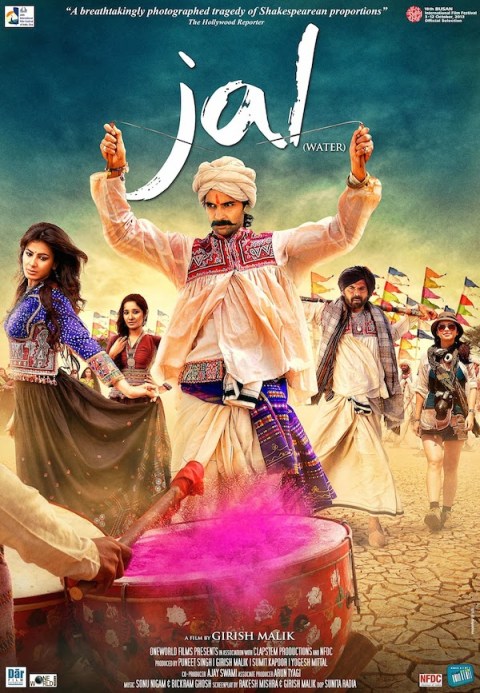
jal-film-poster-fight-club

The trailer for ‘Jal’ came our way recently, and left us somewhat intrigued. Even if the prominent blurb by The Hollywood Reporter — “a breathtakingly photographed tragedy of Shakespearean proportions” — doesn’t catch your attention, the lavish photography will surely charm you. Water has been a contentious resource since ages — prompting anything from friendly neighbourhood quarrels to full-blown riots to inter-governmental conflicts. We hope this premise translates into a good film.

After having travelled the festival circuit last year — it was selected in the New Currents section at Busan International Film Festival 2013 and was screened in the Indian Panorama section at the International Film Festival of India (IFFI) — ‘Jal’ releases on March 21 across India.

Here’s the trailer of the film, followed by the synopsis:

‘Jal’ is a high-octane, action-drama about a young water diviner, Bakka, who is gifted with a special ability to find water in the desert.With the backdrop of water scarcity, the film tells a complex and intriguing story of love, relationships, enmity, deceit and circumstances that bring about the dark side of human character. It is a high-octane, action- drama with a shocking climax. Shot on an epic scale, the film is a visual treat and has managed to capture ‘Rann Of Kutch’ like never before.

Cast and Crew

Produced by ‘One World Films Pvt. Ltd’ and ‘Clapstem Productions’, the film is directed by Girish Malik starring Purab Kohli, Tannishtha Chatterjee, Kirti Kulhari, Saidah Jules, Mukul Dev, Yashpal Sharma, Rahul Singh & Ravi Gosain.

Quite interestingly, the music is by Sonu Nigam and Bickram Ghosh.

For those who wish to learn more, here’s a short interview of Girish Malik in which he speaks about his inspiration for the film, the idea for which had been brewing in his mind for 15 years.

— Posted by @diaporesis

fandry2

1. Because it’s a terrific film.

2. Because it’s a terrific film to debut with. Such an assured debut is rarity.

3. Because it has released with English subtitles all over Maharashtra. And will release outside Maharashtra on 28th February, 2014.

4. Because to quote Mira Nair, if we don’t tell our stories, who will. And to add to that, if we don’t watch our stories, who will.

5. Because only Nagraj Popatrao Manjule could tell this story, not anyone else. Because he has lived it. Much like why nobody thought about setting an entire film inside a tank.

6. Because you probably don’t know what ‘Fandry’ means, even if you are a Marathi manoos. And if not, try asking your Maharashtrian friends. Doubt you will get the answer. We tried it all, saying it from experience. You love your little cocoon.

7. Because current Bollywood has forgotten what “adolescence” means. Same with you.

8. Because you don’t know what your caste is. And it has never mattered in your life.

9. Because every time you saw a pig, you felt it’s ugly and so filthy. Nothing humane there. You don’t need a new feeling.

10. Because it’s that rare film whose 2 scenes made it to our year end list of 16 Most Memorable scenes of the year. Scroll down to read why.

Still looking for another excuse?

We discovered the film at last year’s Mumbai Film Festival. This was our first reaction, or you can call it brief review of the film (was posted here)  :

Fandry – It’s Beasts Of The Maharashtrian Wild. The pains of growing up, of dreaming about the girl from upper caste, trying to get fair skin, and aspiring to own a pair of jeans. About a family of pig catchers who are considered untouchable in the village, and of adolescent days. The harsh reality might seem like poverty porn, but a line from The Great Beauty came to my mind – you can’t talk about poverty, you have to live it. A daring film where the entire film seems to be set-up for the powerful last 20 minutes.

Later on, for our year-end post, Kushan Nandy and Varun Grover wrote about 2 powerful scenes of the film. One has spoiler alert, other you can read.

@kushannandy on Fandry’s climax

[SPOILER ALERT]

Fandry, Nagraj Manjule’s charming story of Jabya, a young boy battling his inner turmoil of being born a Dalit, whose only source of income is rescuing the village from droves of pigs by chasing them out, and only happiness is a teenage infatuation and perhaps a non-existent bird, reaches an inevitable, satirical climax that can truly be described as the successor of the Mahabharata scene from Jaane Bhi Do Yaaro.

Cruelly hilarious and dripping with pathos, the last scene of Fandry is a portrayal of who we truly are. As Jabya is forced to help his aging parents chase the pigs down, the village gathers to celebrate this humiliation, almost like spectators at a T20 match.

At one point, one of the characters uploads Jabya’s plight on his Facebook page. That one moment points out how technology has invaded us and yet human values remain absent.

However, Manjule’s masterstroke is Jabya doing exactly what the viewer had been wanting to do all along. He gathers his frustration and desperation to plant a sounding kick into the belly of the very society that was trying to hold him down. Match over.

Sadly though, Jabya’s non-existent bird somewhere stands for the freedom from society’s humiliation that he shall never ever get.

And this one is SPOILER FREE.

@varungrover on Fandry’s national anthem scene

Only in a state like Maharashtra, where right-wing is so strong that even after the death of their biggest ideologue I don’t feel confident and safe mentioning his name in a post that has no direct criticism of his easily-criticizable styles of functioning, where newspaper offices get ransacked for faintest of hurt sentiments, where people get beaten up for not standing up during the mandatory National Anthem before the film –  a film like ‘Fandry’ is possible. (Just like BR Ambedkar and Vijay Tendulkar couldn’t have been anywhere else.) A state of oppression breeds an inventiveness and ferocity of protest like nothing else.

And in a protest film (though treated like a coming of age for the most part) like ‘Fandry’, comes a scene that makes all the protest scenes in the history of our cinema look tame in comparison. A Dalit family is trying to catch a pig next to a school, the Dalit kid is feeling humiliated ‘cos his friends might be watching the reality of his caste he has so carefully hidden from them, the pig evading them like a pro. After lots of chasing the pig finally seems to be cornered. The family now just has to move closer and catch it and end the misery on both sides of this hunter-hunted divide. The kid seems slightly relieved that the ordeal may be over as they encircle the pig. But, just before they could swoop down, the national anthem starts playing in the school assembly next door. Nobody can move now, except of course the pig. As the Dalit family stands in attention, paying ‘due respects’ to the nation they are equal citizens of, the pig walks away into the free morning.

The whole cinema hall jumped up and applauded the scene wildly. I guess the irreverence, cheekiness, and metaphor it stood for connected with all of us, so used to standing awkwardly before the film, one hand carrying smartphone, another carrying popcorn, thinking ‘Pandit Bhimsen Joshi ji, aalaap mat lo itna lamba. 56 second mein khatam hona chaahiye ideally!

– Click here to watch its trailer and for cast-crew and other details.

Still waiting?

Go, watch it.

– Posted by @NotSoSnob

mastram-poster-moifightclub

This one’s taken some coming (no pun intended). The first look of ‘Mastram’, based on the life of the mythical writer of Hindi erotica from the 90s, surfaced a few weeks before the 15th Mumbai Film Festival (MAMI) last year, where it was an official entry. However, the first trailer has only arrived today.

Those who follow this blog closely will immediately recognise Akhilesh Jaiswal as one of the writers of ‘Gangs as Wasseypur’; while that’s a strong film to have on your resume, it remains to be seen how well he’s managed to adapt this particular story — given how often “bold” themes in our cinema warp into juvenilia —  for the screen. The official Facebook page for ‘Mastram’ has been posting quite of bit of promotional material since the beginning of January: mostly posters that range from cheesy to raunchy.

The trailer itself, which was released earlier today, doesn’t say much about the film, except for putting together a mishmash of various steamy scenes and the angst of a writer. Nonetheless, a friend who watched the film at MAMI last year enjoyed the movie and believes it does well in bringing to light the sheer hypocrisy that oils the wheels of our society.

Here’s the trailer of the film, followed by the synopsis:

Rajaram, a bank clerk in a small town, dreams of traveling to Delhi and becoming a reputed writer. No one takes his aspirations seriously, least of all his uncle, who marries him off to the beautiful Renu. Although a simpleton, Renu wholeheartedly supports her husband’s ambition. Edged on by her encouragement, Rajaram starts stealing writing time from his humdrum work routine, and is eventually forced to leave his job. But being a stay-at-home writer doesn’t go down too well with prying neighbours. Rajaram becomes a butt of all jokes in the neighbourhood.

Turning a deaf ear to the all the snubs, Rajaram starts in earnest to show his work to several publishers. Each time he is rebuked. Finally, Rajaram encounters a fledgling publisher duo – Purohit and his brother-in-law, Bharti. They agree to publish Rajaram’s story about the plight of a small town girl. However, there is one hitch. Rajaram would have to add some necessary sensational elements to his dull tale – some `masala’, as they refer to euphemistically. Rajaram is initially miffed by this writing brief. He is not sure what it means to bring that to his writing – till he meets Chacha, an eccentric, old village Idiot. He introduces Rajaram to the salacious and secret world of soft pornography. It’s on everybody’s mind, but no one will admit it. Chacha does.

Rajaram, scandalized at first, accedes to the “compromise”, and thus starts discovering another facet of literature – erotica. He adopts the colorful pseudonym of `Mastram’ becomes the first author of the first pornographic novel series in Hindi. He churns out colourful stories about sex that his eager readers voraciously devour. Yet, Rajaram’s success still remains elusive to him, as all the glory is due to `Mastram’. Will the “real” Mastram finally be exposed? Will Rajaram’s sudden windfall arouse suspicion in his ever-supportive wife? How will Rajaram face the hypocrisy of a society that secretly enjoys reading porn, but otherwise treats such matters with disdain?

Cast & Crew

Starring Rahul Bagga, Tara Alisha Berry, Akash Dahiya

Produced By Ajay G Rai, Sanjeev Singh Pal
Director : Akhilesh Jaiswal
Casting : Mukesh Chhabra
Costume Designer : Subodh Srivastava
Music : Manan Bharadwaj
Background Music : Saurabh Kalsi
Digital Partner : One Digital Entertainment
Editor : Apurva Motiwale Ashish Mhatre
Production Designer : Dhananjoy Mondal
Director Of Photography : Gavemic Ary
Writer : Akhilesh Jaiswal Gunjan Saxena
Lab : Prime Focus
Co Producer : The Film Label &Ashoke Pandit

– For those who wish to read more, click here and here to read interviews with Akhilesh Jaiswal in which he talks about the real Mastram; the process of researching the film; and then some.

— Posted by @diaporesis

After the success of Pancham Unmixed, the National Award-winning film on RD Burman, filmmaker Brahmanand Siingh is now working on another feature length biopic, this time on legendary ghazal maestro, Jagjit Singh, titled “Kagaz Ki Kashti…”

“Kaghaz Ki Kashti…” is planned to be an evocative account of a down-to-earth small town boy from Rajasthan who became a legend in no time, but not without his share of struggle. In the process, the film will capture that extra something in his music that gave his compositions a certain polish and a soul at the same time which delighted millions of listeners across countries, cultures and age segments.

Through visual and sensory experiences, the film intends to take us on a journey of his choice of poetry — simple but touching world of Urdu lyrics that he chose to sing (sometimes nazms, sometimes ghazals), setting them to soulful tunes and introducing western instrumentation to make them textured, contemporary, and rich. The film will also take us back in time and trace the zigzag marathon run by a man with passion, fire, and soulful melodies within him, which kept him alight all through his luminous career as well as in some difficult personal times, all with a seamless and gripping narrative.

The lyrical film aims to use his music and the poems he chose to tell his own story of love and loss, of tribulations and triumphs. In the process, the film creates a warm portrayal of the man behind the visible, and the artist behind his creations.

Brahmanand’s previous film “Pancham Unmixed” went on to become a big success at film festivals and won two National Awards, among many others, and was a big draw at over 40 International film festivals.

– For all the updates on the film, click here to go to its FB page.

(via press release)

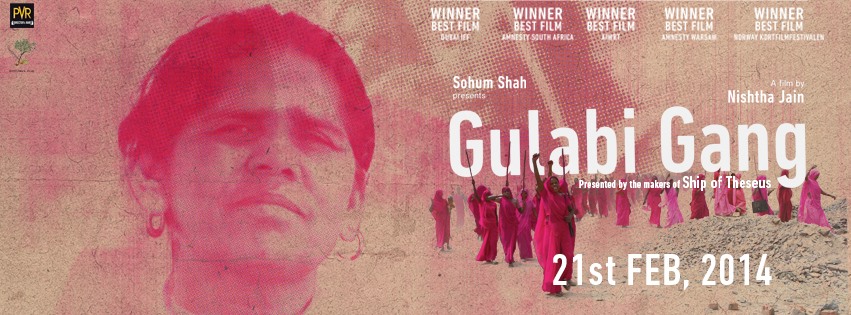
Gulabi Gang

So far we have been hearing about Madhuri Dixit and Juhi Chawala starrer Gulaab Gang directed by Soumik Sen. And now, there’s a twist in the tale. A documentary film titled Gulabi Gang by Nishtha Jain is all set to release before the Bollywood feature. Interestingly, both the films explore the same subject. Our guess is the bollywood film will have much more to it than just the story of Sampat Pal and her Gulabi Gang.

Gulaab Gang is set to release on 7th March, 2014. And PVR Cinemas is releasing the documentary Gulabi Gang on 21st February. Its presented by Sohum Shah, actor-producer of Ship Of Theseus. The film has been doing the festival rounds for quite some time. It also won the Best Director Award in the International Competition section of the recently concluded Mumbai International Film Festival (MIFF) of Shorts, Docus and Animation.

Here’s the trailer of the film –

With the comparisons being made, recently Nishtha clarified few things on her FB post. We are copy-pasting it here –

I’m dismayed and partially amused with a lot of wrong reporting in the print and audio-visual media about my views on the Bollywood film Gulaab Gang, about my own film and it’s theatrical release. I guess I should have expected that nuances will get lost but some of the stuff the media has been putting in my mouth is blatant lies. I just want to clarify that:

1. I have not given the name Gulabi Gang to this group of women. They have been working in Bundelkhand since 2006 under this banner. I’ve only made a documentary about their work. This is not the first or the last film on them. There have been many before and I’m sure there’ll be more. And Budelkhand is not a village it’s a linguistic region of UP and MP.

2. Also I’ve never said that the Bollywood film Gulaab Gang is based on my film. I’ve not seen the film, only their trailer. The makers of Gulaab Gang didn’t need to take permission from me but from the real group called Gulabi Gang for using their name, concept etc.

3. I have never said that mine is the first documentary to be released in India, there have been many before.

4. I have never said my film is entertaining. Yes it is in parts but the words I have been using are engaging, engrossing, disturbing, grey, complex etc. Maybe in common parlance that makes the film entertaining.

5. And this quote which is being curculated bereft of it’s original context “I’m not an ‘activist-filmmaker’. Nor am I ‘woman-filmmaker”. This is what I had said in answer to the question by Dear Cinema:

Dear Cinema: In India, most documentary filmmakers are also activists in their own right. How do you see yourself in that light?

Nishtha Jain: I’m not an ‘activist-filmmaker’. Nor am I ‘woman-filmmaker’. I don’t like all these labels. I’m a filmmaker, a feminist and when the need arises, an activist. My films grow out of my world view and interests.

– To know more about Gulabi Gang, click here.

– To read Nishtha Jain’s interview on the film, click here.

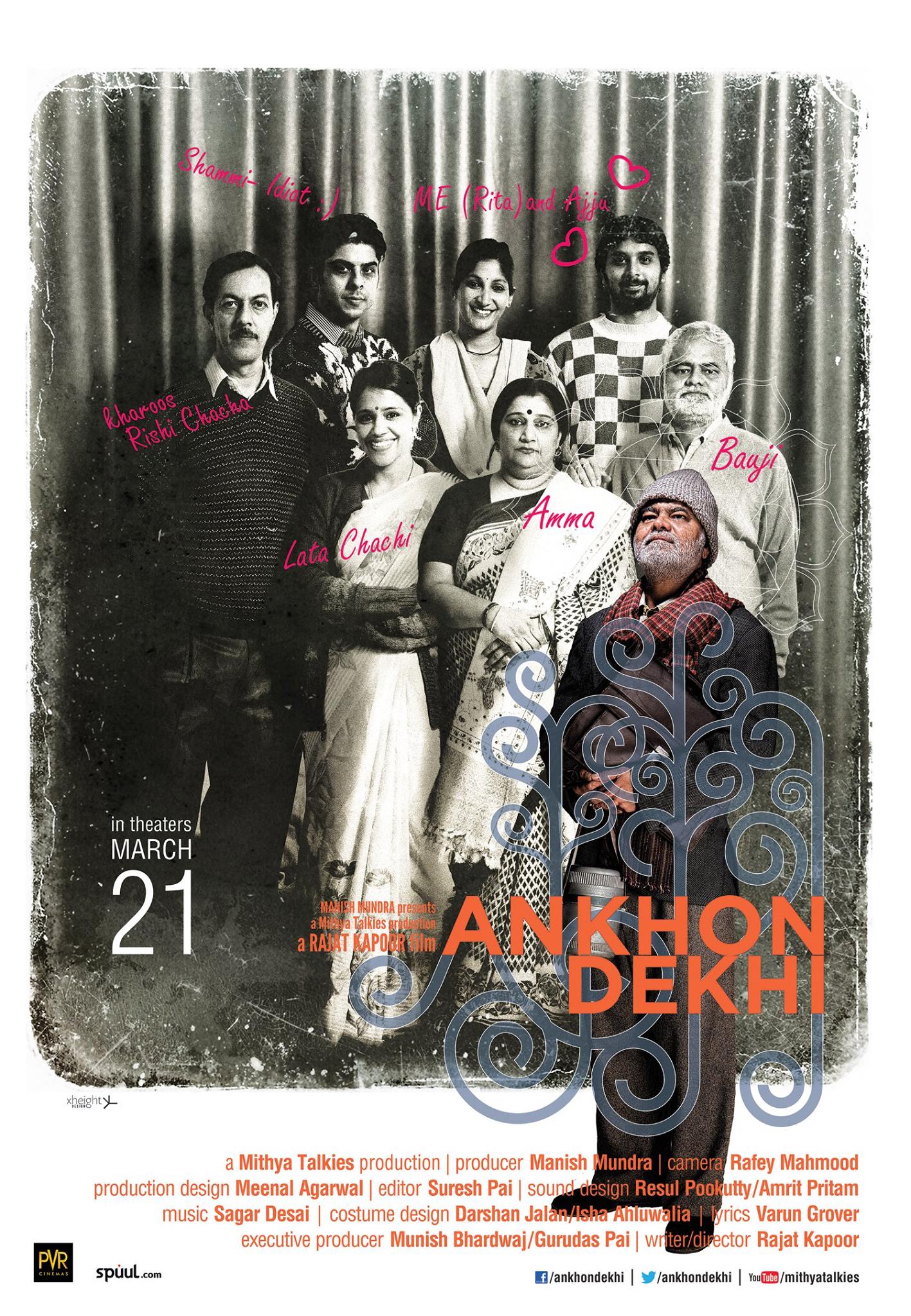
Ankhon Dekhi Poster

We are a bit late on this one, but we still thought we ought to feature it nevertheless. The poster and trailer of Rajat Kapoor’s Ankhon Dekhi arrived online sometime back- and while we are not quite sure how well they sell the film or convey what it’s really about- they give us a feel of the world it’s set in.

Some of us happened to see the film a while back and the reactions were pretty good. It’s an oddball, quirky film that goes through some distinct shifts of tone but always remains interesting and thought provoking. It’s also powered by some good performances from a strong cast led by Sanjay Mishra.

Here’s the trailer of the film, followed by the synopsis:

‘Ankhon Dekhi’ is the story about ‘Bauji’, a 55 year old man, who lives a dreary but eventful life in a joint family, that shares a small house cramped with people and drama. One day Bauji has an epiphany and decides that from that point on he would only believe what he sees with his own eyes, nothing else can be certain. There are a quite a few challenges on his onward journey- but Bauji never loses sight of what is before his eyes.

Produced by Manish Mundra, the film has been written and directed by Rajat Kapoor, who also stars in the film. ‘Aankhon Dekhi’ also features Sanjay Mishra, Seema Pahwa, Taranjeet, Maya Sarao, Namit Das, Brijendra Kala and Manu Rishi Chadha.

Varun Grover, lyricist and our editorial member, has written the songs for the film.

And here we have an interview of Rajat Kapoor where he speaks about Ankhon Dekhi and the challenges of making his brand of cinema.

We have always tried to spread the good word about various crowd-funded projects through our blog. Here’s one more film which looks interesting and you can contribute to its making.

shoot3

Film

Lajwanti (The Honour Keeper) directed by Pushpendra Singh has been selected for the 44th edition of the Berlinale Forum, a section of the Berlin International Film Festival that showcases independent, artistic filmmaking with a disregard for convention. Berlinale Forum will screen twenty-eight world and eight international premieres this year.

Official Synopsis

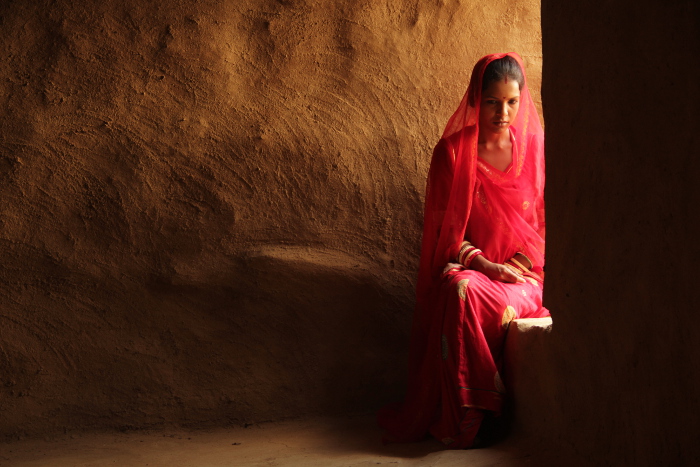
A group of women, in their daily long walk to collect water, recite songs and exchange words that reveal their hidden desires. But, one day, when a crazy dreamer whose only passion is collecting doves crosses their path, one of them, Lajwanti, starts a journey that will take her out of this closed world. She leaves the group when she cannot tolerate their banter and starts walking the long distance alone.

The silence and determination of the man with the doves becomes a curiosity for her and she decides to find more about him. But when the man does not show much interest in her advances, she feels betrayed by her beauty. Her dreams change from being driven by fear to dreams of courage. The veil starts disappearing and a new world opens to her. Will she overcome her dreams driven by fear to keep the honour of that man’s dream rather than that of the society? Will she be able to undo her social conditioning and find her true self?

Trailer

Filmmaker

An alumnus of the Film &Television Institute of India, Pune and Berlin Talent Campus, Pushpendra began his career as an actor playing one of the leads in AmitDutta’s Venice award winning film ‘Aadmi Ki AuratAur Anya Kahaniya’. He then went on to assist AmitDutta on his next feature ‘Nainsukh’ and the latest ‘SattviSair- The seventh walk’. He has also assisted Anup Singh on his award winning feature ‘Qissa- The ghost is a lonely traveler’.  His other credits include acting in the German feature ‘Asta Transfer’ directed by Maximilian Linz which is in its post-production and in the theatre with Barry John on his Honey Trilogy.

Currently he teaches at the Film & Television Institute of India, Pune. Lajwantiis his first feature film as a director.

Why they need the funding

– You can contribute anything between Rs 99 to 50,000. So far the film has managed to collect just 20% of the funding it needs. So do contribute to its making. Lets make it happen.

– Click here to go to its Catapooolt page where you can read more about the film and can make your contribution.