Archive for the ‘Indie’ Category

Mumbai Film Festival – our annual movie ritual is on. And like every year, we are going to cover the festival like nobody else does it. moiFightClub regulars and readers will bring you all the day’s reccos and reviews.

Our Day 1 Wrap is here and Day 2 is here.

anomalisa-620x322

Impressions:
 
Anthem: Since we are watching the new version of National Anthem at least 4 times a day, why not a quick review of that too. Am talking about the 26/11 tribute themed National Anthem with a nearly-manipulative prompt in the beginning voiced by Farhan Akhtar. First of all, that 3-slide prompt has at least 9 spelling errors and one grammatical error. If we care about our martyrs so much, the attention to detail is clearly missing. Secondly, I also feel it’s a disrespect to the anthem if they allow every new cause/TV serial/film/segment of industry to make a version of their own. Why not a simple and straight one that doesn’t take away the attention from the original melody and words.
On the issue of playing it at a film fest, a longer rant some other day. (Probably after 10 years.)
Crowd: In spite of the weekend, the crowds were not much. May be due to more venues spread across the city, and side-bar events like Movie-Mela attracting some people, the usual maara-maari we associate with our film festival is missing. Good progress!

Managed to watch 4 films today, though the third one made me feel the pain.

ANOMALISA by Charlie Kaufman and Duke Johnson

The film whose inclusion alone in the programming made the festival safal for me was watched today. Can’t write anything about it except that Kaufman chacha is GOD. Like there’s observational comedy, this one is an observational tragedy meets existential comedy. Go in blank and come away internal-dancing.

APUR SANSAR by Ray saab

Too insignificant to talk about the film but the restoration work is fabulous. The grain, Subrata Mitra’s oblique frames, Sharmila Tagore’s eyes (aah!), and Soumitra’s shy smile – everything felt like you could stretch your hand and touch it. Pure bliss.

RISK OF ACID RAIN by Behtash Sanaeeha

Very interesting premise and lots of lovely moments and unexpected blasphemies for a film from Iran (hint at homosexuality, women protesting against Hijab, men smoking pot) but self-consciously arty and slow. Had the treatment been snappy or at least non-boiling-potato genre, it’d have been a great film.
LUDO by Q and Nikon
Horror is not my genre at all but had to watch this as was given the job of hosting the post-film Q & A – and this film surprised me. Both the horror and myth angles are very nicely done, and the best part – setting up for the horrors to begin was done in the most provocatively refreshing, damn-the-conventions, Q style. Slightly puzzling that they made it in Bangla as this tale is so universal and required no specific cultural/regional grounding for it to make sense. Though Q promised that they are looking at the possibilities of sequels in Hindi and other languages. Imagine, Q said, “A horror film in Urdu!”

Varun Grover

ANOMALISA by Charlie Kaufman and Duke Johnson
After Kaufman’s searing but over-bearing ‘Synecdoche, New York’ I decided I was done with films about depressed middle-aged white men – the collective weight of movies & novels churned out on the subject could probably sink the Titanic. It was then with a fair amount of skepticism that I ventured into Anomalisa, yet a part of me hoped that Kaufman’s screenplay would spring us a surprise.

I was surprised, but not by the writing. The script plays like a Kaufman greatest hit record, revisiting all his familiar concerns – loneliness, neurosis, the ephemeral nature of real love, the nightmares, the anthropophobia. But what is a revelation is the execution of these ideas in gorgeous stop-motion animation. In a long love making scene, which was the highlight of the film for me – Anomalisa depicts longing, tenderness, awkwardness, passion with a truth that live action films with terrific actors would struggle to emulate. Heck, for a moment it made me forget I was watching animation – any film that can do that is genius.

Without abandoning the melancholia that defines Kaufman’s work, this somehow feels warmer than his earlier work. It’s also a pithier film and rambles far less, though it has enough quirky homages & Easter eggs to send fanboys into a frenzy. An ostensibly simple story with several deeper layers to ruminate on – it’s perhaps the most grown up animation film I’ve ever seen.

A BIGGER SPLASH by Luca Guadagnino

A rock diva and her tightly wound boyfriend are in the midst of a sexy Italian vacation when her manic out-of-control ex turns up with his nymphet daughter and things get complicated. It’s obvious from the very beginning where this one is going, what you want to know is how it’ll get there.

If film festivals are a feast then this is the sort of film you want as your nightcap – beautiful famous people fucking in scenic Italy with lots of rock n roll music. Told with an intoxicating, pulsating energy the film works as a performance piece built around its four leads. While Tilda Swinton is reliably excellent as the rock-star, the real show stealer is Ralph Fiennes playing her ex-lover – a rock n roll producer who is completely obnoxious yet dollops of fun, a real force of nature. This is Fiennes’s best performance in a while & about as far from his somber Shakespearean staple as you can imagine, an Oscar nomination won’t be a surprise.

The lush, sexy drama and the strong performances paper over the essential lightness of the material and the somewhat unconvincing dark turn that the film takes in its latter half. Luca Guadagnino’s ability to sketch out messy relationships with a fevered, kinetic intensity, reminded me of Wong Kar Wai in his pomp.

Caveat- you’ll see more of Lord Voldermort’s phallus than you’ve bargained for.

THE BRAND NEW TESTAMENT  by Jaco Van Dormael

‘What if god exists and he’s actually as asshole?’

What a great premise to make a film on, why didn’t anyone think of it before?! This quirky, clever film re-imagines Christian theology and posits god as a terrible, angry lout who screws with people out of spite. His 10 year old daughter, also the victim of his menace, decides to get even and write her own version of the Testaments and the fun starts.

Throw Raju Hirani and Jean Pierre Jennet into a blender and you’ll get something like this. This hugely entertaining film delivers in equal parts broad comedy, stinging religious satire, whimsical fantasy, profundities about human nature and off-kilter plot twists. TBNT looks like a slick, lavishly produced studio film but has the soul of a blasphemous social agitator.

Constantly inventive, the film is packed with enough pleasurable bright ideas to make you overlook its unevenness and some logical inconsistencies. The loud laughs & whistles were evidence of the fact that this was an outright hit with the audience. The loudest hoots were reserved for when God gets his comeuppance (clearly he’s not as popular as he once was). Someone should immediately reverse engineer this film for Bollywood and give the right wingers even more to be upset about.

Sumit Roy

EVEN RED CAN BE SAD By Amit Dutta

Raamkumar’s words, paintings and childhood routes intermingled on‎ screen to blend into wonderful poetry. The 58 minutes documentary makes you connect to the innermost memories of Raamkumar across rusted houses and beautiful lanes of Shimla.
This sound design and research of Amit Dutta is so top notch that this documentary is a complete surprise at the festival. It is nothing like what you have seen before.

Harsh Desai

FOR THE LOVE OF A MAN  by  Rinku Kalsy

First day at MAMI and who better to make up for the 2 days missed than Thalaiva himself! ‘For the love of a man’, a very engaging and well-crafted documentary that throws an exploratory eye on the worship Rajnikanth evokes in his fans. Broken in five parts, it takes us into the heart of Tamil Nadu and peaks into the lives of Rajni’s fans to try and understand why they do what they do. We all know the stories of the milk bathing of posters, impromptu dances, instant riots and god-like worship but it is another thing altogether to hear the fans speak for themselves. And when I saw their eyes well up with tears enunciating the importance of their icon in their lives, I realised this is something a non-Tamilian like me, could hardly ever fully understand. But I sat there gaping in wonder and amazement at the power of one man. And the power of cinema. Like I said, what a start!

WIND SEED by Babu Eshwar Prasad

Indian films and documentaries is more the mood this time. I chose this because I am interested in knowing what is being made in India these days, the passion projects, not the market-oriented ‘indie’ films. Wind seed meanders its way through its observations on small-town and big-town people through the metaphor of the road and films, self-referencing itself through the other. It explores several ideas at once, of civilisation, of one’s man’s progress and another’s exploitation, of loneliness and cinema and so on. It casts an observation on these, opening up an idea and leaving it at that, and that is a satisfying approach yet the somewhat loose performances and pace gives a sense of, intentionally or unintentionally, a drag. But despite that, for the roads it takes, it’s quite a road movie. (I am also more in the ‘thought behind the film’ mood this time.)

INTERROGATION (Visaranai ) by Vetrimaaran

Raw, hard and loud, ‘Interrogation’ is a straight-from-the-heart film that speaks about how institutional corruption spares none. Based on a real life story, (‘Lock up’), it adds other events of systemic corruption and weaves a heart-rending tale of cold and cutting crime within the system. It operates at extremely high decibels and one only wishes that if only all that passion was channelised into more intensity than drama, more darkness than realism, more implosion than explosion than maybe it would have been a craftier film. Nonetheless, it scores completely in getting its emotional quotient right, stirring up our souls a wee bit more than we’d be comfortable with.

MICROBE AND GASOLINE by Michel Gondry

Despite my vow to stay away from films that shall be easily available ‘elsewhere’, I gave into some Gondry indulgence. And the fourth film of the (hard-working) day did not disappoint one bit. Two boys, both misfits, both from dysfunctional families strike a friendship, a kinship rather, that Gondry weaves into a wonderfully entertaining as well as endearing tale all at once. Their weird escapades, innovative Gondry-style yet as ordinary as their adolescence issues, bloom into a bitter-sweet story told with equal parts head-in-heart and tongue-in-cheek. After the visually stunning yet mildly disappointing ‘Mood Indigo’, Gondry is back, looks like!

Fatema Kagalwala

THE BRAND NEW TESTAMENT  by Jaco Van Dormael

It’s one of those “God a. comes down to Earth or b. Bestows power on some idiot to teach him lessons about humanity” movies, except not really.

In Mr. Nobody director Jaco Van Dormeal’s film, God is an alcoholic, abusive husband and father who mistreats humanity. The film posits that God is the author of all our problems and maladies. When his pre-teen daughter, Ea, finds out about this, she decides to rebel against him and sets out to write the new New Testament.

What follows is a film that straddles between heartwarming, bizarre and whimsical and some times all three at once. A scene transitions from comedy to tragedy quite suddenly but without jarring effect, similar to the comics that France and Belgium put out. Like in Franco-belgian comic books, the people in the story have distinct characteristics, distinct faces that border on the cartoonish. God, for example, has a pudgy nose on a scrunched up miserly face that looks as if it were made for scowling.

Most of the film explores the lives of Ea’s six apostles, all of them starkly different, most of them impeccably beautiful. It’s interesting that while Christ’s apostles were all men, of Ea’s six apostles, two are women, three are men, and one transgender kid.  They all have great fucking stories, each of them could command a sizable short film on their own but, sadly, Catherine Deneuve’s bit is the most bizarre and least impressive (or maybe it struck me so because I’m not French). However, it makes sense if you just assume that her character in the film is the same one she played in Belle De Jour. I think the feminist commentary of the film falls victim to the French peoples’ tendency to patronise feminity to borderline stereotype levels. God’s wife, for example, is portrayed as a mellow, fearful person, perennially befuddled, with eyes threatening to pop out of their sockets when she isn’t knitting.

If not entirely successful, it’s a fun flick, and inventive to boot, with gags such as God creating ordinary (but hellish) annoyances on his computer with absolute glee, and a recurring motif where Ea deduces what song plays in the heart of an individual (they range from “La Mer” by Trenet to Handel). Interspersed throughout out the film are the misadventures of God as he chases down his daughter, each of the segments ending with God getting beat up a lot.
So, yeah, if you’ve ever been fucked by life, this movie is for you.

ANOMALISA  by Charlie Kaufman and Duke Johnson

I’m still thinking about the film and what it had to say. Charlie Kaufman is never subtle. He’s pretty blunt, his writing totally on-point. But his bluntness never feels lazy or pedestrian, because he shrouds it in clever concepts and complications. Anomalisa is no different.

Originally a sound drama, Anomalisa is about a guy who’s fucking bored with people. He’s at that stage where people feel the same. The style of the film takes that and runs with it, placing it in the film quite literally. There’s David Thewlis as Mike Stone, Jennifer Jason Leigh as the eponymous Anomalisa, and Tom Noonan as everyone else. Except for Stone and his lady love, the other characters have the same face and the same voice, kind of like that scene in Kaufman’s first film, Being John Malkovich, where Malkovich enters inside his own head and meets people with the same face.

The film is in stop motion, a beautiful job that doesn’t try to hide the technique or the medium – you see the separations between the two plates (every puppet is made of two face plates, one for the forehead and one for the mouth, each of them replaced multiple times for the animation) that other studios like Laika usually wipe out with CGI.

Some of the expressions they manage to get out of the characters are simply fucking impossible. Some expressions are so subtle they wouldn’t usually work in animation. The film goes to great lengths to humanize these puppets.  We see Stone’s puppet stumble out of the shower, its genitals in full graphic view. Unlike the puppets of Aardman and Laika, Stone has a slight flush of red on his cheeks, adding to the subtle reality of the design. These things would, in an ordinary film, add to the uncanny valley effect, that if an object merely approaches reality, it will be more unnerving than an object that does not lay claim to reality at all. Anomalisa, however, isn’t an ordinary film by any means.

The voice acting is magnificent, with David Thewlis doing his finest work since Mike Leigh’s NAKED, and Tom Noonan, as (literally, in the end credits) “everybody else”, managing to make each character feel like an individual but also, not, as it befits the theme of the film. The film works so well it does because of him, and what he pulls off here is nothing short of genius. The voicework really helps imbibe these obviously unreal puppets with a great amount of humanity.
Another interesting thing that Kaufman does is “break” a stunningly beautiful moment with a comic beat, sometimes bowing down to the basest slapstick, topping the moment with profundity. He finds beauty in the pathetic, in our errors and mistakes, big and small. All of Kaufman’s heroes have been pathetic individuals, and one of the joys of his films has been to see him bore into their souls and dig out the beauty that is inherent in them. This is why his films are so human, because we consider ourselves pathetic and he tells us, through his characters, amplified versions of ourselves, that we are also beautiful. And he does the same with Michael Stone in this film, but then he does something absolutely cruel, tapping into the fleeting pointlessness of happiness.

Anomalisa is a great fucking film. And, like Kaufman’s other work, great fucking therapy.

– @psemophile

Mumbai Film Festival – our annual movie ritual is on. And like every year, we are going to cover the festival like nobody else does it. moiFightClub regulars and readers will bring you all the day’s reccos and reviews.

Our Day 1 Wrap is here.

201511112_5

Impressions:

Things looked way more organised today as no screenings got cancelled and in spite of the weekend, the crowd management was quite smooth. Quick tip for people watching movies at PVR Juhu – head over to Dakshianayan next to ISCKON temple (5-mins walking) for a quick bite or lunch if you are hungry. Very reasonably priced and the best South Indian food on the western line.

Caught three films today too. (While getting nostalgic about the days we would catch 5 films daily. Sher buddha ho gaya ab.)

DHEEPAN by Jacques Audiard

Audiard’s Palm d’Or winner is a continuation of his theme of looking at the French underbelly and the lives of migrant communities there and it’s as brilliant as we have come to expect from him. This time the focus is on Sri Lankan Tamils through the life of a defeated LTTE soldier and it’s easy to understand why it won him the top award at Cannes. The refugee crisis Europe is in the middle of right now finds an intimate reflection in the struggle of Dheepan, played with a breathtaking intensity by ABC, whose own life has many parallels with the fictional story. He moved to France from Sri Lanka 24-years ago, on an illegal passport, escaping from the life of a child-soldier for LTTE. Today he is a known Tamil writer in France but his sincerity in portraying the role probably comes from a line he said while replying to an audience question – “For a refugee, the closure never comes.”

THE IMMORTALS by Shivendra Singh Dungarpur

Shivendra Singh’s documentary feels more like a walk in a brilliantly curated museum of Indian Cinema History, complete with a very romantic audio-guide. It does give us a look at some rare pictures, equipment, stories, and relics from an era that seems to exist in a time thousand years ago, and not just 100. It’s shot like a dream with every frame looking like a master photographer’s creation but the missing names of interviewees, the poetic but rambling narration, and the abrupt narrative stop it from becoming a great film. It’s puzzling that the Director chose this route as he had some great material at hand. But then, every passionate lover has his/her own way of courting the muse. This one happens to be a bit too personal.

THITHI by Ram Reddy

A hundred-year old man (Century Gowda) dies in a village and his family and villagers prepare for the grand feast (Thithi) to celebrate the life of the grand old fucker. Very few Indian films portray village with as much irreverence, quirkiness and in shades of grey (instead of the standard glorification or demonization) as Thithi manages to and that is probably because of Raam Reddy’s writer and Casting Director Eregowda who hails from the same village.

The film is populated with “more than 100” characters, all non-actors casted locally and they bring so much novelty and weight to this occasionally uneven (the last chunk felt like going in too-many-directions) but very ambitious script. A must watch, not just for the humor but also for the philosophical undertones pulled off quite effortlessly.

– Varun Grover

CHAUTHI KOOT by Gurvinder Singh

Gurvinder Singh picks a potent premise – the everyday fears & paranoia of 1980s Punjab & yet delivers a film that feels mostly ineffectual. Singh eschews drama for mood & atmosphere but never quite seems to be in control of his craft enough to deliver the horror that the material intends. What doesn’t help is that the film is full of opaque characters who lack psychological depth – Tommy the dog (who is a crucial part of the narrative) feels like the best realized character. Slow, D.E.L.I.B.E.R.A.T.E.L.Y paced – the kind of film you can snooze through a couple of times without missing much. Underwhelming.

The Sky Trembles and the Earth Is Afraid and the Two Eyes Are Not Brothers by Ben Rivers

Since I’m not into vipasana & don’t plan to do the Iron Man triathlon anytime soon, I compensate by watching the occasional extreme art-house film as a feat of endurance. The reviews for TSTATEIAATTEANB (phew!) promised a tough, challenging watch and that’s exactly what the film delivers.

This visually striking film doesn’t have much of a narrative, instead it plays as a parable on control & the loss of it (or that’s what I think it’s about). It follows a French filmmaker trying to make a film in the majestic yet inhospitable Atlas mountains of Morocco (reminded me of Herzog & Fitzcarraldo) who is kidnapped & subsequently has graphic, painful misfortunes visited upon him. The film’s language is part surreal art project, part improvised documentary and is always destabilizing audience expectations.

Difficult to say that I liked it, though it does have some moments of amazing cinematic power. More appropriate to say that I’m proud I lasted the whole course. Many others in the hall didn’t – haven’t seen these many walk outs during a screening since Love Story 2050.

@Sumit Roy

PLACEBO by Abhay Kumar

Rarely a film hits you so hard, and that too at the right spot. An investigation of lives at the medical school which has one of the toughest admission process, Placebo is a brave, brave documentary film.

The film creates such a stark mood, and at times, it’s so funny and disturbing. The editing must have been crazy as Abhay shot the film over a period of 2 years.  Special mention for the sound design and background score.

Placebo shook me completely. It’s easily one of the best documentaries i have seen coming out of India in the recent times.
There is one more (last) screening on 3rd November at 6.30 pm (PVR ECX Screen 4) Please DO NOT miss it.

Prince Shah

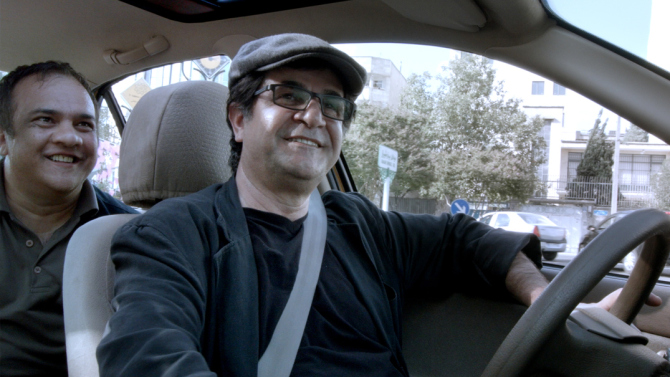
TAXI by Jafar Panahi

Film is Taxi, and its driver and director are the same person – Jafar Panahi.  As he roams around on the streets of Iran pretending to be a taxi driver, people get in/out of his taxi, and the film captures the changing society and it’s morality. Peter Bradshaw aptly described it as Anti-Travis Bickle.

For most part of the film, everything happens inside the taxi. And yet, it’s funny and poignant in equal measure. It’s great fun as passengers of different nature/social status get in and make their point. But it’s sad when you think about the extreme that Panahi has to go to make a film. It’s heartbreaking. Don’t miss the text end plates of the film. This one is a Must Watch.

DHEEPAN by Jacques Audiard

Audiard’s Dheepan reminded me so much of his earlier film, A Prophet. As a ex-LTTE soldier moves to France and tries to start a new life, we realise that it’s never going to be easy for him. Forgetting the turbulent past, making sense of the confusing present, and fear of the unknown future – he and his two unknown companions, who pretend to be his family, battle it everyday.

In the last half hour, the film takes a dramatic turn which is quite different from the tone of rest of the film. But it still remains a powerful film which has empathy for its characters. It completely belongs to his lead actor Antonythasan Jesuthasan who is there in almost every frame, and has a great screen presence.

Jesuthasan was at MAMI to present the film and for the post-screening Q and A. Interestingly, the film mirrors his journey as he was also a member of the LTTE, and later settled in France as a refugee. When i asked him if his life has changed for any better after the film got critical acclaim, bagged the Cannes top award, and he is being invited all over. He said earlier he wouldn’t buy the metro train tickets in France. Now people recognize him and he is forced to buy that 2 Euro train tickets. So that has changed for him – expense of extra 2 euros. And he is still a refugee in France. The difference between life and cinema. Do watch it.

NotSoSnob

As part of our Mumbai Film Festival coverage, we will also be running previews of some of the interesting and lesser known films. This is the first post in the series.

Options_v2-01

‘The Train Leaves At Four’ is a docu-fiction film of about 57 minutes. The film was shot with a family belonging to the ‘Baiga’ tribe, living in remote Madhya Pradesh. The film has been written and directed by Antariksh Jain.

Official Synopsis

As Lamu packs his sack to migrate towards the city to work along with the labour contractor, his aging mother grieves in silence. Even her other two sons are not around to console her.

While the eldest is working on the field, the youngest has set out early this morning towards the government office. He hopes to be employed in the village itself. Those hopes are soon shattered though and he is left overwhelmed. Much of what goes on in the government office – the official paperwork, the government schemes is lost in translation.

By the evening, as Lamu waits for the train to arrive, the contractor’s condescending attitude and stinginess already makes it clear that he has signed up for a disaster, and it is too late for him to go back.

Meanwhile, crestfallen and influenced by his brother, the youngest too confronts his mother and expresses a desire to leave for the city.

MFF Screening

Fri, 30‐Oct – PVR ECX Screen 4 – 11:15 AM
Sun, 01 ‐ Nov Phoenix Screen -3 – 7:15 PM

Trailer

For more info on the film, click here.

CR1oEBvXIAAZJsi

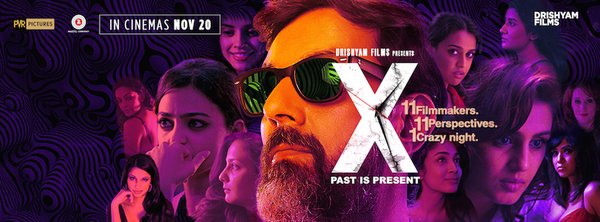
11 Storytellers. 11 Perspectives. One Crazy night!
11 eclectic filmmakers come together to bring you one exciting cinematic vision.

That’s how the makers of “X” have described their film. Interestingly, it’s one-of-its-kind film because eleven Indian filmmakers with disparate styles of filmmaking have come together for this one.

So what is it about? Here’s the official synopsis

A filmmaker with a mid life crisis meets a mysterious young girl who reminds him of his first girlfriend at first, and subsequently, of every woman in his life.

Who is she? Is she real or imaginary? A stalker or a ghost? His past catching up or a character from the script he is writing?

Do check out its new trailer. The film releases on 20th November, 2015.

Cast & Crew

Cast: Aditi Chengappa, Bidita Bag, Gabriella Schmidt, Huma Qureshi, Neha Mahajan, Parno Mitra, Pia Bajpai, Pooja Ruparel, Radhika Apte, Richa Shukla, Rii Sen, Swara Bhaskar, Anshuman Jha and Rajat Kapoor

Directed by: Abhinav Shiv Tiwari, Anu Menon, Hemant Gaba, Nalan Kumarasamy, Pratim D Gupta, Q, Raja Sen, Rajshree Ojha, Sandeep Mohan, Sudhish Kamath and Suparn Verma

Written by: Abhinav Shiv Tiwari, Anu Menon, Hemant Gaba, Pratim D Gupta, Q, Raja Sen, Rajshree Ojha, Sandeep Mohan, Sudhish Kamath, Suparn Verma and Thiagarajan Kumararaja

Directors of Photography: Anuj Dhawan, Aseem Bajaj, Dinesh Krishnan, Gairik Sarkar, Katyayani Mudholkar, Maeve O Connell, Q, Ravi K Chandran, Sandeep Mohan, Siddhartha Nuni, Sidharth Kay and Viraj Sinh Gohil

Edited by: Sreekar Prasad, Vijay Prabakaran, Vijay Venkataramanan, Biplab Goswami, Gairik Sarkar, Dhritiman Das, Shreyas Beltangdy, Ankit Srivastava, Ninaad Khanolkar

Post Production Management & Grading: Siddharth Meer

Sound Mix: Dipankar Jojo Chaki

Lyrics: Pratyush Prakash & Raja Sen

Music: Sudeep Swaroop

Additional Screenplay: Thiagarajan Kumararaja

Executive Producers: Shiladitya Bora & Sudhish Kamath

Produced by: Manish Mundra/Drishyam Films


unnamed

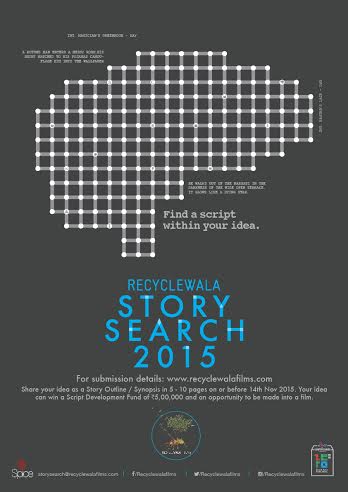
Recyclewala Films have started a new project – Story Search. They are looking for stories that can be developed into film scripts.

– The Script hunt has started from October 14th and will end on November 14th , 2015.

– All they need is a story written out in text format in Hindi or English within 5-10 pages in Arial, 12 point font.

– The selected entries will be announced on 25th November 2015, each of whom will be given a Rs. 5,00,000 script development fund and will get an opportunity to turn their idea into a script, and then a film.

– For more details and submission, click here or here.

Three

 ‘Bring me a dish to satiate my mind and I am happy.’

No, no one great said that, I just made it up coz I wanted to begin with a bang. But that doesn’t mean it is untrue. Kaul, a feature length indie film has had me quite, quite excited since a few days now.

It’s rare a film excites me so much, makes me think so much. So exploring, enquiring, digging, labelling, un-defining…it goes.

Kaulin several cultures, means a call to the divine. It also means higher order or social class. It also means a man of high breed. It also means a purpose or profession. It also means a promise.

How simple is simple?

We live in a world where everything is codified perfectly into two neat brackets, cause and effect, black and white, this or that. Human existence today, is an argument of versus. But simple is a unifying agent, it is a unifying philosophy and has no place for duality. Then?

The task of our times then is to deconstruct. And integrate. To arrive at the core that is simple. Kaul is something like that.

A young man in a small town in Konkan murders a woman and moves to a smaller village. He takes up a job as a teacher, marries and is living a seemingly uneventful life when he undergoes an experience he cannot accept or reject. It is something he cannot define; it is surreal and drives him to the edge of sanity (as defined by common majoritarian understanding). He sets out seeking answers, peeling layers until he arrives at the core.

Mystical? Maybe, but this is not a saintly story of a man’s enlightenment and struggles with it. It is the story of Nietzsche’s ‘Ubermensch’, Camus’ ‘Outsider’, and the 21st century common man experiencing the dark night of his soul fraught with anxiety.

If he kills like Camus’ Stranger and goes off like a being in search of his super-hood, then like our 21st century man he veers towards the confines of psychiatric classifications, depending on the only rules he seems to be made of. ‘Shut me up if I become a threat to the society’, he pleads earnestly, believing himself to have gone bonkers; his classification of insane and normal as binary as the debate between the physical and the metaphysical. In this honesty lies the thread of his search, the honesty that compels him to ensure his road must not end in annihilation of others also leading him to explore the power that lies in that very thought of violence. Is that where ultimate freedom lies?

What if you could just snap your fingers and the world would come to an end?

And what if your redemption lay in it? Through it?

That kind of power is threatening. Life-threatening. Two moves and the torture would end. And it would be a good deed. Or would it be? We are back to polarising.

But it is touch and go, this playing with polarisation, because as is essential, one must quickly leap to integration, from linear to the cyclical, from separation to unification, if one has to arrive at the meaning of existence. In the womb of birth is the seed of death and in the heart of death the first call for creation. Something cannot be destroyed until completely built and cannot be created until it is not completely annihilated. The pendulum has to swing to both extremes to arrive at its true balance. Let me drop the ‘true’ and just say balance. It is simple.

To peel off the layers of our consciousness and definitions of art then, the film throws off layers after layers of myths and faux-labels, crystallising the knowledge, the visual and sound (literally and metaphorically!) in an attempt to integrate sensory experience with emotional resonance in the audience. As the protagonist starts his journey in search of answers we are taken into another world where the physical echoes the metaphysical. The play of day and night, darkness and light, sounds and silences create a universe that is tactile and immersive, daylight exposing the extreme dullness of the regular and darkness the mysteries of the obvious. With this, Kaul gently plays on our senses as it tantalises us to follow the protagonist to find out what is this bat-shit craziness that has descended upon him suddenly.

Two

Do we need the Master?

Needless to say, he finds a guru; the film evoking a Campbell-like mono-myth pattern of a hero’s journey, from afar a simplistic narrative principle, from close quarters simple. As he tries to seek the tutelage of one seemingly mysterious old man another layer of polarity opens up. Along with several other myths the old man also rejects the myth of the ‘guru’, hinting at the infiniteness of the self to find its own way out of this ultra-real world. The role of the seeker as a primary school teacher suddenly gains credence. ‘This whole Guru-Disciple thing is bogus’, roars the old man in defiance, decrying the tradition of looking outward, and by that pushing the protagonist to look within.

He urges him to listen to birds for messages decoding his path.

And what will I find?’ the seeker asks in anticipation.

‘Nothing. You will find nothing. But only after knowing that will you be able to accept it. There is nothing to find.’

A group of philosophers, writers and artists were once asked, ‘Why are we here?’ John Cage famously replied, ‘No why, just here’. Let’s pause here a bit.

Integration is not mathematics, but then maybe it is.

From a distance, there is a danger of viewing and interpreting Kaul as a fable, it is anything but that. Rather it could almost be interpreted as a pataphysical take on the business of spirituality. With a firm belief in the power of self, the film almost cocks-a-snook at the common dialectical understanding of experiential truth and the mysterious secret of man as super-being

Even though interpreting Kaul as a fable would be reductive, there is a certain temptation to do so, given the structure and form it chooses to take. It’s magic realism is Kafkaesque, dark, mysterious and anxious, very anxious. It is mystical and formless, evolving as we go, but it is in enquiry that our existence and the film lies, as embodied by the seeker and that which is being sought. That is the spirit of the film hence its fable-like veneer dismantles before it is fully built as the Kafkaesque intensity deepens, unshackling the viewer from the fluff of fantasy immersing him in the surreality of reality instead. Enquire don’t accept, seek don’t give up, trust your power do not let go of it; some of the ideas the film seems to be urging us to follow with little cushioning.

While merging the hero’s mono-mythical external journey with his internal one, the film adapts and adopts from several theisms and philosophies. Rooted in ancient Hindu philosophy is our mysterious old man, who suggests neti neti is the only path for the insane. In a caustic sweep he derides the modern-day formalist man steeped in illusory materialism and its limited definitions. Neti is a yogic path to enlightenment, propounded in Gnana Yoga and Advaita Vedanta, which emphasises on the rejection of all that is not the Soul and thus coming in touch with it. It is a path of deconstruction, one that nudges the shedding of layers of illusion and belief that we are mere mortals, to reach that germ of immortal within us.

Do what you feel like’ is the only answer the old man has for our angst-ridden protagonist. Hear the calling of honesty. From songs of experience the return to innocence.

It is believed that knowledge or ‘gnana’ was handed down through the alleys of memory, both physical (smriti) and divine (sruti). The Vedas, believed to be central canon of Hindu philosophy, are said to have been written through the assistance of divine memory. The oral tradition of India, (where sagely as well as worldly wisdom was disseminated through stories), and the guru-shishya codification of the same task, then seem to be derivatives of a deeper tradition born of the belief in sruti and smriti.

It is from these traditions that director Aadish Keluskar draws his narrative, borrowing a phrase T S Eliot used to describe the style of metaphysical poets, ‘yoking together’ the content with form in a meta-fictive universe. True to the oral tradition the old man hands down ancient knowledge to the protagonist. Is it from sruti or smriti? The film, like the old man, (its spokesperson almost), gives no ready answers. But there are answers embedded within, for which enquiry is required.

Kaul, bases its world-view, or rather other-world view on prominent philosophies and beliefs, collecting them together to make a base, a context. It then plays within this context of beliefs, pitting one against another to find a middle way. It’s almost like an examination, or experiment rather, of mating the best DNA of Nietzsche’s nihilism, Camus’ absurdism and Hindu spiritualism to free their core and it’s own. What emerges is the distilled idea of the Self. And the absoluteness of its power. From a dot we emerge and into the dot we dissolve, ending where we begin. Again and again, we just need to know it.

The atmosphere of darkness lies like a heavy pall on the film. It is full of bated breaths, the frames holding still in limbo, as anxious and paralysed as its protagonist who doesn’t know where to go from here. Just like neti neti, the structure of the film to arrive at its point is not this, not that. A constant negative reaffirmation. In an admirable example of metafiction, the physical form the film takes is to reflect the essence of its content. In many ways it subverts what we popularly know of the relationship between form and content and how it is practiced. In other ways it is the distilled approach of marrying both, the essence of simple. The old man refuses to provide easy answers to the protagonist pushing him on the path of neti neti and the film does the same to the audience. It is exciting to say the least, to catch clues and link up a path to the centre of the film.

When I reached there, the deepest I could, I found something interesting at the centre of the film. It pretends to be dystopian while it is very utopian and optimistic. Behind the obfuscating mystique, behind the nihilistic violence, behind the weariness of regular life, the film thrusts forth a strong belief in personal power, almost urging us to claim ours. Using violence, it liberates it from the baggage of destruction, leaving only the creative force behind.

one

Perhaps, the richness of the form and content is what I find so exciting in Kaul. The boldness of night photography allowing darkness to rule, the image crystallising as though in response to the call of plot, the soundscape reverberating with enigma, hinting at larger mysteries while guiding through them. It is with a certain intensity that the soundscape plays on the subconscious, informing the world of the film through vibrations, through variations, through space and vacuum, through noise and silence and through the gross and fine. This intensity and vastness of variation melts in with the world of the film, creating a supra-natural, almost physical experience of the protagonist’s journey for the audience.

‘Truth is rarely pure and never simple’ proclaimed Oscar Wilde. Neither is Kaul. It isn’t pure, it isn’t perfect and it isn’t simple. But it wins in nudging us to ask, in our lives and in films, what is simple?

Fatema Kagalwala

(Kaul will be playing at this year’s edition of Mumbai Film Festival and will compete in India Gold section)

It’s one of the most awaited films of the year. And in an interesting promotional strategy, the makers of ‘Titli’ have roped in Anurag Kashyap to introduce the cast and crew of the film. The first video has Kashyap and Dibakar taking about the state of our films, their careers, and producing films. In the second video, Kanu joins them. And then the cast and crew talk about making the film in different videos. Do watch.


NFDC Film Bazaar 2015 has announces the final selected projects for its main segment – the Co-production Market which will be held between 20 – 24 November in Goa.

– This year, 19 projects have been selected to participate in the Market, including one invited project from IFP (Independent  Filmmaker Project).

– The Market has gained added leverage in 2015 with the introduction of Open Pitch where selected filmmakers will be pitching their projects to a curated audience of national and international producers, financiers and sales agents.

The selected projects for 2015 are:

  •  Bombay Rose (Hindi)

Directed by Gitanjali Rao (her short animation film Printed Rainbow won three prizes for the best short film in Cannes Critic’s Week 2006 and was short-listed for the Oscars in 2008) and produced by Clara Mahieu, Les Films D’ici

  • Pirates (Hindi)

Directed by Raj Rishi More (An associate and assistant director on films like  The Lunchbox) Pirates, his first feature, was part of Sundance ScreenWriters’ Lab, India 2015 and produced by Lunchbox director Ritesh Batra’s Poetic License Motion Pictures. It is his maiden production.

  • Newton (Hindi)

Directed by Amit V Masurkar (of Sulemani Keeda fame) and produced by Manish Mundhra, Drishyam Films

  • Manto (Urdu/Hindi)

Directed by Nandita Das and produced by Chhoti Production Company

  • Agra (Hindi)

Directed by Kanu Behl (writer director of Titli)  and produced by UFO Films

  • A Goat’s Life (Malayalam, Hindi, Arabic)

Directed by  Fahad Mustafa (of Katiyabaaz fame) and produced by Globalistan Films

  • Unread Pages (Assamese, English)

Directed and produced by Jahnu Barua, a twelve time National Award winner filmmaker as well as a Padma Bhushan recipient.

  • Aasai Mugam (Tamil)

Direced by Arun Karthick and produced by  Prabhu Ramasamy, Dream Warrior Pictures

  • Bhavarth (Konkani, Portuguese)

Directed by Laxmikant Shetgaonkar and produced by Entertainment network of Goa (ENG)

  • Children of the Sun (Sinhala)

Directed and produced by Prasanna Vithanage, a Sri Lankan filmmaker whose film,Oba Nathuwa Oba Ekka With (You Without You) is the first Sri Lankan film to have commercially released in India.

  • Dhaar (Hindi, English)

Directed and produced by Salil Jason Fernandez

  • Meeting the Sumdees (English, Urdu)

Directed by Michael McNamara and produced by Markham Street Films

  • Memories and My Mother (Bengali)

Directed by Aditya Vikram Sengupta (his debut film Labour of Love premiered at the Venice Film Festival 2014 where it won the FEDEORA award for Best Debut Film) and produced by Vikram Mohinta, Jonaki Bhattacharya – For Films

  • Nigudha Manushyaru (Kannada)

Directed by M S Prakash Babu (His directorial debut, Attihannu mattu Kanaja (Fig Fruit and The Wasps) is co-produced by NFDC) and produced by Bayalu Chitra Productions

  • Sandhya (Marathi, Hindi)

Directed by Mukti Krishnan and produced by 7Seas Films, Ravi Kambhoj

  • The Poacher (Hindi, Bengali, English)

Directed by Suman Ghosh (his first feature film Footsteps won two National Awards)and produced by Colin Burrows, Beautiful Bay Entertainment

  • The Sweet Requeim (Tibetan)

Directed by Ritu Sarin (her debut feature Dreaming Lhasa  premiered at Toronto International Film Festival) and produced by White Crane Films

  • Unromantic Woman (English, Hindi)

Directed by Joan Carr-Wiggin, a former economist who specializes in woman-centric films and produced by David Gordian, Paragraph Pictures Inc.

– A few notable films that were represented at the Co-Production Market over the years are Chaitanya Tamhane’s Court, Anand Gandhi’s Ship of Theseus, Aushim Ahluwalia’s Miss Lovely, Umesh Vinayak Kulkarni’s Deool and Highway and Mostofa Farooki’s Television.

About Film Bazaar

– Film Bazaar in its 9th edition is exclusively created to encourage collaboration between the international and South Asian film fraternities. The market aims at facilitating the sales of world cinema in the region. The 2014 market saw an attendance of 1042 delegates from 38 countries with country delegations from Canada, South Korea and Poland.

– Film Bazaar will be held from 20-24 November 2015 at Goa Marriott Resort in Goa (India).

– FilmBazaar Co-Production Market Team can be reached at – coproduction@filmbazaarindia. com

The much awaited trailer of Kanu Behl’s debut feature ‘Titli’ is finally out. The film has been doing the fest rounds for quite some time, and has been talked about since its Cannes premiere last year. Finally,  it’s all set to release on October 30th, 2015.

Produced by Dibakar Banerjee Productions and Yash Raj Films, Titli features Ranvir Shorey, Amit Sial, Lalit Behl, and newcomers Shashank Arora and Shivani Raghuvanshi in lead roles. And here’s the official synopsis of the film –

In the badlands of Delhi’s dystopic underbelly, Titli, the youngest member of a violent car-jacking brotherhood plots a desperate bid to escape the ‘family’ business.
His struggle to do so is countered at each stage by his indignant brothers, who finally try marrying him off to ‘settle’ him.

Titli, finds an unlikely ally in his new wife, caught though she is in her own web of warped reality and dysfunctional dreams. They form a strange, beneficial partnership, only to confront their inability to escape the bindings of their family roots.  But is escape, the same as freedom?

The makers also released a new poster of the film for its India release.

TITLI

Court

Finally, the Film Federation Of India Jury has made a choice that most people will agree with. The FFI has been getting lot of criticism in the last few years for their weird choices. When it comes to picking films for Oscar, it’s not only about the best film, but also about the right film – one which has made international noise, got some awards, got rave reviews, local subject with global appeal (glo-cal), and little bit of desi exotica that white Academy members can watch and get. And Chaitanya Tamhane’s debut feature Court ticks all the right boxes.

Court premiered at Venice Film Festival where it picked up two important awards, a rare achievement for a desi film/filmmaker. The film went to complete a dream festival run and also picked up the top prize at Mumbai Film Festival.

The film was picked up by 16 member jury of FFI which was headed by Amol Palekar. The other films which were in running included Masaan, PK, Haider, Kaakaa Muttai, Haider.

The kind of spotlight an Oscar win brings, in the last few years, this section has become the toughest one with some of the best films from across the world. 53 films have been officially entered in this year’s foreign-language Oscar race so far. The number is expected to go 80 plus. The first shortlist will be out in January next year.

All the best to Chaitanya Tamhane and his ‘Court’ team!