KAUFMAN - "Or cramming in sex, or car chases, or guns. Or characters learning profound life lessons. Or characters growing or characters changing or characters learning to like each other or characters overcoming obstacles to succeed in the end. Y'know ? Movie shit."
Kaufman is sweating like crazy now. Valerie is quiet for a moment - from "Adaptation".
We are all about CINEMA. That movie shit.
NOTHING is sacred.
NOBODY is spared.
Because we talk about films, dammit.
Not your sex life.
Films, fests, unsung, indies, undiscovered - all that and some fun. If you have dope on anything related to cinema or you would like to share something, do write to us at moifightclub@gmail.com.
The views, opinions, reviews, articles, or positions, expressed by the authors and those providing comments are theirs alone, and do not necessarily reflect the views, opinions, positions or strategies of ANY OF THE EMPLOYERS, FRIENDS, RELATIVES, PR agencies, Production houses, Media group and such third parties associated with the authors. The latter make no representations as to accuracy, completeness, currentness, suitability, or validity of any information on this site and will not be liable for any errors, omissions, or delays in this information or any losses, injuries, or damages arising from its display or use.
In short, if you have an issue with us or any post we've written, write to us at moifightclub@gmail.com
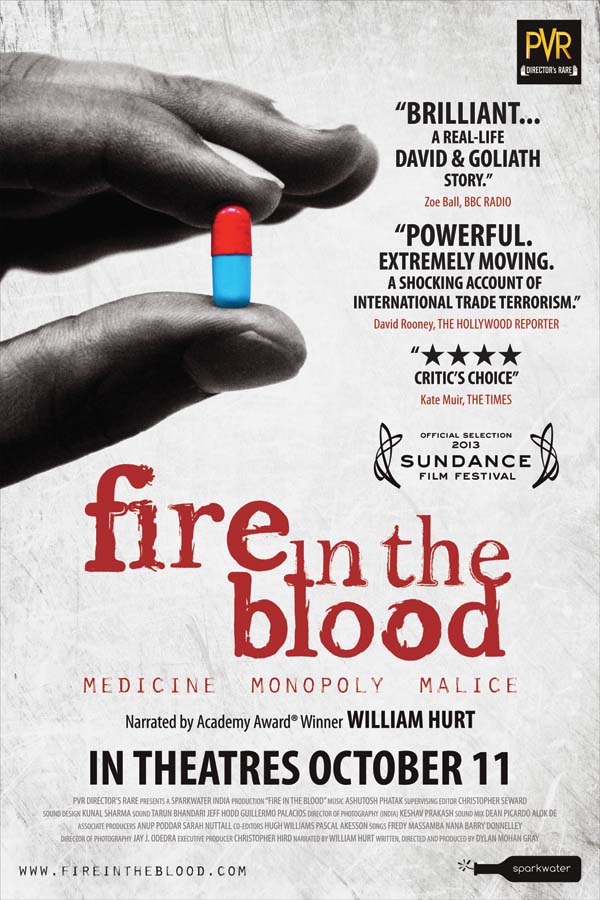
The documentary film, Fire in the Blood, which was selected for the World Cinema Documentary Competition at the Sundance Film Festival, one of the most prestigious and competitive festival for independent films, is releasing today (Oct 11).
Directed by Punjabi-Irish filmmaker Dylan Mohan Gray, the doumentary is an intricate tale of ‘medicine, monopoly and malice’ and tells the story of how Western pharmaceutical companies and governments aggressively blocked access to low-cost AIDS drugs for the countries of Africa and the global south in the years after 1996 – causing ten million or more unnecessary deaths – and the improbable group of people who decided to fight back.
Shot on four continents with contributions from global figures such as Bill Clinton, Desmond Tutu and Joseph Stiglitz, Fire in the Blood ultimately celebrates the remarkable coalition which came together to stop ‘the Crime of the Century’ and save million of lives in the process. The narration is done by Academy Award winner William Hurt.
The film is released by PVR Directors Rare in India.
INFO
To know more about the film, click here to go to its official website.
WHAT : Asia Society India Centre announces the launch of the second edition of New Voices Fellowship for Screenwriters (NVFS) 2013 – 2014, a programme to identify, encourage and support a group of six talented independent screenwriters to develop their feature film scripts with guidance from eminent filmmakers and screenwriters.
FELLOWSHIP
– Through an open application process, 12 writers from across India will be selected from among all the applicants and invited to attend the first workshop to be held in February 2014.
– At the end of the workshop, six of them will be selected to become Fellows of NVFS and enter the eight-month writing programme, in which they will take their stories all the way to a fully-developed script, under the regular and intensive guidance of their mentors.
– A second workshop will be held in May 2014, where writers will receive feedback from other mentors and their peers too. This edition of the Fellowship will conclude in September 2014, and the next edition will commence from 1 October, 2014.
– Each participating Fellow will receive:
A stipend of Rs. 2,00,000.
Regular guidance from the mentors who are eminent screenwriters and writer-directors over the eight-month long programme.
Two five-day-long intensive workshops conducted by Anjum Rajabali, with the active participation of mentors, advisors and other industry professionals.
Recommendations on how to approach production houses and studios, how to pitch, and other professional and legal aspects like contracts, copyright and safeguards.
DATES : Applications will be accepted between 1 October – 15 December, 2013.
ELIGIBILITY : Indian Nationals residing in India, 18 years and above, are eligible to apply.
– There is no application fee. However, an incomplete application form without all the required documents will not be accepted.
– The fellowship is open to all Indian languages. However, all the submissions must be made in English or Hindi.
SCHEDULE
Open for Applications
1 October – 15 December, 2013
Announcement of 12 shortlisted finalists
1 February, 2014
First residential scriptwriting workshop in Khandala, Maharashtra
12 – 16 February, 2014
Interviews of 12 shortlisted finalists
17 February, 2014
Announcement of 6 Fellows
18 February, 2014
Second residential scriptwriting workshop in Khandala, Maharashtra
28 May – 1 June, 2014
Closing Ceremony
15 September, 2014
CONTACT
Asia Society India Centre
2nd Floor, Ramon House
HT Parekh Marg
169, Backbay Reclamation
Churchgate, Mumbai – 400020
Maharashtra
Fahad Mustafa and Deepti Kakkar’s documentary Katiyabaaz (Powerless) was selected for Berlin and Tribeca Film Festival. The film will have its screening at this year’s Mumbai Film Festival. Ahead of the fest, it has got a new trailer. Have a look.
The song in the trailer is sung by Indian Ocean and is written by Varun Grover who is also a regular contributor to this blog.
About the film :
In Kanpur, India, Loha Singh is the local robin-hood, stealing electricity so that homes and businesses could function normally in the face of day-long power-cuts. Meanwhile, the first female chief of the electricity supply company has vowed to rid the town of illegal connections and increase supply. In a summer of crisis, sparks will fly.
Description :
Powerless is a documentary film about the electrical supply shortage in an industrial suburb of Kanpur, India. The story unfurls along miles of tangled copper wires which mirror the diabolical complexity which unfolds in several towns and cities across the country. A picture emerges of a modern dystopia encompassing urban decay and desperation due to the lack of electricity. Underlying the localized crisis in Kanpur is the glaring energy poverty in India, where a third of the population is often without power and the rest grapple with frequent power-cuts that dictate their own terms. Powerless points to the universal need for dependable electrical power while exploring this theme in one of the world’s most ascendant economies.
– To know more about the film, click here to go to its official website.
– To read the Hollywood Reporter’s review of the film from Berlin fest, click here.
Was I worried?” Cuarón says. “Yeah!” He and Lubezki would watch their footage, “and depending on the day, you’re just in a room laughing, like, What the heck are we doing? Chivo’s (Lubezki) favorite phrase was, ‘This is a disaster.’ Some days you’d just have bits and pieces of Sandra Bullock in a box, floating around, surrounded by robots with cameras and lights on them, and you’d think, This is going to be a disaster.
James Cameron said he was stunned, absolutely floored. He called it the best space photography ever done, best space film ever done, and it’s the movie he has been hungry to see for an awful long time.
Well, watch it. To see, feel, float, and experience.
And it’s entirely possible that even after watching the film you might not get its brilliance – why and how. Twitter has made me realise that. And i am not going to try – argue and make you understand. There are many things that many pea-sized brains might not grasp and understand, and i have made peace with it. This post is for those who were blown by it. If you watch movies like i do, can bet that you will come back home and start googling about it. So i am going to make your life easy and putting all the best articles/features/videos on Cuaron and Gravity here. The links are divided into two parts – filmmaking and sci-fi.
FILMMAKING – How and Why
I have to say that I was a bit naïve; I thought making the film would be a lot simpler…
– Digital Trends has got an interesting feature titled “Before Alfonso Cuarón could make ‘Gravity,’ he had to overcome it”. It tells you all about the problems they faced and what they did to find new technology. Click here to read.
– Cuaron is known for his magical long uncut takes. And as we all know Gravity has some 17-minute long jaw-dropping opening sequence. Here’s a video essay on his “Cinematic Canvas”.
Has voice-over by Cuaron.
I’m going to tell you something, the reality is that the movie was so new that when we finished a shot we would get so excited people would scream on set—probably me before anybody else. There were moments when we were shooting and Alfonso said ‘cut’ we would all just jump and scream out of happiness because we’d achieved something that we knew was very special.
– The Credits have done a feature titled “One of the Greatest Cinematographers Ever: Gravity‘s Emmanuel Lubezki”. This one is an interview with Lubezki. Click here to read.
Both of them—along with a number of other Mexicans who would go on to achieve success in Hollywood—were expelled before graduation. “In Mexico, there are a lot of conspiracy theories” about why, Cuarón told me, “and I’m sure that a lot of them are true. The truth of the matter is that I think we were pains in the asses. We disagreed with the ways of the school.” He laughed. “Even if they had their reasons, we were right.
– Vulture has posted a great piece on Cuaron’s career and filmography. It’s titled “The Camera’s Cusp: Alfonso Cuarón Takes Filmmaking to a New Extreme With Gravity”, and this one is a must read. The story of “a Mexican auteur who’d just made a tiny foreign erotic comedy-drama being handed the biggest, most fantastical franchise in movie history.” Click here.
– Cuarón sat down with George Stroumboulopoulos to talk directing, George Clooney and Sandra Bullock, and new voices in world cinema. This one is a funny interview.
Experiencing this film in 2-D is only getting about 20 percent of the experience of Gravity,” says Cuarón.
– The Daily Beast has also done a feature on Cuaron and his film. It took four and a half years to bring the magnificent 3-D film to the screen. The director retraces the journey for Marlow Stern, from Robert Downey Jr. and Angelina Jolie’s departures to creating the most groundbreaking cinematic voyage ever put to film. Click here to read it.
Still, it was a massive culture shock. “I had more toys to play with, but the crew was three times bigger than my Mexican film, with producers giving me notes, which I never had before.
– DGA has also covered Cuaron’s entire career – from Mexico to big Hollywood studios. Click here to read.
Did even this historically auteur-friendly studio (Kubrick, Eastwood, Nolan, et al.) wonder if they’d just gambled away $100 million on the most expensive avant-garde art movie ever made?
– Variety has done an interesting piece saying Gravity’ could be the world’s biggest avant-garde movie and drawn comparisons with Michael Snow’s films. Click here to read.
– And to know how the sound masters of ‘Gravity’ broke the rules to make noise in a vacuum, click here. Another must read.
SCI-FI – Science or Fiction
From my perspective, this movie couldn’t have come at a better time to really stimulate the public. I was very, very impressed with it.
– The Hollywood Reporter has got Astronaut Buzz Aldrin, the second man on the moon, to review the film. Click here to read.
George Clooney’s character, in a rare and fleeting quiet moment says to Sandra’s character, “Beautiful, don’t you think?” And the scene is the sunrise in space. Hold on to that.
– The Time got another astronaut, Marsha Ivins, a veteran of five shuttle flights, with a total of 1,318 hours—or 55 days—in space, to review the film. Click here to read what she thought – how much is real and what all looked fake.
– And there are some rants too. If they can float, can’t they rant? Vanity Fair has put it all together. Click here.
– So how Realistic is the movie? The Atlantic has interviewed the film’s science advisor. Click here to read.
In India, the film has currently released only on IMAX 3D screens. It should be out in normal 3D screens from this friday. And do remember what Mister Moore said.
If you are in Mumbai, i would suggest you watch it at PVR IMAX screen in Lower Parel. No, they haven’t paid me. This is from my experience across various 3D screens in the city. The glasses at PVR, Lower Parel don’t make the screen dark. Also, they are bigger, better and light in weight. So if you already wear one set of glass, this is the best possible option. Rest, as they say, haath kangan and all that jazz.
If you have read or seen any interesting feature, interview, or video related to Gravity or Cuaron’s film, do post in the comments section.
Adoor Gopalakrishnan is considered to be one of the greatest filmmakers of India. In a career comprising four decades, the Padma Vibhushan (the second highest civilian honour) awardee has scripted and directed eleven feature films and several shots and documentaries. Considered the pioneer of the New Cinema movement in Kerala, Gopalakrishnan’s films have fetched him over eighteen National Awards. In 2004, he was awarded the title, ‘Commander of the Order of Arts & Letters’ – the top French honor for culture. Winner of the highest honour of the nation, the Dada Phalke Award, the septuagenarian spoke to National Award winning editor, Apurva Asrani, about his films, his views on popular cinema, and his vision for an intelligent, and committed distribution system.
1. Why are your films not widely available in India?
Firstly, there is the hurdle of language. I make films in Malayalam and this limits the audience for my films to Kerala. I am aware that there exists a niche audience outside my state but there has been little effort to take these films accessible to the audiences outside the state. My films can very well be exhibited with sub-titles in English. We have so many big cities in India and they can substantially support a movement for meaningful cinema in this country. The Governmental agencies like NFDC have done precious little to explore these possibilities.
Strangely even private initiatives are wanting. We lack an intelligent and enlightened distribution system that does not hesitate to explore new avenues for a different kind of cinema.
2. Do you think there is an audience for world cinema in India?
There certainly is. You can gauge the interestfrom the success of the several film festivals spread all over India now. Especially with the advent of the multiplex, it is possible to programme decent films and generate reasonable revenue. But distributors should have faith in these films and be ready to venture into unexplored areas.
3. How true are you to your script? Is there room for improvisation during the shoot?
I always work with a detailed script. And then I prepare a shooting script before I go for a shoot. All the same, no script is sacrosanct when you actually film on locale.
Scripting is perhaps the most important stage in filmmaking. But it should not be treated as final and inviolable. A script is written inside a room, but on location where you have nature and real people interacting, there is every chance for change. Even the position of the sun in the day becomes a very critical factor.
4. What is editing according to you? Do your films evolve in the editing room?
Editing starts even as you are writing your script. It accords the film its rhythm and flow. It is again not necessary that editing follows the script strictly. In fact I do not refer to the script while editing. Though a lot of thought and planning may have gone into scripting, the editor/director should not hesitate to improve upon the material that is available to him. There are many instances of my having altered even the sequence of scenes. The impact is what maters.
5. If we talk of Indian cinemagone global, only two prolific names come to mind immediately; Satyajit Ray and your self. Why is it so?
It may be because we have not compromised with market pressures. These films deal with real people, their problems and their aspirations. Nothing is faked for dramatic or spectacular effect. As these films portray life lived in our land they become authentic documents of Indian life.
6. Would you make a film in Hindi like Ray did?
(Laughs) I don’t see the need. Also, my understanding of the Hindi language is very rudimentary. And don’t forget, language is the flower of a culture. It is not just a mere vehicle to transact ideas. It should not be forgotten that Ray made only one attempt at making a film in Hindi (Shatranj ke Khiladi -1977).
7. InNizhalkkuthu (2002) you have followed a rhythm different from your other films. It is fast paced, stylistically shot and features a mainstream music composer(Ilayaraja). Was that a successful experiment?
Each time I make a film, my attempt is to try things I have not done before. So, every time I pose before myself a new challenge and then try to meet it. The process is very exciting. Some films are slow while others are faster.The pace of a film is invariably dependent on its theme and treatment.
As for the score, I wanted to use folk music as a lait motif. Ilayaraja happens to be a master at that and it worked very well. I was very happy with the result.
8. In Kodiyettam (1977), the lead character, Shankaran kutty slowly sheds his childlike conduct after his marriage. In Swayamvaram (1972) marriage is seen as a rude wake up call from a love story. Do you see marriage as a failed institution?
No. In fact, I see it the other way. Marriage is the meeting of two minds. Sankarankutty who is not prepared for a married life and the responsibilities that come with it, slowly grows into it. His real marriage takes place at the very end when he buys clothes and presents it to his wife. Man presenting clothes to the woman is the core ritual of a Hindu marriage in Kerala. Swayaramvaram is the story of a young man and a woman choosing to live together without the formal bonding of a marriage. It is devoid of the supportive network of their parents. It is the society that they come into that proves to be unwilling to accommodate them.
9. Your stand against popular cinema. What factors you think would allow parallel cinema to survive in India?
I am not against cinema becoming popular. We all want our films to be popular. In their effort to make their films acceptable to the masses, people make all kinds of compromises and the end product turns out to be simply run of the mill. Let me also hasten to add that I do not make parallel cinema. Parallel cinema is a misnomer. I simply make films. It is others who call them by convenient names and I think it is unfair to do so. My films are processed in the same laboratories as the commercial ones and often I use commercially successful stars in them. And I exhibit them in the same cinemas as the others. There is nothing in the making, promotion or exhibition of these films which qualifies them to be termed parallel.
10. How would you compare our approach to film distribution vis-a-vis the west?
Quality films deserve to be treated differently. We can borrow examples from the West. Both in Europe and the US, if a film wins a good prize in an International festival, it becomes the selling point. Our own experience is just the opposite. A film winning a national award is looked down up on with suspicion. Our distributors discreetly avoid it because they presume that popularity or commercial success is inversely proportional to the quality of a film.
And here’s the latest one, and hopefully, the closing chapter in the ongoing Oscar controversy. Ritesh Batra, director of The Lunchbox, has replied to the FFI letter.
Dear Sir,
I just received your letter. Many industry stalwarts have made comments similar to mine but you sent the letter to me, a debutant filmmaker, but I am honoured and proud to speak for my film and team. If an apology is what you demand, you have it. Both you and the jury have my wholehearted apology.
There was no intent to hurt anyone, but rather to participate in the vigorous debate that this decision ignited in the public domain.
I sincerely hope that the annual reactions to our Academy selections from the national press, and this year from even the international press, prompt a new policy for the selection. Sir, please use your good offices to give us a transparent, objective process with a public and not a secret jury. It is a direct and humble request, not a criticism.
I have moved on from this debate to focus on more productive pursuits and I would encourage everyone to do the same. With much respect for your tough job.


 The documentary film, Fire in the Blood, which was selected for the World Cinema Documentary Competition at the Sundance Film Festival, one of the most prestigious and competitive festival for independent films, is releasing today (Oct 11).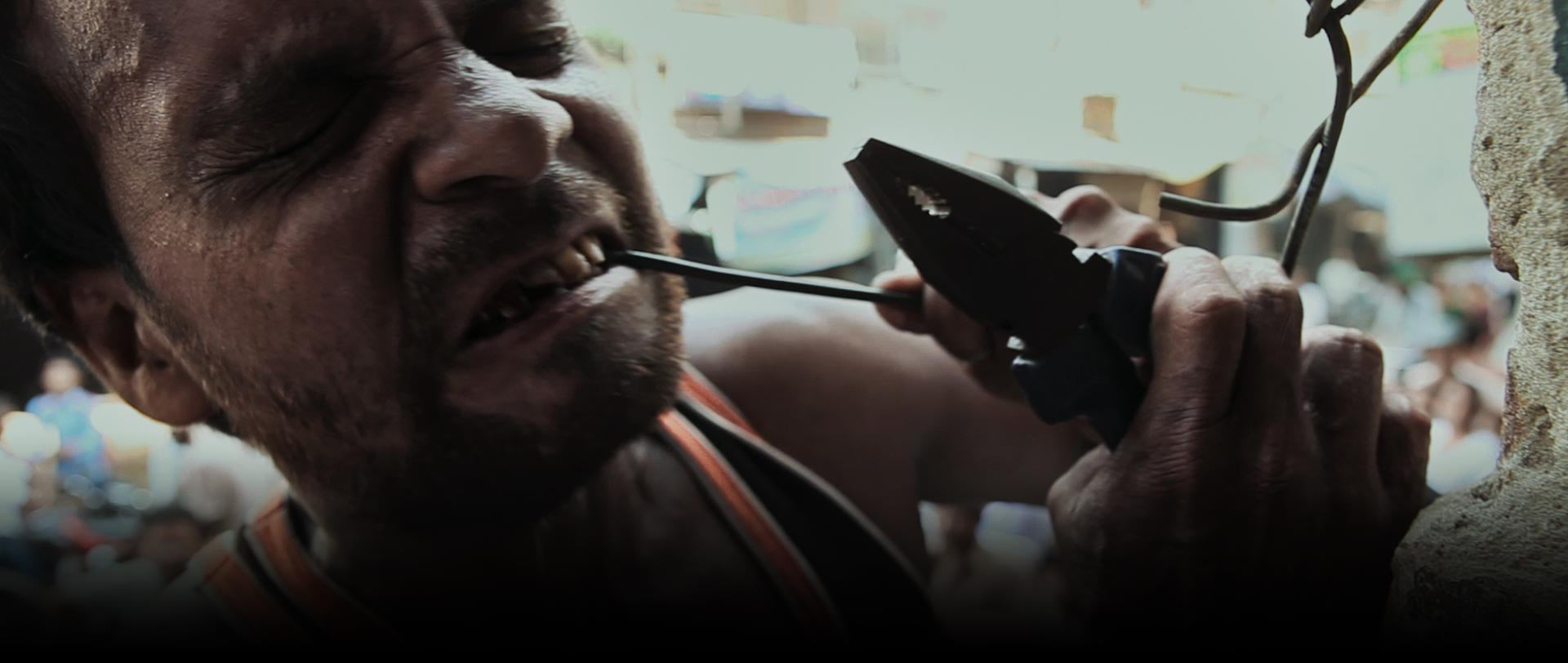



 F.i.g.h.t C.l.u.b