Author Archive

“Injustice anywhere is a threat to justice everywhere.” — Martin Luther King

Dear Board members at MAMI,

My name is Shazia Iqbal. I am the writer-director of a short film titled ‘Bebaak’. Our film was supposed to have its world premiere at the Mumbai Film Festival, this year. It is not going to anymore. The leadership at MAMI decided to drop the film.

Why? That is the answer you owe my team and me.

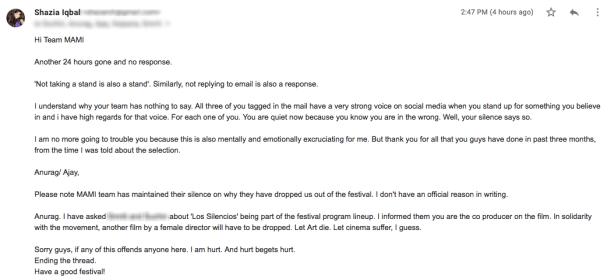
I was not given an official written statement from the board/committee members as to why my film was dropped. This, inspite of me repeatedly asking for the same:

A few more attempts on Whatsapp went unanswered. But this is what I did get:

I was then told by a member that this decision wasn’t fair to me but it was the final decision of the board. And that it was not meant to be a punishment or judgement.

I appreciate the empathy from Team MAMI but it changes nothing.

These are the questions I want to ask:

Then why was the film dropped? If it doesn’t serve as punishment or judgement?

Did you know the content of the film before dropping it? Or were we part of a surface clean-up?

I understand there are ‘collateral damages’ in a battle but my film is as feminist as this battle we are fighting; and if you’re shutting down a film that starts a conversation against misogyny and patriarchy, then what side of the battle are you on?

What side of the movement do you all belong to?

In any fight, you have to keep in mind the words ‘Justice’ and ‘Punishment’.

Justice: being fair and reasonable, treating people equally.

Punishment: the infliction or imposition of a penalty as retribution for an offence.

I was told over a phone call that my film ‘Bebaak’ will be dropped from the festival program because one of the producers is Anurag Kashyap.

I was not told, but was supposed to understand, that since he is accused of “being complicit” in a sexual harassment case (one of the partners at Phantom, Vikas Bahl is accused of sexually assaulting a woman), our film has been disqualified.

Let me clarify that Anurag is one of my two producers. The other is Ajay Rai of Jar Pictures. And the film is independently produced by both.

Phantom Films (of which the directly accused, Vikas Bahl was part of) has nothing to do with us. There was no monetary or production involvement with the accused in any capacity.

This is an open legal case and I will say as much there already is in public domain (and also include some of my personal knowledge) that Anurag did all that he could at the time and unfortunately, yet it wasn’t enough to get the woman complete justice because she did not want to make a formal complaint. (Sorry, I don’t use the politically correct but demoralizing word ‘victim’.)

Anurag was a Board Member of your Academy.

He voluntarily stepped down from the Board to keep your reputation ‘clean’. Here is his tweet (where he also denies being complicit):
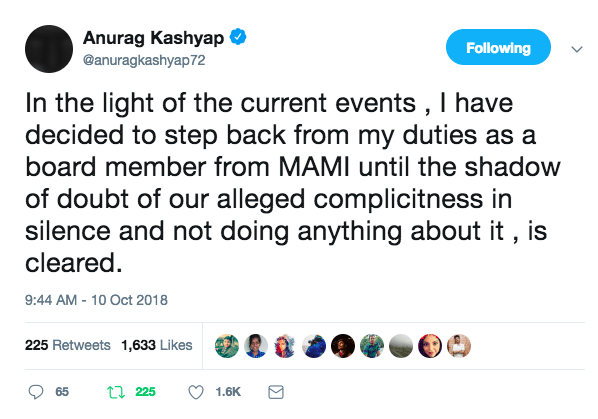
Here is another tweet where he denies being silent:
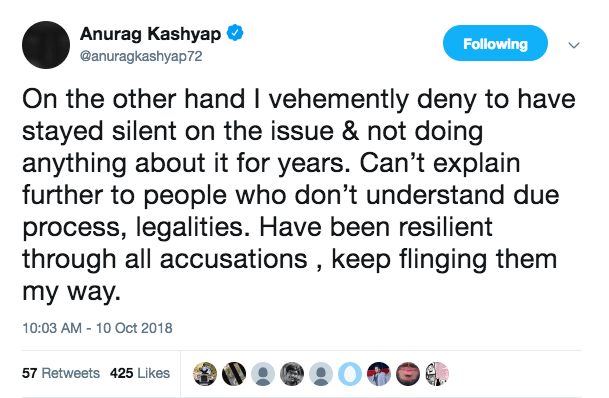
Here he mentions his responsibility to the women with whom he works with (I am one of them) and mentions that we have questioned them regarding the case (him and Vikram):
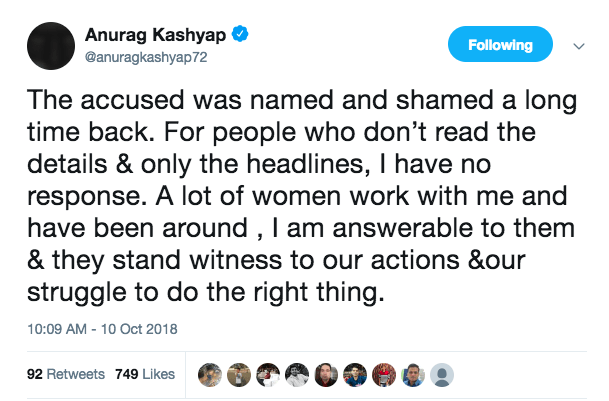
Anurag and Vikram clarified their side of the story, shared their dilemma and apologised.

But apparently none of this mattered.

You chose to believe a one-sided, article written by a so called ‘investigative journalist’ — Ankur Pathak — who kept many details out of the article because it did not suit the narrative of a story he wanted to tell; painting Anurag and Vikram as the wrongdoers, way more than the accused, Vikas Bahl himself!

And instead of standing up for the truth or even looking for it, you would rather go with the lynch mob mentality and a knee jerk reaction than look for a more nuanced solution to the situation.

I am the writer-director of the film. I have a female lead, and more than fifty percent of my main cast and crew are women. We have all become the “collateral damage” of a movement that is meant to empower women. I don’t fully understand law but I understand enough about equality and just treatment. You’re questioning the integrity of two men who are currently defending a woman in court/fighting an accused sexual predator and you’re taking action against them (and my team) based on an article.

Ankur Pathak is NOT the court of law. Isn’t this also a form of harassment?

Anurag and Vikram have apologized for not taking a harder stand, but at no point did they accept being complicit. I have been working with Phantom Films as a Production Designer (since early 2017), and I have never once seen Vikas Bahl, the accused in the company premises or on shoots.

In some personal conversations, Anurag spoke about Vikas and expressed his disgust with the man, said he wanted to take action against the man. I know of Shubhra (his girlfriend) being adamant about the same. He didn’t want his name on Mukkabaaz and later in other films but was bound by the contract. I am a witness to Anurag’s struggle, but since I am an ally, my testimony here doesn’t matter.

After the shoddy Huffpost article was published, Vikram stood amongst all the employees at Phantom Films and asked us to raise any doubts we had about the case. Without any hesitation, I and other women (and men) threw several questions at him regarding the case and each of those questions were answered. Convincingly.

Today he too stands punished. A film produced by him, directed by Atul Mongia has also been removed from your anthology slate. So now any film can be rejected or dropped on the basis of past association, whether the accused is involved or not?

Today Anurag and Vikram are being punished. As is everyone associated with them. Including their films; our films. Meanwhile, Vikas Bahl has slapped a defamation case against them.

Please don’t misconstrue this as personal agenda in support of friends/employers. I am merely stating the facts.

In the meantime, the rest of us have to suffer the wrath against one man. This is where I’m lost. Let’s look at this more objectively.

MAMI is a prestigious film festival. It is run and backed by some of the most powerful people in the industry. My film ‘Bebaak’ is just another short film. What we share in common is that we were both backed by Anurag Kashyap.

You asked me to drop Anurag’s name (because he insisted that ‘Films are bigger than individuals), I agreed. A feminist film getting a platform in the midst of the country’s biggest Me Too wave is a great deal; I revised my DCP, Trailer and Poster and had his name removed. (Poster attached)

Similarly, MAMI was also supported by Anurag as a Board member. He voluntarily stepped down. So now the short film is sans Anurag’s name and MAMI, the big film festival, doesn’t carry his name either. To apply your very fair analogy, if you still decided to drop my short film for my association with Anurag… shouldn’t you also dissolve the board itself for your association with Anurag?

Why don’t YOU take that moral responsibility and shut yourself down for previously being associated with those who YOU believe have been complicit?

Have you also done a check on your other Board members? Made sure they are not in association with any accused? Or not complicit?

Because as I see, there are at least two MAMI Board members who were in the know-how of an actress being harassed during audition by a director (already accused publicly). I was personally told by this actress that your Board members did nothing despite being from a big film family. (You can keep an independent inquiry panel and I will testify and name the board members. I assure you I would not have galls to say this if it wasn’t the truth.)

So does MAMI agree to dissolve its board to stand in solidarity with the movement since their own board members are complicit? Or is this only applicable to filmmakers?

Now let me explain the hypocrisy. These are the films MAMI has dropped:

  1. Satyanshu and Devanshu Singh’s Chintu ka Birthday.

    Producer: AIB (Tanmay Bhat accused of not taking action against accused Utsav Chakravorty, Gursimran Khamba accused by an ex-girlfriend of harassment.)

  2. Rajat Kapoor’s Kadakh. Director himself accused of assaulting a couple of women.
  3. Kanu Behl’s Binnu ka Sapna. Producer: Chintan Ruparel (of Terribly Tiny Tales, accused of harassing multiple women.)
  4. Atul Mongia’s Awake. Producer: Vikramaditya Motwane (partner at Phantom, accused of not taking any action against accused Vikas Bahl).
  5. My film Bebaak. Producer: Anurag Kashyap (partner at Phantom, accused of not taking any action against accused Vikas Bahl).

Each of these films has a different issue, yet every single cast and crew member of the above mentioned films have received the same verdict. Everyone’s film stands cancelled today.

When Hollywood started the Me Too movement and Kevin Spacey was found guilty of assaulting Anthony Rapp, years ago, Netflix replaced him in House of Cards. Only him. Spacey was also replaced in Ridley Scott’s All the money in the world. But the show/film wasn’t cancelled.

Please tell me which Filmmaker/Actor in Hollywood or any other film industry has been punished because they are guilty by association.

But I guess at MAMI, you want to take a very hard stand on this and punish everyone who is in a 100km radius of any accused. This must have required a very strong vetting process, I hoped. But that is not the case.

I am also guessing that the MAMI team aren’t fully aware of these films/incidents mentioned below: (though they are all the over internet and really hard to miss).

  1. Lars Von Trier’s The House That Jack Built. He is directly accused, not a complicit; one of the most powerful filmmakers to be outed during the Me Too movement last year. Singer-Actor Bjork accused him of sexual assault during filming of ‘Dancer in The Dark’.His partner — Peter Aalbæk Jensen — at his company, Zentropa (producers of The house that Jack built) is also accused of sexual misconduct.How does Lars’ film qualify to play?
  2. Beatriz Seigner’s Los Silencios. Anurag is credited as one of the producers on the film. Did you guys know? (Well… I did inform your team.)
    How is one of Anurag’s films still playing at the festival?
  3. Paul Schrader’s First Reform. Harvey Weinstein, a predator of the worst kind has been assaulting women for decades. In response, this is what Paul Schrader had to say in a Facebook post:Is MAMI comfortable playing a film by a maker who is more offended by the recutting of films, than sexual assault on women?Please remind me if any of my producers made such insensitive, vile statements about treating women as secondary to making films.

    Paul Schrader criticised for tone-deaf response to Weinstein allegations

    Hollywood writer-director Paul Schrader has been criticised for claiming he is more offended by film producer Harvey…
    http://www.independent.co.uk

    Also this:

    Paul Schrader’s Rape Comments Aren’t Helping Anyone

    Obviously there have been a lot of horrible takes on the subjects of consent and sexual assault due to the accusations…
    http://www.pajiba.com

  4. Nagraj Manjule’s An Essay of The Rain: The news came last year that Nagraj Manjule, the director of powerful films like Fandry and Sairat was accused by his wife of assaulting her physically, emotionally, verbally and she also gave details of how he kept her locked in the house while the family went to collect National Award for Manjule.But this qualifies at the festival?

    Exclusive: ‘Sairat’ Director’s Ex-Wife Tells Her Story of Abuse

    Nagraj Manjule’s Sairat not only gifted its director glowing reviews, but also crowned him as the maker of Marathi…
    http://www.thequint.com

  5. OXFAM.There is a GENDER EQUALITY award by Oxfam at MAMI.Is this the same Oxfam that was embroiled in major sexual misconduct since 2010? This is a huge one to skip.
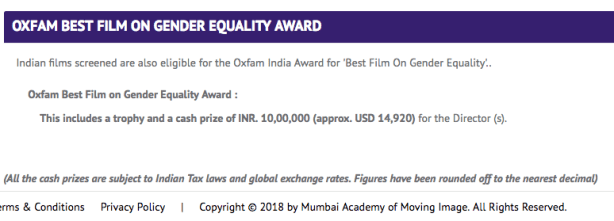
    How Oxfam sexual misconduct scandal unfolded

    Allegations of sexual misconduct by Oxfam workers in 2011 have rocked the aid sector. Here’s how the scandal unfolded…
    news.sky.com

    Few things in the world would be as ironical as naming a gender parity award on a company accused of a major sex scandal.

    Minnie Driver: Oxfam bosses ‘knew what was going on and did nothing’

    Actor and activist who worked with the charity for 20 years stepped down to ‘send a message’ after Haiti sexual…
    http://www.theguardian.com

    26 new cases of sexual harassment and assault at Oxfam, committee hears

    Mark Goldring, chief executive of Oxfam GB, has said that his charity has received 26 new reports of sexual assault and…
    http://www.civilsociety.co.uk

Shouldn’t MAMI step down for getting into partnership with a company that has been informed of several sexual assaults but did nothing? Isn’t this a direct association?
(If this is untrue, I will apologise for it.)

And to end with, I also hope you have put the remaining 200 films screening at MAMI through a strict, vetting process. Because as I see and know of the industry, if every film is to be dropped because a cast or crew member is remotely in any association with an accused… no film will play here. I hope no one at MAMI is naïve to believe otherwise.

I say all of this at the risk of damaging my directorial career that hasn’t even started. I challenge you to dive deep into your conflicted conscience.

Because your own integrity stands questioned now.

My film is about a young woman who defies a religious authority when attacked with blatant misogyny. I was told that if the film is screened, its bigger purpose will be lost. I don’t agree. Keeping a gender equality film away from a social and political change makes no sense. It displays a lack of courage.

I am terribly sorry if I sound angry and hurt and broken. I am all of that.

It takes a lot to make even a short film. Writing, Directing, Designing, Casting, Recces, Auditions, Edit sessions, Subtitles, non stop late night Sound and DI sessions, Production. Managing budgets. Accounts. Constantly losing locations. Even a day before the shoot. Reshoots. Press kits. Catalogues. Trailer. Poster.

I kept shuffling between my short film and five Production design projects, last year. Working at an average of 20 hours a day for months.

It took me a year. One whole year! To make a 20 minutes short.

How much time did you guys take to drop the film?

I decided to make a short film because I couldn’t sell my feature film to any Studio. It had a female lead.

Female lead and female director is a risk. Aap lead ko change kar ke male kar do‘, said one of the Studio heads (they makes family entertainers).

Love the idea. Why don’t you give the script to us? We’ll develop it with another director.
So either the director or the lead had to be male.

But that wasn’t the case for a short.

But we were still making a religiously sensitive film in a deeply religious society. We were thrown from locations — Mosques and Tombs — because even when shoots are allowed in sanctimonious environments, Women aren’t.

While dealing with all the humiliation, I held myself and my team together and decided to put it all in my film. Because that’s what story tellers do. We don’t use our physical might, we use our words.

That struggle, that fight was a nightmare. But expected. This struggle, this fight – unexpected.

I thought of MAMI as female-driven connoisseurs of cinema. But for me now, there is no difference between that studio head who thinks women can’t direct, the men who threw us out from the mosque or the members at MAMI Board. Everyone is only concerned with their farce image.

We are a short film. Film festivals are our only hope. We don’t release in theatres.

We don’t have a chance at 40-crores weekends. All we want is to be seen, for our story to reach people.

Do you think my cast and crew of 80 people and I deserve this? As a feminist group, you have shut down a feminist voice even before it took off. This is so heart breaking for my entire team.

But I will not let this be my embarrassment. It is your embarrassment for treating films and filmmakers like disposable trash.

Do you also understand what does your ‘holier than thou’ decision do to us? You don’t think any festivals, will think twice before picking us up? And I know this letter kills our chance further, but I was not taught to be quiet when wronged.

I am a part of MAMI family. For years! I have written articles and reviews on films screened at MAMI. The day I was told our film was selected by MAMI, will remain special for me. Anurag and I were so happy about it. Home premiere! We can show the film to the people closest to us. Our industry friends, our colleagues, families.
Now we have nothing to tell anyone.

From the time the Me Too movement started in the west, I have felt a silent rage and calm within, at the same time. How badly was this needed! And what an artistic way it has come to finally fight the age old patriarchal, dehumanizing idea of treating women as mere sexual objects.

I say artistic because each woman gets a chance to tell her story. Openly. Fearlessly. How powerful is that?

As a survivor of child abuse, several sexual assaults and harassment at workplace, I find it really odd, discomforting, unfair and traumatizing to be at the receiving end of the most powerful feminist moment of our times.

This isn’t justice.

This is irrational, illogical, unjustifiable penance. How is this not harassment?

Sorry MAMI board members, you missed standing by the #MeToo movement by a mile.

I wait for a response.

Sincerely,

Shazia Iqbal (@shazarch)
On Medium

Varun Grover has been an integral part and regular contributor at MoiFightClub ever since this blog began. It was inevitable that all of us were shaken when allegations of sexual misconduct against him surfaced on Twitter through two handles who posted anonymous screenshots of stories of how he had harassed someone while she was allegedly a junior of his at BHU.

Ever since the allegations surfaced, there was frenzied activity from both sides – those who had decided that Varun was indeed guilty, and those who couldn’t believe he was. There is a third view as well, the nuanced one, that Varun should not be presumed innocent just because his friends believe him to be and every complaint should be taken seriously, even if anonymous, but he should be also heard and allowed a chance to put up arguments pointing to his innocence. After all isn’t that the basis of our judicial system?

A week has passed and we’re still on a stalemate on this case – Varun’s open questions to the two accounts who posted these screenshots remain unanswered and have been met with silence and resistance, and there seems to be no way to decide what to believe either way.

Varun posted this open letter a few hours ago on Medium to maybe share his state of mind, his point of view, and the state of affairs as they stand. We are reproducing the letter – in English and Hindi – here for all of you.

Revolutions are beautiful. They are cathartic, powerful, necessary, and like #metoo — inevitable.

And revolutions, inevitably, have some collateral damage too.

Last week has been a whirlwind of sorts in my life. Amidst the distress and confusion, I have discovered the kind solidarity of many strangers. I was at the receiving end of an anonymous allegation that I know and can prove to be false. In the macro perspective, the wave is bigger and way more important than my isolated small case. Centuries of patriarchy and oppression have created a system that cannot be taken down through polite means.

However, at the same time, my isolated small case does mean the world to me, my family and friends. It affects not just my mental health and professional life but my ability to take a social stand on every injustice I want to speak about.

And therefore, I feel this earnest need to present my side even though no formal complaint has been filed against me. This closure is needed to maintain my own sanity.

The allegations:

On 9th October 2018 at around noon, two screenshots sent by an anonymous account on twitter alleged that I had sexually harassed the person, a junior to me in college (IT-BHU, Varanasi) in 2001. Within minutes the screenshots went viral and within an hour, news channels framed me as a sexual assaulter bundled with other prominent names. It was hurtful and disappointing that the media did not even make the simple distinction while reporting this allegation and other cases. The charges were made by a single anonymous account in my case and multiple well-known women they could reach directly for comments in many of the other cases.

My stance:

I categorically deny the allegations in their entirety as completely baseless fabrications. I have never been involved in any such incident with anybody in my entire life.

The evidence of my innocence:

As stated in my initial statement, I will be readily available to face any independent inquiry to present the facts and help bring the truth out.

Until that happens, I can only present some new findings from my side that refute the allegations made.

A female junior in college in 2001:

a) I joined IT-BHU in July 1999 for a 4-year under-grad course in Civil Engineering. New batches arrive in July every year. So a junior to me in 2001 would mean two batches — 2000–2004 and 2001–2005.

As per official records, in the batch of 2000–2004, a total of 25 females joined the under-grad course and in the batch of 2001–2005, the total female strength was 11. That makes it a total of 36 female students that were my junior at that time.

Out of these 36, my theatre group worked with only four during the course of our stay at the institute and they have remained friends. As the news broke out, these four reached out to me and expressed their solidarity.

Extending their support further, these 4 women reached out to the rest 32 of the female students (spread across the globe) that were my junior at that time and have received confirmation from each one of them that such an incident did not happen. These confirmations can be verified by any independent inquiry.

This proves clearly that the person making the allegations on twitter did not even attend the same college as mine at the time of the incident stated in the allegation.

b) The same check can be done by any independent authority asking the person making the allegations to furnish any valid id card (Engineering completion degree from IT-BHU, semester mark-sheets, original college ID card) to see if they even went to IT-BHU in the batches of 2000–2004 or 2001–2005.

The deadlock:

I completely understand and support the need for anonymity in #metoo stories as our highly biased societal systems and male toxic behavior leave most women no space or platform to speak of their traumas openly or even in private.

No account should be stopped from being published because of its anonymity — but once fact-based counter-claims are made by the accused, the movement as a collective can perhaps make space for the intent to verify them. Further, if the allegations are found untrue, the movement can announce them to be considered removed or at the very least the account can be labeled as ‘pending verification’, till the contested claims are checked.

Over the last 5 days on social media — my requests for carrying out these basic checks have been met with silence, leaving me in a constant state of mental trauma and anguish.

Well-wishers have repeatedly suggested going the legal route to force a solution but I respect the movement, its volunteers, and all the brave women speaking out (openly or anonymously) immensely and won’t intend to affect it negatively. We all will be better allies if the closure is reached mutually.

I understand the excruciating lengths every volunteer and supporter of the movement is traversing to make this cathartic moment in our history happen. I also understand that men have, throughout history, paid very little price even when found guilty while women have constantly suffered even by the faintest of rumors made on their character. A few factually inconsistent cases like mine won’t matter in the larger success of the movement. I am just a number, an abstract concept for the world outside.

But I am not an abstract concept for myself — my family and friends, suffering with me, deserve clarification. We deserve the same fairness this movement stands for.

The resolution:

I’ve said all that I can on this situation and shared the facts that clearly refute the allegations made.

If someone still has any concerns, I urge them to reach out to National Commission for Women (NCW) or any independent commission and file a formal complaint. I will be grateful to present my case.

And one last thing:
Am I angry? Yes. Is my mental health in shambles? Yes. Do I occasionally feel like a victim of an agenda? Yes. And would I still say “Believe All Women”? Yes. But please bring in the checks to differentiate it from “Believe All Screenshots”.

Revolutions can be messy but they can’t be perceived as unjust.

Varun Grover (Mumbai, 15th October 2018)
(Same statement in Hindi follows)

(यही वक्तव्य हिंदी में)

सत्य के लिए आग्रह के साथ खुला ख़त

इंकलाब बहुत खूबसूरत होते हैं. मन का मैल धो देने वाले, शक्तिशाली, निहायत ज़रूरी और #मीटू अभियान की तरह अवश्यंभावी भी.

पर अवश्यंभावी रूप से इंकलाब अपने साथ कुछ अनचाही कुर्बानियाँ भी लाते हैं − कॉलेटरल डैमेज.

बीता हफ़्ता मेरी ज़िन्दगी में एक चक्रवात की तरह गुज़रा. उलझन और उदासी में डूबा. पर मैंने यह भी जाना कि कितने ही अजनबी एकजुटता में मेरे साथ आ खड़े हुए हैं. मेरे ऊपर एक ऐसा गुमनाम आरोप लगाया गया, जिसके बारे में मुझे पता है कि वो गलत है और बाकायदे मैं ये साबित कर सकता हूँ. अब अगर तस्वीर का फ्रेम बड़ा कर देखें तो #मीटू की इस क्रांतिधारा की ज़रूरत और महत्व मेरे अकेले के शहीद हो जाने से कहीं बड़ा है. आखिर सदियों की पितृसत्ता और शोषणचक्र को शिष्ट तरीकों से नहीं गिराया जा सकता.

लेकिन मेरी पूरी दुनिया इस आरोप से दहल गयी है. मैं, मेरे दोस्त, मेरा परिवार सकते में हैं. मेरी दिमाग़ी सेहत और पेशेवर कामकाज पर इसका सीधा असर है. इससे भी बुरा ये कि इसने मेरी नाइंसाफ़ी के खिलाफ़ खड़े होने की और सामाजिक न्याय की हर आवाज़ में अपना स्वर मिलाने की कुव्वत को मुझसे छीन लिया है.

इसलिए, भले मेरे ख़िलाफ़ कोई औपचारिक शिकायत दर्ज ना की गयी हो, फिर भी मेरी ईमानदार कोशिश है कि मैं अपना पक्ष रखूं. यह कोशिश खुद मेरे मन की शांति के लिए ज़रूरी है.

आरोप

9 अक्टूबर 2018 की दोपहर को ट्विटर पर किसी अनाम खाते से दो स्क्रीनशॉट्स डाले गए. इनमें आरोप था कि मैंने साल 2001 में इस इंसान, जो उस वक्त कॉलेज (आईटी-बीएचयू, वाराणसी) में मेरी जूनियर थीं, का यौन शोषण किया है. सोशल मीडिया पर कुछ ही पलों में ये स्क्रीनशॉट वायरल की तरह फैले और अगले ही घंटे मेरा नाम तमाम न्यूज़ चैनल्स पर था, अन्य तमाम बड़े नामों के साथ ‘यौन उत्पीड़क’ वाले खाते में. मीडिया ने इसे रिपोर्ट करते हुए सामान्य सावधानी भी नहीं बरती. जिस तरह मेरे केस को अन्य गंभीर मामलों के साथ एक ही खांचे में डाल दिया गया, यह बहुत तकलीफ़ पहुँचाने वाला और निराशाजनक था. मेरे केस में यह आरोप एक अकेले अनाम खाते द्वारा लगाए गए थे, जबकि अन्य कई मामलों में आरोप लगानेवाली अनेक जानी-मानी महिलाएं थी. ऐसी महिलाएं जिनसे ज़रूरत पड़ने पर मीडिया सीधा संपर्क कर सकता था आैर उनकी टिप्पणी ले सकता था.

मेरा पक्ष

मैं इस आरोप को सिरे से गलत, बनावटी और पूरी तरह आधारहीन बता रहा हूँ. पूरी ज़िन्दगी में मेरे साथ ऐसी कोई घटना नहीं हुई है. किसी के साथ नहीं, कभी नहीं.

मेरी बेगुनाही के सबूत

जैसा मैंने अपने शुरुआती बयान में भी कहा था, मैं किसी भी स्वतंत्र जाँच के समक्ष प्रस्तुत होने और अपने हिस्से के तथ्य रखने को तैयार हूँ, जिससे सच्चाई सबके सामने आ सके.

पर जब तक वो नहीं होता, मैं सिर्फ़ कुछ नए तथ्य आपके सामने रख सकता हूँ. उम्मीद करता हूँ कि इनसे मुझ पर लगाए गए आरोपों का खंडन हो सके.

कॉलेज में मेरी जूनियर, साल 2001

1) मैंने आईटी-बीएचयू में जुलाई 1999 में सिविल इंजीनियरिंग के चार साला स्नातक कोर्स में दाख़िला लिया था. नया बैच वहाँ हर साल जुलाई में ही आता है. इस हिसाब से 2001 में मेरी यह अनाम जूनियर या तो 2000–2004 बैच से हो सकती है, या 2001–2005 बैच से.

अधिकृत दस्तावेज़ों के आधार पर, 2000–2004 के स्नातक बैच में कुल 25 लड़कियों ने दाख़िला लिया था, जबकि 2001–2005 के बैच के लिए यही संख्या 11 थी. इस तरह यही 36 लड़कियाँ ठहरती हैं जो कथित घटना के समय मेरी जूनियर थीं.

इन 36 लड़कियों में से सिर्फ़ 4 थीं, जिनके साथ संस्थान में रहने के दौरान हमारे थियेटर समूह ने काम किया. हमारी ये दोस्ती बाद में भी कायम रही. जब मेरे बारे में आरोप की यह खबर इन चारों तक पहुँची, तो चारों ने मुझसे सम्पर्क किया और मेरे साथ अपनी एकजुटता जाहिर की.

इसी एकजुटता के चलते इन चारों ने दुनियाभर में फैली अपनी बाक़ी 32 स्त्री सहपाठियों से सम्पर्क किया. घटना के समय मेरी जूनियर रही एक-एक लड़की से बात कर इस बात की पुष्टि हासिल की, कि ऐसी कोई घटना कभी हुई ही नहीं. किसी भी स्वतंत्र जाँच में इस बात को वापस सत्यापित किया जा सकता है.

स्पष्ट है कि ट्विटर पर इन आरोपों को लगानेवाला व्यक्ति आरोप में उल्लेखित घटना के समय मेरे संस्थान का छात्र ही नहीं था.

2) यही बात जाँचने का एक सीधा तरीका भी है. किसी भी स्वायत्त अधिकारी द्वारा इस व्यक्ति से ऐसा कोई भी पहचान पत्र (आईटी-बीएचयू से इंजिनियरिंग की डिग्री, किसी भी सेमेस्टर की अंक तालिका या कॉलेज का मूल पहचान पत्र) दिखाने को कहा जाये जो साबित कर सके कि इन्होंने 2000–2004 या 2001–2005 में से किसी बैच में आईटी-बीएचयू में पढ़ाई की है.

बात कहाँ अटकी है

मैं इस बात को समझता हूँ कि इन #मीटू की कहानियों के सामने आने के लिए गुमनाम रहकर अपनी आपबीती को अभिव्यक्त करने का रास्ता ज़रूरी है. मैं आज भी इसके साथ खड़ा हूँ. हमारा पितृसत्तात्मक, पुरुषों के ज़हरीले व्यवहार में गले तक डूबा सामाजिक ढांचा स्त्रियों के लिए कोई और मंच या जगह छोड़ता भी कहाँ है अपने दर्द को बयाँ करने के लिए. ना घर उनका, ना समाज.

किसी भी आपबीती को इसलिए रौशनी में आने से नहीं रोका जा सकता कि उसे बयाँ करनेवाली अभी अपना नाम अंधेरे में रखना चाहती है. लेकिन जब आरोपित व्यक्ति तथ्यों के आधार पर उसकी बात को गलत साबित करे, तो खुद आन्दोलन को आगे बढ़कर तथ्यों की पुष्टि का कोई तरीका निकालना चाहिए. इससे आगे, अगर आरोप गलत पाये जायें तो कम से कम इसकी तो घोषणा की जाये कि इस इंसान का नाम ‘दाग़ियों’ की सूची से हटाया जाता है. या किसी एक की बात साबित होने तक उसके आरोप के साथ ‘पुष्टि नहीं’ ही जोड़ दिया जाये.

बीते 5 दिन से मैं सोशल मीडिया पर यही विनती कर रहा हूँ कि कम से कम आरोप में शामिल इन प्राथमिक तथ्यों की सत्यता तो जाँच ली जाये − लेकिन मेरी बात को अनसुना किया जाता रहा. इस चुप्पी के चलते मैं कैसी मानसिक यंत्रणा से गुज़रा, मैं ही जानता हूँ.

मेरे शुभचिंतक लगातार सलाह देते रहे कि मुझे समाधान के लिए कानूनी रास्ता अपनाना चाहिए, लेकिन मैं इस अभियान का और इसके सिपाहियों का सम्मान करता हूँ. मैं उन तमाम महिलाओं का तहेदिल से सम्मान करता हूँ जो आवाज़ उठा रही हैं (भले सामने आकर या अंधेरे में रहकर) और नहीं चाहता कि मेरी वजह से अभियान पर ज़रा सी भी आँच आए. हमारा एका और बढ़ेगा अगर हम साथ मिलकर किसी समाधान तक पहुँचेंगे.

मैं जानता हूँ कि इस अभियान का प्रत्येक सिपाही और समर्थक हमारे इतिहास में आयी इस आत्मसाक्षात्कार की घड़ी को संभव बनाने के लिए कैसे जी-जान से जुटा है. मैं यह भी जानता हूँ कि पुरुषों ने अपराधी साबित होने पर भी कभी कुछ नहीं खोया, जबकि इतिहास गवाह है कि स्त्री के चरित्र पर अफ़वाह भी हमेशा के लिए दाग़ लगा जाती है.

नहीं, मेरे जैसे कुछ तथ्य से परे मामले इस अभियान की वृहत्तर सफ़लता को रोकनेवाले नहीं हो सकते. मैं एक संख्या भर हूँ. दुनिया के लिए अमूर्त विचार भर. लेकिन मैं खुद के लिए तो अमूर्त संकल्पना भर नहीं. मैं, मेरे परिवार वाले और दोस्त मेरे साथ यह नर्क भुगत रहे हैं. क्या उनका एक स्पष्टीकरण जितना भी हक़ नहीं बनता. न्याय के इस अभियान का न्याय हमें छल नहीं सकता.

समाधान

इस परिस्थिति में मैं जो कुछ कह सकता हूँ, जो भी तथ्य अपनी ओर से सामने रख सकता हूँ, रख रहा हूँ. ऐसे तथ्य जो साफ़तौर पर आरोपों को गलत साबित करते हैं.

मेरा निवेदन है कि अगर अब भी किसी के मन में शक है, तो वह ‘राष्ट्रीय महिला आयोग’ (NCW) या किसी भी अन्य स्वतंत्र जाँचकर्ता समिति में औपचारिक शिकायत करे. मैं खुशी-खुशी अपना पक्ष रखूँगा.

और आखिर में

क्या मैं गुस्सा हूँ? क्या मेरी दिमाग़ी शांति चली गयी है? क्या मुझे रह-रहकर ये लगता है कि मुझे किसी योजना के तहत फंसाया गया? इन सभी सवालों का जवाब ‘हाँ’ है. पर आज भी मुझसे पूछा जाये कि क्या मैं “हर स्त्री पर भरोसा करो” का नारा लगाउंगा? तो मेरा जवाब आज भी ‘हाँ’ होगा. लेकिन यह नारा “हर स्क्रीनशॉट पर भरोसा करो” में ना बदल जाये, इसके लिए हमें जवाबदेही तय करनी ही होगी.

~ वरुण ग्रोवर

About
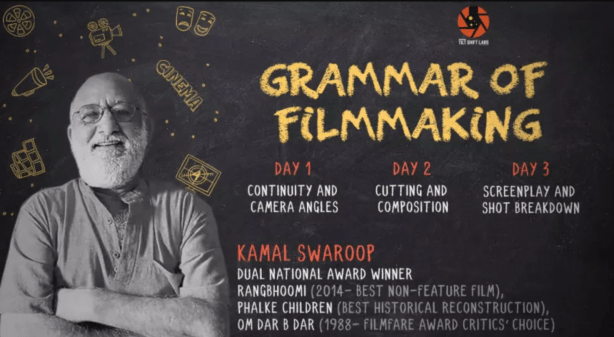
On public demand, Tilt Shift Labs is organising a certified workshop with National Film Award winning director Kamal Swaroop on film writing and direction.

The workshop, titled ‘Grammar of Film Making’, is a three day long (long weekend) intensive workshop for amateur, semi-pro filmmakers or even students of cinema who are looking towards making a career as a filmmaker. This three day filmmaking workshop is the most intensive, instructional program in filmmaking that can be found at any film school. In three days, students are instructed in the basics of writing, directing, camera.

Your film begins here.

What you learn
Basics of Film-Making with focus upon camera angles, composition, cutting,
continuity, constructing a screenplay, and creating a shot breakdown.

Brief
Kamal Swaroop is a dual National Award- and Filmfare Award-winning film,
television and radio director and screenwriter. In 1974 he graduated from the Film and
Television Institute of India, and even his student works met with unusual international
acclaim. He continued with postgraduate studies at the Institute. He assisted the director
Richard Attenborough in the filming of Gandhi (1982). He made documentary as well as
feature films. He is currently working on a full-length documentary titled The Battle of
Benaras, produced by Medient. Famously banned, a formal experimenter, Om-Dar-Ba-
Dar is his master work.

Kamal Swaroop was born in Kashmir. The family then moved to Ajmer, where he graduated
in biology, before moving to Pune to study film direction. He had a brief stint at ISRO,
where he used Russian fairytales to teach science to kids, and then took filmmaking
classes in a remote village of Maharashtra.

Below are the details
Workshop topics
Day 1
Camera angles
Scene, shot, & sequence
Types of camera angles
(objective, subjective, and PoV)
Subject size, angle, and camera height
Extreme long shot
Long shot
Medium shot
Two shot
Close up
Inserts
Descriptive shots
Subject angle
Came height
Level angle
High angle
Low angle
Angle plus angle
Tilt dutch angles
Employing camera angles
Area
Viewpoint
Selection of area and viewpoint
Depicting the action
Change camera angle, lens or both
Scene requirements
Aesthetic factors
Technical factors
Psychological factors
Dramatic factors
Editorial factors
Natural factors
Physical factors
Camera angles on signs and printed matter
Problem camera angles
Conclusion
Continuity
Cinematic time & space
Time & space continuity
Time continuity
Space continuity
Filming the action
Types of action
(controlled action, uncontrolled action)
Filming techniques
(master scene, triple take)
How to use master scene technique
Advantages of filming master scenes
Disadvantages of filming master scenes
Triple take technique
How to use triple take technique
Advantages of triple take technique
Disadvantages of triple take technique
Master scene vs triple-take technique
Directional continuity
Importance of establishing direction
Screen direction
Dynamic screen direction
Use neutral shots
Action axis
How camera set-ups can be used to establish & maintain proper screen direction on moving player or vehicle
Action axis on curves
Action axis on corners
Action axis through doorways
Cheating the action axis
Entrances and exits
Reaction close-up for switching screen direction
Reversing screen direction
Map direction
Location interiors
Planned screen travel
Static screen direction
Matching the look
Look on both sides of lens
Neutral look
Matching look on moving players
Matching look on master scene cut in shots
Matching look with single player
Matching looks on speaker & audience
Action axis for 3 players
Matching looks on group seated around a table
Re-positioning action axis for background cheat
Matching look on stock shots & production scenes
Reverse shots

Day 2
Types of film editing
Continuity cutting
Compilation cutting
Cross cutting
Cutting on activity
Cutting and composition
Moving shots and static shots
Timing moving shots
Loose camera shots
Protection shots
Dissolves
Sound editing problems
Sound flow
Editorial requirements
(aesthetic, technical, and esthetic)
Narrative factors

Composition
Still v/s motion picture composition
Compositional rules
Compositional language
(lines, forms, masses, & movements)
Balance
(formal and informal)
Centre of interest
Lighting, tonal values, & colors
Selective focusing
Eye scan
Image placement
Image size
Integration with angles
Linear and aerial perspective
Background
Framing
Dynamic composition
Suspense composition
Catalog pictures
Compose in depth

Day 3
Process of writing
Discussing individual scripts
Story boarding process
Production planning
The need for story-telling
Visualization strategies
Dramatic strategies
Characterization strategies
Dialogue strategies
Melodrama, docudrama, hyper-drama
The experimental narrative

Venue
The District – Bungalow No. 96
Jankidevi School Rd, Versova, Andheri West, Mumbai, Maharashtra 400061, India

Date and Time
19-20-21st October (10 AM Onwards Daily)
Duration of the event: 3 Days

More Details
https://insider.in/grammar-of-film-making-by-kamal-swaroop-oct19-21-2018/event
Ticket inclusions: Workshop Kit, Mentoring by Kamal Swaroop, Lunch, and Notes.

(WARNING: Watch the movie first. May spoil it for you if you don’t.)

It feels a little strange to call a film titled ‘Andhadhun’ pointedly self-aware. But then if a Sriram Raghavan film won’t kill and resurrect irony a thousand times, then what will?

Just when the Nanas, Bahls and Kavanaughs of the world had you ready to throw yourself in the nearest gutter and die, there comes something so innocuous – a thriller film that ends up giving you hope about life. There is still some goodness left in the world and it’s all stuffed inside Sriram Raghavan’s film.

Wait, hope did you say? In a film full of darkness, little innocence and no redemption? What hope did I find in this universe of dystopia that is so dystopic it doesn’t even take its own dangers seriously? Enough so that I don’t get pimples due to all the invisible tension, you know!

Andhadhun is good for health
It is like anaar juice. You know, rich and full of texture and body wala juice that is actually just clear liquid. You drink and feel you are in heaven but the minute its over it is over. But you still relish it for a long time, that richness and the memory of the texture of the richness. It’s local but exotic at the same time, sweet and sour at the same time and dry and wet at the same time. Anaar juice is also very good for the liver, no?

And apparently, so are rabbits, full of vitamins and minerals. The vitamins and minerals of this film go far beyond the sharply written plot spiralling out of control every five minutes. Or so it seems because it never goes out of hand. The film merely teeters on the edge; as mercurial as Tabu’s performance, as lucid as Radhika’s and as fluid as Ayushmann’s.

What keeps it from teetering off the edge is the phenomenal love for the medium on display, the self-assured craft and the Raghavan moral universe that plays hand in glove with immorality as smoothly as the images, sound, music, words, places, people and performances play with each other; all the worlds he seems to understand equally well.

Such ingenuity cannot come without a distinct love and understanding of the medium and it cannot come without the accompanying genius of your team. Without K.U. Mohanan’s intriguing camera work, Madhu Apsara’s equally trippy and cheeky sound design and Pooja Ladha Surti’s shrewd editing, the film would not have been half of what it is eventually, a sheer treat of music and magic.

Such ingenuity also cannot come without a stronghold on the moral core of the story. Raghavan’s films may all be stories steeped in an immoral universe with equally susceptible heroes, where goodness doesn’t necessarily always get rewarded and evil isn’t always punished. Yet, they operate within a very clear and basic framework of right and wrong that never loses its focus, even when gutted and laughing at its own self.

A completely plot-driven narrative from start to finish, one then almost imagines Raghavan playing similarly with his film. Turning his hero from blind to not blind to blind to we-don’t-even-know-anymore, with a tongue firmly tucked in the cheek. Chuckling away at the absolutely delicious conundrum a murder-gone-wrong can become. Shoot the piano player! Shoot! No, not yet! Shoot! Missed! Run! Hit! Fall! Gotcha! No? Wait…What?! I want a time plus brain machine that can go inside SR’s head and tell me how it was working when he was writing this whacko piece of sheer art.

When the hat tipped and tipped
The film saves its tribute card for Chhayageet and Chitrahaar, very aptly personified as fondly remembered, dearly loved people now no more, with dates et al. (Oh yes, sir, yes!) All the love for Bollywood then flows freely as the thriller merrily turns itself into a musical tribute to Hindi films and films in general; noir in particular – SR’s pet territory. And here comes in Truffaut’s delectable, ‘Shoot The Piano Player’, a film whose language SR borrows from so gracefully and meticulously that he outdoes Truffaut at his own game in creating a unique piece of cinema at once tragic and comic, classical and unconventional, silly and smart but with the distinct impression of a directorial sleight of hand that is playing with his material as consciously as the film seems un-self-conscious while having a lot of fun himself. This is the real tribute, and it is delectable.

The film almost starts similarly, taking the noir trope of a gun chase set-up happening in some other universe and immediately cutting to the universe of the film. The chased in Truffaut’s film is the protagonist’s brother, a semi-central character that turns the film on its head, the chased in Raghavan’s film is a rabbit, a non-character that turns the film on its head. That’s how whimsical is his craft. And delicious!

Kent Jones in his piece on Truffaut’s film says it is a film, “in which all of his assorted gifts and preoccupations are in play and meshed into a uniquely idiosyncratic whole. The film offers powerful evidence of his love of American cinema and literature… There is that wonderful speed, a pleasure in and of itself, that amounts to a kind of worldview—actions, objects, places, and sensations glimpsed and seized on, almost spontaneously forming a vivid afterimage in the mind’s eye. And his high-velocity storytelling is intimately tied to the feeling of impending mortality, the sense of every given moment in time coming and going, never to return. As for surprise, Shoot the Piano Player is about as unpredictable from one moment to the next as any film I know.” Was he speaking of Andhadhun and Sriram Raghavan?!

Perhaps, it is the play of contrasts in the film that lends it its unpredictability and richness. Yoking seriousness with hilarity at every turn, the tonal quality of the film becomes a universally mocking one and freely so. This delicious mockery is directed at everyone, everyone is in on the joke, except the characters. That’s why as Simi’s character unfolds we revel in the knowledge she can never be Nurse Radha – part 2. I am assuming it is a play on Waheeda Rehman’s character in ‘Khamoshi’ (1970), that genteel, heartbroken woman yearning to love again. Lady Macbeth, Lady Macbeth, we say (not only coz it’s the perfect Tabu, the original Lady Maqbool) but until Dr Swamy calls her so we realise she is far away from that too; Simi is absolutely guilt-free, completely soul-less. But then, with the exception of Sophie and Akash, this entire universe is completely soulless. Even Bandu, that see-it-all brat, who quickly enough becomes the audience’s ally in getting to the bottom of this mystery-within-mystery. Until the film takes another crazy spin at interval.

Whose lens is it anyway?
The blind hero who was not blind has now officially turned blind. What is this seeing and unseeing business? It’s a smooth trick of genius-giri. We, as audience begin the film watching Akash’s story first through the innocent, naïve eyes of Sophie, then as we are wisening up to the antics of the film-maker he shifts our POV to a smarter lens, that of a precocious, oversmart Bandu. Just when we think we have caught up with him here too, the proverbial rug is off from under our feet and we are in the deep, dank, dark. Just like our hero. From then on and just like him, we are fumbling in the dark too, with all the secrets hanging around for us to grasp and unravel. Till we are back to being the gullible Sophie again left to put the pieces together. And we do, until a crushed coke can hits a rabbit handled stick and knocks that part of our brain that tells us when we have been played. Check-mated sir, and glad to lose! And that is why I disagree with every review that says the second half is weaker and loses steam. The second half in fact, is as perfect as the first, maybe even better, puncturing perfectly, all the balls of contrast constantly in air.

These contrasts play out on all levels, much like all the cinematic elements in the film, sometimes simultaneously, sometimes one after the other in rapid succession, moulding and remoulding the film as it goes. The permanent warm tone sets up an idyllic, small-town Pune only to open up into the brutality at its borders. Dramatic, operatic music punctuates dramatic scenes as well as turns them comic, and in the scene where Simi and Manu clean the traces of their crime as Akash plays away – tragi-comic (and brilliant!). The sound cuts, diegetic yet full of imminent danger, keep the excitement tingling as the film keeps playing with our senses and feelings. After a point, the musical bit in this ‘musical-thriller’ transcends from the world of Akash’s piano and starts creeping under our skin as it starts underlining the unfolding darkness, tragedy and comedy. I don’t think Beethoven himself could have thought of a better cinematic use for his 5th symphony. Very cheeky, but the classic ‘Teri galiyon mein‘ is now redefined for generations to come. And since we are talking about music, welcome back Amit Trivedi and Jaideep Sahni, it had been a while.

As the film draws to an end, you suddenly become aware of the smile on your face, pasted there with Fevicol for the past 2.20 hrs. You realise you are feeling happy and hopeful. You also realise you wanted the film to go on and on. Especially, since the ending is still open, still incomplete. But then as Sophie says, ‘Kuchh cheezein adhoori honese hi toh poori hoti hain.’

You get up, humming aapse milkar accha laga, bahut accha laga. And walk out giving out a silent, invisible bow. Ekdum liver se.

Fatema Kagalwala

We have all been witness to the recent outpourings from various women in entertainment, media and film industry and other walks of life about their experiences with men crossing the line, taking liberties with their personal space and sexual harassment. This is being called India’s #MeToo movement, some people have also coined the hashtag #MeTooIndia for it. What started with Tanushree Dutta’s allegation of Nana Patekar, and then accounts of incidents about stand-up comic Utsav Chakraborty, soon snowballed and was used as a platform to expose behaviour of many people in comedy, media, films – almost the entire AIB gang, Chetan Bhagat, Vikas Behl (and in this connection Anurag Kashyap), and Rajat Kapoor amongst others, for their behaviour with women assistants, journalists and colleagues. And even how people who were made aware of these incidents in the past chose to not do anything about them.

MAMI being a well-known festival and academy has shown support for the movement through their social handles.

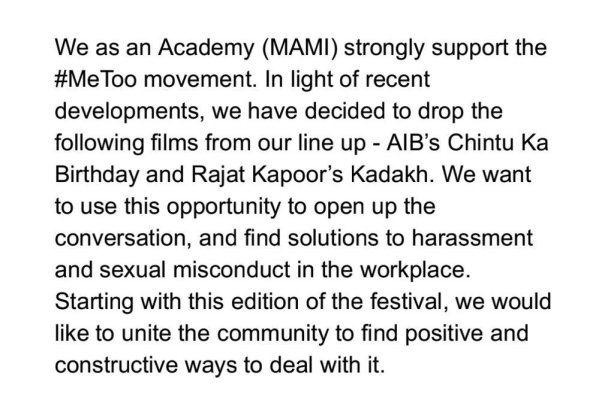
The content of the note is:

We as an Academy (MAMI) strongly support the #MeToo movement. In light of recent developments, we have decided to drop the following films from our line up – AIB’s Chintu Ka Birthday and Rajat Kapoor’s Kadakh. We want to use this opportunity to open up the conversation and find solutions to harassment and sexual misconduct in the workplace. Starting with this edition of the festival, we would like to unite the community to find positive and constructive ways to deal with it.

This is definitely big news for women safety and consent, at least for the entertainment industry!


While we gawk over the intense trailer of Tumbbad that was dropped yesterday, there are rave reviews for the film from the largest genre specific film festival in the US, Fantastic Fest.


‘Tumbbad’ Review: A Striking Artistic Display of the Catastrophic Temptations of Fate
– Matt Donato on SlashFilm

Tumbbad bridges gaps between different worlds – India and any viewer’s homeland – through a common language: storytelling. Costumes and cityscapes may be unfamiliar, but Hastar’s terrifying chase sequences require no translation when it comes to horror appreciation. Mad creature-feature designs, Academy-worthy blends of color and pristine optical packaging, despicable character work meant to provoke heartlessness traded for materialistic grandiosity – Tumbbad is a full genre package seasoned with a pungent foreign kick. A welcoming breed of horror that transcends barrier, creeds, and beliefs.

Fantastic Fest 2018: TUMBBAD Review – Fantasy Folk Horror That Drips With Atmosphere – Jonathan Barkan on Dread Central

Never really a scary film, Tumbbad is more focused on the horror of human behavior than it is on creaking doors and the terror of what lurks in the dark.

Fantastic Fest Interview: Tumbbad Brings Horror to India – Adesh Prasad’s interview in The Austin Chronicle

Fantastic Fest 2018: Adesh Prasad and Jesper Kyd talk “Tumbbad” – co-writer and co-director, Adesh Prasad, and the film’s composer, Jesper Kyd, in an interview with Jackie Ruth in ShuffleOnline

Fantastic Fest 2018: ‘Tumbbad’ is a Feast of Mythology, Greed and Effective Horror – Trey Hilburn III on iHorror.com

It’s rare that something comes together as well as the trifecta of score, direction and scope does, but Tumbbad manages to create something really special, while making sure to keep things nice and horrifying along the way.

Apart from producer and actor Sohum Shah, the film also stars Jyoti Malshe, Dhundhiraj Prabhakar Jogalekar, Anita Date and Deepak Damle, and is releasing in India on October 12th.


We have written in the past about the excitement around our home-grown mythological thriller Tumbbad at Venice Film Festival.

The trailer for the film was released today. Take a look.

The trailer showcases the mood, the mystery, and the special effects that are woven into this story of a goddess who created the entire universe, and the horrors around it. As we write this, the trailer has generated a lot of interest and excitement amongst fans and viewers.


(Photo by Aditya Varma. You’ll want to keep an eye on this talented fella.)

After touring film festivals the world over, Nandita Das’ eponymous film on Saadat Hasan Manto releases in theatres today. While we are excited to watch it, and hear from others about how they like it, here’s something from someone who has worked on the film.

Anubhav Dasgupta had posted this on his Facebook page initially, and we thought it’d be a fit here at MFC. Anubhav has worked on Manto’s post-production.

Over to Anubhav:

In the summer of 2017, I was doing nothing. I’d practically severed ties with everyone I knew and I wasn’t close enough with my Whistling Woods friends to really hang out with them. Consumed by ennui and the buzzing background noise of clinical depression, I barely acted or reacted to anything that was happening around me. The fact that I had topped my batch earlier in the year did nothing to stir my spirits. I was just pretty fucking down, man, and I recognised that as a problem. I got an email about a senior student asking for an additional editor and one of my professors had recommended me, impressed as he was by my work throughout the first quarter of the editing course. Having little else to do, I jumped on it.

Shashwat Gandhi and Yugshrestha Karpatne had adapted Saadat Hasan Manto’s sweet and quietly devastating tale of child prostitution, Dus Rupay, as Five Hundred Rupees for their final year diploma film. Their original editor had begun working with Subhash Ghai but their lovely film remained unfinished so I stepped in to help them complete it. I didn’t think much of Manto back then. I was exposed to his work by a few adaptations fellow colleagues had done and I was quite turned off by the use of schlock and horror. Male perspectives presented his stories as nothing but lust and violence and relied less on the depth and empathy Manto brought to his characters than the violent twists and lurid storytelling. Having avoided Manto because of these misrepresentations, Manto’s stories remained unread. I thought that Five Hundred Rupees would be the end of my sojourn with Manto but I was wrong. I don’t know what forces were in play, but Manto found his way into my life once again.

The work I did on Five Hundred Rupees would lead me to a chance meeting and that chance meeting would lead to a WhatsApp message asking whether I would like to assist on a feature film. It was being directed by a reputed woman filmmaker and starred one of my favourite actors, so I replied, “Yeah sure, why not?” and didn’t hear back from them.

A few weeks later, I was at a crosswords store, browsing their Indian fiction section, shifting aside the usual Durjoy Dutta and Chetan Bhagat schlock to find a copy of Vikram Seth’s A Suitable Boy. I took it in my hands, leafed through it and balked at the price point. As I carefully slid it back into its spot, I noticed a book with an orange cover right next to it. I pulled it out, Bitter Fruit — A Collection of Short Stories by Saadat Hasan Manto, and just looked at it for a bit. At that same instant, my phone rang and someone asked me if I could make it to Bandra in a few hours. School was out, so I answered in the affirmative. Then I had lunch and set off to Bandra on a Sunday. And that’s how my Manto journey began.

I joined in as an edit intern, late in the film’s post-production stage. It was pretty much complete but Nandita Das wanted to cut it down a little more and needed someone who could carry out the necessary exports as the film neared completion. Manto had a small in-house team — initially just me and her assistant Riya — and I found myself taking up more responsibility than I’d anticipated. And through the film Manto, Manto the man and the writer was revealed to me. The film peeled away the layers of grime and violence and revealed the true core of Manto’s stories: empathy, even for the cruellest and the worst, and a terrible sadness at the things that men do. His works and writings became a prism through which I processed my own feelings about the state of the world, the division and the cruelty that men have succumbed to, the blatant permission to commit cruelty that the current rulers seem to have signed off on. The film, too, is in part Nandita’s response to our times. I’ve seen it nearly a hundred times now as a result of my work and each viewing reveals a new detail, a new perspective, evident of the fact that the film was made with a lot of love and passion. Some days I’m moved by it, some days I’m ambivalent. I’ve been moved to tears by it just the one time, but maybe the first time will do it for you. It’s a good film with great scenes, two of which remain my favourite scenes from any film this year.

In some way, because of the coincidences, and especially of Manto leading me to Manto, I believe I was meant to work on this, for my own selfish self-improvement if nothing else. I’ve come in contact with some of the most talented and eminent people in the course of this journey, Sneha Khanwalker, Avani Rai, Tahir Bhasin, Resul Pookutty, Nawazuddin, Rasika Dugal, Kartik Vijay, Manto’s daughters Nuzhat and Nusrat, Nasreen Munni Kabir, Ashok Kumar’s daughter Bharti, Cameron Bailey, just to name a few. This has been one of the more fulfilling experiences of my life so far and I think I’m not the only person who has been changed by working on Manto. It was a special experience for everyone involved.

In becoming an inextricable part of my life Saadat Hasan Manto has achieved his ultimate revenge on me, someone who was militantly ignorant of his works, who went out of his way to avoid Manto. I cannot escape him now, and I’m glad to join the ranks as a Manto fan.

All I’ll say is, I’m proud to have worked on this film, to have worked on a film that I quite like, featuring some of my favourite actors, Neeraj Kabi, Rajshree Deshpande, Nawazuddin, and more, and a film that couldn’t be any more relevant, when the people in power have decided that they do not like what we say and want to rule through paranoia and phantom enemies. Please watch it tomorrow, I can’t assure you that you’ll like it, but I’m sure you will feel the passion and love that has gone into every frame of the film. I would like to thank everyone who was instrumental in making this happen, the people I know, the people I don’t and the people who I have come to know through this film.

Here’s to many more.

Please watch Manto. Out in theaters in this Friday. It’s been made with a lot of love, reverence and passion.

Anubhav Dasgupta

Filmmaker Rima Das’ National Award winning film Village Rockstars is slated for a Pan-India theatrical release on 28th September, 2018.

The film will be released through VKAAO, a joint venture of PVR Pictures and Bookmyshow in metros cities of India and in more than 30 screens in Assam through Kamakhya Films.

Village Rockstars is the story of Dhunu, a girl who grows up in poverty and learns to fend for herself. However, that does not prevent her from following her dream of forming a rock band and owning a guitar someday. Most of the cast members of the film are non-actors including Rima Das’ niece Bhanita who plays Dhunu and the other kids who hail from Das’ native village in Assam.

The film which had its World Premiere at Toronto International Film Festival and India Premiere at Mumbai Film Festival 2018 has screened in more than 70 prestigious international and national film festivals and won 44 awards including 4 National Awards (Best Feature, Best Editing, Audiography and Child Artist)

It was an official selection at Film Bazaar Recommends (at NFDC Film Bazaar 2016), 2017 Marche du Film (Cannes) Work-In-Progress, San Sebastian International Film Festival 2017

Rima Das’ debut film as a writer-director-producer, Man with Binoculars (Antardrishti) premiered at Tallinn Black Nights Film Festival 2016. Village Rockstars, her second feature, premiered at Toronto International Film Festival 2017 under Discovery Section. Bulbul Can Sing made its World Premiere at Toronto International Film Festival 2018 and will make its South Asia Premiere at the prestigious 23rd Busan International Film Festival 2018.

Busan International Film Festival 2018 will see 5 Indian films having their World Premieres in the section titled A Window on Asian Cinema.
The festival is being held from 4th to 13th October 2018.

Namdev Bhau In Search of Silence

Screenplay, Director: Dar Gai
Producer: Dheer Momaya
Starring: Namdev Gurav, Aarya Dave, Zoya Hussain
Running time: 84min

Bhonsle

Director: Devashish Makhija
Producer: Saurabh Gupta, Namita Lal, Piiyush Singh
Starring: Manoj Bajpayee, Santosh Juvekar, Ipshita Chakraborty Singh, Virat Vaibhav
Running time: 128min

Widow of Silence

Director: Praveen Morchhale
Running time: 85min

Kaamyaab / Round Figure

Director: Hardik Mehta
Producer: Manish Mundra, Ridhima Lulla
Starring: Sanjai Mishra, Deepak Dobriyal, Sariika Singh, Isha Talwar, Kaurwakee Vasistha, Amitabh Shrivastava, Avtar Gill
Running time: 111min

Yours Truly

Story, Screenplay, Director: Sanjoy Nag
Producer: Platoon One Films, MDC Filmworks
Starring: Soni Razdan, Pankaj Tripathi
Running time: 78min