Archive for the ‘film’ Category

the_good_road_h

Because that seems to be the only reason why none of us could speak out openly about our “best” film to be sent for Oscars in the Foreign Language category.

Now that i have seen it, let me say it loudly – The Lunchbox is Casablanca compared to The Good Road. I will come back to the film later. Let me also clarify few things first. I have been reading articles, posts and tweets on similar topic since last 3 days, and some of them are on such a wrong tangent. So here it goes.

Oscars

No, it’s not white man’s approval. It’s not even the best function or festival as far as films are concerned. Some of the best American films and actors don’t even bag a nomination. So why are we getting jizz in pants about Oscars?

Because it still matters. Because it’s money, market and reach. Because one nomination (and win) not only puts the spotlight on the director’s entire filmography but the country also comes into focus. Because it opens every possible door for its lead actors. The examples are many. In the last few years only Chile’s No, Israel’s Ajami and Footnote, Algeria’s Outside The Law, Greece’s Dogtooth, Denmark’s In A Better World, Argentina’s The Secret In Their Eyes, Japan’s Departures and Denmark’s After The Wedding have brought so much attention to their country’s cinema just by being nominated. Same goes for actors. Who knew Matthias Schoenaerts before the Bullhead?

A Cannes win also has the power to do all that. Ask the Romanian filmmakers. But Cannes is not so mainstream, Cannes is French, and Oscar is Amreekan. You know the difference, and two shall never meet. One is purely about cinema, the other is more about box office. Btw, do auteurs eat big burgers?

That’s the simple reason why Oscars count. Not for any white man supremacy. In 2011, when Asghar Farhadi went on stage to collect his award for The Separation, almost everyone knew that it was not only the “best foreign film” but it was the “best fucking film of the year”. The white man supremacy and approval logic is so 80s. The world went back to all his films and he was named one of the 100 Most Influential People in the world by Time magazine in 2012. Difficult to believe that the journey started with “Nader and Simin” (title was changed later) getting the distribution fund at Berlin fest.

So do i believe in Oscars? NO.

An award ceremony which never did any justice to Martin Scorsese, how can they be fair?

Do i watch Oscars? YES.

The only day in the year when i get up early and see the rising sun. Why? Because Marty believes in it. Because it’s good fun to watch some of your favourite actors, directors, screenwriters, all under the same roof and still be so cool and candid. And because they still make it “look” professional. Some of the best talents never get their due but when they get, it changes everything. One nod is all it takes. That’s it.

Foreign Language Category & The Good Road

In the last few years, this has become one of the most toughest category. The number of submissions keeps on increasing every year. You are not just competing with the best of the Amreekan cinema but from best of the world. Last year it was a new record with 71 films. This year’s running list already has 45 films. Heavyweight Wong Kar-wai’s The Grandmaster is already in the ring.

Since FFI’s announcement on The Good Road came out, anyone having any doubts about it, the first question asked was have you seen it? And as far as i knew nobody except the FFI jury had seen it. So, before writing any post on it, i decided to watch the film, and am so so disappointed after watching it.

So far i was only arguing that it’s always about the “right” film at the Oscars, it’s not about the “best” film. Why get so holier than thou and sentimental about putting our “best” film?  Especially when Oscars is just another ‘market’ event that does wonders. Put the “right” film out, play according to the games, play it smart, and get a nod. Simple. Just look at the big picture.

Now, if i consider this is the standard of our best film which is being sent to the world audience, am sorry to say that people will laugh at us. Don’t believe me, go watch “The Good Road”. The film is easily available on dvds and #youknowwhere. It doesn’t even look professional. Except an idea and intention, it has nothing to offer. It’s boring, the production looks tacky, direction is bad, performances are inconsistent, and acting by non-actors look like non-acting only. The arid landscape and the use of music are the only things that work.

The only Oscars bait was a sequence involving young girls in prostitution racket standing on platforms surrounded by coloured tubelights. Haven’t seen anything like that on screen.

With “The Good Road” as our submission, what’s our chance at the Oscars? i think ZILCH. I hope am proved wrong but i doubt it.

And what i am most confused about is the sudden support for the film. As a friend pointed out, just because it has suddenly become the David in front of The Lunchbox Goliath with UTV, Karan Johar and Anurag Kashyap in its support? Strange. Very, very strange. Watch both the films and compare the merits.

More strange is the fact that not a single mainstream critic in this country bothered to review the film when it released – in theatres and on dvds. That says more about the state of film criticism in this country.

The Lunchbox

With The Lunchbox, many of us believed it had a *chance*. Yes, just a chance. And we have been shouting about it. It’s a tough battle there. But with Sony Classics having its US rights and many influential American voices already pushing for it after watching the film at Cannes, Toronto and Telluride, it had the right visibility factor going for it. Michael Moore, Ted Hope and many others tweeted about it. Aseem Chhabra has written more about it here. Also, The Hollywood Reporter and Indiewire, the two ends of spectrum, were counting it among the frontrunners. And am sure they know (at least little bit) more and understand their Oscars more than us.

It was just not the “right” film but it’s a much, much better film than “The Good Road”. Just ideas and intentions don’t make a good film, or a good road.

So what did the FFI jury saw in the film which i could not? Let me quote from this interview of Gautam Ghose…

The criteria is simple — we had to select a film that represents the country perfectly.

WTF! Represents the country perfectly? As in peacocks and elephants? Do they watch the Oscars? Not sure what it means (Can someone explain?). After watching the film, all i can say is that The Good Road represents us amateurishly. You all made us look tacky in front of the world. Forget The Lunchbox, any other film would have been better too.

Though just Irrfan Khan and Nimrat Kaur’s performances were enough to pick the film. These two are not just the best performances of the year in Indian cinema, but they can be easily counted as among the best ones in world cinema too. So I would sincerely like to smoke what the FFI jury was smoking. Anyone?

Because this was our chance. Because we needed it. We needed to tell the world that we do more than naach-gaana now. We needed to assure Sony Classics that you can look and pick more Indian films that can do wonders. You don’t need to wait for 10-15 years again. We needed to tell the world that it’s not just Iranians, Romanians, Koreans, Greeks and Australians, we are also heading in right direction. And this was the best stage to do it. We had a chance, a bright and fair chance. But what a fuck up! what a royal fuck up this turned out to be.

One more thing – who made the rules suddenly that FFI can’t disclose the names of jury members? I would surely love to know the names of those 12 or 15 or 19 people who thought The Good Road was better than The Lunchbox and every other film that was submitted for consideration. As far as i remember, when the jury meet used to happen in Mumbai, almost all the jury members used to present in the press conference to announce their choice. What happened suddenly in the last two years or so? Are they afraid to endorse the film publicly because their taste will be questioned? Someone enlighten me here too. Come on, come out, tell us you loved The Good Road. And as the saying goes, any festival selection or win always tells you more about the jury than about the film. I will still try not to judge you.

@cilemasnob

( PS – The only consolation is we are not the only morons. We have company)
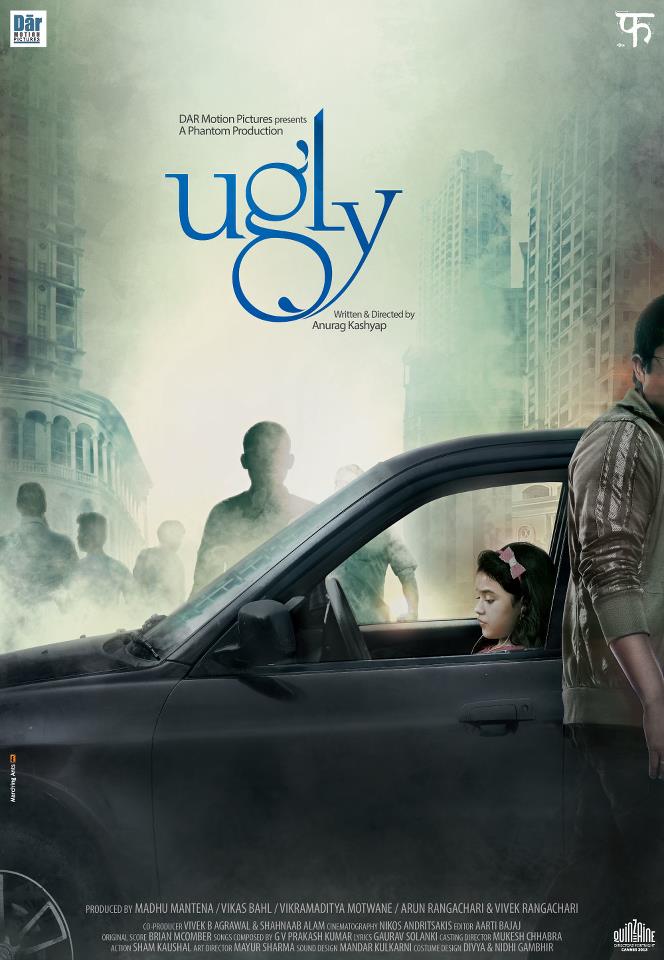
The much awaited trailer of Anurag Kashyap’s new film Ugly is out. Have a look.

It looks damn intriguing. A kidnapping goes wrong and things get ugly.

The film stars Ronit Roy, Rahul Bhat, Tejaswini Kolhapure, Vineet Kumar Singh, Surveen Chawala, Siddhant Kapoor, Anshika Shrivastava & Girish Kulkarni.

Produced by Dar Motion Pictures and Phantom Films, it has music by G V Prakash.

The film had its premiere at the Cannes Film Festival in the Directors Fortnight section.

UglyOfficial Synopsis

Bose, an Additional Commissioner of Police, is an extremely straight-forward professional. However, these lines are a bit blurred in his relationship with his wife Shalini. Shalini is a clinically depressed person and an alcoholic. Shalini was first married to Rahul, a struggling actor and also has a daughter with him, called Kali. The story starts on a Saturday, which is the day when Rahul is allowed to meet Kali as per court custody arrangements. Rahul leaves her in the car as he goes to meet his friend, and Kali goes missing.

What follows is an endless series of blame game and one up-man ship. A dark psychological thriller on the surface, Ugly is an emotional drama within.

To know more about the film, you can follow its FB page here.

Sanjay Leela Bhansali’s Black was heavily inspired from The Miracle Worker. Some scenes were exactly the same, just with some more background music added to it. And now, it seems Karma’s cycle is complete as someone has made it in Turkish (Titled Benim Dünyam, which means My World). Interestingly, the lead actor of the film, Ugur Yucel, is also the director.

We are not sure if it’s official remake or just plagiarised. But from the trailer it’s easy to spot that it’s a frame by frame copy of Black. Though whatever little we could gather with the help of Google Translator, many Turkish articles do mention the film Black. So it might be official remake. Have a look.

Since crowd-funding is in vogue these days, it’s good to see the trend going beyond Hindi indies. If our friends are to believed, Lucia is the first Kannada film to be crowd funded. We don’t have much clue about this one but it surely looks interesting. It’s written and directed by Pawan Kumar and will release with English subtitles. The film is released by PVR Directors Rare.

Lucia

Official Synopsis

From the director of smash hit Lifeu Ishtene, comes Lucia, heralding a new direction for Kannada cinema, being the industry’s first crowd funded film. An usher at a decrepit cinema suffers from insomnia. His life changes when he starts getting weird and wonderful dreams but with a caveat. Set in the teeming young metropolis that is Bangalore, the film is a turbulent ride where the lines between dreams and reality are blurred to delirious effect. Please don’t reveal the ending after you’ve watched the film. Prepare to be surprised, very surprised.

Trailer

Show Timings

Lucia2

– To know more about the film, click here.

– To read the filmmaker’s blog, click here.

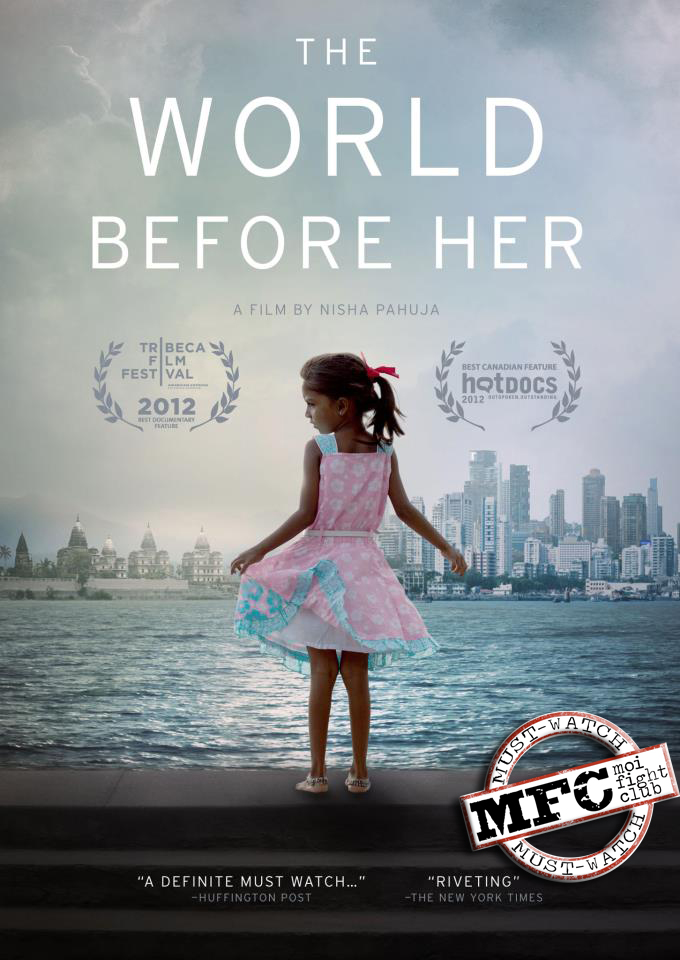
Internet is a great place, especially if you are looking for under-rated gems. Varun Grover stumbled upon this documentary called The World Before Her. Mihir Fadnavis got in touch with the director and we managed to watch the film. So over to Fatema Kagalwala and her ramblings on this stunning and important film. We are putting this in our “Must Watch” film recco List. Watch it.

The World Before Her copy

We love living in extremes. Grey areas aren’t appealing because they force us to think. They are meant for individual assessment whereas black and white are fit for mass consumption. So we’ve draped ourselves with stark definitions of tradition and modernity and live a bipolar existence, merrily swinging between both. Sometimes, we find solace in middle ground but one that is obfuscated with the overpowering implications of the extremes that are tradition and the modernity.

Prachi, Ruhi, Ankita, Pooja – the central protagonists, of ‘The World before Her’, a stunning, award-winning documentary by Nisha Pahuja, are all products, or shall we say victims, of our collective need to ideologically belong somewhere, even if it is within an ideology that seeks to subjugate them. They are perfect lambs for factories manufacturing daily definitions of the traditional and modern according to their convenience.

The struggle between tradition and modernity is ancient. The documentary examines these two polarities with a clear understanding of all its inherent ironies. Let’s take a look at the two worlds it straddles to make its point –

World 1 – Miss India contest 2011 20-day training camp. Of beauty, botox and bikinis.

World 2 – Vishwa Hindu Parishad’s Durga Vahini Camp. Of Hindutva, weapon training and military discipline.

Nisha takes us through both the camps, laying bare their belief system, process and the little dreams behind it all. We see training procedures up-close and peek into the lives of trainees. What makes the ambitious Ms India contestants tick and what drives the fierce Durga Vahinis? Through a thoughtful juxtapositioning, the two opposite worlds collide and before we know, melt into one voice. On the face of it, both espouse contrarian views on female identity. Beyond the façade of the titles of ‘modernity’ and ‘traditionalism’, both bind the very subjects they aim to set free, victimising the very subjects they aim to empower, treating the women they are pretending to liberate as cattle to be branded. The beauty of it all is the film doesn’t state it, but makes it clear with an intuitive stitching together of the narrative.

Nisha delves into both the worlds with care, aware of the mine of uneasy answers she is exploring, mindful of the dust her questions will raise. There is no attempt to impose a comment or paint a particular ideological picture. What makes the documentary a brilliant experience is the careful expose of truths and myths we live in, and the questing female mired in it.

In Ruhi, Ankita and Pooja, we see semi-urban, middle-class young women, very well aware of their social status as females, out to beat the system even if it is through succumbing to it. They are aware of the compromises they have to make and are fine with the cost to their dignity, if it transforms them, like Pooja puts it, ‘from a person to a personality’. The irony of their entire quest for identity within a system out to objectify them, seems to be lost on them. To my mind, Pooja Chopra, the girl whose father insisted on killing her at birth because she was female, almost seems like a tragic figure, bitterly fooled by an arrogant system laughing at her for believing she had carved a separate identity of her own and on her own terms. Ruhi, a young 19 yr old, feels obliged to her parents for bringing her up and feels the need to pay them back by becoming ‘something’, so that their creation is worth it…she never questions the route to fame she has chosen. Nor are her future plans of marriage and children at an appropriate age seem to clash in anyway with her present teen plans of becoming a beauty queen. ‘I can do all this now as I am young, later I won’t be able to do all this’, she says (quote not verbatim). There is no ideology at work here nor a tussle between the old and new. It is simple conditioning speaking but Ruhi doesn’t question any of it, for her her parents support for her contest participation is an empowering, liberating sign of modernity enough. For these women, the shine of glamour and the pain of centuries of repression are too blinding to see anything under or beyond.

At the other extreme is Prachi, the alpha female trainer at Durga Vahini, who has found a purpose and outlet in Hindu fundamentalism to escape the vulnerabilities her gender status thrusts on her. She is a single child of an orthodox Hindu family who feels her father is justified in hitting her (even brutally) because as a female child he let her live. She loves the power being a Durga Vahini trainer gives her, flaunts her dislike for ‘girlie girls’, is proud of being tough and is absolutely against marriage. Like the Ms India contestants, this Aurangabad-based girl too is looking to establishing her worth as a female in all-male world, but by embracing and perpetuating the orthodox mores of Durga Vahini. Unlike the other girls though, she is fully aware that the system she advocates aims at curbing her own freedom, yet, it remains her chosen vehicle to empowerment. Yet, I wondered if there was a glint of wishful-ness, an unacknowledged longing behind the façade of derision as she watched the Ms India contest. I don’t know if it was the artfully calculated shot lingering on her tad longer or my over-wrought zeal to understand her better or an actual fact.

I read criticism of the film saying this isn’t the reality of entire India and that the film does not reflect upon the middle path. It is possible I imagined the subtle jingoism in the criticism, but that apart, what it missed was the fact that these two extremities inform the lives of every woman (and men too) traversing the so-called middle path. Maybe they exist but I am yet to meet a person truly liberated from gender complexities and its socio-economic implications that the film so starkly defines. In fact, I saw Prachi, Ruhi, Ankita and Pooja as sharp and accurate spokespeople of the entire India, irrespective of class distinctions. Trapped in the half-baked definitions made by a commerce-driven, power-hungry, alpha male world, they languish confused in the debris of the shattered female identity they struggle to resurrect. Just like you and me.

As I mull over the needs of these girls, (and they are very familiar, they are around me and inside me) I see their quest with compassion. They have little choice other than adhering to a corrupt system to beat another equally corrupt one, to gain whatever semblance of self-respect they can garner for themselves. Patriarchy hasn’t left much for women to call their own or celebrate in the truest sense, has it? And if that wasn’t enough we have religious fundamentalism adding to the fire. Nisha doesn’t shy from showing news clips of Hindu fundamentalists beating up women in pubs and iterating the fact that Hindu terrorism is a bigger threat to India than Islamic fundamentalism. Not only is this a well-informed, deeply introspective, objective, exploratory documentary but it is very brave as well. One simply wishes the film does not get targeted by pressure groups if and when it comes to India.

As I watched the documentary and later, I wasn’t surprised by the ironical truths about female existence staring at me. It was all seen before, read before, said before. Yet, I couldn’t define the film in words and that is not because of the complexity of the film but of its theme. Which at one level is almost self-explanatory, but dig deeper and it will leave you distraught at the number of knots or rather untied ends it waves at you.

Why have we made the question of women’s identity so complex, almost impossible to unravel? Is it because we fear if we find the answers the world around us will no longer be recognisable? We are all slaves to gender equations and roles. Breaking free is scary because it means starting from scratch for human existence. Without the context of male and female roles and boundaries where would we be? What would we adhere to and what would we fight? Coz isn’t that exactly what gives all of us our purpose? The ‘shoulds’ our gender is supposed to wear? We either wear them with pride or fight them with gusto, satisfied in the purpose we’ve found to base our lives on. We then spend our entire lives empowering the very cycle the protagonists of this film believe/imagine they are fighting. We are no different from them, really. Gender politics apart, men and women, we are all in this together and for once, it isn’t a happy thought.

I realise I can go on writing about this film, such is the subject matter and beauty with which the story has been told. As I pull down the windows on my brains because I really want you to watch it with a fresh curiosity, let me leave u with a few moments that struck me with their irony, pathos and horror.

Pageant diction coach Sabira Merchant (proudly or matter-of-factly?) calling the Ms India training camp “a little factory … where you’re polished like a diamond. The modern Indian woman.” (Did the irony of what she was saying escape her or had she, like the contestants, made peace with it long back?)

Uma Bharti, while protesting against the 1996 Ms World contest to be held in India, “We are against a system that presents women as pieces of meat and judges them based on the size of their chest, waist and hips.” (I never thought I’d appreciate Uma Bharti in this lifetime.)

Prachi, with misty eyes, excusing her father for hitting her, “Knowing that I’m a girl child, he let me live … That’s the best part. In a traditional family, people don’t let a girl child live. They kill the child.” (I don’t think there was anyone among us who didn’t shiver on hearing her say this and actually mean it.)

The Miss India contestants parading in hip-length sacks and denim shorts in a round that judges who has the hottest legs.

Marc Robinson, the organiser, laughing off the indignity of the sack-round.

News clips of Hindutva louts beating up women in pubs.

Little girls at Durga Vahini camps being taught India and Hindutva was under threat from two main sources – Islam and Christianity.

Little girls lapping it up and regurgitating it like it was the only truth.

Chinmayee, a smart 14-yr old, proudly declaring at the end of the camp, ‘No, I don’t have a single Muslim friend. I did when I was younger but then I didn’t know that we are different.’ I didn’t know if I felt horror for India or pity for the little girl.

At the end of the Durga Vahini camp, girls getting sashes to wear identifying them as Durga Vahinis and the (gleeful?) exclamations of, ‘This is just like Miss India, Miss World!’

Touché.

Fatema Kagalwala

– FB page is here.

– If you are in Canada or USA, you can order it here and here.

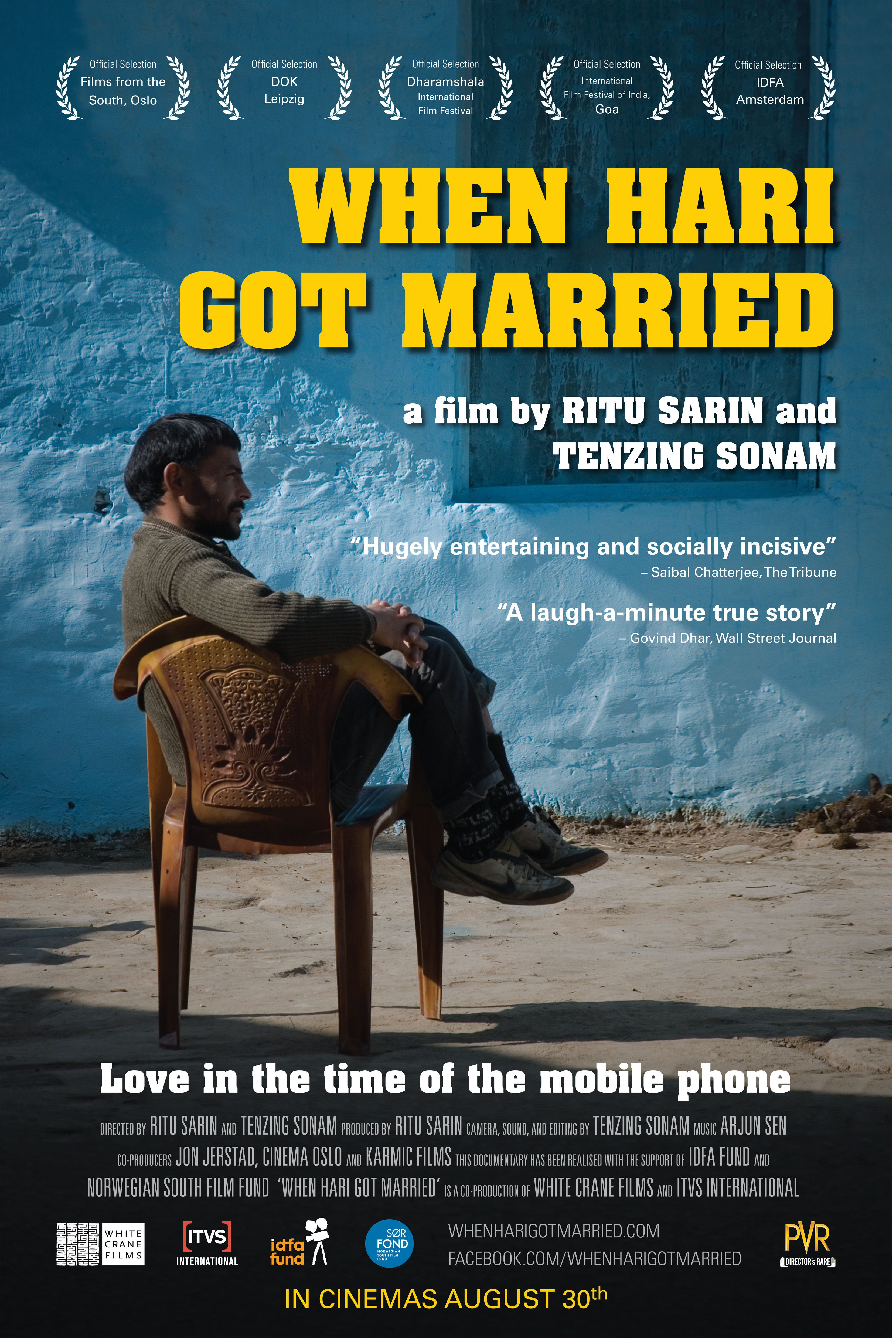
When Hari Got Married, a documentary film by Ritu Sarin and Tenzing Sonam is releasing as part of the PVR Director’s Rare series from 30th August at PVR cinemas in Delhi, Gurgaon, Mumbai, Pune and Bangalore.

“When Hari Got Married” takes a humorous look at Hari, a taxi driver from Dharamshala, as he prepares for his marriage to a girl he has only seen once, and that too, with her face covered. Hari’s frank and outspoken views on love and life, his unusual courtship on the mobile phone, and his eventual marriage provide a warm and illuminating insight into the changes taking place in India as modernisation and globalisation collide with age-old traditions and customs.

More on the film

translite-final-rgbHari, a 30-year-old taxi driver, lives in Dharamshala, a small town in the Himalayan foothills. He is getting married to Suman, a girl he has never met.

Tradition dictates that Hari and Suman will only see each other on the day of their wedding. But Hari has found another way to get to know her: on the mobile phone. Over the past few months they have spoken to each other every day and have fallen in love.

Hari and Suman see each other properly for the first time during the wedding ceremony. Will their telephone love prove strong enough to overcome the awkward obstacles of an arranged marriage?

Hari’s unusual courtship and marriage, coupled with his frank and humorous confessions of fear, doubt, hope and anticipation, provide a warm and illuminating insight into the changes taking place in India as modernisation and globalisation collide with age-old traditions and customs.

A co-production of ITVS International and White Crane Films. With additional funding from IDFA Fund, Amsterdam, and Films From the South, Oslo.

About the filmmakers

Ritu Sarin And Tenzing Sonam are an Indian-Tibetan filmmaking team based in Dharamshala, India. They worked as independent filmmakers in San Francisco and London before moving back to India where they are based in Dharamshala.

Working through their film company, White Crane Films, they have produced and directed several documentaries, mostly focusing on Tibet-related subjects. These include: The Reincarnation of Khensur Rinpoche (1991), The Trials of Telo Rinpoche (1993), and The Shadow Circus: The CIA in Tibet (1998). In 2005, they completed Dreaming Lhasa, a dramatic feature film executive produced by Jeremy Thomas, which premiered at the Toronto International Film Festival. They have also worked on video installations, including Some Questions on the Nature of Your Existence (2007), which was shown at the Mori Art Museum in Tokyo and the 2010 Busan Biennale.

Their feature documentary, The Sun Behind the Clouds: Tibet’s Struggle for Freedom (2009), won several awards including the Vaclav Havel Award at the One World Film Festival in Prague. When Hari Got Married is their most recent film. Ritu and Tenzing are also directors of the Dharamshala International Film Festival, which had its first edition from 1-4 November 2012.

goopiandbagha_01

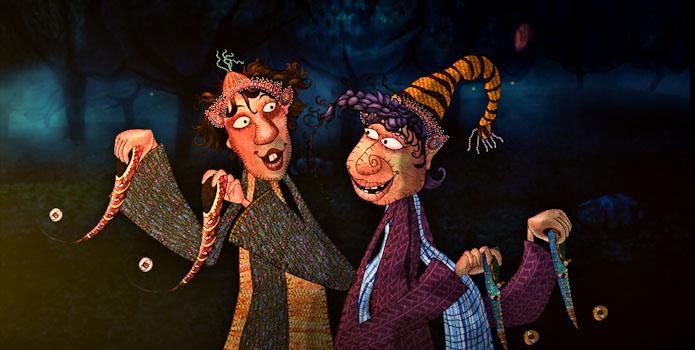
Thanks to TIFF’s announcement, we got to know about this animation film. Satyajit Ray’s acclaimed and an all time favourite film across the generations, “Goopy Gyne Bagha Byne” has now been animated into “Goopi Gawaiiya Bagha Bajaiiya”. It will have its world premiere at this year’s Toronto International Film Festival.

The first trailer of the film is out.

Official synopsis – A captivating animated adaptation of a cherished children’s classic by Satyajit Ray, this timeless fable is the story of Goopi and Bagha, a pair of musicians gifted with magical powers by the King of Ghosts.

Credit and other details

Director: Shilpa Ranade

Country: India

Orig. Work Title Goopy Gyne Bagha Byne

Year: 2013

Language: Hindi

Runtime: 78 minutes

Rating: G

Exec. Producer: Soumitra Ranade

Producer: Shravan Kumar

Production Co.: Children’s Film Society, India

Screenplay: Soumitra Ranade

Source Author: Upendra Kishore Roychowdhury

Animator: Paperboat Animation Studios

Editor: Avinash Walzade

Sound: Narayan Parasuram

Music: Narayan Parasuram

Prod. Designer: Shilpa Ranade


“Tagore-on-an-acid-trip” – that’s how Qaushiq Mukherjee, or Q, as he is popularly known, has described his latest film, Tasher Desh. We discovered Q with his last film Gandu which still remains unreleased in India. And we have been following all his work since then – shorts, music, documentaries.

Here’s the director’s note on his new film which is set to release on 23rd August in Mumbai and Kolkata. It’s based on one of the popular musical dramas of Rabindranath Tagore.

This slideshow requires JavaScript.

(Click on any pic to enlarge and watch the slide show)

Since I was five, Tasher Desh has been on my mind. It’s that fantasy that I always knew I wanted to touch. That elusive texture of human existence, devoid of transient truth. Reality is indeed transient; shifting all the time yet every civilization holds on to its truth till whatever time they can, always leading to antagonism and discontent. The cycle of time makes sure that periods of extreme confusion and chaos happen to alter realities, and we are at the thresholds of such a time.

Tagore wrote Tasher Desh as a mythical utopian expression against the backdrop of a violent turbulence. India was in the process of forming an individual and collective identity. Shaking off a history of oppression and forging a modern society. Tagore saw it as an opportunity perhaps, to tell a story removed so far from reality that it forced the listener to be objective. Modern society is marked by one overwhelming human condition. Of melancholia or depression. Slowly becoming one of the most important issues of our daily reality.

Depression is a symptom of a gloom caused by social system and its invariable ability to isolate individuals.

The film is not about the narrative of the fairy tale. It is but a reflection of how I see the world right now. As it was then, when the piece was written, the world is in a flux. India is changing radically, along with the politics of the world, and these changes are essentially driven by system driven violence. My storyteller, therefore, is a lost soul. Unable to deal with the cacophony of his circumstances, he dives into the fable, as if to save himself. The characters of the fairy tale are all extensions of the storyteller, and the story itself has a life of its own. Every story is the same. And it is always the telling that shifts the paradigms.

In the film, it’s his story that helps the storyteller overcome his ennui and to take a decision that would change his life.

The prince is depressed, because the storyteller is. A deep isolation caused by the sense of loss, of one’s self. Stagnant and paranoid. Stuck in a space and time that is almost a cocoon, with the appearance of a prison. While the storyteller is confined within the two parallel railway tracks, the prince is in his palace, a hopeless fortress, as it seems to him.

Tasher Desh is also about belief and magic. The oracle, the fairy watching over our prince, is needed because impetus is external. This is what connects us to the world outside our mind. Instead of drawing inspiration from the mundane reality, the storyteller as the concerned friend of his protagonist invokes the fairy. The prince’s transformation is immediate. Touched by the power of illusion, he suddenly begins to realize that his emancipation is in movement. He needs to go away. One of the most important things holding him back was his broken mother. He comes out to his mother, and then dives into his fantasy. The storyteller also jumps the wall of his reality.

It could be argued that social governance and its monotheistic, patriarchal nature cause collective depression. Tagore’s utopia is bizarre, with masked beings, strange rules and social paranoia of change. The cards in the film seem to have lost all human tendencies.

When the prince and the friend meet them. But the prince, newly liberated, is impatient to try out the power he has been given. A demi god now, devoid of intrinsic human folly, he delivers the message to the ace of hearts.

The storyteller travels the path he has often traveled in his fantasy, and when he arrives at the palace of his dreams, he finds her. The ace of hearts, a widow living in the shadows of a ruined structure. Mystical, magical, she is the one he was waiting for. Suddenly he has someone to tell the story to. Get it out of his soul. The widow and the ace of hearts merge in his story, and a revolution begins.

Tasher Desh symbolizes the triumph of a pagan form of ritualistic cleansing through love and identification of the self, in a postmodern society. it’s a vision of the man cleansed pure by the woman, and the seed of identity being sexual in nature. The ace of hearts takes away the storyteller’s attention, at the same time making his story more palpable, more intense, and more romantic. The film turns a sharp corner therefore, and begins to intensify on finding that one point, the spark. It’s a feminine revolt that the story narrates now, no longer a tale of male neurosis. A non-­‐violent revolution fuelled by love. In utopia. Tagore was a pure romantic, and i have tried to place his sensibilities in the confusion of our time. a violent world without any screen violence. A fairy tale without any fabrication and frills. I have tried to find the unreal right beside me. All the art properties in the film were objects we can find easily. The locations were live. The look, inspired heavily by Japanese forms, from kabuki to manga, had to be basic. There are no visual effects used, apart from layering two or three visuals together, to find an image that allows all the realities to exist together, form a relationship. And a video game reference that was done with video moshing, a very low fi technique. The idea was minimalist. Within that apparent reality, we would try to find the sublime. The magical.

The film is a musical. Following an ancient oral form, we have retained the songs as they were, written eighty years back. Associating with some of the finest musicians across the world, I have tried to place the sound of Tagore’s time with the current ones. The words of the songs, so eloquent, emerging from a romantic poet of the highest standard, are actually lines for the characters that sing them. With the use of music, the reality is broken time and again, but every song contains a message so intrinsic to the character, one can lose one’s self in them. Sound and colour play crucial roles in the film, creating the environment and the tension of the spaces explored.

Tasher Desh is an experiment in form and structure, using one of the most popular scripts of India’s recent history. I wanted to remain as faithful to the original idea as I could, and then use my treatment to bring the seed of the story out of its stagnancy, caused by the sterility of my culture. It is a story about revolution after all, and magic, and I strongly believe in both.

Q

What’s Tagore’s Tasher Desh is all about

A king banishes the older queen and his son to a palace where they lead a life of luxury and decadence. An oracle whispers the secret words to the prince and he leaves the palace with his friend, the merchant’s son. Their boat sinks and they arrive at the land of cards where the inhabitant cards are governed by a military regime. The prince and his friend get caught and bring about a change in the women cards with music and prophecies of love. The woman cards revolt. The king surrenders and the prince finds the meaning of life.

What’s Q’s Tasher Desh is all about 

Once upon a time, there was a storyteller. In a lonely railway station, somewhere in Kolkata, he spoke to trains. He wanted to tell a story. It was not a new story. But for him, it was the only story to tell. Inside the darkness of his mind, his story unfolds, a kaleidoscope of fantasy.

Once upon a time, there was a prince. a victim of his destiny, he was banished with his mother to a dark and distant prison palace. Here he grows up, without hope, without a future, with his mother drowning herself in alcohol. His depression countered only by his friend, the merchant’s son, who argues that it was indeed the prince’s choice to remain locked in. realizing the extent of his despair, the friend invokes the oracle. A mysterious figure, the oracle passes on a message of liberation. The prince realizes that he is indeed a prisoner of his mind. He takes a decision, to leave. He has a final moment with his mother, who lets him go. The prince takes hold of his destiny, and sets off on a voyage with his friend, searching for an adventure.

The storyteller begins his journey as well, leaving the city, and traveling to a ruined palace, which is where we had found the prince. Here, he encounters a strange woman, a widow, living alone, as if waiting for him to turn up. He is mesmerized by her, and soon, begins to tell her the story. She is his muse, the one who he was waiting for. Finally having found the listener, the storyteller launches into an even more intense narrative.

Shipwrecked on a paradise island, the prince and the friend encounter a strange culture. The islanders are all soldiers, who call themselves the cards, and live by a code of rules that outlaws any human behavior. Before they know it, an aggressive party of the islanders, holds the visitors captive. Presented at court, and having angered the cards by defying their court customs, they are pronounced guilty, and banished. But before he leaves, the prince asks for a last word, and takes the opportunity to whisper the same message of liberation he received from his guardian angel to a few of the card women. The result is chaos. The women are completely shaken, and soon the land of cards sees dissent for the first time.

– For more info on the film and release schedule, click here for its FB page.

Experimenta

Experimenta – the International festival of Moving Image Art in India seeks artists’ films and videos from any country that challenge popular and conventional modes of cinema. Abstract to obscure compositions produced on the margins of contemporary screen-culture are welcome. Innovative, cutting edge and non-traditional work that attempts to aesthetically extend the parameters of the mediums of film and video is encouraged.

– Preview copies must be submitted for selection purposes.

– All lengths of film are considered.

– Please submit entries as soon as possible. The final deadline for receipt of submissions is 30 August 2013.

– The festival programme will be finalised by October 2013, at which time only those whose works are selected will be informed.

– EXPERIMENTA is a curated film festival, and will be held from November 27 – December 1, 2013 in Bangalore India.

– To download a submission form click here  (Opens in new tab; Right click and ‘save link as’)

– Online Submissions are also accepted.

– For further inquiries, clarifications and background on Experimenta India please click here. Can email experimentaindia1@gmail.com

Entry Regulations:

• Final deadline for receipt of all submissions is 30 August 2013

• All submissions in languages other than English must be subtitled in English – only if language is central to the film’s content

• All preview copies will be added to the festival’s archives

• If submitting more than one entry, please make a copy of the entry form for each

• Please ensure that the following enclosures are sent to the festival:

 – Completed entry form (please refer below for specific entry guidelines to the Film and

 – DVD or online preview copy of film/video

 – Hi-res film stills (300 dpi – jpeg, tiff or png)

 • All entries should be sent to the following address. Please send an email in advance informing the festival that your package has been posted: 302 Royal Manor, 70/1 Cunningham Road, Bangalore 560052, India.

Email id: experimentaindia1@gmail.com

 • The festival reserves the right to excerpt programmed works for online promotional material

• Selected filmmakers/artists will be notified if their submission has been accepted and may be contacted anytime after the submission has been received

• If selected, film prints or videos must be sent to the festival prepaid to the specific address that is given to the filmmaker upon acceptance.

• Return shipping costs OF FILM PRINTS ONLY (via select ground-service or postal service) will be covered by the festival, if the filmmaker is not in attendance. Additional charges for express shipping or transshipment to foreign film festivals must be paid by the entrant or the recipient. Experimenta or any of its affiliates cannot accept nor assume responsibility for damage or loss of materials.

Guidelines for FILM format:

• The final exhibition format is 16mm & 35mm only

• For preview purposes film submissions may be made on DVD or online only. Please DO NOT send film prints or dvcam/mini dv tapes. The exhibition film print will be requested for exhibition only after final selection.

• Label preview copy with your name, title of work, year/date of completion and duration

• Films completed after November 2011 are admissible

• For further clarification/information contact experimentaindia1@gmail.com

Guidelines for DIGITAL VIDEO format:

• The final exhibition format is Blu-Ray or Hi Res digital file only.

• For preview purposes video submissions may be made on DVD or online only. Please DO NOT send dvcam/mini dv tapes.

• Label preview copy with your name, title of work, year/date of completion and duration

• Videos completed after November 2011 are admissible

• For further clarification/information contact experimentaindia1@gmail.com

Satyanweshi

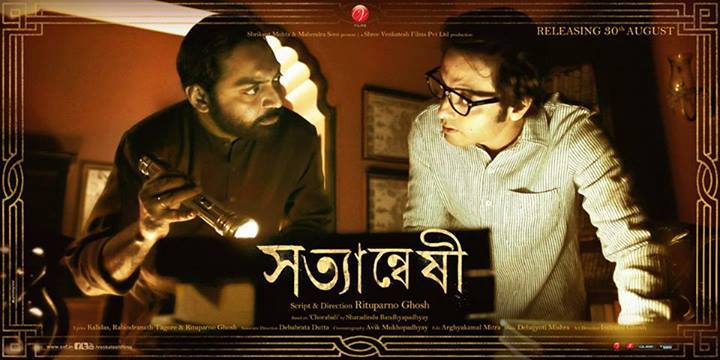
Filmmaker Rituparno Ghosh passed away earlier this year just after completing the shooting of his film on Byomkesh Bakshi. The makers have completed the film and it is ready for release. It’s based on “Chorabali” by Sharadindu Bandyopadhyay.

The film also marks the acting debut of filmmaker Sujoy Ghosh in the lead role of Byomkesh Bakshi.

Here is the first trailer of the film

Official synopsis – Maharaja Arunangshu, the ruler of a princely sate named Balabantpur, had made a wish list on his death bed in the presence of Dewan Chandrashekhar, the family physician Kaligati and the High Priest. It laid down certain conditions for his heir, his son Himangshu. The first of which forbade Himangshu from marrying a non Hindu girl, and the second demanded a legitimate heir within three years of his marriage. Bound by his father’s conditions of succession, Himangshu is compelled to marry Alaka, an aspiring actress.

A year and half into the marriage, Harinath, the young palace librarian disappears without any trace. This mystery occasions the arrival of the sleuth Byomkesh and his author friend Ajit to Balwantpur. The visit though is under the pretext of an invitation for a hunting expedition. In course of their stay, they unfold many secrets involving the residents of the palace and about the topography of Balwantpur.

Film : Satyanweshi.
Starring : Sujoy Ghosh, Aninda Chatterjee, Indraniel Sengupta, Arpita Chatterjee, Sanjoy Nag, Shibaji Bandhopadhyay, Anandi Ghosh
Producer : Shree Venkatesh Films
Presenter : Shrikant Mohta & Mahendra Soni
Direction : Rituparno Ghosh.
DOP : Avik Mukhopadhyay
Music : Debajyoti Mishra