Archive for the ‘Workshop’ Category

 NFDC recently organised the first Directors Lab. One of the participants of the lab, Vasant Nath, Director, Sebastian Wants to Remember (SWTR), writes about his experience of this 2-week residential workshop which was held in Pune recently. And since many of us had doubts about its fee, he also clarifies on that front – was it worth it? If so, why and how.

Vasant Nath’s drama SWTR found an Indian co-producer in Kartikeya Narayan Singh’s production house The Film Café. SWTR is the story of an aging photographer who loses his memory and must embark on a daunting journey with his wife in search of his past. It was selected for NFDC Screenwriters’ Lab 2011 and Co-production Market 2012.

Over to him now.

(Click any of the pics to start the slide show. Hold your cursor on specific pic, details will pop up)

I did not go to film school, I learned whatever I know of filmmaking on the job and through self-study.  Working in production for five years gave me some technical skills.  Working on other people’s screenplays as a creative assistant to another filmmaker taught me the basic mechanics of screenwriting.  Making some short films put me on the path towards finding a personal voice.  Meeting a dead end in my career as an assistant made me try working independently.  That was five years ago – when I wrote my first original feature-length screenplay – ‘Sebastian Wants to Remember’.

‘Sebastian’ has had a long (but necessary) development process – eight drafts till date.  I’ve been fortunate enough to have some excellent mentors during this process, and the steady effort has borne fruit.   The screenplay is in good shape and should serve as a reliable blueprint for the film’s realisation.  However, ’Sebastian’ is by no means an easy film.  It’s a road movie with a 70-year-old amnesiac as the lead character, and he doesn’t talk much.  The story structure is interspersed with flashbacks that introduce a cocktail of emotions to the protagonists each time they happen.  Over the many rewrites, my second character has started competing with the primary character for point of view.  And there are some tough sequences that I have blithely written without the slightest inkling of the challenges they will present when I have to film them.

I’m very happy that I did not let such anxieties limit the writing process, but now, as the time to step out of the secure confines of the writing room draws near, I am visited by a recurrent nightmare where I’m on set as director with a large crew looking to me for instruction…and I have no idea what to say to them!  Initially, I drew comfort from the thought that things would take care of themselves once I start making the film, and that doing was the only way to learn.  Of course there is truth in this, but this film – even looking at it just in terms of scale – is unlike anything I’ve ever done before.  I will have to be extremely well-prepared, and I’m going to be of no use to anyone if I go into the whole thing cowering like a scared rabbit.

Indian filmmakers live in very fortunate climes today – because Marten Rabarts is in the house.  As Development Consultant to the NFDC, he has streamlined the organization’s agenda to work on our filmmakers from the roots and has fuelled its engine with the best development talent from across Europe.  This, coupled with the environment for exchange and collaboration that NFDC’s Film Bazaar provides, is extremely fertile ground for new voices to flourish and for a film like mine to find the support it needs to get made.  By the time I applied for the Director’s Lab, I had already been a sort of crash-test dummy for the other NFDC labs – usually one of the first to apply, usually to be found in the front row taking copious notes once they happened.  By the time I heard of their Director’s Lab, I already had great faith in such endeavours: the NFDC’s 2011 Screenwriter’s Lab I participated in represents perhaps the sharpest learning curve I had experienced till then.

Udayan Prasad is both a teacher and a director – known for his films ‘The Yellow Handkerchief’ and ‘My Son the Fanatic’.  He teaches this director’s lab in the UK, sometimes at the National Film and Television School, and sometimes in London as a three-week summer school.  Here, he had crafted a two-week program that fell somewhere between the longer and shorter versions of his usual course in Europe.  Before arriving, I had wondered how much ground he would be able to cover in this short a time, but there was no way of telling beforehand.  However, once it started, Udayan’s lab was like a feeding frenzy.  Every day of the twelve days that we were there (cooped up in the Marriott Courtyard Hotel in the middle of Pune) we were encouraged to repeatedly bite off more than we could chew with the assurance that the digestion would happen later.

This was the NFDC’s first director’s lab, and – except for maybe three of us – most of the participants were at very early stages with their films – some of them didn’t even have first drafts yet.  I initially feared that I was attending another (very expensive) script lab, because the format of the first two days was more or less identical to that of the opening of the screenwriter’s lab I had attended in 2011.  In both scenarios, it was necessary for the participants to share their stories and visions with each other with as much honesty as possible.  It is a very testing task – both the sharing and the listening.  While telling, you feel that you are suddenly admitting a whole bunch of voyeurs into your head.  While listening, you feel embarrassed for being held privy to the intimate inner worlds of eleven strangers.  But eventually, it turned out that this had immense payoffs for the work we had come there to do.  In my experience with labs, it has been quite clear that any sort of filmmaking workshop can only succeed in an environment of trust.  Through this process of sharing, we grew to recognise the common craziness that united us and brought us there.  As neophytes filmmakers, we all knew something of the anxieties each of us suffered because of the familiar challenges our work presented.  Constantly encouraged by our mentors, we were really starting to trust each other by the time we got to the real meat of the workshop.

Our time was interspersed with lectures, ‘workshop-y’ stuff, master classes given by established industry professionals, film viewings and individual consultations for script and production.  Almost every minute of the waking day was taken up by these for twelve consecutive days.  Whatever was left was spent (at least by me) nursing exhaustion.   As Udayan kept telling us – we were getting what we paid for.  It was only fair!  The whole workshop was consciously kept non-technical and perhaps this came as a surprise to some of the participants who had come there expecting to work with cameras et al.  Udayan focused instead on things that led to good technical choices – with an emphatic emphasis on using all tools available to serve the stories we wanted to tell – trusting that we’d be able to take care of the technical training ourselves.

Acting exercises made up a very large chunk of the workshop – perhaps the most hands-on and ‘workshop-y’ section of the whole experience.  I have done other acting workshops before and what I learned here was that acting workshops oriented towards actors are quite different from acting workshops oriented towards directors; even though both start pretty much from the same place.  A director-oriented acting workshop eventually has to serve the director’s requirement of giving actors the right environment they need to thrive in, and actor-oriented acting workshops do not go that distance because they do not need to.  I found these sessions extremely useful.  The exercises we did here allowed us to experience first what an actor does and then showed us what an actor finds useful in trying to arrive at the right sort of performance.  It was all very practical and methodical – we got to test many tools and techniques even in the short time we had.

The acting exercises proceeded into another very useful section – Scene Analysis – where we had two very accomplished actors – Adil Hussain and Tannishtha Chatterjee – as our clay.  Having already spent two days in the actors’ shoes, we had been sensitised to the challenges they face when receiving instruction from a director that just isn’t playable.  Udayan had been drumming a discipline into our heads – to use verbs instead of adjectives in our instruction; to convey the facts of the script in a systematic way.  With Adil and Tannishtha, we put Udayan’s instructions to work and watched in wonder how a basic line-reading of a script turns into a performance full of genuine feeling and surprise when an actor is provided with the right information, in the right quantity at the right time.

Very soon, we were thrown into the nerve-wracking scenario where we had to put these techniques into play with professional actors (mostly very generous acting grads from FTII) with scenes from our own films.  This was probably the very first time any of us had realised anything from our pages, and it was frightening.  But better to feel the shivers here than on set!  I was given three young actors for a scene that involved two old people…and little else.  The actors knew nothing of my film and I wanted to transfer all my knowledge of the story to them via firewire so that they could quickly enact the scene in my head and be done with it!  But of course, that was not possible.  What was possible, though, was falling back on the techniques that Udayan had taught us –  basic principles of sharing information slowly and carefully, leaving room for the actors to bring something to the scene.  As I got into the flow of the exercise, that’s exactly what happened.  My actors brought a lot to the scene.  In just a couple of hours, they were showing me things that I could never have accomplished while working alone on the page as I had done till then.  Then another problem arose – they just kept on giving!  I had gone from feeling very excited by a lot of new interpretations of my material, but suddenly it felt too much to work with.  Then I took a deep breath and started making decisions…

I may never have five hours to rehearse a one-page scene in an actual shooting scenario.  But the process of going through this exercise – feeling the fear, smelling the failure, being unsuccessful at realising the film in my head, righting myself, making decisions under pressure (even though simulated), trusting a technique, giving, receiving, disciplining myself to only give playable action – all this was f*****g priceless!  Udayan was in and out of the room right through the exercise.  He has this x-ray vision that could diagnose what we were doing wrong within a few minutes of watching our work.  He didn’t go easy on us, and I am very happy he didn’t.

By the time I got through this exercise, the lab had begun to seriously work upon me.  I was already looking at my material differently.  It wasn’t that I was distrusting everything I had written till then, but I was recognising how far the writing had got me and where I needed to steer the process from here on.  There would definitely be some re-writing – I came back from the lab and quickly shot off a fast polish to my producer – Draft 8.1!  Suddenly, there were so many new things to think about.  There was already a greater sense of empowerment when looking at the many difficult choices that lay ahead when I make ’Sebastian’.  At least I knew where to start thinking about the things I’ll need to say to my waiting crew when my nightmare revisits..!

We touched upon various aspects of film craft – production design, cinematography (and point of view), sound – through master-classes and lectures.  The master-classes did well in keeping the theory grounded.  But even with Udayan’s lectures, I never for once felt that we were all sitting in some sort of ivory tower – everything Udayan talked about, he always connected to his experiences as a filmmaker or to the real-world experiences of filmmakers he knew or had studied.  He often invited the professionals conducting the master-classes to comment on the concepts he outlined.  In all sections of the workshop, Udayan’s teachings were a distillation of a very large cross-section of filmmaking traditions.  He brought with him a clear understanding of where these traditions came from, how they could be applied, where they succeeded, where they failed, how they evolved, and – most importantly – what worked well for him in his experience as a filmmaker.   All the theory was accompanied by clips of films that demonstrated the corresponding concepts in successful execution.  The workshop was thus also very enriching in terms of the reading lists and watching lists that Udayan left us with.

The individual consultations for script and production were a very necessary component of the lab, since the participants were each in very different stages with their projects.  I believe it allowed the mentors at least some room to tailor their guidance to each participants’ particular needs. More consultants were brought in for this – Urmi Juvekar, Priya Sreedharan, Shivani Saran – some of whom (along with Marten, of course) represent for me what I call “the NFDC ecosystem” – something that I have come to trust implicitly in my career as an NFDC Lab crash test dummy.  This ecosystem is becoming better with each passing year, and hopefully – in the foreseeable future – when the corresponding production and financing side of the NFDC stands on steadier ground with as great a confidence as its development arm, we will witness a thriving harvest of great new films, in greater volumes, year after year.

By the time we pitched our projects again at the end of the workshop, the difference was apparent.  Some of the participants had made some giant leaps with their material.  They stood on surer ground, knowing exactly what they had to do next. For some, the leap was about being able to kill some of their darlings: things that needed to be unhinged before they could move forward – and imagine how deeply they must have been anchored in their darlings if it took two weeks to unhinge them!

Overall, a lot of ground was covered, but I missed a section on the role and dramatic purpose of Music, only because Udayan had been so comprehensive and enlightening about the other components of film craft that he’d addressed.  Some of the participants were keen on squeezing in a session on comedy, but sadly there just wasn’t any time.  Still, the whole group showed a very strong commitment to the workshop and its structure and I feel that this was one of the main reasons for its success.  The ‘workshop environment’ dictated that every exercise we did was reviewed both by our peers and by our mentors.  We became each others’ first audiences with the added advantage of being able to express and listen to feedback articulated after every presentation.  And none of this would work without the trust I spoke of earlier, consciously cultivated by our mentors.  Because of it, we were able to repeatedly fail before each other without fear.

For me – I left the lab with a greater, deeper engagement with my film.  I remember that it felt almost exactly how it had felt when I finished the 2011 screenwriters’ lab with Marten as my mentor.  Even though it had been such a sharp learning curve for me, it had taken a good two or three years of applying the lab’s principles in various screenplays before I acquired a confident, working knowledge of them.  I take it that it’s going to be the same with Udayan’s teachings; I will have to apply them over and over until they set in.  Apart from everything that he taught us about the craft of our work, I also thoroughly appreciate how Udayan kept telling us time and again about good work practices – simple things like acknowledging your crew at the start of the day, thanking them at the end of it; especially important in our country that subscribes so heavily to ‘the cult of the director’.

I don’t think I can end this review without a comment on the lab fee, because I know so many filmmakers who wanted to and deserved to do this lab but simply could not afford to.  While I feel that the experience the lab afforded me was worth every paisa, Rs. 1.5 lakhs is not a small amount for anyone to pay, especially if their projects do not have funding.  That said, I also think that it was a very brave move by the NFDC and the Lab team to actually take the plunge and hold the lab despite all the protests they must have received about the fee.  I sincerely believe that it is a great precedent.  Only time will stand testament to the actual success of the lab – in terms of how many participants end up making their films successfully – but I have a very good feeling about it.  I do hope that some subsidies come into play soon that lower the cost for the participants, because it will really allow the lab to contribute more fully to the NFDC’s long-term development goals.

With regard to my co-participants’ responses – overall, I saw more smiles than frowns.  I think we all knew that a mountain of work was waiting for us when we got back to the real, non-workshop world.  There were some in the group who were still negotiating with the decision to commit fully to this perilous career – and I could feel their anxiety in the face of the big decisions that lay ahead.  But I think that they knew that this was a good thing.  Good workshops are meant to make you go green.  The work that you do afterwards is the only effective antacid.   I wish my co-participants a happy digestion!  I thank Udayan, Marten and the NFDC – Leena who helms the their lab program, and Mayur who helped execute our twelve days so efficiently – for this wonderful learning experience.

(Vasant Nath’s ‘Sebastian Wants to Remember’ is being produced by Michael Henrichs of Berlin based Die Gesellschaft along with France’s 24 Images and Kartikeya Narayan Singh’s The Film Café.  It is currently in financing, having received EU Media Development Support in 2013, expecting to start production at the end of 2014)
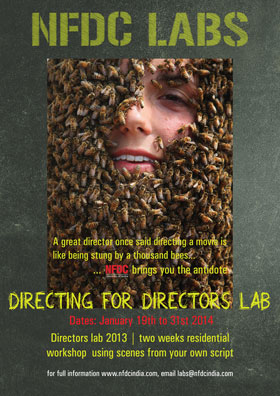
Directors-LabWHAT : NFDC LABS – 2 week, fully residential workshop challenges and empowers directors to enhance, fine tune and balance these complexities.

– Working with actors and script is at the core of this programme and each participant will workshop and develop his/her approach to scenes using scripts provided but also work-shopping scenes from their own upcoming films.

MENTOR : The full time two week programme lead by London based director Udayan Prasad (My Son the Fanatic, The Yellow Handkerchief) and professor of Directing at the UK’s  NFTVS -National Film and Television School, and LFS-London Film School among others.

PROGRAMME :

  • Acting for Directors – being on the other side of the camera.
  • Working with actors and the value of understanding the various processes actors employ in inhabiting their characters
  • Preparing a scene: the building blocks for directing actors
  • Casting – Masterclass & individual consultations
  • Opening reels; a look at the ‘set-up’ from various movies.
  • Point-of-View  – Masterclass
  • Dialogue in cinema.
  • Examination of story, structure and form
  • Screenplay & Writing : Masterclass
  • 1 to 1 script consultations on each directors script from internationally renowned script editors.
  • Use of dramatic space and light in movies.
  • Light, space, colour, framing and movement : Cinematography – Masterclass
  • Music & Sound in film  – Masterclass
  • Choice and manipulation of space : Production design – Masterclass
  • Film screenings and analysis will be used throughout the lab.

– The workshop is designed and will be lead by Udayan Prasad and he will be joined by top professionals* from the industry who will share world class knowledge of their particular discipline.

– Accomplished and acclaimed actors* will add their talent and craft to the scenes which will be work-shopped throughout the programme, and share their personal feedback and experience with the participating directors.

ELIGIBILITY (Profile of Directors) : This lab is for working film directors with experience and/or training in the field.

APPLICANTS : should be currently preparing to shoot a feature or short film script which is moving towards production, and be prepared to workshop scenes from their script within the lab.

WORKSHOP DATES : January 19th to 31st 2014

PARTICIPANTS : Strictly limited to 12, by application and selection.

LOCATION : The ‘Directing for Directors’ lab will be held within a hotel/resort style setting within driving distance of Mumbai, but outside the city to allow a full creative retreat experience to unfold.

APPLICATION FFE : Rs 500

FULL LAB FEE (on selection): Rs 1,50,000

– Food & accommodation is included in the fee.

* additional experts and actors will be announced in 1st week January.

– To know more about the lab and to apply, click here.

We have been thinking about having some filmmaking workshops on a regular basis. It started with our cinematographer friend Mitch aka Mithun Gangopadhyay taking the initiative to conduct a basic cinematography workshop. It was going to be free of cost but logistics always requires money. Thankfully, the nice guys at Babble Fish Productions and LighNLight helped us with the venue, cameras and lighting gear for the workshop. Mithun put out the details on FB group “Crew Call India” and it was open to all on first come first serve basis.

Now that we have tasted blood and it was quite awesome, we have been thinking about making it a regular feature – with screenwriters, cinematographers, production designer, sound designer and the usual suspects.

This is where we need your suggestion and help. The idea is to invite the talent (hopefully there are enough interested souls who would like to share their knowledge) and we figure out the rest. The idea is to keep it free and do it regularly. Suggest and help us with answers to these three questions.

1. What we need – place (at least for 20/30 people to sit) – Do you know anyone who can help us with a place? Either for free (best possible solution) or with nominal charge (we split the cost). Ideally between Bandra and Andheri.

2. If the place is free, a big headache is gone. If we have to pay for it, how much you guys are willing to pay for, say 4-6 hours workshop?

a) less than Rs 500 b) Rs 500 c) Rs 1000 c) more than Rs 1000

3. Any more ideas/suggestions that you have in this regard that will help us make it possible.

Please reply in the comments section under 1, 2, and 3.

Coming back to the first workshop, here are some of the notes that Kartik Krishan managed to take down. Hopefully it will help you.  Over to KK.

Our dear cinematographer friend Mitch held a Basic Cinematography Workshop for aspiring directors at Bablefish compound in Lower Parel. It was meant to be an educational non-profit workshop. Have taken few notes and thought it would be good to share it here. Apologies in advance if I have wrongly quoted him. In case you are interested, Mitch is doing another one on Aesthetics this weekend (he is busy or pretending so).

It’s a very interesting yet difficult time to be a filmmaker. Interesting because Technology is cheap and resources are easily available. But difficult because anyone and everyone can do it. Earlier it took a certain journey to become a filmmaker. Now anyone with a camera claims to be one. To be a filmmaker one has to have something to say and one has to know the tools. For eg: if the camera breaks down, I can’t fix it. But I know how to use it.Cinematography cannot be taught in a day and I will not get into aesthetics at this stage. I will try and cover the gear – how to use it. And also how a director should try and communicate with the DoP. Sometimes even great directors cannot communicate their thoughts/ideas to the crew. Simple things like – framing, headroom etc. Does he want tight controlled frames or loose frames? A DoP should be told what is needed. Eg: A Dir says ‘I need a 4 shot’. So I understand that he wants four people standing in a shot. So I accordingly light it up. But then later he says no just all their faces in a tight frame. I just spent 30 min on lighting when it could have been done in 15 min. What will make a frame/scene look good ?Not just the cinematographer. But production design is 90% of ‘good cinematography’. Then Lighting. A white wall cannot be made to look good. I need character. Eg: Graffiti etc. I sincerely recommend all Dirs & aspiring Dirs to put money in Production Design. Lighting can be done in china bulbs if it is a great looking set. Most of the daily soap sets on TV are so bad that no matter what you do, it won’t look good. Get a good production designer. There Will Be Blood’s DoP thanked the Production Designer in his Oscar Thank you speech. Something looking great to eye can be easily made to look great in camera. Something looking shitty to the eye, it’s quite tough to make it looking great in camera.ASPECT RATIO – CURRENT/RELAVENT4/3 – like the Old TV screens – full gate academy aperture. Everything started with 4/3. Most TV was 4/3. Nowadays even most commercials are in 4/3 safe. I recently did a commercial for Govt of India for which I shot on Alexa – 16/9. But the master went in 4/3. Because the target audience was rural India. ‘No’ – the recent Chilean film was done in 4/3 – shot in a Beta Cam – retro look. Andrea Arnold the director of Fish Tank shoots in 4/3 and she makes great films. I completely agree with her decision to shoot her films 4/3.16/9 – standard HD aspect ratio for all digital cameras. Red, 5D, Sony, DSLR, Alexa – AD films, TV. The standard format.

CinemaScope – 90% of the films shot in India is reduced to Cinemascope (anamorphic  2.35/1). Nowadays if you don’t have cinemascope format the distributors say ‘Picture mein scale nahi hai, hum nahi khareedenge’. We cannot dictate terms on this. I remember Dilli 6 was shot in 1.85 aspect ratio but the distributors raised a hue and cry about it. But the makers said ‘we’re going to go with this format only.’ So the distributors relented. Another example is the great Vittorio Storaro. I learnt cinema by watching his films. In the past 10 yrs he has proposed a new aspect ratio of 2/1 which is somewhat akin to the Renaissance paintings but no avail. Even he couldn’t change the system.

Super 16/35 vs 16/35 mm – in the latter they use a little bit more of frame (from sound). Look of super 16 is grittier-raw. I feel it is a pretty good format. Before DI, earlier super 16 used to be blown up in 1.85/1 (abroad format). 1.78/1 & 1.85/1 are quite similar. The difference is negligible.

There is no point shooting anamorphic if you are shooting in a classroom. Ever since DI has come they don’t rent anamorphic lenses (because they are slow, heavy and expensive). They usually shoot 16/9 and crop it to anamorphic.

Faster lens means smaller F stop. 1/3rd lets more light in lens than 5/6th. The minimum opening of a lens determines how fast or slow it is.

Roger Deakins hates RED cameras. Both the eyepiece and monitor cannot be played at the same time without an additional component. The Alexa is a closer transitional phase camera. Bhaag Milka Bhaag was shot on Red epic. Matru on Alexa.

CAMERA FORMATS

Super 8 – lots of films. For the vintage look.

Super 16 – Dhobhighaat. Zinda. Good for costs. My fav format ever. Nowadays 50D or 500T is available.  Fuji 160D was the most beautiful stock available earlier. Now it’s no longer there.

Just coz it’s on film,  doesnt meanit’s good. I’ve seen stuff shot on 5D which looks better than most films. What you put in front of the Lens is more important than what is behind it. The Production Designer, Actors, Lighting etc is more imp than what camera you are shooting in.

While shooting Day for Night – just ensure some basics are taken care of – like not pointing to the sun, take care of the shadow detail.

Most DoPs are not involved in Grading. It’s much easier to grade an Alexa/Sony image than a Red image.

Days of Heaven was shot only on Magic Hours. Magic hour for film is usually 15 min, for digital it is 20 min.

Upstream color is a great looking film which I believe is shot on GH3 cam (Cheap) but still it looks better than 80% of the films. There’s no hard and fast rule.

Half the film Biutiful – is shot in 1.85. The minute the workers die in the warehouse, the film shifts to Anamorphic.

35/Super 35 mm – Alexa, Red, C300/C500 have super 35 sensor. It is the default camera sensor size.

65/70mm & IMAX

DIGITAL

SD – Standard BetaCam/PD 170. 640X480 is SD. Most of the films on TV are SD.

HD – High Definition >= 720p. Has a progressive image. The i in HDi mean interlaced image. All film is 24fps. All TV in India is 25fps. Hobbit was done on Red 3D 48fps. All HD broadcast in India is 720p

True HD – 1080p and above

Ultra HD – 4K and above. The future is Ultra HD.

CAMERA SENSORS

CCD – Older Technology. Not great in low light

CMOS – used in High End cameras. CMOS sensor is better. 5D has a CMOS sensor. The problem with Rolling Shutter is – the image wobbles when you pan fast. The new Sony Cam has Global Shutter.

US is NTSC. India is PAL 25fps.

5D – 5D has a full frame sensor. It was always a stills camera for photo journos. Then they asked for a video recording facility. Over time one could control the camera. Pretty soon everything changed. Docus, Music videos, low budget ADs were shot on 5D, because of the shallow depth of field.

I was shooting a documentary on kids in foster home (where the kids were talking about the physical/emotional abuse they have suffered in their lives). I kept telling the Dir to shoot on a 1/3 Inch camera to capture all action and movement, but he insisted on 5D. The kids were talking extempore. The Dir wanted tight cuts. What will you do with a shallow focus in a classroom ? Most still lenses are not parfocal lenses (Zoom karne par focus chala jaata hai). The truth is that though most Docus are staged but sometimes doing extempore on 5D is tough. One has to be mindful of these things.

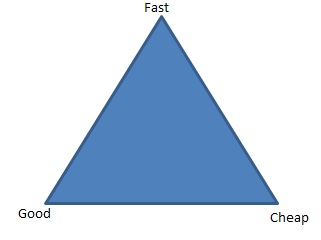
Most of the trade off in filmmaking is this – you will only get two of the three factors right at a time.

Rule of filmmaking

Earlier when using Film, there would be in camera rehearsal. Nowadays there’s no rehearsal blocking done. That is the reason most Indian films look flatly lit. Because the Dirs say – ‘lighting kar de, blocking baad mein dekhte hain’. Making films is a crew making/management deal. Right person and right tools.

LENSES

Spherical (95% of all lenses) & Anamorphic (Special lenses – heavier, expensive, time consuming). Usually spherical lenses are used most of the times. Super Wide, Wide, Normal, Telephoto, Super Telephoto Lenses.

Usually 85-135 lens is a long lens, used more portraits. Exception- in Amelie, all CUs are shot in a wide angle lens!

Cooke lenses – (British) good romantic high end lenses. Used in Drive.

Zeiss – Used in Skyfall

Master Prime – the sharpest lenses in the world. Soft, sharp, Bokeh, depth of field, flares

Film is a SOFT medium. The old lenses will flare (no coating).

LIGHTING

Color Temp – Each light has a color temp. Daylight is 56K Kelvin. Tungsten household bulbs etc are 32K.

Sony F65 has a tungsten sensor, Alexa – Neutral Sensor, Red – Daylight Sensor

You can mimic daylight with HMI (white light). 100 KV HMI = 10,000 volts light

Tungsten light – if you want a face to look good, this is the best light. Although it is inefficient as it becomes very hot. It has 92-93% Accuracy Color Indentation Index (average ‘good’ is considered to be 85-94%).

Florescent Lights – eg Kinoflows – can give you both Tungsten light & Daylight. Has 89% Accuracy Color Indentation Index.

LED Lights – Not as powerful. Color Tones are also inconsistent. It’s basically an array of lights. Portable and can run on a battery for an hour. Cheap. No clean shadow. The smaller LEDs are called Rosco lights.

You can dim down HMI & Tungsten but you cannot dim down Florescent/CFL. Tree of Life – was shot completely in natural light.

HMI – most popular. 575 HMI is equal in power to 2K Tungsten Light. Though more expensive to rent. But it is more versatile. A ‘joker’ is an 800 Watt HMI.Half Light – only one side of face is visible

Hard Light – gives a very pronounced shadow

TECHNIQUES

FRONTAL HOLLYWOOD LIGHTING – to make everyone look good. The shadows are below the face. With a bounceboard (thermocol) below the actor’s face. This is the best way to light an actress.  In Fashion photoraphy – uppar se soft light aur neeche se reflectors.

Frontal Hollywood Lighting
CTO – makes daylight into tungsten

Diffusion – makes light softer (Tracing paper)

In Godfather one cannot see Brando’s eyes (managed by Top light). There’s always skunk eyes (dark shadows on eyes)- that’s the idea.

In Scandinavian countries – it’s always gloomy, rainy, cloudy. The natural light is soft light, diffused.

Always put color before diffusion paper

REMBRANDT LIGHTING –  Light is on the right or left side (45 degree to face). Most classical paintings. Dramatic High Contrast.

Rembrandt Lighting

BUTTERFLY LIGHTING – In between Hollywood & Rembrandt.

Film Noir is usually Hard Light. Like Sin City. A Rom Com is usually Soft Light.

Let the Right One is great because for a horror film, everything is so brightly lit

* Check out the Light ka swash book (similar to the color palette that Art Dirs carry)

THREE POINT LIGHTING – Key light to light your actor/product. The most imp light on the key side of the face. It is what gives illumination to the scene. You want to shoot mostly in the Fill side not the key side. Camera is facing Shadow side and then you put a fill light to show the face. There’s usually a 2 stop diff between the Key & fill.

b3-three-point-lighting

If the fill light is behind the actor then it is Backlight/Edge. South Indian films are back lit heavy.

COVERAGE

A shot list is important so that everyone in the crew knows what you want. Storyboards are a MUST on low budget films as opposed to Big budget films. The idea is that first actors blocking & camera rehearsal is done only with the HoDs and then the actors can be sent for makeup/costume while lighting can happen in the background.

SOFTWARE HELP 

Artemis (Viewfinder) – you can save it and print it out too

Helios (for DoPs) – Tells you the position of Sun

P Cam (for DoPs) – Lighting Software

Tech Scout (for DoPs) – Lighting Requirement

NFDC Screenwriter's Lab

NFDC has announced the list of finalists for NFDC-TIFF Screenwriters Lab which will be held during the Toronto International Film Festival, 2013.

Here are the six finalists  for NFDC Screenwriter’s Lab 2013.

1. Chingari (The Spark) by Rajesh Jhala

2. Dainik (The Daily) by Nikhil Mahajan 

3. Kaalapani (Dark Waters) by Bela Negi

4. Maa Bhagwatiya IIT Coaching  (Mother Goddess IIT Coaching) by Varun Grover

5. My Brother the Salesman and I by Shanker Raman

6. T se Taj M se Mahal (T for Taj M for Mahal) by Ashish Srivastav

Yay! Especially for Varun Grover. Those of you who regularly follow our blog, must be aware that he is one of our regular writers. Some of us have read the script and it’s a terrific one. Hopefully it will get made soon.

All the best to to all the finalists.

Mahindra Sundance1

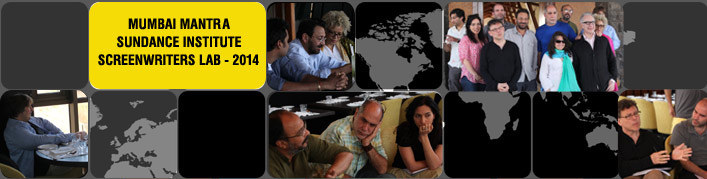
WHAT:  Following the template of the world renowned Sundance Institute Screenwriters Lab, that is held at Park City, USA, the Indian Screenwriters Lab is a five-day writer’s workshop that gives independent screenwriters the opportunity to work intensively on their feature film screenplays with the support of established screenwriters. Mumbai Mantra has collaborated with the Sundance Institute and established India’s annual Mumbai Mantra | Sundance Institute Screenwriters Lab.

Project Selection :

—> 6-8 projects shall be selected for the Screenwriters Lab. All Indian nationals as well as Indians living overseas, people of Indian origin and mixed Indian parentage are eligible to apply.

– Only those who are working on their first or second feature film project shall be eligible. However, they may have worked on documentaries, shorts, advertising films in the past

– The screenplay can be for a film in any Indian language including English. However, the application must be in English, as it is the medium of communication at the Lab.

– Incase there are two writers working on a a screenplay, or a writer-diretor working together on a project, both would be invited to the Lab if selected.

HOW : All you need is 1. A synopsis 2. First five pages of your screenplay 3. An artistic statement 4. A cover letter for the first round.

ADDRESS :   You have to send your submission via post. Materials will NOT be accepted electronically.
Mumbai Mantra | Sundance Institute
Screenwriters Lab Application March 2014
Mumbai Mantra Media Ltd.,
Mahindra Towers, 5th Floor, Worli, Mumbai-400018.

DATE : Last Date for Open Submission: June 1, 2013

– Date for submission of Complete Draft of Screenplay (next round) shall be informed later to selected candidates.

CONTACT :  If you have any more queries related to Mumbai Mantra| Sundance Institute Screenwriters Lab 2014, you can contact them at labqueries@mumbaimantra.com

– For more info on the lab, selection process and all other details, click here.

– If you are wondering what exactly happens at the lab and if at all it’s helpful or not, click here to read Renuka Shahane’s blog where she has written 5 posts on her experiences. Her script was in the lab this year.

– You can also click here to read Vikas Chandra insightful post. His script was in last year’s lab.

Film Writers Association (FWA) has announced the 3rd Indian Screenwriters Conference. The central theme this year is “Untold Stories : Screenwriting and the truth of our times”.

– Venue : Venue: St. Andrew’s Auditorium, Bandra (W), Mumbai

– Dates: February 25, 26, 27, 2013

– Only FWA members can attend. So if you are not a member of FWA yet, do become one. Click here to go to FWA site for more details.

And here’s the programme detail..

screenwriting-215x300Day 1 – Monday, February 25

1000-1020: Introduction to the Conference by Convenor & Co-Convenor, ISC

1020-1030: Welcome Address by President, FWA

1030-1100: Minister HRD (expected) declares the Conference

1100-1130: The Chief Guest’s address

1130-1145: Tea/Coffee break

1145-1230: Keynote Speech by Shiv Vishwanathan

1230-1300: Audience Q&A with Keynote Speaker

1300-1400: Lunch break

1400-1545: Do screenwriters have a social responsibility?

Moderator: K. Hariharan

Panel: Javed Akhtar, Tom Schulman, Rakeysh Mehra, Girish Kulkarni, Dr. Chandraprakash Dwivedi, Vinod Ranganath, Gajra Kottary

1545-1600: Tea/Coffee break

1600-1745: How does our popular cinema and TV portray women?

Moderator: Ranjani Mazumdar

Panel: Ashutosh Gowariker, Anurag Basu, Kumara Raja, Preiti Mamgain, Satyam Tripathi, Ila Bedi

Day 2 : Tuesday, February 26

1000-1130: The charge of the new ‘write’ brigade!

Moderator: Pubali Chaudhuri

Panel: Juhi Chaturvedi, Habib Faisal, Ravi Jadhav, Akshat Verma, Reema Kagti

1130-1145: Tea/Coffee break

1145-1330: Is the old order cracking? New ways of storytelling.

Moderator: Govind Nihalani

Panel: Urmi Juvekar, Anurag Kashyap (TBC), Sanjay Patil, Bejoy Nambiar, Abbas Tyrewala

1330-1430: Lunch break

1430-1600: What is driving TV content? Is it changing? Can it?

Moderator: Saurabh Tewari

Panel: Tripurari Sharan, Vivek Bahl, Sukesh Motwani, R.D.Tailang, Charudutt Acharya, Gul Khan

1600-1615: Tea/Coffee break

1615-1730: The new brigade of TV!

Moderator: Anuradha Tewari

Panel: Raghuvir Shekhavat, Mihir Bhuta, Amal Donvar, Swati Pande, Chinmay Mandlekar, Mrinal Jha

Day 3 : Wednesday, February 27

1000-1145: The empty playroom. Why such few children’s films?

Moderator: Chandita Mukherjee

Panel: Gulzar, Nila Madhab Panda, Preiti Mamgain, Farhan S., Anand Sivakumaran

1145-1200: Tea/Coffee break

1200-1330: The light through the fog: Implications of the amended Copyright Act for film and TV writers

Moderators: Rajesh Dubey & Anjum Rajabali

Panel: Souvik Biswas, Nikhil Krishnamurthy, Sai Gopal, Ameet Dutta

1330-1430: Lunch break

1430-1545: Writer-Producer Bhai-Bhai! The Minimum Basic Contract for film writers

On stage: Dharmesh Tiwari, Vipul Shah, RameshSippy, Nikhil Krishnamurthy, Anjum Rajabali

1545-1600: Tea/Coffee

1600-1730: The way forward! What FWA has for you in the next one year.

On Stage: The Executive Committee of FWA

Conducted by: Vinay Shukla & Kamlesh Pandey

1730-1745: Vote of thanks

– To know more about the topics and the speakers, click here and scroll down to “A MORE DETAILED EXPOSITION“.

– 850 screenwriters and writer-directors are expected to participate. This is the most important event for screenwriting in the country, and ought to impact the profession in a significant way.

– Confirmed participants include : Salim Khan, Javed Akhtar, Gulzar, Ashutosh Gowariker, Anurag Basu, Rakeysh Mehra, Govind Nihalani, Sriram Raghavan, Sudhir Mishra, Amit Khanna, Vipul Shah, Jabbar Patel, Vikramaditya Motwani, Bejoy Nambiar, Abbas Tyrewala, Amole Gupte, Habib Faisal, Navdeep Singh, Girish Kulkarni, Umesh Kulkarni, Lekh Tandon, Abhishek Sharma, Shridhar Raghavan, Kumararaja (Aranya Kandam), Rituparno Ghosh, Hariharan, Urmi Juvekar, Ishita Moitra, Manu Rishi Chadha, Leena Yadav, Prasoon Joshi, and others.

– Also, Tom Schulman (Oscar winner for ‘Dead Poets Society’) and Rebecca Kessinger (Asst. Executive Director of Writers’ Guild of America) will be there as guests since FWA and WGA are planning several collaborative initiatives.

(all info from press release)

– If you are completely clueless and confused whether to attend or not, click here and here to read our coverage of previous FWA conference.

screenwriting-215x300There have been some changes in NFDC’s Screenwriters Lab this year. And also there’s a new partner – Toronto International Film Festival. Scroll down for further details.

WHAT : In keeping with the mandate of promoting the development of the Cinemas of India, the National Film Development Corporation of India (NFDC) conducts the Film Bazaar Screenwriters’ Lab. The 2013 Lab will be in partnership with Toronto International Film Festival.

LAB : The Screenwriters’ Lab 2013 gives an opportunity to six independent screenwriters to develop their skill under the guidance of a variety of industry experts from across the globe. Through one-on-one sessions with their Mentors, the Screenwriter Fellows are advised on tools and techniques required to improve their scripts and methods to pitch the same in the international domain.

—> Selected screenwriters attend the first part at the Toronto International Film Festival and the second part at NFDC’s Film Bazaar, Goa.

The Screenwriters’ Lab is specially re-designed to prepare screenwriters with original Indian stories for working with the international filmmaking market.  The Screenwriters’ Lab also creates a unique opportunity for these scripts to gain a direct entry to the Film Bazaar Co-Production Market.

(Revised) Application Process :

– Apply before March 1, 2013 with your synopsis.

– Short listed participants will then be asked to submit their scripts by June 2013.

– Six participants will be declared in the month of August 2013.

General Rules

– This Lab is open only to Indian passport holders

– The selection process is in two parts. This is the first part of the selection procedure where participants will be shortlisted based on the submitted synopsis.

– Participants shortlisted for the second stage will be given a scheduled duration to submit completed scripts.

– Submission via email only as a single pdf/doc file. Do not send requisite material as separate attachments. No hard copy submissions are to be sent.

– Applications are to be sent to screenwriters-lab@fimbazaarindia.com

– Application Fee for the lab is INR 1000/- only. It is payable by Demand Draft made in favour of National Film Development Corporation Ltd payable at Mumbai or by Wire Transfer.

—> To know more about the rules, regulations, application form and the rest, click here.

From press release

~ Three final projects will be funded with rupees one crore each~

~The completed projects will premier at the Venice Film Festival 2013~

NFDC Labs, the training and development division of NFDC (National Film Development Corporation), announces the launch of a very exciting partnership with Venice Biennale, Venice Film Festival and Gucci. This partnership has been formed with an objective to reach out to the filmmakers community across the globe, with NFDC Labs reaching out to the filmmakers in India.

While the entire initiative will be sponsored by Gucci and Venice Biennale, Gucci will fully cover lab costs and accommodations for the resident workshop(s) and include the possibility of travel scholarships for successful teams selected from outside of Europe.

The initiative is a unique incentive for micro budget films from across the world, which will support teams of directors and their producers to make their first or second feature length audio-visual work. A community of selected film makers from around the world will work alongside an invited team of international experts and tutors to the aesthetics of micro-budget filmmaking and the new integrated models of production, which engage with an audience from the outset.

Modalities: After a first 10-day workshop in Venice for 15 selected projects in January 2013, up to 3 teams will be invited to a second 15-day workshop between February and March and supported with 150.000€ in order to produce and screen the projects at the 2013 Venice International Film Festival.

Commenting on the launch of the partnership, Marten Rabarts, Head- Development and Training, said, “It’s a very exciting initiative that we at NFDC Labs have partnered for with Venice Film Festival, and Gucci. With this we will leverage our platform and network to reach out to filmmakers in India and give them a brilliant chance to get work with a international experts and get funding for their project, once selected. Venice

The Call for Applications is open from the 30th of August 2012 to the 22nd of October 2012 only to teams of directors making their first or second feature and producers with varying degrees of expertise who must have produced at least 3 short films distributed and/or presented at Festivals. 

To know more about all the details, click here.

So what happens in a script lab? Does it really help? If so, in what way? – These are few questions that i have been asked many times since i attended the NFDC-Locarno script lab. Have been thinking about writing a post for a long time but never managed to do so. And so here’s Vikas Chandra‘s post about his experience at Mahindra-Sundance script lab. His script Toothache was one of the eight scripts selected for the lab this year.

To give you a better sense of  this post, am putting a synopsis of his script from the official release – Toothache is a bittersweet tale of a North Korean expat wife named Kim who lives in Delhi during the Emergency of 1976 with her husband – the couple yearns to be back in North Korea, but struggles to find a new and different idea of home in Delhi. Toothache celebrates of the tenacity of the human spirit, and re-affirms that the dawn approaches only after you have lived the darkest hour.

It’s bit long but a great insightful post. Read on.

When he was hired by director Walter Sallas to adapt Che’s memoirs into a film, Jose Rivera began, as he always does, by searching for an image that would propel him into the screenplay. Finally he got one, of a young Ernesto swimming across the river that separated the two societies of the San Pablo leper colony, which led to the central question of The Motorcycle Diaries – Which side of the river do you want to be on?

                                                                         * * * *

This year saw the launch of the prestigious Sundance Screenwriters’ Lab in India with the support of Mumbai Mantra, the media &entertainment division of the Mahindra group. (details here)

After a rigorous evaluation of more than 550 applications from Indian screenwriters across the world, 8 screenplays were selected to be mentored at the lab. The writers of these screenplays along with 11 highly distinguished advisors were then whisked away to an enchanting resort overlooking the Pavna lake near Lonavla, to lead a cocooned existence where the only thing that mattered was an unbridled exchange of ideas.

Over a span of 5 days, the screenplays were discussed threadbare by the advisors and the fellows in one-on-one meetings. Each fellow or writer was assigned 6 mentors, who would go on to give detailed feedback and initiate free-flowing discussions with the writer about their story.

It’s tough to encapsulate everything that transpired in those 5 days, but here I will try to give a brief lowdown on my experience at the lab.

Your donkeys are not carrying enough load!

In the beginning I had no clue on how to prepare or even what to expect from the lab. Worse, I was gripped with the fear that in no time I would be exposed as a writer!

What’s the inner motivation of your character? What’s her outer motivation? Can you draw the Story vs Character Arc graph? Who plays the Shadow archetype? Where is the Belly of the Whale scene? Where have you done foreshadowing in the script?

I expected to be bombarded with questions I had no answers to, at least not at that moment. With such apprehensions, I approached my first session, which was with Audrey Wells.

Thankfully nothing of the above happened.

We started talking about the central character in my script. Why did I choose my protagonist? What do I like about her? Can I connect her to my personal life?

Soon it became clear that the exercise was only about finding the spine of the story – my story. The discussion was rigorous. We went back to the genesis of the idea, the news article that sparked the film in the first place, and how it evolved over various drafts.

I am here to help you tell the story you want to tell

Once we managed to pin down the spine of the story in one line, it became a filter to sieve through the scenes and decide which of them were not working.

Audrey has a simple thumb rule for scene construction. Each scene is like a donkey, which has to carry the load of your plot.

“Is this scene giving me any new information about the character… Is it progressing the plot”

Well…umm….it further shows the cute husband-wife relationship

“It’s a beautifully written scene… but it doesn’t deserve to be here”

In a Kitty Party scene – What should the secondary characters chat about so that the scene doesn’t meander and remain relevant to the plot?

The protagonist’s problems. Other women will talk about their son’s achievements while your protagonist misses her son, they will talk about their wonderful marriages while your character puts up a brave smile. Whatever the others say has to drive another nail in the coffin of your main character.

Audrey is the writer of The Truth About Cats & Dogs &The Kid and writer/director of Under The Tuscan Sun, starring Diane Lane. Most of her stories have been about “sick people getting well”, in some way or the other.

The most valuable advice she has to offer to upcoming writers is – “Be kind to your back. Stand and write.”

Audrey is slated to begin shooting for her next film The Fugees, about a team of refugee soccer players coached by a Jordanian woman, and who go on to become an unlikely success. I cheekily told her that we already have a Bollywood version on similar lines!

What’s the last thing you would change about your story?

Asif Kapadia is a BAFTA award winning filmmaker, known for the visually striking The Warrior and the beautifully crafted biopic Senna. He describes himself as an outsider, making films that explore the live of “outsiders” living in time less, unforgiving landscapes.

“Why a North Korean couple? Why can’t they be a Punjabi refugee couple living in Delhi?”

This is the question I dreaded the most. My script Toothache is about a North Korean expat wife named Kim who lives in India with her husband – the couple yearns to be back in North Korea, but struggles to find a new and different idea of home in Delhi.When I had begun to write it, the question for me was not why.. but why not!Gradually though, as my investment in the story increased, I realized what an uphill task it is to get this kind of a film made.

So when Asif asked the same, I started to buckle..

Umm.. may be.. it’ll definitely make it easier to get produced…

                                                                    * * * *

If the city of Delhi is under curfew, what can you show to convey that effectively..?

For a writer/director its important to breakdown the screenplay into images that imply more than what’s necessarily said in the plot and give the required emotional thrust to the narrative.

In The Warrior, there is a sequence when the army of warriors led by Ir(r)fan Khan attacks the village that had requested for waiver of loans. The otherwise frantically paced sequence ends with a long-ish shot of an earthen pot smashing into the ground and water seeping into the parched earth. Kapadia chanced upon this shot through pure logic – the most precious thing in a desert is water, and hence the loss of water signifies the real extent of loss.

For Kapadia, it is a string of images like these that helped him craft a minimalist film like The Warrior. The genesis of the film itself lay in a solitary image that was derived from a footnote in a short story about a samurai kid who is shown a severed head and asked if it was his father’s.

Before ending the session Asif threw his final salvo at me –

“What is the last thing in your script you would compromise on?”

I hesitated. I knew I had to take a stand. I went back to the beginning, to figure why I had even wanted to tell this particular story.

The fact that the couple is North Korean… is the last thing I would change in my story.

“Good.. that’s a beginning at least”

What do you mean by a hopeless, pathological optimist?

I hate it when I have to describe my characters. I would rather you read my script and draw your own inferences. And I also hate to admit it, but articulation is not one of my strongest points. I still haven’t figured what my primary language is… Hindi? English? Hinglish?

Shekhar caught me not once but several times.

“Yeh teri bhasha nahin lagti..”

“Tu apne hi shabdon mein ulajh raha hai”

                                                                * * * *

Would you like to watch a film like this?

“That’s irrelevant. Would you want to make a film like this?”

Yes.

Then go ahead and make it.

Shekhar Kapur has directed Masoom, Mr India, Bandit Queen & Elizabeth, apart from other films. He was the only Indian advisor I had on my panel.

                                                                      * * * *

Research. Research. Research.

“Which school in Delhi does the Korean kid go to?”

Umm.. she stays in Jangpura.. but definitely can’t afford Bluebells International.. then.. may be.. Kendriya Vidyalaya.

“Then she should be speaking fluent and not broken Hindi.. Every student from KV is good with Hindi”

“What car did the Korean ambassador to India use.. was it an ambassador or an Impala?”

“How long did it take to get an Indian passport in 1976.. how long did it take to get a phone connection?”

“Why do your protagonists have a landline in their house.. why can’t you make them dependent on the neighbor’s phone for receiving their calls, which was a common practice in those days..”

                                                         * * * *

God lies in the details.

What do characters talk about in a scene?

Themselves.

It helps to know the back stories of each of your character, even beyond the scope of the script, in as much detail as possible, as those back stories will tell you what the character will say in any damn situation.

What does a man who’s been shot and thinks he’s going to die, say?

“Main jaa raha hun Phoolan, tu apna khayaal rakhna..” OR “Meri chinta chhod, tu bhaag, apni jaan bacha..”..?

In Bandit Queen, when Vikram Mallah is grievously injured near the pond, he falls into Phoolan’s arms and sensing that his death is near, blurts out,

“Maa se kahi, doodh pee liyo maine..”

You are a land of cobras and tigers.. your country is fierce.. where’s the ferocity in your story..?

I sat across Guillermo Arriaga, author of Amores Perros & Babel, while he drew 9 concentric circles on the title page of my screenplay.

“Where is your protagonist right now?”

Arriaga was referring to Dante’s 9 circles of hell as laid out in Inferno, the first part of his epic poem Divine Comedy.

I hesitated… maybe in the 2nd circle.. at the max 3rd..

“Why can’t you push her to 7th.. 8th.. 9th..?”

But she’s such a nice person…

Nice is boring

The deeper your protagonist is inside the circles of hell, the stronger will be her journey back, and the greater will be the pay off.

Arriaga is a hunter who works as a writer. He doesn’t believe in the 3 Act structure. He hates outlining his story. He doesn’t do research. He draws mostly from his own life, and keeps re-writing drafts of the story till the story has found itself.

Drafts – NOT revisions. Each draft is a draft from scratch.

The Babel that we saw on screen was his 72nd draft.

“Who wants to see the story of a 60 year old woman looking for a medicine.. That’s boring.. I want to see a 19 year hot chick on screen..”

He asked me to rewrite the screenplay with the husband’s POV. Then another draft with their son’s POV. Then another, this time changing the protagonist to a 19 year old girl. Then another…

My heart sank.

Be rigorous with your story. Kill the dearest. Only then the truth in the story will come out

                                                          * * * *

Our meeting did have a silver lining for me though.

Arriaga admitted that he liked my dialogues, and said that my writing has a sense of rhythm. I couldn’t have asked for a better return gift from him. It was March 13, his birthday. I gifted him a DVD of Manirathnam’s Yuva – albeit with a poker face.

This is the story about a woman WHO…

Howard Rodman’s was the 5th advisor meeting I had on my schedule, and he stressed that he wouldn’t want to repeat what the others had already said. Each morning the creative advisors had an extensive meeting where they recounted the sessions of the previous day and shared notes among each other. So, even though each one of them brought their unique perspective to the individual sessions, they also took care to build upon what had already been discussed.

Rodman is a screenwriter, novelist, and educator. His feature adaptation of the book Savage Grace, starring Julianne Moore, premiered at the Cannes Film Festival, and was nominated for the Spirit Award for Best Screenplay. Rodman is also the Vice President of the Writers Guild of America, West.

“Who do you write your screenplays for?”

The Actor. They are a writer’s best friend and the most important medium – who will project your scene.

Write your scenes for an actor – not necessarily for any particular actor. Get into an actor’s shoes and the re-read your scenes to figure out how they might approach the scene.

Take acting workshops – to understand actors’ motivations, to see what they seek from a scene, what’s going on in their minds while acting.

Rodman is 61. Conversations with him are delicious, peppered with a lethal sense of humor.

“Let’s play a game.. Finish the sentence – This is the story about a woman WHO..”

He sums up movies in one line – Bad things happen to not-so-good people so that they become good.

I countered that.. in Hindi cinema, goodness is a virtue heroes are born with – they don’t need character transformation. Apart from other things I also gave him the example of a future blockbuster during the shoot of which the superstar refused to run after the baddies, saying the goons need to come to him to be bashed up.

Quick came the repartee,“I would take that as – Bad things happen to good people and they become better!”

                                                        * * * *

As a writer, I often get stuck after a scene wondering what scene to conjure up next. Is there a formula that can help you decide that?

Rodman let out a secret that was shared with him by the creators of South Park – In every screenplay, there are only three bridges that connect the scenes.

Therefore.

But.

And then.

Sc 1. Therefore. Sc 2. But. Sc 3. And then. Sc 4. Therefore…

If you find that there are more “And then” in your screenplay than “Therefore” and “Buts”, you know your pace is sagging.

Elementary, I now say!

In any situation, where she puts her attention – is her personality

Malia Scotch-Marmo wrote Steven Spielberg’s fantasy Hook, and also served as associate producer on the film. She is an adjunct professor at Columbia Graduate Film School. Recently she co-wrote a script with Sundance Institute Lab alumna, Sabiha Sumar. The film, Rafina, was shot on location in Karachi in 2011.

With Scotch-Marmo, I had the last of the 6 advisor meetings, and surprisingly, the longest one. Even at this stage, when a lot of water had already flown under, she had something new to offer.

                                                     * * * *

I asked her the same question I had been asking everyone.

Would you like to watch a film like this?

“Of course. Why do you even ask?”

                                                      * * * *

The Screenwriters’ Lab has been a core program of the Sundance Institute since its inception. Spearheaded by Founding Director Michelle Satter and Associate Director Alesia Weston, the lab is about their support of writers’ community that embraces originality, risk taking and exploration of common humanity in authentic and distinctive ways.

Bringing the Sundance Screenwriters’ Lab to India is indeed a laudable initiative by Rohit Khattar, Chairman of Mumbai Mantra. Rohit, along with his team led by Aparna Purohit, ensured that this experience was an unforgettable one for all of us.

I missed having one-on-ones with other advisors like Jose Rivera, Anjum Rajabali, Kasi Lemmons, Michael Goldenberg & Marcos Bernstein, but even post-film-screening & dinner-table interactions with them were enriching. It’s humbling to see such stalwarts offer their valuable time and insights into their craft so generously and unconditionally. In a profession where people customarily wear their oh-so-fragile egos on their sleeves, it was liberating to be in the same room as them. It made me look within the petty me – a couple of years in the profession, hardly any achievement to write home about, and yet shards of arrogance had already been creeping up inside me.

I could do nothing but cringe.

                                                                       * * * *

It’s hard to put in words the feeling you get when you see someone else’s eyes light up for your story. That’s why we want to make movies in the first place – to make connections with some stranger in some god-forsaken part of the world, to light up his eyes, to make his day. For me, this lab was about learning to make those connections. It isn’t about scripting the next blockbuster, or finding the right film for the market. It’s about finding the right choices for the stories you’ve been dying to tell. And realizing that somewhere along the line you’d forgotten that these were the stories you’d been dying to tell.

Jose Rivera has a simple explanation for what is known as a Writer’s Block – It’s your inner-self telling you that you lied somewhere in your writing. You have to go back and fix it.

I would like to extend it further to something that can be termed as a Filmmaker’s Block – when I know I’m stuck in the middle, stagnated at a point, not sure of the choices I’ve made in the past, don’t know what choices to make next…It’s time probably to go back and fix my share of lies.

It’s time to swim to the side of the river I want to be on.

(PS – To know more about the Mahindra-Sundance script lab, click here. To know the details of next year’s call for entries, click here.)

WHAT:  Following the template of the world renowned Sundance Institute Screenwriters Lab, that is held at Park City, USA, the Indian Screenwriters Lab is a five-day writer’s workshop that gives independent screenwriters the opportunity to work intensively on their feature film screenplays with the support of established screenwriters. Mumbai Mantra has collaborated with the Sundance Institute and established India’s annual Mumbai Mantra | Sundance Institute Screenwriters Lab.

Project Selection :

—> 6-8 projects shall be selected for the Screenwriters Lab. All Indian nationals as well as Indians living overseas, people of Indian origin and mixed Indian parentage are eligible to apply.

– Only those who are working on their first or second feature film project shall be eligible. However, they may have worked on documentaries, shorts, advertising films in the past

– The screenplay can be for a film in any Indian language including English. However, the application must be in

– English, as it is the medium of communication at the Lab.

– Incase there are two writers working on a a screenplay, or a writer-diretor working together on a project, both would be invited to the Lab if selected.

HOW : All you need is 1. A synopsis 2. First five pages of your screenplay 3. An artistic statement 4. A cover letter for the first round.

ADDRESS :   You have to send your submission via post. Materials will NOT be accepted electronically.
Mumbai Mantra | Sundance Institute
Screenwriters Lab Application March 2013
Mumbai Mantra Media Ltd.,
Mahindra Towers, 5th Floor, Worli, Mumbai-400018.

DATE : Last Date for Open Submission: June 2, 2012.

– Date for submission of Complete Draft of Screenplay (next round) shall be informed later to selected candidates.

CONTACT :  If you have any more queries related to Mumbai Mantra| Sundance Institute Screenwriters Lab 2013, you can contact them at labqueries@mumbaimantra.com

– For more info on the lab, selection process and all other details, click here.