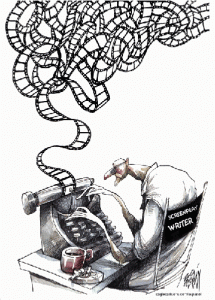
Your Own Voice, Whatever It May Be Worth

Posted: February 24, 2013 by moifightclub in cinema
Tags: , ,

The precocious students of Ruia College nagged and pestered and forced me to do this – a piece for their film publication “Film Eye” which came out last week (a highly readable magazine too). Asked to choose my own subject, I figured directly addressing the students in the piece (whilst being aware of the context of the publication) might have more value than a generic piece that could have appeared anywhere. It was really for their eyes, and perhaps not very smart of me to put it out here but I just feel like doing it. If nothing else, at least it will make me even more unpopular than I presently am (if that is even possible), even though, contrary to what some think, that is not exactly an objective.

 Instead of a general piece on cinema that could be published anywhere, this is an attempt to do a customised piece for this particular publication addressing its readers directly. Many among you may be contemplating a career in the arts – perhaps cinema. That professional world is perhaps inscrutable and even intimidating. Dealing with the clear conflict between the mainstream and personal expression is the toughest battle ahead. This piece uses film references to make its points – for whatever they are worth.

In what is perhaps the greatest documentary series ever made (the “Up Series”), fourteen British children aged 7 were selected from diverse backgrounds in 1964 and their lives revisited on camera every 7 years (director Michael Apted stayed constant too) – in 2012, they were all 56 years old, and there had been 8 films made. From these, the most revealing films are 21 Up (film made when they were 21) and 28 Up – not because of the individual films but because of the transformation that occurred between these two ages. Most of the hopes and aspirations these young men and women had expressed at 21 had been significantly tempered by 28, and a strange sort of auto-pilot acceptance crept into their worldview.

This is not the only evidence to suggest that the age-span 21-26 (or so) is perhaps the most important stage in an individual’s life when his (or her, of course) relationship to his work (any kind of work, not just in the creative fields) is fundamentally determined. It would appear that the majority give up during this time, and focus on stability – in their jobs and family lives. There’s no rocket science required to process why this happens – it is natural and perfectly understandable. Those who develop a different relationship to their work and have a drive and restlessness to reach out for something beyond this assured stability with no guarantees are not necessarily more intelligent or talented; it has more to do with a certain attitude and perhaps it can even be argued that it is often not a voluntary choice one makes but more akin to an urge.

This absolutely does not mean that these people have to achieve something within this age or that people with say, artistic ambitions, have to complete something by then. Many such people may actually take a decade or more to express themselves properly, to create or build something. Some may change several jobs, even professions to find their true calling. What they have in common – regardless of what their muse is, or where their interests lie, is that they don’t stop searching. For some reason, whether consciously or not, the commitment to this mindset appears to be almost invariably made during this 21-26 age-span.

So, this crucial period in your life is now ahead of you when this commitment will be defined, consciously or otherwise. Circumstances have a big role to play here – and no-one should ever be judged on what calls they take on this count. However, given that the vast majority of people (including commercially thriving people) seem to live “lives of quiet desperation” and compromise, some even wearing their unfulfillment on their sleeve, it is likely to be the most important choice you will make as it will define the rest of your life. Perhaps even more than matrimony, as this certainly seems to be more irreversible (as a mindset, not as an act).

However, even if you decide to commit to a life of self-expression (or self-realisation), that would just be the starting point – the long road ahead would still have plenty of potholes to waylay you.

There was an outstanding advertising filmmaker in the late-1980s – everybody believed his transition into feature filmmaking was a certainty (also because he was related to a legendary Bengali filmmaker) and would happen very soon. 25 years later, it still hasn’t. A few years back, he was asked amongst friends why he had never ended up making a feature film – and after some cajoling he said that the idea of matching up to his legendary filmmaker relative intimidated and discouraged him so much that he could never quite get started with any kind of confidence or momentum.

He deserves sympathy not for bearing such a great weight but for getting it so completely wrong. The point of any kind of art is not to match up to anybody (whatever the award shows may suggest to you) – but to put one’s own expression out there – tell one’s own story, try to find and communicate personal truths, whatever it may entail. To get scared of doing that (and there is no other way to quite describe what happened to this advertising filmmaker) suggests a complete misplacement of priorities – where it is craft that is aspired to, not art. The art is in the search and the soul of the work, not in the barebones of craft, however accomplished the latter may be.

We are very emphatically living in an age where how a sentence is crafted is appreciated more than what it conveys. And nowhere is this truer than in India where interpretation (rather than original expression) has been all-important anyway – from folk to classical music, from film songs (where interpretation is happening at every level) to talent shows on television, it has been about getting it “right” first, about technique and “correctness” then individual expression. This, coupled with the post-colonial inferiority complex we are still very comprehensively reeling from, has made creative confidence a very rare commodity in our country.

This is precisely why someone like Quentin Tarantino has destroyed two generations of Indian filmmakers without knowing it. The man who made violence hip and cinematic more than anyone else in film history did it with a slant that was its real dimension but too many in our quarters have gone about mimicking the cool and ignoring the vision (it is this vision that makes Tarantino a great filmmaker, not the craft). Some of our filmmakers discovered that the shock value that could be extracted from this mimicry also provided considerable commercial felicities. Today, the gangster genre (unimaginatively and perhaps typically in our quarters, this is almost the only genre in which this mimickery happens) is the most prolific (and profitable) one in the Mumbai film industry and this brand of quick-shock cinema consistently produces films that amuse more than they last. Some of them make enough money, and even excite enough “critics”, to perpetuate this hollowness.

If a law forced these filmmakers to not allow the characters in their films to bear arms, much like the Chambal dacoits who have been surrendering their arms from the early 1970s, one suspects many of them wouldn’t really know what to do with themselves. It could lead to a forced clarity that would almost certainly have very welcome long-term consequences as they would be forced to look at life around themselves then (as perhaps happened to Iranian cinema, thanks to the limitations imposed upon it). Of course this is just flippant fantasy, as thoughts of forcing anything on anyone should be in a democracy.

Also, unfortunately, most of our younger filmmakers seem to think the path to becoming a world-class film director is through imbibing world cinema immaculately. As a result, they seem to live in this cinema more than in life around them and their rootedness, has, for the most part, gone missing. As certain bastions of the elite cinema universe (like Cannes) evoke the Miss Universe/ World pageant in the 1990s in its temporary interest in work that departs from their exotic notions of Indian cinema (which has tragically been Bollywood for about a decade now), their aspirations even appear to be bearing fruit, which the jaunty media here rejoices over. Overlooking the undeniable fact that not a single indigenously-made Indian film ever commercially crosses over internationally outside the time-honoured melodrama markets (like say, Egypt) or captures the imagination of the world cinema audience (precisely because of that lack of genuine rootedness). For the most part, we produce spurious cinema in these times which is such a waste (especially given what diversity these churning times offer us). Why just films, even our books and popular music do not show signs of much originality and honesty for much the same reasons (with rare, but notable, exceptions).

The over-emphasis on detail and craft (which is also derived from foreign shores) is one of the main reasons why very little work has an original voice in our country, and therefore, very little value beyond the ephemeral. Even the people who consume (the audience) and the ones who judge (the “critics”) are more conscious of these details than the big picture or the soul of the work – this has become the predominant cultural sensibility in our country. Leading to the celebration of ersatz poster boys.

Spiritualists of all kinds and persuasions say one thing in common – that the human mind often comes in the way of fulfilling an individual’s true potential, thanks to the distractions of everyday life and its preoccupations. The same could be said for the stories being told around us – their true soul remains unexplored, underutilised, underappreciated, thanks to the focus on the details around them than the core itself. Every aspect of the entertainment industry perpetuates this these days, especially, sadly, the audience.

Of course, there are in-between spaces where new talent can try and find their feet (and some do but they are almost invariably non-commercial spaces). For example, it is curious that just like new acting talent rarely gets the choicest opportunities without familial connections within the film industry, new filmmakers never ever seem to emerge from outside the “camps” and the various coteries. There is a good reason why the industry is considered by many to be run by a kind of internal “mafia”. So, how does someone with no connections negotiate all this?

Besides adopting the path of least resistance and aligning your objectives to the status quo or opting out altogether (and changing professions), there is a new alternative that is gradually emerging in these digital times. A 1 TB hard-disc costing about Rs 5,000 (when in 2006, it cost about Rs 1.2 lakhs) is just a small indicator of how accessible things have got. Digital cameras and sound equipment are personally affordable today. A huge pitfall for some people is their excessive preoccupation with formats and cameras and technology and the rest – it is all nonsense, really. They forget that even the lower-end cameras they get to work with today are better than the high-end cameras the established professionals may have been working with a decade or two ago (and some produced classics with).

However, the commercial possibilities of cutting-edge work are limited in today’s film environment in India and practically no-one who wants to do innovative and personal work without significant compromise can really make much of a living from it.  Thankfully, due to the dynamics that are changing so rapidly, it is most likely a temporary state of things.

In the meantime though, how does one keep this promise alive? One option could be to try and make filmmaking a hobby, and find a job or a line of work that sustains you financially, perhaps even something allied to films (though it often helps the cause if you do something that does not exercise the same muscles that filmmaking does, to keep the freshness intact). And work in your spare time in cinema – the digital revolution has made DIY (Do-It-Yourself) cinema more achievable than ever before. Find like-minded people to work with and expand the scope of what is possible within your set-up gradually. With the Internet breaking down old ways of distribution as well, this way of working outside the system should eventually end up transforming the mainstream as well. And it may not even take as much time as many fear. By removing middlemen and having direct access to the final consumer, thereby being able to find your core audience much faster than possible ever before, significant profitability (significant enough to at least allow all its participants to earn a living from it) is not such a pipe-dream anymore.

The ones to benefit the most from these changing equations would be those who keep their desire of personal expression alive in some way. And amongst most of you reading this, this decision will happen in the next 4 or 5 years. Whatever you decide, do it consciously. It will probably lead to the most apt decision, for yourself. Good luck.

– Jaideep Varma

The above writer is a fringe filmmaker/writer (Local, Hulla, Leaving Home) and should have very little credibility for those seeking fame and fortune in the entertainment world. The piece, even if it did not provide any food-for-thought, hopefully at least entertained a bit.

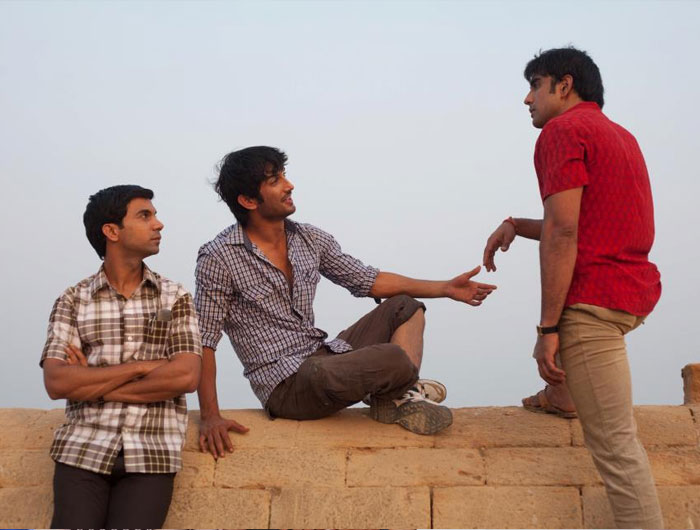
With the positive reviews pouring in from all quarters, i was waiting for some contrarian views. Because what’s the fun if we all are on same page. Though there have been few such views too, and criticism mostly have been looking at the big picture and the issues involved. But Runcil Rebello believes that the film is about “the smaller picture”. And he also writes about how the film is different from the book.

kai-po-che

In Abhishek Kapoor’s Kai Po Che!, it’s all about opposition – ideas clashing with each other, and sometimes both winning, sometimes just one. There is the age-old money versus passion squabble, further highlighted in the academics versus sports issue omnipresent throughout Indian homes. Then there is the overarching notion on which the film is built: friendship versus ideology, and friendship does not always win. There is also Mathematics versus Biology.

Kai Po Che!, adapted from Chetan Bhagat’s The Three Mistakes Of My Life, is a story set in Gujarat around the turn of the millennium. The nineties were done and dusted with. Internet, Nokia mobiles, malls were making their introduction into daily Indian life. The Indian cricket team would become a leading Test-cricket playing nation in the following decade. Religious politics had not yet reached a fuming and flaming high.

But Kai Po Che! doesn’t have its eyes set on such large-scale issues. Rather, it is content telling the story of three friends: Ishaan (Sushant Singh Rajput) – flamboyant, impulsive, passionate, Govind (Raj Kumar Yadav) – logical, ambitious, money-minded, and Omi (Amit Sadh) – simple, lovable, easily swayed, who set up a sports equipments store-cum-cricket training academy-cum-Maths tuition classes. This film is as much an ode to friendship as it is about the decay of that lovely bond.

The idea of opposition isn’t hammered into our heads. It’s brought up now and then, never over the top. Just like the film. The story (written by Abhishek Kapoor, Chetan Bhagat, Pubali Chaudhuri and Supratik Sen) does not veer much from the book, and if you’ve read the book, you’d realise then that it is a story tailor-made for Bollywood. And yet, the writers and the director stitch the film into an altogether different piece of fabric. The film is removed from typical Bollywood treatment. No star actors, no item numbers, no over-the-top treatment, just three songs (Hell! The soundtrack by Amit Trivedi [with lyrics by Swanand Kirkire] includes a garba-beat song in Shubhaarambh, but the film’s garba scene isn’t picturised on it. Unexpected.) Instead, Kai Po Che! is about the small moments in the fabric. Don’t lose sight of the smaller picture.

Characters, especially Omi’s, oscillate, not able to settle on one thing. He, at times, goes where the wind blows, and sometimes marches to the beat of the other drummers of the show. He may not always like what he does, but he is loyal to any cause he signs up for. Govind and Ishaan, on the other hand, are the proverbial immovable object and unstoppable force. They’d go to any distance to get what they want, albeit what they want is in diametrically opposite directions. Govind has to let loose, has to understand that not all things in life are solved by Mathematics, but some by Biology too. Ishaan’s sister Vidya (Amrita Puri) would be his teacher in this regard. Ishaan has to grow up, has to not let anger affect his decisions, but his mind. Ishaan, and to a lesser degree, Govind too, do not care about how religion plays into their plans. They are fine with sitting on the fence when it comes to this particular power struggle, letting Omi handle the dirty work.

What these three have in common, though, is something India is obsessed with: cricket. Cricket (and films) are said to heal wounds. In this film, it is the historic 2001 Calcutta test match between India and Australia that plays the role of mediator and doctor. It is also cricket that brings together children of two opposing homes, Omi and wiz kid Ali (Digvijay Deshmukh), under one roof.

Abhishek Kapoor has a knack for staging event situations. In Rock On!! earlier, he staged rock concerts in a way no Indian film had before. In Kai Po Che!, he goes large scale, but doesn’t make them the focus of his movie. The eye firmly remains on the three friends. Earthquakes, cricket matches and the Godhra Riots form the trifecta of incidents around which they break and mend. Tough decisions are made, mostly on impulse and emotion. When calamities strike, there is no time to think. Govind, Omi and Ishaan choose their respective sides all on basic instinct.

The film, though, has been meticulously planned. If Anay Goswami’s cinematography portrays Gujarat in a favourable light, Hitesh Sonik’s background score livens up the lives of the three friends. Deepa Bhatia transitions from one date to another finely, giving her best cut in the crucial scene during the riots.

Sushant Singh Rajput and Raj Kumar Yadav play their roles well. They really look the part, and so does Manav Kaul, being crafty and smart as Bittoo mama, Omi’s political leader uncle. Amrita Puri is cute and plucky adequately. In fact, the casting (by Mukesh Chhabra) is impeccable. The one actor, though, to make the most impact is Amit Sadh. From portraying a simpleton to a political henchman, Amit Sadh’s eyes, and hair, speak.

All these people, eventually, are just holding the manja. It is Abhishek Kapoor flying this kite, cutting every other kite in his path. He’ll be the one screaming kai po che! at the end of it. And what a delight it has been to watch this kite soar great heights.


P.S.: If you’ve read the book, you’ll understand the flashback and the conclusion has changed; all for the best. Below are a few details of what is different in the film.

(SPOILERS AHEAD!)

Chetan Bhagat, in his book, The Three Mistakes Of My Life, had Govind as the lead character. The biggest change is towards the end. In the riot scene, Omi is the one who protects Ali, Ishaan and Govind from his uncle. Omi dies in the process, and Ishaan doesn’t talk to Govind for years because of the revelation that his sister and he were in a relationship. Govind eventually, before committing suicide many years later, writes a letter to Bhagat, who he is inspired by, thanks to his two books Five Point Someone and One Night At The Call-Centre, who then intervenes and brings all of them together again. An utterly melodramatic end to the story, which thankfully was changed.

Another important section that was missing from the film was the part where the three friends finance a trip for Ali and themselves to Australia to receive cricket coaching. The Australians, seeing the marvel that Ali is, offer to train him but only if he eventually plays for Australia. Ali here in an outright dramatic fashion proves his patriotism for the country by shouting that he’ll play only for India and then they return to India.

Also, Vidya and Govind sleep together on Vidya’s eighteenth birthday at her home itself in the book. This too was changed in the film.

Also, missing in the book is the Diu section. The three friends are basically saints in the book, not leaving their pol to do things normal twenty-something guys would do i.e. to drink.

Abhishek Kapoor also changed the narrative by making all three characters equally important, thereby removing the crux of the story from the ‘three mistakes’.

The rest of the movie is pretty faithful in its adaptation.

Abhishek Kapoor’s new film Kai Po Che has released today. The reviews so far have been unanimously positive. But does it mean anything beyond that – The Big picture? Over to filmmaker Hansal Mehta who connects the dots.

Kai Po che

4 reasons for not watching the increasing number of films released every week –

  1. I am perennially broke
  2. I am lazy
  3. I need to work
  4. My wife is not in the mood
  5. I am hoping I get invited for a preview/premier.

The past few weeks have been different though. The spate of films released and due for release stared at me in the face because

  1. They featured friends in lead roles
  2. They were directed by friends
  3. They were produced by friends
  4. I was looking forward to the films
  5. I felt compelled to watch them

I am going to limit my post to the Hindi films I saw because in the case of foreign films:

  1. I feel inadequate commenting about commenting on them
  2. I did not feel like watching many of them
  3. I am waiting for uncensored DVDs of some of them
  4. I don’t get invited for previews of these films

In the past few years, most significantly 2012, I am seeing a pattern in films that are successful (relatively) and appreciated. A majority of them stand out for their choice of actors, their choice of subject, their non-formulaic narratives and a host of other similarly intellectually stimulating reasons.  One factor that has begun to increasingly stand out in these films is sheer audacity. The more I think about what drew me to watch the films, to like some of them, to dislike some of them and to find some of them memorable was the lack of apologetic film-making that has mostly led our films towards pathetic levels of mediocrity.

I’ve noticed that many film-makers no longer feel pressured to make the same formulaic nonsense with the same boring people over and over again. Many of the older directors also seem to realize the futility of formula and are trying hard to reinvent. Those who aren’t will soon be history.

Ever since I made Shahid, I’ve been asked over and over again about how the trend of biopics is on the increase. The media unfortunately reads trends very poorly and looks for convenient analysis. Trade pundits who have in the past thrived upon silly generalization are very shallow in their understanding of artistic/creative decisions taken by film-makers or in analyzing the success of films that don’t fall into their formulaic comfort zones. The truth is that book adaptations, biopics and stories inspired by true events are an indicator and not trends in themselves. We now have film-makers looking for newer stories to tell. We have film-makers looking for new ways to tell stories. We have film-makers who are fearless. We have film-makers who are not afraid of audacity.

Whether it is Talaash, Gangs of Wasseypur, Ek Main Aur Ekk Tu, Vicky Donor, Special 26 or Kai Po Che, I notice a fearless streak in the directors and the team that has made these films possible. Even potboilers like Dabangg, or before that Wanted, or the recently released ABCD have displayed a certain audacious vision. Rockstar had the audacity to be deeply philosophical and sometimes mendering while pretending to have commercial trappings. A certain Anurag Kashyap whose films either got banned or termed as jinxed is now celebrated because of his delightfully indulgent Gangs of Wasseypur or his subversive take on Devdas. Sujoy Ghosh redeemed himself with the surprising Kahaani. Tigmanshu Dhulia’s Pan Singh Tomar was commercially successful. English Vinglish marked the successful return of a Bollywood diva who churned out some of the most cringe-worthy films of my growing up years. The list could be exhaustive and I’m sure it will soon dominate successful box-office lists. On the other hand there has been a steady increase in films (Ship of Theseus, Miss Lovely, Peddlers etc.) that have found appreciative audiences in international film festivals and critics. These films have shown a fierce independence in their making while giving alternate Indian cinema a new lease of life and an unpretentious, fresh form of expression. They have been audacious in their abandonment of what we perceived as ‘art-house’ or ‘parallel’ cinema in India. They were unabashed in their treatment, style, narratives and expression. These and many other films that I have viewed over the past year and this year have challenged audiences, provoked critics and subverted formulaic convention with amazing audacity. Even more encouraging is the fact that producers, actors (including some stars) and trade have begun to embrace the audacious breed, backing them to the hilt.

So what is the point I’m trying to make? It’s simple. Audacity is in. Safe is not safe anymore. Take the second installment of Dabangg. It disappointed because it succumbed to ‘ingredientization’ and failed to live up to the fearless audacity of the first part. Films like ‘Zila Ghaziabad’  or ‘Jayantabhai Ki Love Story’ are passé. They will continue to get made. They will continue to remind us of everything that is unimaginative and about how we have allowed ourselves to be taken for granted all these years.

So here is my two bit gyaan. Whether you aim for the mainstream or the alternate space, make it audacious. Just making it big will soon cease to work – neither for the makers or the audience. Yes, we will have regular installments of successful franchises. We will have ridiculous remakes. We will have mindless, story-less films – but my guess is that all of them will work for their audacity and not for their adherence to convention.

Audacious will soon be safe. Safe is already dangerous. It could soon be suicidal.

Film Writers Association (FWA) has announced the 3rd Indian Screenwriters Conference. The central theme this year is “Untold Stories : Screenwriting and the truth of our times”.

– Venue : Venue: St. Andrew’s Auditorium, Bandra (W), Mumbai

– Dates: February 25, 26, 27, 2013

– Only FWA members can attend. So if you are not a member of FWA yet, do become one. Click here to go to FWA site for more details.

And here’s the programme detail..

screenwriting-215x300Day 1 – Monday, February 25

1000-1020: Introduction to the Conference by Convenor & Co-Convenor, ISC

1020-1030: Welcome Address by President, FWA

1030-1100: Minister HRD (expected) declares the Conference

1100-1130: The Chief Guest’s address

1130-1145: Tea/Coffee break

1145-1230: Keynote Speech by Shiv Vishwanathan

1230-1300: Audience Q&A with Keynote Speaker

1300-1400: Lunch break

1400-1545: Do screenwriters have a social responsibility?

Moderator: K. Hariharan

Panel: Javed Akhtar, Tom Schulman, Rakeysh Mehra, Girish Kulkarni, Dr. Chandraprakash Dwivedi, Vinod Ranganath, Gajra Kottary

1545-1600: Tea/Coffee break

1600-1745: How does our popular cinema and TV portray women?

Moderator: Ranjani Mazumdar

Panel: Ashutosh Gowariker, Anurag Basu, Kumara Raja, Preiti Mamgain, Satyam Tripathi, Ila Bedi

Day 2 : Tuesday, February 26

1000-1130: The charge of the new ‘write’ brigade!

Moderator: Pubali Chaudhuri

Panel: Juhi Chaturvedi, Habib Faisal, Ravi Jadhav, Akshat Verma, Reema Kagti

1130-1145: Tea/Coffee break

1145-1330: Is the old order cracking? New ways of storytelling.

Moderator: Govind Nihalani

Panel: Urmi Juvekar, Anurag Kashyap (TBC), Sanjay Patil, Bejoy Nambiar, Abbas Tyrewala

1330-1430: Lunch break

1430-1600: What is driving TV content? Is it changing? Can it?

Moderator: Saurabh Tewari

Panel: Tripurari Sharan, Vivek Bahl, Sukesh Motwani, R.D.Tailang, Charudutt Acharya, Gul Khan

1600-1615: Tea/Coffee break

1615-1730: The new brigade of TV!

Moderator: Anuradha Tewari

Panel: Raghuvir Shekhavat, Mihir Bhuta, Amal Donvar, Swati Pande, Chinmay Mandlekar, Mrinal Jha

Day 3 : Wednesday, February 27

1000-1145: The empty playroom. Why such few children’s films?

Moderator: Chandita Mukherjee

Panel: Gulzar, Nila Madhab Panda, Preiti Mamgain, Farhan S., Anand Sivakumaran

1145-1200: Tea/Coffee break

1200-1330: The light through the fog: Implications of the amended Copyright Act for film and TV writers

Moderators: Rajesh Dubey & Anjum Rajabali

Panel: Souvik Biswas, Nikhil Krishnamurthy, Sai Gopal, Ameet Dutta

1330-1430: Lunch break

1430-1545: Writer-Producer Bhai-Bhai! The Minimum Basic Contract for film writers

On stage: Dharmesh Tiwari, Vipul Shah, RameshSippy, Nikhil Krishnamurthy, Anjum Rajabali

1545-1600: Tea/Coffee

1600-1730: The way forward! What FWA has for you in the next one year.

On Stage: The Executive Committee of FWA

Conducted by: Vinay Shukla & Kamlesh Pandey

1730-1745: Vote of thanks

– To know more about the topics and the speakers, click here and scroll down to “A MORE DETAILED EXPOSITION“.

– 850 screenwriters and writer-directors are expected to participate. This is the most important event for screenwriting in the country, and ought to impact the profession in a significant way.

– Confirmed participants include : Salim Khan, Javed Akhtar, Gulzar, Ashutosh Gowariker, Anurag Basu, Rakeysh Mehra, Govind Nihalani, Sriram Raghavan, Sudhir Mishra, Amit Khanna, Vipul Shah, Jabbar Patel, Vikramaditya Motwani, Bejoy Nambiar, Abbas Tyrewala, Amole Gupte, Habib Faisal, Navdeep Singh, Girish Kulkarni, Umesh Kulkarni, Lekh Tandon, Abhishek Sharma, Shridhar Raghavan, Kumararaja (Aranya Kandam), Rituparno Ghosh, Hariharan, Urmi Juvekar, Ishita Moitra, Manu Rishi Chadha, Leena Yadav, Prasoon Joshi, and others.

– Also, Tom Schulman (Oscar winner for ‘Dead Poets Society’) and Rebecca Kessinger (Asst. Executive Director of Writers’ Guild of America) will be there as guests since FWA and WGA are planning several collaborative initiatives.

(all info from press release)

– If you are completely clueless and confused whether to attend or not, click here and here to read our coverage of previous FWA conference.

WHY?

The world needs to know. Anyone?

Here is the trailer.

And here’s the answer

Tip – Sumit.

Fahad Mustafa and Deepti Kakkar’s documentary Powerless was selected to premiere at the ongoing Berlin Film Fest. The first look of the film is out with three interesting trailers.

Powerless is set in Kanpur, a city with 15-hour power cuts, where a nimble young electrician provides robin-hood style services to the poor. Meanwhile, the first female chief of the electricity supply company is on a mission to dismantle the illegal connections, for good. The documentary recently received a grant from Sundance Institute’s Documentary Film Program and Fund.

To read the Hollywood Reporter’s review of the film, click here.

Production companies: Globalistan Films, ITVS International

Directors: Fahad Mustafa, Deepti Kakkar

Producers: Fahad Mustafa, Deepti Kakkar, Judy Tam, Leopold Koegler

Directors of photography: Maria Trieb, Amith Surendran, Fahad Mustafa

Music: Gingger Shankar

Editors: Maria Trieb, Namrata Rao

Sales Agent: Globalistan Films

No rating, 84 minutes

VOTD : Gangs Of Social Media

Posted: February 14, 2013 by moifightclub in VOTD
Tags: ,

The guys behind the troll song of the year “gaana wala song” are back with a new video. And this is a class act. Click on the video and have fun.


Pune 52

If you have been following the blog for a long time, you know our take on “sharing scripts online”. And going with the idea of creating a database of Indian film scripts, we are adding a new one to the list – Pune 52. Most probably the first Marathi film script that we are sharing on the blog.

All thanks to its director Nikhil Mahajan.

To check out other scripts that we have posted on the blog, follow the links “here” :  click here for Sujoy Ghosh’s Kahaani script, click here for Sriram Raghavan’s Agent Vinod script, here  is Shaku Batra’s Ek Main Aur Ekk Tu script. Click here for Vikramaditya Motwane’s Udaan script, here is Anurag Kashyap’s Dev D script and click here for Dev Benegal’s Road, Movie script.)

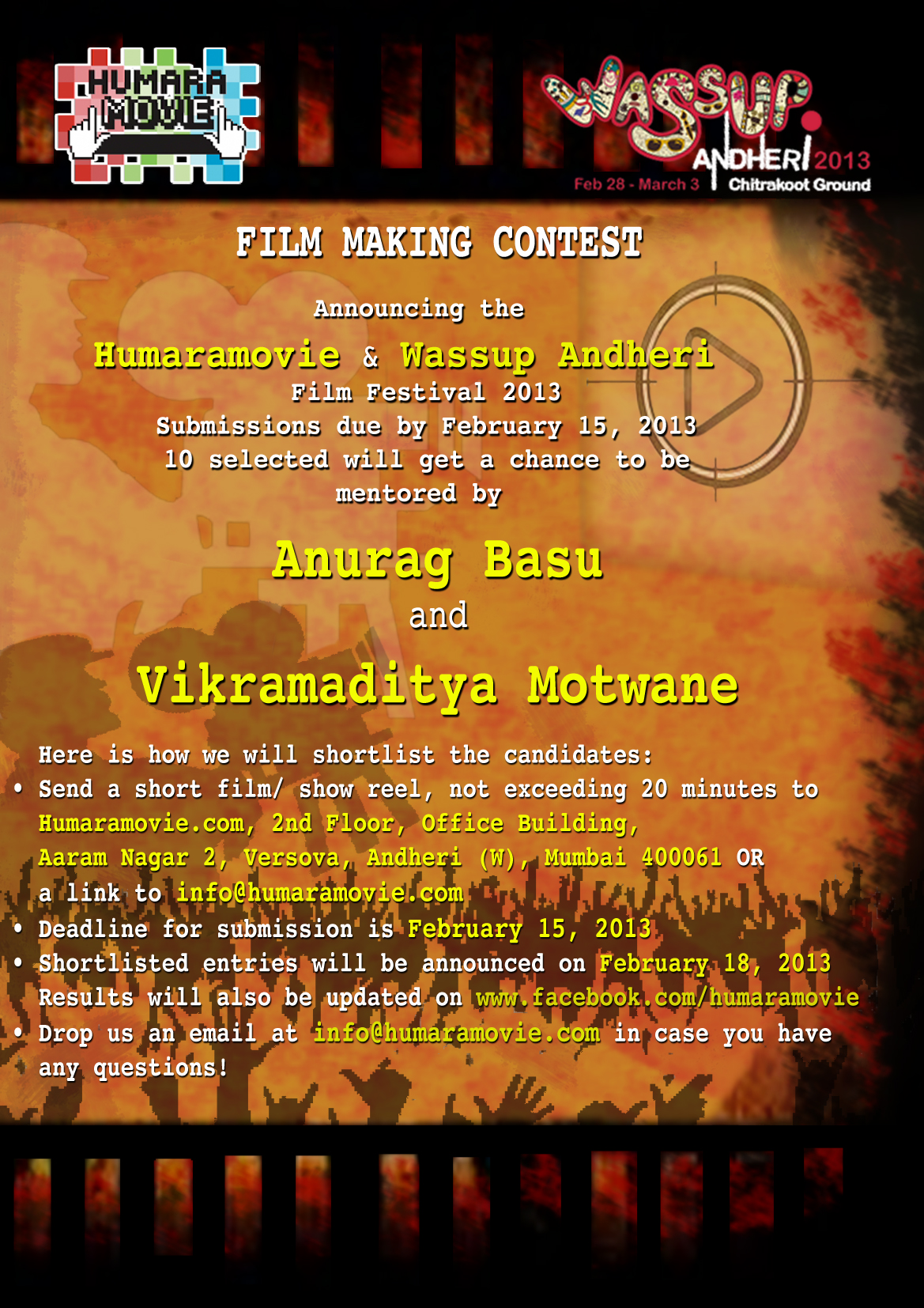
Call for Entries: Humara Movie Short Film Contest

Posted: February 12, 2013 by moifightclub in Call For Entries

The Wassup Andheri festival and humaramovie.com, come together to give aspiring filmmakers a unique mentoring opportunity! Submit your entries to interact and engage with the two leading lights of Indian cinema – Anurag Basu (Director Barfi) & Vikramaditya Motwane (Director Udaan). 10 selected entries will be making their films on a topic suggested by the mentors. All shortlisted candidates will get access to a script consultant, editing consultant & sound consultant.
Here is how we will shortlist the candidates:


Check out Vikramaditya Motwane: 

Shortlisted filmmakers will have the following:
§  Topic will be provided on February 18, 2013
§  Script analyst, Kshiti Nijhavan Agarwal will be available to the filmmakers till the 24th of February, 2013
§  Vikramaditya Motwane & Anurag Basu will mentor 5 filmmakers each
§  Final films to be screened at the festival
§  The winner will be given a cash award.
§  Top two films will gain direct entry into a top European festival
§  The best film will be given a theatrical release in India

humaramovie poster

Direct all questions to info@humaramovie.com or tweet them to @humaramovie


And she has just 9 days to go.

We are starting a new segment on the blog – Fund A Film (FAF). With social media changing the way we communicate and crowd-funding in vogue, we thought it would be nice to highlight the projects that we find interesting. So if you want to contribute and fund a film, you know where to look.

kickstarter image

Today’s Project is “The Tiger Hunter” by Lena Khan.

Over to Lena for an intro..

Years ago, if I had told somebody about the idea of my film, they might have asked, “Is this for Bollywood?” So, for that reason, when I came up with the idea for it…I put it aside. “Who wants to see a movie with brown people,” I thought.

But now, things are different. In America, at least, Indians are the new cool. Sure, we always had a few stand-out successes—the success of The Namesake or the popularity of Bend it Like Beckham. But the market is changing.

Now, we’re mainstream. We’re popular. Sure, we all knew about the popularity of Slumdog Millionaire, but now we’re cool even when we aren’t playing characters that revolve around our skin color. People stand in line to go see Aziz Ansari’s comedy tour. Kal Pen can still headline a Harold and Kumar sequel and stay on How I Met Your Mother for nearly an entire season. Kunal Nayyer is one of the stars of the most popular sitcom on television, The Big Bang Theory. And I’m not sure if you’ve watched FOX lately…but there’s a brown girl named Mindy Kalin heading up her own show there!

My movie, The Tiger Hunter, is about a young Indian man who comes to 1970s America on a quest for success. Is it a story for Indians? Sure. But mostly, now that times have changed—it’s a story for everyone else, too. And I’m moving forward at full speed to get it made.

And here’s more on the film :

The Tiger Hunter is the story of Sami Malik, an ambitious young man with an engineering degree who travels to 1970s Chicago to impress his childhood crush and live up to the legacy of his father, a local legend and tiger hunter. When Sami ends up living in a tiny co-op with two oddball roommates and taking a job as a lowly mail clerk, what ensues is a series of adventures involving outlandish schemes, an arch-nemesis in an absurd office environment, and a variety of misfits that Sami may soon call friends.

– Click here to go its Kickstarter page where you can read more about the film, people attached to it and watch videos. And if you can, contribute. If you can’t, do spread the word.

– She is also blogging about her entire experience. Her blog is Lena Makes A Movie.

– Scott Myers of that awesome blog GoIntoTheStory has also given his endorsement for the film. Click here.

– Click on the play button to watch the pitch video.