KAUFMAN - "Or cramming in sex, or car chases, or guns. Or characters learning profound life lessons. Or characters growing or characters changing or characters learning to like each other or characters overcoming obstacles to succeed in the end. Y'know ? Movie shit."
Kaufman is sweating like crazy now. Valerie is quiet for a moment - from "Adaptation".
We are all about CINEMA. That movie shit.
NOTHING is sacred.
NOBODY is spared.
Because we talk about films, dammit.
Not your sex life.
Films, fests, unsung, indies, undiscovered - all that and some fun. If you have dope on anything related to cinema or you would like to share something, do write to us at moifightclub@gmail.com.
The views, opinions, reviews, articles, or positions, expressed by the authors and those providing comments are theirs alone, and do not necessarily reflect the views, opinions, positions or strategies of ANY OF THE EMPLOYERS, FRIENDS, RELATIVES, PR agencies, Production houses, Media group and such third parties associated with the authors. The latter make no representations as to accuracy, completeness, currentness, suitability, or validity of any information on this site and will not be liable for any errors, omissions, or delays in this information or any losses, injuries, or damages arising from its display or use.
In short, if you have an issue with us or any post we've written, write to us at moifightclub@gmail.com
After the success of Pancham Unmixed, the National Award-winning film on RD Burman, filmmaker Brahmanand Siingh is now working on another feature length biopic, this time on legendary ghazal maestro, Jagjit Singh, titled “Kagaz Ki Kashti…”
“Kaghaz Ki Kashti…” is planned to be an evocative account of a down-to-earth small town boy from Rajasthan who became a legend in no time, but not without his share of struggle. In the process, the film will capture that extra something in his music that gave his compositions a certain polish and a soul at the same time which delighted millions of listeners across countries, cultures and age segments.
Through visual and sensory experiences, the film intends to take us on a journey of his choice of poetry — simple but touching world of Urdu lyrics that he chose to sing (sometimes nazms, sometimes ghazals), setting them to soulful tunes and introducing western instrumentation to make them textured, contemporary, and rich. The film will also take us back in time and trace the zigzag marathon run by a man with passion, fire, and soulful melodies within him, which kept him alight all through his luminous career as well as in some difficult personal times, all with a seamless and gripping narrative.
The lyrical film aims to use his music and the poems he chose to tell his own story of love and loss, of tribulations and triumphs. In the process, the film creates a warm portrayal of the man behind the visible, and the artist behind his creations.
Brahmanand’s previous film “Pancham Unmixed” went on to become a big success at film festivals and won two National Awards, among many others, and was a big draw at over 40 International film festivals.
– For all the updates on the film, click here to go to its FB page.
A documentary film titled ‘Beyond All Boundaries’ directed by Sushrut Jain will have its Indian premiere at the Mumbai Film Festival this year. The film is produced by Kunal Nayyar (of Big Bang Theory fame) who also helped Sushrut raise funds for the project.
TRAILER
OFFICIAL SYNOPSIS
This 98 minute documentary tells three true life stories of cricket lovers and fanatics who gave up everything to pursue their passion. Woven through the tale of India’s progress in the 2011 World Cup are three separate story arcs that speak of the roles cricket can play in the lives of ordinary Indians, for whom the game becomes a source of aspiration, desperation and devotion.
DETAILS
Beyond All Boundaries takes a look at the life of three people
1. Sudhir Kumar Gautam, the well known Indian cricket fan who loves his team, his stars, and at the heart of it, eventually the game. He is India’s most recognizable fan who turns up at matches, his torso and face painted in the colours of the Indian flag, and “Tendulkar” and the number 10 on his back.
2. Prithvi Shaw, a 12-year-old batting prodigy from one of Mumbai’s distant suburbs, whose life and career are driven by the prototype sporting parent – a single father obsessed with turning his son into a professional cricketer.
3. Akshaya Surve, an 18-year-old girl trying out for the Mumbai Under-19 team. Cricket is the centre of her existence and a potential exit for her and her mother, trapped in a single room in one of Mumbai’s many narrow bylanes.
– To know more about the film, click here for its website
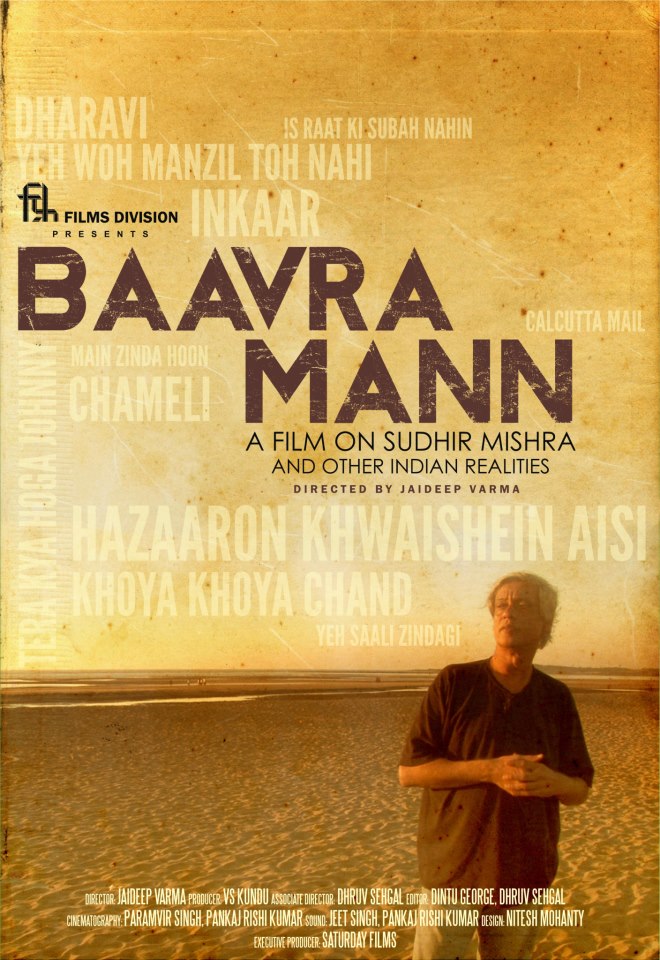
Jaideep Varma’s documentary Baavra Mann is yet to get a release in India. Karan Singh Tyagi saw it at New York Indian Film Festival earlier this year and wrote this post for us. Read on.
(We suggest you play the song in the background while reading the post)
“Who is this long-haired Sanjay Dutt duplicate?”
“Duplicate nahi hai bhaiyya. Iska naam Nirmal Pandey hai. Kya acting kari thi isne ‘Is raat ki subah nahin’ me”, was my prompt reply, as my cousin and I stood in line with a dozen others, scanning movie posters outside Gaiety (Bandra) and booking our tickets for ‘Auzar’. As an 11 year old, I couldn’t contain my excitement, at having recognized Nirmal Pandey in the ‘Auzar’ poster, and went on this long rant about ‘Is raat ki subah nahin’. Much to my cousin’s chagrin, I told him everything about the movie – how it was violent and funny at the same time, how all the actors spoke a very different language, how the story finished in one night, and importantly, how Papa and I were lucky to see the movie on the big screen, as it had a single show in Bombay.
This innocuous little incident came back to me while watching Jaideep Varma’s documentary, ‘Bavra Mann and other Indian Realities’, in New York. For those who haven’t seen it yet, Jaideep’s movie traverses through the life and films of Sudhir Mishra, and somewhere in the middle of the movie, Mishra laments how ‘Is raat ki subah nahin’ was confined to a single show in Bombay and how many people didn’t get to see it. On hearing this, I silently smiled as my mind went back to watching the movie with Papa in the same show that Mishra was referring to. How I wanted to thank my father at that very instant! Not just for taking me to ‘Is raat ki subah nahin’, but for giving me the hereditary gift of love for movies and being the best companion I could have had while I nurtured it.
There were numerous such nostalgia trips throughout Jaideep’s movie. The portions dealing with ‘Hazaron Khwaishein Aisi’ left me mesmerized. Listening to ‘Bavra mann dekhne chala ek sapna’ on the big screen again did my soul so much good; it stirred something deep within me, something in desperate need of stirring. My mind went back to when I first saw ‘Hazaaron..’ I remember crying tears of joy and sadness, laughing gleefully, feeling melancholic and empty, while ‘Bavra Mann’ played on loop and images from the movie interposed with flashes of my life didn’t leave me for days at end. Probably, this is a uniform reaction that ‘Hazaaron..’ elicits. The movie strikes a deep chord somewhere, and makes one confront broken promises, failed dreams, and all those bittersweet memories, that we carry with ourselves. Right after watching Jaideep’s ‘Bavra Mann’, a friend who had accompanied me to the screening in New York forwarded me this by Avijit Ghosh who captures this sentiment beautifully:
“There are a thousand reasons to watch Hazaaron Khwaishein Aisi. But enjoy it as a last anthem for a generation who knew how to believe. Watch it holding the hand of a woman you have loved and lost. And it would be nice if you have drunk some rotten whisky before.”
As must be painfully evident by now, I am easily susceptible to bouts of nostalgia. However, these glorious nostalgia-filled moments were not the only reason why I enjoyed Bavra Mann. I have often wondered what drives filmmakers to make the kind of movies that they do. For example, at the risk of doing a Baradwaj Rangan here, I have been fascinated by two particular scenes from Black Friday and Gangs of Wasseypur.
Sample these dialogues:
Black Friday – “Jiske paas kuch nahi hai karne ke liye, dharam ke naam par chutiya banta rahega”. GOW2 – “Jab tak cinema hai log chutiye bante rahenge”
I have often wanted to argue that we can discern in these dialogues a kind of master narrative, a collection of meanings, and, perhaps, a powerful leitmotif that runs through all of Kashyap’s movies, a kind of slavishness and hive mentality – towards religion in Black Friday, towards cinema and everything that one acquires from it in Gangs of Wasseypur. To take the analogy further, slavishness towards power in Gulal, towards self and personal ego in DevD and No Smoking. Therefore, Kashyap’s movies are magic on celluloid, because he lets characters with such aggressive spirit and slavish devotion face their internal conflicts and external surroundings. What we see on screen is the result of a bundle of contradictory aspects and motivations, a certain kind of dualism that everyone and everything in life has. I have repeatedly asked myself, what are the questions that Kashyap is trying to answer through his work? Has he found any answers yet?
Bavra Mann poses similar questions to someone whom Vikramaditya Motwane calls the “original Anurag Kashyap”. Despite the frequent and frenzied analysis of cinematic moves of all current directors’, I feel there is a strong lack of literature that provides us with enough resources to examine and study their work. This is where Bavra Mann triumphs. It gives enough resources to the audience to interpret Sudhir Mishra and his movies in a new light. Bavra Mann is a fascinating exercise in self-revelation and film lovers will revel in the personal anecdotes and casually delivered remarks that reveal layers and layers of information about Mishra and his body of work. The movie has a series of interviews with Mishra and people close to him, covering the length of Mishra’s career, beginning with his childhood, continuing through his education, his failed marriage with his first wife, his relationship with renowned film editor, Renu Saluja, his early film work, his breakthrough success with Dharavi, and his daring work in Hazaaron.., his most autobiographical Khoya Khoya Chand, and finally his recent movies. There is a treasure trove of diamonds in the movie. After all, who wouldn’t want to eavesdrop on Mishra and Shantanu Moitra’s recounting of how they got Swanand Kirkire to sing ‘Bavra Mann.’
A criticism often peddled against movies like Bavra Mann is that the director holds back, and is reverential towards his subject. Here, Jaideep is never in awe of Sudhir Mishra. His questions are probing and the discussions on films themselves are less about why they’re great and more about how they were put together. Jaideep knows that directors are not good at explaining motives behind making particular films. Movies, like many things else, begin with something very vague and abstract. Jaideep, therefore, never tries to look for definite answers and actual motives behind Mishra’s work. His aim is to allow the viewers the freedom to interpret the scene in the way they want, and depending on how their cinematic education (and earlier experiences of Mishra’s movies) has prepared them. Bavra Mann succeeds in bringing before us the greatest number of possibilities to reinterpret Mishra’s movies. After watching Bavra Mann, I realized that Sudhir Mishra’s movies (especially the earlier ones) resonated with me because they were being truthful about life – the movies expressed some deeper emotional experiences that Sudhir Mishra recognized in his own existence. This in and of itself was a reason for me to love Bavra Mann.
However, for me, the biggest strength of Bavra Mann is that it never wavers from admitting that Sudhir Mishra continues to be plagued with what is an inconsistent body of work. It subtly engages in criticism of some of Sudhir Mishra’s recent movies (the likes of Inkar, Calcutta Mail) to reflect on the present-day infertility of thought in India. By using Sudhir Mishra’s example, Jaideep exposes the dangers inherent in adopting a conformist and consensus-driven career. According to me, it is in this context that the movie makes a brutally frank attempt to unravel the intellectual decline of India and Indian movies (using Sudhir Mishra as a metaphor). The movie, therefore, is an elegy of intellectual life not only of Sudhir Mishra but of us all. In a way, the movie tries to jolt us (Sudhir Mishra included) out of the dark recesses that we have allowed ourselves to fall in.
I do not know if Bavra Mann is getting a theatrical release anytime soon. However, I strongly hope that everyone gets a chance to see it. Watch it to revisit old times, to go back to your personal stories intertwined with Sudhir’s films, watch it to hear “Bavra Mann” on the big screen again, watch it as a student and lover of cinema, and most importantly, watch it because it is a powerful statement on the times that we live in.
Naseerudin Shah says the single most perceptive thing in the movie: “Mishra’s best work is yet to come.” Even though, I love ‘Hazaaron…’, I wouldn’t want it to be Mishra’s best work. I earnestly wish that it turns out to be just a teaser of what he (and by association) Indian cinema goes on to achieve and that no one is ever required to come to the rescue of this long-haired maverick director, like I had to once come to the rescue of his similarly long-haired leading man outside Gaiety.
– Karan Singh Tyagi
(Karan was born in Meerut, lived and studied in Bombay and Harvard, and after a brief stop in Paris, now finds himself in New York. He strongly feels that Ramadhir Singh was directly referring to him while saying, “Sab ke dimaag me apni apni picture chal rahi hai aur sab saale hero banna chah rahe hain apni picture me..” When he is not day-dreaming about movies or Real Madrid, he also works as a lawyer. You can find him on twitter here: @karanstyagi)
Internet is a great place, especially if you are looking for under-rated gems. Varun Grover stumbled upon this documentary called The World Before Her. Mihir Fadnavis got in touch with the director and we managed to watch the film. So over to Fatema Kagalwala and her ramblings on this stunning and important film. We are putting this in our “Must Watch” film recco List. Watch it.
We love living in extremes. Grey areas aren’t appealing because they force us to think. They are meant for individual assessment whereas black and white are fit for mass consumption. So we’ve draped ourselves with stark definitions of tradition and modernity and live a bipolar existence, merrily swinging between both. Sometimes, we find solace in middle ground but one that is obfuscated with the overpowering implications of the extremes that are tradition and the modernity.
Prachi, Ruhi, Ankita, Pooja – the central protagonists, of ‘The World before Her’, a stunning, award-winning documentary by Nisha Pahuja, are all products, or shall we say victims, of our collective need to ideologically belong somewhere, even if it is within an ideology that seeks to subjugate them. They are perfect lambs for factories manufacturing daily definitions of the traditional and modern according to their convenience.
The struggle between tradition and modernity is ancient. The documentary examines these two polarities with a clear understanding of all its inherent ironies. Let’s take a look at the two worlds it straddles to make its point –
World 1 – Miss India contest 2011 20-day training camp. Of beauty, botox and bikinis.
World 2 – Vishwa Hindu Parishad’s Durga Vahini Camp. Of Hindutva, weapon training and military discipline.
Nisha takes us through both the camps, laying bare their belief system, process and the little dreams behind it all. We see training procedures up-close and peek into the lives of trainees. What makes the ambitious Ms India contestants tick and what drives the fierce Durga Vahinis? Through a thoughtful juxtapositioning, the two opposite worlds collide and before we know, melt into one voice. On the face of it, both espouse contrarian views on female identity. Beyond the façade of the titles of ‘modernity’ and ‘traditionalism’, both bind the very subjects they aim to set free, victimising the very subjects they aim to empower, treating the women they are pretending to liberate as cattle to be branded. The beauty of it all is the film doesn’t state it, but makes it clear with an intuitive stitching together of the narrative.
Nisha delves into both the worlds with care, aware of the mine of uneasy answers she is exploring, mindful of the dust her questions will raise. There is no attempt to impose a comment or paint a particular ideological picture. What makes the documentary a brilliant experience is the careful expose of truths and myths we live in, and the questing female mired in it.
In Ruhi, Ankita and Pooja, we see semi-urban, middle-class young women, very well aware of their social status as females, out to beat the system even if it is through succumbing to it. They are aware of the compromises they have to make and are fine with the cost to their dignity, if it transforms them, like Pooja puts it, ‘from a person to a personality’. The irony of their entire quest for identity within a system out to objectify them, seems to be lost on them. To my mind, Pooja Chopra, the girl whose father insisted on killing her at birth because she was female, almost seems like a tragic figure, bitterly fooled by an arrogant system laughing at her for believing she had carved a separate identity of her own and on her own terms. Ruhi, a young 19 yr old, feels obliged to her parents for bringing her up and feels the need to pay them back by becoming ‘something’, so that their creation is worth it…she never questions the route to fame she has chosen. Nor are her future plans of marriage and children at an appropriate age seem to clash in anyway with her present teen plans of becoming a beauty queen. ‘I can do all this now as I am young, later I won’t be able to do all this’, she says (quote not verbatim). There is no ideology at work here nor a tussle between the old and new. It is simple conditioning speaking but Ruhi doesn’t question any of it, for her her parents support for her contest participation is an empowering, liberating sign of modernity enough. For these women, the shine of glamour and the pain of centuries of repression are too blinding to see anything under or beyond.
At the other extreme is Prachi, the alpha female trainer at Durga Vahini, who has found a purpose and outlet in Hindu fundamentalism to escape the vulnerabilities her gender status thrusts on her. She is a single child of an orthodox Hindu family who feels her father is justified in hitting her (even brutally) because as a female child he let her live. She loves the power being a Durga Vahini trainer gives her, flaunts her dislike for ‘girlie girls’, is proud of being tough and is absolutely against marriage. Like the Ms India contestants, this Aurangabad-based girl too is looking to establishing her worth as a female in all-male world, but by embracing and perpetuating the orthodox mores of Durga Vahini. Unlike the other girls though, she is fully aware that the system she advocates aims at curbing her own freedom, yet, it remains her chosen vehicle to empowerment. Yet, I wondered if there was a glint of wishful-ness, an unacknowledged longing behind the façade of derision as she watched the Ms India contest. I don’t know if it was the artfully calculated shot lingering on her tad longer or my over-wrought zeal to understand her better or an actual fact.
I read criticism of the film saying this isn’t the reality of entire India and that the film does not reflect upon the middle path. It is possible I imagined the subtle jingoism in the criticism, but that apart, what it missed was the fact that these two extremities inform the lives of every woman (and men too) traversing the so-called middle path. Maybe they exist but I am yet to meet a person truly liberated from gender complexities and its socio-economic implications that the film so starkly defines. In fact, I saw Prachi, Ruhi, Ankita and Pooja as sharp and accurate spokespeople of the entire India, irrespective of class distinctions. Trapped in the half-baked definitions made by a commerce-driven, power-hungry, alpha male world, they languish confused in the debris of the shattered female identity they struggle to resurrect. Just like you and me.
As I mull over the needs of these girls, (and they are very familiar, they are around me and inside me) I see their quest with compassion. They have little choice other than adhering to a corrupt system to beat another equally corrupt one, to gain whatever semblance of self-respect they can garner for themselves. Patriarchy hasn’t left much for women to call their own or celebrate in the truest sense, has it? And if that wasn’t enough we have religious fundamentalism adding to the fire. Nisha doesn’t shy from showing news clips of Hindu fundamentalists beating up women in pubs and iterating the fact that Hindu terrorism is a bigger threat to India than Islamic fundamentalism. Not only is this a well-informed, deeply introspective, objective, exploratory documentary but it is very brave as well. One simply wishes the film does not get targeted by pressure groups if and when it comes to India.
As I watched the documentary and later, I wasn’t surprised by the ironical truths about female existence staring at me. It was all seen before, read before, said before. Yet, I couldn’t define the film in words and that is not because of the complexity of the film but of its theme. Which at one level is almost self-explanatory, but dig deeper and it will leave you distraught at the number of knots or rather untied ends it waves at you.
Why have we made the question of women’s identity so complex, almost impossible to unravel? Is it because we fear if we find the answers the world around us will no longer be recognisable? We are all slaves to gender equations and roles. Breaking free is scary because it means starting from scratch for human existence. Without the context of male and female roles and boundaries where would we be? What would we adhere to and what would we fight? Coz isn’t that exactly what gives all of us our purpose? The ‘shoulds’ our gender is supposed to wear? We either wear them with pride or fight them with gusto, satisfied in the purpose we’ve found to base our lives on. We then spend our entire lives empowering the very cycle the protagonists of this film believe/imagine they are fighting. We are no different from them, really. Gender politics apart, men and women, we are all in this together and for once, it isn’t a happy thought.
I realise I can go on writing about this film, such is the subject matter and beauty with which the story has been told. As I pull down the windows on my brains because I really want you to watch it with a fresh curiosity, let me leave u with a few moments that struck me with their irony, pathos and horror.
Pageant diction coach Sabira Merchant (proudly or matter-of-factly?) calling the Ms India training camp “a little factory … where you’re polished like a diamond. The modern Indian woman.” (Did the irony of what she was saying escape her or had she, like the contestants, made peace with it long back?)
Uma Bharti, while protesting against the 1996 Ms World contest to be held in India, “We are against a system that presents women as pieces of meat and judges them based on the size of their chest, waist and hips.” (I never thought I’d appreciate Uma Bharti in this lifetime.)
Prachi, with misty eyes, excusing her father for hitting her, “Knowing that I’m a girl child, he let me live … That’s the best part. In a traditional family, people don’t let a girl child live. They kill the child.” (I don’t think there was anyone among us who didn’t shiver on hearing her say this and actually mean it.)
The Miss India contestants parading in hip-length sacks and denim shorts in a round that judges who has the hottest legs.
Marc Robinson, the organiser, laughing off the indignity of the sack-round.
News clips of Hindutva louts beating up women in pubs.
Little girls at Durga Vahini camps being taught India and Hindutva was under threat from two main sources – Islam and Christianity.
Little girls lapping it up and regurgitating it like it was the only truth.
Chinmayee, a smart 14-yr old, proudly declaring at the end of the camp, ‘No, I don’t have a single Muslim friend. I did when I was younger but then I didn’t know that we are different.’ I didn’t know if I felt horror for India or pity for the little girl.
At the end of the Durga Vahini camp, girls getting sashes to wear identifying them as Durga Vahinis and the (gleeful?) exclamations of, ‘This is just like Miss India, Miss World!’
This was long before Tehelka had done any expose. I think the year was 2006. A junior from college had gone on to become a yogi of sorts – a spiritual guru who over the next few years would gather a bunch of powerful politicos as his disciples and put an Orkut profile photo showing Narendra Modi reading Time Magazine with him, in his Yogi costume, on the cover.
I had shifted to Bombay to become a writer and his phone call started with respect for this ‘brave’ decision of mine. Over the next few phone calls during the week he told me about his vision for India and his love for cows, both quite reasonable, and I listened out of curiosity and courtesy. Then, after his self-praise ran dry after multiple ejaculations over 4-5 days, he came to the asli mudda. He wanted me to head the national cultural wing of some organization/movement he was launching soon, in association with Bajrang Dal or VHP (my memory fails). I asked him what are his views on allegations on these organizations being responsible for Gujarat riots, and pat came his monologue which came back to me right after I started watching Joshua Oppenheimer’s The Act of Killing.
He said of course it’s a matter of pride and an act whose time had come. It’s a happy situation that we still have youth who can put their lives on line for their nation. He said he is in fact sitting with two bhai jis who murdered a few people, including a pregnant lady and her child, with their own hands. Sensing my shock he said he and bhai jis can explain everything if I meet them in person just once. And then he handed the phone to one bhai ji when I cut the call in horror. College junior/Yogi called back saying he can understand the fear of rationals over such acts but he is sure that once I know the full story, I will not just accept but hug and applaud these people who murdered muslim women and children on the streets. A more heroic me would have gone to the cops or some TV channel, but I just cut the phone and never took his call again. (He called a number of times over the next month or so.)
This nonchalance puzzled me, kept me awake for many days. I rationalized that he might have been bluffing only, or trying to test me on something. It was too difficult to believe that people could boast about their crimes so easily, that too to almost strangers.
While watching The Act of Killing, in which gangsters hired by Indonesian military regime to kill more than 15 Lakh alleged ‘communists’ in the country revisit their acts with pride and glossy rationalization, I kept swinging between the two extreme emotions. One was the feeling of shock at this bizarre scenario – gangsters were told to re-enact the murders in whatever cinematic genre they want to and they obliged by enthusiastically recounting the methods, madness (sitting on a table placed on victim’s neck and jumping while singing), and ‘reasons’ (“God hates communists”) behind via many genres including musical, war film, crime drama, and comedy. The other was the feeling of familiarity – the feeling of having lived among such people, known them (and we all have known them in India who say ‘Sahi kiya Modi ne!’), and hence feeling no shock at this kind of behavior. It was like looking into the future if we have a Hindu-Military regime someday. The same guys I spoke to on the phone might be calling me again to write songs for the film they would be making to celebrate their own acts of 2002.
So yes, there was a third feeling too. Feeling of ‘Is it okay if I laugh at this scenario?’ Very few films can put you in that space, that uncomfortable space between humaneness and detachment. I did laugh in a few scenes, in spite of being brain-shocked by it. It was farce performing cunnilingus on reality.
The story unfolds through Anwar Congo and his sidekick Herman Koto. Anwar was a gangster (he says gangster means a ‘free man’) in 1965 and killed more than 1000 people in his ‘office’ by his own admission. He loved watching movies, looked like Sidney Potier, and ran the ticket business of cinema halls, and hence appears most earnest about this project presented to him by Oppenheimer. His sidekick, a present day gangster, clearly has acting ambitions as he puts his soul and direction skills in this fractured, b-grade production they are making. The film keeps switching between extremely violent and surreal recreations of 1965 killings, present day life of these gangsters (sometimes watching and critiquing their day’s work like big stars would), and moments of serene silence. And the silences are the most uncomfortable, as they should be.
Not for the faint-hearted, but this is as explosive a mix of documentary, cinema, human condition, and horrors of prejudice as you will ever see. GUT-WRENCHING is an understatement.
“Bidesia in Bambai” is a story of music, migration and mobile phones. Ah, that sounds interesting – the title and its description. And what a gorgeous poster too. Not sure what exactly i was googling when i landed up on this blog. Just found out on Film Divison’s FB page that the first trailer of the film is out. Have a look.
For a better view, you can go directly to its vimeo page here.
Here’s more on the film (from the director’s blog) – Migration is the predominant theme in the music, and the phone is a recurring motif. Mobile phones are also used to circulate the music. And it’s the only way to stay connected to the mothers and wives back home in the village. This film follows two singers in Mumbai who occupy extreme ends of the migrant worker’s vibrant music scene, a taxi-driver chasing his first record deal and Kalpana, the star of the industry.
Film details – 86 minutes/2013/ Bhojpuri and Hindi/ with English subtitles/ INDIA
Screening – The film will have a screening in Mumbai on 20th July. You can follow the FD FB page for venue and other details. Hopefully they will update later on.
If you want to know more about the film, copy/pasting her latest post from the filmmaker’s blog –
Bidesia is Bhojpuri for ‘the one who leaves home’. One in four migrants in Mumbai is Bhojpuria, a people from the north Indian states of Uttar Pradesh and Bihar. Bambai is their name for Mumbai/Bombay.
The bidesia in Bambai, like most recent migrants in this ‘global city’, inhabit the precarious edges of Mumbai. Along with his meagre belongings though, the impoverished migrant brings with him a vibrant musical culture.
Bhojpuri pop music is produced, circulated and performed in the crumbling sites that is home to the bidesia in the big city. Migration is the predominant theme in the music, and the mobile phone is a recurring motif in the songs. Frequently sexually charged, at times religious, often lyrical and occasionally political, the migrant is both the subject of, and the audience for this music. The musical landscape he inhabits mobilises notions of masculinity; gives form to his identity; makes tangible his desire for a place in the city; and evokes his longing for home.
This feature-length film attempts to make the migrant visible by celebrating the musical sphere that he inhabits, in a city that renders him illegal and unwanted.
Remember Pan Nalin? Samsara, Valley Of Flowers? He is ready with a new documentary titled Faith Connections. And its trailer has come online. Have a look.
And here’s a note on the film –
“Faith isn’t faith until it’s all you’re holding onto.”
Filmmaker Pan Nalin travels to Kumbh Mela, one of the world’s most extraordinary religious events. There, he encounters remarkable men of mind and meditation, some facing an inextricable dilemma; to embrace the world or to renounce it. FAITH CONNECTIONS explores such diverse and deeply moving stories as a young runaway kid, a Sadhu, a mother desperately looking for her lost son, a yogi who is raising an abandoned baby, and an ascetic who keeps his calm by smoking cannabis — all connected by one faith against the spectacular display of devotion.
Manjeet Singh’s next feature Chenu has been selected for the 9th edition of L’Atelier organized by the Cinéfondation of the Cannes Film Festival. 15 projects from 14 countries have been selected for 2013 edition of L’Atelier which invites directors/producers to meet potential partners during the Festival. So far, out of 126 projects presented over the last eight years, 83 have been completed and 29 are currently in pre-production. From May 17 to 23, L’Atelier will arrange meetings with the directors for film industry professionals interested in investing in their projects.
DearCinema has more info on the film – Chenu is the story of a young dalit boy in the northern Ganges belt. He is drawn into ongoing war between the naxals and upper caste militia, when his younger sister’s fingers are chopped for plucking mustard leaves from a landlord’s field. The script explores various factions existing in the northern Ganges belt and delves into the humiliating lives of the underprivileged dalits.
Manjeet Singh’s directorial debut Mumbai Cha Raja premiered at TIFF and have been doing the fest rounds since then. Last year Shivajee Chandrabhushan’s project The Untold Tale was selected for L’Atelier.
Tribeca Film festival has released the list of 12 documentaries that will premiere at the fest and will compete in the World Documentary competition section. Fahad Mustafa and Deepti Kakkar’s Powerless, which recently premiered at the Berlin Film festival, will have its North American premiere at Tribeca. Here’s the official synopsis from the Tribeca release..
Would you risk your life to flip a switch? In Kanpur, India, putting oneself in harm’s way to deliver electrical power is all too common. Powerless sheds light on the opposing corners of this political ring, from an electrical Robin Hood tapping wires for neighbors to the myopic utility company whose failure to understand economics forces it deeper into financial disarray. This vibrant exposé gives a whole new meaning to the words “power struggle.” In English, Hindi with subtitles.
To know more about the film, watch its trailer/teaser and for its credit roll, click here.
The 2013 film selection includes feature films from 30 different countries, including 53 World Premieres, 7 International Premieres, 15 North American Premieres, 6 U.S. Premieres and 8 New York Premieres. A total of 113 directors will present feature works at the Festival, with 35 of these filmmakers marking their feature directorial debuts. Among these directors, 26 are women. The 2013 film slate was chosen from a total of 6005 submissions.
Few months back, we had put a post on “The Other Way“, a film by Aniket Dasgupta and Swathy Sethumadhavan documenting the indie filmmaking scene in India, and they were trying to raise funds for it through crowd-funding. Good news is they have managed to raise the funds for it and have just released its first look.
I have always felt that we have a terrible record when it comes to documenting our cinema and the stories surrounding them. A film like this one, Dungarpur’s Celluloid Man, Jaideep Varma’s film on Sudhir Mishra – we need many more such docus.
So check out the first look.
To know more about the film, click here and to read about he making of the film, you can click here for their blog.
After its premiere at the Telluride Film festival, Shivendra Singh Dungarpur’s documentary, Celluloid Man will soon be screened at the Mumbai Film Festival. Here’s the first teaser of the film.
Here’s more on the film from its official FB page…
Celluloid Man is a tribute to an extraordinary man called Mr. P.K. Nair, the founder of the National Film Archive of India, and the guardian of Indian cinema. He built the Archive can by can in a country where the archiving of cinema is considered unimportant.
The fact that the Archive still has nine precious silent films of the 1700 silent films made in India, and that Dadasaheb Phalke, the father of Indian cinema, has a place in history today is because of Mr. Nair. He influenced generations of Indian filmmakers and showed us new worlds through the prism of cinema.
As Mr. Nair speaks, we see the history of Indian cinema unfold. What emerges is a portrait of a man so in love with cinema that even his family had to take a backseat to his obsession. Mr. Nair is not just the founder of the National Film Archive, but a living, breathing museum of cinema. Even in retirement, he chooses to stay across the road from the Archive watching over his legacy. The fact that India has a cinematic heritage at all is the singlehanded achievement of this man.
He is truly India’s Celluloid Man. There will be no one like him again.






 F.i.g.h.t C.l.u.b