Posts Tagged ‘review’

STEVE-LOPEZ-1

“The crucial thing is to find a truth which is truth for me, to find the idea for which I am willing to live and die” Søren Kierkegaard

I begin with Kierkegaard because Rajeev Ravi begins with Camus. “Every act of rebellion expresses a nostalgia for innocence”, his title slate declares. But before that we get a hint about the road the film might take from the title, ‘Njan Steve Lopez.’ I am Steve Lopez.

Steve Lopez is your regular, middle-class, Malayali college-going youngster of Trivandrum, used to singing songs of innocence. Angst and truth do not bother him, he not escaping nor seeking either. His angst limits itself to communicating his love for his childhood crush Anjali (Ahaana Krishna) and displaying mild abrasiveness to his aged grandfather. Anjali returns his affections and the grandfather isn’t a much of a threat yet Steve finds life boring, a mark of a mind seeking something more, finding it in temporary erotic pleasure by peeping at neighbourhood women from his bathroom window and then, well, moving on. As Camus said in The Plague, “The truth is that everyone is bored, and devotes himself to cultivating habits.” Back to boredeom.

Minutes into the film we realise Steve is an onlooker, a spectator of life as it passes by. He doesn’t seem too keen on engaging with it but he does seem to be nursing a placid wish to understand it, even if it is from the fringes. Farhaan Faasil’s big clear eyes and soft looks reflect a certain innocence as did Fahaad Faasil in Rajeev’s debut, ‘Annayum Rasoolum’, help him incredibly in this task. Son of a DYSP who is also a protective father, Steve, by the looks of it seems to fall in that category of dreamy youth who, wasting away, remain lost in their own self-doubts. Hanging onto the fringes of life they keep drifting, out of touch within and without.

But Steve springs to life one day, when a random accident involving a daylight murder leaves a man bleeding to death in front of him. He rushes the man to the hospital only to be admonished by his father later. Clearly, there is a gangwar on and he doesn’t wish his son to be involved in it. Steve doesn’t see the logic but takes his father’s reprimands silently. As though he is trying to understand this part of life as well.

However, Steve decides to punctuate his silences with uncomfortable questions revolving around the culprit Hari. Questions his father and his subordinate do not wish to entertain. Questions that won’t let Steve be in peace. Gnawed by the need to know, he sets out on his own search for tenuous truth. He could just as well have been Sisyphus. Intuitively then, Ravi weaves the web of humanism across all the characters of the film, binding Steve and Hari together with one simple device, both their lady-loves are called Anjali. Hari is nothing like Steve but to Steve, Hari and he don’t seem much different. With this leit motif of the name, it’s almost like Ravi is nudging us to look closer at our own selves, and around; at others whose essence we share…

Njan Steve Lopez must probably be the simplest and least dramatic tale of existential angst ever told. Of course, it is sentimental using music, slow-motion, poetry at is evocative best. But in the sum of it, it is the internal world of Steve that it urges us to explore, a world that isn’t dramatised by form or style, simply reflected in his persona. A world built for us through a linear narrative, one that is as simple and straightforward as the milieu it belongs to, a mileu Ravi knows as well as he does his protagonist. Steve is quite a template character for the theme – sober, moody, innocent, aloof, reserved and prone to pathos. Yet, Rajeev Ravi paints him intuitively, almost seeming to know the next flick of his hair or twitch of an eye before it will happen. And because Ravi seems to know him so well Farhaan portrays him with more sincerity than sheer talent. And this sincerity is spread across the canvas, across the various actors fresh and experienced. Performances are given to a certain amateurishness and direction seems to be a little raw, something that one did not see a glimpse of in Ravi’s refreshing debut, ‘Annayum Rasoolum’, a Mani Rathnam-ish love story of common people busy loving each other the very common way, who find themselves caught in the web of ganglords and crime. However, Njan Steve Lopez is a more personal story, individuated by the search of this young man for truth and his inevitable coming-of-age. It’s a loaded theme, told subtly, even ponderously, something like Udaan what did, and that precisely draws us in, the deceptive simplicity. There is less deftness of skill but more depth of thought, there is less brilliance of craft but more heart and that is heartening for those whom linearity doesn’t appear as simple-minded. Unfortunately, the sensitivity of Steve’s search and the gentle, even motherly manner with which the film looks at him isn’t nurtured into a fully-formed film to give us something we may call satisfying cinema because of a certain hesitation in direction and performances that tags along throughout. There are times when the sincerity and good intentions alone aren’t enough.

Yet, the film appeals due to its personal nature and maybe that is due to the authenticity of the milieu Ravi creates. The middle class Malayalis of Trivandrum that the film is populated with, with their earthy ambitions and homely habits, cloistered morals and systemic conformation. People who have the ringtone of their phone set to the song in which their beloved’s name appears. People who admonish but take care of each other. People who seem very very real. (However, some of my Malayali friends from the region have bemoaned the fact of unripe accents of the actors mar the authenticity of the film.) Going by his two films, Rajeev Ravi, the film-maker, seems to be drawn to small, individual stories that is punctuated by an ethos and operate in a specific socio-politico-economic environment. Like in ‘Annayum Rasoolum’, he is happy speaking of and to a niche audience one that he knows very well. And maybe, because of this very choice Steve’s dilemmas are more palpable to us than they would have been in a universalised, sterile, lowest common denominator type of palette we are used to. Small town stories, regional stories, stories of India’s very common people, if we won’t tell them who will?

How one acts is, from the ethical perspective, more important than any matter of fact, truth is to be found in subjectivity rather than objectivity.” Kierkegaard’s subjective truth becomes Steve’s and in a metafictive universe seems like it is Rajeev’s own aim too.

Fatema Kagalwala

(To read more posts by Fatema, her blog is here)

The film has got a multi-city release with English subtitles.

what’s the best thing about 2014 so far? Well, a new A R Rahman album is already out. Hallelujah! And over to our music man Rohwit for some musing on maestro’s music.

So the periodical excite-fest for music lovers (Also known as AR Rahman’s new album release time) blessed us early this year. Lyrics are penned by Irshad ‘dependable’ kamil and Kash-Krissy

Patakha guddi – A lot of techno and synth sound accompanies the electric duo of Sultana and Jyoti Nooran who are fierce to say the least. The arrangement is not complex. As has been his habit off late, AR Rahman keeps the ‘hook’ of the song almost non existent. The song just flows and sways you in the process. The words of Irshad Kamil are no less Patakha, mind you. If you see people forming a ‘train’ on the dance floor to a 2014 film song, this would be it.

Maahi ve* – AR Rahman on the microphone again. The song gives you a feel as if it was to be (tune wise) a part of the album ‘Jaane Tu Ya Jaane Na’. No doubt this is a long drive song with a simple and ‘sticky on lips’ tune. It also gives out that feeling when (no matter how fucked up things are), you want to believe, everything is fine just because the special someone is with you.

Kahaan ho main* – is sung by Jonita Gandhi. The arrangement and the overall presentation of the song (at least when you hear it) doesn’t sound like it will fit into a film that has a truck driver and a kidnapped village girl in the lead. The extensive use of keyboard lends a very hoity-toity character to the song in context of the film. Would be interesting to see how this pans out on the screen. The song is hummable in a very ‘1990s sung by Kavita Krishnamurthy’ way. Also, the overall feel has a very ‘Meena Kumari complex’ feel to it.

Wanna mash up* –  In the days when anything ‘hep’ has to include ‘kaan-faad’ dubstep, ARR avoids the overuse of the same and gives us this vrooming piece of beauty! Kash, Krissy and Suvi Suresh have jointly penned this bombshell of a song that is guaranteed to take you back to ‘You either HATE it or LOVE it’ times of AR Rahman’s music. It teases and tempts in ways we thought were never possible with A R Rahman at the helm (Lemme dominate your body! Ahem!) . Oh the calls of ‘BOY!’ Hell with the context of the film, give me this any day! All Thumbs up on the way the song ends/climaxes! No pun intended.

Sooha Saha – Zeb and Alia Bhatt jointly present this delicate song with superlative arrangement by Rahman. Don’t worry if at times you feel someone will go ‘Kya bataaaon maa kahan hu main’ from Luka chupi. Thank God that Zeb hasn’t allowed herself to be ‘Rahat-Fateh-Ali-Khan-ised’, so you can expect something new from every song she chooses for our films. At times sounding like a doting mother, Zeb lends so much depth to the song! Alia Bhatt does a good job in adding the innocence to the song. The violins towards the end is a touch of genius. A song जो सीधा कलेजे को छूता है.

Patakha Guddi (AR Rahman) –  Many a times, I have felt that AR Rahman and Sachin Tendulkar have been put under so much pressure that they stopped having fun at work. This song is where we hear AR Rahman going bezerk! Excellent Prasanna gets mad on electric guitar towards the end in a song that is layered unlike it’s female version. Don’t get fooled by the subdued start that the song has. It is explosive by the time ends! Kudos to Rahman for attempting Punjabi and double kudos for his ‘naam rab da naam sai da’ chanting. You don’t get Goosebumps, You get Goosemountains!

Implosive Silence* – is sung by Jonita Gandhi. Kash and Krissy have penned whatever there was to ‘pen’ in the song. The arrangement remains hauntingly simple. The song appears to be sung in reverse (or treated like that). Let’s accept it, we do look forward to an ‘instrumental’ piece in A R Rahman’s album. We have been treated like royalty since ‘Bombay theme’ days and this piece here does the same and goes a step forward. Top class composition and top class atmosphere. Too much feel without words, trademark Rahman!

Tu Kuja –  a traditional song sung by Sunidhi Chauhan gives out a trance like feel from the beginning that stays throughout. An old composition in which Irshad Kamil has added Hindi words to make it relatable. Arrangement wise, the song sounds cluttered, and you are left with the feeling that it should have been sung by Rahman himself. It’s not a bad song, just that in comparison to the level of the album, it pales a bit.

Heera* –  is an old writing by Saint Kabir that has been presented by Rahman in his trademark ‘grand’ style with enough Violins to make you cry with pleasure. Shweta Pandit has sung this in an almost whisper like fashion which compliments the overall feel of the song (For a second, we thought it’s Tulsi Kumar who is singing…o the horror!)

Irshad Kamil is ‘Vishal-Gulzar’-ing with A R Rahman very fast and that’s such a delight to witness.

We have always believed that an album has to compliment the overall feel of the film. While we don’t know how the ‘hoity-toity’ numbers would compliment the feel of the film, we give a thumbs up to this album!

You see the *mark ahead of songs? Those are the songs we feel are a bit hoity-toity under the context that has been set by the teaser/trailer of the film so far.

AR Rahman saar, you remind us of the worldspace tagline…There is so much to listen (when you are at the helm!)

What we couldn’t understand – What’s with the sound quality of the album? ARR is known to be very careful around the same but this album sounds just like the old fake Jai-Mata-Di-cassettes which were a cheaper alternative to HMV cassettes. We understand T-Series owner said that he doesn’t need good musicians to sell music, but, sir, are you sure of what you are selling?

Aseem Chandaver, or Baba Jogeshwari or Gina Kholkar on Twitter or Neelouli on youtube, or by whatever name you might know him, he is hands down the baap of all B-C Grade movie buffs that we know of. Working in Mumbai as a copywriter, the man is responsible for sifting through tons and tons of campy movies, selecting clips, uploading and sharing them in his spare time, purely for the joy and love of B-C Grade cinema. We thought it would be fitting to post what he thought of Miss Lovely and requested him for a review. So here it goes, Aseem on Ashim’s film –

Miss Lovely1

Since the global connection of interconnected computer networks is presently imploding with acute interest, unanticipated awe and limitless curiosity for the once shadowy genre of B, C & D-grade films, I thought since the past one and a half years that director Ashim Ahluwalia’s film Miss Lovely will uphold a sense of equilibrium by retaining the novelty, cleansing the category of all its amassed gloss and prolonging fandom through unseen and unheard tales of cinematic obscurity.

Well, I was wrong. Miss Lovely is definitely a new brand and flavor of soda pop, but without any strong hallmark fizz. An incredibly well-researched and chronicled film that leans on its experiential past without ever paying attention to the evidently weak screenplay and character extinguishes. A stalwart and his coerced unenthusiastic brother who falls in love with the struggling actress, asphyxiated in a subterranean world is not only captivating, but a ticking calm bomb set to explode when you least expect it. Instead of a pensive postmortem or even seeing the world through seedy filmmaking eyes, it does a staccato job of introducing you to half-baked and sometimes clichéd characters with anticlimax dialogues that literally deflate moments of visual narrative and accomplished story.

The film starts with a brilliant spook sequence, which even incorporates cleverly reconstructed POV shots from Director Baby’s B-Grade magnum opus House No. 13, a slight Desi rendition of the movie ‘The Poltergeist’. Ahluwalia’s profound knowledge of what the audience wanted and what psychoactive levels the filmmakers went to entertain those fantasies can be unmistakably seen here.

House No. 13 scene. Watch from 1:00:55 –

In the House No. 13 intro scene, just as the audience gets bored with the ghost being charred to flesh and dust, Ahluwalia reveals years old secret that made some of these films a runaway success. As the House No. 13 reel ends, there begins a Double X rated film which were in the 80s and intermittently in the 90s cut pasted all throughout the film. These double X films were either shot separately with a completely different cast or with the film’s cast continuing a lovemaking scene in the same film but with topless or semi-naked shots. Some insider moments like these keep springing in the first half of the film; two of the most memorable ones being the scenes from Wohin Bhayaanak Raat and a motleyed recreation of Khooni Panja & Hatyarin, where Ahluwalia unveils yet another fascinating tale of fetish based cinematic excellence – Spectrophilia/Necrophilia.

Wohin Bhayanak Raat – From 3.27 –

I think Ashim has been a lot around the sets of B-Auteur Vinod Talwar – The Dulhan Scene particularly motif from these two movies –

Khooni Panja – From 1:02:28

Hatyarin – From 11:23

In one scene, a newlywed bride is being ravished by a monstrous aberration in a sexually charged hypnotic trance which is depicted by Ahluwalia with a hysterical and precise recreation of the shooting style of Camp filmmakers; while in the other we have Kiran Kumar’s deep-fried chicken pakora avatar who ferociously sucks the blood out of female victims is superbly incorporated in the film as if it is made by the film’s lead pair The Duggal Bros (assuming it is made to sound like The Dhillon Bros, a famous B-movie duo).

There are several triumphs like these where the Director outshines and puts a wide smile on enthusiasts and novices alike. The entire movie is laced with a ‘Green Room-esque’ motif, and when you combine the moody direction with ace cinematographer Mohanan’s virtuosity, you are inadvertently left with a princely smack of Cuticura, the mentally depressing lights of the backstage and the impending doom of a wrathful breakdown from the funding Underworld Dons and unpredictably sinister Distributors. The music of the film is absolutely mind-blowing. Instead of lackadaisical 80s guitars and off-tune keyboard sonatas by less known music directors, the music has been perceptively compiled containing the best of post-disco pop such as Nazia Hassan & Biddu and even contains psychedelic compositions by Maestro Ilaiyaraja and Italian exploitation composers Egisto Macchi and Piero Umiliani of Manha Manha fame.

Dum Dum Dede – Miss Lovely Official Song

The musketeers of Miss Lovely are its stylized treatment, costumes, production design and lastly, Da Man Nawazuddin Siddiqui, an actor who rises like a phoenix from a deadpan screenplay and heightens his character even when he stands still, traumatized and sickeningly numb after a prison term, watching his heartless brother’s wife beseeching him not to enter her newly started life. An unforgettable scene where Nawazuddin lifelessly stands still and simply gives a smile, flummoxed at the heartlessness of the world. What masquerades as a dense narrative is actually an intensive lack of scenario. The story is about a forlorn and discontented bloke Sonu (Nawaz) who joins his slightly established B-movie filmmaker Vicky (Anil George) in the Camp movie-making business. After initial shocks and frustrations, he meets Pinky (Niharika Singh), an innocent struggler who hails from a strict family. Sonu pretends to be a filmmaker who promises her a lead role in his upcoming film titled Miss Lovely. After a brutal clash from the underworld and sundry financiers, Vicky lures Sonu into a last resort plan that forever exiles him to oblivion.

Even with the leading characters’ galling complexities, insecurities and their escapades, the film battles between two worlds whether to tell the story of the B, C & D-Grade World through the eccentric mentation of Vicky and Sonu or try to salvage the maladroit storyline impediments of all three characters, leading to an inevitable Bhandarkar-esque situation. And yet the movie is sandwiched by some of the most painstakingly showcased cultural phenomena and developments of the late 80s and early 90s.

With all its narrative faults, Miss Lovely proved to be a commendable watch due to its spectacularly rich recreation of the first ever D-Grade Era, its uncompromisingly Pulp and Psychedelic 80s settings, the Behind-The-Scenes of extremely paltry budget films, dark humor of its characters and of course for the glory for Camp/Cult fanaticism.

P.S – I’m extremely angry as someone flagged my Qatil Chudail video as inappropriate and pulled it out from youtube.

(Editorial Team note – You can check out Aseem’s videos collection here, here and here. And click here for our 2012 rewind post in which we’d written about Miss Lovely)

Nicolas Bourbaki is back. Because it’s call of duty. It’s the same old i-cant-take-criticism-fuck-you attitude. And this time it involved a Tamil film and a popular RJ who has been forced to quit his show. Bourbaki got all the details. Read on.

ebert3

This Diwali, three Tamil films released.

The Ajith-Arya starrer Arrambam, directed by Vishnuvardhan, which opened to bad buzz and terrible word of mouth but the adrenaline quotient in the film and the combined mass fan following of Ajith and Arya ensured that the film took a great opening with the long weekend. It was heavily inspired from Swordfish with scenes liberally borrowed from Hollywood action flicks, including Mission Impossible 4, packaged smartly with the social revenge drama sentiments from Shankar and Rajnikant films.

The second film to hit screens was Karthi starrer All in All Azhaguraja, directed by Rajesh, who is very good with comedy. Produced and distributed by Studio Green (affiliated to actor Suriya’s family), one of the most powerful and influential banners down South today, Azhaguraja had everything going for it pre release. The director hasn’t failed ever and the promos assured a laugh riot. The film, however, opened to terrible buzz online and the deathly silence to jokes and walkouts in theatres forced the makers to edit out about half an hour from the 170 minute long film. Not that it helped.

The third film Suseendran’s Pandianadu was the dark horse, a make or break outing for actor Vishal who hasn’t had the best run at the box office. It opened to great buzz and positive reviews with most critics declaring it the clear winner among the three films.

That being the context, RJ Balaji, Chennai’s most irreverent reviewer known for his tongue in cheek quips on radio, tweeted on Monday night that his segment 120 (a review show where he told listeners if they should spend 120 rupees on the ticket, purely as a voice of the man on the street) would be no more. Here’s the series of tweets explaining his decision.

As many expressed their support to the reviewer, some of the stars on social networks used this opportunity to diss critics and criticism. While some were purely emotional (like Vasuki Bhaskar’s tweet)

and some out of friendship (@actorJiiva and director of Azhaguraja go back a long way), the unkindest cut was from Vishal, who shot himself in the foot and undid any goodwill he had earned from his Diwali release Pandianadu.

(Turns out that Balaji hadn’t even reviewed the film and Vishal was talking about his interaction with viewers who had seen the Diwali releases and the viewers had blasted the films. The third caller had criticised Balaji and he was gracious enough to take the call on air when he had a choice to not allow it. Balaji’s comment was that if a thousand people made a poison biscuit, will you attack the guy who told you it is a poison biscuit or the people who made it? Nothing even remotely personal or below the belt!)

God knows Vishal needs honest criticism the most to triumph at this hour!

If all critics were to say only good things about Arrambam and Azhaguraja out of consideration, to use Vasuki’s analogy, of the babies that were delivered, nobody would have even queued up for Pandianadu. Simply because there is no way people would go watch a third film during the Diwali weekend. Instead of being grateful to people for speaking their mind about what they liked and what they didn’t during the weekend, Vishal actually chose this weekend of all, to suck up to the most influential banner.

About 80 per cent of the films made are either flop or lose money. Not because of criticism but because the makers made a bad film. Singham 2 is one of the highest grossing film down South in recent times despite terrible reviews. Because people liked it even if critics didn’t. People are not always right in recognising good cinema which is why we need critics sometimes to point them in the right direction. We need someone to be the bad guy and say the truth out aloud that this film stinks, go watch the other one.

Because filmmakers don’t offer refunds.

It is extremely juvenile and downright stupid to lash out against critics in times of social media because today, the common man is a critic. One smart tweet summing up a film can get retweeted more times than any review. When everyone is a critic, mass opinion infiltrates the aggregate of tweets and buzz on the film. Which is even more reason you need honest and brave criticism to prevail.

In a world without dissent, the powerful will rule and underdogs will die. Do you want your cinema to be controlled in the hands of a few? Critics are not your enemies, they are your friends.

The real enemies are within your system. The stars who charge salaries that make your project unviable. The marketing spends you invest to beat the competition that puts you at greater risk. The lack of effort in writing or picking the good scripts. The money spent on foreign trips, lavish sets for dance numbers, business class tickets, five star hotels, success parties, audio launches and invites, buying your own tickets to keep the halls housefull… These are the things you can do without.

Criticism, you can do with.

(PS – Bourbaki just got to know that it was scary scenario for the RJ. Got threats too. The way it happens in those bad zimbly zouth films. Only difference is in real life they are scary. So he has decided to opt for something non-filmy now)

(PS1 – More discussion on the controversy is going on here : http://j.mp/1cKMF3F , http://j.mp/175Ibq3  & http://j.mp/1cKMLIu ) Also, another post on the same issue is here.

(PS2 – If you have problem with Bourbaki, his Godfather Banksy got an answer for you here.)

alfonso-cuaron-sandra-bullock-george-clooney-gravity-set-970x0

Was I worried?” Cuarón says. “Yeah!” He and Lubezki would watch their footage, “and depending on the day, you’re just in a room laughing, like, What the heck are we doing? Chivo’s (Lubezki) favorite phrase was, ‘This is a disaster.’ Some days you’d just have bits and pieces of Sandra Bullock in a box, floating around, surrounded by robots with cameras and lights on them, and you’d think, This is going to be a disaster.

James Cameron said he was stunned, absolutely floored. He called it the best space photography ever done, best space film ever done, and it’s the movie he has been hungry to see for an awful long time.

Rian Johnson tweeted something more interesting…

https://twitter.com/rianjohnson/status/385301804365279232

Michael Moore also pitched in and asked people to watch it in 3D.

Tarantino has already put it in his Top 10 of the year. And the best one comes from Edgar Wright.

SO WHAT’S THE BIG DEAL ABOUT GRAVITY?

Well, watch it. To see, feel, float, and experience.

CuaronAnd it’s entirely possible that even after watching the film you might not get its brilliance – why and how. Twitter has made me realise that. And i am not going to try – argue and make you understand. There are many things that many pea-sized brains might not grasp and understand, and i have made peace with it. This post is for those who were blown by it. If you watch movies like i do, can bet that you will come back home and start googling about it. So i am going to make your life easy and putting all the best articles/features/videos on Cuaron and Gravity here. The links are divided into two parts – filmmaking and sci-fi.

FILMMAKING – How and Why

I have to say that I was a bit naïve; I thought making the film would be a lot simpler…

– Digital Trends has got an interesting feature titled “Before Alfonso Cuarón could make ‘Gravity,’ he had to overcome it”. It tells you all about the problems they faced and what they did to find new technology. Click here to read.

– Cuaron is known for his magical long uncut takes. And as we all know Gravity has some 17-minute long jaw-dropping opening sequence. Here’s a video essay on his “Cinematic Canvas”.

Has voice-over by Cuaron.

I’m going to tell you something, the reality is that the movie was so new that when we finished a shot we would get so excited people would scream on set—probably me before anybody else. There were moments when we were shooting and Alfonso said ‘cut’ we would all just jump and scream out of happiness because we’d achieved something that we knew was very special.

– The Credits have done a feature titled “One of the Greatest Cinematographers Ever: Gravity‘s Emmanuel Lubezki”. This one is an interview with Lubezki. Click here to read.

Both of them—along with a number of other Mexicans who would go on to achieve success in Hollywood—were expelled before graduation. “In Mexico, there are a lot of conspiracy theories” about why, Cuarón told me, “and I’m sure that a lot of them are true. The truth of the matter is that I think we were pains in the asses. We disagreed with the ways of the school.” He laughed. “Even if they had their reasons, we were right.

– Vulture has posted a great piece on Cuaron’s career and filmography. It’s titled “The Camera’s Cusp: Alfonso Cuarón Takes Filmmaking to a New Extreme With Gravity”, and this one is a must read. The story of “a Mexican auteur who’d just made a tiny foreign erotic ­comedy-drama being handed the biggest, most fantastical franchise in movie history.” Click here.

– Cuarón sat down with George Stroumboulopoulos to talk directing, George Clooney and Sandra Bullock, and new voices in world cinema. This one is a funny interview.

Experiencing this film in 2-D is only getting about 20 percent of the experience of Gravity,” says Cuarón.

– The Daily Beast has also done a feature on Cuaron and his film. It took four and a half years to bring the magnificent 3-D film to the screen. The director retraces the journey for Marlow Stern, from Robert Downey Jr. and Angelina Jolie’s departures to creating the most groundbreaking cinematic voyage ever put to film. Click here to read it.

Still, it was a massive culture shock. “I had more toys to play with, but the crew was three times bigger than my Mexican film, with producers giving me notes, which I never had before.

– DGA has also covered Cuaron’s entire career – from Mexico to big Hollywood studios. Click here to read.

Did even this historically auteur-friendly studio (Kubrick, Eastwood, Nolan, et al.) wonder if they’d just gambled away $100 million on the most expensive avant-garde art movie ever made?

– Variety has done an interesting piece saying Gravity’ could be the world’s biggest avant-garde movie and drawn comparisons with Michael Snow’s films. Click here to read.

– And to know how the sound masters of ‘Gravity’ broke the rules to make noise in a vacuum, click here. Another must read.

SCI-FI – Science or Fiction

 From my perspective, this movie couldn’t have come at a better time to really stimulate the public. I was very, very impressed with it.

– The Hollywood Reporter has got Astronaut Buzz Aldrin, the second man on the moon, to review the film. Click here to read.

George Clooney’s character, in a rare and fleeting quiet moment says to Sandra’s character, “Beautiful, don’t you think?” And the scene is the sunrise in space. Hold on to that.

– The Time got another astronaut, Marsha Ivins, a veteran of five shuttle flights, with a total of 1,318 hours—or 55 days—in space, to review the film. Click here to read what she thought – how much is real and what all looked fake.

– And there are some rants too. If they can float, can’t they rant? Vanity Fair has put it all together. Click here.

– So how Realistic is the movie? The Atlantic has interviewed the film’s science advisor. Click here to read.

In India, the film has currently released only on IMAX 3D screens. It should be out in normal 3D screens from this friday. And do remember what Mister Moore said.

If you are in Mumbai, i would suggest you watch it at PVR IMAX screen in Lower Parel. No, they haven’t paid me. This is from my experience across various 3D screens in the city. The glasses at PVR, Lower Parel don’t make the screen dark. Also, they are bigger, better and light in weight. So if you already wear one set of glass, this is the best possible option. Rest, as they say, haath kangan and all that jazz.

If you have read or seen any interesting feature, interview, or video related to Gravity or Cuaron’s film, do post in the comments section.

@cilemasnob

(ps – due apologies to Woody Allen for stealing half of his title for the post and even turning it into a category)

LKF
Kenny Basumatary’s Local Kung Fu (with English subtitles) released this friday. Some of us had seen the film and quite enjoyed it. Here is a Baradwaj Rangan-ish bullet point movie recco post by Kartik Krishnan.
  1. Dash of Takashi Kitano humor and tribute to oranges-Andaz Apna Apna.
  2. Goon with the funny smile plastered on his face 24X7
  3. The 70 yr old grandfather who wields the stick with Kamal-Hassan-Thevar-Magan-ish dexterity.
  4. The superb tongue-in-cheek Guthka khaane se swasth ko haani pahunchti hai PSA cleverly forced in
  5. Candid out takes end credit sequence
  6. Fried Silkworms, Snail curry, rice pancakes ahhh the food
  7. The overweight Karate goon who sings Raagas
  8. Spirit of the cast and crew and a budget of less than a lakh
  9. Ekta Kapoor spoof
  10. Absolutely naturalistic performances
  11. The Number One U 18 goon – Bonzo !
  12. The energetic action sequences
  13. The girl with Assamese-Malayali roots
  14. The gallis and koochas of Assam
  15. The uncle who asks “You need to take a crap or something?”
  16. The music (Wish the songs were subtitled too) Sample this
  17. The Requiem-waala montage thrown in once or twice
  18. DLFG – Delhi Liberation Front For Gurgaon
  19. The stories told in each and every fight – kaun kispar kaise bhaari padta hai 
  20. The irreverence and non seriousness of it all – with the tone set from the the opening statement itself !
  21. The goons shaving & whiling away time when bikes enter in super slow motion!
  22. Even a small time thief fights back in Kung Fu-style
  23. The villain whose caller tune is the sound effect of kicks & punches
  24. No pretentiousness of an art film, No (ok, may be a little) filmy-pana of a commercial film
  25. The vision guts and passion of Kenny Basumatary who has acted, written, directed and edited the film

Do catch the film playing at the limited screens.

loval-kung-fun2

– To know more about the film, click here to read an old post by the film’s lead actor, writer an director Kenny Basumatary.

– For more info on the film, visit its Facebook page here.

– To watch its trailer, click here.

shuddh-desi-romance copy2

Since we have become a generation of Buzzfeed and because “listicles” are still not dead, am going to pick the easy route. Here are the top 10 reasons why i loved Shuddh Desi Romance and why you shouldn’t miss it.

1. Jaideep Sahni – I was wondering if he will deliver or not. This is a virgin territory for him – a full throttle romantic film. And more suspicious because he was talking like my another favourite screenwriter, Charlie Kaufman. Love versus love portrayed in films, expectations versus reality and all that jazz. Well, he not only delivers but pushes the envelope and sends it out of the park. Terrific lines all over, all that which seems so natural that it’s difficult to believe someone actually wrote it. And especially at a time when everyone is taking this dialogue route, at least in mainstream hindi cinema space.

2. Morality is Dead – A friend got a sms from a veteran journalist – SDR’s morality is falling faster and lower than the rupee. Not surprising. This film might be shocking for the conventional theatre going crowd and especially when it’s not set in any Tier-1 city. Aha, what fun, to piss of those old holy cows.

3. Marriage is Dead – Commitment is fine. But why do we need the shackles to remind us that we are “committed”. Ironically, this one comes from the same production house which is in shaadi-binness. U-Turn? Hell yeah! Mommy, are you listening?

4. Parineeti Chopra – Mommy, if you still insist, can you try her. I have been skeptical about her main-chulbuli-always-smiling-full-on-enthu avatar in the last two films of her. Are they going to typecast her? But three films down and i think we can easily brand her as “show stealer”. Put her in any film, she is bound to walk away with all the glory while making it look oh so easy. Girl, you are going far.

5. No Melodrama – It’s never been our strength. To keep it minimum, to keep it subtle and yet pack a punch. Now, just see what all can a “thanda” do in situations where there is huge scope for such drama. Am not going to explain the scenes here to kill the fun. But i wanted to get up and applaud in the first “thanda lao” scene. I don’t remember when was the last time someone played it so smoothly in such a loaded scenario.

6. So much silence – Again, another rarity in mainstream bollywood. What do you write on those blank pages where your characters look into each other and say nothing and give those strange expressions that is difficult to define. It comes only with those weird situations that you get into. SDR is full of those and director Maneesh Sharma knows how to capture them.

7. No dil-jigar-dard-tukda song – what a relief. Dil hi toh hai saala, tutne do. Devads is over and out. To quote Sahni from another favourite, Rocket Singh, bikhre nahi toh kaise nikhrogey, uljhe nahi toh kaise suljhogey.

8. Climax – 2 couples and 4 characters – what a masterstroke. The way 4 characters are stuck at the same crossroads and the dialogues were criss-crossing, it reminded me of my favourite scene in That Girl In Yellow Boots – two telephonic conversations going on at the same time. Also, the climax doesn’t try to follow the conventional route. It sticks to its core idea that its prescribing from the beginning.

9. The “repetitive” tool – I read some comments saying that lot of it is “repetitive”, especially the dialogues. I thought that was brilliant writing – to use the same stuff with different characters. You know the lines, the character doesn’t. It happens more than once and the funniest is when Sushant and Parineeti try to find out about each other from Rishi Kapoor.

10. Pigeons, Monkeys and Milieu – As the film started, i kept on smiling as it played the montage filled with these various creatures. It’s been a while since our kabootar did ja ja for Mister Saajan. They are not just props, they slowly construct that rare thing which is difficult to achieve – milieu. And being aware of the world around you always helps.

All hail Jaideep Sahni! At a time when the market is flooded with fucking remakes and sequels with the sole intention of making money, here’s the one with the original voice and daring content.

Chanchal mann, ati random
De gayo dhoka sambhal gayo re
Phisal gayo re…

– Posted by @CilemaSnob

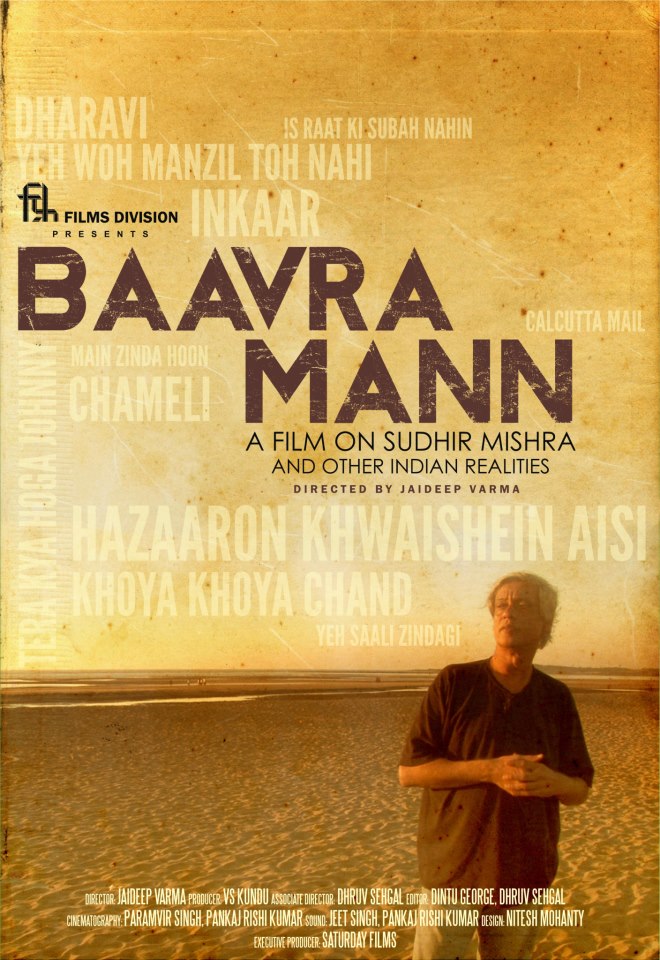
Jaideep Varma’s documentary Baavra Mann is yet to get a release in India. Karan Singh Tyagi saw it at New York Indian Film Festival earlier this year and wrote this post for us. Read on.

(We suggest you play the song in the background while reading the post)

Baavra MannWho is this long-haired Sanjay Dutt duplicate?

Duplicate nahi hai bhaiyya. Iska naam Nirmal Pandey hai. Kya acting kari thi isne ‘Is raat ki subah nahin’ me”, was my prompt reply, as my cousin and I stood in line with a dozen others, scanning movie posters outside Gaiety (Bandra) and booking our tickets for ‘Auzar’. As an 11 year old, I couldn’t contain my excitement, at having recognized Nirmal Pandey in the ‘Auzar’ poster, and went on this long rant about ‘Is raat ki subah nahin’. Much to my cousin’s chagrin, I told him everything about the movie – how it was violent and funny at the same time, how all the actors spoke a very different language, how the story finished in one night, and importantly, how Papa and I were lucky to see the movie on the big screen, as it had a single show in Bombay.

This innocuous little incident came back to me while watching Jaideep Varma’s documentary, ‘Bavra Mann and other Indian Realities’, in New York. For those who haven’t seen it yet, Jaideep’s movie traverses through the life and films of Sudhir Mishra, and somewhere in the middle of the movie, Mishra laments how ‘Is raat ki subah nahin’ was confined to a single show in Bombay and how many people didn’t get to see it. On hearing this, I silently smiled as my mind went back to watching the movie with Papa in the same show that Mishra was referring to. How I wanted to thank my father at that very instant! Not just for taking me to ‘Is raat ki subah nahin’, but for giving me the hereditary gift of love for movies and being the best companion I could have had while I nurtured  it.

There were numerous such nostalgia trips throughout Jaideep’s movie. The portions dealing with ‘Hazaron Khwaishein Aisi’ left me mesmerized. Listening to ‘Bavra mann dekhne chala ek sapna’ on the big screen again did my soul so much good; it stirred something deep within me, something in desperate need of stirring. My mind went back to when I first saw ‘Hazaaron..’ I remember crying tears of joy and sadness, laughing gleefully, feeling melancholic and empty, while ‘Bavra Mann’ played on loop and images from the movie interposed with flashes of my life didn’t leave me for days at end.  Probably, this is a uniform reaction that ‘Hazaaron..’ elicits. The movie strikes a deep chord somewhere, and makes one confront broken promises, failed dreams, and all those bittersweet memories, that we carry with ourselves. Right after watching Jaideep’s ‘Bavra Mann’, a friend who had accompanied me to the screening in New York forwarded me this by Avijit Ghosh who captures this sentiment beautifully:

There are a thousand reasons to watch Hazaaron Khwaishein Aisi. But enjoy it as a last anthem for a generation who knew how to believe. Watch it holding the hand of a woman you have loved and lost. And it would be nice if you have drunk some rotten whisky before.

As must be painfully evident by now, I am easily susceptible to bouts of nostalgia. However, these glorious nostalgia-filled moments were not the only reason why I enjoyed Bavra Mann. I have often wondered what drives filmmakers to make the kind of movies that they do. For example, at the risk of doing a Baradwaj Rangan here, I have been fascinated by two particular scenes from Black Friday and Gangs of Wasseypur.

Sample these dialogues:

Black Friday – “Jiske paas kuch nahi hai karne ke liye, dharam ke naam par chutiya banta rahega”. GOW2 – “Jab tak cinema hai log chutiye bante rahenge

I have often wanted to argue that we can discern in these dialogues a kind of master narrative, a collection of meanings, and, perhaps, a powerful leitmotif that runs through all of Kashyap’s movies, a kind of slavishness and hive mentality – towards religion in Black Friday, towards cinema and everything that one acquires from it in Gangs of Wasseypur. To take the analogy further, slavishness towards power in Gulal, towards self and personal ego in DevD and No Smoking. Therefore, Kashyap’s movies are magic on celluloid, because he lets characters with such aggressive spirit and slavish devotion face their internal conflicts and external surroundings. What we see on screen is the result of a bundle of contradictory aspects and motivations, a certain kind of dualism that everyone and everything in life has. I have repeatedly asked myself, what are the questions that Kashyap is trying to answer through his work? Has he found any answers yet?

Bavra Mann poses similar questions to someone whom Vikramaditya Motwane calls the “original Anurag Kashyap”. Despite the frequent and frenzied analysis of cinematic moves of all current directors’, I feel there is a strong lack of literature that provides us with enough resources to examine and study their work. This is where Bavra Mann triumphs. It gives enough resources to the audience to interpret Sudhir Mishra and his movies in a new light. Bavra Mann is a fascinating exercise in self-revelation and film lovers will revel in the personal anecdotes and casually delivered remarks that reveal layers and layers of information about Mishra and his body of work. The movie has a series of interviews with Mishra and people close to him, covering the length of Mishra’s career, beginning with his childhood, continuing through his education, his failed marriage with his first wife, his relationship with renowned film editor, Renu Saluja, his early film work, his breakthrough success with Dharavi, and his daring work in Hazaaron.., his most autobiographical Khoya Khoya Chand, and finally his recent movies. There is a treasure trove of diamonds in the movie. After all, who wouldn’t want to eavesdrop on Mishra and Shantanu Moitra’s recounting of how they got Swanand Kirkire to sing ‘Bavra Mann.’

A criticism often peddled against movies like Bavra Mann is that the director holds back, and is reverential towards his subject. Here, Jaideep is never in awe of Sudhir Mishra. His questions are probing and the discussions on films themselves are less about why they’re great and more about how they were put together. Jaideep knows that directors are not good at explaining motives behind making particular films. Movies, like many things else, begin with something very vague and abstract. Jaideep, therefore, never tries to look for definite answers and actual motives behind Mishra’s work. His aim is to allow the viewers the freedom to interpret the scene in the way they want, and depending on how their cinematic education (and earlier experiences of Mishra’s movies) has prepared them. Bavra Mann succeeds in bringing before us the greatest number of possibilities to reinterpret Mishra’s movies. After watching Bavra Mann, I realized that Sudhir Mishra’s movies (especially the earlier ones) resonated with me because they were being truthful about life – the movies expressed some deeper emotional experiences that Sudhir Mishra recognized in his own existence. This in and of itself was a reason for me to love Bavra Mann.

However, for me, the biggest strength of Bavra Mann is that it never wavers from admitting that Sudhir Mishra continues to be plagued with what is an inconsistent body of work. It subtly engages in criticism of some of Sudhir Mishra’s recent movies (the likes of Inkar, Calcutta Mail) to reflect on the present-day infertility of thought in India. By using Sudhir Mishra’s example, Jaideep exposes the dangers inherent in adopting a conformist and consensus-driven career. According to me, it is in this context that the movie makes a brutally frank attempt to unravel the intellectual decline of India and Indian movies (using Sudhir Mishra as a metaphor).  The movie, therefore, is an elegy of intellectual life not only of Sudhir Mishra but of us all. In a way, the movie tries to jolt us (Sudhir Mishra included) out of the dark recesses that we have allowed ourselves to fall in.

I do not know if Bavra Mann is getting a theatrical release anytime soon. However, I strongly hope that everyone gets a chance to see it. Watch it to revisit old times, to go back to your personal stories intertwined with Sudhir’s films, watch it to hear “Bavra Mann” on the big screen again, watch it as a student and lover of cinema, and most importantly, watch it because it is a powerful statement on the times that we live in.

Naseerudin Shah says the single most perceptive thing in the movie: “Mishra’s best work is yet to come.” Even though, I love ‘Hazaaron…’, I wouldn’t want it to be Mishra’s best work. I earnestly wish that it turns out to be just a teaser of what he (and by association) Indian cinema goes on to achieve and that no one is ever required to come to the rescue of this long-haired maverick director, like I had to once come to the rescue of his similarly long-haired leading man outside Gaiety.

– Karan Singh Tyagi

(Karan was born in Meerut, lived and studied in Bombay and Harvard, and after a brief stop in Paris, now finds himself in New York. He strongly feels that Ramadhir Singh was directly referring to him while saying, “Sab ke dimaag me apni apni picture chal rahi hai aur sab saale hero banna chah rahe hain apni picture me..” When he is not day-dreaming about movies or Real Madrid, he also works as a lawyer. You can find him on twitter here: @karanstyagi)

Baandhon is the first Jahnu Barua film to get a multi-city release outside Assam. Thanks to PVR Directors Rare. For cities and show timings, do check the poster below. And here’s Pradeep Menon on the film.

943271_470624503025894_1991809589_n

The media, social and otherwise, has been abuzz with the latest Hindi release; an exciting, talented director’s sophomore feature, one that is making critics and audiences alike gush over gorgeous frames, celebrate the coming of clean cinematic craft, and most importantly, reminisce about romances of the days of old.

Indeed, sometimes one can’t help but feel that, in this day and age, we’ve all forgotten how to fall in love. We’ve forgotten what it is like to drown oneself in that heady rush of a new romance, embrace unbridled passion today like there isn’t a tomorrow and push the limits of rational behaviour in the pursuit of real life moments that make us feel like we’re living a movie.

But here’s the thing about romance – it always dies away. No question about it. So what remains then? What happens when you spend years, or even decades, with a person? Hopefully, once the romance, the passion and the giddy joy of the other’s company gradually ebb away, what you’re left with is respect, stability, comfort, and, if you’re extremely lucky, a lifelong friendship.

That, precisely, is what Jahnu Barua’s ‘Baandhon’ (“Waves of Silence”) is about. On the surface, it appears to be about the complex relationship shared by a married couple; a man and a woman who’ve spent nearly their entire life together. But if you really pause to think about it, it is quite simple. Their love has evaporated perhaps, but they are left with the next best thing – companionship.

Baandhon spends more than half its run-time soaking itself in a single fight between an aged husband and wife; a couple that has already been bereaved of its offspring, and is now solely alive for their grandson, who studies in IIT Mumbai. However, right from the outset, we know that this fight isn’t for real. They’ve done it to death umpteen times before, and it is perhaps the only thing that keeps them going on a daily basis. One ticks because the other is.

But, before we even see the couple for the first time, we are told the date of the fight. 26th of November 2008; a day that sent waves of silence of its own, all around the country. And immediately, you know that this is a story that is always going to end in some sort of a tragedy.

Barua, then, with his decades of filmmaking experience and multiple National Awards, chooses to douse his narrative in such minimalism and sparseness that not only is there never a twist, but there also isn’t even the anticipation of one. The terse inevitability of the path the film traverses is always writ large over the goings-on, and yet, Baandhon gently attempts to reaffirm faith in humanity while admitting that somewhere along the way, humanity has failed.

Reminiscent more than once of Mahesh Bhatt’s ‘Saaransh’, yet largely steering clear of some of the harsh questions and issues that Bhatt’s film raises, ‘Baandhon’ roots itself in economy of craft and storytelling. Even the background score of the film tries its best to camouflage itself behind the visuals; so rare for Indian cinema today, which nearly always attempts to elevate every emotion with over-the-top mood music embellishment.

There isn’t an overt attempt at displaying craft or technique here. Baandhon could easily have been a play. It is set mostly in Guwahati, before the climax, if I can call it that, shifts to Mumbai. Yet, there is no attempt to give the film a texture that sets it in a particular time or place. It could be happening anywhere, at any time. The 26/11 backdrop gives it a real world context perhaps, but even that could just as easily have been a fictional human tragedy that only needed Mumbai to be the place it occurs in. This of course, is clearly intentional on Barua’s part. If you’ve watched ‘Maine Gandhi Ko Nahin Mara’, you know that he’s fully capable of creating a perceptible flavour of place and time.

Baandhon also has no solutions on offer. In fact, it hardly asks any questions. All the film does is give us a brief window of a few days, into the life of a man and woman who, after 73 years of their life, have only each other, even if their journey brings in their path a few kind souls who unselfishly look out for them. It is in these side characters, the ones that attempt to show you that humanity has hope after all, where the film really falters. Our cynical selves will find it hard to swallow the genuine goodness that the peripheral characters go out of their way to shower on our protagonists.

It doesn’t help that most of these side characters aren’t particularly well performed either. Even Bina Patangia, who plays one half of our couple, has an adorable character to fall back on, but her performance itself is mostly functional. Only Bishnu Kharghoria, who plays the husband, truly manages to turn in a memorable performance.

Despite some almost naïve writing and characterization, it is in its silences and pauses that Baandhon’s honesty shines through. This honesty draws you in and makes you want to sit right next to the couple as they deal with loss. Yet, just before your hand reaches out to caress them, you realize that they still have each other. And as you draw your hand back and walk away from them, all you really tell yourself is that perhaps that is all one needs – another person to fall back on, forever.

( To read more posts by Pradeep, you can check out his blog here)

Raanjhanaa(Has SPOILERS)

Like most Bollywood films these days, Raanjhanaa is completely two different films packed in one – pre and post-interval. One is the “politics of love” and the other is “lovers in politics”, and there’s a big difference between the two. As the initial reactions and reviews started pouring in, the verdict seems to be unanimous – first half is fun, the curse of 2nd half strikes yet again. As i stepped into the theatre, i was ready for it. But as i came out of the theatre, i realised that i belong to that minority group which liked the second half more.

First half is easy, you know the tricks, you have seen it many times, love stories in small towns and galli mohalls is not new. It’s charming and easy to like. There’s no way one cannot not like it. Some might argue that it’s stalking and glorification of it, then let me say that you have never been part of any small town love story. It’s stark reality. That’s the way it happens. If you don’t know a friend who has cut his wrist or drank kerosene (sleeping tablets is for metroes), the film might seem a bit stranger to you. But what stood out for me was how ruthlessly selfish the lovers are. Sonam (Zoya) knows Dhanush (Kundan) loves her. And so she uses him in every possible way. It’s the same with Kundan, who knows that Swara (Bindiya) can do anything for him. And he uses her blatantly. It all seems fun and jovial on the surface but scratch it and you realise how cunning their acts are. It’s the politics of love. Their love might be pure but the tricks aren’t.

Some even might point out the physical equation between Kundan, Bindiya and Murari. How can you hit her? i would say this is what “camaraderie” between friends is all about, without being aware of one’s gender. And in the scene when Bindiya says kewal mere baap ke hi kapde phadega, and Kundan backs out, you know that she isn’t the shy kind. If she had protested, these guys would have backed out long back. It’s part of the game, of growing up together.

Now, the second half seems like a completely different film.  A death, and the childhood romance of Benaras moves to ambitious student politics of Delhi. Kundan doesn’t know why he is there. He is lost. He is not sure what to do with his life. He has tried every possible option. Is he still chasing Zoya? Yes. Kind of. Does he know why? No. Has he any more hopes from her? No. The simple chasing the girl routine turns into a heavy cocktail of ambitions and emotions. Let’s see how. So Zoya aspires to fulfill the ambitions of her dead lover (Abhay/Akram). But slowly it looks like all these dreams will come true only through Kundan whom she hates now, whom she holds responsible for Akram’s death. It’s a difficult choice to make. Can she accept Kundan now? And even if she does, the world will curse her for being selfish and opportunist who forgot her lover after his death. Between love, life and dreams, she is confused with no easy way out. And then comes an opportunity to turn it all over and conquer it all. She opts for it too but the guilt is too heavy to bear.

Kundan is caught in a similar situation. He is aimless, he is just tagging along and is getting lucky wherever he puts his foot, except in love. And when it all comes to the conclusion, he realises that even if he wins everything, he has lost the only thing he ever wanted from life – love. So what’s the point of living? Someone who can slash his wrist so easily, he has no fear of death. The monologue in the climax wraps it up beautifully. Lovers always claim to be ready to die in love. But only few dare to do it. And very few directors and writers dare to opt for such uncompromised end for a love story. Nothing else was possible. All credit to writer Himanshu Sharma and director Anand L Rai for going the whole hog. And this is exactly why i liked the second half more. It’s complicated,  and the makers went for the unusual choices. I think first half is easy to write, and easy to like. Second half is damn difficult to write from the point when Dhanush lands up in Delhi not knowing what to do. I could hear the writer’s voice there – what to do with this mujhe-bus-Zoya-chahiye character? He (character and writer) really doesn’t know what to do now.

Raanjhanaa2

Now, the running joke. In a scriptlab where Sriram Raghavan was our mentor, we used to joke that whenever you are stuck at any page, just put a gun in that page. Sriram will like it for sure. Here the formula is slightly different – stuck on the page, opt for the blade. Not once or twice, but three times. Woah!

Interestingly, the entire film is one long montage cut on back to back songs. You can exactly count the numbers of the scenes where the characters talk. But the flavour of the real locations and the terrific acting by Dhanush, Swara Bhaskar and Mohammed Zeeshan Ayyub makes it look perfectly smooth. Also, it might be a smart decision keeping Dhanush’s dialogue delivery in mind. They have justified his character, and his hindi diction is weird but it’s not jarring to ears. So a big credit must go to its music director A R Rahman. His music is the thread that holds this complicated tale of unrequited love together. Sonam seems to have improved a lot from her previous films but her dialogue delivery is still irritating. And Kumud Mishra is always quite pleasant to watch onscreen.

I never bothered to watch Rai’s earlier films. But going by Tanu Weds Manu (i like it and TERRIFIC album) and Raanjhanaa, i think Imtiaz Ali has some competition finally. Especially if it’s matters of hearts in small towns. And Dhanush, welcome to bollywood.

Watch it. And if uncomfortable, take off your “metro” shoes.

@CilemaSnob