Archive for May, 2011

This recco post is by Gyandeep Pattnayak. You can read his previous recco posts here (Chaser), here (The Proposition) and here (Tell No One).

Are we ever satisfied with the way we define love? Ask yourself this question. Cut out the entire philosophical dialog-pedia such as, “Love is friendship” or “Love is when you don’t know you are in love”. Think deep and you will come to realize that love can not only be not defined but can also be an emotion which you know intuitively but you don’t know why you know it. The question that lurks at the core of Mark Romanek’s hauntingly beautiful Never Let Me Go is a difficult one, to begin with. It’s not difficult in the sense that it can be or can’t be answered; it is difficult because it HAS to be asked.

Based on Kazuo Ishiguro’s bestselling (and said to be unfilmable) novel of the same name, Never Let Me Go begins with a school called Hailsham where kids are told that they are special and that Hailsham is a special school. Kids here are required to swipe in their attendances with the help of a metal wrist band. Intriguing? Even more so because the year is 1978 and a title card suggests that breakthrough in medical science came when it was discovered in 1952 that human life can be extended beyond the normal 100 years. We are introduced to the three principal characters – Tommy, a lonely boy who finds it difficult to mingle with his friends; Kathy, a girl who takes a liking to Tommy because he behaves strangely; Ruth, a manipulative girl who decides to come in between Kathy and Tommy for seemingly no particular reason.

The children of Hailsham are brought up like normal children – they are given food, clothing and shelter. They are taught everything that normal kids should learn, they are taught to actively take part in arts. But, there is one exception – a rule is imposed on all of them that nobody should cross the school boundaries. The world outside is dark and violent, they are told. As any normal kid would, they believe in the stories. There is no reason for them to question these rules. Tell me, if you were taught right since your childhood that a horse is called a rabbit, you will definitely call it a rabbit – unless somebody tells you otherwise. Anyway, the kids grow up and leave Hailsham and move to a new place – ‘The Cottages’. It is here where they start questioning their choices and the reasons why they are called ‘special’. I don’t want to give out any spoilers and ruin the show for you. Let me be extra careful here — when our protagonists get into the ‘conflict’, they do not understand what to make of their existence. Slowly, Kathy makes peace with everything but Tommy is devastated. Everything he has been living for is a lie. I can’t even begin to imagine how nightmarish it would be for me if everybody around me told me tomorrow that we all are not called humans but “zodpackia”. (Don’t make too much of the word, I’m just giving you a hypothetical scenario)

Andrew Garfield’s performance can be described in one and only one word – heartbreaking. Piece by piece, we see him disintegrate into nothing, literally. Physically delving into the role, Garfield creates one of the most endearing characters on screen in recent times. Nothing I say will be a perfect measure of what Garfield brings to his performance. He is as vulnerable and as earnest as a kid sitting next to you in the exams asking you the answer to question number 5 because if he doesn’t answer that particular thing, he’s going to fail. (Please don’t assume that I am making a lousy comparison.) Tommy is searching for answers and he is pretty confident that he has it all figured out. Just watch the scene in which Garfield lets out a wail of anguish at nothing in particular when he realizes that he has been denied something which he deserves so rightfully. It might have been a loud, uneven scene had it been in a different film or performed by a different actor. Garfield makes the pain his own.

Carey Mulligan portrays Kathy as a person who has a sensible understanding of what’s going on around her, even if she believes some of the stories which she has heard at Hailsham. “My name is Kathy H.” she says and thus begins the film. Take one look at her expression and listen to the lines as she speaks and you’ll know why she is one of the brightest talents to have emerged from British cinema. Kathy is, let’s say, too mature for her age and Mulligan nails it by going a bit further and portraying Kathy as someone who can accept defeat and still be satisfied that she ‘lived’ to accept defeat. Keira Knightley essays the role of the manipulative Ruth, who decides she must love Tommy even if she doesn’t understand why she has to love Tommy. Or anyone. Didn’t I just tell you that love is a strange emotion? Strangely, I found myself sympathizing with the Ruth character even when I knew that she had to do something with the gradual separation of Tommy and Kathy. I believe you will too. And it is to the abundantly talented actress’ credit that she doesn’t make Ruth the caricature that she could have so easily been.

One word about the child actors Charlie Rowe, Isobel Meikle-Small and Ella Purnell who portray Tommy, Kathy and Ruth respectively – that their faces resemble so much of the adult actors isn’t the only thing to be admired here. These kids actually become Tommy, Kathy and Ruth when they grow up. May be it is the other way around – because Garfield, Mulligan and Knightley definitely behave like these kids once they start playing their adult versions on screen.

The screenplay is by Alex Garland, the man behind the ingenious Sunshine, which was cruelly overlooked when it released in 2007. Garland distinctly separates the two facets upon which the premise of Ishiguro’s novel is based – love and death – and then makes us question these themes, about what really are our choices. There is a slight sci-fi bend in this love story and thankfully nothing is overdone. What I mean to say exactly is there are no futuristic machines, no jargon-spewing people and no undecipherable mess. Garland is not an ordinary writer; I never had any doubt about that. But, when he hangs up his boots (which I hope he never does), Never Let Me Go will feature prominently as one of his best works ever. This is Mark Romanek’s debut film as a director and I feel Romanek’s importance as a director has been established, given that he has an impressive number of music videos on his resume. He is a director with a vision. Going for restrained shots and a bleak setting and loads of melancholia, Romanek delivers a spectacle of a movie aided by Garland’s brave and uncompromising screenplay.

You may have seen love stories but none as profound as this, none as unsettling as this. And it is not disturbing because of some gratuitous elements; it is disturbing because you will have to answer the fundamental question posed by this movie. You know the answer. It isn’t a puzzle but sometimes, the truth isn’t meant to liberate.

Often done to death and diabetically sweet, love stories are a tricky genre. Hopefully, the times are changing. Because after 2009’s excellent (500) Days of Summer, we not only have a great love story but also something that can be hailed as one of the best films of the year gone by.

P.S. – There is a solo-violin piece in the movie called ‘We All Complete’ by Rachel Portman and I haven’t been able to get it out of my head ever since I heard it.
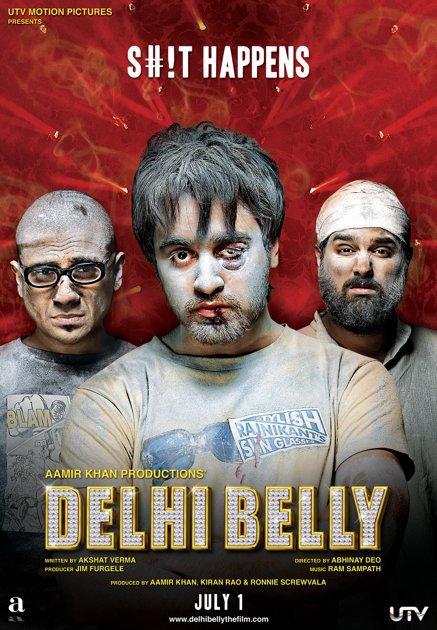
Here it is…

It’s directed by Abhinay Deo, written by Akshat Verma and stars Imran Khan, Vir Das, Kunal Roy Kapoor and Shenaz Treasurywala. And here’s the official synopsis….

Tashi, Arun and Nitin – flat mates, buddies and partners in crime. Tashi is to get married in a month but still doesn’t know if his fiancee is THE ONE! Arun can’t make up his mind who he wants to kill first – his girlfriend (who has just dumped him) or his stupid, annoying boss (whose idea of creativity is sketching a smiling banana). And Nitin is about to discover that eating delicious Tandoori Chicken off a street vendor is going to give him the worst case of Delhi Belly he’s ever known! Three regular blokes, living the regular life except for one small detail – they are on the hit list of one of the world’s deadliest crime syndicates. Will they be able to get away before the shit hits the roof and it comes crashing down? Delhi Belly is the meanest comedy you’re ever likely to see.

On 7th May, 2011, it’s the 150th birth anniversary of Gurudev Rabindranath Tagore. And to celebrate it, Ministry of Culture and Ministry of I & B in association with NFDC will release a commemorative dvd pack called Tagore Stories on Film.

“Tagore Stories on Film”, is a collection of 6 DVD’s and is a rare compilation of five classic stories written by Tagore and filmed by different talented directors. It also includes  2 documentaries as bonus features based on Tagore’s life. These films, the material for which was acquired from various sources in India and abroad, have undergone both picture and sound restoration.

The five films are…

1. National award winning film from Tagore’s classic story ‘Khudito Pashan’ (Hungry Stones) by Tapan Sinha, 1960 in Bengali.

2. Teen Kanya (Three Daughters) directed by Satyajit Ray, 1961 in Bengali, based on three of Tagore’s stories – The Post Master, Monihara and Samapti.

3. Critically and commercially successful ‘Kabuliwala’ directed by Hemen Gupta in Hindi, 1961 featuring Balraj Sahni.

 4. Cannes Film Festival Golden Palm Nominee film, a 1984 classic, Ghare Bhaire (Home and the World) by Satyajit Ray based on women’s empowerment.

 5. A poignant comment on the adverse effects of nationalism and a nuanced interpretation of Tagore’s novella, Char Adhyay (Four Chapters), directed by Kumar Shahani, 1997 in Hindi.

6a) The silent film Natir Puja is a compilation of the footage available of the film that was directed by Rabindranath Tagore. A picturization of the dance-drama Natir Puja, this partial but restored film forms a landmark in Indian Cinema being the only film where Tagore was directly involved in production. Shot over four days on the occasion of Tagore’s 70th Birth Anniversary on 1932, the film also features Rabindranath Tagore in an important role.

6b) The second documentary was made by Satyajit Ray in 1961 to celebrate Tagore’s Birth centenary called ‘Rabindranath Tagore’.

If you want to know more about the films, keep on scrolling…

Disc 1. Khudito Pashan (Hungry Stones). Tapan Sinha.  1960. Bengali.  106min. B&W

A classic by every standard, this National Award winning film, originally the story of a tax collector who moves into a haunted mansion in a small town and falls in love with a beautiful ghost, finds a unique, visual interpretation from an ardent Tagore Fan – Tapan Sinha.

Disc 2. Teen Kanya (Three Daughters). Satyajit Ray. 1961. Bengali. 161 min. B&W

Satyajit Ray’s neorealistic style of filmmaking found an ally in Tagore’s stories of ordinary folks. Teen Kanya is based on three of his stories – The Post Master, Monihara and Samapti, and tells the story of a young village girl taught by a city-bred postmaster, a woman’s obsession with her jewels and a tomboyish girls who changes after marriage.

Disc 3. Kabuliwala. Hemen Gupta. 1961.  Hindi. 140 min. B&W

A critical and commercial success, Kabuliwala is the tender story of a widower Afghani Pathan, played evocatively by Balraj Sahni, compelled to leave his daughter in Afghanistan and relocate to India. He misses his daughter and showers his affections on a young girl in this emotional memorable film that tugs at the heart of audiences.

Disc 4. Ghare Baire (The Home and the world). Satyajit Ray. 1984.  Bengali.  138 min.  Color

This Cannes Film Festival Golden Palm Nominee film is one of the most telling statements on women’s empowerment. Encouraged by her Bengali Noble husband Nikhil, Bimala takes her first step to emancipation, only to fall for the hypocritical, but charismatic nationalist leader Sandip.

Disc 5. Char Adhyay (Four Chapters). Kumar Shahani. 1997. Hindi. 110 min. Color

A poignant comment on the adverse affects of nationalism and a nuanced interpretation of Tagore’s novella, Char Adhyay is the story of Ela, loved by armed revolutionaries of the Indian freedom movement as a mascot for the country, who questions this blind indoctrination after falling in love with Atin.

Bonus Features:

Disc 6

 1. Natir Puja l Rabindranath Tagore | 1932 | Silent with Commentary in English | 20 min | B&W

Natir Puja is a landmark in Indian cinema being the only film where Tagore was directly involved in production. Shot over four days on the occasion of Tagore’s 70th birth anniversary in 1932, this partial, but restored film written by Tagore also features him in an important role.

 2. Rabindranath Tagore l Satyajit Ray l 1961 l English l 52 min l B&W

Made by Satyajit Ray in 1961 to celebrate Tagore’s birth centenary, this dramatized documentary features some deft cinematic touches of a master filmmaker that sets it apart from most biographical documentaries in the world.

Locarno Film festival has announced the projects selected for the Open Doors Co-production Lab this year. From over 200 projects submitted, in 18 different languages, from 30 regions in India, these are the 12 finalists which will participate in Open Doors, the Festival del film Locarno’s co-production lab.

The selected projects are:

–  Aharbal Falls by Ajay Raina

–  Ajeeb Aashiq / Strange Love by Natasha Mendonca

–  Arunoday / Sunrise by Partho Sen-Gupta

–  Burqa Boxers by Alka Raghuram

–  Char, The Island Within by Sourav Sarangi

–  Jat Panchayat / The Judgement by Satish Manwar

–  Lasya / The Gentle Dance by Anup Singh

–  Samaadhi / The Penance by Sidharth Srinivasan

–  Sebastian Wants to Remember by Vasant Nath

–  The Trapper’s Snare by Shanker Raman

–  Thread / Le Fil by Lilium Leonard

–  Vidhvastha / Devastated by Ashish Avikunthak

Supported, since its inception in 2003, by the Swiss Foreign Ministry’s Agency for Development and Cooperation (SDC), Open Doors aims to assist the directors and producers of the selected projects to find co-production partners, to complete their film. It is organised in close collaboration with the Festival’s Industry Office and enjoys support from the following partners: ACE (Ateliers du Cinéma Européen), EAVE (European Audiovisual Entrepreneurs), EPC (European Producers Club) and Producers Network Marché du Film (Festival de Cannes).

At the end of the three-day workshop a prize of 50,000 CHF (approx 39,000 euros) is funded by Open Doors. A second prize of 7,000 euros is financed by the CNC (Centre national du cinéma et de l’image animée) and ARTE will award the International Relations ARTE Prize of 6,000 euros.

The Open Doors co-production lab will take place August 6-9, 2011 as part of the 64th edition of the Festival del film Locarno.

To know more about the projects and the directors, do click here.

Coup d’état vs Coup de grâce

Posted: May 1, 2011 by moifightclub in cinema
Tags: ,

In media res : My favourite literary technique where, to put it quite simply, the story starts at the middle and not at the beginning and the end. Most of my favourite movies employ it to great effect, and I still think it’s the most interesting way to tell a story. A certain Chris Nolan seems to think so as well, but that’s name dropping and star fucking which is the fundamental reason of why PFC is dead and will remain so in all but name.

My story starts about 3 years ago in NYC where I was trying my hardest to avoid anything and everything Bollywood because I was in voluntary exile from the Emerald City (See how cleverly I foreshadowed Oz. I’m nothing if not subtle). I don’t even remember how but I came across the PFC blog and was very interested to read a rambling, almost incoherent account about a Scriptwriting workshop which had diggaj log like Vishal Bhardwaj, Javed Akhtar etc.

If you know me personally, then you might get the impression that I’m a bit of a snob. I’ve tried to dispel this perception of myself for a very long time but having turned 30 recently I’m like fuck this shit. If you can’t fight it, then bite it. You see I despise amateurism and mediocrity in everything, especially myself. I have a pretty good idea of my strengths and a very good idea of my weaknesses. I limit my singing to drunken karaoke sessions and in the shower and I keep my mouth shut if I know nothing about the topic being discussed. I don’t feel the need to express my opinion on everything under the sun but I realize I’m a minority. I’m not easily impressed by other people’s work and thankfully I hold myself to those same standards. I’m the first person to admit I fucked up or did a crappy job.

Coming back to that avtaar of pfc, everything seemed mickey mouse to me, so as is my habit, I wasn’t impressed. Cut to almost a year later, I land up in LA knowing exactly one person who ran the US division of the biggest Indian studio. (See how I name dropped here since I’m from Delhi it’s second nature). I was in a strange town, without a car and it was Christmas season. I remember spending a very sad and lonely new year by myself eating pizza and watching reruns of house.

It was during these less than champagne days of my life before I began to metaphorically rock the casbah that I recalled PFC and became an author. Mainak was one of the first people to friend me in LA and buy me some truly diabolical chai (See my latent snobbery emerging here again) and I thought, “hey this is pretty cool.” Even while being tadipaar I can kinda sorta keep in touch with desi filmmakers and maybe we can collaborate. Gheun Tak, as they say.

I think I blogged for about a year and a half and the quality of my posts varied mightily in quality, content and grammar. It was really influenced by the state of my liver, love life and very occasionally by intense bouts of homesickness. Some of my posts make me cringe now and I wish they would vanish forever but like films once it’s out there you have to live with it forever. PFC in that time changed it’s look and editorial direction a few times.

I got in touch with some amazing people and made some very close friends with PFC folk. I’ve had the good fortune of working with some of them and hope that their tribe increases with every passing day. I’m not gonna name you guys since clearly your not famous yet so I’m gonna wait till you are winning awards and shit till I start bragging bout you guys. Btw, Shripriya’s film is playing in NYC this week. So catch it if you can (Shri, it’s ok to plug you). Very recently I shot a documentary on the legendary K Balachander for another PFC founding member Vijay. (Note the blatant the name dropping here? Respect my authoritah !!)

Now that I’m back home, I run into a lot of people who know me through my posts on PFC, and in a sense I’m probably the one who took advantage of PFC the most as I was able to have a foothold in Bombay even as I was slogging my ass in LA and working towards my goal of racking up imdb credits like it was going out of business. PFC was a pleasant distraction but I never lost sight of what’s important i.e honing my skills and craft.

I have a lot to be thankful for, to PFC and to Oz, but the thing is, buddy, you can’t demand gratitude, you gotta earn it and it’s the most delicate thing in the world. As far as emotions go, it’s pretty much unobtanium. You can’t rub it in people’s faces and demand to be worshipped. It works when your Idi Amin Dada but not when you are Oz. For someone who always thought himself to be spiritually enlightened, you forgot the basic tenet of Karma. What goes around comes around. But enough of Oz who misguided though he was was in reality a puppet of the greater problem.

The problem was you, dear reader, who supported mediocrity in all manners possible and never put your money where your mouth was. For all the talk about supporting being warriors for indie cinema, it was Yashraj and UTV which got you hard. Indie cinema was a mere footnote and even at that moral relativity came into play. A film is not good or bad based on it’s budget or it’s director. It’s just good or bad. You refused to call a spade a spade and lavished praised on films which were meh and condemned films which were decent just because they were masala.

Why did I start reading PFC ? Because I wanted to read what a filmmaker went through while making a film not what the audience thought about it. I wanted to read about the blood, sweat and tears. I wanted to read about how they failed and how they triumphed. What I didn’t wanna read was fanboys giving online blowjobs, which what PFC ultimately mutated into. I’ve shot enough real porn to make fanboy porn look very boring. Then, of course, was the other end of the spectrum of the trolls getting their kicks by being a bitch.

Remember what I said about being a snob and keeping my mouth shut when I don’t know what I’m talking about? There are two sides to that coin. Shut the fuck up when you don’t know what you are talking about as well !!!! The amount of pinheads waving their dicks around in the name of their take on cinema was staggering. I mean, really would you tolerate it if I came to your place of work and gave you pointers on how to code or build a car from the ground up ? You would brand me a loony and kick me out on my ass. If PFC had done that long ago then it wouldn’t be a vestigal entity right now.

Mediocrity breeds mediocrity. It seems unfair to pick on one person but as a case study let’s take the enigmatic XX (Not exclusive author, just a blogger). I’m sure he’s a wonderful human being but as a writer he’s the donkey’s bollocks. If you can’t write in English then for god’s sake write in Hindi or Swahili for that matter. Why must you brutalize the language and cinema in the process? I can tell you for a fact he was one of the primary reasons why a lot of bloggers who were actual filmmakers quit PFC coz they couldn’t bear to write on a site where XX reigned supreme.

His divinely incoherent posts replete with bad grammar, syntax and almost zero understanding of the craft of filmmaking was a sight to behold. If you ever engaged him in an conversation, then the prospect of cutting your balls off with a blunt nail would probably prove to be less painful. When XX wrote, the collective soul of PFC had an orgasm and that sperm resulted in something much more dangerous. The pollen seed of mediocrity which spread like the kudzu weed and in the end throttled the life and soul of PFC. The folks who actually made or wanted to make films. When XX can write, so can anybody with access to a computer. All very democratic and idealistic wouldn’t you agree?

Unfortunately this very idea that everyone can make a film proved to be the death knell of PFC. Life isn’t a democracy and neither are films. It’s equal parts idiocracy and meritocracy with each playing the role of yin and yang. Once again as I’m a snob I believe there needs to be a barrier between the artist and the customer otherwise what will result is not going to be a work of daring individuality but rather a cookie cutter compromise intended to please the most number of people.

In essence a fast moving consumer good rather than an artifact of the human condition. Yes, PFC unearthed a lot of filmmakers and gave them hope and put them in touch with their heroes but there was a price to be paid. The price was mind-numbing sycophancy and with sycophancy comes the loss of perspective and eventually megalomania. It’s happened to lot of filmmakers who were touted as the saviors of Indian cinema and now they are nothing but a case study of what went wrong.

PFC was a great idea but it’s time is past and it’s for the better interest of the filmmakers themselves that I beg you not to indulge the fanboys and fan the fires of mediocrity. I know it’s a great ego boost but I’m pretty sure Kubrick didn’t a software engineer or any other random dude with an intense need to starfuck to tell how him great he was.

Another sad fallout of the entire PFC movement was that a lot of budding filmmakers got it into their head that the lack of craft in their films made it somehow more legit and honest. You would have an entire generation of filmmakers for whom being amateurish in their approach was a badge of honor. Even for established filmmakers excuses were made and discounts were given for their slipshod films.

I personally think the worst thing you can do to anybody in a creative endeavor is to give them dishonest feedback. This is the time I go arty farty and quote Rumi, “If you are irritated by every rub, how will your mirror be polished?”

I studied Business in my undergrad and despite having forgotten most of what I studied, one thing has always remained with men and hopefully always will. The two most important things for any entity be it for profit or otherwise are goodwill and brand perception. Once lost it’s almost impossible to get back and there is always a faintly rotten smell in the premises. PFC lost it’s goodwill a while ago and it’s brand perception is a joke.

I won’t be coming back to write on PFC and most probably on any other forum either as I am terrified of what sycophancy will do to my creative process. Now I understand why most visionaries are recluses. I’m no genius or visionary but I do value my work so I leave PFC to XX and his merry men. I feel sorry for picking on you but you are endemic of all I deplore in life the most, namely the celebration of mediocrity in the name of democracy. More than the folks who write on PFC it’s the people who read it now are the problem.

In the end just to prove how fucking indie/hatke/cool/ I am, I leave you with these words from William Shakespeare who may or may not have been from Kapurthala.

I come to bury Caesar, not to praise him.

The evil that men do lives after them;

The good is oft interred with their bones

 – Mitchinder Singh Mathurawaale aka Mitch aka Gangopadhyay
