KAUFMAN - "Or cramming in sex, or car chases, or guns. Or characters learning profound life lessons. Or characters growing or characters changing or characters learning to like each other or characters overcoming obstacles to succeed in the end. Y'know ? Movie shit."
Kaufman is sweating like crazy now. Valerie is quiet for a moment - from "Adaptation".
We are all about CINEMA. That movie shit.
NOTHING is sacred.
NOBODY is spared.
Because we talk about films, dammit.
Not your sex life.
Films, fests, unsung, indies, undiscovered - all that and some fun. If you have dope on anything related to cinema or you would like to share something, do write to us at moifightclub@gmail.com.
The views, opinions, reviews, articles, or positions, expressed by the authors and those providing comments are theirs alone, and do not necessarily reflect the views, opinions, positions or strategies of ANY OF THE EMPLOYERS, FRIENDS, RELATIVES, PR agencies, Production houses, Media group and such third parties associated with the authors. The latter make no representations as to accuracy, completeness, currentness, suitability, or validity of any information on this site and will not be liable for any errors, omissions, or delays in this information or any losses, injuries, or damages arising from its display or use.
In short, if you have an issue with us or any post we've written, write to us at moifightclub@gmail.com
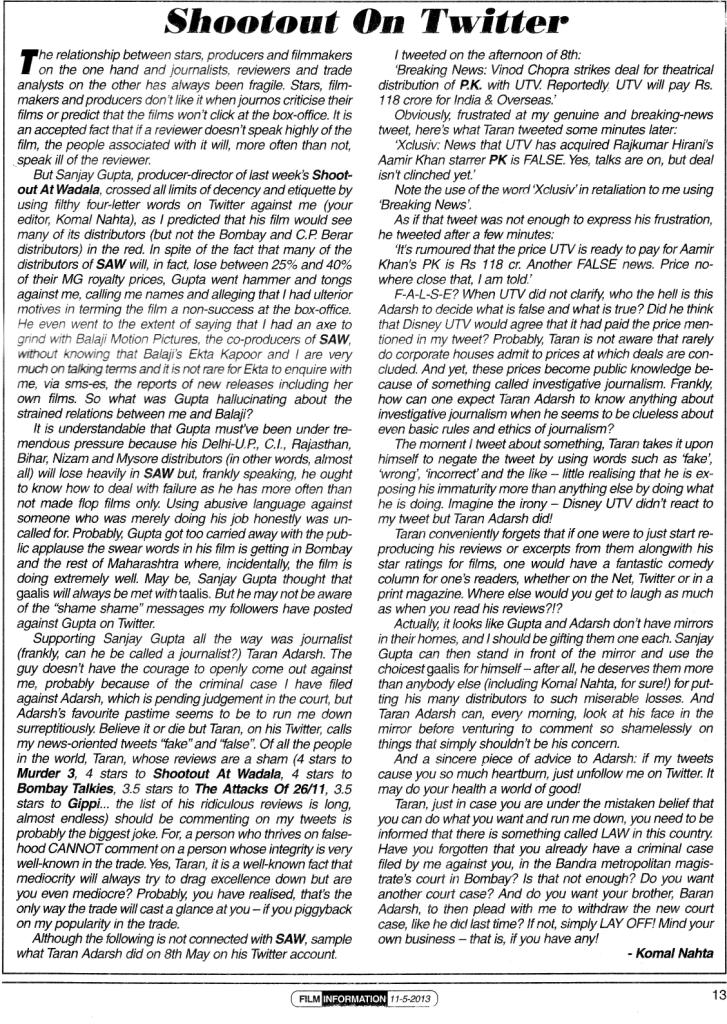
We started the segment “Just A Page” with completely different intention. But here’s a fun page in the same category. Read it to know more. It’s from the latest issue of trade magazine Film Information.
Aah, bollywood. There’s a reason why we love it so much.
“Pain is temporary, film is forever” – Michael J. Fox
Unfortunately, it is not. And neither are memories, both die, if not carefully preserved. Without memories, the past is a blank slate, existing in a space where we cannot touch it. Without a past we are a blank slate, forever trapped in a present that makes little sense. Films, like all our art, keeps our past safe, for us to delve into and understand how we came this far and, more importantly, where to go from here.
P.K. Nair understood this and scraped together our largely dissipated past, bit by bit, literally from across the country’s landscape and even beyond. What I felt when I heard that was sheer awe. And awe-inspiring is everything about Shivendra Singh Dungarpur’s documentary, “Celluloid Man”.
The film is the centre of attention right now, thanks to a much-deserved release (a shout out to the rare PVR Rare!), the National Awards, the Cannes selection and especially the centenary of our much-maligned yet much-beloved Hindi Film Industry. Much has been written about it so I’d like to simply share what the film did to me instead.
I like watching documentaries in the theatre. Especially our Indian docus which, by default, generally have a rusty appeal that somehow get an exotic aura in the hall. I also like everything old and forgotten; its romance and nostalgia, and the bitter-sweet pain that memories always bring with them. Celluloid Man, smelling of museums and ruins, was tailor-made for me. I walked in with the same excitement, same anticipation I had while watching Hugo, except that this was a bit more personal. This was about history that was specifically ‘mine’.
I settled down and there was this old, decrepit man detailing first-hand, his journey of collecting films and teaching a stubborn India the importance of preserving its history. How he salvaged the print of Dadasaheb Phalke’s ‘Kaliya Mardan’ and put the film together with little besides Phalke’s small notebook and his own diligence. How he travelled to remote corners of the country to collect film negatives, even bits. How Ardeshir Irani’s son confessed to having sold his father’s negatives for silver extraction. How he made prints of films that came to FTII for screening without bothering about permission. How he bargained and bartered copies of Indian films for foreign ones. His meeting with Langlois of Paris’ Cinematheque (I particularly loved how unimpressed he was about the meeting with what seemed-like a rather stuffy Langlois purely from the way Nair saab relates the meeting). And how much he now misses being close to what was probably the only love of his life, films.
But that was not all. The legendary man has a legendary memory of the location of every scene in every film he has archived. The NFAI under him collected 12,000 films, 8000 Indian and 4000 foreign. The mind boggles, yes. But that is not all, as he walked around FTII he also recollected memories of the old Prabhat Studios effortlessly. Of a certain make-up room at the then Prabhat Studios and now FTII campus that was Madhubala’s favourite. Of a certain wooden floor having a tank underneath to convert it for outdoor water sequences. Of the sturdy equipment still in use. Of Prabhat Studios being modelled on the best of Hollywood indoor studios. His memory and appetite for trivia seemed as marvellous as his legacy.
Even more marvellous was to watch the number of lives he touched. Lives of the very people who have created our celluloid history. It was immensely humbling to watch each one of them speak ever-so-warmly about their association with him. Of Girish Kasavaralli recalling how his thoroughly neglected Ghattashraddha was restored and archived. Of Jahnua Barua talking of how Nair saab helped him out by giving him a much-need job which he suspects was an unofficial arrangement. Of an aged Jaya Bachchan recalling with the pride of a young student how she was the only girl allowed for night screenings because Nair saab vouched for her dedication. Of Naseeruddin Shah gleefully talking of surreptitious screenings of censored cuts. Of Vidhu Vinod Chopra’s awe at being handed the print of Godard’s Breathless to study for as long as he wished. He came across as this strict Guru, dedicated to authentic instruction and learning, willing to go to any lengths to open up a student’s horizons if he sensed the hunger. And of Gulzar saab warmly (rightly) placing him next to Dadasaheb Phalke in importance to our film history.
The film packed in bytes with so many important film personalities, right from Sitara Devi, that it felt like some sort of a masterclass in itself. Maybe it is to accommodate their presence then, it has a loose structure. It pans out as a long-winded stroll down memory lane piecing together the painstaking effort of Nair saab’s work with the sole purpose of celebrating the man and his achievements through his and other’s eyes. I didn’t mind the rather meandering and sometimes repetitive narrative solely because this is one film that proves Roger Ebert wrong. The ‘what’ matters more than the ‘how’. Besides, where do you ever get to listen to the likes of Adoor Gopalkrishnan, Kumar Shahani, Gulzar saab, Saeed Mirza and Shyam Benegal at length, at one place?
The film is an unabashed ode, yet, Shivendra Singh Dungarpur takes care to include controversies surrounding the exclusion of Nair saab post his retirement. Neither does he shy away from asking him a tough question, framing his habit of making copies without permission as ‘stealing’. And keeping the camera rolling through an uncomfortable silence and a louder repetition of the question. It could have been edited out but it wasn’t.
He also goes beyond the purview of Nair saab’s work, into his personal life to give us a better glimpse of the man. Unacknowledged, but I was dreading this part. When have men with a singular passion ever had happy personal lives? What followed were long and touchingly forthcoming interviews with Beena Nair, his daughter who confessed how father was never available during her and her brother’s childhood. But now things had changed as she had accepted that it wasn’t lack of love for them but too much love for films that kept him away. I didn’t want to look at her face closely or read her emotions because it seemed like a preciously personal part of her past she was sharing, who am I to peek into someone’s pain? It touched a raw nerve nevertheless. Having an emotionally unavailable parent isn’t easy, I have one. Besides, there is this incident from childhood sharply imprinted on my memory that it sruck. My father is a huge fan of the Gujarati shayar/poet Mareez. He quotes him off-handedly at any point with a look of pure bliss. Once, he had the opportunity to meet him, that too at his home. My gushing dad asked Mareez to recite a few lines for him and Mareez saab obliged. After the recital, his daughter came forward and thanked my father and said something like, ‘Thanks to you we heard father’s poetry today. He never shares anything with us, ever. He is in his own world, it’s like we don’t exist.’ As a child I understood the girl, as an older person with a few insistent passions of her own, I understand Mareez and Nair saab too today. Passion does that. Separates you from everything. You are alone in it, because there you are already with that one thing you love, you don’t need anyone else.
In more than two hours, what I saw unfold onscreen was a meta experience. A while into the film and it became difficult for me to distinguish between Nair’s passion for films and Dungarpur’s for Nair saab’s work. Because, passion, after all has only one language and if you speak it you understand it and Shivendra Singh Dungarpur clearly does. It made me emotional to see that kind of drive for something considered unimportant and a mere commodity. Because, in my eyes, what the two men had done was save me a chunk of my history, not only as culture but as art via the very medium I love so much. How can I thank them enough for that?
I am leaving you with some of the quotes from the film that stayed with me. (might not be verbatim)
“You can see a hundred years from now; you can see a certain aspect of life which was there only at the time, on that day. It means a lot. It means more than Greek Tragedy where everything is heightened beyond compare. But those very small things get so beautifully manifest (on film). It is the very, I think, soul of art of any kind.” -Kumar Shahani
(It is important for us to preserve our past because) “We have a rich past but a very poor history, whereas the West has a significant past. (Perhaps) Not a rich past, but a very significant history.” – U. R. Ananthamurthy
“Before P.K.Nair, there was no one else. After P.K. Nair there is no one else.” – Shyam Benegal
“As an archivist I cannot accept that we have lost forever the print of Raja Harishchandra”. – P.K. Nair
As a film lover, I cannot accept that either. But at least we had Nair saab.
I don’t remember the last time I felt so raw while watching a film.
Bombay Talkies has released in the theatres. And so far the unanimous verdict is that Dibakar Banerjee’s short Star is easily the best out of the lot. Click here to read what we thought about the other short films and do vote for your favourites.
Back to Dibakar’s. It’s based on a short story by Satyajit Ray titled Patol Babu Filmstar. Though the basic idea is the same Dibakar has added many new elements to it and given it a new setting too. Do read.
Karan Johar, Dibakar Banerjee, Zoya Akhtar and Anurag Kashyap – four filmmakers with distinct signature style of filmmaking. So it’s interesting that a film like Bombay Talkies managed to bring them together. Though the occasion is 100 years of Indian cinema, all four shorts don’t have a strong cinema connect.
Interestingly, we also have got four writers to write about these four films. Read the post, watch the films and do vote for your favourite short in our poll.
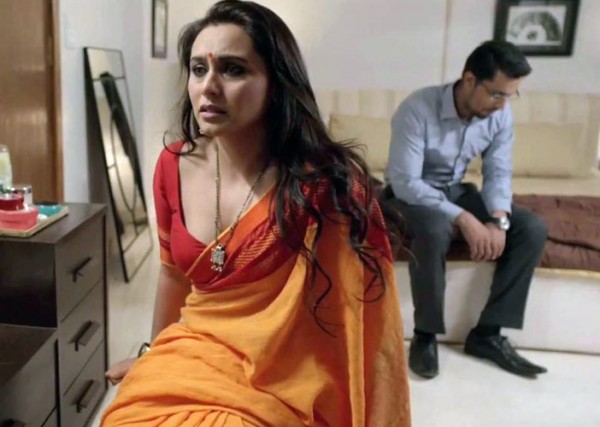
Of the four shorts in Bombay Talkies, I was most interested in Karan Johar’s film. One couldn’t quite tell what it is about beyond the fact that there is a troubled marriage in an urban setting (between Rani and Randeep) and a blossoming friendship (between Rani and Saqib) that perhaps gets the plot rolling. Also, there was a delicous sense of irony in the fact that in an anthology including films by Anurag, Zoya and Dibakar, it was K-Jo’s that seemed like the most dark and bleak!
What Karan has delivered in Bombay Talkies is something I did not expect (and I’m sure no one did). And with unexpected elan as well! Not just daring and bold, but equally graceful and poised- this is a Karan Johar you haven’t seen before. Or maybe he always had this in him but was waiting for the right time and a film where he did not have to wear the producer’s hat. I won’t reveal the plot of the film here (even though soon people would be talking about it) but when a filmmaker like Karan Johar makes a film like this, it isn’t just a film, it’s a massive statement. A few glass ceilings have been instantly shattered in a snap.
But let’s give Karan Johar, the guy everyone is probably looking at as the dark horse black sheep among these four, credit for more than just audaciousness. Ajeeb Dastan Hai Yeh grabs you by thecollar and jolts you in its very first scene. But it instantly and nonchalantly moves on. This isn’t a Madhur Bhandarkar ‘shockfest’ or a film about ‘issues’.
What you get is an astutely made relationship drama- funny, candid, empathetic and in the end, wonderfully poignant. As I thought of the film later, I also appreciated how economically and smoothly it moved, everything is established so quickly and well. The characters are all flawed; there are no judgments made, no quick answers given, no simple resolutions. Apart from the odd cornball line in the beginning (‘Gale mein mangalsutra, aakhon mein kamasutra!‘- and that too from an intern to his boss!) the dialogue is smart and well written. And yes, no clumsy melodrama either. Maybe it’s the effect of shooting in ‘real’ locations! 😉
The performances are excellent and fearless. After trying too hard in NOKJ & Aiyaa, Rani Mukerji is back to doing what she does best- in Talaash, and now this. She is raw and wonderful, and the camera doesn’t look away from the love handles pouring out of her blouse or the freckles on her face. This is the sexiest and most beautiful she has looked in a long time. Saqib has cocky charm, but also a heart-breaking vulnerability. This is a role few young actors with Bollywood-Hero aspirations would take on. And Randeep Hooda surprises with a superbly reined-in performance, emotions carefully simmering under the surface.
As tempting as it is to discuss the story, I’d prefer to let everyone discover it on their own and react. This is surely going to be the most talked-about film of the four. And bagging second place in such illustrious company is no mean feat either. So many good directors stumble when it comes to short films- and well, here we have a filmmaker who’s so often reviled and not exactly known for brevity- making such a terrific one.
Mr Johar, you had my attention, now you have my curiosity. I’m curious to see where you go from here. You’ve taken the big leap, now don’t stop.
PS: You’ll be humming the ‘title song’ for a long, long time after the film. 🙂
अगस्त 2011. हम रेखा झा से पटना में मिले थे. उन्होंने ‘गैंग्स ऑफ़ वासेपुर’ में ‘वुमनिया’ गीत गाया था. वो एक और गाने (तार बिजली) में कोरस की लड़कियों वाले ग्रुप में आई थीं. स्नेहा खानवलकर को उनकी आवाज़ अच्छी लगी और उन्हें अलग से पूरा गाना मिल गया. वापसी के समय उनके पति (झा बाबू) मुझे अपनी टैक्सी में छोड़ने आये. उनका पटना में ही भाड़े की टैक्सी का बिजनेस है. रास्ते में उन्होंने बताया कि वो १९९०/९१ के आस-पास एक बार बंबई आये थे; हीरो बनने. “उस समय अगर कोई हमको बोल देता कि दस मंजिल से कूद जाओ और हम तुम्हें हीरो बना देंगे तो हम कूद जाते.” मैंने पूछा “तो किसी ने बोला क्या?” उन्होंने बताया काफी दिन बंबई में भटकने के बाद उन्हें एक जुगाड़ मिला. बाज़ीगर की शूट चल रही थी…लोनावला साइड कहीं पे. वो वहां पहुँच गए और यही ताव (कूद जायेंगे वाला) सब प्रोडक्शन वालों को सुनाने लगे. एक ने कह दिया, यह नदी है सामने छोटी सी, इसको तैर के पार कर लो तो किसी एक सीन में हीरो के अगल-बगल कहीं खड़े होने को मिल जाएगा. जनाब कूद गए. तैरना नहीं आता था, फिर भी कूद गए. किसी और को उन्हें पकड़ के निकालना पड़ा. झा बाबू के मुताबिक़ उनकी इस हिम्मत को देखकर सेट पर मौजूद (वीनस वाले) रतन जैन का दिल पिघल गया और उन्होंने झा जी को एक हफ्ते बाद बंबई में अपने दफ्तर बुलाया. झा जी एक हफ्ते तक सडकों पर रहे, बस स्टाप पर सोये, पर रतन जैन से मिलने का दिन आने से पहले ही उनका सारा सामान, जिसमें रतन जैन के दफ्तर का पता भी था, चोरी हो गया. उन्हें वापस पटना लौटना पड़ा. हमेशा के लिए.
कट टू – जनवरी 2013. एक अवार्ड फंक्शन में रेखा झा वुमनिया के लिए nominate हुयीं. झा जी भी उनके साथ बंबई आये. यशराज स्टूडियो के अन्दर बैठ के उस दुनिया को देखा जिसके लिए वो कूद जाना चाहते थे. मुझे सुपरमैन ऑफ़ मालेगांव के शायर फरोग़ जाफरी याद आ गए. (“मैं कब से बंबई की तरफ चल रहा हूँ. मालेगांव से बंबई बस एक रात का सफ़र है. पर ये रात ख़त्म नहीं होती.”) झा जी की छलांग भी 22-साल तक लगती ही रही.
कट टू – मई 2013. दिबाकर बनर्जी की फिल्म ‘स्टार’ में पुरंदर (नवाज़ुद्दीन सिद्दीकी, हमेशा की तरह बवाल) भी ऐसी ही एक छलांग के बीच में कहीं है. और पुरंदर की छलांग इतनी सीधी भी नहीं है. वो कई दिशाओं में कूद रहा है. या हवा में कहीं बीच में लटक रहा है. दिबाकर बनर्जी की हर अच्छी फिल्म की हर खासियत इस २०-२५ मिनट की फिल्म में मिल जायेगी – बहुत ही कडुवा सा sense of humor; social issues पर एक तीखी नज़र; खतरनाक casting (हमारे drunk-शायर और असल ज़िन्दगी में बहुत ही sincere, assistant director कार्तिक कृष्णन का इस से अच्छा इस्तेमाल नहीं हो सकता था, नवाज़ की पत्नी के रोल में एक गज़ब की नयी एक्टर (sorry नाम नहीं देख पाया end credits के गीले कचरे से भी बदतर गाने के चक्कर में), और सदाशिव अमरापुरकर की धांसू वापसी); कहने को एक बहुत ही गहरी बात; और एक गांड-फाड opening scene.
बल्कि अगर दिबाकर की फिल्मों का एक सबसे बड़ा recurring structural-motif ढूँढा जाए तो वो यही होगा कि उनकी हर फिल्म का पहला सीन पूरी फिल्म का सार होता है. और अपने आप में एक complete short-film भी. LSD में short-film या meta-film का element deliberately बहुत साफ़ था, लेकिन बाकी हर फिल्म में (‘ओये लक्की..’ में तो बहुत ही गज़ब तरह से) पहले सीन को लिखने की मेहनत साफ़ दिखती है. Shanghai पर हज़ार debate हुए कि फिल्म किसके बारे में थी लेकिन दिबाकर के motif से जाएँ तो फिल्म का पहला सीन साफ़ कर देता है कि फिल्म मामा और भग्गू के बारे में ही थी.
और ‘स्टार’ का पहला सीन ‘ओये लक्की’ की टक्कर का है. बस उनके पिछले काम से काफी अलग, (के.के. के शब्द) “फुल बंगाली सिनेमा है रे!” और सिर्फ पहला सीन ही नहीं, क्योंकि पूरी फिल्म सत्यजित रे की लघु कथा ‘पोटोल बाबू फिल्म स्टार’ से है, तो बहुत जगह रे की छाप साफ़ दिखती है. (मुझे एक जगह ‘नायक’ दिखी और एक जगह ‘महानगर’. और एक जगह एक जानवर में रे बाबू की २-३ लघु कथाएँ.)
फिल्म के बारे में कोई spoilers नहीं लिख रहा. लेकिन बस इतना ही कि Bombay Talkies की चारों फिल्मों का पैसा मेरे लिए इस अकेली में ही वसूल हो गया. (करण जोहर की फिल्म भी शानदार लगी वैसे.) नवाज़, दिबाकर बनर्जी, और सत्यजित रे – इससे आगे कोई क्या मांगेगा?
Update: अभी अभी एक जुगाड़ से नवाज़ की पत्नी का रोल करने वाली एक्टर का नाम पता चल गया. मराठी थियेटर की एक्टर – शुभांगी भुजबल. और ये भी पता चला कि वो खुद ऐसी ही एक चाल में पली-बढ़ी जैसी फिल्म में दिखाई गयी है.
(If you have difficulty reading it in Hindi, scroll down and read its English transalation)
It’s more Taare Zameen Par than Pankh. The 6 yr old’s desires stifled by the ‘Sharma ji’ type moochad father with shades of Naseer-Ishan Nair (the fat dancing kid from Monsoon Wedding) conflict. मेरे-Parents-चाहते-हैं-मैं-आम-खाऊँ-जबकि-मुझे-केले-पसंद-हैं is the dillema/drama. The sexuality theme is not explored (or maybe I’m reading too much into it).
The film stealthily enters the kid(s) world and takes you along. Not the most ‘fresh’ stories but again very well done, non-melodramatic realistic treatment by Zoya Akhtar (with Excel Ent Production Design from LBC not Rock On). The casting of the kids and mom is spot on. And the relationship between the siblings could’ve been autobiographical, which is probably why it is so heart tugging despite being no Children of Heaven. They help each other out in the ‘trying circumstances’ and unlike the एक दूसरे की चुगली करने वाले बच्चे, would probably be best ‘friends for life’. The message of the film is not so much ‘Follow Your Dreams’ but more ‘Follow Your Dreams लेकिन शान्पट्टी से’. Slightly underwhelming coming from Zoya Akhtar but it seems her most ‘personal’ film (like KJo’s and AK’s short films). ‘शुरू होते ही ख़त्म हो जाती है’, ‘3rd Act है ही नही, setup ही setup है’ were the common refrain but the climactic performance with the arresting cutaways is itself worth the price of ticket itself.
The pillow conversations at night between the siblings took me back to my childhood days, and that’s why may be I’m being a little too lenient unlike rest. ‘मानता हूँ Cliche है Sir लेकिन Conviction से किया जाए तो आज भी work करता है !’
P.S – An aside – On the occasion of 100 yrs of Indian cinema celebration – here are two of the most brilliant kids performances in recent cinematic history for you – this & this.
Twice during the film, I was reminded of this funny inimitable character from my childhood. There was a short period of time, when we used to get dabbawala food at home in Banaras (Yes! there are dabbawalas in Banaras too). That man had a wild imagination. From the stories about owning the golden temple land to getting his mobile phone repaired in 2 lakhs (back in 2000! well, that sounds ridiculous even now), there was no end to his cock-and-bull stories, and there was a new किस्सा everyday.
The sequence where Vijay is regaling his fellow travelers in the train reminded me of many such characters from Banaras. जैसे दिल्ली में गाली देना सच में गाली देना नहीं होता, वैसे ही पूर्वांचल में गप्प मारना झूठ बोलना नहीं होता। Another one from a train journey is that of a group biharis…I remember looking at my brother and suppressing a giggle when one of the men said “ये बहुत संघर्शेबुल (sangharsh-able) हैं “. ऐसी बहुत सी सुनी-सुनाई कहानियां हैं अपने यहाँ के amazing गप्पी लोगों की, जो याद करके भी हँसी आ जाती है. Anyway, the point here being that the film captures that character and that space very well. For me, this was the best part of the film.
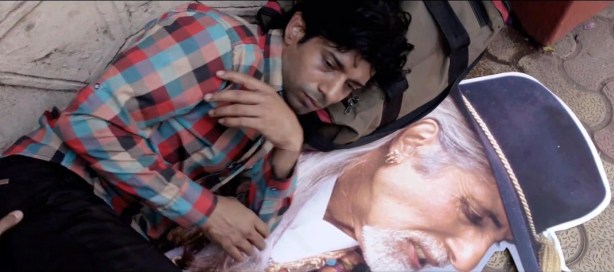
The film is about a young man traveling from Allahabad to Mumbai to meet Amitabh Bachchan so that he can offer the superstar a piece of Murabba that his mother has made. This is his father’s “last wish”. As far as the theme of celebrating 100 years of Indian cinema goes, among all four shorts, this film comes closest to capture the passionate frenzy that bollywood has created among the masses over the years. As usual Kashyap get the milieu right but the punchline is not strong enough to make you fall in love with the film. Unfortunately the film goes downhill as soon as Mr. Bachchan makes an appearance. There are moments that made me nostalgic and made me chuckle but overall the film was a bit of a disappointment. But inspite of all the shortcomings, I am sure all the fanboys/girls out there who have done crazy things for the stars they love, will connect to the film.
PS: The other thing that I noticed is that when Vijay’s father asked him where he was, Vijay replies “मेल में थे”. The people in and around Allahanad always call the kumbh mela as just “mela” whereas it is the outsider (mostly the पढ़ा – लिखा वर्ग) that always calls in “kumbh” or “kumbh mela”. Full marks to AK for that.
*****
The film ends with an atrocious music video which seems to be have been produced on MS Paint. Though the initial montage of yesteryear actors make it look slightly better. As a friend pointed out, wish they had just used the opening credits of Luck By Chance in the end credits here. That would have been enough.
And do vote for your favourite short. You can vote for 2 films.
UPDATE – 3rd May, 2013
(Since many people have been asking for English translation of Varun’s post on Star, here it is. We still suggest that you try in Hindi first, Do “Control +”, make the font bigger and it becomes easy. If not, here you go)
August 2011. We met Rekha Jha in Patna. She would sing ‘Womaniya’ for ‘Gangs of Wasseypur’ a few days later. She was part of the group of girls we had called for chorus singing in ‘Taar Bijli Se’ song. Sneha Khanwalkar liked her voice so much that she got offered a full song to herself. On my way back from Patna, her husband (Jha babu) dropped me to the airport in his taxi. He has a small taxi-rental business in Patna. He started talking and told me ‘I had gone to Bombay sometime in 1990/91; to become a hero. If at that time, somebody had told me to jump from a 10-storeyed building to get a role in films, I’d have done that.’ I asked – ‘So did somebody say that to you?’ He said after wasting many days in Bombay, he somehow landed one contact which took him to the film shoot of ‘Baazigar’ in Lonavla or around. On the sets of Baazigar, he again started bragging that he can jump from a building to get a role, and some production hand dared him to cross the small river nearby. He promised Jha Babu a role (of being in the same frame as the film’s hero) if he finished the swim across the river. Jha babu jumped in the river without a thought. He didn’t know how to swim, but jumped anyway. He had to be rescued by some locals else he was sure to drown. Seeing the commotion and young man’s stupid desperation, Ratan Jain (Tips owner) was impressed. He gave Jha babu his card and asked him to come over at the Bombay office a week later. The whole coming week Jha ji spent on the roads, sleeping on bus stops, but before the big day arrived his whole luggage including the address of Ratan Jain was stolen. He returned back home to Patna, never to attempt his Bombay dreams again.
Cut to: January 2013. An award function nominated Rekha Jha for singing ‘Womaniya’. Jha babu came with her to Bombay, first time since he left it in 1991. Sitting inside Yashraj Studios, he finally saw the unreal world he wanted to jump from a high-rise for, up-close and live. I was reminded of Farogue Jafari, the poet and writer of/from Supermen of Malegaon – “Main kab se Bombay ki taraf chal raha hoon. Malegaon se Bombay bas ek raat ka safar hai. Par ye raat khatam nahin hoti.” (I have been walking towards Bombay for a long time. Malegaon to Bombay is just an overnight journey. But this night is too long.) Jha babu’s jump also lasted for 22-years.
Cut to: May 2013. Purandar (Nawazuddin Siddiqui, terrific as always) in Dibakar Banerjee’s segment ‘Star’ is also in the middle of one such night/jump. But Purandar’s jump is not so simple. He is jumping in many directions simultaneously. Or may be he just thinks he is jumping while being magically, depressingly hanging static mid-air, like a cartoon dog from Tom and Jerry. The 25 minute film has all the best elements of all the good Dibakar Banerjee films. A very wry sense of humor, a sharp comment on social issues (right from the very first scene that stays on long enough for you to attempt decode its meaning), pitch-perfect casting (our drunk-shaayar and a sincere assistant director Kartik Krishnan couldn’t have been cast in a better role, the lady playing Nawaz’s wife Shubhangi Bhujbal is a gem of a find from Marathi theatre though her name gets drowned in that horribly composed and shot end-credits song, and Sadashiv Amrapurkar’s comeback to cinema alone is worthy enough for this film to be made), a new world to explore, and a kick-ass opening scene – all DB strengths are at their top-game in ‘Star’.
In fact, a recurring structural-motif of DB’s films has been a meta-film like opening scene that has the sly-synopsis and tone of the entire film you’re going to watch. If you go back to any of his film after finishing it, and watch the opening scene again, you’ll be surprised by the number of hidden-meanings it contained. LSD had the short-film/meta-film element deliberately carved out but even the rest of his films have a masterful opening scene (OLLO has the strongest one). Shanghai generated many debates, chief among them was who the film ACTUALLY is about, and going by this motif the opening scene of the film clearly says that the film is about Bhaggu and Mama, the two ‘killers’.
And the first scene in ‘Star’ is as powerful and poetic as Dibakar has ever written/shot. Though in a different league/tone altogether (as Kartik Krishnan said ‘Full Bengali cinema hai re!’). And not just the opening scene, the entire film bears a noticeable stamp of Satyajit Ray as the screenplay is adapted from a Satyajit ray short-story (“Potol Babu Film Star”). I could spot a hat-tip to ‘Nayak’ (appearance of Sadashiv Amrapurkar scene), and another to ‘Mahanagar’ (working wife and daily memorabilia for child), and a pet-animal Purandar keeps reminded me of a couple more short-stories of Ray. (Fascination with abnormal/surreal animals/plants is a recurring motif in Ray’s stories for children.)
Keeping it spoiler-free so can’t write much more. Just enough to say that DB’s ‘Star’ alone is worth the price of admission for Bombay Talkies. (While K-Jo’s film too is as good as they come.) Nawaz+Dibakar+Satyajit Ray – and the sum is greater than the parts!
(Note : To make life bit simpler, now you don’t need to fill in all the details to post comments. If you are already logged into Facebook or Twitter, just log in with your FB/T account. Click on comment box, you can see the small (FB/T) icon below the comment box, click on FB/T, a pop up will appear, authorize the app and you are done)
NFDC (National Film Development Corporation) along with filmmaker Kamal Swaroop has just published his limited edition book Tracing Phalke.
Researched, written and compiled by Kamal Swaroop, it’s a text-based visual treat that lends a magnified view into Dadasaheb’s life. The iconic coffee table book is an eponymous compilation tracing the life span of the Father of Indian Cinema, with rare details right through his schooling, places he visited, people he met and experiences that lent value to his innate genius and imagination that eventually lead to the birth of Indian Cinema.
If you have not seen the “making of” Udaan, you have missed the best “making of” (film) made in recent years. Quickly go here and here and watch it. It’s as good as Udaan and is a film in itself.
Cut to
Lootera.
Again. Hope no controversies this time 🙂
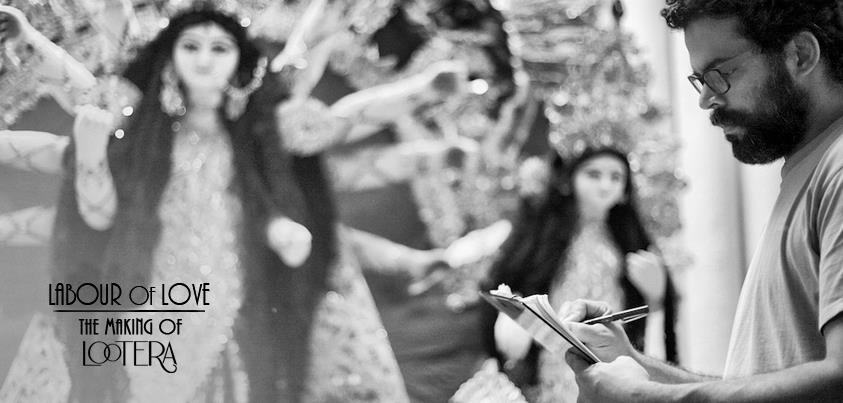
Since they started teasing about it, we have been keenly waiting for Lootera making. Good news is it’s out. Bad news is it’s just 5 minutes. But it looks good – unlike others it gives a real sense of “making a film”. We hope they soon release the full making of the film.
The latest offering by Mira Nair features various artists and the album has as many as 14 tracks.
The album starts with Kangna, a traditional qawaali performed wonderfully by Fareed Ayaz and Abu Muhammad. The accentuated bass towards the end remind us that this is for a Film and not performed for anything else. Although the duo have sung this song for Coke Studio Pakistan as well where the duration was in excess of 10 mins, this one ends in less than 6 minutes, melodious nonetheless.
Bijli aaye ya na aaye features the otherwise serious Meesha Shafi. Severely let down on the lyrics the song survives because of the lovely throw that Meesha demonstrates. Peppy. The lyrics are so bad that they actually redefine the word ‘random’. However, this for sure will be closely walking with the narrative, of which I am sure.
Kaindey ney sung by Zahara Khan is up next. Performed with just a guitar and Sarod by the side for most part, Zahara appears slightly out of sync at times in this average song.
Ali Sethihums Dil jalaney ki baat kartey ho extremely well and leaves you wanting for more because the track is barely 2 mins long.
Atif Aslam croons Mori araj suno and even though he tries very hard, thanks to the varied versions of this ageless composition that we have come across, this track falls short. But it does sound very theatrical.
Measure of me by Amy Ray is the best song of the album. Slow, melancholic and very high on melody. The arrangement is so simple that you might even ignore it. The backup vocal arrangement is brilliant as well.
A young man has to take a stand performed by Michael Andrewsis a track filled with a lot of tension thanks to the eerie arrangement and loads of violins used. Ends quickly echoing the tension in the head.
Jannissary again performed by Michael is a slow piano piece with continuous violins. Somehow reminded me of 1947 The earth, this piece. Nicely done.
Something happened – Bass and a lot of bass instills anticipation in what appears to be an anxious track. A track that is very rich on sounds. Faintly heard someone sharpening knife, someone running through a door and then it all descends to a pause. One of the best instrumental pieces in a long time. Highly recommended.
God bless America A very short track comprising of crowds cheering and a continuous beat that eventually fades out far too quickly.
Love in Urdu by Rizzle kicks is a delicately arranged all instrumental piece peppered with subtle Sarod and guitar. Not as beautiful as love in Urdu would be but a soothing and simple track.
Focus on fundamentals paints a picture of tension, yet again. Aided in just right measure with violins and a dying bass line throughout. Eerie. Tensed. Dark.
Get us both killed has got a very dark tone throughout. The riffs remind you of a particular O.S.T. Which shall not be named here. the tempo steadily rises but never peaks and that’s quite eerie.
Too much blood has poured into this river With near absent vocals, this track keeps the dark undertone of the album alive. Aided by flute, the overall grave atmosphere gets a touch of sadness. The almost silent alaap is a touch of class in this track.
With Mira Nair, we are sure that the music will be totally circumstantial and compliment the feel of the film. The Reluctant Fundamentalist is no different. Will I hear it as much as the O.S.T. Of ‘The Namesake’? Well, No. The reason is simple. This O.S.T. stays so closely hugged to the film’s feel that you slip into sadness with some of the tracks of this film.
2 Thumbs up! If you are an O.S.T. Collector, do not miss this at any cost!









 the tempo steadily rises but never peaks and that’s quite eerie.
 F.i.g.h.t C.l.u.b