Archive for the ‘Bengali’ Category

Satyanweshi

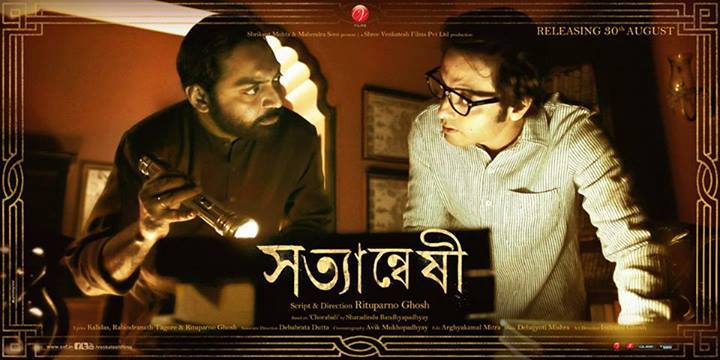
Filmmaker Rituparno Ghosh passed away earlier this year just after completing the shooting of his film on Byomkesh Bakshi. The makers have completed the film and it is ready for release. It’s based on “Chorabali” by Sharadindu Bandyopadhyay.

The film also marks the acting debut of filmmaker Sujoy Ghosh in the lead role of Byomkesh Bakshi.

Here is the first trailer of the film

Official synopsis – Maharaja Arunangshu, the ruler of a princely sate named Balabantpur, had made a wish list on his death bed in the presence of Dewan Chandrashekhar, the family physician Kaligati and the High Priest. It laid down certain conditions for his heir, his son Himangshu. The first of which forbade Himangshu from marrying a non Hindu girl, and the second demanded a legitimate heir within three years of his marriage. Bound by his father’s conditions of succession, Himangshu is compelled to marry Alaka, an aspiring actress.

A year and half into the marriage, Harinath, the young palace librarian disappears without any trace. This mystery occasions the arrival of the sleuth Byomkesh and his author friend Ajit to Balwantpur. The visit though is under the pretext of an invitation for a hunting expedition. In course of their stay, they unfold many secrets involving the residents of the palace and about the topography of Balwantpur.

Film : Satyanweshi.
Starring : Sujoy Ghosh, Aninda Chatterjee, Indraniel Sengupta, Arpita Chatterjee, Sanjoy Nag, Shibaji Bandhopadhyay, Anandi Ghosh
Producer : Shree Venkatesh Films
Presenter : Shrikant Mohta & Mahendra Soni
Direction : Rituparno Ghosh.
DOP : Avik Mukhopadhyay
Music : Debajyoti Mishra

guide gufraan official poster

This came in our mailbox. We don’t know anyone connected with this film, but it looks damn interesting – the poster and the trailer. So we are featuring the first look of this 50min long feature Guide Gufraan here. Directed by Ayushman Mitra, a graduate from Calcutta’s St Xavier’s  College. It’s made with the help of his friends from Xavier’s who have formed a group called Backgate Studio. Have a look.

Synopsis:

Raas, the cosmic meeting of opposite energies, is the cornerstone of all creation. Raas is widely illustrated as a celebration of love with an important involvement of dance and music. A few stories of love live beyond the boundaries of time and society; Krishna’s ‘raas’ is a timeless tale of erotica and passion. For most, he is more human than god. What is amazing is the acceptance that he receives from a conservative society like ours.

Guide Gufraan is Pasha’s journey from repression to acceptance of his own self. As he enters the city of Calcutta to retrace his past and seek spiritual asylum, where questions are asked and many are left unanswered, he begins an exploration of the self, the self he is desperately running away from, challenging his quest for peace. Finally, a city guide acts as the catalyst and pushes him to the limits till he embraces his true self. It is a celebration of acceptance, as people choose to live liberated lives shunning the social stigmas on love, sex and relationships. People come together and tear apart, some are fondly remembered, while some disappear into the chaotic rhythm of the ‘raas’. It is only natural that Krishna in the Mahabharata essays the role of a ‘sarathi’, in other words, a guide.

Cast & credit :

Cast: Ayushman Mitra, Sreemoyee Kasturi Banerjee, Neeraj Dugar, Sneha Ghosh, Zoheb Akbar, Yashodhara Basu Mallick, Sharmistha Jha, Urmila Subhadra Majumdar, Gautam Vir Prashad and Gosto Kumar

Director: Ayushman Mitra

Story & Screenplay: Ayushman Mitra , Sreemoyee Kasturi Banerjee

Director of Photography: Gairik Sarkar, Rusha Bose

Editor: Gairik Sarkar Creative

Producer: Rohini Ghosh

Music: Sambit Chatterjee, Yudhajit Biswas, Ronodeep Bose

Production Designer: Ayushman Mitra

Production Manager: Anirvan Sengupta

Costumes: Sneha Ghosh

Co-Producers: Sumit Mitra, Srijon Kaushik Banerjee

—> For any queries about the film, you can write to anirvansengupta91@gmail.com

meghe

Ever since Sashwata Chatterjee made his mark on national radar as Bob Biswas in Sujoy Ghosh’s Kahaani, suddenly we have been seeing more of him. Or maybe he is getting interesting roles since then. Recently he was in Aparna Sen’s hilarious film Goynor Baksho, and now he is playing the lead role of Ritwik Ghatak in Kamaleswar Mukherjee’s Meghe Dhaka Tara (The Cloud-Capped Star).

When i heard about the title of the film, the first thought in my head was blasphemy, blasphemy! But thankfully, the black and white trailer looks interesting. And seems like Sashwata is going to steal the show again, especially towards the end, when he portrays the madness.

Have a look. It’s with English subs. Hope more producers learn from this and realise that they have a market beyond their state. It’s a slow process but that’s how you build your audience. So do release your trailer, promos, songs with subs.

Official synopsis

Kamaleswar Mukherjee’s Meghe Dhaka Tara is inspired in every way possible from the legendary director Ritwik Ghatak’s life. From putting together bits and pieces of his eventful life to using the title of one of his most famous movies, and to naming the characters from his last film Jukti Tokko Goppo, Kamaleswar’s movie is an apt tribute to the great director.

Although inspired from Ghatak’s life, Meghe Dhaka Tara is neither a biopic on him, nor a remake of his famous film. To Kamaleswar, Ritwik is a true star, a legend, with immense contributions to the world of cinema. And yet he is still quite the unsung hero. Hence, he is the “Meghe Dhaka Tara”.

Credits

Starring : Saswata Chatterjee, Ananya Chatterjee, Abir Chatterjee & others
Producer : Shree Venkatesh Films
Presenter : Shrikant Mohta & Mahendra Soni
Direction : Kamleswar Mukherjee
Screenplay : Kamaleswar Mukherjee
DOP: Soumik Halder
Music : Debojyoti Mishra

– For more updates, it’s Facebook page is here.

DB StarBombay Talkies has released in the theatres. And so far the unanimous verdict is that Dibakar Banerjee’s short Star is easily the best out of the lot. Click here to read what we thought about the other short films and do vote for your favourites.

Back to Dibakar’s. It’s based on a short story by Satyajit Ray titled Patol Babu Filmstar. Though the basic idea is the same Dibakar has added many new elements to it and given it a new setting too. Do read.

Tip – Pavan Jha

Last week i watched Kannan Iyer’s Ek Thi Daayan. It’s co-produced and co-written by Vishal Bhardwaj. And last night i watched Aparna Sen’s Goynar Baksho. And i could not stop myself from comparing the two. Apart from Konkona Sensharma’s spectacular acting, there are few more common factors between the two. Both the films are based on literary work. Ek Thi Daayan is based on a short story written by Konkona’s father Mukul Sharma. (You can read the story here) Goynar Baksho is based on Shirshendu Mukhopadhyay’s story titled “Rashmonir Sonadana”. So in a way one is Mommy’s film and the other one is Daddy’s. Though both are in supernatural space, in terms of what they deliver, the difference is huge.

Ek Thi Daayan is a strange film. Because it’s two films in one. Though it plays around with all the common elements of horror films in first half, it sets up a great mood, is deliciously ambiguous, and keeps you totally hooked. Konkona and the kids keep you engaged in their mouse and cat game. The 2nd half is drastically different – almost a Vikram Bhatt film. Everything is on the face, new rules are set, it’s silly, becomes unintentionally hilarious and has a strange closure. What is Kalki’s character doing in the film? She is just to misguide us? Is it all about who is the witch out of the two? It all boils down to one spoiler? There have been many rumours floating around about the film’s climax being changed by its producer, and once you watch the film you realise that all those rumours must have been true. There can’t be no other reason for the second half to be so disappointing.

Now, about the end. A wise man once said that you must ask yourself 3 Questions – 1. what’s the film about? 2. What’s the film *really* about? 3. What’s the film *really, really* about? If you know the answers, you are on right track. And the answers to these three questions tells you the difference between these two films – Ek Thi Daayan and Goynar Baksho – why one works and why the other doesn’t. Let’s see.

(SPOILER ALERT)

Magician Bobo can hear voices. Because he has a back story. Because his sister was mysteriously killed by his step-mom/witch. Interval. Bobo has a GF/wife. He also has a kid. A new stranger who might be a witch. BOOM! She is not the witch. The GF/wife is the witch. But why is Konkona suddenly back, and from where? What’s the sudden funda of pisach? And all that choti-wali ladayee? Why kill all ambiguity? Was there a way out in the same set-up? i think so. It was all there, just needed to be perfectly tied up like Konkona’s hair braid.

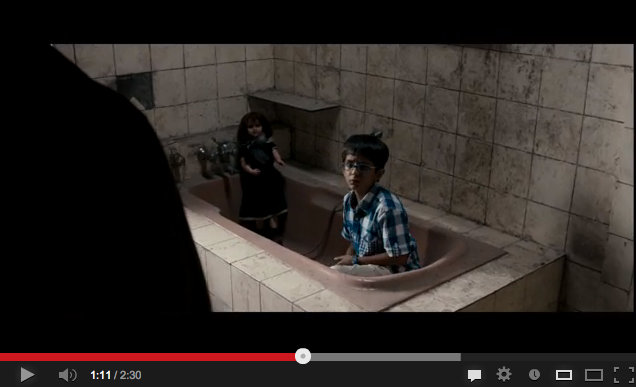
For me, the answer would have been Bobo’s adopted kid, Zubin. Going by the trend of orphan kids who get superpowers, he perfectly fits the demography too. We don’t know about his real parents. Aha, that’s where the magic and mystic happens. If you see the second trailer here (at 01:05), you will know that there was more to Zubin for sure. See the screenshot – Zubin talking to a doll (or Misha?) when Bobo spots him. This scene was not there in the film.

The film just used him for the choti-kaato act. Given a choice, i would have gone with Zubin getting some of the supernatural powers to hear/see daayans, something that connect Bobo and Zubin, and then a closure for Bobo’s story with him coming to terms with Misha’s (his sister) death in some way. I believe it was also there in the script – if the lift is going down, it’s going to hell. Can Bobo take the lift up to heaven for Misha? As for Lisa (Kalki’s character), isn’t she going to be step-mother for Zubin? When it plays around on the funda of sauteli maa acchi ho toh sakti hai par hoti nahi, isn’t Zubin in same scenario as Bobo? Aha, the loop.

(SPOILER OVER)

ETD2

And if there’s something more funnier than Vikram Bhatt style kaat-choti-kaat act, it was the disclaimer in the beginning of the film. Easy to understand that neither the makers nor the Censor Board is guilty of that. It’s because of the times we live in, where the fringe groups are always looking for such occasions to raise their voice and get attention. This is where Aparna Sen’s Goynar Baksho hits the ball straight out of the boundary.

On the surface it’s a story about three generations of women and their relationship with Goynar baksho (jewellery box). But Aparna manages to pack in so much, that it’s unbelievable. And treated it in a humourous tone, this one should work for all. In a memorable and heart breaking sequence in the film, Pishima (aunt in bengali, father’s sister), a child widow who has died and become ghost, asks Konkona Sen (new daughter-in-law) what sex feels like? Does she enjoy cuddling? In today’s times of offending sensibilities, this might be counted as quite sacrilegious. But this is where the bravery and the brilliance of the film lies – it packs everything with humour.

Pishima got married at 12 and was widow at 13. Forget love, relationship, or any such pleasure, widows were not even allowed to have good food. All she got was boiled veggies, all she wore was white sarees. It reminded me of someone i know closely. Married at young age, she had a son just after marriage, and then her husband died soon. She returned back to her parents and brothers. Since then it was been a life of white sarees, religious stuff and only vegetarian food. It’s actually quite a common sight in bengali families, mostly in rural areas – the eldest daughter who is married at young age and if she becomes widow, she comes back to her parents and stays with them for the rest of her life.

Moushumi Chatterjee plays the role of Pishima, an authoritative voice in the house. Because she owns those expensive jewels, nobody wants to be in her bad books. But the fun begins once she dies and becomes a ghost. Interestingly, only Konkona’s character of Somlata (new daughter-in-law) can see her. She is new in the house, she is scared and to make things worse, she even stammers. With a hookah in her hand and more abuses that you can count, initially Pishima starts bullying Konkona to protect her jewellery box, and then slowly they develop a bond. Pishima is bitter, sarcastic and is always cursing everyone around, but all done with dollops of humour in her Faridpur accent. Her dead character is the life of the film.

Goynar Baksho

In another sequence she gets emotional as she talks about how the men in the house always had all the pleasures, and all she got was this jewellary box. The (pishima) ghost played brilliantly by Moushmi Chatterjee, instigates Konkona’s character to go out, fight for her rights, to pursue her passion and enjoy everything that’s forbidden. Who talks about heaven and hell? As a ghost she knows it better than everyone. Enjoy till you can and then your body will perish one day.

Konkona’s character of Somlata represents the second generation. She is on the other extreme compared to her Ek Thi Daayan role. Set in a completely rural background, instead of scaring others, in this film she is always scared. And like in almost every other film of hers, she is so convincing that you would think she has a twin sister who acted in ETD. She is undoubtedly the best actress of our generation. The last 15mins of the film feels bit odd but you get what the filmmaker is trying to do – the third generation. You can also see the limitation of budget and resources, but this one is a must watch.

The film has released with subtitles in Mumbai and other cities. Though the subtitles might not be able to translate the fun of Faridpur accent but do watch it. Bollywood desperately needs some funny ghosts. And Vikram Bhatt needs to put his tacky ghosts in his closet for sometime.

So in two weeks we had two supernatural stories – one with mysterious witches and the other with loveable ghost. Both with three leading ladies. For whatever reason, one remains a half-baked affair, the other manages to pack a punch. One doesn’t say anything new, the other takes a strong stand on so many issues without making a big fuss about it. And it all comes from the same family. I guess in the end it’s all about the *choices* – we are the stories we tell.

@CilemaSnob

(PS – To make life bit simpler, now you don’t need to fill in all the details to post comments. If you are already logged into Facebook or Twitter, just log in with your FB/T account. Click on comment box, you can see the small (FB/T) icon below the comment box, click on FB/T, a pop up will appear, authorize the app and you are done)

always-being-born-recipient-of-dadasaheb-phalke-award-mrinal-sen-a-memoir-275x275-imad96etkbdskjezRecently I watched a documentary film where Mrinal Sen is quoted. Mrinal Sen? It left me wondering when was the last time I heard his name. Honestly, not sure. In which discussion? Well, really not sure. We talk so much about world cinema, but we rarely get to hear the desi names beyond the few obvious ones.

People like us, who could easily be branded as the fest-fuckers, are bigger culprits. Even before fests became kind of cool for kids here, Sen had been there, done that. Apart from many other international awards, his Kharij was in Cannes Official Competition and bagged the Jury Prize in 1983. His another film Akaler Shandhaney (In Search Of A Famine) was in cometition at Berlin Fest where it bagged the Silver Bear in 1981, and at Venice Film Festival, Ek Din Achanak got an Honourable Mention. Do watch the films if you haven’t.

Back to Sen, and we have a new segment – Just A Page. The film reminded me of his memoir, Always Being Born. I had read it long back. As soon as i came back home, i took out the book and read few pages. Ironically, even at the risk of it being used to poke fun at me for obvious reasons (by friends and well-wishers mostly), am going to quote a page from this book. Quite a terrific one. Do read.

Suddenly, from behind a boulder on which I was seated, appeared a boy, hardly ten, the external anatomy giving the appearance of a beggar. He stood before me, but unlike a hungry beggar, his eyes were bright. I smiled and he smiled back. I pulled out a ten-rupee note, quite a fat amount in those days, and gave it to him. He could not believe that the amount was meant for him. I drew him close, patted him on the shoulder and gave him the push with a smile. The boy ran away with the money, looked back from a distance, his eyes beaming, and disappeared. Instantly, I felt I was a different man altogether. I sprang to my feet and, with nobody around, i shouted at the top of my voice and in ecstasy uttered a few Bengali words, Dekh-re Shala’ra, Kemon Aami Nirbaashan’e Aachhi! (Look bastards, I’m an exile here!) And there was nobody around. Bengali, for the first time in last three days, because it was Greek in Jhansi. Could there be a streak of madness in me? Or, to quote Jacques Tati or getting a kick from Chaplin, Inspired Nonsense?

I, then, returned to my hotel, shut myself up in my small room and moved towards the tall mirror. Standing before the mirror, I could see myself from top to toe, head to foot. Watching me, I enjoyed looking at “it”. As I looked deep into the eyes of my ‘double’, I wanted to see more of ‘it’, the whole of ‘it’. Without caring to behave myself, I made a violent move to strip myself.

There stood my ‘double’, stark naked, face to face with me. Was the look menancing? The double’s? Or mine? I did not remember. I remembered the ‘talk’ I had with ‘him’. I said, hugely intrigued:

There you are, Mr Mrinal Sen, one who read a lot on cinema, wrote substantially on its aesthetics and made frantic efforts to impress others! Now, here you are, Mr Sen, a dawai-walla (medicine-seller), who once wanted to be a filmmaker! Didn’t you, Mr Sen, manage to hook a money-backer and finally backed out for fear of making  lousy film? Oh, no! Serve your bosses well, rot here and try to get an increment. To feel bored is not your business, you cannot afford it, can you?

So saying, I made faces, muttered words in languages I know, then giggled and laughed and made all kinds of absurd gestures and finally, unable to control myself, I cried. Cried like a child. All alone in a hotel room in Jhansi!

After three days, I sent a long telegram to the management in Bombay and I resigned.

You can order the book from Flipkart here.

(PS – To make life bit simpler, now you don’t need to fill in all the details to post comments. If you are already logged into Facebook or Twitter, just log in with your FB/T account. Click on the small (FB/T) icon below the comment box, a pop up will appear, authorize the app and you are done)

@NotSoSnob

It’s a weird position to be in. And in India it’s almost like a joke because people instantly quote two names to get their points across – Khalid Mohamed and Samar Khan. Remember how Subhash Ghai reviewed Fiza? The precedent is bad but who said that we can’t change the future. So what happens when a film reviewer changes track and moves to the opposite side? Over to Pratim D Gupta, who has been reviewing films for The Telegraph for last few years and has now made his directorial debut with a bengali film titled Paanch Adhyay which has just released. The film stars Priyanshu Chatterjee, Dia Mirza and Soumitra Chatterjee.

This is so damn difficult to write. I have been staring at this empty word file on my Macbook screen for the last couple of hours. That’s like the time I usually take to write my film reviews every Friday.

Any more time and that page wouldn’t reach you the next day. But then every Friday I am your man at the movies. For this Friday, I am the man behind your movie. Perhaps the only way I can put this together is if I tell you about Paanch Adhyay in five chapters.

Chapter 1: The write of passage…

It was always all about cinema waala love. From Uttam Kumar’s cigarette smoke swirl in Nayak to Sanjay Dutt’s eyepatch in Khalnayak, from James Bond’s black tuxedo in every film to Govinda’s yellow pants in every film, I chewed and chomped anything that spelt cinema. So the three-figure JEE rank was dunked and I got into film studies. Soon the Rays and Ratnams had company in Kurosawa and Kieslowski, Tarkovsky and Tarantino.

The world was passing by at 24 frames per second. I had to jump cut. I chose to write myself into the script.

Watch movies, write about them, speak to the guys who make them and try and understand the craft a little more. So incredibly I was attending the best customised film school possible; where I could speak to A.R. Rahman about the core of his scores, discuss the finer nuances of acting with Irrfan Khan, debate shot lengths with Ashok Mehta or just discuss life in cinema and cinema in life with Farhan Akhtar.

One of my earliest on-set assignments was Pradeep Sarkar’s Parineeta shoot in Siliguri. And I remember the film’s leading man, who became Mr Bebo a couple of days back, telling me with a chuckle: “Making a film is like waging a war.” I didn’t fully understand it then. No one knows it better than me now.

Chapter 2: The man who almost made a movie…

I started writing a script in mid-2008 because a filmmaker friend from here liked the idea and promised that he would get me funding for it.

The script happened, the promise wasn’t kept.

I took the script to other producers; everyone shooed me away. Since it was lying ready, I made an English version of it and sent it to international screenwriting competitions. It got selected as one of six scripts at the Locarno International Film Festival and went on to become the first Indian project at the Independent Film Week in New York.

Still no funding came through.

Next a Mumbai-based producer committed to fund the film at Film Bazaar in Goa and even got a French co-producer. I happily got a cast and crew together — the very best talent from here in Calcutta. The pre-production started and locations were scouted. And then the man from Mumbai stopped taking my calls and replying to my mails. When I bumped into him at a social do, he promptly fled from the party.

I actually started believing that I would be remembered (laughed at, really) as that guy who came closest to making a movie but could never make one. You know how artistes love romancing the pain. The pleasure of putting your head down on a wet pillow every night.

Chapter 3: Traces of treason…

Of course at that same time there was something equally terrible happening on the personal front. Everything was shutting down around me. I thought to myself the only way out of this is to write a new script. Yes another very romantic way of looking at things — you got to do what you can do. A batsman has to bat his way back to form; a writer has to write.

That’s how Paanch Adhyay was born. It was called Resh then. Resh as in traces… traces of a relationship. I wanted to narrate what I was going through with a what-could-have-happened twist to the tale. I wanted to tell a love story like a thriller. And because I wanted to go berserk with the structure, I wanted to keep the story simple. Very, very simple.

I slit my veins onto the script. This time I was not writing to get the film made; I was writing to get a move on in life. Writing Resh felt gratifyingly cathartic. I finished the first draft and there it stayed saved in a folder on my lappie. It’s job was done. Or so I thought.

Chapter 4: Moment by moment…

I knew of Kaustuv Roy as a man who threw big parties even though I had never attended one. He called me one fine evening — I still remember I was in a taxi and passing by Park Street — and said: “I have heard about your scripts; why don’t you come and narrate me one?” Honestly, I was tired and I really didn’t want to go through that whole reading-your-heart-out-to-blank-faces ordeal one more time. I told him I would come over one day and forgot about it.

But I kept bumping into him and he kept pestering me about a narration. Just to get him off my back, I took a printout of the 60-odd pages of Resh and went and read it out in his freezing, smoke-filled office. I couldn’t wait to run out of that cold chimney when he said he was producing the film and calling it Paanch Adhyay after the five chapters the film was split into.

Eleven drafts, three Mumbai trips, four months later I embarked upon what has been the bestest year of my life. Composing the songs, shooting the film, editing it, dubbing it, re-editing it, scoring it, re-re-editing it, grading it, mixing it… every moment has been a blessing.

Watching Shantanuda (Moitra) walk out of the room and come back with the most moving piece of melody, watching Dia (Mirza) howl incessantly in the dubbing room to match the mood of the moment, watching Arghyada (Arghyakamal Mitra) slip in a prolonged shot of silence to create the most heartbreaking of effects…. The endless wait up till the Paanch Adhyay experience has all been worth it.

Chapter 5: A new chapter…

“You have not been nice to so many films and filmmakers; get ready to face the music!” Now, that has been the most “critical” concern from my friends, colleagues and well-wishers. Ironically in our jobs, we are remembered more for the gaali reviews than the glowing reviews.

Well, can I share a secret? From the moment those lights go off at the theatres, nothing else matters. It’s just you and the film. Hype, reputation, personal fondness, fanboyhood… everything’s dug deep into the popcorn tub. You know it when you like a film; you know it when you don’t. And you got to be honest about it. That’s all I have been. Always.

There’s a line Dia’s Ishita tells Priyanshu’s Arindam, who plays a filmmaker in Paanch Adhyay, in the film: “That you have been able to make the film the way you wanted to make it, isn’t that enough?” It’s enough for me. It’s enough for me that I could make this film the way I wanted to make it. With my friends, with like-minded artistes and technicians, with heart and soul. Nobody can take away that experience from me. Of course, you can take a happy song and make it better. Because by the time you are reading this, my baby has crawled out to a theatre near you.

Hope you enjoy the show. Pam param pam!

– This piece first appeared in The Telegraph.

– To know more about the film, click here for its Facebook page. And click here to watch its trailers and songs.

– The film will also have its screening at the ongoing Mumbai Film Festival on 23rd October. Venue – INOX, Time – 6pm.

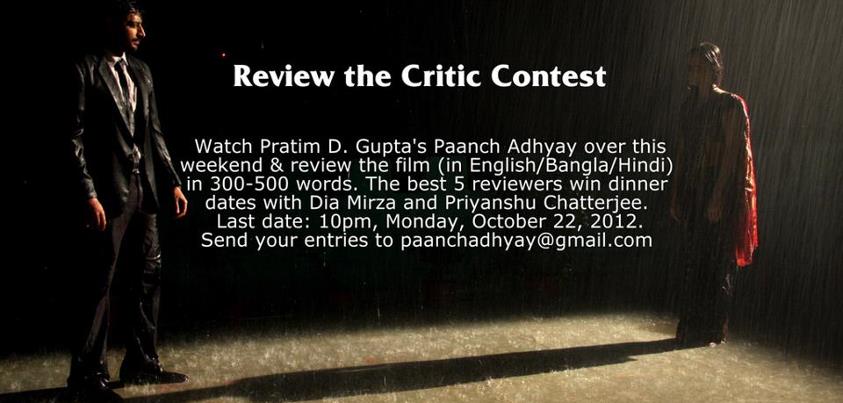
– The makers of the film are also having an interesting contest called “Review The Critic”. Deatils in the pic and on its FB page.

For small and regional films, social networking platforms can be quite a boon. If anything is good, one doesn’t need to worry about its audience. When people become your ambassador, you don’t need advertising or pr. I discovered the wonderful trailer of Bhooter Bhobishyot on FB and was instantly hooked. Have been following it since then and it’s finally getting a limited release in Mumbai today. So here’s a recco post on the film by Aniruddha Chatterjee. But first watch the trailer. Wish they had released it with subtitles.

Imagine this. Two ghosts, one a zamindar who got killed by the dacaits, and the other, a British officer who served in pre-independent India, are auditioning other ghosts to fill the zamindar’s abandoned mansion. This is because most old mansions and houses are demolished and turned to shopping malls and multiplexes by money hungry promoters and are ruining the culture and heritage of the city. So the ghosts all over the world, especially in Kolkata, are finding it very difficult to find a place to live in. Interestingly, even the ghosts are worried about their food, entertainment and security. The selections in the audition are made accordingly. This is the crux of debutant director Anik Dutta’s delicious bengali film Bhooter Bhobishyot.

Siraj-ud-Daulah’s trusted cook who gave his life in the Battle of Plassey, an Indian army officer who got killed during the Kargil war, an actress cum singing Kanan Devi-isque sensation of the 1940s who committed suicide after her producer boyfriend ditched her and married someone else, a Bangla rock band member who overdosed himself to death, a Bihari rickshaw puller who was killed due to reckless driving by a rich brat, a Hindu refugee from Bangladesh who was killed during partition, and a modern day city girl who jumped from her apartment terrace when her industrialist father refused to let her marry a Muslim boy – all of them get selected after the audition. The thread connecting all the ghosts is that they all died unusual deaths.

The ghosts sing, dance, romance, go to picnic, argue over hilsa and prawn, and when endangered, unite to fight against a promoter who wants to destroy Choudhury mansion and build a mall.

The script is unique and original, and is one of the most satisfying satirical comedies of late. The filmmaker takes a dig at everything that is Bengali – the intellectual filmmakers who only prefer Godard, Fellini and Ray, the pseudo communist rebel who thinks wearing Che Guevara t-shirt proves everything, the Dada and Didi of Bengali politics including the Rizwanur Rahman incident, and the everlasting fight between ghoti and bangal. It is refreshing to see usage of Spookbook, Facebook for ghosts, to find a suitable match for an item number.

Interestingly, the narrative is a tribute to Ray’s Hirak Rajar Deshe, as almost every character in the film speaks by rhyming their lines. The humour is subtle and situational. Literal and political references are plenty, and so it needs to be seen whether non-Bengalis find the humour appealing or not.

Another aspect that must be mentioned is the music. Raja Narayan Deb has created one of a kind soundtrack with influences from every genre possible – rock, pop, rabindra sangeet, jazz, folk or qawwali, and also from the different eras the characters belong to. (Click here to watch a terrific song medley from the film)

Also, it has excellent performances by the entire ensemble cast, but Sumit Samaddar as the Bangladeshi refugee and Swastika Mukherjee as Kadalibala, the actress cum singer of the black and white era, are the scene stealers.

Anik Dutta, the writer-director of the film is a renowned ad-filmmaker. This is his first feature film and for that he deserves every bit of accolade he is receiving for creating such an entertaining film.

Currently, the film is playing in theaters all over West Bengal. It’s getting a limited release in Mumbai on 27th April. Don’t miss it!

For more details, film’s Facebook page is here. For Bombay’s theatre listing, click here.