KAUFMAN - "Or cramming in sex, or car chases, or guns. Or characters learning profound life lessons. Or characters growing or characters changing or characters learning to like each other or characters overcoming obstacles to succeed in the end. Y'know ? Movie shit."
Kaufman is sweating like crazy now. Valerie is quiet for a moment - from "Adaptation".
We are all about CINEMA. That movie shit.
NOTHING is sacred.
NOBODY is spared.
Because we talk about films, dammit.
Not your sex life.
Films, fests, unsung, indies, undiscovered - all that and some fun. If you have dope on anything related to cinema or you would like to share something, do write to us at moifightclub@gmail.com.
The views, opinions, reviews, articles, or positions, expressed by the authors and those providing comments are theirs alone, and do not necessarily reflect the views, opinions, positions or strategies of ANY OF THE EMPLOYERS, FRIENDS, RELATIVES, PR agencies, Production houses, Media group and such third parties associated with the authors. The latter make no representations as to accuracy, completeness, currentness, suitability, or validity of any information on this site and will not be liable for any errors, omissions, or delays in this information or any losses, injuries, or damages arising from its display or use.
In short, if you have an issue with us or any post we've written, write to us at moifightclub@gmail.com
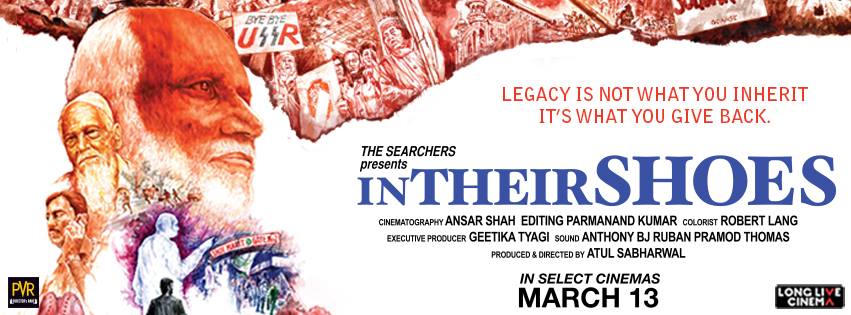
After making his debut with Hindi feature Aurangzeb, and TV series, Powder, Atul Sabharwal is now coming out with a documentary titled “In Their Shoes”.
Centered on the shoe industry in Agra and the people who are engaged in it, this feature length documentary is set to get a limited release in 5 cities (Mumbai, Delhi, Bangalore, Agra and Pune) on March 13th, 2015, through PVR Director’s Rare and Long Live Cinema in five cities
And here’s the trailer
In the docu, filmmaker Atul Sabharwal goes on a quest to find out why his father pushed him away from
joining their family business of shoe material trading in Agra. With a runtime of 92 minutes, this film navigates through the narrow alleys, crowded slums and giant export houses of the historic city of Agra, India, exploring certain answers through the interviews of footwear artisans, traders, manufacturers, exporters and government officials. Through their voices this film pieces together the tale of the industry and the men who built it and sailed it through or got sunk with the global events like India-Pakistan Partition, rise of the USSR, Solidarnosc movement of Poland, the collapse of Berlin Wall, opening of trade economies.
Shot by Ansar Shah and edited by Parmananad Kumar, this film allows the filmmaker to unravel the history of the footwear industry in Agra, and discovers how the global events of his growing up years impacted his relationship with his father.
For more info, FB page is here. Twitter account is here.
‘Om Dar Ba Dar’ fame Kamal Swaroop is ready with his next documentary and if these teasers are any proof, then it looks quite fascinating.
Banaras, Narendra Modi, Arvind Kejriwal, and the biggest democratic exercise on this planet – seen through the auteur vision of Kamal Swaroop should be a heady mix.
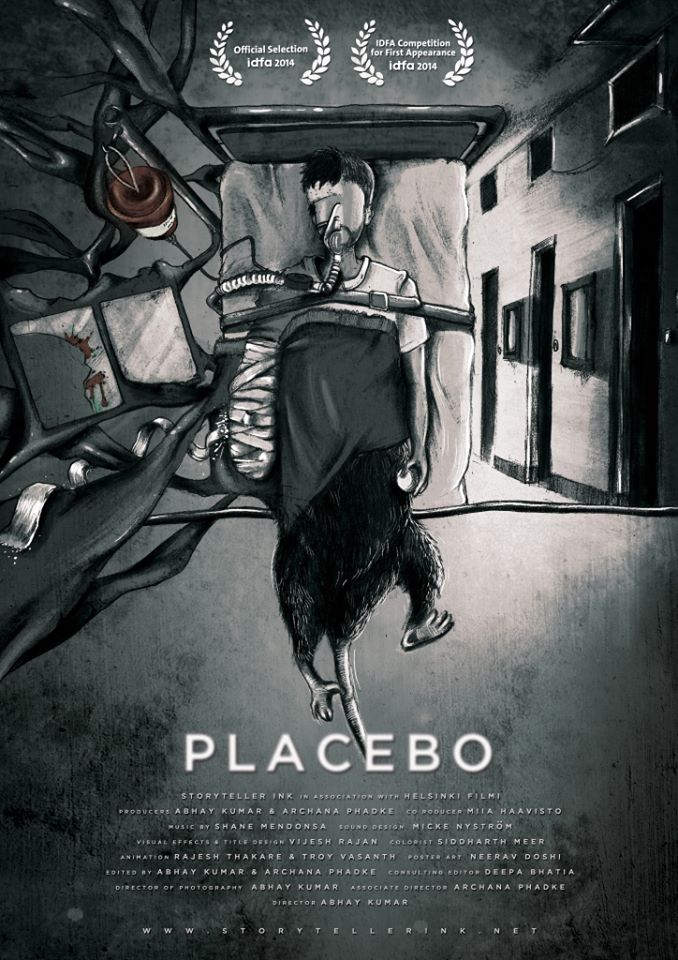
Abhay Kumar’s documentary film, Placebo, just had its international premiere at the reputed International Documentary Film Festival of Amsterdam (IDFA).
And the good news is the film has also been nominated for Best Film in “Competition for First Appearance” category. It’s competing with Always Together (Czech Republic) by Eva Tomanova, Drifter (Hungary/Germany) by Gábor Hörcher and Mother of the Unborn (Egypt/United Arab Emirates) by Nadine Salib.
Here’s the first look teaser of the film
Synopsis
After witnessing an act of brutal violence, a film maker starts following the lives of four students at one of the prmiere educational institutes of India. However, as the camera starts infiltrating this complex mindscape of ambition and restless youth, a startling new reality begins to emerge – one in which an implosion is taking place. In this world, what can be the cure?
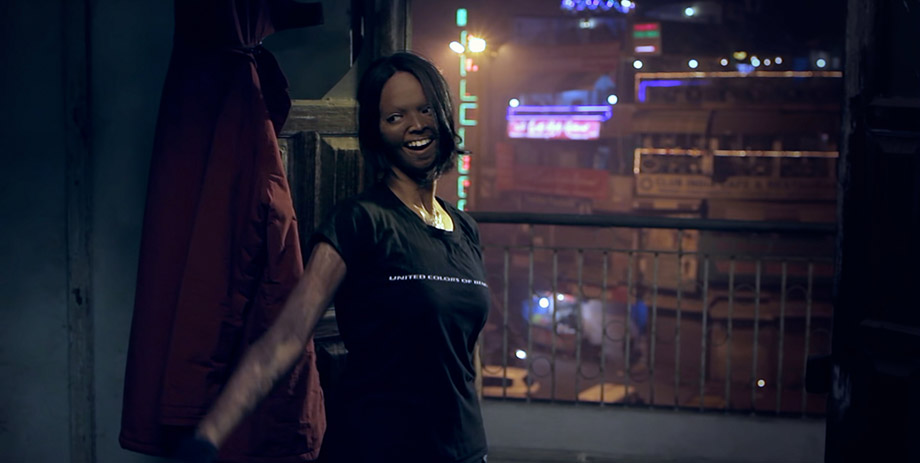
Megha Ramaswamy’s documentary Newborns premiered at Toronto International Film Festival. And now it’s online for a limited time as part of Vimeo’s presentation of TIFF Short Cuts.
Watch it.
From fest site – A hauntingly beautiful documentary that follows female survivors of acid attacks, who bravely defy the trauma and fear that will always accompany them.
Cast, Crew and Other Details
Country: India
Year: 2014
Language: Hindi
Premiere Status: World Premiere
Runtime: 8 minutes
Rating: STC
Producer: Anand Gandhi, Sohum Shah, Ruchi Bhimani
Production Company: Recyclewala Labs
Principal Cast: Laxmi, Nasreen, Sapna, Daya Kishan, Usha, Rupesh Tillu, Heena Agrawal
Screenplay: Megha Ramaswamy
Cinematographer: Satya Rai Nagpaul
Editor: Anand Gandhi, Rohit Pandey
Sound: Ajit Rathore, Aditya Jadav
Production Designer: Megha Ramaswamy
The 2014 edition of Toronto International Film Festival has added 2 more Indian films in its schedule.
Margarita, with a Straw directed by Shonali Bose will have its world premiere Contemporary World Cinema section.
From fest site – In this inspirational love story, a Delhi university student and aspiring writer afflicted with cerebral palsy (Kalki Koechlin, Dev.D, That Girl in Yellow Boots) leaves India for New York University, where she falls for a fiery young activist.The programme presents the latest works of some of the most provocative and important voices in cinema from around the globe. Bose’s debut film Amu had also been screened at Toronto in 2005.
Cast, Credit and other details
Country: India
Year: 2014
Language: Hindi/English
Premiere Status: World Premiere
Runtime: 100 minutes
Rating: 14A
Producer: Shonali Bose, Nilesh Maniyar
Production Company: Ishan Talkies, Viacom18 Motion Pictures, Jakhotia Group
Principal Cast: Kalki Koechlin, Revathy, Sayani Gupta, William Moseley, Hussain Dalal
Screenplay: Shonali Bose, Nilesh Maniyar
Cinematographer: Anne Misawa
Editor: Monisha Baldawa
Sound: Resul Pookutty, Amrit Pritam
Music: Mikey McCleary, Prasoon Joshi
Production Designer: Somenath Pakre, Prasun Chakraborty
The second film is Megha Ramaswamy’s Newborns. It’s part of theinaugural Short Cuts International programme.
From fest site – A hauntingly beautiful documentary that follows female survivors of acid attacks, who bravely defy the trauma and fear that will always accompany them.
Cast, Crew and Other Details
Country: India
Year: 2014
Language: Hindi
Premiere Status: World Premiere
Runtime: 8 minutes
Rating: STC
Producer: Anand Gandhi, Sohum Shah, Ruchi Bhimani
Production Company: Recyclewala Labs
Principal Cast: Laxmi, Nasreen, Sapna, Daya Kishan, Usha, Rupesh Tillu, Heena Agrawal
Screenplay: Megha Ramaswamy
Cinematographer: Satya Rai Nagpaul
Editor: Anand Gandhi, Rohit Pandey
Sound: Ajit Rathore, Aditya Jadav
Production Designer: Megha Ramaswamy
Trailer
The Festival will run from September 4 to 14, 2014.
With Recyclewala Films presenting Gulabi Gang and Anurag Kashyap putting his might behind The World Before Her, we are seeing a great new trend of documentary release in India. And this is what is required to push those small gems which don’t have the big marketing budget. Hope more well known filmmakers and production houses will come forward for this kind of endeavor. The latest one is Phantom Films presenting Fahad Mustafa and Deepti Kakkar’s documentary Katiyabaaz. The film will hit the screens of 22nd August, 2014. It has lyrics by our Varun Grover.
Official synopsis – The film highlights the issues faced by the city of Kanpur due to power cuts and failures from the perspective of Loha Singh, a local katiyabaaz who, with an almost vigilante like attitude, steals electricity for the locals of the town.
If the synopsis sounds serious, don’t go by it. Trust our words – it’s a fun film. Though it looks staged at many places but it’s worth a watch. The film also bagged the National Award for the Best Investigative film at the 61st National Awards, won the India Gold for Best film at the Mumbai Film Festival, 2013, and received a grant from the prestigious Sundance Institute.
The World Before Her, directed by Nisha Pahuja is currently playing in select cinemas across India. Fatema Kagalwala first wrote about it on our blog, where we called it a ‘must-watch’. Here’s another post about the film by Shazia Iqbal:
“The question isn’t who is going to let me; it’s who is going to stop me”
These are words of Objectivist Ayn Rand who rejected religion and faith and believed in rational reasoning as the way to make sense of life. Her words tore up the frame as the sub text every time the two protagonists (along with other girls) spoke in Nisha Pahuja’s powerful documentary ‘The World Before Her’. The irony is the world they want to capture; a world where they know they can’t be stopped has already caged them with its regressive ideologies and unfortunately they aren’t even aware of it. I watched the film a few days ago and it has been pulling me back for several reasons. Not because the film is full of strange, depressing truths about a divided India, and a women’s identity in the same, more so because it asked the very questions I have been asking of myself for years now. Who else does an atheist woman go to? I love and respect Ayn Rand and women like her who publicly shunned religion because it’s a tad bit more difficult for women to deny God than their counterparts.
I am a Muslim woman. My surname makes me a minority in a country that largely has fixed notions of the community I belong to. My gender makes me a minority in a patriarchal society. Also to make things a little more twisted for myself, I questioned and tried to reason with my religion and others, and bracketed myself in another group, the atheists. Minority again. Minority within minority is a task to pull off, I now realize. In a world where humans are so deeply fucked up, it sometime gets lonely to not even have a god but when you see the madness in the ones that have him, you know you are better off not belonging anywhere.
When asked about my faith, my regular responses are ‘I’m not a Muslim.. I’m an Atheist’, ‘Agnostic?’ Or simpler: ‘My parents follow Islam.’
‘So you are a Muslim?’ ‘No, I don’t belong’ ‘Don’t belong?’ ‘Don’t belong to any religion.. I’m fine without knowing the truth about God’s existence.’
Somehow my answers have never been good enough to not raise eyebrows. For years I have been looking for an identity. And I have made my peace with not having one and my questions being unanswered. I don’t look at myself as a Muslim and that’s why I have not felt discriminated against though being called a Pakistani is something most Indian Muslims grow up with and get used to. I am not victimizing Muslims, just that being a minority comes with its own share of pros and cons in every part of the world. We have our own. So every time my surname separated me from the crowd and I was treated differently, I didn’t retaliate because why should I? I am not a Muslim. So I thought.
I think my parents are a rare case because they celebrated the birth of their first daughter, when everyone around was killing the female child. I was born in a small village near Patna. After two sons, they were craving for a daughter. I am not thankful to my parents for not killing me, I take it for granted as my right to live and yet the character I empathized with the most in the film is Prachi Trivedi, the 24 year old instructor at the training camp of Durga Vahini, the women’s wing of VHP (Vishwa Hindu Parishad) because she is grateful to her father for not killing her at birth. That line made me realize how deeply complexed we are as a society.
My life is not about a movement, I don’t hate Gandhi and terrorizing people is not my idea of teaching. And yet it was Prachi’s volatile relationship with her father that touched my heart. Prachi is aware that the world that gives her strength to fight the enemies of the Hindu Culture (apparently the Muslims and Christians) is also the world that eventually asks her to follow the norms of marriage and children, something she doesn’t agree with. The ideologies that tell her women are not meant for house chores also tell her she ‘has’ to be tamed by getting married and not fly high and dream of a career. Girls don’t do that. Prachi struggles to balance the two contradicting ideologies, while asserting the right to find her way. Like Prachi, I have had my own daddy issues. My emancipated father raised me and my sister like ‘boys’. He told me very early in life about carving out a place for myself in the world. Marriage was not his idea of making a good life. It’s never been my idea of anything. We never spoke about marriage. But our relationship is volatile and argumentative because of our different belief systems of surviving in a society, where we are lesser in numbers compare to other race. It’s not about me being atheist. Although I have defied God in his presence, he is liberal enough to mostly let me think with my own head. The only one issue I have had with him is he asked his children to be quiet and not rebel because ‘we are minorities’. Under different circumstances, we fought over the same issue, and never reached common ground.
During a Ganapati festival, my mother was just back from a long stint in hospital. The noise mongers were playing loud music at 5 in the morning, and after bearing with it for days in row, I finally decided to call the police. He stopped me. ‘We are Muslims, we can’t complain. You are a girl and people don’t show their bias to women but you’ll know some day’. I argued and was told ‘ladki ho, ladki hi raho’ (You are a girl, behave like one). I struggled to understand if this was the same man who took pride in raising his daughters like sons. And whether I should be a boy and speak up or be a girl and shut up. And what’s stopping me from speaking up is it being a Muslim or being a girl? Or both? I felt suffocated in the hypocrisy of the world my father created for me. I didn’t choose to be a Muslim or a girl. Why do others have the rights that I don’t? Lottery of being born a man? Lottery of being born in a religion that’s bigger in numbers? I didn’t want this world. I wanted to make my own new one that doesn’t chain people in their own thoughts. But largely this is the reason why most anonymous in history have been women.
Somewhere halfway through the film, when you are already exposed to two very different, yet parallel, disturbing worlds, a young teen at the training camp gushes with pride ‘No, I don’t have any Muslim friends and I am proud about it’. After bearing with a few prejudices, this one felt like a sharp knife cut through the heart. I felt stifled. A few drop of tears streamed out. Why did it affect me so much when I don’t consider myself part of the community? When I proudly defy standing by any faith. When I don’t feel the need to group with a bunch of people who have similar ideologies and believe we are superior to the other race. Her words made me realize that even though I have left the religion years ago, it hasn’t left me. And in all probability, it never will.
Her words reminded me of how I felt years ago, when Bombay’s lifeline, the trains were attacked on 7/11. I worked as an Asst Art director back then and was shooting in a studio at Filmcity for a feature film. We were working with a couple of stars and anticipated an early pack up that evening. But as soon as the blast news came out of the vanity, the set became a story in itself. Chaos reigned. People panicked and called home. I managed to call home and found everyone safe, except my brother, who none of us could trace. Production decided to lock up the set till the bombings stopped. It went on for 11 minutes but we kept getting news. Mostly post blast rumours. My mother realized that the sixth train that blew up was my brother’s regular ride back home. That was it. I fell on a chair and broke down. A couple of Asst directors gathered around me. Out of nowhere the production manager, a paan chewing middle aged man, shrugged them aside and attacked me in his stringent language ‘kyun ro rahi hai? Tum logon ne toh karaya hai yeh sab’ (why are you crying when you and your people have executed this). I looked at him. The asst director retaliated ‘What the hell! She is a girl…’
He attacked further, ‘the girls carry the bomb inside the veil.. ’ He said that and spat his chewed betel leaf next to me. My friend blabbered something that I didn’t hear. I was numb. I don’t know the chemical composition of a bomb, not even as much as Prachi’s knowledge of an AK-47. But we are both victims here. I have never worn a veil and have fought against people who support and justify women being bound in a veil. I realized that I belong neither to a community that wears the veil nor to the one that’s judges it and labels them a terrorist because of it. I feel that spit on my face every time I recollect this incident. I remembered my father’s words and reasoned his fear of speaking out as a minority.
Ruhi is a Miss India contestant who dreams of winning the crown to make her parents of their product, that’s her. Jo-Ann Endicott in Pina Bausch’s Walzer struts around angrily, frustrated and enraged at a world that tells her how to carry off her body. She chalks out a boundary in different spacial forms her body creates and repeatedly screams ‘I don’t need your help or anybody else’s help, Thank you!! ’ She describes how she is asked to sit with an erect posture, so her legs don’t look fat and ugly. She struggles to keep her thighs together because they fall apart or hold her boobs up with a bra or they hang, sometimes right till the floor. There is rule for every part of the body, the fingers, wrist, elbow, the long neck, the longer hair, the various ways of doing up the hair, which lets the world categorize as classy or trashy. She wants to let her hair down and be herself. She wants to hide herself behind her long hair but they wont let her. Her face, her torso, her spine, her legs, her gait is all exposed for her to be judged. This is the gist of what beauty pageants stand for. Girls in this country have grown up dreaming of the crown from the time Sushmita Sens and Aishwarya Rais won the Miss world crown and made India ‘Proud’. The beauty standards pretty much changed in this country since then and how.
I would love to say fuck your fascist beauty standards if I myself wasn’t falling prey to it every now and then.
It was only a couple of months ago when I went to a skin clinic for a regular acne issue; they asked me to undergo a surgery for a sharper Jawline. A half an hour procedure that would apparently change my life. I was dumbfounded. The doctor told me it would give me confidence to face the world with a new face. Ha! Fortunately I didn’t think anything wrong with the current one. I smiled and walked away. But a lot of women fall prey. The rising numbers of these clinics are a proof of that. Everything is wrong with a world that tells a women a certain body type, certain shapes, particular complexion are what makes an ideal women, empowers them. Botox, skin whiteners, weight control, boob jobs are not going to let me have my place in the world. A director once belittled me when I refused to do a fairness cream TVC. He said if not me, somebody else would take it up. Exactly! I am aware.
Wearing a bikini doesn’t empower women. Neither does holding a gun and being able to pull the trigger. You are not empowered by exposing your bra strap or by being married and raising kids at 18; not by having ideal torso and limbs, not even by internalising the politics of hatred in a religious camp.
If this is power, I don’t want it. I want the opportunity to voice my opinion and be heard respectfully. I do not ask for permission before I speak. It is my right as a human. I do not want a career to escape the world you have made; I want to create my own world. Don’t allot me my space. Give me the freedom to carve my own niche. That would be empowerment. Hope Prachi and Ruhi and thousands like them comprehend this and liberate themselves from the world that is thrown before them.
Thank you- Nisha Pahuja for this hard-hitting story and Anurag Kashyap for supporting it.
(Shazia Iqbal is an Art director, and has worked in Films and Advertising since last eight years. She designed Dum Maaro Dum and many other films. Her script was selected for NFDC’s Director’s Lab.)
After Leaving Home and Baavra Mann, filmmaker Jaideep Varma has directed one more documentary – I Am Offended. According to official post, it’s a documentary about stand up comedy in India within the context of Indian humor and growing intolerance in the country today. Featuring some of the brightest talents, in stand up comedy in India.
Director of Final Solution, Rakesh Sharma claims so. This is what he shared on his Facebook –
A Short Film About Lying
Spent last evening and today speaking to a range of journalists. Despite telling everyone that all documents are in public realm, it is painful to read reportage full of inaccuracies or partial quotes and misquotes.
Kher is yet to accept he lied on Times Now and CNN-IBN. He is yet to apologise to all the viewers.
His tweets and press statements keep shifting the terrain – he speaks of “agendas”, “pseudo seculars” etc – but is yet to accept that he lied blatantly. He is also tweeting links to my audience Q & A in 2013 in his defence.
So, I decided to compile this short film – so you can see it all for yourself.
If you have been living in some other planet and are completely clueless about it, here’s his earlier post –
Stop lying, Mr Anupam Kher!
It has been brought to my notice that Mr Anupam Kher, ex-Chairman, CBFC has been making patently false claims about the sequence of events surrounding the ban on my film Final Solution (on the Gujarat 2002 carnage) during his tenure. It seems that on Times Now (April 16) and CNN-IBN (April 17), Mr Kher, while engaging in debates with Anand Patwardhan, said:
a. The film was ‘cleared’ while the BJP (NDA) was still the ruling party.
b. He was personally responsible for ‘clearing’ the film.
c. His actions filled me with immense gratitude
Mr Kher seems to be suffering either from serious memory lapses or is indulging in his age-old affliction of ‘creativitis’, merrily distorting and falsifying facts to score points in a live TV debate.
On CNN IBN he says that I sent him an “sms saying I want to touch your feet for your magnanimity”. Anupam Kher either has verbal diarrhoea or the Alzheimmers or both. Such a remark also belies his feudal mindset, where he perhaps saw himself as the King of the Censor Board and expected his subjects to fall at his feet. And for what – for him to finally perform his constitutionally mandated functions, ie, just doing his job, without bias, fear or favour?
1. Final Solution was submitted to the CBFC in March-April 2004, while the NDA was in power.
2. Right from the start, CBFC tried to harass the film-maker by raising all sorts of objections concerning the submission of the application itself (eg, ‘improper’ binding of the script, typefaces etc).
3. Ever since its international premiere at the Berlin International film festival on Feb 5, 2004, the film started getting invitations to several filmfests as well as many awards. At Berlinale itself, the film got 2 awards, including the Staudte Award (now known as Golden Bear for Best Debut), which has never gone to a documentary before or ever since.
The CBFC responded by sending two legal notices to the film-maker on matters outside its purview (customs and foreign exchange related violations for international film festival screenings). The CBFC was formally advised that it had no jurisdiction and these notices were malafide.
4. After many representations to CBFC, an Examining Committee was finally convened on July 30, 2004 where the film was denied certifications and thus ‘banned’. Their exact ruling text can be found on the URL above.
5. Apprehending such a possibility, we had requested 2 independent journalists (The Telegraph and Mid-Day) to unobtrusively be present at CBFC (with an asstt director) to observe the entire process. The committee took less than 3 hours to watch the film, hold extensive discussions and then draft a ruling citing all relevant legal provisions therein. The problem: The film was over 3.5 hours long! Both the journalists published details of this sham the next day. I personally wrote to Mr Kher at CBFC on Aug 4, 2004 (letter available on URL above).
6. By this time, at the centre, a UPA government was sworn in following NDA’s defeat in the national elections. I now approached Mr Jaipal Reddy, Minister for I & B, urging him to invoke a rarely-used provision of the Cinematograph Act, to overturn the CBFC’s partisan ruling. (letter on URL above). In subsequent meetings with him and senior officers of the Ministry, I also demanded stringent action against the CBFC personnel involved in illegal and malfide actions.
7. Following serious protests by the documentary film-makers fraternity, and after the Ministry’s own internal inquiries into the episode, Regional Officer Mr Singla was reverted to his parent cadre, permanently removed from the CBFC. Assistant RO Amitabh Sharma was transferred from CBFC, Mumbai to CBFC, Cuttack. As this action was being finalized in Delhi, Mr Kher saw the writing on the wall.
8. He called me and urged me to re-apply; I declined on the grounds that the CBFC had never seen the film in its entirety. Applying to a Revising Committee was tantamount to sanctifying the illegal and partisan proceedings of the earlier committee. One he failed to have me re-apply, Mr Kher took a suo moto decision to convene a special committee, headed by the noted director Shyam Benegal, which cleared the film without a single cut.
9. 4-5 days after this, Mr Kher was summarily sacked by the Government of India. He accused ‘documentary film-makers’ of orchestrating his removal, strangely claiming credit for clearing my film, while attacking me for my lack of ‘gratitude’. At the time, I rebutted all his claims, even calling his regime one of the worst tenures in the history of CBFC (reported extensively by all leading newspapers in mid Oct, 2004).
I am deeply shocked to find that Mr Kher is once again claiming credit for ‘clearing’ my film in his TV studio discussions! Factually speaking, Mr Kher and his coterie of partisan officers first harassed me, while refusing to schedule the film for a CBFC panel screening. When they finally did so, it was done with utter malintent, hurrying the ban on the film. Mr Kher is believed to have personally called up the Police Commissioner, Bangalore to prevent a public screening of my film as the curtain raiser to the Films for Freedom Festival in Bangalore on July 29, 2004, a day before the CBFC ‘banned’ the film.
If Mr Kher’s conduct as Chairman, CBFC was less than professional and even partisan, his behavior now defies credulity. His rightwing beliefs are too well-documented to bear repetition here. His association with Panun Kashmir and his proximity to the BJP too have been in public realm. His attempts to present himself as some sort of champion of free speech as the CBFC chairman amount to sheer duplicity and dishonesty.
I’d, in fact, prefer him to resort to the truth and proudly claim his role in preventing public screenings of my film as well as denying it a censor certificate through a carefully-planned drama on July 30, 2004.
I have placed all relevant documents in the public realm. Mr Anupam Kher is welcome to prove that he cleared the film during the BJP/NDA regime.
Incidentally, Final Solution was not the only film to get ‘stuck’! Other Gujarat-related films too faced assorted problems. Here is a report from Aug 22, 2004, when Mr Kher was Chairman, CBFC. http://www.telegraphindia.com/1040822/asp/look/story_3631619.asp
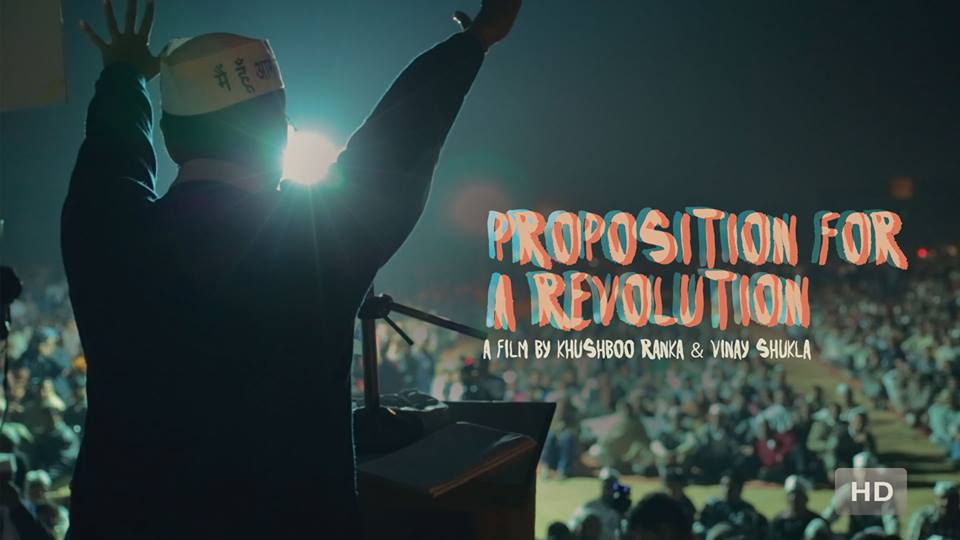
Khushboo Ranka and Vinay Shukla have documented one of the most exciting political turn of events in recent times – the making of AAP and the rise of Arvind Kejriwal. They have just released the first look of the documentary titled ‘Proposition For A Revolution’. They are also looking for post-production funds. So do check this out and if you like, do contribute.
– To contribute, you can go to their official site here.





 F.i.g.h.t C.l.u.b