Archive for the ‘film’ Category

This slideshow requires JavaScript.

An interesting trailer of Ajay Bahl’s debut film “BA Pass” came out online recently. If you still haven’t seen it, click on the play button.

The cast includes Shilpa Shukla, Shadab Kamal, Rajesh Sharma, Dibyendu Bhattacharya and Geeta Agarwal.

And here’s the official synopsis of the film –

A young small town boy moves to Delhi to stay with his aunt and finish his college. Soon a mysterious married woman seduces him known to him as Sarika ‘Aunty’. Set amidst the neon-lit by lanes of Delhi’s Paharganj unfolds an erotic human drama between the two. A relationship based on lust, lies and deceit is forged. As the young boy gets more and more entrenched into his surroundings he discovers a city that thrives on corrupting even the most naive and innocent.

– The film is based on Mohan Sikka’s story “The Railway Aunty”, which was part of the anthology “Delhi Noir”. The story is available online. If you haven’t read it yet, click here.

– Click here to read an interview of the director on DearCinema.com.

– The film will have its next screening at New York Indian Film Festival which is scheduled from April 30th to May4th, 2013.

– To know more about the film, you can follow its Facebook page.

Lootera

The man behind one of the best debuts films in recent times Udaan, Vikramaditya Motwane is back with a new film titled Lootera starring Ranveer Singh and Sonakshi Sinha. And as the latest trend in bollywood goes, the first look of the film is just a teaser and not the full trailer.

The teaser doesn’t tell you much about the film but just gives you a sense of the place and the mood of the film. But close your eyes and watch the teaser again – i think it’s the music. Old world charm, silent glances, character introductions and then those last 30 seconds where it kicks in – snow, gun, letters, light, fire and dhickiyoon, credits and the hero limping on snow! Now, give me the full trailer.

This completely stands out from the garbage that Bollywood is churning out these days. There’s so much silence, and most importantly, there’s NO FUCKING TEXT on screen to explain it. But this also seems to be from school of Sanjay Leela Bhansali. Just hope that it’s less grand, less manipulative and more intimate.

The credit list seems to be the same as that of Udaan. DoP is Mahendra Shetty. Screenplay by Vikramaditya Motwane and Bhavani Iyer. Dialogues – Anurag Kashyap. Music – Amit Trivedi. Lyrics – Amitabh Bhattacharya.

Though the makers have been saying it publicly that it’s inspired/based on O Henry’s short The Last Leaf, why isn’t it mentioned in the credit plate?

TheMaster.php

Great cinema always inspires great writing. And going by that rule, the latest one to join the club is P T Anderson’s The Master. And like us, if you also love reading everything possible related to a film once you have seen it and love it, then you have come to the right place. Some of us have seen the film and googled everything on it so that you don’t have to. Also, there are high chances that once you have seen the film, you will have too many questions. This post has links to some of the explanations offered.

But DON’T READ ANYTHING if you have not seen the film.

The Master is finally getting a theatrical release in India this friday. It might not work for everyone but you can’t deny Anderson’s stamp of great film-making all over. So don’t miss it. And for two more reasons – it deserves to be seen on big screen. There’s no other way. If it works out well, we might get to see much better releases in the coming months.

At the end of the scene, Lancaster sings “(I’d Like to Get You On) A Slow Boat to China” to Freddie. And yes, it’s eerie and perhaps more than a little homoerotic, but it also feels like a twisted version of a lullaby — the most domestic and familial of actions turned into something terrifying and strange — making it clear once and for all that Freddie’s dream of becoming a family with Lancaster and Peggy Dodd is an impossibility. And freeing him, ironically, to try and form a new family — perhaps with Winn, the girl he’s met in the final scenes of the film, right before we see him lying next to the female sand sculpture, suggesting that his search goes on.

– Vulture has done a brilliant piece titled “What Is The Master Really About?: Five Interpretations”. Click here to read.

It’s hard to make a lot. That was one thing when I was working on The Master, they kept being like, “well, he’s got a tea kettle, and he’s making gallons of spirit out of it.” I’m like, “Mmm, you might get a shot of spirit out of a tea kettle.” Like that flask setup in the shed in the cabbage field? No way that would have produced a five-gallon glass carboy full of moonshine, unless you were working every day for several weeks. But, you know, movie magic.

– Vulture has also done a piece answering that million dollar question which everyone will surely ask after watching the film – Can You Really Make Booze Out of Paint Thinner? Click here to know the answer.

The haunting, utterly inward stillness of the actors in “The Master” is one of the director Paul Thomas Anderson’s most apparent achievements, and it’s no mere ornament or element of dramatic plausibility—it’s at the core of the film, as is the very question of performance as such.

– New Yorker’s Rochard brody has written a long essay titled “The Astonishing Power Of The Master”. Click here to read.

– And if you want to read about the making of the film, click here for a long interview.
In “The Master,” we’re often left gasping for air, as in the scene when Freddie is required not to  blink for a painfully long stretch of his processing. Or because of the sheer beauty of some of the compositions. Warts, wanderings, reiterations and all, this is a film destined to be processed in many different ways. And hallelujah to that.
– Michael Philips’ 4 star review is here.
There are hints of an erotic relationship between Freddie and Dodd’s daughter (Ambyr Childers) and a not-too-veiled suggestion that Dodd’s paternal yearnings for Freddie are complicated by other desires. But at the risk of issuing a spoiler of sorts, beyond a bewildering point-of-view sequence when Freddie imagines that all the women at a Philadelphia cocktail party are naked, this is a film suffused with sexual desire that has no sex in it. If you look at “The Master” through the lens of Paul Thomas Anderson’s body of work, this is a prelude to the world of “Boogie Nights,” a disordered America where nobody was getting any that led straight to the disordered America where everybody was getting too much.
– Another great piece by Salon’s Andrew O’Hehir. It’s titled “The Master: A forbidding portrait of L. Ron Hubbard’s America” . Click here to read.
All of this striving — absurd, tragic, grotesque and beautiful — can feel like too much. “The Master” is wild and enormous, its scale almost commensurate with Lancaster Dodd’s hubris and its soul nearly as restless as Freddie Quell’s. It is a movie about the lure and folly of greatness that comes as close as anything I’ve seen recently to being a great movie. There will be skeptics, but the cult is already forming. Count me in.
– A O Scott’s article is wickedly titled “There Will Be Megalomania”. Click here to read.
– Time Out Chicago also offers “An Explanation” of the film. Click here to read.

So where does this leave “The Master” on the Anderson landscape, that oddly populated terrain? Few modern films have been as crowded as “Boogie Nights” and “Magnolia,” and few have been more lonely than “There Will Be Blood.” The new work sways toward the latter. I kept expecting, and even hoping, that Dodd would acquire a tinge of Elmer Gantry—that he might start to muster large throngs to the Cause, with Freddie employed as the muscle to keep the mob in line. But the scale of the story, for all Dodd’s swagger, remains compact, and the plot slowly condenses into a blend of character studies. Look at Amy Adams in closeup, for instance, all the scarier for being so perky and correct, her features filling the screen as she quizzes the reprobate. Or look at Phoenix, lifting his head high and proud, as Brando used to do, with an added, cranky stiffness that comes from having, or being, a serious pain in the neck. The eyes narrow and the mouth is awry, one corner twisting into an Elvis curl, though it looks too sour for seduction, let alone song.

– Anthony Lane’s review in the New Yorker is here. And it’s a must read.

Why do you make things so difficult? Else it wouldn’t be fun.

–  1 hour long Q & A with Anderson
– The Career of Paul Thomas Anderson in Five Shots
If you read any other brilliant essay on the film, do post it in the comments section.

unhung heroSince none of us are getting much time to write posts these days, i thought let’s at least compile cinema related interesting news bits that we come across on the net everyday and put it in a post. Otherwise it just gets lost in the timeline flood.

When i first heard the term “cockumentary”, i had no clue how to react. But that’s how Patrick Moote branded his film “Unhung Hero” – a cockumentary. And it started because of his cock size and because of which he was publicly rejected by the girl whom he proposed. The film is premiering at the ongoing SXSW Festival.

Indiewire has got a clip. Click here to read more about it and watch the clip.

Twitchfilm has reviewed the film. Click here to read.

But does size matter? Well, this isn’t the first time that the million dollar question has bothered men. And this won’t be the last. You can’t deny that it’s a serious issue. Problem is the moment one tries to talk about it, the reactions goes in all extreme directions.

And like Moote, filmmaker Lawrence Barraclough also has mini-me issue. And he made two docus on it, putting the camera on his dick. First one is called “My Penis and I” which was made for BBC. The second one is called “My Penis and Everyone Else’s”. Both the films are quite funny, sad and serious. He even talks to his girlfriend and parents about it. If not big dick, this surely needs big balls. Do watch.

And that’s not all. If you were offended by Seth MacFarlane’s “We Saw Your Boobs”, Ladies, here’s your revenge – we saw your junk. Have fun.

Pic courtesy – FB page of the film

Two festival news updates.

Manjeet Singh’s next feature Chenu has been selected for the 9th edition of L’Atelier organized by the Cinéfondation of the Cannes Film Festival. 15 projects from 14 countries have been selected for 2013 edition of L’Atelier which invites directors/producers to meet potential partners during the Festival. So far, out of 126 projects presented over the last eight years, 83 have been completed and 29 are currently in pre-production. From May 17 to 23, L’Atelier will arrange meetings with the directors for film industry professionals interested in investing in their projects.

DearCinema has more info on the film – Chenu is the story of a young dalit boy in the northern Ganges belt. He is drawn into ongoing war between the naxals and upper caste militia, when his younger sister’s fingers are chopped for plucking mustard leaves from a landlord’s field. The script explores various factions existing in the northern Ganges belt and delves into the humiliating lives of the underprivileged dalits.

Manjeet Singh’s directorial debut Mumbai Cha Raja premiered at TIFF and have been doing the fest rounds since then. Last year Shivajee Chandrabhushan’s project The Untold Tale was selected for L’Atelier.

powerless_tff

Tribeca Film festival has released the list of 12 documentaries that will premiere at the fest and will compete in the World Documentary competition section. Fahad Mustafa and Deepti Kakkar’s Powerless, which recently premiered at the Berlin Film festival, will have its North American premiere at Tribeca. Here’s the official synopsis from the Tribeca release..

Would you risk your life to flip a switch? In Kanpur, India, putting oneself in harm’s way to deliver electrical power is all too common. Powerless sheds light on the opposing corners of this political ring, from an electrical Robin Hood tapping wires for neighbors to the myopic utility company whose failure to understand economics forces it deeper into financial disarray. This vibrant exposé gives a whole new meaning to the words “power struggle.” In English, Hindi with subtitles.

To know more about the film, watch its trailer/teaser and for its credit roll, click here.

The 2013 film selection includes feature films from 30 different countries, including 53 World Premieres, 7 International Premieres, 15 North American Premieres, 6 U.S. Premieres and 8 New York Premieres. A total of 113 directors will present feature works at the Festival, with 35 of these filmmakers marking their feature directorial debuts. Among these directors, 26 are women. The 2013 film slate was chosen from a total of 6005 submissions.

With the positive reviews pouring in from all quarters, i was waiting for some contrarian views. Because what’s the fun if we all are on same page. Though there have been few such views too, and criticism mostly have been looking at the big picture and the issues involved. But Runcil Rebello believes that the film is about “the smaller picture”. And he also writes about how the film is different from the book.

kai-po-che

In Abhishek Kapoor’s Kai Po Che!, it’s all about opposition – ideas clashing with each other, and sometimes both winning, sometimes just one. There is the age-old money versus passion squabble, further highlighted in the academics versus sports issue omnipresent throughout Indian homes. Then there is the overarching notion on which the film is built: friendship versus ideology, and friendship does not always win. There is also Mathematics versus Biology.

Kai Po Che!, adapted from Chetan Bhagat’s The Three Mistakes Of My Life, is a story set in Gujarat around the turn of the millennium. The nineties were done and dusted with. Internet, Nokia mobiles, malls were making their introduction into daily Indian life. The Indian cricket team would become a leading Test-cricket playing nation in the following decade. Religious politics had not yet reached a fuming and flaming high.

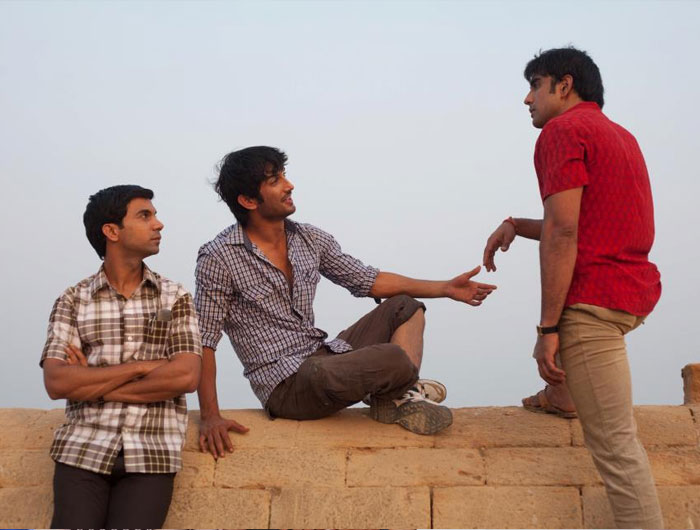
But Kai Po Che! doesn’t have its eyes set on such large-scale issues. Rather, it is content telling the story of three friends: Ishaan (Sushant Singh Rajput) – flamboyant, impulsive, passionate, Govind (Raj Kumar Yadav) – logical, ambitious, money-minded, and Omi (Amit Sadh) – simple, lovable, easily swayed, who set up a sports equipments store-cum-cricket training academy-cum-Maths tuition classes. This film is as much an ode to friendship as it is about the decay of that lovely bond.

The idea of opposition isn’t hammered into our heads. It’s brought up now and then, never over the top. Just like the film. The story (written by Abhishek Kapoor, Chetan Bhagat, Pubali Chaudhuri and Supratik Sen) does not veer much from the book, and if you’ve read the book, you’d realise then that it is a story tailor-made for Bollywood. And yet, the writers and the director stitch the film into an altogether different piece of fabric. The film is removed from typical Bollywood treatment. No star actors, no item numbers, no over-the-top treatment, just three songs (Hell! The soundtrack by Amit Trivedi [with lyrics by Swanand Kirkire] includes a garba-beat song in Shubhaarambh, but the film’s garba scene isn’t picturised on it. Unexpected.) Instead, Kai Po Che! is about the small moments in the fabric. Don’t lose sight of the smaller picture.

Characters, especially Omi’s, oscillate, not able to settle on one thing. He, at times, goes where the wind blows, and sometimes marches to the beat of the other drummers of the show. He may not always like what he does, but he is loyal to any cause he signs up for. Govind and Ishaan, on the other hand, are the proverbial immovable object and unstoppable force. They’d go to any distance to get what they want, albeit what they want is in diametrically opposite directions. Govind has to let loose, has to understand that not all things in life are solved by Mathematics, but some by Biology too. Ishaan’s sister Vidya (Amrita Puri) would be his teacher in this regard. Ishaan has to grow up, has to not let anger affect his decisions, but his mind. Ishaan, and to a lesser degree, Govind too, do not care about how religion plays into their plans. They are fine with sitting on the fence when it comes to this particular power struggle, letting Omi handle the dirty work.

What these three have in common, though, is something India is obsessed with: cricket. Cricket (and films) are said to heal wounds. In this film, it is the historic 2001 Calcutta test match between India and Australia that plays the role of mediator and doctor. It is also cricket that brings together children of two opposing homes, Omi and wiz kid Ali (Digvijay Deshmukh), under one roof.

Abhishek Kapoor has a knack for staging event situations. In Rock On!! earlier, he staged rock concerts in a way no Indian film had before. In Kai Po Che!, he goes large scale, but doesn’t make them the focus of his movie. The eye firmly remains on the three friends. Earthquakes, cricket matches and the Godhra Riots form the trifecta of incidents around which they break and mend. Tough decisions are made, mostly on impulse and emotion. When calamities strike, there is no time to think. Govind, Omi and Ishaan choose their respective sides all on basic instinct.

The film, though, has been meticulously planned. If Anay Goswami’s cinematography portrays Gujarat in a favourable light, Hitesh Sonik’s background score livens up the lives of the three friends. Deepa Bhatia transitions from one date to another finely, giving her best cut in the crucial scene during the riots.

Sushant Singh Rajput and Raj Kumar Yadav play their roles well. They really look the part, and so does Manav Kaul, being crafty and smart as Bittoo mama, Omi’s political leader uncle. Amrita Puri is cute and plucky adequately. In fact, the casting (by Mukesh Chhabra) is impeccable. The one actor, though, to make the most impact is Amit Sadh. From portraying a simpleton to a political henchman, Amit Sadh’s eyes, and hair, speak.

All these people, eventually, are just holding the manja. It is Abhishek Kapoor flying this kite, cutting every other kite in his path. He’ll be the one screaming kai po che! at the end of it. And what a delight it has been to watch this kite soar great heights.


P.S.: If you’ve read the book, you’ll understand the flashback and the conclusion has changed; all for the best. Below are a few details of what is different in the film.

(SPOILERS AHEAD!)

Chetan Bhagat, in his book, The Three Mistakes Of My Life, had Govind as the lead character. The biggest change is towards the end. In the riot scene, Omi is the one who protects Ali, Ishaan and Govind from his uncle. Omi dies in the process, and Ishaan doesn’t talk to Govind for years because of the revelation that his sister and he were in a relationship. Govind eventually, before committing suicide many years later, writes a letter to Bhagat, who he is inspired by, thanks to his two books Five Point Someone and One Night At The Call-Centre, who then intervenes and brings all of them together again. An utterly melodramatic end to the story, which thankfully was changed.

Another important section that was missing from the film was the part where the three friends finance a trip for Ali and themselves to Australia to receive cricket coaching. The Australians, seeing the marvel that Ali is, offer to train him but only if he eventually plays for Australia. Ali here in an outright dramatic fashion proves his patriotism for the country by shouting that he’ll play only for India and then they return to India.

Also, Vidya and Govind sleep together on Vidya’s eighteenth birthday at her home itself in the book. This too was changed in the film.

Also, missing in the book is the Diu section. The three friends are basically saints in the book, not leaving their pol to do things normal twenty-something guys would do i.e. to drink.

Abhishek Kapoor also changed the narrative by making all three characters equally important, thereby removing the crux of the story from the ‘three mistakes’.

The rest of the movie is pretty faithful in its adaptation.

Abhishek Kapoor’s new film Kai Po Che has released today. The reviews so far have been unanimously positive. But does it mean anything beyond that – The Big picture? Over to filmmaker Hansal Mehta who connects the dots.

Kai Po che

4 reasons for not watching the increasing number of films released every week –

  1. I am perennially broke
  2. I am lazy
  3. I need to work
  4. My wife is not in the mood
  5. I am hoping I get invited for a preview/premier.

The past few weeks have been different though. The spate of films released and due for release stared at me in the face because

  1. They featured friends in lead roles
  2. They were directed by friends
  3. They were produced by friends
  4. I was looking forward to the films
  5. I felt compelled to watch them

I am going to limit my post to the Hindi films I saw because in the case of foreign films:

  1. I feel inadequate commenting about commenting on them
  2. I did not feel like watching many of them
  3. I am waiting for uncensored DVDs of some of them
  4. I don’t get invited for previews of these films

In the past few years, most significantly 2012, I am seeing a pattern in films that are successful (relatively) and appreciated. A majority of them stand out for their choice of actors, their choice of subject, their non-formulaic narratives and a host of other similarly intellectually stimulating reasons.  One factor that has begun to increasingly stand out in these films is sheer audacity. The more I think about what drew me to watch the films, to like some of them, to dislike some of them and to find some of them memorable was the lack of apologetic film-making that has mostly led our films towards pathetic levels of mediocrity.

I’ve noticed that many film-makers no longer feel pressured to make the same formulaic nonsense with the same boring people over and over again. Many of the older directors also seem to realize the futility of formula and are trying hard to reinvent. Those who aren’t will soon be history.

Ever since I made Shahid, I’ve been asked over and over again about how the trend of biopics is on the increase. The media unfortunately reads trends very poorly and looks for convenient analysis. Trade pundits who have in the past thrived upon silly generalization are very shallow in their understanding of artistic/creative decisions taken by film-makers or in analyzing the success of films that don’t fall into their formulaic comfort zones. The truth is that book adaptations, biopics and stories inspired by true events are an indicator and not trends in themselves. We now have film-makers looking for newer stories to tell. We have film-makers looking for new ways to tell stories. We have film-makers who are fearless. We have film-makers who are not afraid of audacity.

Whether it is Talaash, Gangs of Wasseypur, Ek Main Aur Ekk Tu, Vicky Donor, Special 26 or Kai Po Che, I notice a fearless streak in the directors and the team that has made these films possible. Even potboilers like Dabangg, or before that Wanted, or the recently released ABCD have displayed a certain audacious vision. Rockstar had the audacity to be deeply philosophical and sometimes mendering while pretending to have commercial trappings. A certain Anurag Kashyap whose films either got banned or termed as jinxed is now celebrated because of his delightfully indulgent Gangs of Wasseypur or his subversive take on Devdas. Sujoy Ghosh redeemed himself with the surprising Kahaani. Tigmanshu Dhulia’s Pan Singh Tomar was commercially successful. English Vinglish marked the successful return of a Bollywood diva who churned out some of the most cringe-worthy films of my growing up years. The list could be exhaustive and I’m sure it will soon dominate successful box-office lists. On the other hand there has been a steady increase in films (Ship of Theseus, Miss Lovely, Peddlers etc.) that have found appreciative audiences in international film festivals and critics. These films have shown a fierce independence in their making while giving alternate Indian cinema a new lease of life and an unpretentious, fresh form of expression. They have been audacious in their abandonment of what we perceived as ‘art-house’ or ‘parallel’ cinema in India. They were unabashed in their treatment, style, narratives and expression. These and many other films that I have viewed over the past year and this year have challenged audiences, provoked critics and subverted formulaic convention with amazing audacity. Even more encouraging is the fact that producers, actors (including some stars) and trade have begun to embrace the audacious breed, backing them to the hilt.

So what is the point I’m trying to make? It’s simple. Audacity is in. Safe is not safe anymore. Take the second installment of Dabangg. It disappointed because it succumbed to ‘ingredientization’ and failed to live up to the fearless audacity of the first part. Films like ‘Zila Ghaziabad’  or ‘Jayantabhai Ki Love Story’ are passé. They will continue to get made. They will continue to remind us of everything that is unimaginative and about how we have allowed ourselves to be taken for granted all these years.

So here is my two bit gyaan. Whether you aim for the mainstream or the alternate space, make it audacious. Just making it big will soon cease to work – neither for the makers or the audience. Yes, we will have regular installments of successful franchises. We will have ridiculous remakes. We will have mindless, story-less films – but my guess is that all of them will work for their audacity and not for their adherence to convention.

Audacious will soon be safe. Safe is already dangerous. It could soon be suicidal.

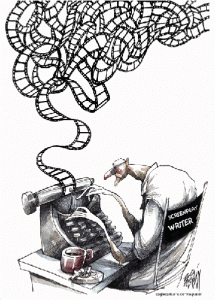
Film Writers Association (FWA) has announced the 3rd Indian Screenwriters Conference. The central theme this year is “Untold Stories : Screenwriting and the truth of our times”.

– Venue : Venue: St. Andrew’s Auditorium, Bandra (W), Mumbai

– Dates: February 25, 26, 27, 2013

– Only FWA members can attend. So if you are not a member of FWA yet, do become one. Click here to go to FWA site for more details.

And here’s the programme detail..

screenwriting-215x300Day 1 – Monday, February 25

1000-1020: Introduction to the Conference by Convenor & Co-Convenor, ISC

1020-1030: Welcome Address by President, FWA

1030-1100: Minister HRD (expected) declares the Conference

1100-1130: The Chief Guest’s address

1130-1145: Tea/Coffee break

1145-1230: Keynote Speech by Shiv Vishwanathan

1230-1300: Audience Q&A with Keynote Speaker

1300-1400: Lunch break

1400-1545: Do screenwriters have a social responsibility?

Moderator: K. Hariharan

Panel: Javed Akhtar, Tom Schulman, Rakeysh Mehra, Girish Kulkarni, Dr. Chandraprakash Dwivedi, Vinod Ranganath, Gajra Kottary

1545-1600: Tea/Coffee break

1600-1745: How does our popular cinema and TV portray women?

Moderator: Ranjani Mazumdar

Panel: Ashutosh Gowariker, Anurag Basu, Kumara Raja, Preiti Mamgain, Satyam Tripathi, Ila Bedi

Day 2 : Tuesday, February 26

1000-1130: The charge of the new ‘write’ brigade!

Moderator: Pubali Chaudhuri

Panel: Juhi Chaturvedi, Habib Faisal, Ravi Jadhav, Akshat Verma, Reema Kagti

1130-1145: Tea/Coffee break

1145-1330: Is the old order cracking? New ways of storytelling.

Moderator: Govind Nihalani

Panel: Urmi Juvekar, Anurag Kashyap (TBC), Sanjay Patil, Bejoy Nambiar, Abbas Tyrewala

1330-1430: Lunch break

1430-1600: What is driving TV content? Is it changing? Can it?

Moderator: Saurabh Tewari

Panel: Tripurari Sharan, Vivek Bahl, Sukesh Motwani, R.D.Tailang, Charudutt Acharya, Gul Khan

1600-1615: Tea/Coffee break

1615-1730: The new brigade of TV!

Moderator: Anuradha Tewari

Panel: Raghuvir Shekhavat, Mihir Bhuta, Amal Donvar, Swati Pande, Chinmay Mandlekar, Mrinal Jha

Day 3 : Wednesday, February 27

1000-1145: The empty playroom. Why such few children’s films?

Moderator: Chandita Mukherjee

Panel: Gulzar, Nila Madhab Panda, Preiti Mamgain, Farhan S., Anand Sivakumaran

1145-1200: Tea/Coffee break

1200-1330: The light through the fog: Implications of the amended Copyright Act for film and TV writers

Moderators: Rajesh Dubey & Anjum Rajabali

Panel: Souvik Biswas, Nikhil Krishnamurthy, Sai Gopal, Ameet Dutta

1330-1430: Lunch break

1430-1545: Writer-Producer Bhai-Bhai! The Minimum Basic Contract for film writers

On stage: Dharmesh Tiwari, Vipul Shah, RameshSippy, Nikhil Krishnamurthy, Anjum Rajabali

1545-1600: Tea/Coffee

1600-1730: The way forward! What FWA has for you in the next one year.

On Stage: The Executive Committee of FWA

Conducted by: Vinay Shukla & Kamlesh Pandey

1730-1745: Vote of thanks

– To know more about the topics and the speakers, click here and scroll down to “A MORE DETAILED EXPOSITION“.

– 850 screenwriters and writer-directors are expected to participate. This is the most important event for screenwriting in the country, and ought to impact the profession in a significant way.

– Confirmed participants include : Salim Khan, Javed Akhtar, Gulzar, Ashutosh Gowariker, Anurag Basu, Rakeysh Mehra, Govind Nihalani, Sriram Raghavan, Sudhir Mishra, Amit Khanna, Vipul Shah, Jabbar Patel, Vikramaditya Motwani, Bejoy Nambiar, Abbas Tyrewala, Amole Gupte, Habib Faisal, Navdeep Singh, Girish Kulkarni, Umesh Kulkarni, Lekh Tandon, Abhishek Sharma, Shridhar Raghavan, Kumararaja (Aranya Kandam), Rituparno Ghosh, Hariharan, Urmi Juvekar, Ishita Moitra, Manu Rishi Chadha, Leena Yadav, Prasoon Joshi, and others.

– Also, Tom Schulman (Oscar winner for ‘Dead Poets Society’) and Rebecca Kessinger (Asst. Executive Director of Writers’ Guild of America) will be there as guests since FWA and WGA are planning several collaborative initiatives.

(all info from press release)

– If you are completely clueless and confused whether to attend or not, click here and here to read our coverage of previous FWA conference.

WHY?

The world needs to know. Anyone?

Here is the trailer.

And here’s the answer

Tip – Sumit.

And she has just 9 days to go.

We are starting a new segment on the blog – Fund A Film (FAF). With social media changing the way we communicate and crowd-funding in vogue, we thought it would be nice to highlight the projects that we find interesting. So if you want to contribute and fund a film, you know where to look.

kickstarter image

Today’s Project is “The Tiger Hunter” by Lena Khan.

Over to Lena for an intro..

Years ago, if I had told somebody about the idea of my film, they might have asked, “Is this for Bollywood?” So, for that reason, when I came up with the idea for it…I put it aside. “Who wants to see a movie with brown people,” I thought.

But now, things are different. In America, at least, Indians are the new cool. Sure, we always had a few stand-out successes—the success of The Namesake or the popularity of Bend it Like Beckham. But the market is changing.

Now, we’re mainstream. We’re popular. Sure, we all knew about the popularity of Slumdog Millionaire, but now we’re cool even when we aren’t playing characters that revolve around our skin color. People stand in line to go see Aziz Ansari’s comedy tour. Kal Pen can still headline a Harold and Kumar sequel and stay on How I Met Your Mother for nearly an entire season. Kunal Nayyer is one of the stars of the most popular sitcom on television, The Big Bang Theory. And I’m not sure if you’ve watched FOX lately…but there’s a brown girl named Mindy Kalin heading up her own show there!

My movie, The Tiger Hunter, is about a young Indian man who comes to 1970s America on a quest for success. Is it a story for Indians? Sure. But mostly, now that times have changed—it’s a story for everyone else, too. And I’m moving forward at full speed to get it made.

And here’s more on the film :

The Tiger Hunter is the story of Sami Malik, an ambitious young man with an engineering degree who travels to 1970s Chicago to impress his childhood crush and live up to the legacy of his father, a local legend and tiger hunter. When Sami ends up living in a tiny co-op with two oddball roommates and taking a job as a lowly mail clerk, what ensues is a series of adventures involving outlandish schemes, an arch-nemesis in an absurd office environment, and a variety of misfits that Sami may soon call friends.

– Click here to go its Kickstarter page where you can read more about the film, people attached to it and watch videos. And if you can, contribute. If you can’t, do spread the word.

– She is also blogging about her entire experience. Her blog is Lena Makes A Movie.

– Scott Myers of that awesome blog GoIntoTheStory has also given his endorsement for the film. Click here.

– Click on the play button to watch the pitch video.