Archive for the ‘Indie’ Category

Internet is a great place, especially if you are looking for under-rated gems. Varun Grover stumbled upon this documentary called The World Before Her. Mihir Fadnavis got in touch with the director and we managed to watch the film. So over to Fatema Kagalwala and her ramblings on this stunning and important film. We are putting this in our “Must Watch” film recco List. Watch it.
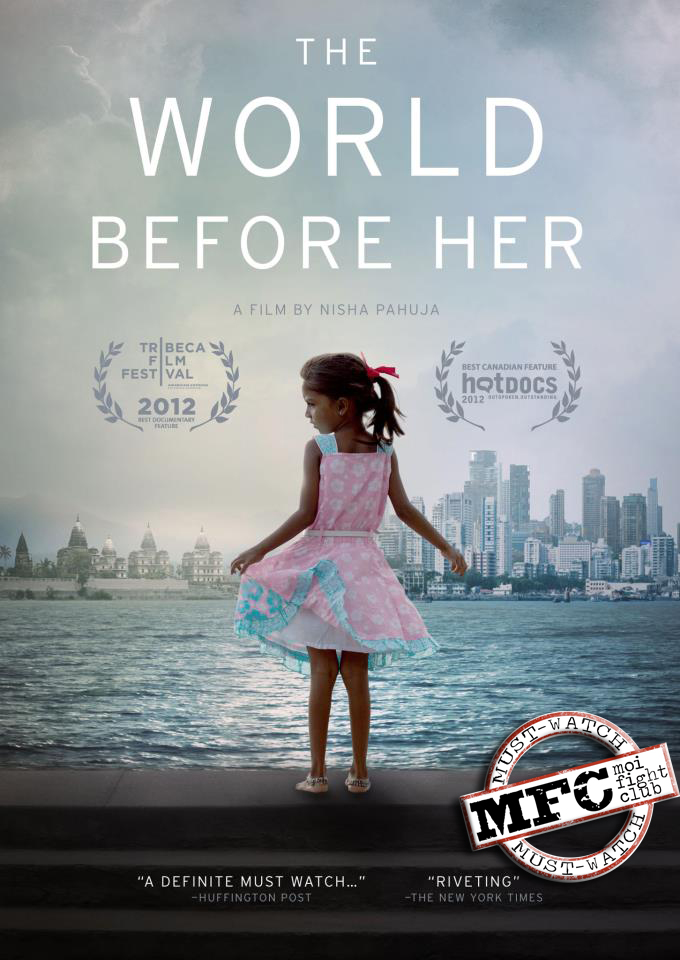
The World Before Her copy

We love living in extremes. Grey areas aren’t appealing because they force us to think. They are meant for individual assessment whereas black and white are fit for mass consumption. So we’ve draped ourselves with stark definitions of tradition and modernity and live a bipolar existence, merrily swinging between both. Sometimes, we find solace in middle ground but one that is obfuscated with the overpowering implications of the extremes that are tradition and the modernity.

Prachi, Ruhi, Ankita, Pooja – the central protagonists, of ‘The World before Her’, a stunning, award-winning documentary by Nisha Pahuja, are all products, or shall we say victims, of our collective need to ideologically belong somewhere, even if it is within an ideology that seeks to subjugate them. They are perfect lambs for factories manufacturing daily definitions of the traditional and modern according to their convenience.

The struggle between tradition and modernity is ancient. The documentary examines these two polarities with a clear understanding of all its inherent ironies. Let’s take a look at the two worlds it straddles to make its point –

World 1 – Miss India contest 2011 20-day training camp. Of beauty, botox and bikinis.

World 2 – Vishwa Hindu Parishad’s Durga Vahini Camp. Of Hindutva, weapon training and military discipline.

Nisha takes us through both the camps, laying bare their belief system, process and the little dreams behind it all. We see training procedures up-close and peek into the lives of trainees. What makes the ambitious Ms India contestants tick and what drives the fierce Durga Vahinis? Through a thoughtful juxtapositioning, the two opposite worlds collide and before we know, melt into one voice. On the face of it, both espouse contrarian views on female identity. Beyond the façade of the titles of ‘modernity’ and ‘traditionalism’, both bind the very subjects they aim to set free, victimising the very subjects they aim to empower, treating the women they are pretending to liberate as cattle to be branded. The beauty of it all is the film doesn’t state it, but makes it clear with an intuitive stitching together of the narrative.

Nisha delves into both the worlds with care, aware of the mine of uneasy answers she is exploring, mindful of the dust her questions will raise. There is no attempt to impose a comment or paint a particular ideological picture. What makes the documentary a brilliant experience is the careful expose of truths and myths we live in, and the questing female mired in it.

In Ruhi, Ankita and Pooja, we see semi-urban, middle-class young women, very well aware of their social status as females, out to beat the system even if it is through succumbing to it. They are aware of the compromises they have to make and are fine with the cost to their dignity, if it transforms them, like Pooja puts it, ‘from a person to a personality’. The irony of their entire quest for identity within a system out to objectify them, seems to be lost on them. To my mind, Pooja Chopra, the girl whose father insisted on killing her at birth because she was female, almost seems like a tragic figure, bitterly fooled by an arrogant system laughing at her for believing she had carved a separate identity of her own and on her own terms. Ruhi, a young 19 yr old, feels obliged to her parents for bringing her up and feels the need to pay them back by becoming ‘something’, so that their creation is worth it…she never questions the route to fame she has chosen. Nor are her future plans of marriage and children at an appropriate age seem to clash in anyway with her present teen plans of becoming a beauty queen. ‘I can do all this now as I am young, later I won’t be able to do all this’, she says (quote not verbatim). There is no ideology at work here nor a tussle between the old and new. It is simple conditioning speaking but Ruhi doesn’t question any of it, for her her parents support for her contest participation is an empowering, liberating sign of modernity enough. For these women, the shine of glamour and the pain of centuries of repression are too blinding to see anything under or beyond.

At the other extreme is Prachi, the alpha female trainer at Durga Vahini, who has found a purpose and outlet in Hindu fundamentalism to escape the vulnerabilities her gender status thrusts on her. She is a single child of an orthodox Hindu family who feels her father is justified in hitting her (even brutally) because as a female child he let her live. She loves the power being a Durga Vahini trainer gives her, flaunts her dislike for ‘girlie girls’, is proud of being tough and is absolutely against marriage. Like the Ms India contestants, this Aurangabad-based girl too is looking to establishing her worth as a female in all-male world, but by embracing and perpetuating the orthodox mores of Durga Vahini. Unlike the other girls though, she is fully aware that the system she advocates aims at curbing her own freedom, yet, it remains her chosen vehicle to empowerment. Yet, I wondered if there was a glint of wishful-ness, an unacknowledged longing behind the façade of derision as she watched the Ms India contest. I don’t know if it was the artfully calculated shot lingering on her tad longer or my over-wrought zeal to understand her better or an actual fact.

I read criticism of the film saying this isn’t the reality of entire India and that the film does not reflect upon the middle path. It is possible I imagined the subtle jingoism in the criticism, but that apart, what it missed was the fact that these two extremities inform the lives of every woman (and men too) traversing the so-called middle path. Maybe they exist but I am yet to meet a person truly liberated from gender complexities and its socio-economic implications that the film so starkly defines. In fact, I saw Prachi, Ruhi, Ankita and Pooja as sharp and accurate spokespeople of the entire India, irrespective of class distinctions. Trapped in the half-baked definitions made by a commerce-driven, power-hungry, alpha male world, they languish confused in the debris of the shattered female identity they struggle to resurrect. Just like you and me.

As I mull over the needs of these girls, (and they are very familiar, they are around me and inside me) I see their quest with compassion. They have little choice other than adhering to a corrupt system to beat another equally corrupt one, to gain whatever semblance of self-respect they can garner for themselves. Patriarchy hasn’t left much for women to call their own or celebrate in the truest sense, has it? And if that wasn’t enough we have religious fundamentalism adding to the fire. Nisha doesn’t shy from showing news clips of Hindu fundamentalists beating up women in pubs and iterating the fact that Hindu terrorism is a bigger threat to India than Islamic fundamentalism. Not only is this a well-informed, deeply introspective, objective, exploratory documentary but it is very brave as well. One simply wishes the film does not get targeted by pressure groups if and when it comes to India.

As I watched the documentary and later, I wasn’t surprised by the ironical truths about female existence staring at me. It was all seen before, read before, said before. Yet, I couldn’t define the film in words and that is not because of the complexity of the film but of its theme. Which at one level is almost self-explanatory, but dig deeper and it will leave you distraught at the number of knots or rather untied ends it waves at you.

Why have we made the question of women’s identity so complex, almost impossible to unravel? Is it because we fear if we find the answers the world around us will no longer be recognisable? We are all slaves to gender equations and roles. Breaking free is scary because it means starting from scratch for human existence. Without the context of male and female roles and boundaries where would we be? What would we adhere to and what would we fight? Coz isn’t that exactly what gives all of us our purpose? The ‘shoulds’ our gender is supposed to wear? We either wear them with pride or fight them with gusto, satisfied in the purpose we’ve found to base our lives on. We then spend our entire lives empowering the very cycle the protagonists of this film believe/imagine they are fighting. We are no different from them, really. Gender politics apart, men and women, we are all in this together and for once, it isn’t a happy thought.

I realise I can go on writing about this film, such is the subject matter and beauty with which the story has been told. As I pull down the windows on my brains because I really want you to watch it with a fresh curiosity, let me leave u with a few moments that struck me with their irony, pathos and horror.

Pageant diction coach Sabira Merchant (proudly or matter-of-factly?) calling the Ms India training camp “a little factory … where you’re polished like a diamond. The modern Indian woman.” (Did the irony of what she was saying escape her or had she, like the contestants, made peace with it long back?)

Uma Bharti, while protesting against the 1996 Ms World contest to be held in India, “We are against a system that presents women as pieces of meat and judges them based on the size of their chest, waist and hips.” (I never thought I’d appreciate Uma Bharti in this lifetime.)

Prachi, with misty eyes, excusing her father for hitting her, “Knowing that I’m a girl child, he let me live … That’s the best part. In a traditional family, people don’t let a girl child live. They kill the child.” (I don’t think there was anyone among us who didn’t shiver on hearing her say this and actually mean it.)

The Miss India contestants parading in hip-length sacks and denim shorts in a round that judges who has the hottest legs.

Marc Robinson, the organiser, laughing off the indignity of the sack-round.

News clips of Hindutva louts beating up women in pubs.

Little girls at Durga Vahini camps being taught India and Hindutva was under threat from two main sources – Islam and Christianity.

Little girls lapping it up and regurgitating it like it was the only truth.

Chinmayee, a smart 14-yr old, proudly declaring at the end of the camp, ‘No, I don’t have a single Muslim friend. I did when I was younger but then I didn’t know that we are different.’ I didn’t know if I felt horror for India or pity for the little girl.

At the end of the Durga Vahini camp, girls getting sashes to wear identifying them as Durga Vahinis and the (gleeful?) exclamations of, ‘This is just like Miss India, Miss World!’

Touché.

Fatema Kagalwala

– FB page is here.

– If you are in Canada or USA, you can order it here and here.
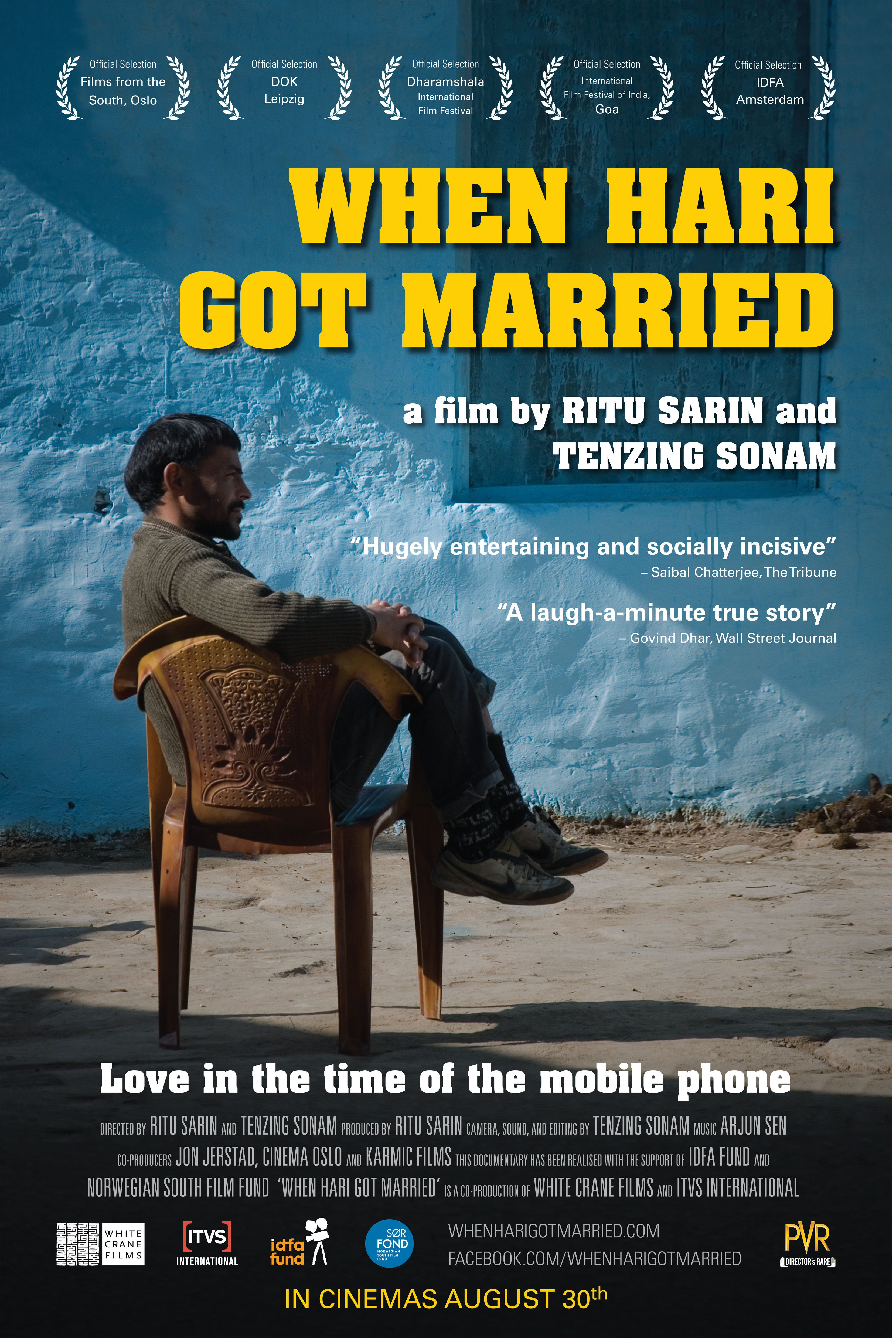
When Hari Got Married, a documentary film by Ritu Sarin and Tenzing Sonam is releasing as part of the PVR Director’s Rare series from 30th August at PVR cinemas in Delhi, Gurgaon, Mumbai, Pune and Bangalore.

“When Hari Got Married” takes a humorous look at Hari, a taxi driver from Dharamshala, as he prepares for his marriage to a girl he has only seen once, and that too, with her face covered. Hari’s frank and outspoken views on love and life, his unusual courtship on the mobile phone, and his eventual marriage provide a warm and illuminating insight into the changes taking place in India as modernisation and globalisation collide with age-old traditions and customs.

More on the film

translite-final-rgbHari, a 30-year-old taxi driver, lives in Dharamshala, a small town in the Himalayan foothills. He is getting married to Suman, a girl he has never met.

Tradition dictates that Hari and Suman will only see each other on the day of their wedding. But Hari has found another way to get to know her: on the mobile phone. Over the past few months they have spoken to each other every day and have fallen in love.

Hari and Suman see each other properly for the first time during the wedding ceremony. Will their telephone love prove strong enough to overcome the awkward obstacles of an arranged marriage?

Hari’s unusual courtship and marriage, coupled with his frank and humorous confessions of fear, doubt, hope and anticipation, provide a warm and illuminating insight into the changes taking place in India as modernisation and globalisation collide with age-old traditions and customs.

A co-production of ITVS International and White Crane Films. With additional funding from IDFA Fund, Amsterdam, and Films From the South, Oslo.

About the filmmakers

Ritu Sarin And Tenzing Sonam are an Indian-Tibetan filmmaking team based in Dharamshala, India. They worked as independent filmmakers in San Francisco and London before moving back to India where they are based in Dharamshala.

Working through their film company, White Crane Films, they have produced and directed several documentaries, mostly focusing on Tibet-related subjects. These include: The Reincarnation of Khensur Rinpoche (1991), The Trials of Telo Rinpoche (1993), and The Shadow Circus: The CIA in Tibet (1998). In 2005, they completed Dreaming Lhasa, a dramatic feature film executive produced by Jeremy Thomas, which premiered at the Toronto International Film Festival. They have also worked on video installations, including Some Questions on the Nature of Your Existence (2007), which was shown at the Mori Art Museum in Tokyo and the 2010 Busan Biennale.

Their feature documentary, The Sun Behind the Clouds: Tibet’s Struggle for Freedom (2009), won several awards including the Vaclav Havel Award at the One World Film Festival in Prague. When Hari Got Married is their most recent film. Ritu and Tenzing are also directors of the Dharamshala International Film Festival, which had its first edition from 1-4 November 2012.


“Tagore-on-an-acid-trip” – that’s how Qaushiq Mukherjee, or Q, as he is popularly known, has described his latest film, Tasher Desh. We discovered Q with his last film Gandu which still remains unreleased in India. And we have been following all his work since then – shorts, music, documentaries.

Here’s the director’s note on his new film which is set to release on 23rd August in Mumbai and Kolkata. It’s based on one of the popular musical dramas of Rabindranath Tagore.

This slideshow requires JavaScript.

(Click on any pic to enlarge and watch the slide show)

Since I was five, Tasher Desh has been on my mind. It’s that fantasy that I always knew I wanted to touch. That elusive texture of human existence, devoid of transient truth. Reality is indeed transient; shifting all the time yet every civilization holds on to its truth till whatever time they can, always leading to antagonism and discontent. The cycle of time makes sure that periods of extreme confusion and chaos happen to alter realities, and we are at the thresholds of such a time.

Tagore wrote Tasher Desh as a mythical utopian expression against the backdrop of a violent turbulence. India was in the process of forming an individual and collective identity. Shaking off a history of oppression and forging a modern society. Tagore saw it as an opportunity perhaps, to tell a story removed so far from reality that it forced the listener to be objective. Modern society is marked by one overwhelming human condition. Of melancholia or depression. Slowly becoming one of the most important issues of our daily reality.

Depression is a symptom of a gloom caused by social system and its invariable ability to isolate individuals.

The film is not about the narrative of the fairy tale. It is but a reflection of how I see the world right now. As it was then, when the piece was written, the world is in a flux. India is changing radically, along with the politics of the world, and these changes are essentially driven by system driven violence. My storyteller, therefore, is a lost soul. Unable to deal with the cacophony of his circumstances, he dives into the fable, as if to save himself. The characters of the fairy tale are all extensions of the storyteller, and the story itself has a life of its own. Every story is the same. And it is always the telling that shifts the paradigms.

In the film, it’s his story that helps the storyteller overcome his ennui and to take a decision that would change his life.

The prince is depressed, because the storyteller is. A deep isolation caused by the sense of loss, of one’s self. Stagnant and paranoid. Stuck in a space and time that is almost a cocoon, with the appearance of a prison. While the storyteller is confined within the two parallel railway tracks, the prince is in his palace, a hopeless fortress, as it seems to him.

Tasher Desh is also about belief and magic. The oracle, the fairy watching over our prince, is needed because impetus is external. This is what connects us to the world outside our mind. Instead of drawing inspiration from the mundane reality, the storyteller as the concerned friend of his protagonist invokes the fairy. The prince’s transformation is immediate. Touched by the power of illusion, he suddenly begins to realize that his emancipation is in movement. He needs to go away. One of the most important things holding him back was his broken mother. He comes out to his mother, and then dives into his fantasy. The storyteller also jumps the wall of his reality.

It could be argued that social governance and its monotheistic, patriarchal nature cause collective depression. Tagore’s utopia is bizarre, with masked beings, strange rules and social paranoia of change. The cards in the film seem to have lost all human tendencies.

When the prince and the friend meet them. But the prince, newly liberated, is impatient to try out the power he has been given. A demi god now, devoid of intrinsic human folly, he delivers the message to the ace of hearts.

The storyteller travels the path he has often traveled in his fantasy, and when he arrives at the palace of his dreams, he finds her. The ace of hearts, a widow living in the shadows of a ruined structure. Mystical, magical, she is the one he was waiting for. Suddenly he has someone to tell the story to. Get it out of his soul. The widow and the ace of hearts merge in his story, and a revolution begins.

Tasher Desh symbolizes the triumph of a pagan form of ritualistic cleansing through love and identification of the self, in a postmodern society. it’s a vision of the man cleansed pure by the woman, and the seed of identity being sexual in nature. The ace of hearts takes away the storyteller’s attention, at the same time making his story more palpable, more intense, and more romantic. The film turns a sharp corner therefore, and begins to intensify on finding that one point, the spark. It’s a feminine revolt that the story narrates now, no longer a tale of male neurosis. A non-­‐violent revolution fuelled by love. In utopia. Tagore was a pure romantic, and i have tried to place his sensibilities in the confusion of our time. a violent world without any screen violence. A fairy tale without any fabrication and frills. I have tried to find the unreal right beside me. All the art properties in the film were objects we can find easily. The locations were live. The look, inspired heavily by Japanese forms, from kabuki to manga, had to be basic. There are no visual effects used, apart from layering two or three visuals together, to find an image that allows all the realities to exist together, form a relationship. And a video game reference that was done with video moshing, a very low fi technique. The idea was minimalist. Within that apparent reality, we would try to find the sublime. The magical.

The film is a musical. Following an ancient oral form, we have retained the songs as they were, written eighty years back. Associating with some of the finest musicians across the world, I have tried to place the sound of Tagore’s time with the current ones. The words of the songs, so eloquent, emerging from a romantic poet of the highest standard, are actually lines for the characters that sing them. With the use of music, the reality is broken time and again, but every song contains a message so intrinsic to the character, one can lose one’s self in them. Sound and colour play crucial roles in the film, creating the environment and the tension of the spaces explored.

Tasher Desh is an experiment in form and structure, using one of the most popular scripts of India’s recent history. I wanted to remain as faithful to the original idea as I could, and then use my treatment to bring the seed of the story out of its stagnancy, caused by the sterility of my culture. It is a story about revolution after all, and magic, and I strongly believe in both.

Q

What’s Tagore’s Tasher Desh is all about

A king banishes the older queen and his son to a palace where they lead a life of luxury and decadence. An oracle whispers the secret words to the prince and he leaves the palace with his friend, the merchant’s son. Their boat sinks and they arrive at the land of cards where the inhabitant cards are governed by a military regime. The prince and his friend get caught and bring about a change in the women cards with music and prophecies of love. The woman cards revolt. The king surrenders and the prince finds the meaning of life.

What’s Q’s Tasher Desh is all about 

Once upon a time, there was a storyteller. In a lonely railway station, somewhere in Kolkata, he spoke to trains. He wanted to tell a story. It was not a new story. But for him, it was the only story to tell. Inside the darkness of his mind, his story unfolds, a kaleidoscope of fantasy.

Once upon a time, there was a prince. a victim of his destiny, he was banished with his mother to a dark and distant prison palace. Here he grows up, without hope, without a future, with his mother drowning herself in alcohol. His depression countered only by his friend, the merchant’s son, who argues that it was indeed the prince’s choice to remain locked in. realizing the extent of his despair, the friend invokes the oracle. A mysterious figure, the oracle passes on a message of liberation. The prince realizes that he is indeed a prisoner of his mind. He takes a decision, to leave. He has a final moment with his mother, who lets him go. The prince takes hold of his destiny, and sets off on a voyage with his friend, searching for an adventure.

The storyteller begins his journey as well, leaving the city, and traveling to a ruined palace, which is where we had found the prince. Here, he encounters a strange woman, a widow, living alone, as if waiting for him to turn up. He is mesmerized by her, and soon, begins to tell her the story. She is his muse, the one who he was waiting for. Finally having found the listener, the storyteller launches into an even more intense narrative.

Shipwrecked on a paradise island, the prince and the friend encounter a strange culture. The islanders are all soldiers, who call themselves the cards, and live by a code of rules that outlaws any human behavior. Before they know it, an aggressive party of the islanders, holds the visitors captive. Presented at court, and having angered the cards by defying their court customs, they are pronounced guilty, and banished. But before he leaves, the prince asks for a last word, and takes the opportunity to whisper the same message of liberation he received from his guardian angel to a few of the card women. The result is chaos. The women are completely shaken, and soon the land of cards sees dissent for the first time.

– For more info on the film and release schedule, click here for its FB page.

Through this blog we have always tried to spread the good word about various crowd-funded (Kickstarter, wishberry and such) projects. Here’s one more film which looks interesting and you can contribute to its making.

Have a look at this trailer –

And here’s one more clip –

If you find the trailer and the clip interesting, you can help the filmmakers complete the film. Click here to go their IndieGoGo page and fund the film.

If you want to know more the film and the filmmakers, over to the team for all the other details.

  1. design_final Who are we

Adam Dow (Co-Director, born and raised in Seattle, and is currently settled in Mumbai) has been making films since the age of twelve with his father’s old VHS camera. He has written and directed several short films that have been circulated in the US festival circuit. He received the Mary Gates Scholarship for leadership in 2001 and started the University of Washington’s first improvisational theatre troupe. Upon his move to Mumbai in 2007 he founded India’s first Improv Group known as Improv Comedy Mumbai and in 2011 was nominated as one of the people to watch in Mumbai by CNN.

Ruchika Muchhala, (Co-Director, is of Indian roots, born and raised in Indonesia and Singapore, and is currently settled in New York). She has worked on several documentary projects as an editor and television series as a writer and director. Her directorial debut was “The Great Indian Marriage Bazaar”, a documentary in which she navigates through the complex system of arranged marriages in modern-day India. The film aired internationally on various television channels, including BBC World, and at women’s and international film festivals in 2012.

 2. Story behind Beyond Bollywood

Both of us were complete “outsiders” to the world of Bollywood, when we came in 2007 to Mumbai to work on a web series about the different facets of Bollywood. During the making of the web-series, we came across 4 very interesting characters – Pooja Kasekar (dancer), Harry Key (Australian “white” extra), Ojas Rajani (make up artist) and Prem Singh Thakur (Union Leader) – and when we approached them with the idea of making a film on them/their lives, they readily agreed.

So, the Beyond Bollywood journey began in 2008 and we decided to finish shoot after 4 years of filming, in 2012, which is when we decided that it was time to now start putting the film together. We realized, while filming, that in order to capture their journey’s in the industry (and of their lives), we would need to spend time with them. Only then the audience will be able to see some character growth and development – but more than that, their real stories. Both of us truly believe in storytelling and wanted the audience to feel that they were watching a film, and not snippets of their lives, being narrated by a voice over.

3. Why should you support “Beyond Bollywood”?

 We decided to follow these characters because we felt a certain connect with them and found them to be extremely passionate about what they were doing – Pooja Kasekar, whose idol is Madhuri Dixit, came to Mumbai to become a dancer and through sheer hard work, moved on from being a background dancer to a lead dancer and also got a role in a film as the lead actress.

Prem Singh Thakur, who a lot of our filmmaker friends would know, is meant to be one of the most honest men in this profession and has been elected Vice Chairman of the Union over and over again.

Ojas Rajani has been in the film industry for more than 20 years now (is considered one of the top make up artists in the industry) and has done make up for some of the biggest names in the business.

Harry Key, a complete outsider, came to India to travel and possibly find some work, landed up on a film set the day he arrived in India. Initially it was tough for him to find work here, but again, through sheer hard work and perseverance, he decided to stick around, kept trying, and managed to do TV Commercials and Films (as an extra). He also got a major role in a small hindi film, which unfortunately didn’t release.

They all came from outside the film industry (most from outside of Mumbai), had a dream of making it BIG (a subjective term), were extremely passionate about what they were doing, and each one through sheer hard work and determination was able to do something that they (and everyone around them) would certainly be proud of. They did something BIG in their own right!

We want to tell their stories, which are similar to the stories of most people that come to Mumbai (from across India and the world) to try their luck in Bollywood! We also feel that this film will help a lot of people that are not part of the industry, understand the space better (especially our very own family members, who are asking us all the time – Beta, aap karte kya ho? / Child, what do you really do?)

 4. What do we need the money for?

So far, we have funded the production and post production on our own and now we have run out of funds (and our parents have stopped supporting us too!). We need US$ 12,000 to complete the film – sound, picture and some licensing fees for the film/music clips we are using in our documentary. We are running a crowd funding campaign on Indiegogo (link here) to raise the funds to be able to complete the film. Please watch the trailer and visit our Facebook site and help us by contributing and/or passing on the trailer/fb link to your friends and family who might be able to contribute.

CREW:

Producer:                Manas Malhotra

Co-Producers:         Adam Dow & Ruchika Muchhala

Co-Directors:          Adam Dow & Ruchika Muchhala

Cinematographer:   Adam Dow

Editor:                    Monisha Baldawa

Sound:                    Kamood Kharade

Additional Editors:   Darren Lund & Atanu Mukherjee

Music Composers:  Tarun Shahani & Vinayak Manohar

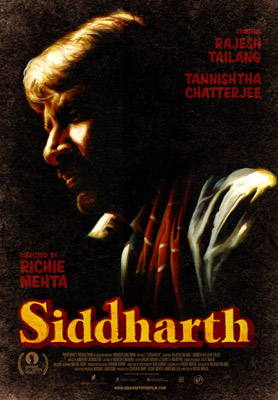
The first look of Richie Mehta’s new film, Siddharth, is out. The film will have its premiere at the 10th edition of Venice Days Program of the Biennale.

Venice Days is a separate festival within the Venice Fest and it runs during the entire duration of the main fest (August 28-Sept. 7). Its lineup includes 12 feature films, two shorts, three special events and two special screenings.

Here’s the trailer and synopsis of the film

SiddharthSIDDHARTH by Richie Mehta

With Rajesh Tailang, Tannishtha Chatterjee, Anurag Arora, Shobha Sharma Jassi, Geeta Agarwal Sharma, Naseeruddin Shah

India/Canada, World Premiere

Production: Poor Man’s Productions Ltd.

Mahendra works on street corners as a chain-wallah (a zipper-fixer), while his wife Suman stays at home with their two young children, twelve-year-old Siddharth and his sister. To contribute to the family budget, the boy is sent far away from home, from New Dehli to Ludhiana, where a relative has a job for him and a place to sleep. It seems like a dream come true to his father, until he realises that his son has vanished into thin air: kidnapped, perhaps, or dead. Mahendra learns how confusing the world beyond his front door really is, but that doesn´t stop him from stubbornly seeking Siddharth all over India, its cities and countryside combined. Co-written by its star and the director (who now lives in Canada), the film builds on the emotions of one man´s painful awakening, and shows a different, almost neorealist India, described with that ingredient of universal humanity that is Italian film´s gift to the world.

Lunchbox

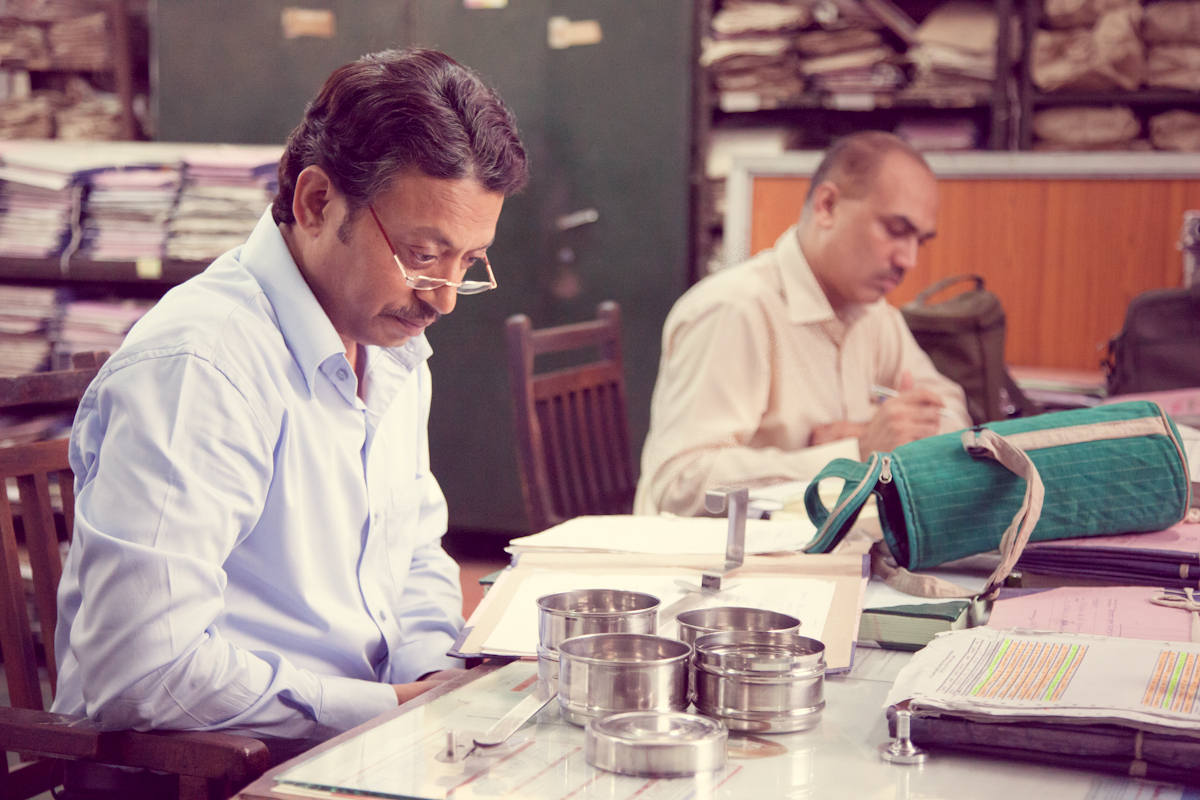
Here’s the good news about one of the best films of the year, The Lunchbox. Producer-director Karan Johar has come on board to present the film and it will be released by UTV on September 20th. This is exactly what we need – big faces should attach themselves with brilliant indies and make them reach the theatres. Otherwise distribution is a pain in the current scenario. After Kiran Rao came on board to help Ship Of Theseus’ release, this is another step in right direction.

Some of us have seen the film and let us assure that it’s a simple and solid film. Directed by Ritesh Batra, it’s not only one of the best debuts of the year, it also has two of the best performances of the year – Irrfan Khan and Nimrat Kaur.

– You can read more about “The Lunchbox” here (on Sony Classics deal) and here (all the Cannes buzz)

And now another bit of news – The Toronto International Film Festival has announced its first list of films selected for the 2013 edition of the festival. And two desi films feature in the list – Ritesh Batra’s The Lunchbox and Maneesh Sharma’s Shuddh Desi Romance. Here’s more on both the films (from the official release) :

The Lunchbox Ritesh Batra, India/France/Germany North American Premiere

– Middle class housewife Ila is trying once again to add some spice to her marriage, this time through her cooking. She desperately hopes this new recipe will finally arouse some kind of reaction from her neglectful husband. Unbeknownst to her, the special lunchbox she prepared is mistakenly delivered to miserable office worker Saajan, a lonely man on the verge of retirement. Curious about the lack of reaction from her husband, Ila puts a little note in the following day’s lunchbox which sparks a series of exchanged notes between Saajan and Ila. Evolving into an unexpected friendship between anonymous strangers, they become lost in a virtual relationship that could jeopardize both of their realities.

Shuddh Desi Romance Maneesh Sharma, India Canadian Premiere

– Shuddh Desi Romance follows a fresh and very real love story about the hair-raising minefield between love, attraction and commitment. A romantic comedy that tells it like it is, providing a candid look at the affairs of the heart in today’s desi heartland. Starring Rishi Kapoor, Sushant Singh Rajput, Parineeti Chopra and Vaani Kapoor.

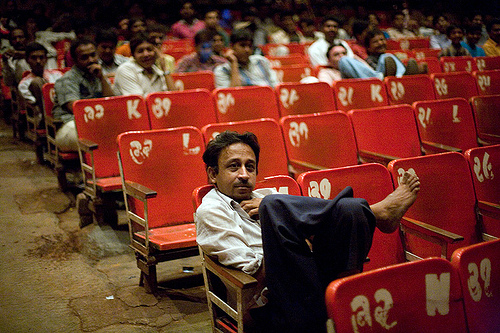
With the release of Ship Of Theseus, we are not only debating its merit (here and here) but another conversation has started on social media – about ticket prices. Why is it so expensive? Should indie tickets be less expensive? Is it even possible? Well, we do believe that if a film is great, it’s worth the ticket price. But if you are still bothered about the price, here’s Shiladitya Bora on why it isn’t so easy to control ticket prices.

cinema

To be brutally honest, no one (and that includes me as well) genuinely knows what is the best way to distribute an Indian Indie in India. The revival of Indian Independent film industry has just started and it is currently in a very nascent stage. We all are experimenting and trying to identify the best case scenario factoring all the constraints (read quality of the film, limited appeal, limited marketing budget and resources etc). There is no one single formula applicable for all Indies and each film requires a customized plan. While owning theatres/ screens (like in case of PVR) helps a bit to screen indie content; other distributor(non cinema owners) mostly rely on relationships built over years with programmers and cinema chains to be able to screen indies.

Whenever an indie releases we see people starting endless debates on the social media platforms with respect to shows, show-timings, ticket prices etc. In order to make the most out of these debates it is of pivotal importance to first have our basics right.

1. So who actually decides how many shows to be allocated to an indie and in which theatres?

For an indie releasing on a Friday, on the preceding Monday the distributor send show requests (wish list in terms of cities, theatres, number of shows, show timings) to the programming teams of various cinema chains. The concerned programming teams then works out a tentative showcasing plan based on factors like the number of films releasing on that particular Friday, performance of last week releases, expected target audience of the film, past performance of similar indies etc. This tentative schedule is then shared with Cinema Operations Team for final approval.

Cinema Operations – Each theatre is managed by a cinema manager who has a target to achieve in terms of number of admits, ATP (average ticket price), SPH (sales per head) – a daily target, weekly target, monthly target, quarterly target and annual target. The career of a cinema manager is directly proportional to these targets and hence all his/her efforts are focused on optimizing the same.

Statistics show that the performance of Indian Indies is abysmally poor in all the three parameters – admits, ATP and SPH and hence not many cinema managers are keen on showcasing Indies at his/her property. So if we want Indies to be released in as many theatres as possible, we need to make the people who run the cinemas confident about the product and this is possible only when a few Indies start performing.

So we come to the next big question on ticket pricing.

2. How is ticket pricing decided?

Every cinema has to operate within price bands pre-approved by the government and no theatre can sell tickets below the lowest price band. The best thing an indie distributor can do is to request the respective cinemas to run the film on the lowest price band and it’s at the discretion of the individual cinemas/ Operations to agree to the request or not.

In addition to the above there is a regular pricing and a blockbuster pricing. Blockbuster pricing is applicable during weeks of tentpole/ big releases and in case an indie is releasing in a week with a tentpole film, blockbuster pricing is applicable to the indie as well in most cases.

We are trying to work out a special discounted price band for Indies released through Director’s Rare.

Another solution can be government waiving off the E.Tax for Indies but for that we need clear cut guidelines to define a film as an independent film.

 3. At PVR Director’s Cut, Vasant Kunj, Delhi, the ticket price of an Indie is above Rs. 1000. Why?

First of all I would like to clarify that PVR Director’s Cut and PVR Director’s Rare are 2 different things. PVR Director’s Cut is a super luxury premium theatre located at Vasant Kunj, New Delhi where as PVR Director’s Rare is a banner for theatrical distribution/ showcasing of niche content.

Director’s Cut being a premium theatre, not only Indies but every film is at a premium price. This is like the Business class of an airline and we have a dedicated clientele for this property.

Now the question is if Director’s Cut is a premium property, what is the point of releasing an Indie there?

There are a few reasons for the same.

First it has always been a struggle to get screens for an Indie in Delhi as most of the multiplexes in Delhi have 3-5 screens which is not enough when compared to the number of films releasing in a particular week unlike that in Mumbai, Bangalore, Pune etc.

In PVR Director’s Cut, there is one dedicated auditorium for showing alternate content and hence we always get a show there. And I have always believed that it is better to release the film in Director’s Cut rather than not releasing the film in Delhi at all. In most of the cases we release the film simultaneously in PVR MGF Mall/ PVR Ambience Mall etc, which are regular priced cinemas.

Also if we analyze the total box office earnings of an indie in most cases (not all), a major percentage of the collections is from PVR Director’s Cut. This is because the producer’s earnings on a ticket of Director’s Cut after tax are almost 3-4 times as compared to a regular cinema.

4. In Delhi, the spread of theatres for Indies are mostly limited to South Delhi. Why is this so?

We have to understand one thing that when a film is released, there is a cost attached to it.  For releasing a film in one show in one theatre, the total expense on content comes to around INR 18000 per property per week ( INR 14000 Virtual print fee + 12.3% tax + INR 2000 for cloning and cargo). For a producer to recover this cost on content, we need net box office sale of close to INR 40-45000 for that particular property. So as of now it is really not a very good decision to release such niche content in theatres other than in South Delhi. May be in future once the market matures, we will be able to spread the reach all over Delhi NCR.

All said and done we must rejoice on the fact that this is perhaps one of the best phases to  be in for an Indian Indie filmmaker and the future will be better.

A few observations/ suggestions which may be useful for aspiring Independent filmmakers.

Make a kickass Indie. There is no substitute to that. No amount of support, gyaan, strategy, patronizing, social media buzz can save a bad/mediocre indie. Do not compare with Rowdy Rathores of the world because that industry works on a completely different dynamics.

When you are planning an indie, in case you do not have access to marketing and distribution budget of around INR 1.5-2 crores, the production cost of your indie should not exceed a few lakhs at any cost. But is it possible to make a good film with such minimal amount? Read about Karan Gour’s KSHAY, which I consider as a classic case study of a successful Indian Indie.

Do not try to do everything yourself. Not every one of us is a Robert Rodriguez. I know we have budget constraints but it is always better to rope in professionals wherever possible and do pay them a fee (whatever best you can afford). Know your weak spots. For e.g if you are not very good at writing, it is always advisable to hire a screen writer to write the screenplay for you. You will find many talented screenwriters willing to help you out. Roping in professionals will definitely help in raising the quality of the final output.

Once you have made a good film, invest some money in hiring a good intelligent publicist who will help with creating the much required aura around the film. Rope in a good designer and get some good artwork ready. Invest in a professional promo editor. These are few small things but if done properly will go a long way in packaging the film well which in turn may yield better results during distribution phase.

(Shiladitaya Bora manages PVR Director’s Rare and has been actively involved with the theatrical distribution of more than 30 independent films)

Pic Courtesy 1 / 2

What’s the fun if a film doesn’t get its share of contrarian views? And with all honesty, not for the sake of it. So over to Aditya Sudarshan who ponders over the latest indie film which is the toast of the town.

SoT

(Contains plot information)

By now, Ship of Theseus is a phenomenon. From UK critics to Bollywood directors, from Dibakar Bannerjee to Karan Johar, it has been hailed as an absolute, once-in-a-blue-moon work of genius. That these opinions are honest, that the film genuinely spoke to people, is not being questioned here. The question I am asking is: Why? How? And what does this say about us- sociologically?

I say ‘sociologically’, because as art goes, I am going to argue that Ship of Theseus features a level of thought that can at best be termed ‘half-baked’, and a level of storytelling which is strictly average. And perhaps if either of these elements had been different- for better or worse- the flaws of the movie would have become indisputably clear. It’s easy to recognize that a film which has nothing to say and says it badly, is bad- take any example from mainstream Bollywood. It’s also easy to recognize ‘grand failures’- for example, Terrence Malik’s Tree of Life, grounded as it is in actually deep philosophy, shows up its failed story-telling. But deception arises when a movie has nothing particular to say and says it not too badly. In the case of SoT, this multiplication of mediocrity has passed as good- and then, wedded to the truly beautiful cinematography, has passed as genius.

Why is the thought in SoT mediocre? Because name-dropping is not the same as knowledge. Because being enamoured of philosophy is not the same as doing philosophy. In the history of human thought, the Grecian paradoxes, like Theseus’, and Zeno’s (who asked how a man could cross a room, when he must first cross half the room and before that half of the half and so on infinitely), have actually been tackled. Understanding what infinity really implies is a part of the answer. Getting to grips with ‘God’ is a part of the answer.

But I am getting ahead of myself. I am starting to engage seriously  with questions that SoT does not even seriously raise. And the key word here is seriously. If SoT had seriously put forth a vision of a Godless universe where karmic causality is the only truth (as in the lines from the monk’s chant, Naham Janami), of a world without boundaries where we are really not individuals but colonies, where there is no intrinsic right or wrong but only consequences to actions- had the movie had this power, then it would have made sense to plunge into such discussions.

The very fact that these discussions seem unwarranted and ‘too much’ here, is testimony to SoT’s half-heartedness. After all, enjoying a mantra is not the same as understanding its meaning. The mystery of free-will is not disposed off because a long-haired lawyer has read an anecdote about the behaviour of ants. Our moral sense of right and wrong is not shown to be illusory because an old woman with a broken leg has probably read ‘The Secret’.

What such scenes and dialogues do, is flatter viewers into believing they have engaged with deep and significant truths, when really they have merely gawked at them- from a very, very safe distance.

I have less to write about the story-telling, because as I said earlier, had it not been for their supposed philosophical weight, I doubt these stories would in any case have been so praised. Without doubt, the three stories in SoT all feature interesting, meaningful premises and strong performances. But the film fails to confront a single great crisis in any of them. All together, they are a bundle of beginnings. The story of the blind photographer reaches her crisis- and rests there. Why and how the monk’s faith alters, and what the alteration really means to him- is untold. And humour and stock cliches (the ‘fat sidekick’, the ‘hapless slum-dweller’) become means to escape engagement with the real moral realities of ‘do-gooding.’ When the grandmother says the line that closes the third story (prior to the epilogue)- ‘itna hi hota hai‘- she could well be talking about the whole movie. So you thought Ship of Theseus would really say something? Arre bhai- ‘itna hi hota hai‘.

I hope it will be noted here that I’m not heaping any insults whatsoever on this film. I don’t say it’s pretentious. I don’t say it’s dishonest. It is, in my opinion, almost touchingly honest- the way an adolescent enamoured of big ideas- and unequal to them- is touchingly honest. Unconsummated ideas, unconsummated stories, there are all the honest expressions of an over-awed and wonder-struck mind.

What is not ok, is for such an un-rigorous and adolescent piece of work (and ‘adolescent’ here, I emphasize, is not a pejorative, but a term of description), to pass as a mature masterpiece. This brings me to the question I started with and am also closing with, because I am going to think about it further myself. (And this is the only real food for thought SoT left me with). Why is this movie a phenomenon? Are we such suckers for beautiful cinematography? Surely not. Or are we so starved for any spiritual ideas in our lives whatsoever, that we can’t recognize cooked material from uncooked? I think perhaps this is close to the answer. Perhaps we have kept ourselves so desperately stranded from the big questions- the meaning of life, religion, morality, God- that even a child-made raft, passing by our desolation, can be hailed by us as our flag-ship.

(Aditya Sudarshan is the author of two novels, A Nice Quiet Holiday (Westland Books, 2009) and Show Me A Hero (Rupa and Co., 2011) and several plays, including The Green Room, winner of the Hindu Metroplus Playwright Award for 2011.)

This one is a brief  (and spoiler free) recco/review of the film. We happened to catch this at a private screening and quite enjoyed it. Here’s the post containing the trailer and the short story on which it is based on. The film releases on 12th July. Here are two small reviews by Kartik Krishnan and Nusrat Jafri.

BA Pass3

Ajay Bahl takes us through the narrow lanes of Pahadgunj and the badi badi kothis of Kamla Nagar/Rajpura/DU in his adaptation of Railway Aunty by Mohan Sikka (one of the many stories in the must read book Delhi Noir). The days are lazy with the freshly served wahi-purana-Rajma-Chawal-wali-Punju-Middle class Dilli-Roohafza sherbets-Cokey Coley; while the nights are neon lit with all kinds of depraved creatures on the prowl (Beer se naha kar Gaddi chalane wale Jaat, Rishwatkhor Thulley – you know the ilk). Such is the world the characters of BA Pass inhabit.

The story is fairly straightforward in the Noir ballpark. This ‘Postman Always Rings Twice‘  begins with the very talented Shilpa Shukla playing the seductress with zestful ferocity and oomph, charming the young & unsuspecting Shadab Kamal, who then delves deeper into the behind-the-parde-wala world of Kothiwali aunties residing in posh Delhi colonies. Money is tempting; Sex with ‘experienced’ married (lonely) women is irresistible, and a combination of both is a potent enough mindf**k for any below average BA/B Com/B Sc student. Not only is he struggling to make ends meet with two younger sisters (and their troubles) but is also feeling suffocated in a not so pleasant rishtedaaron ke ghar mein PG environment. Slowly but steadily, the pyaada goes onto becoming the wazir but not before he traverses through the netherworld, with the transition punctuated by clear daylights transforming into rang birangi tubelit hazy nights.

This erotic drama boasts of arresting performances by the supporting cast right down to the junior artists. While the ‘Bijis’ & the ‘Chachis’ add color to the story, the benevolent gravedigger Johnny (played adequately by Dibyendu Bhattacharya – though may be a Vinod Nagpal or M K Raina might have taken the role to another level) and the ever reliable Rajesh Sharma (once again pitching in with a bravura 3-4 scene performance) stand out. Shilpa Shukla nails Sarika Aunty to perfection and hope she gets meaty roles like this in Bollywood. One wishes however, that the pivotal performance by the sincere Shadab Kamal had been a little more nuanced and multi layered as opposed to the two note one. Also may be the film could have gone one a tangent than in the somewhat predictable direction, but that is perhaps a limitation imposed by a faithful adaptation of the short story.

But a special mention for Ajay Bahl (the Director – Dop – Producer) who’s done quite an impressive task of faithfully adapting the story and embellishing it with realism and drama. It is to his credit (along with the enthusiastic production design) that the film (considering the subject material at hand) steers away from B Grade/Kanti Shah/tacky-pulpy/Low budget ‘gareeb’ film territory and that there is enough foregrounding/back grounding in the frames to lend an aesthetic richness to the film. Definitely looking forward to the director’s next.

Kartik Krishnan

Ajay Behl’s Erotic Noir film, BA PASS is based on Mohan Sikka’s short story “Railway Aunty,” which was published in Delhi Noir. And true to the tagline of the book, B A Pass is indeed the story of “Darkness and Despair.”

Mukesh, is a young, shy, small town boy, who moves in to live with his Bua’s family in Delhi, after tragedy strikes home. He is burdened with the responsibility of two younger sisters, with whom he longs to re-unite. He runs errands in the house and plays chess in a graveyard at leisure. Until Mukesh meets the flirtatious Sarika “Aunty” at his Bua’s kitty party, and his rollercoaster ride of sex, life and deceit begins. Their surreptitious affair and dealings go on till Sarika’s husband walks in on them. Things go out of control and life reveals it’s ugly teachings to Mukesh.

When I saw the promo of the film, I was captivated. It looked classy and well made, even though the amount of sex in the promo itself was a bit concerning. Films made on such shoe – string budgets, can easily look tasteless but B A Pass is aesthetic to say the least.

Ajay Behl, donning the cap of both the Director and the Cinematographer takes you into the world of Mukesh, the naïve, and emotionally vulnerable boy. In a perverse world that not only exists but also flourishes behind the veneer of boredom that middle class lives project. It takes us into the mysterious world of Sarika, who is not only fiercely attractive but has desires that break the hypocrisy of our middle class notions of modesty. Shilpa Shukla, adds power to the character with her is impressive performance. She has gotten into the skin of the character and not let inhibitions get in the way. Rarely seen in Indian films.

Sex is a big part of the film.  Seeing purely from the growth of Mukesh’s character, it goes from initial lust driven to fulfilling the quirky requests of Sarika, to hilarious script narrations with one of the other women clients! But never once is it lewd.  The scene when Khanna, (Sarika’s husband) walks in on her and Mukesh, gave me goose bumps. It was scary and real in equal measures.

Behl has captured a middle class Delhi of colonies and gullies. One that is aspiring and ruthless at the same time. He uses sound and silences beautifully. Shadab Kamal, is raw and his performance as the lonely, timid and vulnerable boy, is very good. Though at some point I felt the transformation in his character didn’t surface too well. Supporting cast members, Dibyendu as the graveyard caretaker and Sarika’s husband are all fantastic.

I loved Bibiji, in the scene (it’s in the trailer too!) when she says “vo dayan hai” to Mukesh, she is brilliant!

Mohan Sikka’s short story ends quite metaphorically; Behl’s screenplay leaves Mukesh with even fewer choices.

If Noir has it’s roots in German Expressionist Cinematography, BA Pass has it’s in Neon – Realistic Cinematography (If I may be allowed to coin a phrase!). This is the Pahargunj we saw in Dev D, but only more asphyxiating, garish, neon lit, and yet real. Tough lessons for this BA Pass.

Nusrat Jafri

guide gufraan official poster

This came in our mailbox. We don’t know anyone connected with this film, but it looks damn interesting – the poster and the trailer. So we are featuring the first look of this 50min long feature Guide Gufraan here. Directed by Ayushman Mitra, a graduate from Calcutta’s St Xavier’s  College. It’s made with the help of his friends from Xavier’s who have formed a group called Backgate Studio. Have a look.

Synopsis:

Raas, the cosmic meeting of opposite energies, is the cornerstone of all creation. Raas is widely illustrated as a celebration of love with an important involvement of dance and music. A few stories of love live beyond the boundaries of time and society; Krishna’s ‘raas’ is a timeless tale of erotica and passion. For most, he is more human than god. What is amazing is the acceptance that he receives from a conservative society like ours.

Guide Gufraan is Pasha’s journey from repression to acceptance of his own self. As he enters the city of Calcutta to retrace his past and seek spiritual asylum, where questions are asked and many are left unanswered, he begins an exploration of the self, the self he is desperately running away from, challenging his quest for peace. Finally, a city guide acts as the catalyst and pushes him to the limits till he embraces his true self. It is a celebration of acceptance, as people choose to live liberated lives shunning the social stigmas on love, sex and relationships. People come together and tear apart, some are fondly remembered, while some disappear into the chaotic rhythm of the ‘raas’. It is only natural that Krishna in the Mahabharata essays the role of a ‘sarathi’, in other words, a guide.

Cast & credit :

Cast: Ayushman Mitra, Sreemoyee Kasturi Banerjee, Neeraj Dugar, Sneha Ghosh, Zoheb Akbar, Yashodhara Basu Mallick, Sharmistha Jha, Urmila Subhadra Majumdar, Gautam Vir Prashad and Gosto Kumar

Director: Ayushman Mitra

Story & Screenplay: Ayushman Mitra , Sreemoyee Kasturi Banerjee

Director of Photography: Gairik Sarkar, Rusha Bose

Editor: Gairik Sarkar Creative

Producer: Rohini Ghosh

Music: Sambit Chatterjee, Yudhajit Biswas, Ronodeep Bose

Production Designer: Ayushman Mitra

Production Manager: Anirvan Sengupta

Costumes: Sneha Ghosh

Co-Producers: Sumit Mitra, Srijon Kaushik Banerjee

—> For any queries about the film, you can write to anirvansengupta91@gmail.com