Archive for the ‘movie reviews’ Category

We first heard about Baboo Band Baaja when it bagged three national awards – for Best First Film of a Director, Best Actress and Best Child Artist. The film has been ready for quite sometime and it finally released last friday. Some of the theatres are screening the film with  subtitles. Here’s Mohit Patil‘s recco post for the film.

This is Mohit‘s first post here. When he isn’t busy attending engineering college, he worships Kaufman, Bhardwaj and Scorsese.In the very first scene in director Rajesh Pinjani’s Baboo Band Baaja, we are given a glimpse of the life led by Baboo (played brilliantly by Vivek Chabukswar) – that his family must bank on the deaths/births happening in their village in order to make a living. His father Jaggya (Milind Shinde) is a band player. Once a band party owner, he now earns a (rather lumpish) living by playing at modest wedding processions and cortegès. His mother Shirmi (Mitali Jagtap) works as a Bohareen – selling utensils in exchange for old, used garments. The story begins as Baboo finds his rucksack missing, and so does an endless struggle of this family to change things.

Jaggya wants Baboo to become a band member like him. The reason for this call isn’t a father wanting to see his son to be like him, but his presumption that there is no other way out. “We villagers are in no way helped by the technological advancements,” he argues, “All that has changed is the number of airplanes flying above our heads”. Throughout the film, we see his mother as a heterodox in a comparatively orthodoxical society. She wants to educate her son and goes to great lengths to earn money to buy books for Baboo, whose school master won’t allow him in without books and uniform. She’s elated when she gets a pair of khaki shorts in exchange for a larger vessel, which can be used as her son’s school uniform. And she is enraged when she discovers that the reason for her husband’s anger is the fact that Baboo has lost his rattle and not that he has lost his school bag.

One of the film’s biggest triumphs is that it sticks to its business and tells the story of the family’s endeavor with great simplicity and without diverting its focus towards “shocking the viewer with the appalling reality…” etc. I did find the emotions exaggerated at places with the lurid low angle shots of the school master punishing Baboo or the histrionics of the wily politician, and wished it weren’t as overstated, but it all works nevertheless.

Another very impressive thing about Baboo Band Baaja is that it has a very keen eye for detail. Not a single thing here seems unauthentic or out-of-place. Especially, the language used here, is pure gold. If you couldn’t buy the Hindi speaking characters in some of our recent urban rom-coms, or the characters not referring to Mumbai as Bombay or Bambai in Dhobi Ghat, you are bound to be more than satisfied with the language and the actors’ inch perfect dialect here. The instruments that the bandwallahs play in the film, the songs that they play, selecting the dress code for the grand wedding they are appointed for, the astute observations about the local life in Vidarbha… Discovering these rural life vignettes first hand is pure joy, so I’d rather not spoil it for you.

The characters are very well written, and the actors who play them are terrific for the most part, save for the school teacher who is baselessly portrayed as an evil baddie, as opposed to someone who is just doing his job. Watch Mitali Jagtap and Vivek Chabukswar speak through their eyes in one of the best moments in the film; the scene which has hardly any dialogue, in which Shirmi readies Baboo for school.

<Mild spoilers>

The film uses all its subplots, which rather smartly towards the culmination. There is metrical dichotomy in the way things fall back into place towards the end. The beautiful symmetry between the first and the last scene of the film more than made up for my feeling of redundancy after the final blow.

<Spoilers end>

Baboo Band Baaja is a simple, heartfelt story of what appears to be parents’ struggle to make things better, and turns into something so painful, it takes a piece of your heart.

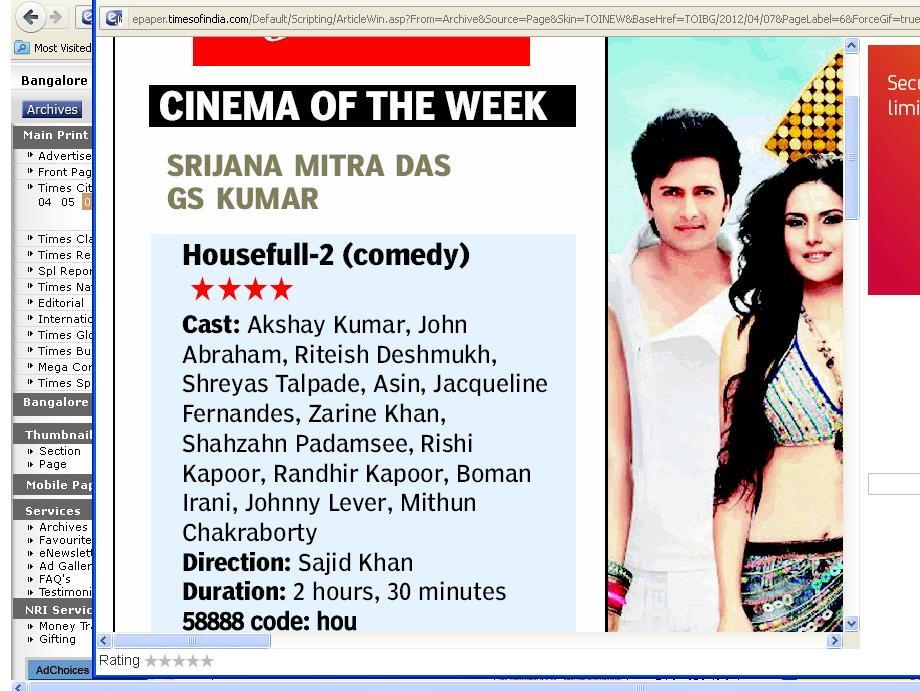
Times of India’s film critic Srijana Mitra Das has given 4 stars to Sajid Khan’s Housefull2. Who is this enlightened soul? Someone please introduce us to him/her. Seems like a bong. And a bong with such unique taste in cinema must belong to some rare tribe. Anyway, if the 4 stars weren’t baffling eough, there’s more to the story. Take a look at this pic.

This is the Bangalore edition of TOI. Have taken a screengrab of the review page. Reviewer is the same Srijana Mitra Das and rating is 4 stars. Now take a look at this next pic.

This screengrab is from the Chennai edition of TOI. Again, reviewer is the same Srijana Mitra Das. But the rating is 2.5 stars. Who ate up my 1.5 stars?

Same film, same reviewer, same newspaper but two editions and two different ratings.

WTF!

Who writes the reviews? Who gives the ratings? Does Srijan Mitra Das really exist?

CAN SOMEONE PLEASE EXPLAIN THIS TO US?

Tip – Yashpal Singh/Dhanya Rajendran

Agent Vinod was one of the most anticipated films of the year. Those who know the filmmaker and love Ek Haseea Thi and Johnny Gaddar, they know what #JaiSriram means. So did he score a hattrick? The Matunga Fanboy is disappointed for sure.

“Hey! Johnny, matlab hi hai aasli yaar…”

Greed, vengeance, love, doom, betrayal, survival.

With little budget and a story to tell, it was all packed in awesomely in his earlier attempts. With more resources to film, more chases and explosions, and a lead actor/producer with adequate passion to “make-it-large”, there was little to tell and a lot to show in quick cuts.

Agent Vinod dangerously fell into the “we-got-a-Great-Title-now-what-to-do” films/PROJECTS. With everything sounding great at the onset – Title, Concept, Cast, Budget, it seems a kick-ass script was the only thing that was left. Probably keeping that as the last thing to do without any other worry puts too much pressure on the one most important thing to begin a film with…and that being kept last, with everything being taken care off, “shayad joote pasand nahi aaye” – One might not be able to pin point what exactly is going right as the support and resource is right there. Tough task and especially for a super self-critical person, that must have been one exhaustive task. It shows. It’s complicated and ironic how one manages with little resource and more imagination and…

A mild mannered middle-class Matunga boy with loads of pulp movies and literature consumed, and some-corner-room-twisted perspectives could add his mild humble magic to anything he touches with his “not so sure” demeanor beneath a killer observer. RABTA being just one Single Shot example of that. The simplicity of those couple of minutes completely overshadows the rest of the Millions spent on the quick cut Peter Hein action.

60% of the times I was either looking at a Peter Hein shot or a second unit exotic pick up shoot. I sorely missed my Desi Jim Gordon’s smooth humble touch to it. There were glimpses of it. But far and few, or maybe when it’s someone who grants some access inside his “Hard-Case” Adventureland gates only once in 5 years, it better be all him – A 100% Sriram Raghavan affair.

Plus, when you have a great title, why not exploit it? Casino Royal played it quite well with “Bond James Bond” coming just about when the End Credits began to roll but then that was the 21st Bond film. Why not use Agent Vinod to full effect throughout the film? It’s anyways a kickass name, why guise it, guard it and hold it and not let it breath? As Vinod says, he wants to go back for those 8 minutes on the cable, I too just wanted that feel of those 8 minutes and not the entire film to be about those 8 minutes. What makes Bond and Bourne is that they push me precariously close to those 8 minutes but then get me out and show me more of what happened before and after. Where we cherish those 8 minutes and treasure them, we wanted Sriram to give me those 8 minutes (Rabta give me a couple for sure) not Peter Hein.

Waiting for the next.

MatungaFanboy

We are desperate for comebacks. And we are quick to dismiss too. All it takes is just a status update or 140 characters.

When Tigamanshu Dhulia’s last film, Sahib Biwi Aur Gangster released, it was the usual hype on the social networking platforms. As if friends, family and colleagues were dying to put that “comeback” tag on him. The film had it’s charm but it was nowhere close to what it was made out to be. The usual suspects tried the same with Ramu and his Not A Love Story. To put it mildly, that was unadulterated garbage in every way.

But, this is what a comeback looks like – Paan Singh Tomar. Ironic that the producers (UTV) had to sell the film as “from the director of Sahib Biwi Aur Gangster”. May be it wouldn’t have got a theatrical release even if it wasn’t for SBAG’s success. The film has been ready for quite sometime (about two years). They sent it to few desi festivals in USA where the general feedback was “Irrfan is good, film is bad”. News started doing the rounds that UTV was planning to dump it on tv along with some half a dozen other films. Then SBAG happened. Some strings were pulled, a release date was quickly announced and without much pubilcity or promotions, the film was released.

Those who have seen both the versions of the film, they said that music has surely been changed. But how much can just the “background music” change the film? No clue, not sure.

I went to see the film FDFS. Just because of that actor called Irrfan Khan. Or just Irrfan. Seems he has dropped his surname. Good, we have too many of them in this industry anyway. When i entered the auditorium, it felt like it was going to be a private screening only for me – the luxury that makers provide to few critics to give a bloated sense of being important and score some brownie points. Slowly some dozen people turned up including a director whose film has recently released.

The film opens with Brijendra Kala, an actor who is a delight to watch – the desi Bill Murray who knows his deadpan too well. As Irrfan narrates his story to Kala, it goes into flashback and we get to see the story of Paan Singh Tomar. I have been often told that narrating a story to a character to get into flashback is the worst device in a film. But with two terrific actors in the frame, they make everything mundane look so interesting. There are just counted few scenes between the two, but that thing called chemistry, well, it’s found in strange places between stranger people.

I have always felt that the mark of a good director is in the casting of those actors who have just one or two lines to deliver. You go to watch a film because of the lead actors but you come back home with those “character actors” who steal the show. This is where Paan Singh Tomar scores again. Even Zakir Hussain and Mahie Gill are so impressive in such small roles. Though it seems Nawazuddin had more to do in the film and it was edited out later on.

Paan Singh Tomar is the Tigamanshu we knew, the one we wanted to see again after Haasil. The director who could take us to a new place, away from bollywood where he knows the terrain, its politics and dialect well. Written by Sanjay Chouhan with dialogues by Dhulia, it captures the sound and soul of that barren land with a dose of black humour – a rarity in this industry. So when i saw his other film Shagird, i could not believe it was the same director. From one extreme to other – how could one go so far? As a screenwriter who saw the film with us  said, this is Race for intellectuals.

Welcome back, Tigmanshu. It’s been long.

And Irrfan? Well, he can do anything. Just anything. No wonder he is the only Khan they know in the west. It’s our bad luck that he is born in a country and at a time when we are obsessed with the weekend numbers and 100-crore mark, and we don’t make films that can’t justify his talent. Forget films, we don’t even dare to put him on magazine covers. I hope and pray that in your next birth you get a better place which knows how to respect talent.

The actor doesn’t need lines, his glances pack a punch. In the scene where he comes to meet his son and asks him not to touch him, when his son leaves and he looks around, that glance stays with you long after you have left the theater. Much like that awkward hug with his son’s girlfriend in one of my favourite films of all time, Namesake. He is about to hug her, she is about to kiss, and then that slight bend, slow movement and a strange look on his face. He can play young, can play old and even a father of a young man in the same film. He can run and romance with equal ease.

Only weird thing about the film is that it leaves you with a strange vacuous feeling – Not sure how you react to the character in the end. It keeps you engaged through the film but doesn’t hit the spot in the end which you desperately want it to.The emotional hook? Or may be just a bit of empathy.

As for Paan Singh Tomar, in other part of the world the most famous runner’s mom told him that life was like a box of chocolates, you never know what you’re gonna get. This side, we are sure about one thing – there’s no box, there are no chocolates and life is just a race which you must complete.

Early reviews in bollywood are unlike anything in the rest of the world – you can never trust them. And at a time of social networking, everything spreads like wild fire. So when i heard good things about Ek Main Aur Ekk Tu, the first person who was skeptical about it was film buff and screenwriter Navjot Gulati and rightly so. Big banner, big stars, screening for friends and family and early review by so called trade analysts – why would anyone trust it? And then he saw the film and ran in other direction. Why and how? Read on. Has SPOILER.

The heading is a popular line from a popular tv campaign. However, the Pappu in question here is director Shakun Batra, who did an Aamir Khan impersonation in the song Pappu can’t dance saala (from 2:46 ).

Now, before I start talking about the film, let me tell you that this post is about the film and also about the director. How a rank outsider was able to make such a big debut?  And to top it all, he was able to make a “perfectly average” film with the same banner that made great films (NOT) like Agneepath, Kurbaan, We are Family ( I call it We all Act Hammily) and I Hate Luv Stories. You may wonder what is so common between all these five films including Ek Main Aur Ekk Tu. Interestingly, all of them have been directed by debutant directors.

What sets Shakun Batra apart is the fact that he made a big budget romcom with an indie feel, and, with a banner which is known for making candyfloss films set in unreal world. Shakun is also the one who started the Assistant Director’s community on Facebook which has helped thousands of people since its inception around five years back. One would think it has to be good karma as he was able to make his debut after assisting in just four films. I know people who have been working with top production houses and have assisted in more than eight films and still can’t even write a story, forget about making a film. The point being if you are talented and smart, you will always be able to make a film. Shakun’s smartness was in striking friendship with Imran Khan, who, let’s face it, may not be a great actor but he certainly has an eye for “good” scripts. Yes, if you are an outsider wanting to make big films, this is one way which can work.

Now coming to the film.

EMAET is a film which almost 80 percent of the population of Indian will be able to connect to because every character in the film is relatable. The Goofball dad Philip, sexed up Boolani,  demanding Kapoors, not-in-a-zone-to-get-in-a-relationship Riana, highly-under-the-influence-of-family Rahul and my favorite, the Granny. We all have seen such people around us and that is what makes you believe that this is “your” story.

It starts off as little over the top but it was refreshing to see the detailing in the film and the body language of Imran Khan, an actor known for NOT knowing what acting is. Imran’s family was bit over the top too but then came Kareena, almost like a breath of fresh air and the film was never the same again. She reminded me of Summer Fin from 500 days of Summer – a girl every boy wants to fall in love with. As the film progresses, you know that this is going to end up in only one way but you still want the guy to get the girl and so the movie works.

The movie does not go over the top even in any of the dramatic sequences, like the dinner table chopstick scene and the one in the school corridor. Kareena is so good that I fell in love with her all over again. Last time it was in 2007 with Jab We Met. The character she plays is the girl every guy wants to end up with for the rest of his life. Sweet, sexy, adventurous and caring.

But the one who steals the show is Imran Khan. Finally, the boy becomes man and learns to act and changes his hairstyle too. Watch him in the scene where he goes on a date with Anusha. He is damn funny! This is the first romcom to not have a kiss in the end, or the Indian equivalent to kiss – “hug” or better “marriage”. The film breaks all the clichés of Hindi romcoms and does it in style by having an ambiguous end. Although it is very clear that she does not love him but what the director leaves us with is that lil’ hope, that she may come back to him sometime in the future.

The photography along with the background music sets the mood perfectly and lets you flow with the story smoothly. Just listen to the way Clinton Cerejo jazzes up aaja aaja main hoon pyaar tera. Music by Amit Trivedi is of timeless variety – a rarity in today’s times when music is forgotten a week after the film releases. To sum it up, this is one of those rare films where I could not find a single thing that would put me off, everything was “Perfectly Average”, just like the 90 percent of the world’s population.

(P.S – I know the film has been inspired from various romcoms like What Happens in Vegas, 500 days of Summer, and desi flicks like Jab We Met and Wake Up Sid. But i did not mind the inspiration because the writers made something of their own from the inspired material.)

And our favourite writer, Subrat is back. After many requests, much cajoling and few smses, he managed to sit down and write this post on a film that he really liked. Read on.

We like to deal with the big issues. Those that are significant. The crisis of capitalism. Saving the earth. World peace. On the fabric of society, these are the big pictures. Acknowledging them is mankind’s acceptance of its collective failure. There’s something charmingly uplifting when we discuss our frailty in plural. It ennobles us. With such vexing problems to solve for the collective, why are we then, individually, beset with the trivialities of life? Why does the insignificant ground us? Betrayal. Loss. Estrangement. These warp and weft of life that should have subsumed themselves to the grand design. Instead, they force your attention to them. And to you. To your imperfections.

Imperfection is what Alexander Payne wants us to meditate over in his new film The Descendants. It’s seven years since Payne gave us Sideways and, on the evidence of this film, it’s reassuring to note these years were well spent on the minutiae. And, on imperfections. This gives us a film that is in turns profound and farcical while managing a lightness of touch that is often sought but seldom achieved. There is an unhurried pace to the story that eschews dramatic highs and showdowns though there’s ample opportunity in the script for both to surface. More importantly, the director avoids the trap of caricaturing the shallow, ordinary American family that seems veering towards dysfunctionality.

In a society that worships achievement, it is interesting how being ordinary is celebrated in American literature and films. May be it is the impact of American Realism; of Mark Twain and Henry James who crafted their stories around everyday people facing moral choices. How deep is their impact on American culture can only be gauged by the currency that stories of ordinary lives have enjoyed for the better part of last century in America. From Faulkener, Updike, Franzen in literature to a whole host of films that have rightly (or, wrongly) won critical acclaim for protraying ordinary lives. Just run through the list of Oscar winners over the years to see the impact that realism still holds on American psyche. Strong enough to have Ordinary People win the Best Picture nod in the year of Raging Bull (a more compelling case for the entire lot of voting members face the firing squad hasn’t been made).

That aside, if any contemporary director in Hollywood can lay claim to that real tradition of realism, it has to be Alexander Payne. Payne has an instinctive grasp of an ordinary life, its tribulations and, like the realists of the yore, he lets the character stumble his way through reaching the right conclusion. And, like them, he understands locations. From Omaha, Nebraska (About Schmidt) to Napa Valley (Sideways) or even that last segment that he directed of Paris je t’aime, Payne has few peers in weaving in the location into his films. In The Descendants Payne takes the unlikeliest of locations for depicting a family in strife, Hawaii, and makes it integral to the film.

Matt King (George Clooney) isn’t an ordinary Hawaiian as he informs you in the voice-over that starts the film. While disabsuing us of the notion that Hawaii is a tropical paradise (yes, there’s poverty and grime there), he quickly establishes his bloodline that traces its history to the tribal royalty and the early white settlers in the middle of the 19th century. He is a partner in a real estate law firm who has worked hard to build his identity separate from his ancestry. Matt, though, is burdened by this ancestry that has bequeathed on him the responsibility of disposing off a large virgin tract of land in one of the islands for ‘redevelopment’. This is big news locally as it pits the alleged forces of development (malls, amusement parks et al) against environment. Matt and his sprawling extended family of cousins (there’s a cousin popping up every minute in the film in brightly coloured shirts and chappals) are indifferent to the debate. There’s no less messy way of dividing up the family fortune and quite a few cousins are hard up.

These, seemingly, larger issues hardly match up to what fate has dealt Matt. His wife of many years, Elizabeth, lies in a coma in a Honolulu hospital with doctors ruling out any chances of survival. Matt’s younger daughter Scottie (Amara Miller) is a 10-year old who is precocious in the wrong way whose favorite pastime seems to be to confuse her friends on adult issues. Matt, admittedly, has never been a hands-on parent (a backup as he calls himself in a voiceover) and, in Elizabeth’s absence, he finds Scottie a handful. There’s also Matt’s older daughter, Alex (Shailene Woodley), who’s been sent away to a boarding school to rid her off her drug habit. Matt brings her back to make sure the family is together when the doctors pull the plug on Elizabeth. He had hardly bargained for the secret that Alex carries that seems to make her loathe her mother – Elizabeth was cheating on him. Matt becomes obsessed about finding out Elizabeth’s lover and breaking the news of her impending death squarely to him.

The narrative arc is quite familiar from here on. Matt has to pull his family together, learn to be friends again with his daughters, put his wife’s transgressions behind him, do the right thing on the land deal and seek redemption. This is a territory susceptible to high melodrama and in the hands of lesser director would have turned into a soppy, sentimentalist work. But Alexander Payne elevates this into a whimsical and wry look at life by keeping sentiments at a safe distance. He is ably supported in this by an ensemble cast that is completely in step with the director’s alternating profound and farcical treatment of the subject. Especially noteworthy are the cameo turns – Nick Krause as Sid, the irascible boyfriend of Elizabeth who isn’t as shallow as he seems, Judy Greer, who chews up the scenery in just the two scenes she is there.

The triumph of The Descendants is how it meanders through this familiar arc. There is no pre-determined denouement that the film is hurtling towards. There are no certainties here, like life. It appears like everyone has time to spare. Unhurried is perhaps the term. Matt, who has all the emotional cards dealt to him, is often driven by petty instincts. You are bound to be sympathetic to him but you are intrigued by his fickleness and his decisions. Payne isn’t judgmental in his portrayals. You take each character from your own station of life. It’s rare for a film to achieve this.

The cynic in me wanted to see through all of this. This whole calibrated business – of ordinariness, of making George Clooney look stupid, of having a bunch of kids dysfunctional on surface but being alright at the end and of making a statement about development versus environment. I have let the cynic question it all. I have done my best to see through the deception. It’s been over a month since I saw it and I have failed.

May be, for once, there’s something real here. You be the judge.

But take my advice. Don’t bet against The Descendants this awards season. There’s no Raging Bull in the ring. And, The Descendants is no Ordinary People. Though that title may have fitted it perfectly.

The year was 1994. I was in class 9th. It’s the year when the world starts reminding you that life and death will be based on your next year’s results. So, this is the year before you are crucified for the board exams. Have as much fun as you can have.

My class found its first official couple that year – those who declared their love without saying anything. Boy from middle-class. Girl from Officers’ colony. In a small coal town in Jharkhand (it was Bihar then) where dating wasn’t part of our dictionary, it was a big thing. Quite daring too. Because unlike in big cities, we all knew how many chappatis our neighbours had for lunch and how many they finished in dinner. Everyone knew everyone else and every affair related to them. Love in a small town was a risky business.

So for the rest of us, it was a teasing game – oh, she is with him and he is with her. The peer pressure that makes you imagine weird things. It was all just in the head. But for the couple, i was the middle man. The boy used to sit on my right as we shared the desk. The girl, on my left, had a separate desk. And between the boring classes, writing and passing love chits was their favourite activity. Being a good friend, i had no choice but to spice up the chits when asked by my friend. And help her in  studies too. She is your friend’s girlfriend. If not you, for the first time someone in your life has a girlfriend. You have no other choice.

The first chit, the first letter, the first chocholate that was shared – it was all before my eyes.  And like all small town love stories, this also ended with a Jagjit Singh ghazal. He came back from Benaras and told me that he did exactly what Jagjit Singh sang in Arth – Tere khusboo me base khat mein jalata kaise….Pyaar me doobe huye khat mein jalata kaise…Tere haathon ke likhe khat mein jalata kaise…Teri khat aaj mein ganga me baha aaya hun….Aag behete huye paani me laga aaya hun.

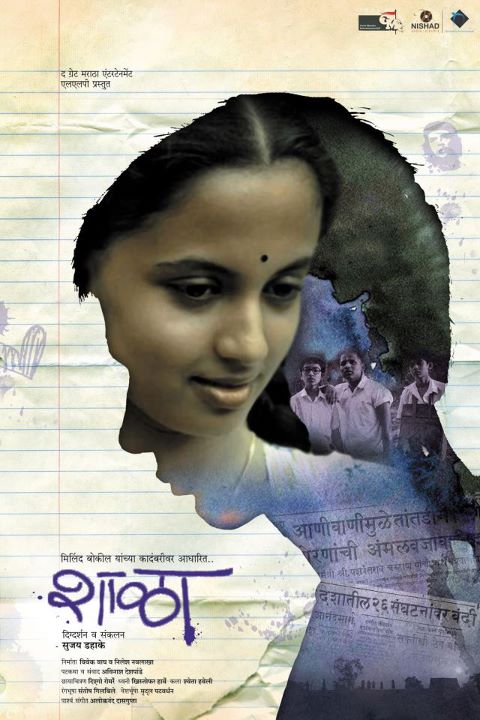
We never discussed this later on. But sometimes i still do think about the entire episode and a big smile appears on my face. For two hours i had the same smile on my face as i watched Sujay Dahake’s directorial debut Shala.

Based on Milind Bokil’s novel by the same name, this is an assured debut. And believe it or not, the filmmaker is just 25 year old.

The film doesn’t state anything new. It’s a trip down memory lane that you have seen many times before. Just the set-up is different and the faces are new. But everything is captured so well – it’s all about the silences, glances, moments and the memories. School, best friends, love, heartbreaks, first rush of hormones, crush on your favourite teacher and that first introduction to politics which tells you that the real world is not what it looked like so far – say it, and it’s all there.

Best thing about Shala is that it doesn’t look like a film at all. The acting is so natural, the camera is so non-intrusive and lingers on frames with so much ease that it feels as if someone just put a camera in a school. There is not a single false note in the family affairs too where the scenes are quite delightful.

The story is set in the backdrop of the emergency. Though it doesn’t add much political colour to the main story and which seems like a tokenism, but Sujay belongs to “subtle school of filmmaking”.

A common factor in any good film is that you will always remember a character who is there in just 2-3 scenes. Mr Joshi (lead character’s father) played by Nandu Madhav is that character in Shala. Watch him in the scene when he receives the letter from the school – knowing some of my friends and their strange equation with their dads, can bet that many people will wish that they had a father like him.

The lead actors played by Anshuman Joshi and Ketaki Mategaonkar have such a terrific and delicate chemistry between them that it’s impossible to believe that it’s just onscreen love. They do nothing heroic about their love story but those tender moments filled with soulful music are so powerful that they will stay with you long after you have left the theater.

Another place where it scores a high point is that the film doesn’t aim for the big bang climax. It’s all about the journey, it’s not a “destination movie”. Because the pain of growing up can’t have a happy ending. Nothing prepares you for the cynicism. The joy is in the journey. Shala celebrates that. This is what pure and uncompromising cinema looks like. And since that’s a rare genre in this country, i suggest you don’t miss this one.

Watch it. Watch it because nostalgia is a bitch, and when the bitch is so beautiful, there is no way out.

And what’s your class 9th story? Do tell us.

The film is playing at Mumbai’s 24 Karat Theater (Jogeshwari) with Subtitles. They have only one show at 3:30pm. If you know about any other show with subtitles, do let us know.

Click here to check out the official website of the film.

We were bit clueless about how to approach this film. Sudhish Kamath is a good friend and that means we will do whatever we can to support the release of the film and make it more visible. But how good or bad the film is – that’s a completely different question where friendship has no space. You can be our best friend and make the worst film that we will not endorse publicly. And you might be the biggest dodooth* in the town and deliver the best film which we will happily endorse. Also, to be honest and fair with your friends’ films is quite a difficult task. And while we were in this dharam-sankat, Shubhodeep offered to review it. We were more than happy to share the burden. This is his second post here. To read the first one, click here.

Read on.

The guy introduces himself as Turia to the girl. I wonder aloud what the name means. Indeed, whether it means anything at all. A couple of minutes later, the girl says: “What kind of a name is Turia?” I grin and prepare myself for their night-long conversation.

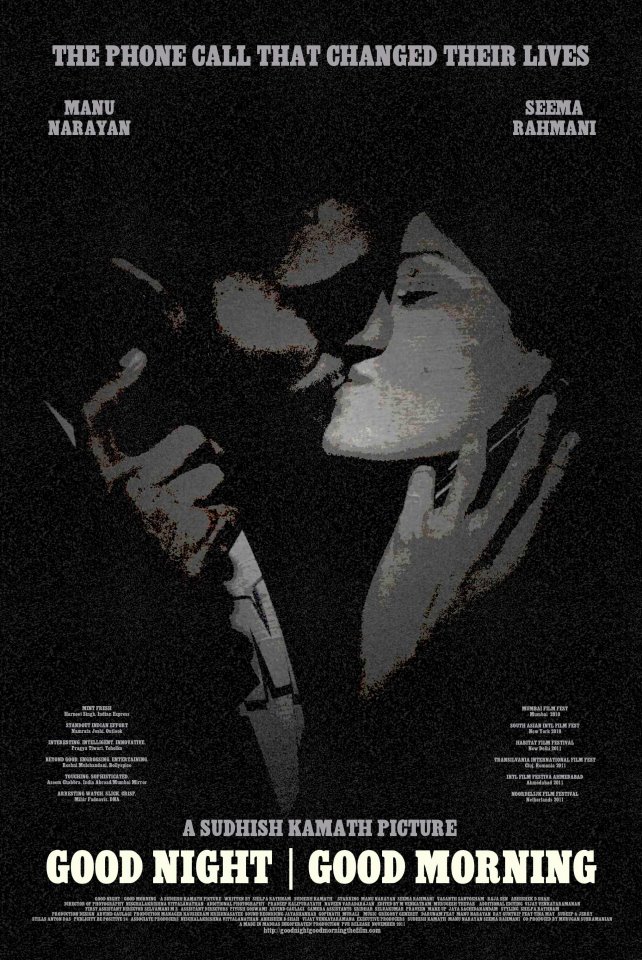
Sudhish Kamath’s Good Night Good Morning is that kind of a movie. Shot in gorgeous black and white (curiously under-produced at a couple of spots) it surprises, amuses and frequently offers situations and dialogue that resonate with déjà vu. All this in accompaniment to a jazz soundtrack that sweeps across the movie and infuses it with much life.

The story straddles New Year in New York: a time usually defined by merriment and debauchery. Neither element is present as this story begins. He is a hopeless romantic unable to get over a broken relationship. She is, at least on the exterior, a cynic who doesn’t believe in relationships. They both have troubled pasts. Both of them appear to be in need of comforting company. We’ve met both characters before in reel as well as real life; nevertheless, the two occupy these comfortably stereotypical characters with an unexpectedly invigorating freshness. He drunk dials her number while riding in a car with three sloshed friends. What follows is an engaging and witty conversation that almost anyone will identify with. I’m certain the movie had snatches of conversations that I’ve actually had verbatim in “real” life. Love, losing love, the oft-perceived hopelessness and uselessness of relationships, are sensitively articulated in the movie. It’s easy to lose yourself in a melee of your own ruminations once you start thinking with them.

As the movie progressed, I became acutely aware of the two writers at work, weaving their words on a fabric so tenuous as to not exist at all. Writing near-endless lines of dialogue, interspersed with little or no action, can be a forbidding task. Not only have Shilpa Rathnam and Sudhish Kamath managed to veer away from schmaltz, they’ve done a telling job of keeping the pace of conversation mostly even. I remember reading that the screenplay of Richard Linklater’s Before Sunset (which, along with Before Sunrise, is perhaps the best “conversation movie” of the past two decades and is indeed referenced in GNGM as well) were largely written by the two leads, Ethan Hawke and Julie Delpy, who drew on their “real” lives for parts of the story. I might be grossly overstating my case but the writing in GNGM seems to suggest that Messrs Kamath and Rathnam share an affectionate camaraderie that has helped them produce a truly well-written script. The chemistry of their writing shines through in the virtual chemistry of the protagonists.

The only real gripe, and a minor one at that, I have with the movie is that it could so easily have been even more relatable and enjoyable had the writers (and director) chosen to do it Hindi (or even Tamil). Indeed, half-way through the movie I was dreaming up a gloriously fun Hindi movie on the lines of GNGM. Even though the dialogues and situation were overwhelmingly familiar, I found it hard to find any sense of belonging to the boroughs of New York. Perhaps because this is a film by an Indian filmmaker I really pined to see a more “accessible” movie as far as the setting was concerned. Of course, choosing what to make and where is a decision that is best left to the filmmaker, but I feel this movie could have stayed indie and yet explored a more Indian setting precisely because it had the potential to be quite a successful entertainer for the masses.

However, back to the movie. Conversation flows freely in GNGM. The lines are incisive and intelligent – sometimes a bit too intelligent – but never over-smart. That is one of the most enduring virtues of the film. Apart from a few moments that fall prey to kitsch, the dialogues sparkle with vim and wit, throwing in memorable lines now and then: “Long-distance success stories are a work of fiction my boy”. “Stories are meant to be simple.” When the dialogues become laborious, the action cleverly changes to the antics of Turia’s three inebriated companions in the car. It’s curious however that the best lines seem to have been reserved (by design or chance) for Seema Rehmani who occupies, with glorious vitality, a character that has been done to death.

Ms Rehmani does a star turn, outshining her male counterpart and keeps us interested in the movie till the end. Manu Narayan is reliably consistent, and even remarkably good at places, but I wish the script had more for hm. Raja Sen and gang exhibit much promise initially but are eventually let down by the script. They’re efficient in the beginning – with Mr Sen turning in a few sharp lines accompanied by epic expressions magnified by his magnificent tache – but seem to dwindle in importance and utility as the story progresses. Ultimately, their tomfoolery becomes mildly irritating in a movie that stands out due to its consistently winsome glow.

GNGM is not a movie that will make you froth at the mouth with amazement or feel giddy with euphoria. Indeed, that is perhaps its most becoming virtue. It neither wallows in conceit nor lays claim to greatness. Instead, like the rising warmth of a hot cup of coffee, its fingertips will lovingly graze your skin like that of a soulmate and that sensation will linger many hours after you’ve watched it. And like the tender glow of a winter sun descending into the fog, it will lure you into cosying up to it again on a rainy day.

I’m eagerly waiting for that day.

Shubhodeep Pal

The film has been released by PVR Cinemas and is currently showing in Mumbai, Delhi, Gurgaon, Ahmedabad, Bangalore and Chennai.

(PS – If you still haven’t read Sudhish’s now famous rant (The Truth About Films : Ungrateful. F***ing. Bitches), click here.

(PS2 – Karan Johar reviewed the film for Rediff as Raja Sen makes his on screen debut in this one. Click here)

(*doodoth = dodo + ch**th the word has been devised for that rare tribe)

Rockstar is Imtiaz Ali’s fourth film after Socha Na Tha, Jab We Met and Love Aaj Kal. Thanks to some good friends, I had some idea about the story of the film long before it was announced because Imtiaz has been trying to make the film since last few years. But after SNT, JWM and LAK, what i was more curious to know was that if Imtiaz will follow the same template of his previous three films. And the template is…

Cool and confused lovers will travel a (physical) distance to realise their true love.

Now try SNT, JWM and LAK. Cool boy will meet cool girl. They will be easy to like and good fun to hang out with. They will become friends. They fall in love but are not sure about it. They will be confused and take a wrong step which will lead to some kind of travel and they will finally meet.

Add marriage to it and you are done. With marriage, Ali takes one step at a time. SNT – the marriage talk is on. JWM – She is about to get married. Almost. LAK – She gets married. SPOILER Rockstar – She gets married and makes love with the boyfriend. SPOILER Ends. Next is what? Extra-marital affair? Let’s wait and watch.

In Rockstar, Imtiaz Ali follows the same template. But as the name suggests, it’s also about music. So what works and what doesn’t? Opting for the easy route by writing it in points.

– The film entirely belongs to Ranbir Kapoor. Hand him all the awards for the Best Actor this year. It has been terrible year anyway. And nobody comes close to him. He is such a delight on screen, makes everything look so natural.

– And it would have been a different game without Rahman. After Ranbir, the film belongs to him. It’s easily the best album of the year and i wanted to see more of songs in the film.

– When it comes to rom-com, writer Imtiaz knows his stuff really well. The scenes, the dialogues, the moments – he knows how to write and handle them. How about a rom-com masterclass, Mr Ali?

– Nargis Fakhri. Great screen presence, gorgeous to look at but as soon as she opens her mouth, it’s all over. Terrible casting. Was it just a silent audition for her? If it was someone else, the film could have gone to another level.

– The film suffers from the same curse which most desi films have : the curse of 2nd half. It seems Imtiaz had no clue what to do in the second half. Is there a way we can edit out “interval” from our films? That seems to be the main culprit.

SPOILER

–  Going by conventional mainstream rule book, the film has a sad ending. But looks like we have become so scared of the box office monster that even when the story is going in that direction, we are finding it difficult to endorse it on screen.

SPOILER Ends.

– Kun faaya fun gave me goose flesh. It’s not the way it’s shot, it’s the moment it captures.

– Shammi saab, such a graceful presence. Wish the ‘dichotomy of fame’ track had only him and Ranbir without jumping over to other scenes. Even when he is playing the shehnai, you can see that he is making the efforts to make it look real. He is just not faking it.

– They really blurred the “Tibet” part in the “Free Tibet” banner. That’s disgusting. What is an artist without his/her politics? And this is such a far fetched endorsement. Weird because they shot the song in Dharmshala with Tibetans who are waving their flags and banners and are on stage with Ranbir.

– The narrative style is not linear. Almost every second sequence moves between past, present and future. Am not sure if it helped the narrative in anyway. Need to watch it again. Also, was it done in the edit? Or Imtiaz thought about it while writing the script? Any inputs will be helpful.

Muazzam Beg has an opening story credit along with Imtiaz Ali.

– Was damn disappointed with Kumud Mishra in That Girl In Yellow Boots. He has compensated for everything in the film. Also, can we see more of Aditi Rao Hydari?

– What else? Aha, Rumi saab gets proper credit in the film.

Go, watch it and do share your thoughts. Am sure this film is going to divide the house completely.

Here’s continuing from our Mumbai Film Festival. The recco list is here, click here for Day 1 & 2 report and here is the post on Dimensions Mumbai.

Moving on –

Day 3

1. Jesus Henry Christ – A super non filmy yet subversive (you-dont-know-where-it-is-headed) film, my little miss sunshine of this year. Eccentric & weird american family-comedy. Trippy and funny all the way. Recco for everyone and especially for aspiring screenwriters

2. Toast – Stanley ka dabba meets Udaan. At first felt like a food porn film but slowly goes onto becoming a coming of age film set in UK 60s-70s. Very good film based on the life of a famous british chef. Also stars Helen Bonham Carter (and she’s not the only reason to watch the film)! Dont watch it on a hungry stomach !

3. Monster’s Dinner – ok clearly the most bizzare film of the day inviting maximum different opinions. Two couples have dinner in a dystopian turkey urban town. Smoking banned, painting banned, child abuse allowed and become a buisness, social norms are abnormal, satire on everyone under the sun. Clearly set up like a “play” with a single house setting (read low budget and limited resources so maximum innovation). Dark and creepy without showing a single violent act but puke-inducing. Many felt the film doesn’t move after the first 30 min (and may be even after the first 60 min), but personally felt it was very well directed. Very interesting film to watch it for sure – depending on if you decide to hate/love it later

4. First time for everything – Another russian Udaan father-son bonding story. Walked out after 70 min since it was taking way tooo much time to make a point.

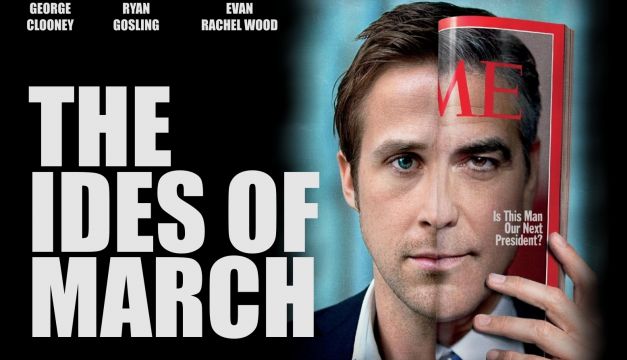
5. Ides of March – Big Q for this one. Guess I know the right people. Nevertheless managed to sneak in. Must watch. Shiva the God Of Death goes corrupted. Wow. Watch it. Just felt longing for more by the end of it. Depressing film in a moral-istic way.

6. Aadukalam – national award winning tamil film. Had seen it already. But neverthless do check it out. A super film (yes made in commercial tam film format) And as a friend said – the drama is pretty “shakespearean”

Other mentions – Wrecked starring adrien brody, saamna, king of devil’s island (starring the super stellan skarsgard), armadillo. Didn’t see them since they are available (you-know-where). Will check them out. Comments welcome in case you did watch them

Day 4

1. Chinese takeaway – super stud ricardo darin (secret in their eyes, aura, 9 queens, carancho, signal) is reason enough to watch this quriky comedy film. An irritable common hardware shop owner’s life gets disturbed by a chinese man who comes into his life. Very well written and expertly directed. Recco’d

2. Tabloid – docu by Errol morris – a “simple” case gone awry thanks to the scandal-loving Brit media. Based on a true story. Highly recco’d. Offers multiple insights (pov’s) into the case – what happened, what was witnessed, what was reported.

3. Mountain – another low budget film with two characters and a “setting”. Thelma & Louise meets Kids are all right meets Rabbit Hole. But wow. And for a change great to see the dir not just relying on the lovely visuals of snow capped peaks but also wonderful drama. And someone give the leading lady an oscar for the best performance please. Was also part of an (informal) Q&A. Shot on Red. Must must “mast” watch. Silences, minimal dialogues but superb.

4. 17 girls – Based on a real life incident. 17 rebel-without (or with)-a-cause high school girls decide to get pregnant simultaneously. Liked it a lot despite the fact that pregnant women freak me out (I know I know, I’m sorry. Just have a phobia). Recco’d. And the girls are such good actors. I wondered how does one write the script of one such film.

5. Sleeping beauty – Epic fail super NG film. Everything established in the first 45 min, after that its purely one tharki budhdha after another. As Prof Saab said – “Pure mind fuck but no penetration”. Avoid. Allegedly an indian well versed “indie” director asked the dir of the film “Were you aware of what you were trying to do?”. Didnt get a satisfying response. I cursed myself for going for this and not standing in the 500 odd queue off Pina !

Other mentions – Win win by station agent, visitor dir, 36 chowringhee lane (arguably best film by aparna sen), Pina (still to be seen but have heard great things about it)

Day 5

1. Aparoopa – Finally saw a Jahnu Barua film on the big screen.. His debut film based on a real life incident which happened in assam in the 60s. A gorgeous suhasini muley and breathtaking assam visuals (DOP – Binod Pradhan), lovely music. A story and treatment which might seem a little dated today but for it’s time it was quite “progressive”. A typical HKA-ish/Charulata-ish Love triangle in which there is no bad guy (villain). And the good news is that he is trying to get all of his films released on DVD. Fingers crossed.

2. Love Wrinkle Free– A good first time effort by dir Sandeep mohan. Goa eccentric family comedy of sorts, in english. Couldve been trimmed by 20 min or so. Low budget film but which boasts of some good performances from the ensemble.

3. OR (Mon tresor) – Minimal dialogues, long takes, lovely visuals, self destructive characters, Father-son character from Aaranya Kaandam into a mom-daughter track.This is what Sleeping Beauty should have been. Highly recco’d. Last 5 min couldve been trimmed but still.

4. Almanya – Funny german family comedy. A man travels from turkey to germany to start a life. 50 yrs later family moves back on a vacation to turkey. Film cuts back and forth. Slightly meta-filmy (and hence also) super. Recco’d.

Other mentions – Salt of life, Habesu Papam (heard they were good), JBDY (need one say more?), Yellow Sea (hmmm-need repeat viewing. Some superb action sequences), Even the rain (available you-know-where), Another Earth, Melancholia (ho-hum, except super performances)