Whenever there has been a film worth having a conversation, we have always tried to get the creative heads involved, and get them talking. We have been waiting for a long time to get Sriram Raghavan do the same. Finally, we got him for post-screening Q & A of Badlapur. Much thanks to Sriram, who not only obliged for it at a short notice, but he also got his co-writers Arijit Biswas and Pooja Ladha Surti for the discussion, whom we rarely get to hear.

Thanks to PVR Cinemas and Shiladitya Bora for the venue.

And a big thanks to Mihir Desai, Aniruddha Patankar & Anusha Singhania who recorded the entire event in poor light, edited it all, managed all the sound fuckups, and uploaded the videos for you all to see.

(PS – If you like our blog and are film fanatics like us, do like our FB page for all the cool cinema related stuff and discussions)

Indian Express recently did a feature on the new Censor Board. They interviewed all the Board members on films, violence & sex in films and other such related stuff. It’s difficult to imagine from which stone age  they picked up these fossils who will now censor and certify the films. Except Dr Chandra Prakash Dwivedi, everyone’s IQ seems to be the same. Click here to read the feature.

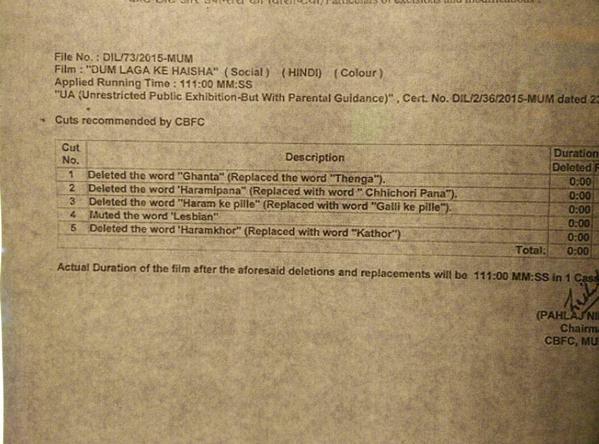
Today the news is out that the Censor Board had asked the makers of Dum Laga Ke Haisha to mute the word “lesbian”. Ghanta, haramipana, haram ke pille and haramkhor words have also been replaced (see the image).

wbaDaHoo

Well, nothing surprising there. But “lesbian”? What’s wrong with the word? or in what context is it wrong? We called up one of the Board members who was against it and we got to know the exact scene.

When the female lawyer is consoling Sandhya at the court and touches her face lovingly, her younger brother says – ‘Mummy…didi lesbian toh na hoti jaari..‘ Mummy says ‘Ye kya hota hai?‘ and then the brother says ‘Bade shehron ki bimaari hai..

The_L_Word_logo

Aing! The “L” word. What’s so scary there? Since it was shot in such a way that the makers could not mute the word, so they had to remove the entire dialogue.

Will someone please enlighten us what was so wrong with “lesbian” or its context in the scene?

dum-laga-ke-haisha-poster

After a long time, a sexy love story.
I wish to share the joy I felt seeing The Dum Laga Ke Haisha race as a metaphor for sexual love.

Of course throughout the film, sex has been spoken about – real sex, real problems and some harsh realities.
Hurtful things have been said, like
“Let alone making love, I do not even feel like touching her, a man who had to be in the same bed as her would know what hell means.”
The narrative allows her to give him a (well-deserved) slap.
He has said hurtful things and she has borne the rejection.
There can be nothing worse for a woman to hear that the man she loves has spoken so derogatorily about her.
She has been hurt and angry.
She has slapped him in anger.
He has slapped her back in anger, in retaliation.
In guilt?
In love?

What love, we may ask
“S&M?”                                                                                                                                                                                     We may sneer with the shallow labelling that people who think they know all about sex fall back upon?
Yes, we know the terms and we throw them around in our endless conversations about sex, which we are so busy having that we have forgotten how once, just in the way that is contained in those two slaps, we felt hate and love all mixed up.
We fight for the right to depict sex in our films, our writing.
We think of twisted narratives, and explicit scenes which will prove us bold.

And while we sexualize every story, every argument, a seemingly simple story not only speaks bravely about sex without using a single expletive, and without vulgar visuals, in an evocative way makes us feel the sexual love.
Kya aisi hi filmein hai jisse kranti aayegi?

I congratulate (and envy) the writer of Dum Laga Ke Haisha.

To the race.
It is flagged off by a singer whose fan Prem has been all his life.
Unsuccessful, loser Prem.
Taunted and laughed at for his one obsession.
All he did was listen to the voice of a distant singer.

Today, when for once, he has dared to take on a challenge, when he needs it most, his idol is there.
Not any machine here, but Prem’s Deus himself- in person.
But that is another story, another one of those many nice things in this film.
The race- yes, first they have to be convinced to participate.
Bua knocks on the door.
Come in, they answer- of course –for they are not together- that is emphasized.
Bua enters the room.
Nain Tara Bua has something to say.
Death has forced her to leave behind, finally, a dead marriage.
The one-sided marriage that she had bitterly kept alive, and yet not lived.
She comes to the couple not with advice from someone who has made partnerships a success, but as someone who knows what it is to be alone.
She has been alone, and perhaps that is why she knows the importance of being together.
She comes as a person who has nothing.
Perhaps that is why she says -When you have nothing to lose, why not dosomething which is not aimed at winning?
For its own sake.
Why not do something together?
For each other? She asks.
From this point the Dum Laga Ke Haisha race is a metaphor for sexual love.
Beautiful sexual love. Beautiful it is and am not going to spoil the subtlety of it by drawing parallels to any acts so to speak.
Let us just go through the various stages of the race and feel it in our hearts.
The race begins. This couple has not, unlike the others practiced.
She encourages him, tries to erase his fears – why are you so afraid, she asks.
Initially, they are awkward, a little slower than the rest.  Then slowly, establishing comfort with each other, they dare to go faster.
She knows his weaknesses and advises him accordingly.

While the other couples are making a beeline for the finish, we see Sandhya gently instructing him.
Not to rush over the obstacles. Put both feet in one tyre, then taking time, go to the next one. This takes longer, but he obeys her gentle instructions and sure enough, even as others stumble and fall, our couple makes their way across.

Finally what makes them eligible to compete for the last lap is the fall in a muddy puddle.
The competitor couple falls too. The competitor couple who roughly pick themselves up, in a hurry to make a beeline again.
Sandhya and Prem take the time to look at each other, even laugh at each other first, then at each of their own selves, and finally at themselves as Us.
Most important is the fact that we see that of the competing pair, the girl is injured, but paying no heed to this, her husband pulls her and literally drags her to achieving the end.

Prem on the other hand has asked Sandhya whether she is okay – her well being is more important to him than setting the record.

They are concerned about each other, laugh together and then run together. We already know who will win.
The screenplay too has won – has succeeded in being sensual while telling a simple story, has succeeded in being feminist while telling ‘just a ‘ love story.

The most beautiful , triumphant finale comes while they have to come out of this fall, this puddle.
She emerges stronger – as she has in the narrative.
She is stronger and holds out her hand.
Again, as I said, let us not disturb the subtlety of this fine writing, so I am not mentioning their earlier discussion on prepositions.

He is still struggling and she holds out her hand , and with an expression of utter pleasure – pride and pleasure on his face, Prem allows himself to be supported out of the obstacle .
And they are off on their way.
Together now, but for that crucial moment, much to his happiness, she has clearly, been on top.

Nadi Palshikar

(An MBBS doctor by training, Nadi has done screenplay writing course at FTII, is currently doing Gender Studies at Pune University, and is a published author. Sutak is her first novel.)

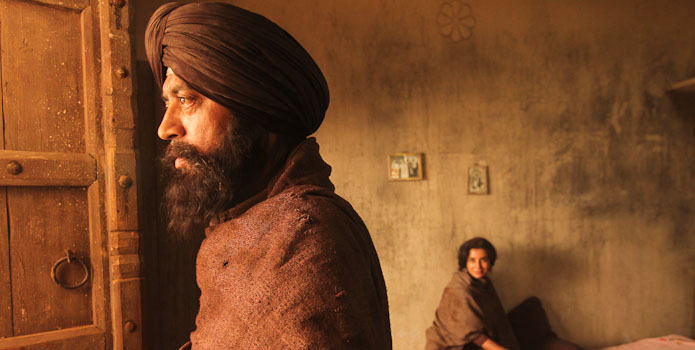
qissa_01

We at mFC have been vocal supporter of Anup Singh’s Punjabi film Qissa. We not only loved and recommended the film, but we put it in our mFC’s Must-Watch list also. So it was bit shocking to us when he was accused of not crediting the original source of the story. A Facebook post by theatre actor and co-founder of Why Loiter? Mumbai, Neha Singh, has gone viral in the last few days. We are copy-pasting the post here –

It’s disappointing that the makers of the film Qissa forgot to give credit to the marvelous Rajasthani writer Vijaydan Detha on whose short story ‘Dohri Zindagi‘ the film is based. Vijaydan Detha (1926-2013) is a par excellent Indian writer who wrote in Rajasthani and on whose stories filmmakers Mani Kaul (Duvidha), Amol Palekar (Paheli) and Prakash Jha (Parinati) have made films. Dohri Zindagi is a story of a man who raises his daughter like a boy, hides the fact that she is a girl from everyone is the village and then marries her off to another girl. When the bride realizes her husband is a woman, she is devastated, but she decides to stick with her. Both of them run away, while the villagers try to kill them, and a ghost comes as their saviour. When the girl that was raised as a boy pleads with the ghost to turn her into a man, he does so. As soon as the girl turns into a boy, she tries raping the wife.

It is unfortunate that the credit wasn’t given, because the filmmakers are depriving the young audiences in getting acquainted with this literary stalwart. When I went to see the film, the young film buffs sitting besides me exclaimed ‘what a concept’, ‘how revolutionary’, without knowing that this story was written by a simple Rajasthani writer in a village many decades ago. Vijaydan Detha is a Padma Shri and Sahitya Academy award recipient as was nominated for the Nobel Prize in 2011. He wrote over 1300 poems and over 300 short stories. His works have been translated in Hindi and English but its a pity hardly anyone knows about him. But everyone knows about Chetan Bhagat.

The original post is here.

Anup Singh has now clarified his stand on this credit controversy in another Facebook post. This is his post –

Anyone who has seen Qissa must feel the intimate, personal nature of the tale. It’s a thing difficult for me to mention, but please keep in mind that I grew up a Sikh in Africa. The long hair and the frail body of a teenaged boy in a culture unfamiliar with Sikhism often led, as you might imagine, to traumatic experiences. And surrounding that, the refugee tales of my grandfather of lost relatives, of old ghosts coming alive in the telling — these are the real secret threads of Qissa.

It’s always wondrous how these little threads of a personal lived experience, the tales of our forefathers lead us to weave stories that evoke and dialogue with other intense experiences become tales in other cultures. There are African tales of girls living as men, there are similar Egyptian and Moroccan and Turkish tales. And tales in Spain …

Qissa is my childhood, my response to the violence of our time, my putting the ghosts of my grandfather and other relatives to rest.

Please do not reduce our imagination to a single reading or a single tale. We are all many tales, many possibilities.

You can read the post on FB here.

In our Sunday Shorts, today we are featuring Whiplash. The short film which was the pitch for the feature by the same title. This is also directed by Damien Chazelle.

Based on his own experiences, Damien wrote the script and it made to Black List of 2012. He then turned his script for feature length film into a short film script. The short was screened at Sundance Film Festival, got rave reviews, won the Short Film Jury Award, and the feature got funding as well.

Made in less than $5millon budget, and shot in just 19 days, the film went on to bag three Oscar Awards this years.

Click here to read a feature on Damien’s journey to the Oscars with Whiplash, his second feature film.

Tip – ShortFilmWindow

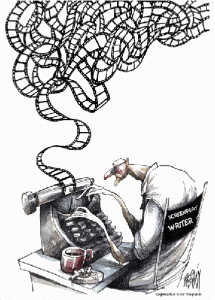
screenwriting-215x300WHAT : Manish Mundra’s film production company, Drishyam, in partnership with Sundance Institute, is organising Drishyam – Sundance Institute Screenwriters Lab 2015 to be held in Goa April 12-16.

The Drishyam Sundance Screenwriters Lab will provide an opportunity for writers to develop their work under the guidance of accomplished international advisors in an environment that encourages storytelling at the highest level. Srinivasan Narayanan, the former Festival Director of Mumbai Film Festival (MAMI) will be heading this initiative in India.

The Lab is inviting applications as part of its Open Submission Process.

LAST DATE :

The deadline for submission of scripts is March 5, 2015.

ELIGIBILITY :

– The Lab is for filmmakers making their first or second narrative feature;

– Co-writers, writer/directors, or writer/director teams will be considered, and the scripts should be independent in terms of story and spirit, and also in terms of budget.

LANGUAGE :

The film can be in any Indian language. However, for the lab, the screenplay should be submitted in English only.

APPLICATION:

– In order to apply, filmmakers must submit a complete draft of a screenplay as well as supporting materials (cover letter, artistic statement, bio, synopsis, and directing sample if applicable).

– There is no word limit or format requirements.

– Directing sample, if any, should be submitted as an online link

– Send complete application docket to drishyamsundancelab@sundance.org

CONTACT :

– For any queries/doubts, do write to – drishyamsundancelab@sundance.org. Or you can check their FB page here.

So happy writing!


Coffee Bloom

After having its premiere at the last edition of Mumbai Film Festival, Manu Warrier’s indie feature Coffee Bloom is all set to hit the screens on 6th March, 2015.

Directed by Manu and produced by Harish Amin,  the film will now be receiving a major international release as it releases simultaneously in India, USA and Toronto.

Here’s the official synopsis of the film –

Coffee Bloom’ is the story of Dev Anand (Arjun Mathur), who is a self proclaimed wise man and has given up on life as a result of a love gone wrong. A life changing event takes him on a journey to a coffee plantation. There he meets Anika (Sugandha Ram), his long lost love, currently his boss. Love blooms in an idyllic setting, bringing Dev out of his self imposed funk and Dev finds a new reason to live. Coffee Bloom also stars veteran actor Mohan Kapoor and Bengali actress Ishwari Bose in supporting roles.

Starring Arjun Mathur, Sugandha Ram, Mohan Kapoor and Ishwari Bose, Coffee Bloom is all set to hit theatres in India (Delhi, Mumbai, Kolkata, Chennai, Bangalore, Ahmedabad, Pune, Jaipur), US(San Francisco, LA, Seattle, New Jersey, Chicago) and Canada(Toronto).

And here’s the trailer –

Anup Singh’s Qissa is finally releasing in India. It’s a limited release in 5 cities with just a few shows. Scroll down to the bottom of the post to see the release details. But here’s the good news – even if you are not in any of the 5 cities or you are outside India, you can watch it on VoD. Click here to go to NFDC’s VoD link and enjoy the film. The film is in Punjabi with English subtitles.

We are re-posting an old recco post on the film. Don’t miss it- it’s a must-watch and has made it to our mFC Recco List.

Qissa

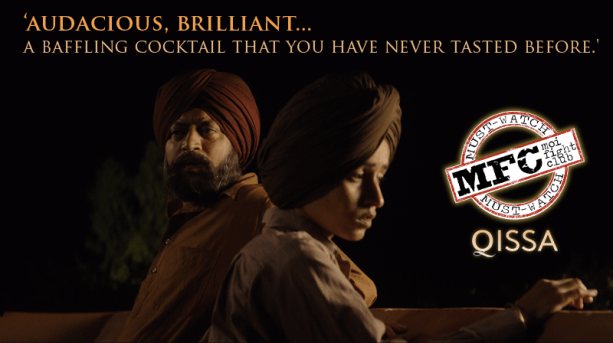
If the header of the post seems loaded, you will be surprised more when you watch the film. Yes, there’s gender-bending, it’s genre-bending, and a ghostly tale. Add partition, identity crisis, sexuality, female foeticide, sibling rivalry. It’s a baffling cocktail that you have never tasted before.

The ghostly part might be considered a spoiler, but since the film’s title already tells you that, am not sure if it should be counted as one. The film is titled “Qissa – The Tale Of A Lonely Ghost”. I think that’s a smart choice to let the audience know what they are getting into, and be prepared for it. On a similar tangent, it was a mistake which Talaash makers did by not getting the spoiler out.

Varun Grover saw the film at TIFF where it premiered, and reccoed it in a post here – “A film based on partition, in Punjabi, starring Irrfan and Tillotama Shome and Rasika Duggal and Tisca Chopra! I was already sold. And though it deals with partition in a more symbolic, metaphoric, allegorical way – I was moved immensely by it. Many friends had issues with the logic and amount of suspension of disbelief it demands (basic premise of a father who brings up his daughter as a son without letting anybody else know is a bit of a stretch, yes) – but it still managed to disturb and involve me probably because of the magic realism zone it enters in the 2nd half. And also because of Rasika and Tillotama’s terrific performances. Probably it’s only me but I think the film gives a solid theory on why Punjab has the maximum cases of female foeticide/infanticide. (Qissa won the NETPAC Award at TIFF)”

So i was already prepared for it. But i had no clue that it will be such a fascinating ride. The film starts with a voice-over that feels like a folktale. But it soon jumps into the reality of partition and ethnic cleansing which forms its backdrop. In the aftermath of partition, Umber Singh (Irrfan Khan) is forced to move to Punjab with his family. A loss of identity, roots and that place you call home. Do you ever get that back?

And from the politics of the land the film moves to gender politics. Having already three daughters, Irrfan forces the forth daughter to grow up like a son. The gender identity part is strange and you might question its believability factor. But i have always felt that never let the truth (or logic/reason/whatever you call it) come in the way of a great story telling. Let the filmmaker be your guiding torch in this new dark room that you have never entered. Just hold his hand tightly and enjoy the ride. Leave him only if he trips over something. In that dark room, the only thing that matters is the conviction with which the filmmaker guides you, and how much are you willing to trust him. I live to enjoy this cheap thrill, and trust me, most of the times the experience has been rewarding. It’s easy to spot the ones who know their craft and can direct. Qissa is one such dark room which you have never entered. It’s strange, it’s weird, it’s unique. You need that torch and that trust. So as you buy into the premise of its gender politics, you realise that this strange tale is becoming weird, and you keep wondering where it will end up.

Then comes the magic realism bit which wraps up the story and completes the circle. The sudden tonal shift feels slightly jerky but it’s a minor quibble in an otherwise brilliant film. Anup Singh captures the sights and sounds of the land beautifully. The arid landscape, the rustic rituals, the folksy sound, and the dialect of the region, there’s not a single false note in Qissa. Backed by strong acting talents – Irrfan Khan, Tilottama Shome, Rasika Dugal and Tisca Chopra, they manage to pull off this difficult film with much ease. Describing anything more of the film will spoil the fun for you.

Qissa is an audacious film, and all credit must go to Anup Singh for stepping into this rare territory which we hardly explore, and for delivering such a brilliant film. This is the reason why it might alienate some audience too. You are not sure how to tackle this film. So remember the dark room and hold that torch. You will be fine. Don’t miss this one. It’s rare to find such a gem. Because it’s rare to find a desi filmmaker who takes such an untrodden path.

@NotSoSnob

Qissa

The Ghanta Awards, 2015 – Nomination List

Posted: February 19, 2015 by moifightclub in Awards, bollywood, WTF
Tags: ,

Pic 1The 5th edition of the Ghanta Awards is here and the team behind the awards have come up with this year’s nomination list. The East India Comedy (Sorabh Pant, Sapan Verma, Sahil Shah and Kunal Rao) will host the Awards in Mumbai on 8th March, 2015.

1. Worst Film

Action Jackson

Humshakals

Kick


2. Worst Director

Farah Khan: HNY

Sajid Khan: Humshakals

Anant Mahadevan: The Xpose


3. Worst Actor

Ajay Devgn in Action Jackson

Saif/Ram/Riteish in Humshakals

Akshay in It’s Entertainment


4. Worst Actress

Bipasha: Creature 3D/Humshakals

Sonakshi Sinha: Holiday/Action Jackson

Sunny Leone in Ragini MMS 2


5. Worst Song

“Photocopy” from Jai Ho

“Icecream Khaungi” from The Xposé

“Callertune” from Humshakals


6. Worst Debut

Shekhar Suman in Heartless (as Director)

Mannara in Zid

Mika & Shaan in Balwinder Singh Famous Ho Gaya


7. WTF Was That!

SRK learning to dance from a bar dancer in Happy New Year

Jackie Bhagnani ‘inheriting’ the PMship in Youngistaan

Ajay Devgn’s genitals being a good luck charm in Action Jackson


8. Anything But Sexy

Sonakshi Boxing/Playing Rugby in Holiday

Randeep Hooda & Nandana Sen having sex in paint in Rang Rasiya

Deepika Padukone animated in Kochadaiyyaan


9. Most Controversial Controversy

TOI’s Deepika Cleavagegate

Ridiculous demands to ban PK

Ali Zafar insulting Afridi in Total Siyappa


10. Worst Couple

Ajay Devgn/Sonakshi/Yami/Manasvi in Action Jackson

Arjun & Ranveer in Gunday

Akshay Kumar & a Golden Retriever in It’s Entertainment


11. Worst Miscasting

Priyanka Chopra as Mary Kom

Alia Bhat & Arjun Kapoor as MBA’s in 2 States

Sonam Kapoor as a Physiotherapist in Khoobsurat


12. Worst Brand Endorsement

Shreyas Talpade for Red Bus

Hrithik & Sonam for Oppo Mobile

Viveik Oberoi for Swacch Bharat Campaign


13. Worst Supporting Role

Suniel Shetty and a tank in Jai Ho!

Everyone (Except SRK) in Happy New Year

KRK in Ek Villain


14. Shit Nobody Saw

Sholay 3D

Ungli

Dhishikiyaoon

Bey Yaar – It was a small budget Gujarati film that nobody had heard about. And then something magical happened. Again, something that nobody had heard about. The film’s writer Niren Bhatt tells us about the making of the film, the hurdles it faced, and its amazing journey – how it not only recovered its cost but went to earn almost 10 times its budget.

Bey Yaar

Any Gujarati (I hate the word Gujju) reading this blog is (I assume) aware of ‘Bey Yaar’, for others – it’s a small independent regional film which recently completed 25 Weeks in cinemas. It’s beyond belief (even for us) considering the fact that it directly competed with all major Bollywood releases for almost 4 months now, in a market conventionally strong for Hindi films, and in a space where regional content is absolutely non-existent in multiplexes.

For decades, Gujarati cinema was on ventilator. It was far away from urban diaspora. It was as if it did not exist. It was looked down upon, and urban audiences strictly stayed away from it. There were a few notable attempts to change the state of affairs by some maverick film makers, but somehow the outcomes were quite inadequate. Finally, things started changing after 2012 due to the success of Kevi rite Jaish.

That’s when we (Me and co-writer Bhavesh Mandalia) decided to give it a shot. We knew that taking a plunge in a nascent industry was commercially an imprudent decision. We also knew that tangible remuneration would be negligible. But what the heck, it was for the love of the language. And we had a big in-suppressible urge (i.e. chool) to do it. We had a few ideas and over the period of time, zeroed down on ‘Bey Yaar‘ with director Abhishek Jain.

We wanted to break free of mainstream Bollywood’s infinite commercial constraints.  The attempt was to organically create a story. We did not want anyone to tell us ‘iss mein love track kaha hai?’ or ‘iss mein item number daal do’. We wanted the freedom to let the screenplay take shape by itself.

As both of us (Me and Bhavesh) were doing screenwriting for a Gujarati film for the first time, it was an alien territory; we were not quite sure how it would pan out. But as they say, ‘a writer’s purest expression is always in his mother tongue’. We started realizing it as we started writing. The flair of the language, colloquial words, vernacular slang gave a whole new perspective to the narrative. The title ‘Bey yaar’ itself is a quintessential slang of Ahmadabad. Colloquially, it’s a short form of ‘Abey Yaar’, and literally it means ‘2 friends’.

Almost all the characters came from our real lives. They spoke our language; they had dialects, they had our sensibilities. There were no inhibitions; direct references were made from Van Gogh to Picasso, from Stanislasky to Pachino and from ‘Cubism’ to ‘Pop art’. Script’s requirement was fulfilled without anyone telling ‘apni audience ko ye sab nahi samjega’.

At the end of it, we knew that we had a winner on our hands. Since the story had a universal appeal, some producers advised us to directly make it in Hindi. But that didn’t tempt us a bit because it had to be in Gujarati. Its not a secret that real work is happening in regional cinema, especially in Marathi, Tamil, Malayalam, Bengali. We were simply in awe of films like Deool, Fandry, Aaranya Kandam, Aadukalam, Lucia and many many more. These guys were masterfully telling their own stories in their own languages. We had to tell our story in our language first. We had a belief – ‘if it can be done in other languages, it can be done in Gujarati too’.

We had certain actors in mind while writing the script. Convincing them wasn’t easy either.  Some actors straightaway refused because it was a Gujarati film. But after multiple narrations, frequent meetings, and relentless efforts, finally we had our desired cast in place.

The film was shot in Ahmadabad, in 35 days flat, in a modest budget. Marketing and distribution were always going to be the biggest challenges. Regional television is also going through the crisis similar to regional cinema in Gujarat, not having a viewer base in urban spaces. So tv was not an option. We relied too heavily on social media. Sachin Jigar’s music was a big plus for us. Songs immediately went viral and caught the attention of youth. FM channels generally don’t play regional songs in their regular slots; we had to buy special spots to play our songs.

There are no established distribution channels for urban Gujarati films. So exhibitors had to be coaxed and cajoled individually to screen the film. Exhibitors showed very little interest initially and we had a humble release in about 35 screens across Gujarat and 4 screens in Mumbai. But the initial response was really positive and more screens were added over the weekend. For a month we went go to cinema halls to interact with audiences and ask them to spread the word. Local media supported us really well; TOI gave a 4 star review. Chitralekha – the most popular Gujarati magazine helped us in a big way by doing a cover story about the film. The most popular columnists of Gujarat wrote about the film and highly recommended it. And then the magic happened happened – the most potent and effective ‘Word of mouth’ started spreading. Film’s FB page was flooded with compliments. Screens started adding up, and rest as they say is ‘history’.

In Mumbai, the film was out on 3rd week, then re-released in 5th week in 2 screens, after a week again it was taken out due to release of Haider and Bang Bang. Again re-re-released after a week, and then it had a dream run, uninterrupted for about 15 weeks. At one point, Bey Yaar had more than 60 shows in Mumbai.

Bey Yaar became a global phenomenon, the first Gujarati film to get screened in 4 continents, received rave reviews from Australia, New Zealand, US, UK, UAE, Belgium etc.

For us, it was our own little effort to change audiences’ perception about Gujarati cinema. Without being modest, I think this film has achieved that.

But this is an ongoing process. The success of this film is just the beginning. We desperately hope this trend continues. We hope new voices, new story tellers, new film makers will emerge now. And we hope they express themselves with utmost conviction and integrity.

– Niren Bhatt