Posts Tagged ‘anurag kashyap’

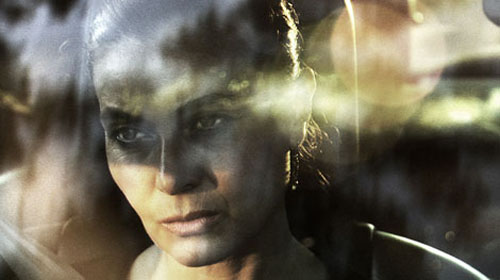
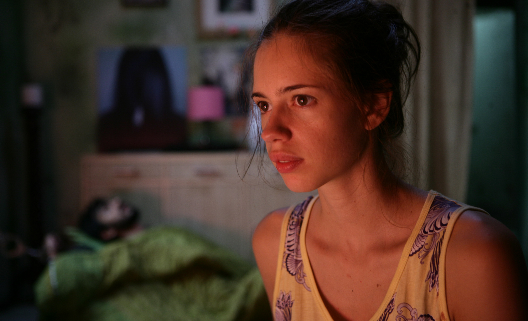
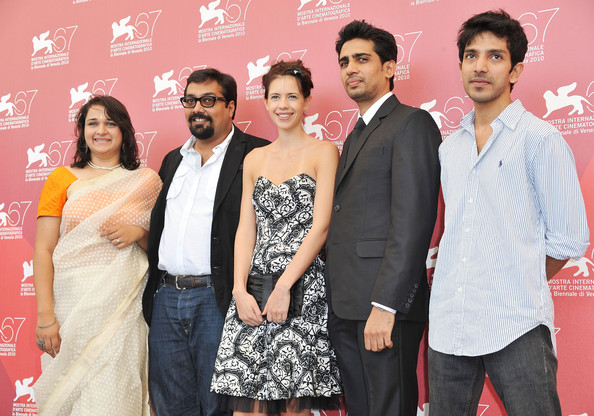
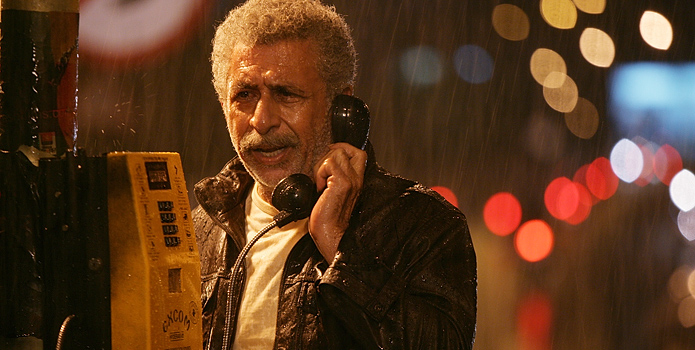
After graduating with an MBA degree and working for five years in Pune and Delhi, Neeraj Ghaywan moved to Mumbai. A new job for another 3 months and then he quit it all. To live, breathe and make Cinema. He started working with Anurag Kashyap. Life hasn’t been much easier since then but Ghaywan survived. Assisted Kashyap on Wasseypur and after working with him for a year, he has now directed a short called Shor. I saw it, loved it, and never thought that AK School Of Filmmaking could churn out another graduate so fast. In this post, Ghaywan blogs about making his short, from research to writing, casting to shooting..read on.. Some stills and the trailer is attached.

I read this research snippet about a woman doing a research on the influence of hormones on relationships. A part of the research involved the woman standing on an empty street asking out men for a date. She asked over 20 men. Her success rate was 40%. She did the same thing on a dangling bridge on a rough weather day. Her success rate jumped to about 85%. Though the static may not be exact but the hypothesis that she arrived at was that people are vulnerable to fall in love in dangerous situations. I had forgotten the article but it stuck in my subconscious and eventually led to an idea about the human condition at the face of death. When we embrace death, our most vulnerable time, we find our truest side. We confront what really matters to us. That became the basis for Shor. Yes, I wasn’t too happy with the title myself but when you see the film you’ll realize we couldn’t have come up with another name.

Shor is about Lallan and Meena, a couple from Banaras (North India), consumed by their pursuit to survive in the seedy ghettos of Mumbai city. Lallan has lost his job at the factory and ambles about hopelessly searching for a way out. Meena has taken up tailoring to make ends meet, losing touch with her emotions, and almost turning into a machine herself. One day they truly find each other while embracing death, divorce and redemption, all just over a phone call.

I had the basic structure of the script ready but I didn’t want to compromise with the culture and milieu of the characters. For me it is very essential to have the premise to adhere to a agreed upon set of culture and ethos. I used to take autorickshaw rides and speak to the drivers at length, recording the conversation on my phone and later make notes from it. I must have spoken to some 40 odd rickshaw drivers to arrive at 4 of them who were from Banaras. I conducted a focus group with these people, inviting them to my house. Yes yes, I have an academic and corporate background and old habits die hard. Anyway, I spoke to them for a long time about their lives, their homes, how they dealt with their wives, I made them call their wives and understand how they spoke to them in crisis etc. Finally, I wrote the script along with dialogue. I was very scared and excited. It was ready and I had to show it to Anurag ( I was assisting him on Wasseypur). It’s like you are going for an appraisal interview to your boss. He read the first page and rejected it. He didn’t read further and I was heartbroken. I felt terrible, this was not just a short film script, but my first work to my boss and he had rejected it. Some people rubbed it in. I almost felt like abandoning the whole idea of becoming a filmmaker. It was humiliating. I thought I should still do this.

I called my rickshawala brotherhood. I decided to go to their homes. Some of them were kind enough to oblige. I spent time at their place; observing their lifestyle, the objects in their houses, the kids, the neighborhood, what they did in their free time, what pained them, what made them happy etc. It helped in understanding their lifestyle and most importantly what language they spoke. Now that I had enough material, I started rewriting the dialogues. When you start writing dialogues, you realize how difficult is writing a screenplay as against a book or a short story. The research helped me in identifying the insecurities that they lived with and how they expressed themselves. I wrote a draft and ran it past Vineet Singh (the lead actor of Shor) and Varun Grover ( a writer friend). They made some tone and grammar corrections with the dialogue I wrote. By the way, Vineet Singh has the fine charm of the angry young man and I have lost the count of how many languages he knows. Finally Anurag read the script. He said it has great potential if I had established the two characters in the same space. He had couple of ideas. I put everything together but didn’t show the final draft which by the way, was the tenth draft.

I just wanted to go ahead and shoot. The more I deliberated the more I’d distance from the passion to make it. Also, there was this pressure of having assisted for only six months and here I was, attempting to make a difficult short film in complete guerrilla style. The folks at Tumbhi.com loved the script and I was ready to go. But there was one problem; the shooting process could only be started in August along with the competing short films, which was completely understandable. But I couldn’t have shot in the monsoons as the film was mostly in difficult exterior locations. So I borrowed money from friends for the shoot (Thank You Anubhuti Kashyap and Suresh Nayak). We got into pre-production, Rishabh and Puja jumped into help me on the film. Rishabh was great help on the locations and convincing people for the shoot.  Puja is responsible for the look  and the costumes. Poor her, she had to stay away from the action for all the work. They have really worked hard during the film. Super line producer Deep Singh came on board. We did the shot breakdowns, location recces and the research for costume, art and the train routes and stations. Mukesh Chhabra unconditionally helped me to understand what to look for while casting actors. He even did couple of auditions for me.

Umpteen number of rehearsals happened. Ratnabali, the female lead of Shor, was doing English theatre. To be honest, I was panicking because I wanted everyone to get the accent right. I am a stickler for accents. Vineet and I had a lot of sessions on accent modulation with Ratnabali. And when we did the final rehearsal, Ratnabali took me by surprise. I was shocked the way she picked the nuances of the culture. Amardeep Jha, agreed to play the amma. She was perfect in that role and she brought in her own mannerisms to add depth to her role. I remember someone telling me “Oh wow, she’s Sharman’s mom from Three Idiots”.

After an elaborate session we finally arrived at the shot break down. I am of the opinion that it’s almost impossible to replicate the feel of real locations and objects. I abstained from an extensive production design, relying completely on the property available on location (Malwani and Dharavi). . You can never think of a plastic toy of a swan couple with a broken wing. Like how coincidental is that!One of the auto drivers from the research, Pavan Sharma offered his house to make it as our crew base. His neighbor Irshad Shah offered his house as the main house of the film. Not only that, he and his wife also acted in the film. Pavan’s son was the little kid who plays Lallan and Meena’s son. His expressions still haunt me. Milind Shirke, my DoP is fantastic at guerrilla shoots. In public locations he would just hold the camera and either look away or talk over the phone. He used to tell me that if you set the frame, don’t look into the viewfinder for static shots. When you look in to your camera’s view finder, that’s when people look into the camera. He has great sense of framing and very quick at conceptualizing them too. We shot on Canon 7D as the motion capture is better on a 7D as against 5D. For the wide top angle shots, I got the watchman of the only tall building in the ghetto to agree use the building terrace. On the day of the shoot he backed out. In my broken Bhojpuri I made him believe that we are shooting a docu which is about ‘our people’ from Bihar and this film will be a ‘message to the government to listen to us to our woes’. That watchman got all charged up; thankfully he never asked me what I was fighting against. He was all supportive but he still declined. And then I realized he is expecting me to bribe him. I never felt so guilty in my life to have bribed someone, not even when I got caught driving without a license. It was a great idea to go all guerrilla with the shoot.

Without the guerrilla style, the film could have easily become one of the most expensive short films in India. More than the saving, it gave us the freedom of canning the shots exactly the way we wanted. The authorities would have never allowed us to take certain shots if we had shot with permissions. Honestly, if we were caught, we all would have been in jail. To avoid that, we made rules. No three people will be seen together, video assist was avoided. As much as I wanted it, we didn’t take the boom mike. We managed to shoot in sync sound with couple of lapels and a mini sound recorder for ambience. Every location we would find a make-shift base and hide whenever cops or some authorities would come around. I can’t thank Vineet and Ratnabali enough for their courage and conviction. They both risked their lives while shooting for Shor.

Post production took way longer than I had anticipated. I am working on the post-production of Wasseypur and I made Shor in between all the running around for Wasseypur. That was the most difficult part. I had to teleport myself from one studio to another studio, one film to another. Both films were equally close to my heart and it was difficult juggling and two timing. Thankfully, I had a great editor in Nitin Baid. I was handling post and he was assisting the head editor,Shweta Venkat for Wasseypur. They are a lovely team to work with. For few days, when I ran out of money for studios, Shweta loaned her macbook to me and also allowed Nitin to work on Shor while working on Wasseypur. It was great help. Zahir Bandukwala designed the sound and Suhaas Ahuja (You will soon experience their work in That Girl In Yellow Boots). We did a 5.1 surround mix for sound and think it really is achievement by the sound team to pull of sync sound in such difficult locations . Vijesh Rajan, is a bundle of joy to work with. He did the VFX, color correction ( made a DSLR short film look like a film)  and the titles. He also made the poster.

I don’t know which filmmaker said this that the biggest task for a filmmaker is to assemble a great team which is excited about the project. That’s what worked for me the most. All of this was possible through http://www.tumbhi.com. Most of the cast and crew were found on their portal. It’s a great platform to discover talent from all corners of India. I am eternally indebted to Tumbhi.com for not only funding the project but also to give us a platform to make this happen. Above all, thanks Anurag! I owe this to you.

( PS – This post was first published on Tumbhi.com)

With any Anurag Kashyap film, one thing is for sure – a debate. A divided house. We are also swinging from one side to another with every new post on the film. This is Salik Shah‘s first post here. Read on..

That Girl In Yellow Boots is Kalki Koechlin’s debut as a filmmaker. It’s written all over the film. Anurag Kashyap just happened to be there while Rajeev Ravi was busy setting up his camera on the ‘stage.’ Except for one scene where Ruth smokes against the dazzling red screen, the audience never notices his camera tricks. There is one scene though — where they abruptly cut from a close up to a mid shot of the two protagonists who seem to have finally accepted the tragedy of their solitary existence— which seemed to be an attempt to tease the audience by not allowing them to have their ‘emotional cumshot’ exactly where they needed it.

Pulp Fiction is an old trick—but can provide little ‘happy endings’ in otherwise an unhappy film. The happy diversions in That Girl In Yellow Boots are just that. The sad thing is the mistiming. In an otherwise comic scene, where Ruth spins a story about her father’s death, a little mischief was desirable. A camera angle or two, hinting at her playfulness, where she appears brutally honest to the innocent criminal but palpably mischievous to us, might have been forgiven by the neo-realists. Excess is bad, but so is overt restraint.

Sound is a tricky affair; the jarring background score wasn’t called for at key scenes—or was it placed there to deny the audience any sympathy for Ruth? How I wish I could mute to listen deeply to Ruth’s silences… A minimalist approach might have further polarized the audience—but the result might have been a rewarding experience. Years ago, I couldn’t understand Nobody Needs to Know (Azazel Jacobs, 2003), but the expressionless, unfathomable face of its female lead has stayed with me. That Girl In Yellow Boots works in silence, often brilliantly.

There are people as they are—and many of AK’s assistants have verily filled in as Ruth’s steady customers. Prashant, however, is the film’s most visible link to the theater. The words he chooses, the way he moves—all seem to be a reminiscence of an era behind us. Be it in the Skeleton Woman, Ek, Do (FTII) or That Girl In Yellow Boots, he is there—loud, unchecked, mimicking himself. You can see that he is acting—a constant reminder of the film’s limitation.

Cinema is not an actively participatory experience like the theater. When the human contact is lost, you’ve to employ literary, theatrical or cinematic techniques to fuel the audience’s imagination to fill in the gaps in the visual narrative. That is why you get the unborn child manifested in Three Monkeys. That is why whole sequences in After the Rehearsal are devised to ‘mesmerize’ the audience. Here we get face to face with Ruth and Ben as they are—helpless, victims of their own doing, hopeless—all in a very straight-forward, good in a theatrical way.

If anything, it’s an exercise—for Anurag Kashyap, for you and for me. Why should it be anything else? Making a film is all that matters to him; while we go to great lengths to obtain and frame a fake poster of a pirated film! Strip the cinema of its greatness, please. Today every man with a camera is a filmmaker. While I don’t expect them to be Wong Kar-Wai or Tarkovsky—which they might very well be; they don’t need to be—I do believe if given a chance, they could be more authentic. It’s a good thing for cinema. It’s the new pen of our times; let them write; let us write with it. That’s indie. And no one seems to understand this better than this father of ‘Hindie.’

Keep shooting.

 — Salik

Forget Salman Khan, even Fatema Kagalwala is on a roll. One day, two posts. Click here to read her hilarious dissection of Bodyguard, and scroll down to read her post on Anurag Kashyap’s latest release, That Girl In Yellow Boots.

Seedy is not Mumbai’s underbelly, it is the defining aspect of its identity. In this quagmire is a young girl struggling to survive. An English citizen in a strange city, she is but twenty years old. At a time when most of us our dreaming of building fancy careers, watching our weight, worrying about skin/hair problems while striving to date that hot bod, she is fighting to stay afloat in the dense-ness of red tape and sexual exploitation.

She is Ruth, Anurag Kashyap’s protagonist in his latest film, ‘That Girl in Yellow Boots’. She is as vulnerable as she is steely and as undaunted as she is brittle. She meets exploitation at every corner, simply because she is young, female, single and white-skinned. She is looking for her father who abandoned her when she was five. There is darkness everywhere she turns and she buys some light with the money she earns by giving massages and handjobs to willing customers, what she ironically calls, ‘happy endings’. As the official synopsis reads ‘everyone wants a piece of her’, and she obliges – if it will lead her to father.

Anurag Kashyap lays it out thick. Grime, blood, sweat and semen. Loss, pain, failures and trauma. Darkness is no stranger to the film-maker, his oeuvre almost revels in it. He always says it as it is, sometimes even too much. But TGYIB doesn’t suffer from over-doing. Ruth’s world is murky and steeped in pain but there is spirit in her struggle. Her existence seems doomed but there is assurance in her steps. There is an emptiness in her eyes and a desperation in her heart but her mind is focused. She is love-less but not lost. She is gathered and determined.

So is the narrative. It follows its story with focus even though it becomes unstructured and loose at times. It doesn’t give into impulsive cinematic expressions at the cost of her character’s journey and that seems to be symptomatic of a creative evolution of the maker. For that alone, this can be called a notable film.

This time round there is no shying away from emotions. There is no uncomfortable distance from vulnerability and neediness is not wrong. There is a unique objectivity which is a hallmark frame of reference with Anurag Kashyap’s films, something that made Black Friday the classic it is. Along with this objectivity there was also apparent a seeming reluctance to engage emotionally with the character. Hence Dev simply remained a lost drunkard, Chanda an unapologetic fighter and Paro’s vulnerability never found the sure footing to blossom enough.

But Ruth is not like that. She is almost life and blood. I say almost because she falls prey to a lot of unsure moments in the film which keep her from blossoming fully. Her interactions with her boyfriend seem half-heartedly performed and the fault does not lie with the protagonist but the choreography and uncultivated chemistry between actors. Her denouement is not intense enough but while she is on unsure ground she is also explored from more ways than one. However, she is not sentimentalised and therein lies the strength of the film. Wouldn’t that have simply undone the very premise of her character?

Kashyap employs child abuse as a prominent theme, perhaps to enforce yet another layer of brutality to the already dismal world of the film. But this he juxtaposes with a fatherly figure, Ruth’s only male massage customer who is affectionate to her without objectifying her. Female strength finds yet another towering personification in the massage parlour owner, Maya (A brilliant, effortless and sparklingly honest Puja Sarup). Their identification and subsequent bond speaks volumes about the opposing forces of exploitation and survival.

Cinematic elements come together in harmony to tell the story of Ruth’s journey. Even as Rajiv Ravi’s digital camera caresses Ruth’s dismal life with an expressive graininess, Wasiq Khan’s seamless production design melts grunge with the dullness of the ordinary. We notice the torn beige sofa and the darkly-lit, narrow parlour lounge almost becoming metaphors of Ruth’s dislocated life.

In the pursuit of defining its protagonist’s journey, the film however fails it’s peripheral characters. Shiv Subramaniam, Mushtaq Khan, Divya Jagdale, Makrand Deshpande, Piyush Mishra, all remain mere tools of the exploitative environment without completing an experience. This singularity becomes representative and seems forced and has much to do with broad-stroked writing, seeming to take the ‘easy’ way out.

There is also the sketchily written character of Kannadiga ganglord Chitiappa explosively performed by Gulshan Devaiah, easily the star of the film. He settles in instantly and shines through till the end, effortlessly balancing the Nana Patekar-esque eccentric stereotype with the defencelessness of a school boy. This balance is what Prashant Prakash never gets right unfortunately. His see-sawing volatile character had immense scope to capture a spectrum of moods, emotions, swings and even personalities but he never really manages to get under our skin.

The film begins on an unsure footing, taking us slowly into Ruth’s world, introducing it through her encounters. Dialogues are many a times listless, almost murdering moments. Improvisation shows in the body language of actors and sync sound catches the uncertain intonations of lines made up on the spur of the moment. For a film crafted to evoke a response beyond the intellectual and focused on following Ruth’s path to her father, this serves as an undoing.

The film largely works because of its choice of actors. Kalki’s oval-faced innocence, a full-mouth unable to hide the Bugs Bunny teeth and the clear sad eyes looking at you become synonymous with Ruth right from the beginning. The actress wears her character unlike any other she has done before, and it is this certain ‘giving up to the character’ that one senses, which becomes the most appealing. We never cry with her or hurt for her but somewhere the film convinces us to feel enough for her to know what will happen to her and silently wish her well. As a takeaway, that is big.

Luis Bunuel said – “Fortunately, somewhere between chance and mystery lies imagination, the only thing that protects our freedom, despite the fact that people keep trying to reduce it or kill it off altogether.” Team TGYIB uses theirs very well to give us a world that is precisely between chance and mystery. 

And worst even, why should Bodyguard be his benchmark?

Is that even a nursery level contest – to make a film better than Bodyguard?

And if it’s so, you are on the wrong page. Like other film buffs, i have been following his campaign to sell 6,50,000 tickets so that he can keep on making his kind of cinema. Well, i hope it happens. And we need it to happen. Because as my twitter buddy @rmanish1 tweeted, kyunki har ek cinema zaroori hota hai.

But that should not be the reason to celebrate a mediocre attempt as the best thing to have happened to our cinema in recent times.

Anurag Kashyap and his brand of cinema needs no introduction. Few directors in this country can claim to have genuine fanboys. And believe it or not, a friend told me that a classmate of his from St Xavier’s even had a poster of AK in his room. To some extent, one of the reason is that everyone loves a good underdog story. He represents that. Everyone loves a good middle finger to be shown to the world that they hate but can’t do. He is been there, done that. And then there’s his filmography. Long list of films written and directed by him.

In the last few years he has almost become the messiah of everything independent. But since we are not sure how to define “indie” in India, let’s just say he is the strongest voice for anyone struggling to make a film. He is also easily the best filmmaking school in the country. Plus his talent to spot and back some of the best talents in front and behind the camera. Amit Trivedi, Amitabh Bhattacharya, Rajeev Ravi, Mahie Gill, Vikramaditya Motwane among many others.

Also, at a time when we are dying to find a connect with the auteurs of the world cinema and the film fests,  he became our window to the world. Name the fests, the actors or the filmmakers, and he is there.  The list is again long – Quentin Tarantino, Michael Winterbottom, Ang Lee, Wong Kar Wai, Tilda Swinton, Danis Tanovic and others.

So what do you expect from the filmmaker?

His last film released almost two years back. And in those two years, the cinema world map and awareness has also changed accordingly. With various legal and illegal means to source the best cinema from across the world, why should our benchmark be so low for any film, made in India or outside? And that’s why That Girl In Yellow Boots fails miserably.

I had read the script too. Well, only because he is one filmmaker who doesn’t fuss about his scripts being read and he will even happily show his unreleased film to anyone. All respect for that. Even when i read the script, i could not believe it was written by AK. Scenes would start and end with, Hi. Hello. Ok. Blah blah blah. Bye. I had to fight with a friend because i could not believe it was written by AK.

Then i saw the film. Twice. For me, it’s his most simplistic tale till date. Shocking? Morality? Huh! And i still can’t find the point of the film. What’s the motive behind making the film? What’s the point of telling this story? Hell yeah, what *exactly* are you trying to tell? I know, all artists have all the rights to do whatever they want. But to ponder and blabber over it, that’s mine.

Selling shock? There are Korean Masters.

Selling sex? There is Lars Von Trier. And then the French are there.

Selling indie? There is Once. Monster.And many many more. It doesn’t even come close.

Selling struggle? Jafar Panahi is in jail.

So where does TGIYB stands in the context of the world cinema, the cinema that we know, talk, discuss, follow, love and get excited by and aspire to be ? Sadly, nowhere.

TGIYB’s magic is only in the making. Someone can get the cast and crew excited about the script and complete the shoot in just two weeks, that’s a great achievement. But why should i count your struggle in my film viewing experience?

Gulshan Devaiya and Puja Sarup are just delicious. The film belongs to them even though they hardly matter in the main story. Dear Bollywood, can we please see them more? Kalki’s acting is uneven. In some scenes she is the perfect Ruth, you can’t think of anyone else, and then there are scenes that make you feel that she is Kashyap’s wife. Taken for granted. Prashant Prakash is so loud and theatrical. Someone needs to tell him that it’s not stage, there is a camera that register every nerve movement. AK’s brand of dry humour elevates the impact of many scenes but he fails in the finale. The scene which is designed to give the final blow, you cringe in your seat wondering how could he let it pass because the actor looks so clueless. It seems nobody was sure about his emotions.

With AK, you don’t need to worry about the craft, the sound or the visuals. Loved the scene where Kalki and Puja are on the phone, both talking to two different persons but it follows so smoothly. That’s the mark of a good director.

But all you worry about is why TGIYB is even a feature film? Why it couldn’t be a short? Some of the best filmmakers worldwide indulge in shorts whenever they feel like. TGIYB’s story even follows the pattern of a short. Then?

Was it designed to woo the fests? He should have sent his Black Friday then. Was it written/directed as a gift to Kalki? People do crazy things in love. It’s ok then. Or was it really written because he and Kalki felt like telling this story? Then it’s quite a lazy piece of writing.

To quote Kashyap’s review of Black, i would say TGIYB is best (or shocking or whatever you want to call) for those who haven’t seen better.

Let me quote few more lines from the same review,

On a day such as this, I can only hope we make better films than statements. Our best is far, far away from the world’s best cinema. They are not even a mile within the threshold of the top 100 films of world cinema.

It was written in 2005. We are still struggling. And the filmmaker who wrote these lines, if he can’t deliver, then whom do we expect to do it? Why should he get a concession?

Though it’s a great thrill to see the names of some of your best friends in the opening credits but why should that be a reason for not shouting out about the emperor’s clothes.

And strangely, for the fans of Salman Khan and Anurag Kashyap, who belong to two different extremes, one thing is common this weekend – disappointment. Both deserve much much better.

UPDATE (3rd September, 2011) : The trailer has been removed because it’s not the final one.

The trailer of Ribhu Dasgupta’s debut film Michael is out. Its produced by Anurag Kashyap and Studio18. The principal cast includes Naseeruddin Shah, Mahie Gill, Purav Bhandare, Sabyasachi Chakraborty and Irawati Harshe.

Other credits include Screenplay : Debaloy Bhattacharya and Nilendu Guha, Cinematographer : Somak Mukherjee, Editor : Lionel Fernandez, Sound : Kunal Sharma, and Music : Vinayak Netke, Aatur Soni, B. Gauri (lyrics).

The film will have its world premiere at Toronto International Film Festival. And scroll down to read TIFF Programmer Cameron Bailey’s note…

Producer/director Anurag Kashyap (who also exhibits his acting skills at this year’s Festival in Trishna) is leading a whole new wave of vibrant independent cinema in India. With Michael, Kashyap’s latest collab­orator, first-time director Ribhu Dasgupta, takes on a slow-burning, character-driven psychological drama.

In the film’s opening shots, Michael (Naseeruddin Shah) stands paralyzed as Kolkata traffic swirls around him. The film then flashes back to a younger Michael, in the days when he was a police officer. We find him nervously surveying a swell­ing crowd of protesters. When the order comes down to open fire on the peaceful demonstration, Michael shoots low to avoid causing death. Nonetheless, a ricochet strikes and kills a twelve-year-old boy. At this point Michael’s life begins to unravel. His eyesight worsens, he loses his job and he struggles to care for his son. When Michael finds work illegally pirating Bollywood films, he starts receiving phone calls from the father of the boy he accidentally killed, threatening to kill his own son when the boy turns twelve. Michael is sent into a paranoid race against the clock.

Dasgupta uses intricate camera move­ments, angular framing and hazy point-of­-view shots to explore Michael’s psychological and physical deterioration. Kolkata’s rainy, hectic streets, captured in mesmerizing detail by the late cinematographer Somak Mukherjee, provide the bleak and progres­sively nightmarish backdrop. Performing with strength and subtlety, Shah (Monsoon Wedding, The League of Extraordinary Gentlemen) carries the film. Opposite him, Mahie Gill (Dev D) delivers a gentle and sympathetic performance as the nurse who becomes Michael’s companion. As Michael’s sight weakens, so too does his grip on real­ity, resulting in a heart-wrenching tale of a father on the cusp of losing everything.

(PS : Note is from TIFF’s official website)

Trishna and Michael, both the films will have its world premiere at the Toronto International Film Festival.

Michael Winterbottom’s latest film Trishna is not only set in India but it was more than one desi connect. The film’s trailer is out and according to official release,  it’s an adaptation of Thomas Hardy’s Tess of the D’Urbervilles set against a contemporary Indian backdrop. Freida Pinto stars as the titular Trishna, a young woman who is seduced by the wealthy son(Riz Ahmed) of a property developer. As the romance develops, their relationship also becomes increasingly sordid and volatile.

Click on the play button to check out the trailer. what a smooth and soothing track! Wow, Amit Trivedi, scores again? Seems so, at least from the trailer.

Michael is the latest production of Anurag Kashyap films. Directed by debutant Ribhu Dasgupta, the film’s trailer or poster is not out yet. But you can check out some of the stills. It stars Naseeruddin Shah, Mahie Gill, Purav Bhandare, Sabyasachi Chakraborty and Irawati Harshe.

According to official release, it’s a character-driven psychological drama. Using intricate camerawork and intimate point of view shooting, Dasgupta tracks one man’s physical and psychological deterioration in the rainy, traffic-filled streets of Kolkata. Check out the stills.

This slideshow requires JavaScript.

Toronto International Film Festival has announced its international line-up for this year’s fest. So far four Indian films are in the list.

1. Mausam (Seasons of Love), Pankaj Kapur, India World Premiere

Mausam is a story of timeless love in the face of political hostilities and religious conflict, between a proud Punjabi Air Force Officer and an innocent Kashmiri refugee. Set against a landscape that transcends decades and spans continents, Mausam is a classic journey that transports one into a world of indestructible bonds of love enveloped by the roulette of destiny. Starring Shahid Kapur, Sonam A Kapoor and Anupam Kher.


2. Michael, Ribhu Dasgupta, India World Premiere

Michael, an ex-cop, lives with his 11-year-old son and works in a theatre as a projectionist pirating DVDs for a living. When he starts receiving death threats for his son from someone in his past, he gets caught up in a complex web of his own impending blindness comprised of his insecurities. First-time director Ribhu Dasgupta teams up with India’s guru of independent cinema, producer Anurag Kashyap, and veteran actor Naseeruddin Shah for this character-driven, psychological drama.

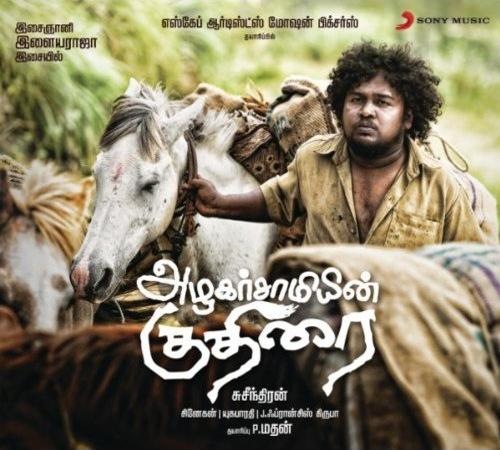
3. Azhagarsamy’s Horse, Suseendran, India International Premiere

In a small Tamil village, a ceremonial wooden-horse statue goes missing. With a crucial holy symbol suddenly gone, the village falls into recriminations and comic chaos. At the same time, Azhagarsami, a young man who earns his livelihood by ferrying loads on his horse, puts his marriage on hold when his horse also disappears.

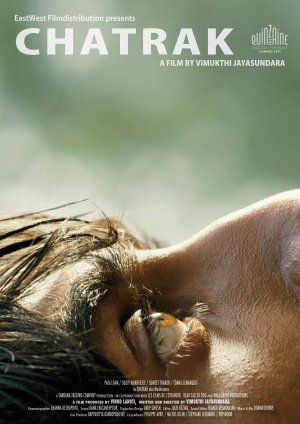
4. Chatrak (Mushrooms), Vimukthi Jayasundara, India/France North American Premiere

Rahul, a Bengali architect who had gone off to build a career in Dubai, returns to Kolkata to launch a huge construction site. He is reunited with his girlfriend, Paoli, who had long awaited his homecoming. Together, they try to find Rahuls brother, who is said to have gone mad, living in the forest and sleeping in the trees. Despite appearances, the two brothers might have a lot in common.

An Indo-France co-production, Chhatrak (Mushrooms) directed by Sri Lankan filmmaker Vimukthi Jayasundara was also part of the official lineup of Cannes Directors Fortnight. His debut film The Forsaken Land had won the Camera d’Or for best debut feature at Cannes in 2005.

Another film with an Indian connect at TIFF is Michael Winterbottom’s Trishna. Starring Freida Pinto and Riz Ahmed, and based on Thomas Hardy‟s novel Tess of the d‟Urbervilles, the film is set in contemporary India and tells the tragic love story between the son of a wealthy property developer and the daughter of a rickshaw driver.

Anurag Kashyap’s next release That Girl In Yellow Boots finally gets an official poster. Not sure if it’s the same agency which has designed the posters of Dev D, Shaitan and now TGIYB but some design hangover seems to be there…similar elements, colours and that garish touch.

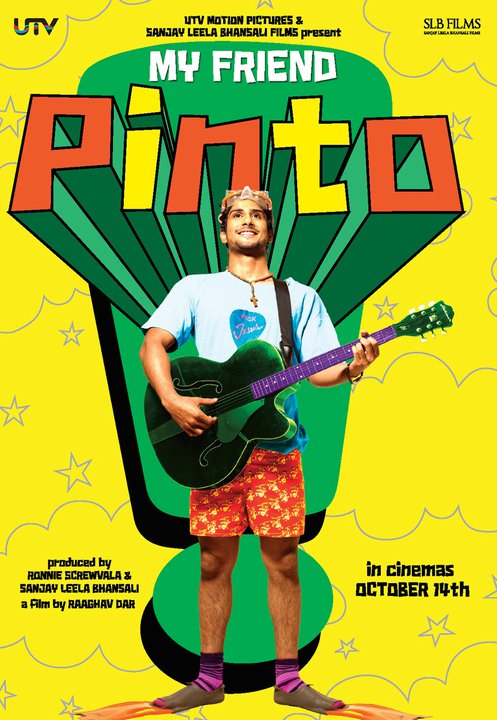
Sanjay Leela Bhansali is also ready with his next production, My Friend Pinto. Directed by debutant Raaghav Dar, it stars Prateik, Kalki Koechlin, Arjun Mathur, Divya Dutta, Raj Zutshi and Shruti Seth.

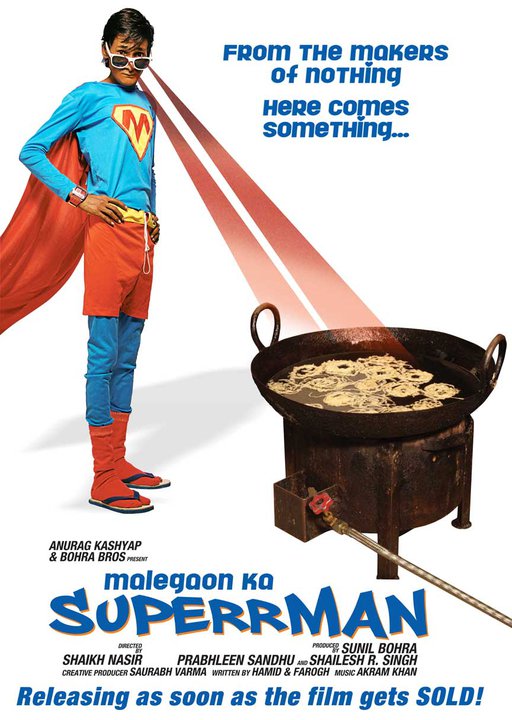
And the third one is Malegaon Ka Superman. This one comes from the cottage film industry of Malegaon. Do check out its tagline.

We are quite late on this one. And we are still a divided house. The reactions have been quite extreme. Sample some – Like it for what it is, What the F really – Anurag Kashyap Films is rehashing Anurag Kashyap films, it’s in amateurish territories, What a freakin’ headache, he is definitely exciting and with more content to back might make something really noteworthy, Major Hype Overkill, it is an unfortunate coincidence; we seem to have learnt the style to narrate at exactly the same time when we have forgotten what to narrate, all said and done…I loved Khoya Khoya Chaand. And the debate is still going strong.

So, here’s a post on Shaitan by Kenny Basumatary. He is actor, writer, director, and Kung Fu  can easily be his middle name. And yeah, he is music composer and lyricist too. Now even a published author…woosh!

And since there’s no good film at the theaters this friday, do check out Shaitan.

(SPOILER CAUTION: Preferably read this piece only if you have watched the film.)

 A maniac drives his vehicle at murderous speeds, weaving in and out of traffic and nearly hitting you and several other pedestrians and vehicles. You feel like shouting, or maybe you actually do shout, “Abbe saale marega #*&$% k$ *&#$^!!!!”

 In my opinion, Shaitan is that very shout. It’s a warning that says “This is what’ll happen to you, assholes!” to all those irresponsible kids who drive like saare raaste unke pitashree ke hain.

 I frequently see kids, especially on bikes, driving like they think they’re in Dhoom 3 and all the other people on the road are stunt drivers meant to give them way. It’s hardly surprising that accidents caused by such retarded jerks are on the rise. A few weeks ago I read of an 80 year old man who was hit and killed by a biker trying to race. Last month, a friend’s roommate was hit by another overspeeding kid on a bike. She was literally thrown some distance away, and couldn’t stand up or hear properly for two days – luckily she’s healed now. I was quite happy to hear that the sonofabitch who’d rammed into her was hauled off to the police station.

I toyed for a while with the idea of writing a film about the kind of serious consequences that can happen because of stupid deluded kids who think they’re becoming John Abraham by racing on public roads. In my film, two kids would be racing and get into a serious accident. One visual I had in my mind was one of them – helmetless, of course – flying through the air, and then his face – somewhere around the nose and upper lip – would crash into the footpath and shatter in extreme slow motion a la the crash scene in Death Proof. And then a truck would run over his skull and there’d be a loud popping sound – wait, I think I’m getting carried away here.

I’d have focused on the second kid getting grievously injured and having to spend a year in bed without being able to pee or crap on his own, and maybe even losing a limb or becoming unrecognizably disfigured. I’m sure many of us know of such cases. A college friend of mine drove his bike drunk at night and crashed into an electric pole. He needed months of physiotherapy to walk properly again. Another friend’s kid brother was pillion riding while his friend was playing the hero, with the result that the kid brother was the one who ended up in bed for months. A very talented chap who could play guitar very fast also drove his car very fast, and one fine night he crashed and not only landed in a very serious state in hospital, but worse, landed his friends in hospital as well.

My intentions would have been to scare irresponsible drivers so shitless than they’d never race even in their nightmares. Just like one would show people Requiem for a Dream to forever scare them off drugs, this film, if it had ever gotten made, would scare people off racing herogiri.

But now Bejoy Nambiar’s already made that film. And done an excellent job of it. I haven’t personally asked him what his intention was while telling this story, but I suspect it’s what I said at the beginning – a warning – “This could happen to you, assholes!”

Various friends have said that one doesn’t really care much for Shaitan’s characters, and they’re trying to be too cool, but I think that’s exactly the point – we’re not supposed to care for these characters, at least not KC or Dash. I, for one, relished all the trouble that they deservedly got into – KC getting slapped, for example. (“Aur maaro saale ko!”)

I wasn’t excited by the trailer at all – it looked like the film was trying too hard to be hip and cool – highlighting supposedly the most scandalous bits – a girl-girl hardly-there kiss, girls buying condoms, very violent violence, but the moment the accident happened, I was won over. Okay! So that’s what this film is about! It’s not about youngsters trying to be too cool and hip; it’s about youngsters trying to be too cool and hip and consequently getting into shitloads of trouble. Good. I like it.

This isn’t a review of the film, but I must say, I loved almost everything about it – the acting, the dialog, the shots, music, editing. I was a little surprised that absolutely no time was spent on the accident victim’s family, but that would probably be a different revenge film altogether. Even the divorce subplot was dispensable, but the divorce court scene made it worthwhile.

Rajeev Khandelwal was perfect. I would actually like to see another film with this same character – I felt Inspector Mathur was the real-world equivalent of Chulbul Pandey.

Shaitan isn’t easy to watch (unless you’re used to the levels of violence in, say, Chan-Woo Park’s Vengeance trilogy). Some bits are quite violent – do not take your kids along. But I would say the violence is essential to drive home the point the film makes. It’s worth a watch. High production values don’t automatically mean a film is mainstream crap and low production values don’t necessarily mean a film isn’t non-mainstream crap, and vice versa.

This isn’t a tale of heroic feats. It’s about two lives running parallel for a while, with common aspirations and similar dreams.

-Ernesto Guevara de la Serna

I am bad with names. I guess, terrible. And am very good with excuses. So, it gets compensated mostly. And that’s why whenever I save a new contact in my phone, I always add a suffix or prefix to the name. It makes life easier. Because whenever I am searching for anyone, if not the name, the suffix or prefix will help. Either place, profession, common friends, where we met, how  we met, why we met, and noun, pronoun, adjectives, verb (don’t pick) of all kinds.

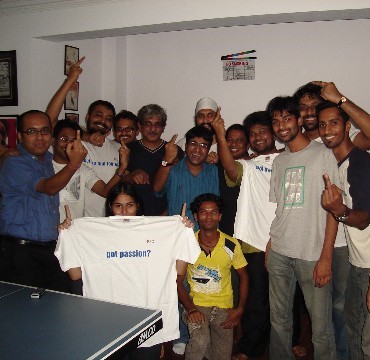
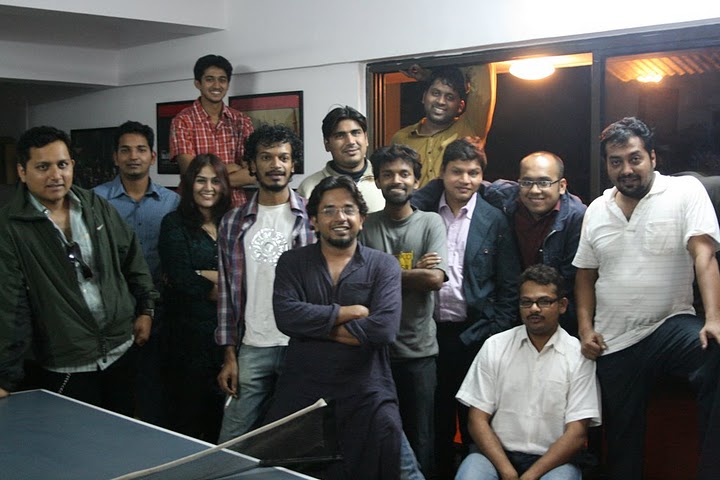
Before I started writing the post, I quickly searched for PFC in my phone’s contacts list and believe it or not, the number of contacts with PFC as suffix is 44 – covering almost every alphabet from A(shish) to W(B), even Z if you count Zoorya (Surya) as I call him. And in the last few years some of them have become 4am friends too. And am not counting any filmmaker, producer, writer or celeb here, with them it’s always aspirational, at least to start with. Talking about mere mortals like us. Friends from across states, nations and even continents. Many of us have met each other, shared our stories and bonded over everything that’s life. At the end of the day,  I guess, that’s what PFC has done. Internet, you beauty. Add cinema, and we are alive.

PFC started in August-September 2006. I guess I joined in December. How, why – don’t remember exactly. I wasn’t in a boring cubicle and my day job wasn’t boring either. Then? Must have been a google search for ‘Anurag Kashyap’. Because there was a time when PFC = AK, which wasn’t true but the industry always thought so. “Oh, AK’s mouthpiece. So much negativity on that site!”. Well, that’s the way it was.  Just because we had endless rounds of biryanis and drinks at his place with access to some of the best world cinema, it didn’t mean that we had to worship him or his friends. Criticise him and he will listen. He will argue, fight, try to make fun of you, put his favourite question to you, “tune kya likha/banaya hai?“. But that’s just him, trying to figure out if you really know your shit or just blabbering. And yeah, No Smoking had equal number of posts on both the extremes. Let me also confess that there were times when many comments which attacked AK were moderated and without telling anyone I used to approve them. If it’s about cinema, if someone is making a point that AK might not agree with, there is no point in blocking that comment. The general policy was to keeps the trolls away from filmmakers, keep the site clean but what’s life without some cheap thrills. If it’s AK’s cinema, his post, let him face it.

There was also Suparn Varma, Hansal Mehta, Pavan Kaul, Sourabh Usha Narang, Sam Longoria, Ramu Ramanathan, Bhavani Iyer (Onir, Navdeep Singh came onboard later) and some 30-35 bloggers from across the world. Forget everything else, we had no clue about each others names also. Some of us used to write posts with nicknames/handles and we used to address each with those handles. Honhaar Goonda, DPac, RK, Ranga, Macchar Kumar, Dabba – some of the handles that I can think of right now. Once a friend was visiting London and he needed some cash urgently. The first name that came to my mind was Honhar Goonda and I had to ask another friend for his real name. There were mele-mein-bichhde-huye-bhai too, Pavan Saab and Subrat: where Google fails, they come to the rescue. Do you know Chic Chocolate?

Then there was Kartik Krishnan (KK) – the face of PFC in Mumbai. He would go to any length to do anything for PFC, would travel any distance to meet any new author of PFC. With Vasan, three of us soon became the point persons for all kinds of activity. And the invisible brain, the hand, the man behind everything else was Oz. PFC was his idea, his intiative. Log milte gaye aur karwaan banta gaya.

For the first few years, it was all smooth. We never bothered to ask how the site was running, how much space, what the readership was and  other such technical details. That was all Oz’s headache. A bunch of 10-12 editors, including three of us, used to take editorial calls and we were busy blogging – shouting, screaming, fighting – all for cinema.

I might be completely wrong but I think the first time we had some kind of disagreement when a filmmaker gave the idea of turning PFC into commercial venture and someone decided to do it. Since it was mostly one man control as far as any cost was concern, it was all his call. Rest of us were foot soldiers. Discussion soon moved from club to chain mails and many of us expressed our discomfort about the way the decision was taken. We were blogging because we loved it, there was no intention of making it IndiaFM or any such commercial venture.

Of course there was ample space and time given to everyone to debate, discuss and put forward all kinds of suggestions in Club. Those days authorship wasn’t open to everyone, but by invitation only. We had a club for the authors which was not visible to the rest of the world. And countless nights have been spent on random discussion threads in that club. Those were the Club days too!

There was Review contest (Yes, Thani), One minute short film contest, Poster design contest, Pitcher contest – Oz was always the man to go and we would execute it in best possible way. TOI gave us half page coverage too, with some of us happily posing for the camera in the middle of  a busy road in Dadar’s Hindu colony. Aha, the cheap thrills. Every mention of PFC in the media was one step forward in making it more visible, making it more mainstream. The industry slowly took notice and mostly loved to hate us.

Krsn Kavita Kasturi (I hope I have got her name right) – She was one of the  respected blogger at PFC who knew her cinema quite well. As it mostly happened in the club, once she disagreed on some point which we all were gung-ho about. We were quick to brand her as PFC-Drohi and me and KK got into an altercation with her. I Still can’t remember what was the reason, the exact topic. Blame it on age. But we were PFC-Bhakts and she was PFCDrohi soon. She quit PFC after that. KKK, if you have Google Alert on, apologies from me. Because all this seems too trivial now.

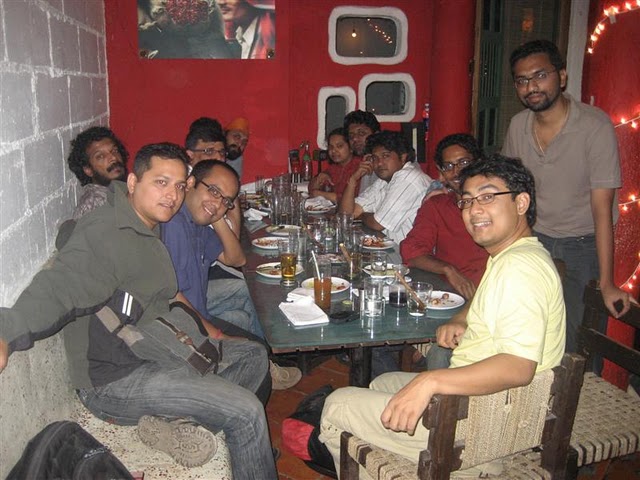
And what a surprise, in the next two years, I was in her shoes. As a dozen of us  met last night  at a friend’s place and we started talking about PFC, we could not agree on one version of the story – how it started? Was it this or that? And there were alternate versions too. Why we could not agree on few things?

Among many other things (man with an agenda, conspirator), I was even branded racist. I could not figure out the reason then and discovered it much later that I had put a comment saying “firangi” or something like that in one of the threads in the Club and by that time one of us had got married to someone for whom that was racist remark or kind of. I tried the search option in my gmail, went through some mails, and gave up. Too tedious, too kiddish. There must be hundreds of those mails, may be we will tell our grand kids about it.

Like every story has my right side and your wrong side, it was the same for PFC. Also, it was “Catfish” syndrome for some of us. “Dude, he is so boring. Come on, we can’t say it to him. We have to meet him. No, you go away, I will skip.”  We also realised that the set-up was becoming too feudal. One man would control it all, he would not listen to anyone except those who  agree with him and celebrate him. We asked questions, raised our voice and it made things worse. The reason given was, “I quit my job, I gave my life and soul to it, my space, my time for it. How dare can anyone ask me what i want to do?”.  And we thought, “But who asked you to do so? We all have our jobs, we all still contribute”. The ping-pong game continued.

By that time, the commercial venture keeda had done the trick too. The critic we had no respect for and who is known for his extremely biased reviews, was asked if he would blog at PFC. Posts/blogs were done in tie-up with films/directors. The aim was to get more page views, more readership and thus generate revenue.

Things started piling up. All kind of decisions were taken on the basis of MBBS (Miyan-Biwi-Baccha-Samet). Many bloggers were finding an excuse to quit it.  Or as Roger Ebert wrote in the review of Blue Valentine, “I’ve read reviews saying Cianfrance isn’t clear about what went wrong as they got from there to here. Is anybody?” When in doubt, trust Ebert.

Oz also used to run DesiTrain.com, his personal blog. And there were some incidents where personal things got mixed up with PFC. It involved his family, he felt that some of us said/did something nasty about someone related to him, he wrote a post on it, we commented there, he was hurt, attacks, counter-attacks. And back to Ebert. Since there was no professional set-up for PFC, it was again Oz’s call. So, if he was pissed off with someone because of some personal reason, that also meant that it’s the end for him/her at PFC. You can take any side here and have your arguments, and we did the same. As I wrote earlier, I am not sure if this was the correct flow of the events. Flashbacks are not so smooth always as they show in movies. I might have missed many things but I am writing whatever I can remember now.

What else? I am still trying to think if there was any big reason apart from “making PFC commercial”. We tied up with Tehelka for PFC Awards, some felt we were moving too hastily,  some felt it’s better to do something rather than ponder over it and make powerpoint presentations. Few calls and more miscommunication – ‘how dare you hang up the phone, it was ISD call and so must have been the time difference my and your voice, you sent such a nasty SMS when I was going through a family crisis’, ‘But that was a joke and how am I supposed to know that you had a crisis at home..’ – everything that counts for the lovers’ tiff, we had it all. And like in every lovers’ tiff which ends in separation, this story is from one side, the other side’s story might be completely different.

I quit. KK quit. And for similar reasons some 20 authors also quit one after another. And we all felt strange that nobody thought that this was strange – if 20 active bloggers decide to quit one by one, there has to be some reason, some logic, some problem. Someone must be wrong somewhere. Naah, by that time it has straight forward – we are right, they are wrong. It was Us Vs Them. Those who stayed Vs Those who left. Those who stayed – we stayed at the worst period of PFC, we are friends, we saved him, saved PFC. Those who left – they don’t make any sense, it’s feudal approach, it’s MBBS, power drunk, dropping names, enough! It might have been lil’ bit of this, lil’ bit of that, some ego here and there, and that was the end for us. But I/we never thought that it would end in such a bitter way.

I started writing this as a Goodbye post and soon realised that it might not be a goodbye after all. But I thought it’s better to complete it.

So, Dear PFC – Cheers for all those 40 friends and 4am buddies, and apologies for all kinds of ugly spats, intentionally or otherwise, it just seems so funny now, or may be it was all for cheap thrill. May be we all were in our best possible Natural Born Killers avatar and part of that secret club. It was great fun till it lasted.

But no apologies for watching the 2nd half of Contract before the first half and then again going to the other screen to catch the first half, no apologies for asking Ramu, “Do you think you have lost it?”, no apologies for not liking No Smoking and Jaane Tu Ya Jaane Na and million other such things.

(PS: Questions have been raised many times about exclusive authors/filmmakers. Why don’t they write more often? They come only for their film promotions. But let me clarify – most of the time we wanted them to blog. Except few, it was us who approached them. They were not dying to blog. We wanted them and they had a film for release, they had something to say, so they blogged whatever they could. There is no point in putting the blame on them. We were eager to get them onboard – always!)

(PPS – Hansal – Sirjee, I have never cooked for anyone.)

What else? Lots, but can’t remember. Told ya, the age.

Yours,

Phoenixnu

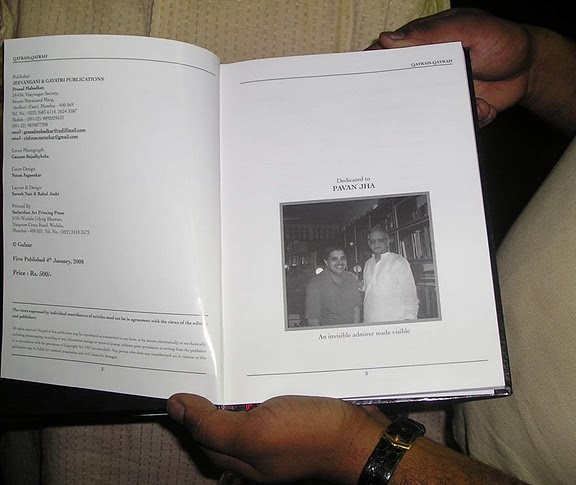
RK now runs Cinemanthan,  Sameer went full time with his CinemaaOnline, Shripriya’s site is Tatvam, Mitch’s work can be seen at Bokehchaser, Fatema reviews films for Indiaentertainment and blogs at filmsandwords, and Pavan still runs GulzarOneline. Also, Indraneel can be found here, Sudhir is here, Jahan Bakshi writes here, Dipankar is here, and Srinivas here . And a bunch of us still create nuisance here at mFC. 🙂 For the rest, they are all on Facebook and Twitter.