Posts Tagged ‘NFDC’

NFDC Film Bazaar

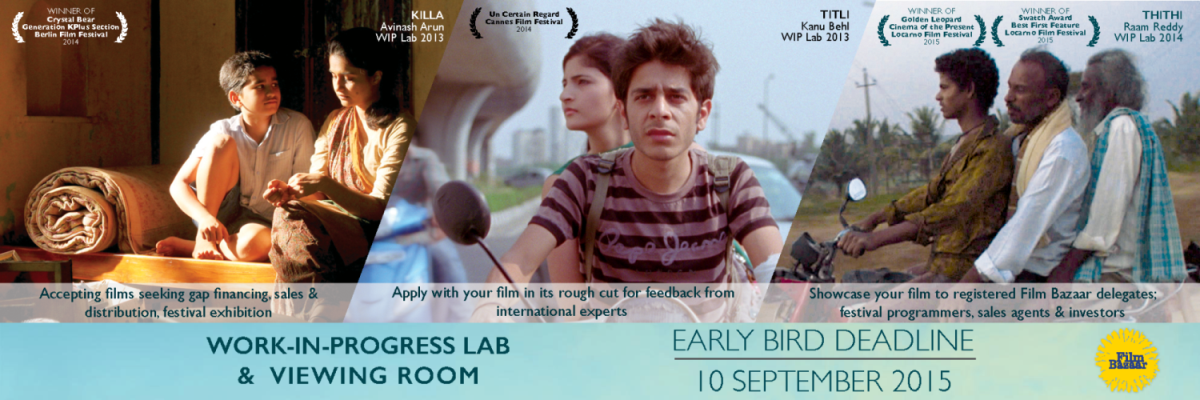
NFDC Film Bazaar, 2015, is calling for entries for the Work-in-Progress (WIP) Lab and the Viewing Room (VR). This year, the Film Bazaar will be held from November 20-24, 2015 at the Goa Marriott Resort, alongside the International Film Festival of India (IFFI) 2015.

Films previously in the Work-in-Progress Labs at Film Bazaar have had their world premieres at leading international films festivals, often winning awards as well as enjoying successful theatrical runs.

WIP Labs

– Submissions are invited for the two WIP Labs: WIP Fiction and WIP Documentary.

– In each WIP Lab, upto five projects in their rough-cut stage will be selected for mentoring and presentation to a panel of international film experts.

– The WIP Documentary Lab is only accepting feature-length creative documentaries in the rough-cut stage, aiming for a theatrical release.

– Feature-length films of any genre in the rough-cut stage are invited to apply to the WIP lab.

Viewing Room

– Films of all genres and lengths, in rough or final cut, are invited to apply to the Viewing Room where films seeking finishing funds, world sales, distribution partners and film festival exhibition are presented.

– The Viewing Room hosts individual computer terminals in private booths, where investors, world sales agents and film festival programmers attending the Film Bazaar can watch submitted films via specially designed software. This allows them to contact the director or the producer directly through email.

– Feature length films in the rough cut stage are eligible to apply to both WIP Lab and Viewing Room.

– This year, NFDC Film Bazaar has introduced an Early Bird Deadline of 10th September 2015 for application to the WIP Lab and Viewing Room, which offers a discount on application fees.

– The regular deadline is 30th September 2015.

– Please visit www.filmbazaarindia.com for Application Forms and more details.

– For further queries, write to: films@filmbazaarindia.com.

– The most recent successes of the Film Bazaar WIP Labs are:

  • Raam Reddy’s Thithi(Premiered at Locarno Film Festival 2015 and Winner of ‘Golden Leopard, Filmmakers of the Present Competition’ as well as ‘Best First Feature Film Award’)
  • Avinash Arun’s Killa(Premiered at Berlin Film Festival 2014 where it won the ‘Crystal Bear Award’ and National Award winner)
  • Kanu Behl’s Titli(Premiered in the ‘Un Certain Regard’ section at Cannes Film Festival 2014)
  • Ashim Ahluwalia’s Miss Lovely(Premiered in the ‘Un Certain Regard’ section at Cannes Film Festival 2012 and National Award winner)
  • Anand Gandhi’s Ship of Theseus(Premiered at the Toronto Film Festival 2012
  • Gyan Correa’sThe Good Road (National Award winner and India’s selection for the Oscars)
  • Ajay Bahl’s BA Pass(Premiered at and won Best Film at the 12th Osian’s Cinefan Film Festival
  • Sange Dorjee Thangdok’s Crossing Bridges(National Award winner)

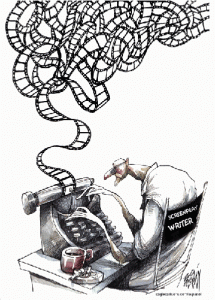
screenwriting-215x300National Film Development Corporation, India announced its selection of six projects for the Screenwriters’ Lab 2015, from submission of about 280 applications.

Previously hosted in Toronto, Locarno and Venice film festivals, Screenwriters’ Lab is going to be held in collaboration with the Sarajevo Film Festival this year.

Selected projects will travel to Sarajevo in August for the first part of the lab and then to Goa in November for the second, before being presented at Film Bazaar, the annual international film market, held alongside the International Film Festival of India (IFFI).

The selection this year includes projects spanning across varied stories, styles and genres.

Scripts

Bombay Rose – Gitanjali Rao

City of Light – Shubhashish Bhutiani

Dastaan-E-Awaargi – Ankit Kothari

Mango’s Tale – Sidharth Gupt

The Return – Asad Hussain

The Sun Goes Round the Earth – Arijit Biswas

Writers

Gitanjali Rao is an animator and filmmaker whose latest project, True Love Story, premiered at Cannes Critics’ Week, 2014 in competition. Her other animation short, Printed Rainbow, received several awards including the Kodak Short Film Award, and the Young Critics Award at Cannes Critics’ Week, 2006.

Shubhashish Bhutiani forayed into filmmaking with his short film Kush which won the Orizzonti Prize for Best Short Film at Venice International Film Festival. He has previously worked as an assistant director in commercials and feature films.

Ankit Kothari is an emerging writer who graduated with a BFA in Applied Arts from MSU, Baroda. Kothari worked as an art director in the advertising industry before venturing into filmmaking.

Sidharth Gupt is a filmmaker who wrote and directed one of the segments in Shorts, a compilation of five short films, produced by Anurag Kashyap. As an assistant director, Gupt has worked in Dasvidaniya, Gangs of Wasseypur and Khoobsurat.

Asad Hussain’s journey as a screenplay writer led him to co-write Children of War, a film based on the war for Bangladesh’s liberation. He has written the additional screenplay for Bajrangi Bhaijan. Apart from these, Hussain has also worked for educational content in Afghanistan.

Arijit Biswas is the co-writer of Agent Vinod and Badlapur. He has also written extensively for Hindi and Bengali television.

unnamed

WHAT : NFDC’s Film Bazaar Co-Production Market 2015 has officially announced call for submissions from filmmakers with compelling South Asian stories seeking co-production, financial and artistic support from attending co-producers, sales agents, distributors and financiers from the world over.

DATES : Entries will be accepted from 19 June, 2015, and submissions close on 31 July, 2015.

HOW : 20 remarkable South Asian stories will be selected this year. Projects get to pitch their film to the Indian and international film community that attends Film Bazaar with a focus on fiction features.

– The pre-requisite of submission states that a film project must be an original story with a South Asian connect and must have a producer attached with 25% of the finance in place.

– In addition to the above the project must have scope for international co-production, distribution and sales.

In 2014 the Co-Production Market hosted 32 projects from 12 different countries.  Click here to view the 2014 Co-Production Market Selected Projects.

-The ninth edition of Film Bazaar organised by National Film Development Corporation will continue to provide intensive individual support to selected projects in a creative and informal setting at Goa Marriot Resort in Goa (India) from 20-24 November, 2015.

– Film Bazaar is organised to discover, support and showcase South Asian talent and content. The aim is to boost collaboration in the realms of filmmaking, production and distribution between the South Asian and film fraternities of the world.

– Qualified filmmakers can submit their entries by filling out an online application by registering with the market at http://www.filmbazaarindia.com/programs/co-production-market/

– Further queries can be addressed to – coproduction@filmbazaarindia.com

– Starting this year, the program has gained added leverage with the inclusion of an open forum on pitching. This activity has been introduced based on industry feedback with the intention that filmmakers should not be required to make multiple pitches during meetings.

– The forum will be organised a day prior to the start of the Co-production Market and will allow selected participants to pitch their projects to noted industry professionals attending the market. This enables participants to effectively use their time during the one-on-one meetings for more in-depth discussions focused on project specific needs and negotiations.

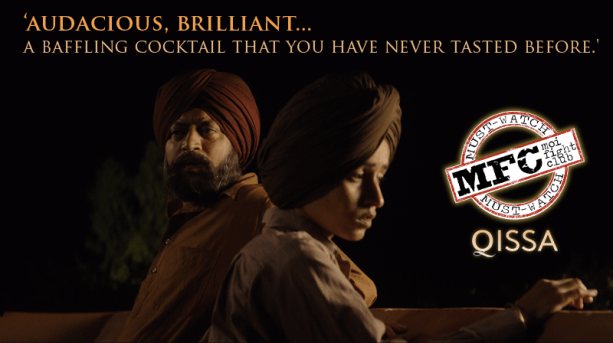
Anup Singh’s Qissa is finally releasing in India. It’s a limited release in 5 cities with just a few shows. Scroll down to the bottom of the post to see the release details. But here’s the good news – even if you are not in any of the 5 cities or you are outside India, you can watch it on VoD. Click here to go to NFDC’s VoD link and enjoy the film. The film is in Punjabi with English subtitles.

We are re-posting an old recco post on the film. Don’t miss it- it’s a must-watch and has made it to our mFC Recco List.

Qissa

If the header of the post seems loaded, you will be surprised more when you watch the film. Yes, there’s gender-bending, it’s genre-bending, and a ghostly tale. Add partition, identity crisis, sexuality, female foeticide, sibling rivalry. It’s a baffling cocktail that you have never tasted before.

The ghostly part might be considered a spoiler, but since the film’s title already tells you that, am not sure if it should be counted as one. The film is titled “Qissa – The Tale Of A Lonely Ghost”. I think that’s a smart choice to let the audience know what they are getting into, and be prepared for it. On a similar tangent, it was a mistake which Talaash makers did by not getting the spoiler out.

Varun Grover saw the film at TIFF where it premiered, and reccoed it in a post here – “A film based on partition, in Punjabi, starring Irrfan and Tillotama Shome and Rasika Duggal and Tisca Chopra! I was already sold. And though it deals with partition in a more symbolic, metaphoric, allegorical way – I was moved immensely by it. Many friends had issues with the logic and amount of suspension of disbelief it demands (basic premise of a father who brings up his daughter as a son without letting anybody else know is a bit of a stretch, yes) – but it still managed to disturb and involve me probably because of the magic realism zone it enters in the 2nd half. And also because of Rasika and Tillotama’s terrific performances. Probably it’s only me but I think the film gives a solid theory on why Punjab has the maximum cases of female foeticide/infanticide. (Qissa won the NETPAC Award at TIFF)”

So i was already prepared for it. But i had no clue that it will be such a fascinating ride. The film starts with a voice-over that feels like a folktale. But it soon jumps into the reality of partition and ethnic cleansing which forms its backdrop. In the aftermath of partition, Umber Singh (Irrfan Khan) is forced to move to Punjab with his family. A loss of identity, roots and that place you call home. Do you ever get that back?

And from the politics of the land the film moves to gender politics. Having already three daughters, Irrfan forces the forth daughter to grow up like a son. The gender identity part is strange and you might question its believability factor. But i have always felt that never let the truth (or logic/reason/whatever you call it) come in the way of a great story telling. Let the filmmaker be your guiding torch in this new dark room that you have never entered. Just hold his hand tightly and enjoy the ride. Leave him only if he trips over something. In that dark room, the only thing that matters is the conviction with which the filmmaker guides you, and how much are you willing to trust him. I live to enjoy this cheap thrill, and trust me, most of the times the experience has been rewarding. It’s easy to spot the ones who know their craft and can direct. Qissa is one such dark room which you have never entered. It’s strange, it’s weird, it’s unique. You need that torch and that trust. So as you buy into the premise of its gender politics, you realise that this strange tale is becoming weird, and you keep wondering where it will end up.

Then comes the magic realism bit which wraps up the story and completes the circle. The sudden tonal shift feels slightly jerky but it’s a minor quibble in an otherwise brilliant film. Anup Singh captures the sights and sounds of the land beautifully. The arid landscape, the rustic rituals, the folksy sound, and the dialect of the region, there’s not a single false note in Qissa. Backed by strong acting talents – Irrfan Khan, Tilottama Shome, Rasika Dugal and Tisca Chopra, they manage to pull off this difficult film with much ease. Describing anything more of the film will spoil the fun for you.

Qissa is an audacious film, and all credit must go to Anup Singh for stepping into this rare territory which we hardly explore, and for delivering such a brilliant film. This is the reason why it might alienate some audience too. You are not sure how to tackle this film. So remember the dark room and hold that torch. You will be fine. Don’t miss this one. It’s rare to find such a gem. Because it’s rare to find a desi filmmaker who takes such an untrodden path.

@NotSoSnob

Qissa

National Film Development Corporation (NFDC) has announced 32 finalists for the Co-Production Market to be held during Film Bazaar in Goa from November 20-24, 2014.

The 32 finalists in the Co-production Market, hoping to attract funding and distribution from potential co-producers, distributors and sales agents from across the globe, include 18 projects from India and 14 from overseas.

 Among the 18 Indian finalists, six are from the Screenwriters Lab 2014:

  • By/Two – Directed byDevashish Makheja and produced by Dutta Dave
  • The School Directed by Suchita Bhhatia and produced by Vivek Kajaria
  • Blossoms (Pallavi)- Directed and produced byNila Madhab Panda
  • Nuclear Hearts– Directed by Bornila Chatterjee and produced by Tanaji Dasgupta
  • Seven (Saat)- Directed byAshish Bende and produced by Suhrud Godbole
  • Medium Spicy– Directed by Mohit Takalkar and produced by Nikhil Mahajan
  • The Invisible One– Directed by Amit Datta and produced by Anjali Panjabi
  • Ashwathama – Directed by Pushpendra Singh and produced by Sanjay Gulati
  • Rainbow– Directed by Shona Urvashi and produced by Raman Lamba
  • Overcoat– Directed by Abhijeet Singh Parmar and produced by Rishebh Batnagar
  • Mantra- Directed by Nicholas Kharkongor and produced by Rajat Kapoor
  • The Indian Prisoner -Directed and produced by Shashwati Talukdar
  • The Boyfriend– Vidur Nauriyal and Ashim Ahluwalia
  • Winter– Aamir Bashir
  • Char Log Kya Kahenge– Hitesh Bhatia
  • Flow – Vandana Kohli
  • All about Her– Ruchi Joshi
  • The Sunset Club– Karan Tejpal

The 14 international projects to be showcased in the eighth edition of the Film Bazaar Co-Production Market include two films from the US, two from Sri Lanka,  a film from Pakistan, Afghanistan, Nepal, Bangladesh, Norway, France, Germany, Singapore and United Kingdom and an IFP project which is selected through NFDC collaboration with Independent Filmmaker Project, USA.


  • Three and a Half- Produced by Mira Nair and directed by Sooni Taraporewala (USA)
  • Interpreter of Maladies – Produced and directed by Amitav Kaul (USA)
  • Minefield– Directed by Shiladitya Bora, the PVR Rare head and produced by the award winning Sri Lankan filmmaker Prasanna Vithanage (Sri Lanka)
  • Womb – Directed by Nishantha Shanthadeva and produced and Rasitha Jinasenaby (Sri Lanka)
  • The Judgement– directed by Sabiha Sumar and produced by Sachithanandam Sathananthan (Pakistan)
  • Summer with Azita- directed by Fazila Amiri and produced by Paul Lee (Afghanistan) 
  • Abomination- directed by Karan Shrestha and produced by Kshitiz Adhiraj (Nepal)
  • No Land’s Man –directed and produced by Mostofa Sarwar Farooki (Bangladesh)
  • Gilded Cage –directed and produced by Vijay Chandran (Singapore)
  • What Will People Say (Hva Vil Folk Si)- directed by Iram Haq’s and produced by  Maria Ekerhovd (Norway)
  • Goa directed by Jamie Mateus-Tique and produced by Luc Bossi (France)
  • Once Againdirected by Kanwal Sethi and produced by Holm Taddiken (Germany)
  • End Game directed by Geetha J and produced by Ian McDonald (United Kingdom)
  • Colony – Pulkit Datta (IFP Project)


The National Film Development Corporation (NFDC) has announced the nine scripts selected for the second edition of the National Script Lab to be running from October 2014 – March 2015.

The first screenwriting workshop will be held from October 1217, 2014 at the Courtyard Marriott, Chakan, Pune, followed by two more workshops and 1 to 1 consultation sessions over the next six months.

Marten Rabarts- Senior Consultant, Training and Development, NFDC; Olivia Stewart- Producer of The House of Mirth, Brassed Off, and script consultant on The Lunchbox and  Rajat Kapoor, writer-director of the much acclaimed Ankhon Dekhi will mentor these scriptwriters one-to-one during intensive residential workshops over the coming six months

Also as part of the National Script Lab program, the screenwriters will be able to attend NFDC’s Film Bazaar 2014 (Nov 2024) to network and introduce their upcoming projects to both the Indian and international film fraternity attending the market.

This year the Script Lab has a special focus on Youth and Children’s stories which feature strongly in the following line up.

 The Selected Writers and Scripts are:

1. Konkona Sensharma – Death In the Gunj

The acclaimed actress and the winner of two National Awards has acted in more than 40 films in Hindi, Bengali and English language.  She co-wrote and directed a short called ‘Naamkaran’ (The Christening) and anticipates this script will be her first feature as writer director, following in a family tradition established by her mother the renowned Film-maker and Actress Aparna Sen.

 2. Ranjeet Bahadur – Oddball

The editor of Rajkumar Hirani’s 3 Idiots, Sudhir Mishra’s Chameli and Ruchi Narain’s  Kal  Ranjeet has done his Post Graduation in film at Satyajit Ray Film & TV Institute, Kolkata, and now turns his attention to writing his first feature.

3. Vicky Barmecha – Naadaan

Vicky has spent the past 2.5 years working as assistant director and postproduction supervisor on Anurag Kashyap’s upcoming Bombay Velvet. He is the older brother of the Udaan actor Rajat Barmecha.

 4. Neha Sharma – Under the Skin

Neha, followed up her filmmaking studies in Capetown, South Africa with the screenwriting programme at FTII Pune. Neha has written dialogues for the TV show Ladies Special and is in active development of several feature films and documentaries. She has honed her craft as an assistant director on films such as The Dirty Picture , Agent Vinod and many others.

 5. Piyush C Panjvani – Idgah

A  Film & Television studies  grad from St. Xaviers IOC Mumbai, Piyush is a multi award winning director/producer of Ad films , shooting around the world for such mega brands as Pepsi and Samsung among others. He is currently developing a documentary on Himalayan shepherds, and will base his debut feature film on a story by Shri Mumchi Prechan.

 6. Abhaya Simha – Bhamini

Based in Bangalore, FTII graduate Abhaya has written and directed three feature films in Kannada and one in Malyalam. His      first feature film, Gubbachigalu won the National Award In 2008 for the Best Children’s Film.

 7. Rigzin Kalon – Neki Kar Kala Kala

The writer-director-producer has worked on shorts, TV , documentaries and feature films, including Ngonsum  a feature set in Ladakh based on short stories by Gabriel Garcia Marquez. Rigzin lives between Mumbai and his native Ladakh, where he is an active figure in the development of this regions emerging cinema scene.

 8. Ruchika Lalwani – A story of Two

Is the writer of Walkaway, an independent American film with Bollywood flair made and released in the USA where she studied Film in New York. Ruchika’s student short film, I’m Afraid I am Hitler was screened and awarded at many international film festivals.

 9. Sudhakar Reddy Yakkanti – Paperweight

An FTII Pune graduate in Cinematography, Sudhakar wrote, directed and shot the short film Ek Aakas, winnning the Special Jury, National Award and in 2010 his documentary short film Duel of Angels  was awarded at the prestigious IDFA in Amsterdam. He also shot Umesh Kulkarnis Deool which won Three National Awards, among a long list of other features as  a cinematographer.

(via press release)

NFDC Labs, the Training and Development arm of NFDC (The National Film Development Corporation Ltd), has announced six finalists for the NFDC – Harlequin Romance Screenwriters’ Lab. The first of its kind three-part Lab with romance and women-centric plots as the themes, has Habib Faisal and Bhavani Iyer as mentors. Ashok Banker and Shoma Narayanan will guide the parallely held Harlequin Lab.

Post the Lab, Harlequin will offer book deals to the most promising writers.

The final six scripts / writers are:

1. Anjuna Beats – Thomas Jacob

2. Love in the Time of Moral Policing – Niharika Negi

3. Magic for Maria – Annie Zaidi

4. Vanmala – Abhimanyu Kulkarni

5. A Second Life – Pravina Srivastava

6. The Falcon Hunter – Vineet Gupta

1. Anjuna Beats (English) by Thomas Jacob – A writer / director and having worked on one feature film, one short film, 3D shorts, corporate films and documentaries, Thomas was one of the young filmmakers invited for the prestigious Berlinale Talent Campus 2010 conducted by the Berlin International Film Festival (2010).

2. Love in the Time of Moral Policing (English – Hindi – Marathi) by Niharika Negi – Niharika has an interesting mix of experience in Film and Theatre- India and London, with stints at Shree Ashtavinayak Cine Vision Limited, FutureWorks, Channel [V], Big Boy Productions (London), The Hat Factory Arts Center (London), Poor Box Productions, QTP’s Thespo amongst others.

3. Magic for Maria (Hindi – English) by Annie Zaidi – Annie has been writing across various genres and has directed short films and plays. She has contributed to various newspapers and magazines including Mid-Day, Frontline, Tehelka, Caravan, Mint, Elle, Femina, and DNA (Daily News and Analysis).

4. Vanmala (English) by Abhimanyu Kulkarni – Abhimanyu is a design professional at an MNC and is passionate about writing. His interest in screenplay writing has led him to do a professional course from UCLA followed by two commissioned projects.

5. A Second Life (English) by Pravina Srivastava – A media professional in the past, now based in Pondicherry, Pravina is an aspiring writer with A Second Life as her first attempt in screenplay writing.

6. The Falcon Hunter (English) by Vineet Gupta – Vineet is a Consulting Analyst with a strong academic background. A graduate from Harvard University, Vineet has done his PHD in Mathematics from California Institute of Technology and other programs from leading international universities like Cambridge and Stanford. The Falcon Hunter will be Vineet’s first project as a scriptwriter.

The three part Lab will include 2 residential programs, the schedule being:

First part at a hotel in Pune – 27 – 31 July 2014;

Second part – offline program conducted as per schedule mutually decided between the mentors and the writers;

Third and the final part – 16 – 20 November 2014 at Film Bazaar in Goa.

NFDC (National Film Development Corporation Ltd) today announced the six finalists of the Screenwriters’ Lab 2014.

In its eighth edition, the first stage of the Lab this year will be held in Sarajevo Film Festival (15 – 23 August 2014) culminating in the second stage prior to and during Film Bazaar (20- 24 November 2014). The market, like every year, will be held along side IFFI (International Film Festival), in Goa.

 The six scripts / screenwriters selected are:

  1.  The Boyfriend – Vidur Nauriyal and Ashim Ahluwalia
  2. Winter– Aamir Bashir
  3. Char Log Kya Kahenge – Hitesh Bhatia
  4. Flow – Vandana Kohli
  5. All about Her – Ruchi Joshi
  6. The Sunset Club – Karan Tejpal

Details about the scripts/writers

– Vidur Nauriyal and Ashim Ahluwalia – The Boyfriend will be the second feature from the team behind Miss Lovely, directed by Ashim Ahluwalia, which was screened at Un Certain Regard at Cannes Film Festival 2013. Ashim recently received the Hubert Bals Fund for script and project development (a Rotterdam festival initiative) for The Boyfriend. Miss Lovely was one of the five projects at Film Bazaar’s Co-production Market 2008 and Work-In-Progress Lab 2011.

– Aamir Bashir – Winter, is the second feature to follow Harud (Autumn), Aamir’s debut film, which premiered in Toronto Film Festival 2010. As an actor he has also appeared in some of the highlights of the new independent cinema including A Wednesday, Peepli Live and Frozen (TIFF 2007)

– Hitesh Bhatia – Comes to the Lab with a wealth of experience in commercials and directing commercial TV shows and has moved his focus to feature films as he embarks on this new phase in his career with his project Char Log Kya Kahenge

– Vandana Kohli – Has scripted, directed and edited projects for clients including The National Geographic Channel, The History Channel, and India’s national broadcaster Doordarshan. Also a photographer and musician, Flow is Vandana’s first feature film project.

– Ruchi Joshi – Followed her film studies in Melbourne Australia with work in music videos, commercials and independent feature films in Mumbai. All about Her is her second project as a screenwriter.

– Karan Tejpal – Has worked for several years in the film industry making commercials for global brands and working as assistant director on mainstream feature films including the mega-hit 3 Idiots, Lage Raho Munnabhai and Ferrari Ki Sawari. His first feature will be The Sunset Club, adapted from Khushwant Singh’s novel of the same name.

– The mentors of the Lab include noted experts from the industry, namely, Marten Rabarts, Senior Consultant – Training and Development, NFDC Labs; Olivia Stewart, Script Developer; Urmi Juvekar, Script Developer; Bianca Taal, International Industry Advisor.

– NFDC’s Screenwriters’ Lab was introduced in the year 2007 with the Co-production Market in the inception year of Film Bazaar. The Lab gives an opportunity to six independent screenwriters to develop their skill under the guidance of a variety of industry experts from across the globe. Through one-on-one sessions with their mentors, the Screenwriter fellows are advised on tools and techniques required to improve their scripts and methods to pitch the same in the international domain. The previous editions of the Lab were held in Locarno, Venice and Toronto International Film Festivals.

– The Screenwriters’ Lab is specially re-designed to prepare screenwriters with original Indian stories for working with the international filmmaking market.

– The Screenwriters’ Lab 2013 finalists at Film Bazaar included: Rajesh Jala’s Chingari (The Spark), Nikhil Mahajan’s Dainik (Daily), Bela Negi’s Kaalapani (Dark Waters), Varun Grover’s Maa Bhagwatiya IIT Coaching Class (Mother Goddess Coaching Class), Shanker Raman’s My Brother the Salesman and I, and Ashish Aryan’s T Se Taj Mahal (T for Taj Mahal). While Rajesh Jala won the Incredible India award for Chingari and also got Cedomir Kolar’s France based ASAP Films board as the co-producer of the film, Nikhil Mahajan’s Blue Drop boarded Varun Grover’s Maa Bhagwatiya IIT Coaching Class as the producer of the film.

– Please visit http://filmbazaarindia.com/programs/screen-writers-lab/ for more details about the Lab and its mentors.

NFDC Labs has announced mentors for their Romance Screenwriters Lab.

Habib Faisal (writer/ director) and Bhavani Iyer (writer) are going to mentor the participants of the recently announced Romance Screenwriters’ Lab, and Ashok Banker and Shoma Narayanan will mentor the parallely scheduled Harlequin lab for screen to novel adaptations.

SCREENWRITERS LAB

NFDC, in association with Harlequin, is organising the first-ever Romance Screenwriters’ Lab, which will focus on developing scripts based on romance and women-centric plots.

– The Lab will be held in three stages and the participants will be mentored by three eminent people from the Indian film industry.

– The last stage of the Lab will culminate at Film Bazaar, Goa, where the participants will be given the opportunity to pitch the projects to prospective producers.

– Harlequin will also offer book deals to some of the selected projects, and organize independent workshops with mentors from the publishing industry.

– The Lab is open only to adult Indian passport holders

SELECTION

– The selection process is in two parts. This is the first part of the selection procedure where participants will be shortlisted based on the selected synopsis

– Participants shortlisted for the second stage will be given a scheduled duration to submit completed scripts. Submissions should be made via email only as a single pdf/doc file. Do not send material as separate attachments. No hard copy of submissions are to be sent.

DEADLINE

– All Applications must be received on or before 31st May 2014 by 6 pm.

FEES

– Application fee for the lab is INR 5,000/- only. It is payable by Demand draft made in favour of National Film Development Corporation Ltd., payable at Mumbai, or by Wire Transfer.

– To know more about the rules, regulations, FAQs and application form, click here.

 NFDC recently organised the first Directors Lab. One of the participants of the lab, Vasant Nath, Director, Sebastian Wants to Remember (SWTR), writes about his experience of this 2-week residential workshop which was held in Pune recently. And since many of us had doubts about its fee, he also clarifies on that front – was it worth it? If so, why and how.

Vasant Nath’s drama SWTR found an Indian co-producer in Kartikeya Narayan Singh’s production house The Film Café. SWTR is the story of an aging photographer who loses his memory and must embark on a daunting journey with his wife in search of his past. It was selected for NFDC Screenwriters’ Lab 2011 and Co-production Market 2012.

Over to him now.

(Click any of the pics to start the slide show. Hold your cursor on specific pic, details will pop up)

I did not go to film school, I learned whatever I know of filmmaking on the job and through self-study.  Working in production for five years gave me some technical skills.  Working on other people’s screenplays as a creative assistant to another filmmaker taught me the basic mechanics of screenwriting.  Making some short films put me on the path towards finding a personal voice.  Meeting a dead end in my career as an assistant made me try working independently.  That was five years ago – when I wrote my first original feature-length screenplay – ‘Sebastian Wants to Remember’.

‘Sebastian’ has had a long (but necessary) development process – eight drafts till date.  I’ve been fortunate enough to have some excellent mentors during this process, and the steady effort has borne fruit.   The screenplay is in good shape and should serve as a reliable blueprint for the film’s realisation.  However, ’Sebastian’ is by no means an easy film.  It’s a road movie with a 70-year-old amnesiac as the lead character, and he doesn’t talk much.  The story structure is interspersed with flashbacks that introduce a cocktail of emotions to the protagonists each time they happen.  Over the many rewrites, my second character has started competing with the primary character for point of view.  And there are some tough sequences that I have blithely written without the slightest inkling of the challenges they will present when I have to film them.

I’m very happy that I did not let such anxieties limit the writing process, but now, as the time to step out of the secure confines of the writing room draws near, I am visited by a recurrent nightmare where I’m on set as director with a large crew looking to me for instruction…and I have no idea what to say to them!  Initially, I drew comfort from the thought that things would take care of themselves once I start making the film, and that doing was the only way to learn.  Of course there is truth in this, but this film – even looking at it just in terms of scale – is unlike anything I’ve ever done before.  I will have to be extremely well-prepared, and I’m going to be of no use to anyone if I go into the whole thing cowering like a scared rabbit.

Indian filmmakers live in very fortunate climes today – because Marten Rabarts is in the house.  As Development Consultant to the NFDC, he has streamlined the organization’s agenda to work on our filmmakers from the roots and has fuelled its engine with the best development talent from across Europe.  This, coupled with the environment for exchange and collaboration that NFDC’s Film Bazaar provides, is extremely fertile ground for new voices to flourish and for a film like mine to find the support it needs to get made.  By the time I applied for the Director’s Lab, I had already been a sort of crash-test dummy for the other NFDC labs – usually one of the first to apply, usually to be found in the front row taking copious notes once they happened.  By the time I heard of their Director’s Lab, I already had great faith in such endeavours: the NFDC’s 2011 Screenwriter’s Lab I participated in represents perhaps the sharpest learning curve I had experienced till then.

Udayan Prasad is both a teacher and a director – known for his films ‘The Yellow Handkerchief’ and ‘My Son the Fanatic’.  He teaches this director’s lab in the UK, sometimes at the National Film and Television School, and sometimes in London as a three-week summer school.  Here, he had crafted a two-week program that fell somewhere between the longer and shorter versions of his usual course in Europe.  Before arriving, I had wondered how much ground he would be able to cover in this short a time, but there was no way of telling beforehand.  However, once it started, Udayan’s lab was like a feeding frenzy.  Every day of the twelve days that we were there (cooped up in the Marriott Courtyard Hotel in the middle of Pune) we were encouraged to repeatedly bite off more than we could chew with the assurance that the digestion would happen later.

This was the NFDC’s first director’s lab, and – except for maybe three of us – most of the participants were at very early stages with their films – some of them didn’t even have first drafts yet.  I initially feared that I was attending another (very expensive) script lab, because the format of the first two days was more or less identical to that of the opening of the screenwriter’s lab I had attended in 2011.  In both scenarios, it was necessary for the participants to share their stories and visions with each other with as much honesty as possible.  It is a very testing task – both the sharing and the listening.  While telling, you feel that you are suddenly admitting a whole bunch of voyeurs into your head.  While listening, you feel embarrassed for being held privy to the intimate inner worlds of eleven strangers.  But eventually, it turned out that this had immense payoffs for the work we had come there to do.  In my experience with labs, it has been quite clear that any sort of filmmaking workshop can only succeed in an environment of trust.  Through this process of sharing, we grew to recognise the common craziness that united us and brought us there.  As neophytes filmmakers, we all knew something of the anxieties each of us suffered because of the familiar challenges our work presented.  Constantly encouraged by our mentors, we were really starting to trust each other by the time we got to the real meat of the workshop.

Our time was interspersed with lectures, ‘workshop-y’ stuff, master classes given by established industry professionals, film viewings and individual consultations for script and production.  Almost every minute of the waking day was taken up by these for twelve consecutive days.  Whatever was left was spent (at least by me) nursing exhaustion.   As Udayan kept telling us – we were getting what we paid for.  It was only fair!  The whole workshop was consciously kept non-technical and perhaps this came as a surprise to some of the participants who had come there expecting to work with cameras et al.  Udayan focused instead on things that led to good technical choices – with an emphatic emphasis on using all tools available to serve the stories we wanted to tell – trusting that we’d be able to take care of the technical training ourselves.

Acting exercises made up a very large chunk of the workshop – perhaps the most hands-on and ‘workshop-y’ section of the whole experience.  I have done other acting workshops before and what I learned here was that acting workshops oriented towards actors are quite different from acting workshops oriented towards directors; even though both start pretty much from the same place.  A director-oriented acting workshop eventually has to serve the director’s requirement of giving actors the right environment they need to thrive in, and actor-oriented acting workshops do not go that distance because they do not need to.  I found these sessions extremely useful.  The exercises we did here allowed us to experience first what an actor does and then showed us what an actor finds useful in trying to arrive at the right sort of performance.  It was all very practical and methodical – we got to test many tools and techniques even in the short time we had.

The acting exercises proceeded into another very useful section – Scene Analysis – where we had two very accomplished actors – Adil Hussain and Tannishtha Chatterjee – as our clay.  Having already spent two days in the actors’ shoes, we had been sensitised to the challenges they face when receiving instruction from a director that just isn’t playable.  Udayan had been drumming a discipline into our heads – to use verbs instead of adjectives in our instruction; to convey the facts of the script in a systematic way.  With Adil and Tannishtha, we put Udayan’s instructions to work and watched in wonder how a basic line-reading of a script turns into a performance full of genuine feeling and surprise when an actor is provided with the right information, in the right quantity at the right time.

Very soon, we were thrown into the nerve-wracking scenario where we had to put these techniques into play with professional actors (mostly very generous acting grads from FTII) with scenes from our own films.  This was probably the very first time any of us had realised anything from our pages, and it was frightening.  But better to feel the shivers here than on set!  I was given three young actors for a scene that involved two old people…and little else.  The actors knew nothing of my film and I wanted to transfer all my knowledge of the story to them via firewire so that they could quickly enact the scene in my head and be done with it!  But of course, that was not possible.  What was possible, though, was falling back on the techniques that Udayan had taught us –  basic principles of sharing information slowly and carefully, leaving room for the actors to bring something to the scene.  As I got into the flow of the exercise, that’s exactly what happened.  My actors brought a lot to the scene.  In just a couple of hours, they were showing me things that I could never have accomplished while working alone on the page as I had done till then.  Then another problem arose – they just kept on giving!  I had gone from feeling very excited by a lot of new interpretations of my material, but suddenly it felt too much to work with.  Then I took a deep breath and started making decisions…

I may never have five hours to rehearse a one-page scene in an actual shooting scenario.  But the process of going through this exercise – feeling the fear, smelling the failure, being unsuccessful at realising the film in my head, righting myself, making decisions under pressure (even though simulated), trusting a technique, giving, receiving, disciplining myself to only give playable action – all this was f*****g priceless!  Udayan was in and out of the room right through the exercise.  He has this x-ray vision that could diagnose what we were doing wrong within a few minutes of watching our work.  He didn’t go easy on us, and I am very happy he didn’t.

By the time I got through this exercise, the lab had begun to seriously work upon me.  I was already looking at my material differently.  It wasn’t that I was distrusting everything I had written till then, but I was recognising how far the writing had got me and where I needed to steer the process from here on.  There would definitely be some re-writing – I came back from the lab and quickly shot off a fast polish to my producer – Draft 8.1!  Suddenly, there were so many new things to think about.  There was already a greater sense of empowerment when looking at the many difficult choices that lay ahead when I make ’Sebastian’.  At least I knew where to start thinking about the things I’ll need to say to my waiting crew when my nightmare revisits..!

We touched upon various aspects of film craft – production design, cinematography (and point of view), sound – through master-classes and lectures.  The master-classes did well in keeping the theory grounded.  But even with Udayan’s lectures, I never for once felt that we were all sitting in some sort of ivory tower – everything Udayan talked about, he always connected to his experiences as a filmmaker or to the real-world experiences of filmmakers he knew or had studied.  He often invited the professionals conducting the master-classes to comment on the concepts he outlined.  In all sections of the workshop, Udayan’s teachings were a distillation of a very large cross-section of filmmaking traditions.  He brought with him a clear understanding of where these traditions came from, how they could be applied, where they succeeded, where they failed, how they evolved, and – most importantly – what worked well for him in his experience as a filmmaker.   All the theory was accompanied by clips of films that demonstrated the corresponding concepts in successful execution.  The workshop was thus also very enriching in terms of the reading lists and watching lists that Udayan left us with.

The individual consultations for script and production were a very necessary component of the lab, since the participants were each in very different stages with their projects.  I believe it allowed the mentors at least some room to tailor their guidance to each participants’ particular needs. More consultants were brought in for this – Urmi Juvekar, Priya Sreedharan, Shivani Saran – some of whom (along with Marten, of course) represent for me what I call “the NFDC ecosystem” – something that I have come to trust implicitly in my career as an NFDC Lab crash test dummy.  This ecosystem is becoming better with each passing year, and hopefully – in the foreseeable future – when the corresponding production and financing side of the NFDC stands on steadier ground with as great a confidence as its development arm, we will witness a thriving harvest of great new films, in greater volumes, year after year.

By the time we pitched our projects again at the end of the workshop, the difference was apparent.  Some of the participants had made some giant leaps with their material.  They stood on surer ground, knowing exactly what they had to do next. For some, the leap was about being able to kill some of their darlings: things that needed to be unhinged before they could move forward – and imagine how deeply they must have been anchored in their darlings if it took two weeks to unhinge them!

Overall, a lot of ground was covered, but I missed a section on the role and dramatic purpose of Music, only because Udayan had been so comprehensive and enlightening about the other components of film craft that he’d addressed.  Some of the participants were keen on squeezing in a session on comedy, but sadly there just wasn’t any time.  Still, the whole group showed a very strong commitment to the workshop and its structure and I feel that this was one of the main reasons for its success.  The ‘workshop environment’ dictated that every exercise we did was reviewed both by our peers and by our mentors.  We became each others’ first audiences with the added advantage of being able to express and listen to feedback articulated after every presentation.  And none of this would work without the trust I spoke of earlier, consciously cultivated by our mentors.  Because of it, we were able to repeatedly fail before each other without fear.

For me – I left the lab with a greater, deeper engagement with my film.  I remember that it felt almost exactly how it had felt when I finished the 2011 screenwriters’ lab with Marten as my mentor.  Even though it had been such a sharp learning curve for me, it had taken a good two or three years of applying the lab’s principles in various screenplays before I acquired a confident, working knowledge of them.  I take it that it’s going to be the same with Udayan’s teachings; I will have to apply them over and over until they set in.  Apart from everything that he taught us about the craft of our work, I also thoroughly appreciate how Udayan kept telling us time and again about good work practices – simple things like acknowledging your crew at the start of the day, thanking them at the end of it; especially important in our country that subscribes so heavily to ‘the cult of the director’.

I don’t think I can end this review without a comment on the lab fee, because I know so many filmmakers who wanted to and deserved to do this lab but simply could not afford to.  While I feel that the experience the lab afforded me was worth every paisa, Rs. 1.5 lakhs is not a small amount for anyone to pay, especially if their projects do not have funding.  That said, I also think that it was a very brave move by the NFDC and the Lab team to actually take the plunge and hold the lab despite all the protests they must have received about the fee.  I sincerely believe that it is a great precedent.  Only time will stand testament to the actual success of the lab – in terms of how many participants end up making their films successfully – but I have a very good feeling about it.  I do hope that some subsidies come into play soon that lower the cost for the participants, because it will really allow the lab to contribute more fully to the NFDC’s long-term development goals.

With regard to my co-participants’ responses – overall, I saw more smiles than frowns.  I think we all knew that a mountain of work was waiting for us when we got back to the real, non-workshop world.  There were some in the group who were still negotiating with the decision to commit fully to this perilous career – and I could feel their anxiety in the face of the big decisions that lay ahead.  But I think that they knew that this was a good thing.  Good workshops are meant to make you go green.  The work that you do afterwards is the only effective antacid.   I wish my co-participants a happy digestion!  I thank Udayan, Marten and the NFDC – Leena who helms the their lab program, and Mayur who helped execute our twelve days so efficiently – for this wonderful learning experience.

(Vasant Nath’s ‘Sebastian Wants to Remember’ is being produced by Michael Henrichs of Berlin based Die Gesellschaft along with France’s 24 Images and Kartikeya Narayan Singh’s The Film Café.  It is currently in financing, having received EU Media Development Support in 2013, expecting to start production at the end of 2014)