Archive for the ‘cinema’ Category

We have always tried to spread the good word about various crowd-funded projects through our blog. Here’s one more film which looks interesting and you can contribute to its making.

shoot3

Film

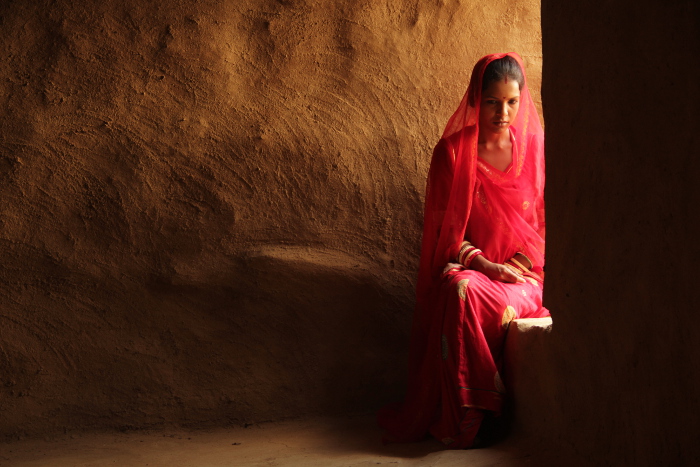
Lajwanti (The Honour Keeper) directed by Pushpendra Singh has been selected for the 44th edition of the Berlinale Forum, a section of the Berlin International Film Festival that showcases independent, artistic filmmaking with a disregard for convention. Berlinale Forum will screen twenty-eight world and eight international premieres this year.

Official Synopsis

A group of women, in their daily long walk to collect water, recite songs and exchange words that reveal their hidden desires. But, one day, when a crazy dreamer whose only passion is collecting doves crosses their path, one of them, Lajwanti, starts a journey that will take her out of this closed world. She leaves the group when she cannot tolerate their banter and starts walking the long distance alone.

The silence and determination of the man with the doves becomes a curiosity for her and she decides to find more about him. But when the man does not show much interest in her advances, she feels betrayed by her beauty. Her dreams change from being driven by fear to dreams of courage. The veil starts disappearing and a new world opens to her. Will she overcome her dreams driven by fear to keep the honour of that man’s dream rather than that of the society? Will she be able to undo her social conditioning and find her true self?

Trailer

Filmmaker

An alumnus of the Film &Television Institute of India, Pune and Berlin Talent Campus, Pushpendra began his career as an actor playing one of the leads in AmitDutta’s Venice award winning film ‘Aadmi Ki AuratAur Anya Kahaniya’. He then went on to assist AmitDutta on his next feature ‘Nainsukh’ and the latest ‘SattviSair- The seventh walk’. He has also assisted Anup Singh on his award winning feature ‘Qissa- The ghost is a lonely traveler’.  His other credits include acting in the German feature ‘Asta Transfer’ directed by Maximilian Linz which is in its post-production and in the theatre with Barry John on his Honey Trilogy.

Currently he teaches at the Film & Television Institute of India, Pune. Lajwantiis his first feature film as a director.

Why they need the funding

– You can contribute anything between Rs 99 to 50,000. So far the film has managed to collect just 20% of the funding it needs. So do contribute to its making. Lets make it happen.

– Click here to go to its Catapooolt page where you can read more about the film and can make your contribution.

If you are regular reader of the blog, you probably know his name. Neeraj Ghaywan is part of the editorial team and is a regular contributor to the blog. So it’s a great news for all of us. Yay! Yay! Yay!

Sundance Institute and Mahindra today announced the winners of the 2014 Sundance Institute | Mahindra Global Filmmaking Award, in recognition and support of emerging independent filmmakers from around the world. The winning directors and projects are Hong Khaou, MONSOON from Vietnam/UK; Tobias Lindholm, A WAR from Denmark; Ashlee Page, ARCHIVE from Australia; and Neeraj Ghaywan, FLY AWAY SOLO from India.

– Each of the four winning filmmakers will receive a cash award of $10,000, attendance at the Sundance Film Festival for targeted industry and creative meetings, year-round mentoring from Institute staff and creative advisors, eligibility to participate in a Sundance Institute Lab, and ongoing creative and strategic support from Sundance Institute’s renowned Feature Film Program.

More details about the winners and their films –

Hong Khaou / MONSOON (Vietnam/UK): Two young men visit present day Vietnam, and are confronted with the war’s ramifications nearly forty years after its end.

Hong Khaou’s debut feature film Lilting premiered in World Cinema Competition at the 2014 Sundance Film Festival.  The film stars Ben Whishaw and Cheng Pei Pei. He is also the director of three short films, including Spring, which premiered at the 2011 Sundance Film Festival, and Summer, which premiered at the 2006 Berlinale. This year, Hong was named one of the Stars of Tomorrow by Screen International.

Tobias Lindholm / A WAR (Denmark):  The major of a Danish unit in Afghanistan faces the consequences of his actions in the aftermath of his most dangerous mission..

Tobias Lindholm graduated as a screenwriter from the National Film School of Denmark in 2007, and has collaborated with Thomas Vinterberg as co-writer on Submarino and Oscar nominee The Hunt. In 2010 he wrote and directed his first feature film in collaboration with Michael Noer, and in 2012 he wrote and directed the critical acclaimed A hijacking.

Ashlee Page / ARCHIVE (Australia): With the help of a supercomputer, an isolated 16-year-old girl grows plant life on Saturn’s moon Titan in the hope of one day restoring Earth’s ecosystems. But when an unexpected accident leads her to the moon’s surface, she discovers evidence that her mission is a lie and that her life is in danger.

Ashlee Page is an Australian writer and director. Her multi-award winning short The Kiss screened at Busan, Clermont-Ferrand, Palm Springs and Tribeca film festivals. Her most recent work is on the film compendium The Turning, adapted from the novel by Tim Winton. Archive is her first feature film.

Neeraj Ghaywan / FLY AWAY SOLO (India): Four lives intersect along the Ganges river: a lower-caste boy in a hopeless love, a daughter torn with guilt, a father sinking in greed, and a spirited kid craving a family, all yearning to escape the constrictions of a small-town.

Neeraj Ghaywan worked with Anurag Kashyap on the veteran director’s two-part opus Gangs of Wasseypur and as the second unit director on Ugly.  His short films as writer-director include Shor and The Epiphany. Shor won the grand jury prize at three International film festivals.

– The script of Fly Away Solo is been written by Varun Grover.

– You can watch Neeraj’s short films Shor and Epiphany here and here. And click here to read a post by him on the making of Shor.

– Also, Love.Love.Love, a short documentary directed by FTII student Sandhya Daisy Sundaram, won the Short Film Special Jury award for non-fiction at the ongoing Sundance Film Festival. More details here.

Still haven’t seen Om Dar-B-Dar? Want more reasons? Well, listen to Anurag Kashyap, Imtiaz Ali, Amole Gupte, Kiran Rao and Resul Pookutty to understand what the film means to them and why.

And here’s Rajat Dholakia on its music madness

ODBDT

Avinash Arun’s directorial debut, the Marathi feature film Killa (The Fort) will have its world premiere at the upcoming Berlinal International Film Festival. The fest runs from February 6-16, 2014.

The film is selected in the Generation Kplus competitive category. IT stars Amruta Subhash, Archit Deodhar, Parth Bhalerao and Shrikant Yadav. Avinash has also shot the film.

Official Synopsis

Killa deals with the universal conflict of migration, and how it impacts the lives of people, especially children. The story revolves around a young boy Chinu who finds it difficult to adjust to his new surroundings where he has migrated to, after his father’s death. But gradually he makes new friends and gains more confidence.

Produced by Madhukar R Musle, Ajay G Rai, Alan McAlex under the banner, Jar Pictures and presented by M R Filmworks, the film was a part of NFDC Film Bazaar’s Work-in-Progress (WIP) Lab in 2013.

There are few other Indian films at this edition of Berlin Fest. Gaurav Saxena’s Rangzen will also have its world premiere in Generation Kplus. Imtiaz Ali’s Highway and Papilio Buddha (India/USA) directed by Jayan Cherian will be screened in the Panorama section. Lajwanti (The Honour Keeper) directed by Pushpendra Singh has been selected for Berlinale Forum which is for avant garde, experimental works, essays, long-term observations, political reportage and yet-to-be-discovered cinematic landscapes. Also, Berlinale Talent Campus has selected 3 Indians – Producer Sanjay Shah, documentary filmmaker Nishtha Jain and director/screenwriter Dipesh Jain. More details here.

Are you done with watching Om Dar-B-Dar? No? what are you doing here? Go, watch the film and then come back to this post. If you have seen the film, you can read this post by Varun Grover to clarify all your doubts. Read? Got it? Your mind has opened up a bit? Great. Now watch these 3 videos where Kamal Swaroop talks about the film and his idea of sense and nonsense.

Thanks to Deepti DCunha, she recorded these videos when the restored version of the film had its premiere at Rome Film Festival in November, 2013.

The video quality is not great but the audio is clear and we can promise that it’s worth it. So do watch.

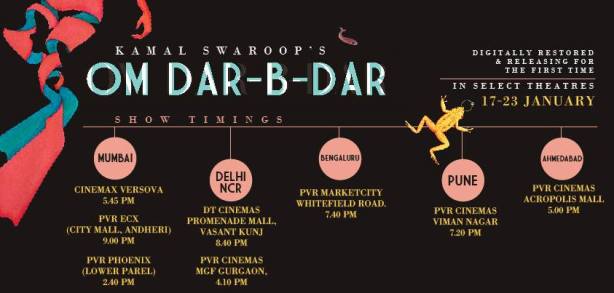
Kamal Swaroop’s cult film Om Dar-B-Dar has been restored and its finally in the theatres. Don’t miss it.

DON’T .  MISS.   IT.

And we are going with the mood of the film, so recycling an old post by Varun Grover which was written 3/4 years ago. Don’t worry, it still reads new just like the film and its ideas. If you have seen the film and are still wondering what the real story is, this post got all your answers.
ODBD

Death and mythology in a small town

बबलू बेबीलॉन से, बबली टेलीफोन से  (Bablu calling from Babylon, Babli listening on telephone)

Om Dar-B-Dar.  Om here and there. Or more precisely, Om here and there, helpless. That’s the name of a film I first heard about around 10-years back. It sounded like a typical wannabe ‘Indian Parallel Cinema Movement’ film of the 80’s. Though the ‘movement’ never went beyond the occasional film festival screening in India then (and now, much later, beyond the difficult-to-find DVDs in malls with bad architecture and heavy security) – it did give the otherwise angry-for-no-reason 70’s and colored-clay-pot strewn 80’s some credibility. Shyam Benegal, Govind Nihalani, Basu Chatterjee, Mani Kaul, Kumar Shahani and with a much lighter hand, Sai Paranjape made cinema which was sometimes as local as a small stretch of highway in north India (Uski Roti (Our Daily Bread), Mani Kaul, 1970) or a residential chawl in a Bombay suburb (Katha (The story), Sai Paranjpe, 1983). In fact, they were the only people making cinema with a very strict sense of time and place – love letters which started with a date and place on top.

But then, art cinema movement too had groupies trying to pass off as the real rockstar. Films with dim lights, grim faces, and half a social issue (invariably leftist in thought) would instantly be termed as ‘parallel’, get the government of India funding, and be sent to film festivals abroad. Om Dar-B-Dar sounded like that kind of film, especially after one article I had read which described the film as some kind of existential study into the life of a teenager in a small town of Rajasthan.

Watching it recently for the first time, I realized, it is anything but me-too. Or even close to ‘art cinema’, as we know it. It exists in a league of its own. And though that may not be intended as a high praise, but that’s the only way it can be described.

मिथ्या है संसार – माया है संसार  (The world is a lie – the world is an illusion)

Kamal Swaroop, a scientist with DRDO (Defense Research and Development Organization) of India, turned a filmmaker, graduating from FTII, Pune, to debut with Om Dar-B-Dar. He calls his only feature film to date a kind of spoof on ‘art films’ of the time. “If anything, I wanted to make an anti-intellectual film. I didn’t want to make a film on some social issue or sad people. I just wanted to make a film about a small town”, said Swaroop in a personal interaction after the screening a few months ago. Having stayed in Pushkar in Rajasthan, famous for its annual Hindu mela (fare), probably helped him nail the setting of the film. His love for science and mythology admittedly helped in deciding the next two important aspects – the central character of teenaged Om and the basic conflict points in the story.

But is there a story in Om Dar-B-Dar? Kamal Swaroop insists there is – though the group with which I watched the film was clueless. Swaroop calls it bad conditioning – looking for story and only story in cinema. He says cinema is not necessarily mass communication, it can be a personal expression too; a painting or a poem. Though many were not convinced, Swaroop claims that the film, when screened in small villages of Rajasthan, was completely ‘understood’ and enjoyed by the simple villagers. Reasons being – less conditioning and more connection to the vibes and idiosyncrasies of a small town.

Next question – does the film have a form, a structure? Swaroop’s crisp answer – even deform is a form. What about accessibility? Comprehension? Head and tail? Again – Swaroop’s answer – why should cinema be objective? Why a film should be only one of the two things – I got it or I didn’t get it?

That raises some very valid debate points – story, form, and accessibility in cinema. Indian cinema, traditionally has been a story-driven exercise in videography. Starting off with mythological tales in the 30’s and 40’s, and evolving into equally simplistic good vs. evil (Hero vs Villain) cinema of the 60’s and 70’s – there is a long and deeply ingrained history of accessible stories pushing ‘cinema’ more and more into the ever-expanding space of ‘mass-media’. Rumor has it, two of the greatest films of Hindi cinema (Mughal-e-Azam, Guide) had their endings tweaked to accommodate popular tastes. (Anarkali being given a safe passage by the emperor and rains arriving on Raju’s death respectively).

The third aspect – form or structure, was also rarely played with in popular cinema, with the most adventurous of the lot taking the ‘flashback’ route as the only standout narrative element. It can be noted here that most of the art cinema movement films too had a strong focus on story-accessibility couple – they differed majorly in the structure/form department. In addition to having more realistic settings and acting, they succeeded in creating a new cinematic-clock for themselves – a form where time moves slower and hence more details are visible, and vice versa.

And here lies the most distinct element of Om Dar-B-Dar – cinematic clock, here, moves as fast, if not faster than a regular commercial Hindi film while the other two aspects (story and accessibility) are given the least respect. In fact, it would be much enjoyable to watch it as 20 short films (a lot of them very funny, and an equal number completely nonsensical) about Om’s family and friends, stitched together with music, surreal dreams and a mythological back-story. So, for the math-minded – ODBD is an anti-art, anti-commercial film moving at the pace of a commercial film and having the details of an art-film.

टैडपोल से हम (We are like Tadpoles)

After the film screening is over, and after heated debates on whether it can even be called a film in the first place are done with, Kamal Swaroop smiles and asks whether anybody still wants to know the story. A few hands go up and Swaroop relents.

(SPOILERS) Om, a teenager, is blessed with a magical power and he can hold his breath for any desired duration of time. This results in him putting up a show at the holy place of Pushkar (ascribed as the only heaven on Earth in Hindu mythological texts), where he goes inside water and holds his breath. Once, to protest against Brahma, the Hindu God credited as the creator of the world, who has decided to remove the ‘heaven’ status of Pushkar, the locals decide to put up a non-cooperation movement against Brahma. The only non-cooperation they can do to Brahma is to stop breathing, as that’s the only gift he has given. But since Om’s natural tendency is to not breath, for him, the non-cooperation would be the act of breathing. At the time of protest, Om happens to be inside the pond where he puts up his show. He breathes, to support the non-cooperation, and dies. (spoilers end)

But then, one has to watch the film many times to get this story – and as I said, there are at least 20 more stories, all equally layered, and delivered at a crazy pace. At times, it looks like an MTV Production, with the kind of visual liberties, caricatures, and abrupt cutting involved. (No wonder, Swaroop later helmed the launch of Channel V in India, playing a crucial role in defining the ‘funky’ auro-visual space it’s known for now.)

 कसप (How do I know)

In a crucial scene in Hindi novelist Manohar Shyam Joshi’s ‘Kasap’, the male protagonist’s naada (thread of pajamas) gets stuck in a knot in front of the girl he is wooing. In Om Dar-B-Dar, a similar thing happens when a young man is about to start making love to his girlfriend. Funny, sad, frustrating, and deeply observational at the same time – moments like these make ODBD a watch to remember.

Whether it’s a film with story, structure, accessibility, or (latest buzzword) ‘take-homes’ is a debate worth drunken nights with friends. The film released in 1988, and has been getting buzz (positive, negative, both) at regular intervals. Though that doesn’t guarantee a great, path-breaking, or cult status to any work of art (or mass-media) – it surely means there are enough cinema crazies in the world.

As for whether you will like it, the only answer is ‘कसप’.

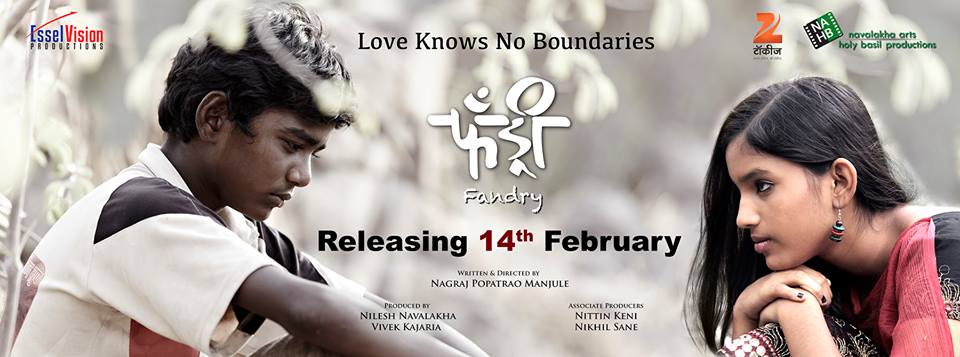
Fandry

Initially it was the title of the film that made us curious. And strangely, nobody knew the meaning because though it seems like a Marathi word, it isn’t. And then we saw the film at Mumbai Film Festival and loved it. It even featured in our best scenes of the year list.

The film has been written and directed by Nagraj Manjule. The makers have just released the official first trailer of the film. It perfectly captures the mood and the essence of the film. Have a look. And thankfully, it’s with English subtitles.

Official Synopsis

A mesmeric force pulls Jabya onto the other side. The rarest of rare Black Sparrow, he is told, is the cure to his problem. The hypnotic spell of the sparrow makes him wander relentlessly. Completely away from the magical world of Jabya, exists the callous reality of his parents who are working at the most oppressed level of the Indian Class Structure and assume him to do the same work which they have done all their life. The protagonist Jabya has to now struggle between his quest to find the magical sparrow and his parents’ expectations. Will Jabya be successful in his pursuit of the Black Sparrow? Will the magnetic power surpass the class differences between Jabya and Shalu created by centuries of customs.? Will Jabya break the fences and pass onto the other side?

Cast & Crew

Studio – Navalakha Arts and Holy Basil Combine

Director – Nagraj Manjule

Writer – Nagraj Manjule

Screenplay – Nagraj Manjule

Music – Alokananda Dasgupta

Producer – Nilesh Navalakha and Vivek Kajaria

Cast – Kishor Kadam, Chhaya Kadam, Somnath Avghade, Suraj Pawar, Rajshree Kharat,
Sakshi Vyavhare, Aishvarya Shinde, Pravin Tarde, Bhushan Manjule, Nagraj Manjule

– Click here to read our review note from MFF.

– Click here to read Varun Grover and Kushan Nandy’s take on their favourite scenes of the year, both from Fandry.

– Click here to visit film’s official FB page.

And do watch it. It’s releasing on 14h Feb.

Aseem Chandaver, or Baba Jogeshwari or Gina Kholkar on Twitter or Neelouli on youtube, or by whatever name you might know him, he is hands down the baap of all B-C Grade movie buffs that we know of. Working in Mumbai as a copywriter, the man is responsible for sifting through tons and tons of campy movies, selecting clips, uploading and sharing them in his spare time, purely for the joy and love of B-C Grade cinema. We thought it would be fitting to post what he thought of Miss Lovely and requested him for a review. So here it goes, Aseem on Ashim’s film –

Miss Lovely1

Since the global connection of interconnected computer networks is presently imploding with acute interest, unanticipated awe and limitless curiosity for the once shadowy genre of B, C & D-grade films, I thought since the past one and a half years that director Ashim Ahluwalia’s film Miss Lovely will uphold a sense of equilibrium by retaining the novelty, cleansing the category of all its amassed gloss and prolonging fandom through unseen and unheard tales of cinematic obscurity.

Well, I was wrong. Miss Lovely is definitely a new brand and flavor of soda pop, but without any strong hallmark fizz. An incredibly well-researched and chronicled film that leans on its experiential past without ever paying attention to the evidently weak screenplay and character extinguishes. A stalwart and his coerced unenthusiastic brother who falls in love with the struggling actress, asphyxiated in a subterranean world is not only captivating, but a ticking calm bomb set to explode when you least expect it. Instead of a pensive postmortem or even seeing the world through seedy filmmaking eyes, it does a staccato job of introducing you to half-baked and sometimes clichéd characters with anticlimax dialogues that literally deflate moments of visual narrative and accomplished story.

The film starts with a brilliant spook sequence, which even incorporates cleverly reconstructed POV shots from Director Baby’s B-Grade magnum opus House No. 13, a slight Desi rendition of the movie ‘The Poltergeist’. Ahluwalia’s profound knowledge of what the audience wanted and what psychoactive levels the filmmakers went to entertain those fantasies can be unmistakably seen here.

House No. 13 scene. Watch from 1:00:55 –

In the House No. 13 intro scene, just as the audience gets bored with the ghost being charred to flesh and dust, Ahluwalia reveals years old secret that made some of these films a runaway success. As the House No. 13 reel ends, there begins a Double X rated film which were in the 80s and intermittently in the 90s cut pasted all throughout the film. These double X films were either shot separately with a completely different cast or with the film’s cast continuing a lovemaking scene in the same film but with topless or semi-naked shots. Some insider moments like these keep springing in the first half of the film; two of the most memorable ones being the scenes from Wohin Bhayaanak Raat and a motleyed recreation of Khooni Panja & Hatyarin, where Ahluwalia unveils yet another fascinating tale of fetish based cinematic excellence – Spectrophilia/Necrophilia.

Wohin Bhayanak Raat – From 3.27 –

I think Ashim has been a lot around the sets of B-Auteur Vinod Talwar – The Dulhan Scene particularly motif from these two movies –

Khooni Panja – From 1:02:28

Hatyarin – From 11:23

In one scene, a newlywed bride is being ravished by a monstrous aberration in a sexually charged hypnotic trance which is depicted by Ahluwalia with a hysterical and precise recreation of the shooting style of Camp filmmakers; while in the other we have Kiran Kumar’s deep-fried chicken pakora avatar who ferociously sucks the blood out of female victims is superbly incorporated in the film as if it is made by the film’s lead pair The Duggal Bros (assuming it is made to sound like The Dhillon Bros, a famous B-movie duo).

There are several triumphs like these where the Director outshines and puts a wide smile on enthusiasts and novices alike. The entire movie is laced with a ‘Green Room-esque’ motif, and when you combine the moody direction with ace cinematographer Mohanan’s virtuosity, you are inadvertently left with a princely smack of Cuticura, the mentally depressing lights of the backstage and the impending doom of a wrathful breakdown from the funding Underworld Dons and unpredictably sinister Distributors. The music of the film is absolutely mind-blowing. Instead of lackadaisical 80s guitars and off-tune keyboard sonatas by less known music directors, the music has been perceptively compiled containing the best of post-disco pop such as Nazia Hassan & Biddu and even contains psychedelic compositions by Maestro Ilaiyaraja and Italian exploitation composers Egisto Macchi and Piero Umiliani of Manha Manha fame.

Dum Dum Dede – Miss Lovely Official Song

The musketeers of Miss Lovely are its stylized treatment, costumes, production design and lastly, Da Man Nawazuddin Siddiqui, an actor who rises like a phoenix from a deadpan screenplay and heightens his character even when he stands still, traumatized and sickeningly numb after a prison term, watching his heartless brother’s wife beseeching him not to enter her newly started life. An unforgettable scene where Nawazuddin lifelessly stands still and simply gives a smile, flummoxed at the heartlessness of the world. What masquerades as a dense narrative is actually an intensive lack of scenario. The story is about a forlorn and discontented bloke Sonu (Nawaz) who joins his slightly established B-movie filmmaker Vicky (Anil George) in the Camp movie-making business. After initial shocks and frustrations, he meets Pinky (Niharika Singh), an innocent struggler who hails from a strict family. Sonu pretends to be a filmmaker who promises her a lead role in his upcoming film titled Miss Lovely. After a brutal clash from the underworld and sundry financiers, Vicky lures Sonu into a last resort plan that forever exiles him to oblivion.

Even with the leading characters’ galling complexities, insecurities and their escapades, the film battles between two worlds whether to tell the story of the B, C & D-Grade World through the eccentric mentation of Vicky and Sonu or try to salvage the maladroit storyline impediments of all three characters, leading to an inevitable Bhandarkar-esque situation. And yet the movie is sandwiched by some of the most painstakingly showcased cultural phenomena and developments of the late 80s and early 90s.

With all its narrative faults, Miss Lovely proved to be a commendable watch due to its spectacularly rich recreation of the first ever D-Grade Era, its uncompromisingly Pulp and Psychedelic 80s settings, the Behind-The-Scenes of extremely paltry budget films, dark humor of its characters and of course for the glory for Camp/Cult fanaticism.

P.S – I’m extremely angry as someone flagged my Qatil Chudail video as inappropriate and pulled it out from youtube.

(Editorial Team note – You can check out Aseem’s videos collection here, here and here. And click here for our 2012 rewind post in which we’d written about Miss Lovely)

Ashim Ahluwalia’s film Miss Lovely premiered at Cannes Film Festival in 2012 and has been doing the fest rounds since then. Finally, it’s all set to release this friday.

The official synopsis describes the film as follows – Set in the lower depths of Bombay’s “C” grade film industry, MISS LOVELY follows the devastating story of two brothers who produce sex horror films in the mid-1980s. Some of us saw the film at Mumbai Film Festival and loved it. A great atmospheric film which makes you feel claustrophobic and displays great filmmaking craft which is so rare in Indian cinema.

In this post, Ashim takes us behind the scenes of the film and tells the story of making of the film through these 8 images. Do click on any of the pic to start the slide show and do watch the images in full size because even these stills capture the mood of the film so well.

PIC 1 – Nawaz (top left)

I was very lucky to cast Nawaz in his first leading role – he had struggled for ages and nobody would give him a lead, only character parts. I didn’t know who he was, but when he did the screen test he appeared so broken by the industry, so frustrated, with a lot of pent up anger, I was amazed. I realized that he was, in real life, just like my character Sonu Duggal – who is also very unfulfilled, working like a donkey for his dominating elder brother.

PIC 2 –  DoP, Horror film set (top right)

My DoP is Mohanan. He shot my first film, John & Jane. We are like brothers separated at birth. He gets me – we discuss stock, processing, colour temperature, texture, framing  – and we are almost always on the same page. Miss Lovely is in some ways about the end of celluloid, the end of cinema as we know it – so I didn’t want to shoot digital – it needed to be on film. I wanted Miss Lovely to look like it was shot on the (now unavailable) Indu stock of the 1980s. F**ked up, warm, grainy, with a very particular desi look. He thought I would ruin his career with all the Ramsay Brothers gels that we were using, but I think that he now feels very proud, like this is one of the more beautiful films he has shot.

PIC 3 – Cat fight. Crowd (2nd from top right)

We don’t have enough cat fights in our films anymore and I kind of miss that. This is a scene where two actresses – Poonam and Nadia – get rough with each other. Poonam is from a previous generation, she’s had her time, and Nadia is young and all set to replace her. Nadia is wearing an outfit straight out of a silk smitha film. Unfortunately, they actually started fighting and it got out of hand. Nawaz tried to separate them and got slammed into the mattebox of the camera. He was bleeding – it was stressful to shoot this scene.

PIC 4 – Movie on screen

Everything was shot on location. We were trying to recreate a Bombay of the mid-1980s that is also the Bombay of mid-1980s cinema. You will get it if you’re from a certain kind of background. I wanted quintessential Hindi cinema—the villains by the pool, the cabaret. Miss Lovely is an architectural film—it’s my kind of Bombay film, in a way.

It’s virtually impossible to recreate 1980s Bombay since there’s almost nothing left. Forty per cent of our locations have been knocked down.

The times were flash but also faded. We spent a lot of time dipping costumes into tea and deteriorating them. I wouldn’t let anybody take a shower or wash off make-up. I wanted things to look lived in.

 PIC – 5, 6, 7 (Nawaz on bed, Anil George with crowd, Legs on top)

Shooting a fake porn scene at the Darukhana ship breaking yard was not easy. We didn’t have permission and while we were shooting the police raid where Sonu gets arrested, all the dock workers showed up to watch the shoot. They saw cops (who were actors in costume) chasing a woman covered only in a bedsheet and a guy in his underwear and thought that there was something serious going on. They thought we were TV crews covering the real event. I decided to include the actual crowd in the scene without them realizing it – it was total madness, an almost riot-like situation, but I am most happy with this scene.

PIC – 8 (Niharika on the sets)

Both Nawaz and Niharika were frustrated with the industry when I met them. I didn’t know either – I just screen tested them. Niharika had shot two Himesh Reshimmiya films that had been shelved. She was fed up waiting to be a heroine and was ready for something new. Her character Pinky is a struggling actor, who is also very exhausted trying to make it – so like Nawaz her real life overlapped a lot with her character in the film.

 – To know more about the film, cast and crew, click here.

1507938_10152164416485350_1695984920_n

Few years back when i was searching for a copy of Om Dar B Dar, every search ended in disappointment. Everyone had heard about the film, few had seen it and nobody had a copy. As the chain spread through friends, and their friends and more friends, we finally got to know someone who had a copy of the film. But he wasn’t willing to give it to us for the screening. He said he will come with the copy, screen the film and take it back. And that made sense because who would part away with something so rare. This is what you call a cult classic.

Thanks to NFDC and PVR Directors Rare, the film has been restored and is getting a release this friday. Don’t miss this one in theatres. Can bet that you haven’t seen anything like this in Indian cinema. As i keep repeating myself, i remember it as mixed media art installation. It’s esoteric, funny, trippy and yet completely accessible. If you have any apprehensions, don’t worry, just enjoy the ride. And remember, Kamal Swaroop made frogs cool much before P T Anderson discovered them.

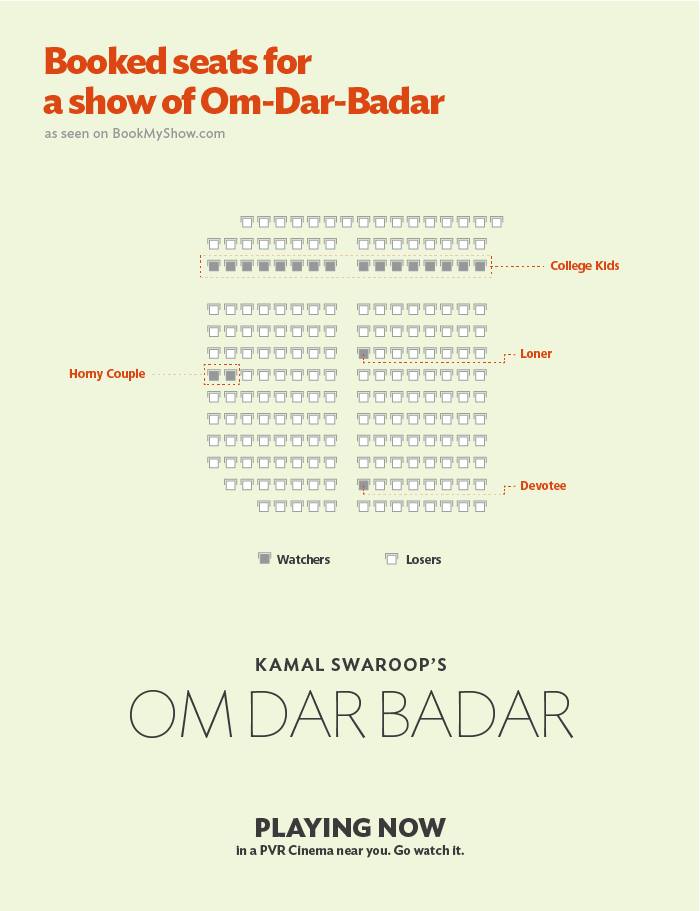
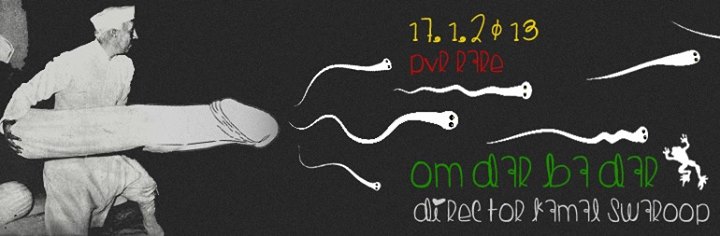
Recently Kamal Swaroop posted a status on FB asking for fan posters. And entries have been pouring since then. We are sharing some of the fan posters. The last one is the official poster of the film. Click on any pic to start the slide show.

– To check out more fan posters, click here to go to its FB page.

– To check out the film’s new trailer and more info about it, click here.