Archive for the ‘cinema’ Category

We have been thinking about having some filmmaking workshops on a regular basis. It started with our cinematographer friend Mitch aka Mithun Gangopadhyay taking the initiative to conduct a basic cinematography workshop. It was going to be free of cost but logistics always requires money. Thankfully, the nice guys at Babble Fish Productions and LighNLight helped us with the venue, cameras and lighting gear for the workshop. Mithun put out the details on FB group “Crew Call India” and it was open to all on first come first serve basis.

Now that we have tasted blood and it was quite awesome, we have been thinking about making it a regular feature – with screenwriters, cinematographers, production designer, sound designer and the usual suspects.

This is where we need your suggestion and help. The idea is to invite the talent (hopefully there are enough interested souls who would like to share their knowledge) and we figure out the rest. The idea is to keep it free and do it regularly. Suggest and help us with answers to these three questions.

1. What we need – place (at least for 20/30 people to sit) – Do you know anyone who can help us with a place? Either for free (best possible solution) or with nominal charge (we split the cost). Ideally between Bandra and Andheri.

2. If the place is free, a big headache is gone. If we have to pay for it, how much you guys are willing to pay for, say 4-6 hours workshop?

a) less than Rs 500 b) Rs 500 c) Rs 1000 c) more than Rs 1000

3. Any more ideas/suggestions that you have in this regard that will help us make it possible.

Please reply in the comments section under 1, 2, and 3.

Coming back to the first workshop, here are some of the notes that Kartik Krishan managed to take down. Hopefully it will help you.  Over to KK.

Our dear cinematographer friend Mitch held a Basic Cinematography Workshop for aspiring directors at Bablefish compound in Lower Parel. It was meant to be an educational non-profit workshop. Have taken few notes and thought it would be good to share it here. Apologies in advance if I have wrongly quoted him. In case you are interested, Mitch is doing another one on Aesthetics this weekend (he is busy or pretending so).

It’s a very interesting yet difficult time to be a filmmaker. Interesting because Technology is cheap and resources are easily available. But difficult because anyone and everyone can do it. Earlier it took a certain journey to become a filmmaker. Now anyone with a camera claims to be one. To be a filmmaker one has to have something to say and one has to know the tools. For eg: if the camera breaks down, I can’t fix it. But I know how to use it.Cinematography cannot be taught in a day and I will not get into aesthetics at this stage. I will try and cover the gear – how to use it. And also how a director should try and communicate with the DoP. Sometimes even great directors cannot communicate their thoughts/ideas to the crew. Simple things like – framing, headroom etc. Does he want tight controlled frames or loose frames? A DoP should be told what is needed. Eg: A Dir says ‘I need a 4 shot’. So I understand that he wants four people standing in a shot. So I accordingly light it up. But then later he says no just all their faces in a tight frame. I just spent 30 min on lighting when it could have been done in 15 min. What will make a frame/scene look good ?Not just the cinematographer. But production design is 90% of ‘good cinematography’. Then Lighting. A white wall cannot be made to look good. I need character. Eg: Graffiti etc. I sincerely recommend all Dirs & aspiring Dirs to put money in Production Design. Lighting can be done in china bulbs if it is a great looking set. Most of the daily soap sets on TV are so bad that no matter what you do, it won’t look good. Get a good production designer. There Will Be Blood’s DoP thanked the Production Designer in his Oscar Thank you speech. Something looking great to eye can be easily made to look great in camera. Something looking shitty to the eye, it’s quite tough to make it looking great in camera.ASPECT RATIO – CURRENT/RELAVENT4/3 – like the Old TV screens – full gate academy aperture. Everything started with 4/3. Most TV was 4/3. Nowadays even most commercials are in 4/3 safe. I recently did a commercial for Govt of India for which I shot on Alexa – 16/9. But the master went in 4/3. Because the target audience was rural India. ‘No’ – the recent Chilean film was done in 4/3 – shot in a Beta Cam – retro look. Andrea Arnold the director of Fish Tank shoots in 4/3 and she makes great films. I completely agree with her decision to shoot her films 4/3.16/9 – standard HD aspect ratio for all digital cameras. Red, 5D, Sony, DSLR, Alexa – AD films, TV. The standard format.

CinemaScope – 90% of the films shot in India is reduced to Cinemascope (anamorphic  2.35/1). Nowadays if you don’t have cinemascope format the distributors say ‘Picture mein scale nahi hai, hum nahi khareedenge’. We cannot dictate terms on this. I remember Dilli 6 was shot in 1.85 aspect ratio but the distributors raised a hue and cry about it. But the makers said ‘we’re going to go with this format only.’ So the distributors relented. Another example is the great Vittorio Storaro. I learnt cinema by watching his films. In the past 10 yrs he has proposed a new aspect ratio of 2/1 which is somewhat akin to the Renaissance paintings but no avail. Even he couldn’t change the system.

Super 16/35 vs 16/35 mm – in the latter they use a little bit more of frame (from sound). Look of super 16 is grittier-raw. I feel it is a pretty good format. Before DI, earlier super 16 used to be blown up in 1.85/1 (abroad format). 1.78/1 & 1.85/1 are quite similar. The difference is negligible.

There is no point shooting anamorphic if you are shooting in a classroom. Ever since DI has come they don’t rent anamorphic lenses (because they are slow, heavy and expensive). They usually shoot 16/9 and crop it to anamorphic.

Faster lens means smaller F stop. 1/3rd lets more light in lens than 5/6th. The minimum opening of a lens determines how fast or slow it is.

Roger Deakins hates RED cameras. Both the eyepiece and monitor cannot be played at the same time without an additional component. The Alexa is a closer transitional phase camera. Bhaag Milka Bhaag was shot on Red epic. Matru on Alexa.

CAMERA FORMATS

Super 8 – lots of films. For the vintage look.

Super 16 – Dhobhighaat. Zinda. Good for costs. My fav format ever. Nowadays 50D or 500T is available.  Fuji 160D was the most beautiful stock available earlier. Now it’s no longer there.

Just coz it’s on film,  doesnt meanit’s good. I’ve seen stuff shot on 5D which looks better than most films. What you put in front of the Lens is more important than what is behind it. The Production Designer, Actors, Lighting etc is more imp than what camera you are shooting in.

While shooting Day for Night – just ensure some basics are taken care of – like not pointing to the sun, take care of the shadow detail.

Most DoPs are not involved in Grading. It’s much easier to grade an Alexa/Sony image than a Red image.

Days of Heaven was shot only on Magic Hours. Magic hour for film is usually 15 min, for digital it is 20 min.

Upstream color is a great looking film which I believe is shot on GH3 cam (Cheap) but still it looks better than 80% of the films. There’s no hard and fast rule.

Half the film Biutiful – is shot in 1.85. The minute the workers die in the warehouse, the film shifts to Anamorphic.

35/Super 35 mm – Alexa, Red, C300/C500 have super 35 sensor. It is the default camera sensor size.

65/70mm & IMAX

DIGITAL

SD – Standard BetaCam/PD 170. 640X480 is SD. Most of the films on TV are SD.

HD – High Definition >= 720p. Has a progressive image. The i in HDi mean interlaced image. All film is 24fps. All TV in India is 25fps. Hobbit was done on Red 3D 48fps. All HD broadcast in India is 720p

True HD – 1080p and above

Ultra HD – 4K and above. The future is Ultra HD.

CAMERA SENSORS

CCD – Older Technology. Not great in low light

CMOS – used in High End cameras. CMOS sensor is better. 5D has a CMOS sensor. The problem with Rolling Shutter is – the image wobbles when you pan fast. The new Sony Cam has Global Shutter.

US is NTSC. India is PAL 25fps.

5D – 5D has a full frame sensor. It was always a stills camera for photo journos. Then they asked for a video recording facility. Over time one could control the camera. Pretty soon everything changed. Docus, Music videos, low budget ADs were shot on 5D, because of the shallow depth of field.

I was shooting a documentary on kids in foster home (where the kids were talking about the physical/emotional abuse they have suffered in their lives). I kept telling the Dir to shoot on a 1/3 Inch camera to capture all action and movement, but he insisted on 5D. The kids were talking extempore. The Dir wanted tight cuts. What will you do with a shallow focus in a classroom ? Most still lenses are not parfocal lenses (Zoom karne par focus chala jaata hai). The truth is that though most Docus are staged but sometimes doing extempore on 5D is tough. One has to be mindful of these things.

Most of the trade off in filmmaking is this – you will only get two of the three factors right at a time.
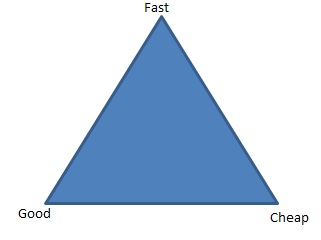
Rule of filmmaking

Earlier when using Film, there would be in camera rehearsal. Nowadays there’s no rehearsal blocking done. That is the reason most Indian films look flatly lit. Because the Dirs say – ‘lighting kar de, blocking baad mein dekhte hain’. Making films is a crew making/management deal. Right person and right tools.

LENSES

Spherical (95% of all lenses) & Anamorphic (Special lenses – heavier, expensive, time consuming). Usually spherical lenses are used most of the times. Super Wide, Wide, Normal, Telephoto, Super Telephoto Lenses.

Usually 85-135 lens is a long lens, used more portraits. Exception- in Amelie, all CUs are shot in a wide angle lens!

Cooke lenses – (British) good romantic high end lenses. Used in Drive.

Zeiss – Used in Skyfall

Master Prime – the sharpest lenses in the world. Soft, sharp, Bokeh, depth of field, flares

Film is a SOFT medium. The old lenses will flare (no coating).

LIGHTING

Color Temp – Each light has a color temp. Daylight is 56K Kelvin. Tungsten household bulbs etc are 32K.

Sony F65 has a tungsten sensor, Alexa – Neutral Sensor, Red – Daylight Sensor

You can mimic daylight with HMI (white light). 100 KV HMI = 10,000 volts light

Tungsten light – if you want a face to look good, this is the best light. Although it is inefficient as it becomes very hot. It has 92-93% Accuracy Color Indentation Index (average ‘good’ is considered to be 85-94%).

Florescent Lights – eg Kinoflows – can give you both Tungsten light & Daylight. Has 89% Accuracy Color Indentation Index.

LED Lights – Not as powerful. Color Tones are also inconsistent. It’s basically an array of lights. Portable and can run on a battery for an hour. Cheap. No clean shadow. The smaller LEDs are called Rosco lights.

You can dim down HMI & Tungsten but you cannot dim down Florescent/CFL. Tree of Life – was shot completely in natural light.

HMI – most popular. 575 HMI is equal in power to 2K Tungsten Light. Though more expensive to rent. But it is more versatile. A ‘joker’ is an 800 Watt HMI.Half Light – only one side of face is visible

Hard Light – gives a very pronounced shadow

TECHNIQUES

FRONTAL HOLLYWOOD LIGHTING – to make everyone look good. The shadows are below the face. With a bounceboard (thermocol) below the actor’s face. This is the best way to light an actress.  In Fashion photoraphy – uppar se soft light aur neeche se reflectors.

Frontal Hollywood Lighting
CTO – makes daylight into tungsten

Diffusion – makes light softer (Tracing paper)

In Godfather one cannot see Brando’s eyes (managed by Top light). There’s always skunk eyes (dark shadows on eyes)- that’s the idea.

In Scandinavian countries – it’s always gloomy, rainy, cloudy. The natural light is soft light, diffused.

Always put color before diffusion paper

REMBRANDT LIGHTING –  Light is on the right or left side (45 degree to face). Most classical paintings. Dramatic High Contrast.

Rembrandt Lighting

BUTTERFLY LIGHTING – In between Hollywood & Rembrandt.

Film Noir is usually Hard Light. Like Sin City. A Rom Com is usually Soft Light.

Let the Right One is great because for a horror film, everything is so brightly lit

* Check out the Light ka swash book (similar to the color palette that Art Dirs carry)

THREE POINT LIGHTING – Key light to light your actor/product. The most imp light on the key side of the face. It is what gives illumination to the scene. You want to shoot mostly in the Fill side not the key side. Camera is facing Shadow side and then you put a fill light to show the face. There’s usually a 2 stop diff between the Key & fill.

b3-three-point-lighting

If the fill light is behind the actor then it is Backlight/Edge. South Indian films are back lit heavy.

COVERAGE

A shot list is important so that everyone in the crew knows what you want. Storyboards are a MUST on low budget films as opposed to Big budget films. The idea is that first actors blocking & camera rehearsal is done only with the HoDs and then the actors can be sent for makeup/costume while lighting can happen in the background.

SOFTWARE HELP 

Artemis (Viewfinder) – you can save it and print it out too

Helios (for DoPs) – Tells you the position of Sun

P Cam (for DoPs) – Lighting Software

Tech Scout (for DoPs) – Lighting Requirement

London Film Festival (LFF) has announced its schedule for this year. The 57th edition of the festival will run from 9-20 October and will screen 234 feature-length films & 134 shorts from 74 countries.

India seems to have a good score at LFF this year as seven desi films have been selected for the fest. The titles include Buddhadeb Dasgupta’s Anwar Ka Ajab Kissa, Ritesh Batra’s fest favourite The Lunchbox, Nagraj Manjule’s Fandry, Richie Mehta’s Siddharth, Shaina Anand and Ashok Sukumaran’s From Gulf To Gulf, Rituparno Ghosh’s Jeevan Smriti and Uday Shankar’s Kalpana. The Lunchbox is in official competition section of the fest.

But the one that we are most excited about is Anwar Ka Ajab Kissa (Sniffer). We have been hearing about it for sometime and now more details have come out.

ANWAR KA AJAB KISSA

sniffer-002

Master Bengali filmmaker Buddhadeb Dasgupta teams up with India’s hottest indie actor Nawazuddin Siddiqui in this richly textured black comedy, set against a magical, surreal tableaux of the Bengali city and countryside that’s typical of Dasgupta’s eye. Anwar (Nawazuddin Siddiqui) is a well meaning if clumsy private detective, or ‘sniffer’, who can’t help getting personally embroiled with the clients he is spying on. His only true companion is an old dog. His pet and his regular drunkenness put him at odds with the local orthodox Muslim housing block, who want him out. At the same time, Anwar increasingly struggles to cope with his small-time sleuth work that shows him that, in the modern world, even love is for sale. When a case takes Anwar back to his rural homeland, he’s forced to confront his own love tragedy. Siddiqui lights up the screen, displaying a talent for deft comic timing that makes Sniffer a joy to watch.

– Director-Screenwriter : Buddhadeb Dasgupta

– Producers : Ajay Sharma, Archismaan Sharma

– With Nawazuddin Siddiqui, Pankaj Tripathi, Ananya Chatterjee

– Duration :132 mins

FANDRY

fandry

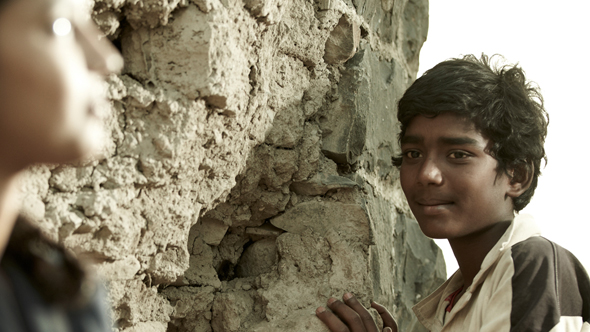
The ‘untouchable’ Jabya struggles to reconcile his status with his dreams in Nagraj Manjule’s uncompromising indictment of India’s caste system.

– Director-Screenwriter : Nagraj Manjule

– Producers : Vivek Kajaria, Nilesh Navalakha

– With Somnath Avghade, Suraj Pawar, Kishor Kadam

– Duration : 105 mins

– Production company Navalakha Arts and Holy Basil Combine

Nagraj Manjule’s film is a scorching indictment of the caste system that persists in modern India despite legislation introduced since independence. It is depicted through the eyes of an intelligent Dalit (untouchable) teenager, Jabya, who has a deeply rooted inferiority complex about his looks, caste and his family’s staggering poverty. These feelings prevent him from expressing his affection for his fellow classmate and cherished love, the fair-skinned Shalu, who is the daughter of a higher-caste family. His father is against him going to school and aspiring too highly and fellow villagers expect him to do menial work like the rest of his clan.

SIDDHARTH

siddharth-002

A modern-day quest to find his missing son leads Delhi tailor Mahendra on a perilous journey into the unknown in Richie Mehta’s cautionary tale.

– Director-Screenwriter Richie Mehta

– Producers Steven N Bray, David Miller

– With Rajesh Tailang, Tannishtha Chatterjee, Anuray Arora

– Canada-India 2013

– Duration 96 mins

– Production company Poor Man’s Productions

– Sales : Fortissimo

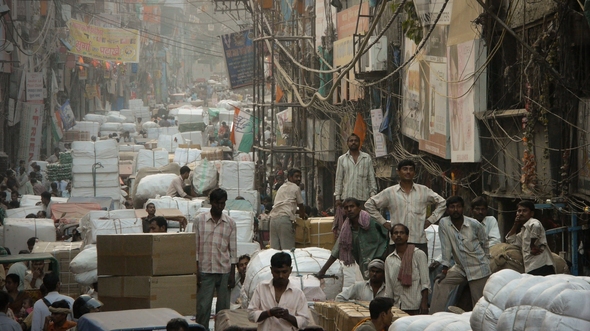
Director Richie Mehta returns to London with a powerful tale that is all too sadly a common story in today’s Indian cities. In Delhi, a door-to-door tailor, Mahendra, and his long-suffering wife, played by Tannishtha Chatterjee (Brick Lane), are struggling to make ends meet. They send their 12-year-old son Siddharth off to work illegally in a factory in Punjab, but when he doesn’t arrive back on the agreed date, the couple go to the middle men who arranged their son’s job and then the police. As they don’t have a photo of their son, identification is near impossible. As tales of child abduction are raised the desperate father borrows money from his fellow local street vendors and sets off on a quest to trace his son’s journey into the unknown.

FROM GULF TO GULF

from-gulf-to-gulf-to-gulf-002

Mobile phone video from the sailors who brave the routes between India and the Persian Gulf form the basis of grassroots true-life adventure.

– Directors : Shaina Anand, Ashok Sukumaran

– Producer CAMP

– India-United Arab Emirates 2013

– Duration : 81 mins

– Production company : Sharjah Art Foundation

‘A film based on actual events, and videos of actual events.’ Four years ago the Indian artists’ collective CAMP started to work with the boats that crisscross the Arabian Sea from the Gulf of Kutch between India and Pakistan to the Persian Gulf. This film draws from these years of dialogue, friendship and video exchange with sailors, most of whom are from Gujarat in India, Southern Iran and Pakistan. Rather than directing, the filmmakers act as editors, deftly compiling from the sailors’ mobile phone footage an authentic grassroots picture of the experiences of these usually invisible sea workers. But, with the impressive wooden boats and the joyous soundtrack (chosen by the sailors themselves), this humble material is ultimately transformed into a modern adventure on the high seas.

 JEEVAN SMRITI

jeevan-smriti-002

The swansong of the late Rituparno Ghosh is a fittingly personal take on the LFF favourite’s own inspiration, the poet-artist Rabindranath Tagore.

– Director-Screenwriter : Rituparno Ghosh

– Producer : Sanjoy Nag

– With Sanjoy Nag, Samadarshi Dutta, Raima Sen, Anirban Ghosh

– Duration 78 mins

– Sales : National Film Development Corporation

This is a sumptuous, very personal docu-drama about his own inspiration – the legendary poet and artist Rabindranath Tagore. Flamboyant Rituparno, with his camera team, set off from Kolkata in the monsoons to Tagore’s country birthplace, on a journey of love and poetic admiration. On the way they uncover the lesser-known personal life of this Bengali hero. A stunningly photographed dramatic story, backed by great actors like Raima Sen, depicts the inner struggles of the young, introvert Tagore who, in spite of his comfortable background, was constantly tortured but also inspired by love and terrible loss.

Kalpana is Uday Shankar’s classic which has been restored by World Cinema Foundation at Cineteca di Bologna/ L’Immagine Ritrovata laboratory in association with the National Film Archive of India.

Info and pics courtesy : BFI

Phoring2

In the last few years, Bengali cinema has been trying and delivering some really out of the box gems. Films which don’t follow the conventional rules. If you follow the blog regularly, we try to put the spotlight on those films whenever we can.

A new film titled “Phoring” caught our attention. Have a look at its trailer. It has English subs.

Though the topic is not new but the setting and the detailing makes it really look good. Have never heard this description of Coca Cola. The film is directed by Indranil Roychowdhury and is releasing on September 27, 2013.

It was also in NFDC’s Film-In-Progress Lab and had won The Prasad Lab Award for DI and Colour correction.

Official Synopsis

Phoring is a story of adolescence that most adults deny they ever had. In fact, we all prefer to believe that we jumped straight from the flowery innocence of childhood to the informed maturity of adulthood. The mid-greys of awkwardness, lack of direction, gawkiness, lack of identity are the themes that we prefer not to associate with ourselves. Phoring is a sweet reminder of a film in that sense. It’s a children’s story for adults.

– To know more about the film, you can follow its FB page here. And can read a Business Standard piece on the film here.

(PS – Look at that gorgeous font/design)

The Lunhcbox2Cannes, Award, Sony Picture Classics, Toronto Festival, KJo-UTV release, and now, Telluride – this must be a dream run for a debut filmmaker.

The much respected Telluride Film Festival has just unveiled its line-up for this year. The fest is known for keeping its film selections a secret till the last minute. This year, the festival is celebrating its 40th anniversary and will run from 29th August to 2nd September.

Ritesh Batra’s The Lunchbox is the only desi film at the fest this year.

And have we told you guys how simple, solid and awesome it is. It’s releasing on 20th September, and if you trust our film reccos, you can book your tickets.


To know more about the film (cast/crew), synopsis, trailer, click here.


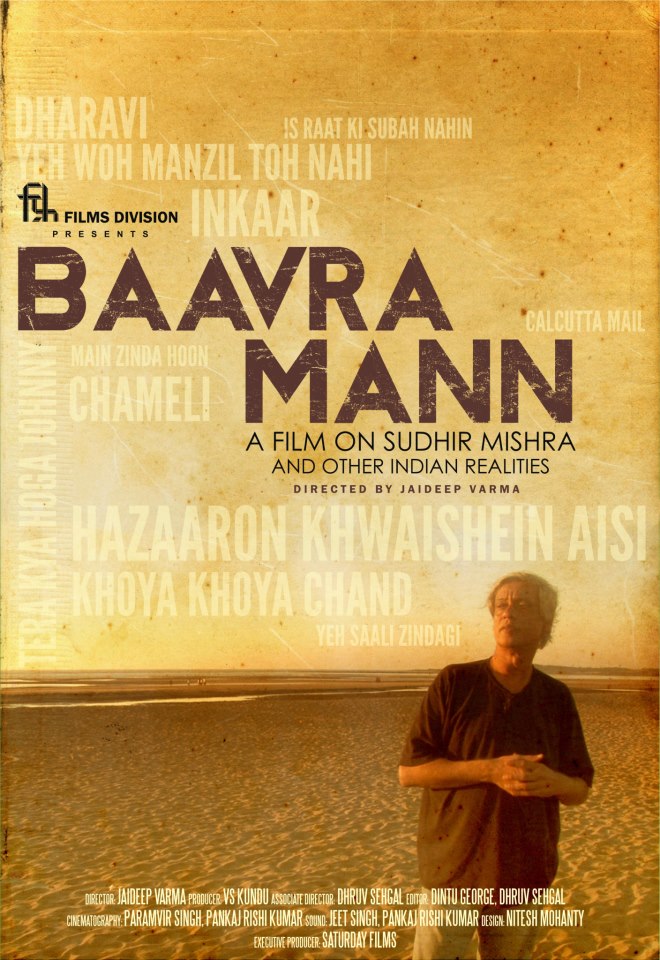
Jaideep Varma’s documentary Baavra Mann is yet to get a release in India. Karan Singh Tyagi saw it at New York Indian Film Festival earlier this year and wrote this post for us. Read on.

(We suggest you play the song in the background while reading the post)

Baavra MannWho is this long-haired Sanjay Dutt duplicate?

Duplicate nahi hai bhaiyya. Iska naam Nirmal Pandey hai. Kya acting kari thi isne ‘Is raat ki subah nahin’ me”, was my prompt reply, as my cousin and I stood in line with a dozen others, scanning movie posters outside Gaiety (Bandra) and booking our tickets for ‘Auzar’. As an 11 year old, I couldn’t contain my excitement, at having recognized Nirmal Pandey in the ‘Auzar’ poster, and went on this long rant about ‘Is raat ki subah nahin’. Much to my cousin’s chagrin, I told him everything about the movie – how it was violent and funny at the same time, how all the actors spoke a very different language, how the story finished in one night, and importantly, how Papa and I were lucky to see the movie on the big screen, as it had a single show in Bombay.

This innocuous little incident came back to me while watching Jaideep Varma’s documentary, ‘Bavra Mann and other Indian Realities’, in New York. For those who haven’t seen it yet, Jaideep’s movie traverses through the life and films of Sudhir Mishra, and somewhere in the middle of the movie, Mishra laments how ‘Is raat ki subah nahin’ was confined to a single show in Bombay and how many people didn’t get to see it. On hearing this, I silently smiled as my mind went back to watching the movie with Papa in the same show that Mishra was referring to. How I wanted to thank my father at that very instant! Not just for taking me to ‘Is raat ki subah nahin’, but for giving me the hereditary gift of love for movies and being the best companion I could have had while I nurtured  it.

There were numerous such nostalgia trips throughout Jaideep’s movie. The portions dealing with ‘Hazaron Khwaishein Aisi’ left me mesmerized. Listening to ‘Bavra mann dekhne chala ek sapna’ on the big screen again did my soul so much good; it stirred something deep within me, something in desperate need of stirring. My mind went back to when I first saw ‘Hazaaron..’ I remember crying tears of joy and sadness, laughing gleefully, feeling melancholic and empty, while ‘Bavra Mann’ played on loop and images from the movie interposed with flashes of my life didn’t leave me for days at end.  Probably, this is a uniform reaction that ‘Hazaaron..’ elicits. The movie strikes a deep chord somewhere, and makes one confront broken promises, failed dreams, and all those bittersweet memories, that we carry with ourselves. Right after watching Jaideep’s ‘Bavra Mann’, a friend who had accompanied me to the screening in New York forwarded me this by Avijit Ghosh who captures this sentiment beautifully:

There are a thousand reasons to watch Hazaaron Khwaishein Aisi. But enjoy it as a last anthem for a generation who knew how to believe. Watch it holding the hand of a woman you have loved and lost. And it would be nice if you have drunk some rotten whisky before.

As must be painfully evident by now, I am easily susceptible to bouts of nostalgia. However, these glorious nostalgia-filled moments were not the only reason why I enjoyed Bavra Mann. I have often wondered what drives filmmakers to make the kind of movies that they do. For example, at the risk of doing a Baradwaj Rangan here, I have been fascinated by two particular scenes from Black Friday and Gangs of Wasseypur.

Sample these dialogues:

Black Friday – “Jiske paas kuch nahi hai karne ke liye, dharam ke naam par chutiya banta rahega”. GOW2 – “Jab tak cinema hai log chutiye bante rahenge

I have often wanted to argue that we can discern in these dialogues a kind of master narrative, a collection of meanings, and, perhaps, a powerful leitmotif that runs through all of Kashyap’s movies, a kind of slavishness and hive mentality – towards religion in Black Friday, towards cinema and everything that one acquires from it in Gangs of Wasseypur. To take the analogy further, slavishness towards power in Gulal, towards self and personal ego in DevD and No Smoking. Therefore, Kashyap’s movies are magic on celluloid, because he lets characters with such aggressive spirit and slavish devotion face their internal conflicts and external surroundings. What we see on screen is the result of a bundle of contradictory aspects and motivations, a certain kind of dualism that everyone and everything in life has. I have repeatedly asked myself, what are the questions that Kashyap is trying to answer through his work? Has he found any answers yet?

Bavra Mann poses similar questions to someone whom Vikramaditya Motwane calls the “original Anurag Kashyap”. Despite the frequent and frenzied analysis of cinematic moves of all current directors’, I feel there is a strong lack of literature that provides us with enough resources to examine and study their work. This is where Bavra Mann triumphs. It gives enough resources to the audience to interpret Sudhir Mishra and his movies in a new light. Bavra Mann is a fascinating exercise in self-revelation and film lovers will revel in the personal anecdotes and casually delivered remarks that reveal layers and layers of information about Mishra and his body of work. The movie has a series of interviews with Mishra and people close to him, covering the length of Mishra’s career, beginning with his childhood, continuing through his education, his failed marriage with his first wife, his relationship with renowned film editor, Renu Saluja, his early film work, his breakthrough success with Dharavi, and his daring work in Hazaaron.., his most autobiographical Khoya Khoya Chand, and finally his recent movies. There is a treasure trove of diamonds in the movie. After all, who wouldn’t want to eavesdrop on Mishra and Shantanu Moitra’s recounting of how they got Swanand Kirkire to sing ‘Bavra Mann.’

A criticism often peddled against movies like Bavra Mann is that the director holds back, and is reverential towards his subject. Here, Jaideep is never in awe of Sudhir Mishra. His questions are probing and the discussions on films themselves are less about why they’re great and more about how they were put together. Jaideep knows that directors are not good at explaining motives behind making particular films. Movies, like many things else, begin with something very vague and abstract. Jaideep, therefore, never tries to look for definite answers and actual motives behind Mishra’s work. His aim is to allow the viewers the freedom to interpret the scene in the way they want, and depending on how their cinematic education (and earlier experiences of Mishra’s movies) has prepared them. Bavra Mann succeeds in bringing before us the greatest number of possibilities to reinterpret Mishra’s movies. After watching Bavra Mann, I realized that Sudhir Mishra’s movies (especially the earlier ones) resonated with me because they were being truthful about life – the movies expressed some deeper emotional experiences that Sudhir Mishra recognized in his own existence. This in and of itself was a reason for me to love Bavra Mann.

However, for me, the biggest strength of Bavra Mann is that it never wavers from admitting that Sudhir Mishra continues to be plagued with what is an inconsistent body of work. It subtly engages in criticism of some of Sudhir Mishra’s recent movies (the likes of Inkar, Calcutta Mail) to reflect on the present-day infertility of thought in India. By using Sudhir Mishra’s example, Jaideep exposes the dangers inherent in adopting a conformist and consensus-driven career. According to me, it is in this context that the movie makes a brutally frank attempt to unravel the intellectual decline of India and Indian movies (using Sudhir Mishra as a metaphor).  The movie, therefore, is an elegy of intellectual life not only of Sudhir Mishra but of us all. In a way, the movie tries to jolt us (Sudhir Mishra included) out of the dark recesses that we have allowed ourselves to fall in.

I do not know if Bavra Mann is getting a theatrical release anytime soon. However, I strongly hope that everyone gets a chance to see it. Watch it to revisit old times, to go back to your personal stories intertwined with Sudhir’s films, watch it to hear “Bavra Mann” on the big screen again, watch it as a student and lover of cinema, and most importantly, watch it because it is a powerful statement on the times that we live in.

Naseerudin Shah says the single most perceptive thing in the movie: “Mishra’s best work is yet to come.” Even though, I love ‘Hazaaron…’, I wouldn’t want it to be Mishra’s best work. I earnestly wish that it turns out to be just a teaser of what he (and by association) Indian cinema goes on to achieve and that no one is ever required to come to the rescue of this long-haired maverick director, like I had to once come to the rescue of his similarly long-haired leading man outside Gaiety.

– Karan Singh Tyagi

(Karan was born in Meerut, lived and studied in Bombay and Harvard, and after a brief stop in Paris, now finds himself in New York. He strongly feels that Ramadhir Singh was directly referring to him while saying, “Sab ke dimaag me apni apni picture chal rahi hai aur sab saale hero banna chah rahe hain apni picture me..” When he is not day-dreaming about movies or Real Madrid, he also works as a lawyer. You can find him on twitter here: @karanstyagi)

It’s that time of the year again. Time for a new season of Coke Studio India. That time when we will again become hopeful about it, and then finally give up, and go back to the edition of Pakistan. Aha, still not there.

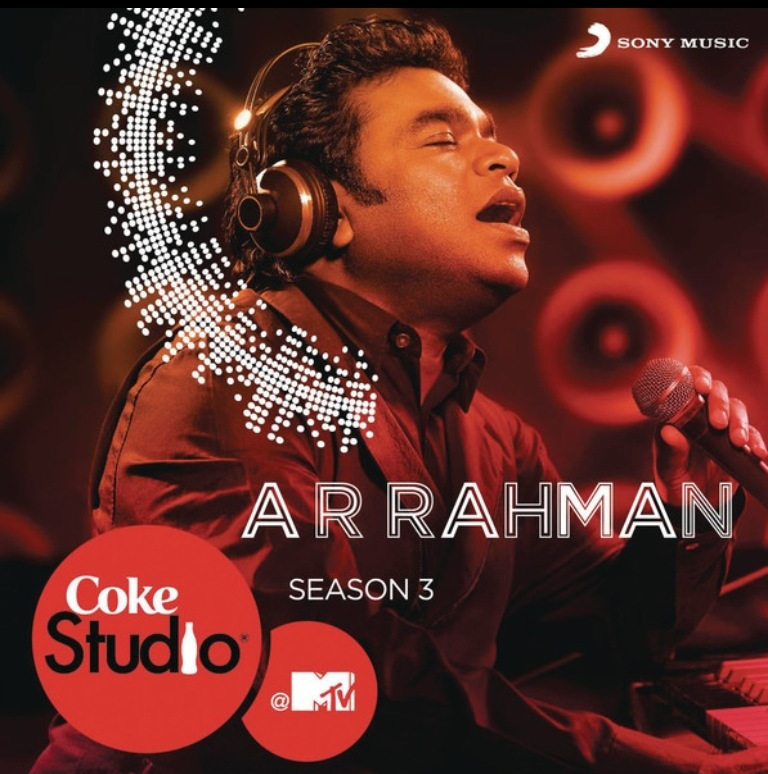
Rohwit earlier wrote this post wondering if this new edition will finally deliver what Coke Studio really stands for in our neighboring country. This season opened with A R Rahman. And then? Well, play the songs and keep reading. And let us know in comments section if you agree with our views or not.

Coke Studio1

The much awaited Season 3 of the Indian Version of Coke Studio kickstarted with a bang on August 17, with none other than ARRahman and his team of musicians. The anticipation was 2 inches above sky high because of the hype that MTV successfully created with systematic ‘leaks’ and a million teasers. Let’s see if it did what it has to do and must do!

ZariyaAni Choying Drolma sets the pace with superb bass accompanying the arrangement. She chants, and enchants! Not before long the backup girls spring into action (One of them is the Indian Idol Season 1 contestant Prajakta shukre as well). Couldn’t help but feel the girls were singing on that all too familiar ‘ishwar allah’ (1947 The Earth) tune. But that’s when Farah Siraj makes an entry and stays till the end of the song. A typical ‘hook’ in the song is missing and arrives just 2 mins before the song ends. It’s not a ‘typical’ song. It’s a prayer, a call for love and we have never experienced Tibetan chants the way this song makes you experience them. There are 3 vocal characters in the song – Ani, Back up vocals, and Farah Siraj. Farah is the ‘hook’ and she soon infects the backup girls to sing to her tune as Ani goes about with the chants. Music equivalent of the word ‘heaven’ was explored with this song and HOW! The percussion is spot on, ARR on fingerboard was spot on so much so that he was smiling, swaying, something we thought we would never see! The arrangement feels studio, Coke Studio!

Naan yen – Rayhanah calls out and while the call in itself sounded a little rough, AR Rahman brings in polish with this free flowing composition that gives the soul some rest the same way Nenjukulle soothed us in Unplugged. We would have liked a bite more from Reyhanah though. A Tamil track that makes the entire ‘language barrier’ incidental and almost insignificant. Highly recommended!

Aao Balma – Padma Bhushan Ustad Ghulam Mustafa Khan (one of the doyens of Indian classical music and the uncle of Ustad Rashid Khan) in all his glory takes the dias in this song. A Hindustani classical piece that flirts melodiously with Carnatic. The song starts delicately giving an overall feel of a beloved welcoming her lover. The sargam in between was arranged well and even though at times the arrangement dominated the voice, nothing went out of sync. The percussion in between did very little to lift the song and in my view it broke the continuity of the song. Towards the end it felt a little scattered. Will I hear it again? Not much. Will I see it again? YES! perhaps a million times! The visual delight that we have come to associate with Coke Studio is there for all to see in it’s full glory in this song. Be it the Juganbandi between Ustad and Prasanna (who makes the electric guitar sound like an electric bulbul tarang at times in the song). The grandson Faiz Mustafa sounds promising along with Murtuza, Qadir, Rabbani and Hasan Mustafa.

Ennile Maha Oliyo – The shortest offering from the episode and we wish that was longer. Issrath and Rayhanah sing the song together and you can make out easily how well prepared they are. Easy on ears, the tune will lead you to play this on repeat (just like Naan Yen) and I am referring to people who don’t understand Tamil (like me). That’s what ARR does and does it in style! The guitar man (Prasanna) flirts with carnatic notes yet again and does a huge favor on our senses. The percussion by Sivamani is fragile yet perfect!

Jagao mere desh ko – AR Rahman tries his hand in Bangla in the opening part of the song and does rather well. However, the continuous descending tone of the opening notes is what will catch your attention first. It is from there, the song goes up up and away! Fusion at its (Coke Studio) best! It is quite tough what to praise most. The superb arrangement, the excellent Suchi, the superlative backups or Blaaze. Back in Pakistan they used bohemia in turns and not together with the singers but here, ARR gets Blaaze to sing along and boy does it sound good! Of course there were some pronunciation issues and towards the end you feel the song if going a bit off track, but when you can live with someone pronouncing ‘ghut ke’ as ‘gutkhe’ here, you can certainly let go of these minor glitches. We did! And it felt superb! Try it.

Soz O Salaam – Again the three generations team up to present this song. The magician Ustad Ghulam Mustafa Khan sahab welomes us to the composition and his grandson Faiz Mustafa holds his ground well. The song could have done slight better had the words been clearer. The tune makes up for it though. Tune wise (even though the rest of the season remains to be seen), this would be one of the best this year. The ‘ARR’ continuum fingerboard adds an overall feeling of a spaced out composition which is unmatched by any other song from this episode. Ironical that this song wasn’t featured on August 17 episode (but is available here). Word has it that this will be featured on T.V. in the ‘sum up’ episode that will have one song from each producer.

With so much already being said (rightfully so, most of it) about Coke Studio India, this episode has set the right tone and it looks like we are in for a cracking season, finally! With the promising line up ahead, we have all the reasons to believe so.

It also reinforces the new formula that a lot of music shows would want to imitate….’When in trouble, call Allah-Rakha Rahman’

shahid_04

Aha, finally the good news. Hansal Mehta’s Shahid has been acquired by UTV and they will soon announce the release date. Hopefully the film should be out in theatres in next few months. The film marks Hansal’s terrific comeback after a long time and Raj Kumar Yadav is so effortlessly good that he makes you believe that he is the real “Shahid Azmi”. The film has been doing the fest rounds for quite sometime now. Do watch it when it releases.

UTV really seems to be going in right direction with the perfect balance of masala and non-mainstream films. First, Ship Of Theseus, then The Lunchbox and now, Shahid. I would say i wouldn’t mind the assault of the big budget braindead star vehicles as long as they keep on balancing it with some sold small and good films. And hopefully other production houses will follow them.

Click here to read a post on Shahid written by Ad filmmaker Ravi Deshpande.

Official Synopsis

Shahid is the remarkable true story of slain human rights activist and lawyer Shahid Azmi, who was killed in 2010 by unidentified assailants in his office. From attempting to become a terrorist, to being wrongly imprisoned under a draconian anti-terrorism law, to becoming a champion of human rights (particularly of the Muslim minorities in India), Shahid traces the inspiring personal journey of a boy who became an unlikely messiah for human rights, while following the rise of communal violence in India. This story of an impoverished Muslim struggling to come to terms with injustice and inequality, whilerising above his circumstances is an inspiring testament to the human spirit. Starring Raj Kumar, Prabhleen Sandhu and Baljinder Kaur.

Cast and crew

Director: Hansal Mehta

Language: Hindi

Runtime: 123 minutes

Exec. Producer: Jai Mehta, Kunal Rohra

Producer: Sunil Bohra, Shailesh Singh, Guneet Monga and Anurag Kashyap

Production Co: Bohra Bros Pvt. Ltd. and Anurag Kashyap Films Pvt. Ltd.

Principal Cast: Raj Kumar, Prabhleen Sandhu, Baljinder Kaur, Tigmanshu Dhulia, K K Menon, Yusuf Husain, Prabal Panjabi, Vinod Rawat, Vipin Sharma, Shalini Vatsa, Paritosh Sand, Pavan Kumar, Vivek Ghamande, Akash Sinha, Mohd Zeeshan Ayyub, Mukesh Chhabra

Screenplay: Sameer Gautam Singh, Apurva Asrani, Hansal Mehta

Cinematographer: Anuj Dhawan

Editor: Apurva Asrani

Sound: Mandar Kulkarni

Prod. Designer: Rabiul Sarkar

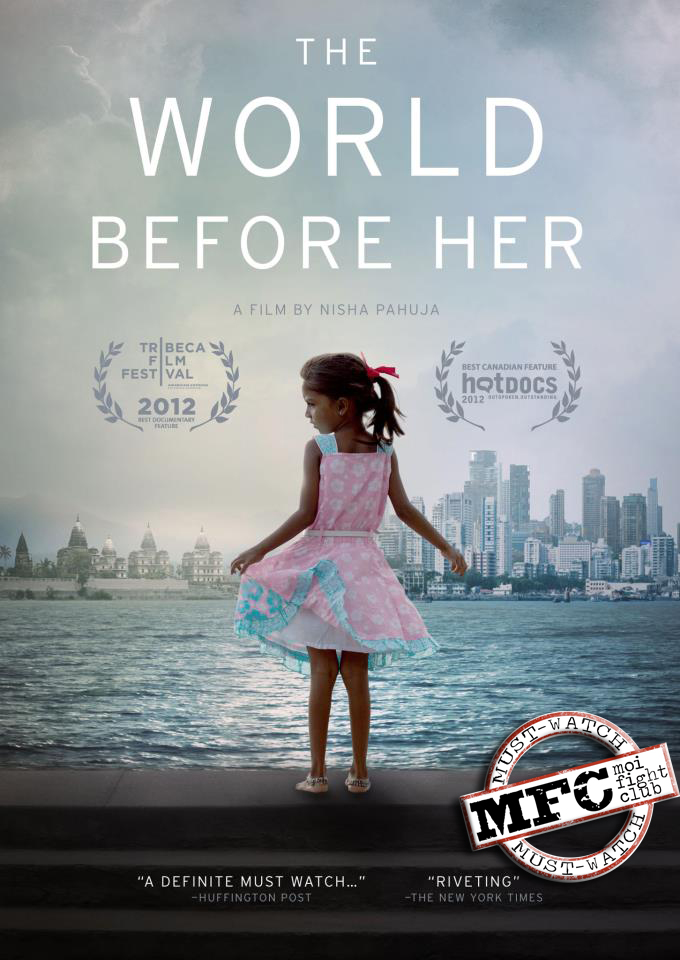
Internet is a great place, especially if you are looking for under-rated gems. Varun Grover stumbled upon this documentary called The World Before Her. Mihir Fadnavis got in touch with the director and we managed to watch the film. So over to Fatema Kagalwala and her ramblings on this stunning and important film. We are putting this in our “Must Watch” film recco List. Watch it.

The World Before Her copy

We love living in extremes. Grey areas aren’t appealing because they force us to think. They are meant for individual assessment whereas black and white are fit for mass consumption. So we’ve draped ourselves with stark definitions of tradition and modernity and live a bipolar existence, merrily swinging between both. Sometimes, we find solace in middle ground but one that is obfuscated with the overpowering implications of the extremes that are tradition and the modernity.

Prachi, Ruhi, Ankita, Pooja – the central protagonists, of ‘The World before Her’, a stunning, award-winning documentary by Nisha Pahuja, are all products, or shall we say victims, of our collective need to ideologically belong somewhere, even if it is within an ideology that seeks to subjugate them. They are perfect lambs for factories manufacturing daily definitions of the traditional and modern according to their convenience.

The struggle between tradition and modernity is ancient. The documentary examines these two polarities with a clear understanding of all its inherent ironies. Let’s take a look at the two worlds it straddles to make its point –

World 1 – Miss India contest 2011 20-day training camp. Of beauty, botox and bikinis.

World 2 – Vishwa Hindu Parishad’s Durga Vahini Camp. Of Hindutva, weapon training and military discipline.

Nisha takes us through both the camps, laying bare their belief system, process and the little dreams behind it all. We see training procedures up-close and peek into the lives of trainees. What makes the ambitious Ms India contestants tick and what drives the fierce Durga Vahinis? Through a thoughtful juxtapositioning, the two opposite worlds collide and before we know, melt into one voice. On the face of it, both espouse contrarian views on female identity. Beyond the façade of the titles of ‘modernity’ and ‘traditionalism’, both bind the very subjects they aim to set free, victimising the very subjects they aim to empower, treating the women they are pretending to liberate as cattle to be branded. The beauty of it all is the film doesn’t state it, but makes it clear with an intuitive stitching together of the narrative.

Nisha delves into both the worlds with care, aware of the mine of uneasy answers she is exploring, mindful of the dust her questions will raise. There is no attempt to impose a comment or paint a particular ideological picture. What makes the documentary a brilliant experience is the careful expose of truths and myths we live in, and the questing female mired in it.

In Ruhi, Ankita and Pooja, we see semi-urban, middle-class young women, very well aware of their social status as females, out to beat the system even if it is through succumbing to it. They are aware of the compromises they have to make and are fine with the cost to their dignity, if it transforms them, like Pooja puts it, ‘from a person to a personality’. The irony of their entire quest for identity within a system out to objectify them, seems to be lost on them. To my mind, Pooja Chopra, the girl whose father insisted on killing her at birth because she was female, almost seems like a tragic figure, bitterly fooled by an arrogant system laughing at her for believing she had carved a separate identity of her own and on her own terms. Ruhi, a young 19 yr old, feels obliged to her parents for bringing her up and feels the need to pay them back by becoming ‘something’, so that their creation is worth it…she never questions the route to fame she has chosen. Nor are her future plans of marriage and children at an appropriate age seem to clash in anyway with her present teen plans of becoming a beauty queen. ‘I can do all this now as I am young, later I won’t be able to do all this’, she says (quote not verbatim). There is no ideology at work here nor a tussle between the old and new. It is simple conditioning speaking but Ruhi doesn’t question any of it, for her her parents support for her contest participation is an empowering, liberating sign of modernity enough. For these women, the shine of glamour and the pain of centuries of repression are too blinding to see anything under or beyond.

At the other extreme is Prachi, the alpha female trainer at Durga Vahini, who has found a purpose and outlet in Hindu fundamentalism to escape the vulnerabilities her gender status thrusts on her. She is a single child of an orthodox Hindu family who feels her father is justified in hitting her (even brutally) because as a female child he let her live. She loves the power being a Durga Vahini trainer gives her, flaunts her dislike for ‘girlie girls’, is proud of being tough and is absolutely against marriage. Like the Ms India contestants, this Aurangabad-based girl too is looking to establishing her worth as a female in all-male world, but by embracing and perpetuating the orthodox mores of Durga Vahini. Unlike the other girls though, she is fully aware that the system she advocates aims at curbing her own freedom, yet, it remains her chosen vehicle to empowerment. Yet, I wondered if there was a glint of wishful-ness, an unacknowledged longing behind the façade of derision as she watched the Ms India contest. I don’t know if it was the artfully calculated shot lingering on her tad longer or my over-wrought zeal to understand her better or an actual fact.

I read criticism of the film saying this isn’t the reality of entire India and that the film does not reflect upon the middle path. It is possible I imagined the subtle jingoism in the criticism, but that apart, what it missed was the fact that these two extremities inform the lives of every woman (and men too) traversing the so-called middle path. Maybe they exist but I am yet to meet a person truly liberated from gender complexities and its socio-economic implications that the film so starkly defines. In fact, I saw Prachi, Ruhi, Ankita and Pooja as sharp and accurate spokespeople of the entire India, irrespective of class distinctions. Trapped in the half-baked definitions made by a commerce-driven, power-hungry, alpha male world, they languish confused in the debris of the shattered female identity they struggle to resurrect. Just like you and me.

As I mull over the needs of these girls, (and they are very familiar, they are around me and inside me) I see their quest with compassion. They have little choice other than adhering to a corrupt system to beat another equally corrupt one, to gain whatever semblance of self-respect they can garner for themselves. Patriarchy hasn’t left much for women to call their own or celebrate in the truest sense, has it? And if that wasn’t enough we have religious fundamentalism adding to the fire. Nisha doesn’t shy from showing news clips of Hindu fundamentalists beating up women in pubs and iterating the fact that Hindu terrorism is a bigger threat to India than Islamic fundamentalism. Not only is this a well-informed, deeply introspective, objective, exploratory documentary but it is very brave as well. One simply wishes the film does not get targeted by pressure groups if and when it comes to India.

As I watched the documentary and later, I wasn’t surprised by the ironical truths about female existence staring at me. It was all seen before, read before, said before. Yet, I couldn’t define the film in words and that is not because of the complexity of the film but of its theme. Which at one level is almost self-explanatory, but dig deeper and it will leave you distraught at the number of knots or rather untied ends it waves at you.

Why have we made the question of women’s identity so complex, almost impossible to unravel? Is it because we fear if we find the answers the world around us will no longer be recognisable? We are all slaves to gender equations and roles. Breaking free is scary because it means starting from scratch for human existence. Without the context of male and female roles and boundaries where would we be? What would we adhere to and what would we fight? Coz isn’t that exactly what gives all of us our purpose? The ‘shoulds’ our gender is supposed to wear? We either wear them with pride or fight them with gusto, satisfied in the purpose we’ve found to base our lives on. We then spend our entire lives empowering the very cycle the protagonists of this film believe/imagine they are fighting. We are no different from them, really. Gender politics apart, men and women, we are all in this together and for once, it isn’t a happy thought.

I realise I can go on writing about this film, such is the subject matter and beauty with which the story has been told. As I pull down the windows on my brains because I really want you to watch it with a fresh curiosity, let me leave u with a few moments that struck me with their irony, pathos and horror.

Pageant diction coach Sabira Merchant (proudly or matter-of-factly?) calling the Ms India training camp “a little factory … where you’re polished like a diamond. The modern Indian woman.” (Did the irony of what she was saying escape her or had she, like the contestants, made peace with it long back?)

Uma Bharti, while protesting against the 1996 Ms World contest to be held in India, “We are against a system that presents women as pieces of meat and judges them based on the size of their chest, waist and hips.” (I never thought I’d appreciate Uma Bharti in this lifetime.)

Prachi, with misty eyes, excusing her father for hitting her, “Knowing that I’m a girl child, he let me live … That’s the best part. In a traditional family, people don’t let a girl child live. They kill the child.” (I don’t think there was anyone among us who didn’t shiver on hearing her say this and actually mean it.)

The Miss India contestants parading in hip-length sacks and denim shorts in a round that judges who has the hottest legs.

Marc Robinson, the organiser, laughing off the indignity of the sack-round.

News clips of Hindutva louts beating up women in pubs.

Little girls at Durga Vahini camps being taught India and Hindutva was under threat from two main sources – Islam and Christianity.

Little girls lapping it up and regurgitating it like it was the only truth.

Chinmayee, a smart 14-yr old, proudly declaring at the end of the camp, ‘No, I don’t have a single Muslim friend. I did when I was younger but then I didn’t know that we are different.’ I didn’t know if I felt horror for India or pity for the little girl.

At the end of the Durga Vahini camp, girls getting sashes to wear identifying them as Durga Vahinis and the (gleeful?) exclamations of, ‘This is just like Miss India, Miss World!’

Touché.

Fatema Kagalwala

– FB page is here.

– If you are in Canada or USA, you can order it here and here.

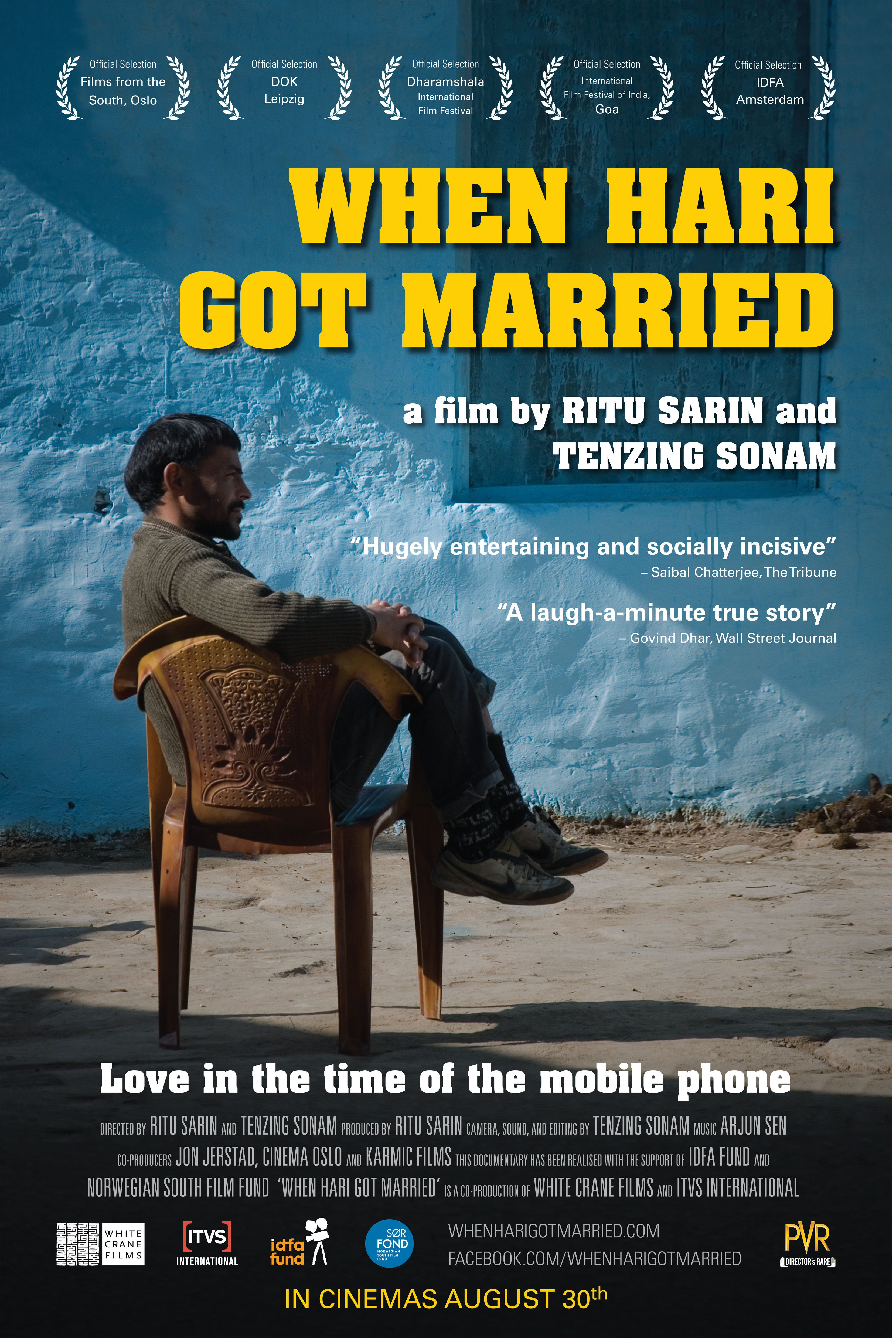
When Hari Got Married, a documentary film by Ritu Sarin and Tenzing Sonam is releasing as part of the PVR Director’s Rare series from 30th August at PVR cinemas in Delhi, Gurgaon, Mumbai, Pune and Bangalore.

“When Hari Got Married” takes a humorous look at Hari, a taxi driver from Dharamshala, as he prepares for his marriage to a girl he has only seen once, and that too, with her face covered. Hari’s frank and outspoken views on love and life, his unusual courtship on the mobile phone, and his eventual marriage provide a warm and illuminating insight into the changes taking place in India as modernisation and globalisation collide with age-old traditions and customs.

More on the film

translite-final-rgbHari, a 30-year-old taxi driver, lives in Dharamshala, a small town in the Himalayan foothills. He is getting married to Suman, a girl he has never met.

Tradition dictates that Hari and Suman will only see each other on the day of their wedding. But Hari has found another way to get to know her: on the mobile phone. Over the past few months they have spoken to each other every day and have fallen in love.

Hari and Suman see each other properly for the first time during the wedding ceremony. Will their telephone love prove strong enough to overcome the awkward obstacles of an arranged marriage?

Hari’s unusual courtship and marriage, coupled with his frank and humorous confessions of fear, doubt, hope and anticipation, provide a warm and illuminating insight into the changes taking place in India as modernisation and globalisation collide with age-old traditions and customs.

A co-production of ITVS International and White Crane Films. With additional funding from IDFA Fund, Amsterdam, and Films From the South, Oslo.

About the filmmakers

Ritu Sarin And Tenzing Sonam are an Indian-Tibetan filmmaking team based in Dharamshala, India. They worked as independent filmmakers in San Francisco and London before moving back to India where they are based in Dharamshala.

Working through their film company, White Crane Films, they have produced and directed several documentaries, mostly focusing on Tibet-related subjects. These include: The Reincarnation of Khensur Rinpoche (1991), The Trials of Telo Rinpoche (1993), and The Shadow Circus: The CIA in Tibet (1998). In 2005, they completed Dreaming Lhasa, a dramatic feature film executive produced by Jeremy Thomas, which premiered at the Toronto International Film Festival. They have also worked on video installations, including Some Questions on the Nature of Your Existence (2007), which was shown at the Mori Art Museum in Tokyo and the 2010 Busan Biennale.

Their feature documentary, The Sun Behind the Clouds: Tibet’s Struggle for Freedom (2009), won several awards including the Vaclav Havel Award at the One World Film Festival in Prague. When Hari Got Married is their most recent film. Ritu and Tenzing are also directors of the Dharamshala International Film Festival, which had its first edition from 1-4 November 2012.

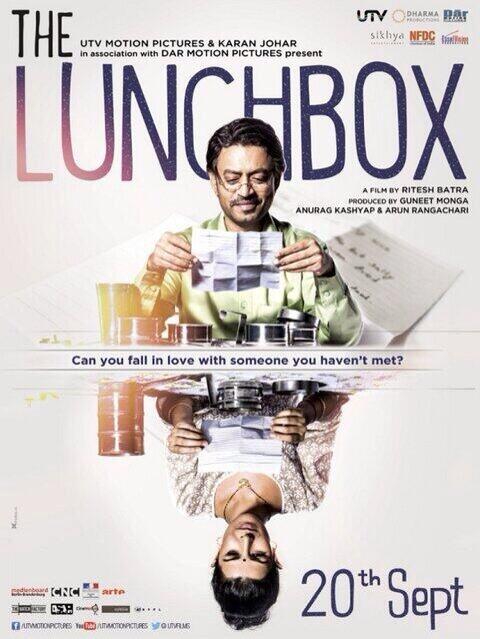
With UTV and Karan Johar on board as presenters, and with a release date (20th September), Ritesh Batra’s debut feature finally gets a trailer. Have a look.

As i keep repeating myself, don’t miss this one. It’s easily one of the best films of the year – simple and solid. And with two terrific performances – by Irrfan and Nimrat Kaur.

And here’s the official synopsis

Middle class housewife Ila is trying once again to add some spice to her marriage, this time through her cooking. She desperately hopes that this new recipe will finally arouse some kind of reaction from her neglectful husband. Unknowing to her is that the special lunchbox she prepared has been mistakenly delivered to an office worker Saajan, a lonely man on the verge of retirement. Curious about the lack of reaction from her husband, Ila puts a little note in the following day’s lunchbox, in the hopes of getting to the bottom of the mystery.

This begins a series of lunchbox notes between Saajan and Ila, and the mere comfort of communicating with a stranger anonymously soon evolves into an unexpected friendship. Gradually, their notes become little confessions about their loneliness, memories, regrets, fears, and even small joys. They each discover a new sense of self and find an anchor to hold on to in the big city of Mumbai that so often crushes hopes and dreams. But since they’ve never met, Ila and Saajan become lost in a virtual relationship that could jeopardize both their realities.

Cast

Irrfan Khan as Saajan
Nimrat Kaur as Ila
Nawazuddin Siddiqui as Shaikh (Saajan’s Colleague)
Denzil Smith as Mr. Shroff
Bharati Achrekar as Mrs. Krishnan
Nakul Vaid as Ila’s Husband
Yashvi Puneet Nagar as Yashvi
Lillete Dubey as Ila’s Mother

The film had its premiere at the Cannes Film festival in Critics Week section. To know more about the film, click here, here and here.