KAUFMAN - "Or cramming in sex, or car chases, or guns. Or characters learning profound life lessons. Or characters growing or characters changing or characters learning to like each other or characters overcoming obstacles to succeed in the end. Y'know ? Movie shit."
Kaufman is sweating like crazy now. Valerie is quiet for a moment - from "Adaptation".
We are all about CINEMA. That movie shit.
NOTHING is sacred.
NOBODY is spared.
Because we talk about films, dammit.
Not your sex life.
Films, fests, unsung, indies, undiscovered - all that and some fun. If you have dope on anything related to cinema or you would like to share something, do write to us at moifightclub@gmail.com.
The views, opinions, reviews, articles, or positions, expressed by the authors and those providing comments are theirs alone, and do not necessarily reflect the views, opinions, positions or strategies of ANY OF THE EMPLOYERS, FRIENDS, RELATIVES, PR agencies, Production houses, Media group and such third parties associated with the authors. The latter make no representations as to accuracy, completeness, currentness, suitability, or validity of any information on this site and will not be liable for any errors, omissions, or delays in this information or any losses, injuries, or damages arising from its display or use.
In short, if you have an issue with us or any post we've written, write to us at moifightclub@gmail.com
Toronto International Film Festival (TIFF) has unveiled the first set of film titles premiering in the Gala and Special Presentations programmes in this year’s edition of the fest. Three Indian films will have there world premiere at Toronto. All the three films are part of Special Presentations.
Anurag Kashyap’s latest film Mukkebaaz is titled The Brawler for the fest edition. The 145-min long film is about a lower caste boxer struggling to make his mark on the boxing world. The film stars Vineet Singh in the lead role.
Hansal Mehta’s Omerta recounts the story of infamous British-born terrorist Ahmed Omar Saeed Sheikh, who kidnapped and murdered Wall Street Journal reporter Daniel Pearl in 2002. It stars Raj Kummar Rao in the lead and is 96 minutes long.
The third one is Bornilla Chatterjee’s The Hungry. It relocates Shakespeare’s bloody tragedy Titus Andronicus to modern-day India, where corruption, greed, and revenge run rampant at an extravagant wedding.
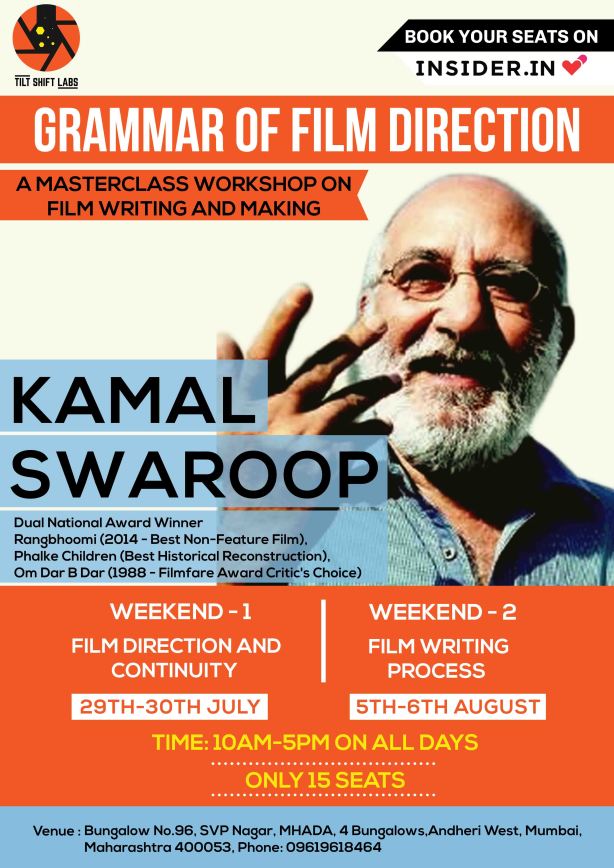
Tilt Shift Labs is organising its first ever certified workshop with National film award winning director Kamal Swaroop. The workshop titled ‘Grammar of Film Direction’ is a two-weekend intensive workshop for amateurs/students of cinema who are looking towards making a career in films.
– In two short weekends, students will be instructed on the basics of writing, directing, camera, and each student will write a short film project which will be guided and mentored by Kamal Swaroop.
– About the director:
Swaroop is a well acclaimed filmmaker and screenwriter. He graduated from Film and Television Institute of India in 1974, and later on did his postgraduate studies at the Institute. In 1982, he assisted Sir Richard Attenborough in the filming of Gandhi. His feature, Om-Dar-B- Dar (1988) is still considered a path breaking film, and it has a massive cult following among cinephiles.
Swaroop’s career, spanning 42 years, covers a broad range of films, channel promos for Channel V India, ads and Radio Spots. In 2014, he directed The Battle of Benaras, produced by Medient, and went on to release Tracing Phalke in 2015 for Films Division of India. Later on, he made Pushkar Puran (2016), and Atul (2016), based on the world renowned Dadaist artist Atul Dodiya.
Battle for Benaras premiered at Cinema Du Reel, Paris, while Atul premiered at the Cochin Biennale. He is currently working on a musical, Miss Palmolive All Night Cabaret and The Third Police Man, a metaphysical murder mystery.
Weekend I
Session I
Camera Angles
Scene, Shot & Sequence
Types Of Camera Angles: Objective, Subjective, Point-Of-View
Objective Camera Angles
Subjective Camera Angles
Subject Size
Subject Angle
Camera Height
Extreme Long Shot
Long Shot
Medium Shot
Typical Two Shots
Close-Up
Inserts
Descriptive Shots
High Angle
Low Angle
Angle Plus Angle
Dutch Angle
Selecting Area And Viewpoint
Other Angles
Weekend I
Session II
Continuity
Cinematic Time And Space
Filming The Action (Controlled And Uncontrolled)
Filming Techniques (Master Scene And Triple Take)
Screen Direction (Dynamic And Static)
Neutral Shots
Reverse Shots
Screen Travel
Pictorial Transitions (Fades, Dissolves And, Wipes)
Sound Transitions
Weekend II
Session I
Process Of Writing
Back Story
Internal Need
Inciting Incident
External Goal
Preparation
Opposition
Self Revelation
Obsession
Battle
Resolution
Weekend II
Session II
Process Of Writing
Discussing Individual Scripts
Story Boarding Process
Production Planning
The Need For Story-Telling
Visualization Strategies
Dramatic Strategies
Characterization Strategies
Dialogue Strategies
Melodrama, Docudrama, Hyperdrama
The Experimental Narrative
Well known cinematographer Shanker Raman makes his directorial debut with Gurgaon. Though Versova’s rumour mills suggest he might have ghost-directed one of the most acclaimed indies (insert wink-wink-nudge-nudge emoji). Produced by JAR Pictures, the film stars Akshay Oberoi, Ragini Khanna, Pankaj Tripathi, Aamir Bashir and Shalini Vatsa.
Here’s the official synopsis –
Kehri Singh, a real estate baron, runs his business ‘Preet Real Estate’ in his daughter’s name. She is his lucky charm and the apple of his eye. Kehri Singh’s oldest son Nikki Singh, is often side-lined by his father as a brash, insolent, good for nothing, who only brings bad luck. Driven by his need to pay off a large debt to a local bookie, Nikki Singh sets off a chilling chain of events, that unwittingly force his cold-blooded father to confront his buried past.
Gurgaon, is a cautionary tale that reminds us of the famous saying, what goes around, comes around.
It was selected at Work-In-Progress Lab of NFDC Film Bazaar in 2015, won the Prasad DI Award in the fiction feature category.
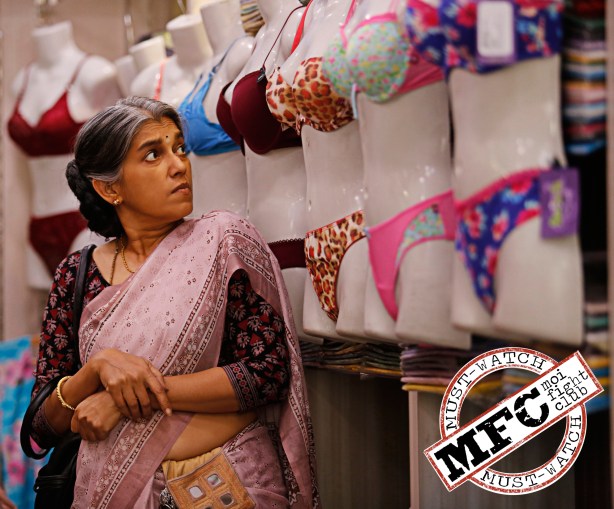
Most of us saw Lipstick Under My Burkha at last year’s Mumbai Film Festival (MFF). Since then, the film has been doing the fest rounds and winning accolades internationally. On home ground though, it has been the exactly opposite scene. Battle with CBFC went for long, and then the task to find a proper release and distribution partner. Ekta Kapoor came on-board and gave the much needed boost to make it look visible. The film is finally in theatres this friday.
Here’s our recco post on the film, written by Raj Kumari. It was written last year after the MFF screening.
No Male Rescuers
Lipstick Under My Burkha (LUMB) was one of the best films I saw at MAMI 2016 – a bold & honest take on female sexuality. All four protagonists are females (how often that happens in India?) so it can be easily said that it is about female sexuality but I felt at the deepest level it is not. And I am so happy about it being not so.
But still it shows the different perceptions about female sexuality in four different stages of a women’s life through four characters Rehana Saeed (a college girl), Leela (a young lady of so-called marriageable age), Shireen Aslam (a middle-aged married women) and Usha Bua ji (an elderly woman).
The film explores their desires, fantasies, and struggle to own their heartbreaks with such honesty and poignant sensitivity that it’s impossible not to see your own secrets in them.
And even after crossing so many slippery alleys of this topic of female sexuality and repression when it becomes very easy (and even cathartic) to take sides by providing a rescuer for these characters, this film allows itself not to take such a decisive stand and sticks to its POV of just being a witness. The film doesn’t rescue them, it just lets them be. The focus remains tight on the process of suppression only, and hence the core of sexuality comes out blazingly clear.
And what is it?
Sexuality is never about body. And more primarily about male or female body. It can not be. As it involves both male and female energies, whatever be the outer form of the body, male or female or any other gender. Sexuality is about being free, being open, being whole in your presence which generally manifests as being with your own body. And of course, this openness and freedom can come through wearing what you like, smoking, being explicitly exposing or demanding sex openly (some of the tropes repeatedly used/reinforced in our films to show a ‘liberated’ woman). But being sexually liberated is further about understanding that these are just few symbols of freedom against respective symbols of suppression. They ALONE are NOT freedom. Yes, they do serve till some deeper grounds of being open with the self is found. And the film attempts to take us to that depth too.
(SPOILERS AHEAD)
It defines the core of freedom in the scene where Bua-ji owns her desires, and her ownership of them in front of all who used to respect her. She didn’t feel any shame, grudge or pity. She showed courage to assemble all of her torn, broken, humiliated self in her arms and took shelter in her bedroom calmly and with the same ownership. There were male oppressors but there was no male rescuer in the film, and this itself says how deeply mature the intent of the film is. I loved the film a little extra for this one golden aspect.
And in the last scene, how beautifully it showed that such a place of courage becomes a platform for all such courageous hearts to identify with their struggle. A platform to make mistakes, comparing your struggles with others, and finally seeing the commonality of self ownership as the final rescue.
Do watch it. And let us know what you thought about the film.
Ritesh Batra’s new film, Our Souls at Night, will have its world premiere at Venice International Film Festival in an out-of-competition slot. The film stars Robert Redford and Jane Fonda. Both the actors will also be honored with Golden Lions for Lifetime Achievement at the 74th edition of the fest.
Based on the novel by Kent Haruf and adapted for screen by Scott Neustadter and Michael H. Weber, Our Souls At Night is set in Colorado, and begins when Addie Moore (Fonda) pays an unexpected visit to a neighbor Louis Waters (Redford). Her husband died years ago, as did his wife, and in such a small town, they’d been neighbors for decades but had little contact. Netflix is launching the film globally next year. (via Deadline)
The fest will run from Aug. 30 till Sept. 9, 2017
The Song of Scorpions directed by Anup Singh, starring Irrfan Khan and Golshifteh Farahani will have its world première at Locarno Film Festival. The festival is celebrating its 70th anniversary this year.
The Song of Scorpions is a story of twisted love, revenge and the redemptive power of a song. Nooran, carefree and defiantly independent, is a tribal woman learning the ancient art of healing from her grandmother, a revered scorpion-singer. When Aadam, a camel trader in the Rajasthan desert, hears her sing, he falls desperately in love. But even before they can get to know each other better, Nooran is poisoned by a brutal treachery that sets her on a perilous journey to avenge herself and find her song.
The Locarno Film Festival runs from Aug. 2-12, 2017.
किनारा में एक चीज़ तो कमाल की थी. जो कहावत है ना कि ’बाप का माल’, तो बाप का माल बहुत चुराया मैंने”
Pancham
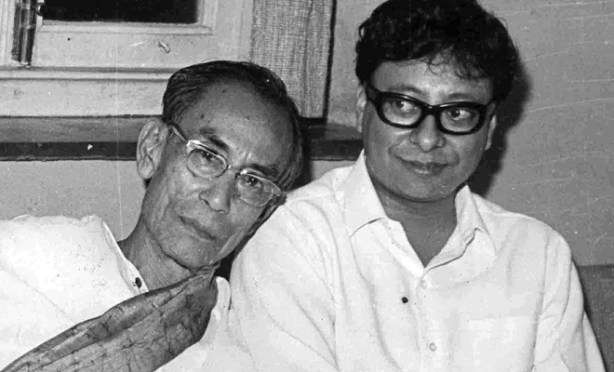
Without any doubts, one can say that Sachin Dev Burman is one of the greatest music directors of all time. His musical creations are forever, but his most special creation was his son “Pancham”, yet another musical genius whose creations stood the test of time. Pancham was born on this day 78 years ago on June 27th 1939. Pancham’s destiny was given a definite path when Dada Burman took him along from Kolkata to Mumbai, despite reservations from Pancham’s mother & naani. Pancham began his music learning and soon started contributing to Dada’s music at an early age. Dada Burman used one of Pancham’s tune in ‘Funtoosh’ for the song “Ae meri topi palat ke aa“.
Pancham continued to be a big support to Dada Burman as an assistant music director, both officially and unofficially. A lot of musical pieces from 60s and 70s of Dada Burman carry a significant and visible Pancham. Pyaasa‘s theme for Mala Sinha, the unforgettable Harmonica play in “Hai apna dil to awaara“, the title and dance music in Teen Deviyaan along with his harmonica, to name just a few. One of the most significant achievement of Pancham’s career was that he could come out of the shadow of the very successful father and created his own independent space with his distinct style, sound, and thirst for innovation. Yet one can always find a lot of traces of Dada Burman’s music in Pancham’s composition in the later years. Pancham had made an honest confession about it in a radio show, admitting that he recycled/reused a lot of his father’s tunes. Much more than a father-son relationship, it was a creative collaboration of two brilliant minds supplementing & complementing each other in the musical journey where each of them supported the cause of other. Today we explore his “Baap Ka Maal” in this post. Join in.
1. Kandibo na Fagun gele – SD Burman / Abke Na Saawan Barse – Kinara
Dada Burman sang and composed the Bengali non-film song in earlier years of his career. Pancham reused the tune to create Abke na saawan barse in Kinara (1977)
Once again Pancham took inspiration from one of the Dada Burman’s earlier works, to come up with beautiful Khaali haath shaam aayi hai in Ijaazat(1987). The influence is primarily in the opening part as Pancham gave the composition a new look, color and mood.
3. Sujata Title Music – SD Burman / Aapke Kamre Me Koi Rehta Hai – RD Burman
An interesting and experimental makeover to what originally was a popular Rabindra Sangeet (Ore jhawr nemey aaye) which Dada Burman used in Sujata’s title music, and later Pancham reworked it to create the musical extravaganza as ‘Aapke Kamre me koi rehta hai‘ in Yaadon ki Baraat (1973). He has also used the tune to create a beautiful romantic number a few years earlier in a Bengali film Rajkumari (1970).
4. Hai ki jey kori – SD Burman / Tune O Rangeele – RD Burman
Pancham used the basic structure of the Mukhda and reworked the “Piya Piya” hook to come up with another melody in Kudrat (1983) for Tune o rangeele.
5. Katha kao dao saara – SD Burman / Ummeed Hogi Koi – RD Burman
Dada Burman’s version (which was not composed by him but Subol Dasgupta, as informed by Aniruddha Bhattacharjee) has minimalism in folk ambiance, while Pancham gives it a modern color for the brilliant non-film collaboration “Dil Padosi Hai” (1987). Both excel in their respective versions. Two melancholic beauties derived from one composition.
6. Kuhu kuhu koyaliya – SD Burman / Kuhu kuhu bole koyaliya – RD Burman
Dada Burman sang this popular Nazrulgeeti in early part of his career. Pancham reworked it with Gulzar for the unreleased DevDas (1975). Dada Burman’s version carry the earthy/rustic feel of Jaggery, while Pancham version had the sweet flow of finished honey with the voice of Lata Mangeshkar.
Dada Burman’s popular composition which also has traces of Rabindra Sangeet in the interlude was reused by Pancham in Shaukeen (1982).
8. Aami Soite pari – SD Burman / Kya bura hai kya bhala – RD Burman
A beautiful Karta composition again with minimal use of instrument just with the use of Sarangi & Tabla. Pancham gave his version a modern qawwali treatment for unreleased Libaas. His second ever & last song with Lata in duets.
A semi classical gem by Dada Burman. Beta Burman reused it in Kinara (1977) with a lot of improvisation in treatment
10. Rongila rongila rongila re – SD Burman / Kuchh na kaho opening – RD Burman
The soul song of Dada Burman, a song which marked the beginning of Dada Burman’s musical journey, and Pancham used the core hook beautifully in his legendary comeback score of 1942 – A Love Story, as if he was given his last Tribute to his father & their collaboration.
And finally, here it is – Pancham’s confession on “Baap Ka Maal” -Hear from the Horse’s mouth.
Emergency was imposed on India on this day 42 years ago, on June 25, 1975, and it lasted for about 21 months. During the emergency, Kishore Kumar was banned by Ministry of I&B on All India Radio & Doordarshan for his non-participation in one of the major public events organised by the people in power then.
When Emergency was finally revoked in 1977, India opted to form a new Government, the country saw a big turn around and supported Janta Party coalition. With Janta Party in power, Kishore Kumar sang a protest song for the film Nasbandi (1978) and scored an interesting musical revenge. The film was produced & directed by IS Johar.
The film version of the song was censored and curtailed for a stanza featuring names of some politicians. The antagonistic lyrics were penned by Indeevar and the song was composed by Kalyanji-Anandji. An unusual musical documentation of an important event in modern history.
Kishore da recording the song with Kalyanji-Anandji. IS Johar can be seen too
– Pic credits: Kaustubh Pingle
Full Lyrics :
जनता की आवाज़ है ये
सुन ले ओ बापू गांधी
ये कैसा हाहाकार देश मे
ये कैसी आग की आंधी
कहां गयी वो तेरी अहिंसा, कहां गया वो प्यार
गांधी तेरे देश में ये कैसा अत्याचार
बापू तेरे देश में ये कैसा अत्याचार
इक भारत में बन गये जलियांवाले बाग़ हज़ार
बापू तेरे देश मे ये कैसा अत्याचार
तूने जब आवाज़ लगाई, सारा हिंदुस्तान उठा
अंग्रेज़ों के दिल भी दहले, ऐसा इक तूफ़ान उठा
खुशी-खुशी तेरे कहने पर भारतवासी जेल गये
सीने पे गोली झेल गये, अपने प्राणों पर खेल गये
नाम पे तेरे लाखों जवां, दुनिया के सब सुख भूल गये
दुल्हन का घूंघट बिन खोले ही फांसी पर झूल गये
तू स्वराज ले आया, हम तो फिर भी रहे लाचार
गांधी तेरे देश में ये कैसा अत्याचार
आज़ादी की जंग लड़ा था क्या इसीलिये ये हिन्दुस्तां
अरे न्याय मांगने न्यायालय मे जा ना सके कोई इंसान
कितने ही निर्दोष यहां ’मीसा’ के अन्दर बन्द हुए
अंधे कुएं में कितने ही आज़ाद समंदर बंद हुए
इस्मत लूटा करते हैं जो बन कर लाज के पहरेदार
अपनी सत्ता रखने को जो छीने जनता के अधिकार
सौंप गया है ऐसे के हाथ मे देश की क्यों पतवार
गांधी तेरे देश मे ये कैसा अत्याचार
देखी कहीं कलमबन्दी, देखी कहीं ज़ुबांबन्दी
डर की हुकुमत हर दिल पर थी, सारा हिन्दुस्तां बन्दी
नसबन्दी के नाम पे जुल्म हुए वो दुखियो दीनों पर
लगता था लटका हो जैसे प्रजातन्त्र संगीनों पर
तुर्कमान वो आस्मां टूटा जहां ज़मीनों पर
चढ़ा दिये जब बुलडोज़र जब बेबस लोगों के सीनों पर
अपनो के हाथों ही अपनों पर गोली की बौछार
गांधी तेरे देश मे ये कैसा अत्याचार
सारे देश पर ज़ुल्मो-सितम के घोर अन्धेरे जब छाए
तब प्रकाश की किरणें लेकर जय प्रकाश आगे आए
विजय लक्ष्मी पंडित ने जनता का मनोबल बढ़ा दिया
राज नारायण ने नामुमकिन, मुमकिन करके दिखा दिया
मज़हब से कम नहीं मुल्क, बोले जामा मस्जिद के इमाम
प्रजातन्त्र को नव-जीवन देने आये जगजीवन राम
जॉर्ज फ़र्नांडिस तोड के आये इल्ज़ामों की जन्ज़ीरें
श्रीमोरारजी के आने से चमक उठी फिर तकदीरें
चरन सिंह और चन्द्रशेखर ने लोगों के दिलों को जीता
वापस ले आई जनता अपनी आज़ादी की सीता
अटलबिहारी, आडवानी, नाना ने किया उद्धार
गांधी तेरे नाम की अब होगी जय-जयकार
अरे जो भी हुकुमत ज़ुल्म करेगी उसकी होगी हार
जो भी हुकुमत ज़ुल्म करेगी उसकी होगी हार
–
फ़िल्म : नसबन्दी -1978
गायक : किशोर कुमार & कोरस
गीतकार : इंदीवर
संगीतकार : कल्याणजी-आनंद्जी
It’s always difficult to write about a film when it comes back home with you as a very palpable emotion. The conflict is between whether to talk about the film (like a semi-review, talking about the great crew and cast, plot, motifs etc.) or the memories & insights it triggered. Since it’s a quick & short piece written in the middle of a very tight schedule, mainly to excite the reader enough to go and watch the film, I will stay somewhere in between – a bit clumsy but functional.
We all have been Shutu at some point of time in our lives. I know I have been, for many years. Bullied, ridiculed, misunderstood, misfit and still trying to smile lest I should be seen as ‘sissy’. Fitting into this world of men is a constant struggle for men even. It’s a game whose rules we laid on our own and still laid them so tough that now we are having a hard time catching up. Why did we do this to ourselves? Why we continue to do this – trying to check items off a laundry list to pretend that we have grown up (from a male perspective only)? Why do we want to grow up? Due to social pressure or survival mechanism – like preys turning into predator?
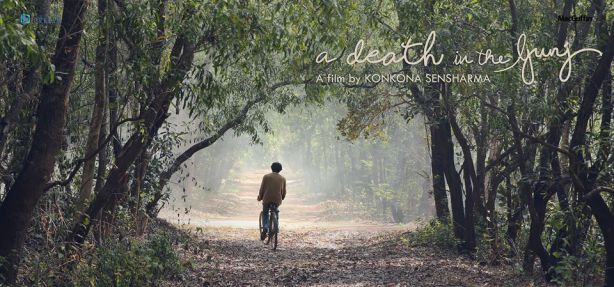
Konkona Sen Sharma’s directorial debut A Death In The Gunj takes one to such places – beautiful and uncomfortable – places where innocent nostalgia meets the darkest memories. Set in 1979, it’s about a Bengali family with a severe Raj-era hangover on a quaint holiday in Bihar’s (now Jharkhand’s) McCluskieganj – a place with an equally severe Raj-era hangover. The family has many people and egos, a bunch of well-adjusted, seemingly non-threatening abnormals. And the family has Shutu (Vikrant Massey in a role of a lifetime) – the younger brother broadly seen as a silent-introvert type. The constant clash between the two worlds – one inhabited by the family with its bikes & muttons & drinks & pranks & love-games, and another in which Shutu sits by the window sketching frogs in an old diary – scrapes the paints off both of them. The delicate locking mechanism that had kept them together starts wearing off and the moment of truth, or whatever the grown-up version of that is, comes closer and closer.
The only bridge between the two worlds is Shutu’s teenaged niece Tani – already bored of the games adults play & constantly fascinated by Shutu’s scientific-poetic lonely view of the world. It’s not a coincidence that the bridge is a female ‘cos this is a film deeply aware of its gender politics (and at a couple of places, class politics too). Men behave like boys-behaving-like-men, women behave like women-seen-through-men’s-eyes, as two conflicted souls (Shutu and Tani) clutch at straws while drowning in the waters of such rigid definitions.
As a fat teenaged kid in the 90s, I loved watching cricket and I wasn’t bad at playing it too but nobody would select me in the team. My fatness and my academic bent (the tag of “padhaaku”) were a liability nobody was willing to carry. Even if selected in the team (the last to be picked), I’d not get a chance to bat or bowl. So I’d put all my efforts into fielding well. I’d kill myself to get that throw from the boundary right.
But still, just to show I am cool with this treatment, I would offer to play the umpire. That way, I’d get to be on the field at least, get to hold the ball at the end of every over (just for a few seconds before I toss it to the next bowler), and be treated with respect by both the teams. I’d apply myself to the task & be the most unbiased, observant umpire. Sometimes, I’d get to play a few balls or bowl an over – and I believe that became possible only because of the bridges I made as an umpire. But in the process, I lost something precious too. I lost my courage to openly cry in public. I lost my feminine side, or at least suppressed it for the longest time, to fit into this world of men.
And that’s why, when in one scene Shutu is the last to be picked for a game of kabaddi, his state of mind was so relatable that I felt like crying. I did not, yet again.
For those looking for a quick list of reasons to watch (and watch you MUST):
Konkona Sen Sharma’s assured, sensitive debut as a Director. Ace!
Konkona Sen Sharma’s screenplay co-written with Disha Rindani (based on a short story by Mukul Sharma) is full of delightful dialogue & an eerie sense of impending doom.
Rich texture and detailing. Made on a small budget but NEVER looks like it. Sirsha Ray (DOP) and Sidhharth Sirohi (Production Design) bring their A-game to the table.
McCluskieganj’s wild charm has been captured so ethereally that you can smell the air, touch the greenery.
The film has four languages (English, Hindi, Bangla, and Chhota Nagpuri) and all spoken with a natural effortlessness rare to find in Indian cinema.
The brilliant original score and music by Sagar Desai (disclosure: I worked with him in ‘Ankhon Dekhi’) elevates and layers the film with great precision.
One of the best ensemble casts in recent memory – Ranvir Shorey, Kalki Koechlin, Tilottama Shome, Gulshan Devaiah, Jim Sarbh, Arya Sharma, Tanuja, and Om Puri (one of his last roles and what a delight he is!).
Such well-etched and distinct characters – right from Ranvir Shorey’s Vikram to Kalki’s Mimi to Tilottama’s Bonnie to Gulshan Devaiah’s Nandu – constantly chattering, surprising and layering the film with their brilliant mannerisms.
Vikrant Massey got the kind of role actors crave for and he hits it out of the park. Shutu is beautiful and heartbreaking.
Every department has delivered and the best thing is – the sum is way greater than the parts. Do not miss this film.
Cannes Film Festival has announced the official selection of shorts for the 70th edition of the festival. Payal Kapadia’s short film, Afternoon Clouds, has been selected for the Cinéfondation forum.
Payal is a third-year student of direction at the Film and Television Institute of India (FTII), Pune. Her 13-minute short film is among 16 films chosen, from among 2,600 works submitted this year.
Afternoon Clouds depicts a 60-year old widow, who lives with her Nepali maid, Malati. The entire movie revolves around a single afternoon in their house. This film features Usha Naik and Trimala Adhikari.
A jury presided over by Romanian filmmaker Cristian Mungiu will decide the winners. The three Cinéfondation prizes will be awarded at a ceremony preceding the screening of the prize-winning films on Friday 26th May in the Buñuel Theatre.
To get the reference of the country in the header of the post, you have to watch the film. Surely that can’t be enough reason to watch it, so here’s Varun Grover’s recco post on the film.
ये फ़िल्म देख लीजिए सब लोग। बैठे-बैठे ढेरों कारण तो अभी गिना सकता हूँ। उसके अलावा, जो हर फ़िल्म में होता है कि जो गिनाया नहीं जा सकता (जैसे आँसू या तालियाँ), जो एक अंदरूनी जादू है – उसके लिए तो सिनेमा हॉल जाना ही पड़ेगा। (और जैसा कि अक्सर होता है, ऐसी फ़िल्में मेहनत करवाती हैं। शो कम हैं, दूर हैं, पब्लिसिटी नहीं है – लेकिन यही आपके प्यार की परीक्षा भी है।)
१ – Avinash Das की #AnarkaliOfAarah वहाँ जाती है जहाँ सिनेमा तो क्या, हम लोग असल ज़िंदगी में भी जाने से डरते हैं। सोच की उस हद तक। Male entitlement और female consent पे बहुत बात हो रही है पिछले कुछ समय से लेकिन फिर भी जो बातें और लोग उन mainstream debates से छूट गयीं/गए, या जो सही से नहीं कहीं गयीं, उन सबका धुआँधार निचोड़ है।
२ – स्वरा भास्कर (Swara Bhasker) ने जो आत्मा फूँकी है अनारकली में, अपने अस्तित्व का एक-एक कण डाल दिया है। ऐसी दमदार मुख्य किरदार कि आपको उसके लिए डर लगे।
३ – ग़ज़ब के गाने। छिछोरे से लेकर क्रांतिकारी तक – और कई बार दोनों ही एक साथ। रोहित शर्मा का संगीत, और Ravinder Randhawa, Ramkumar Singh, Dr सागर, और ख़ुद Avinash के बोल – (“हम खेत तू कूदारी, हम चाल तू जुआरी”), पावनी पांडे और स्वाति शर्मा की आवाज़ें – बेहतरीन।
४ – फ़िल्म की भाषा। इतनी प्रामाणिक भाषा बहुत कम हिंदी फ़िल्मों में सुनने को मिलेगी। भकुआना से लेकर सीजना – हर शब्द में रस है। जो भी ‘उधर के’ लोग हैं, उनको तो मज़ा ही आ जाएगा।
५ – फ़िल्म का पहला और आख़िरी सीन। दो बिंदुओं से वैसे तो एक लाइन बनती है लेकिन यहाँ एक पूरा वृत्त बनता है।
६ – ‘तीसरी क़सम’ को दिया गया छोटा सा, सुंदर सा tribute।
७ – अनारकली के universe के बाक़ी किरदार। Pankaj Tripathi का ‘नाच’, Sanjai Mishra का वीभत्स रूप, इश्तेयाक खान का हैरी, अनवर (Mayur More), मफ़लर, एटीएम।
८ – अविनाश दास की पहली फ़िल्म, एकदम independently बनायी हुयी, सिर्फ़ दोस्तों और पागलपन की मदद से – तो ऐसी चीज़ों से जो धुआँ उठता है वो अलग ही रंग देता है।


 Weekend I


 “
“ Emergency was imposed on India on this day 42 years ago, on June 25, 1975, and it lasted for about 21 months. During the emergency, Kishore Kumar was banned by Ministry of I&B on All India Radio & Doordarshan for his non-participation in one of the major public events organised by the people in power then.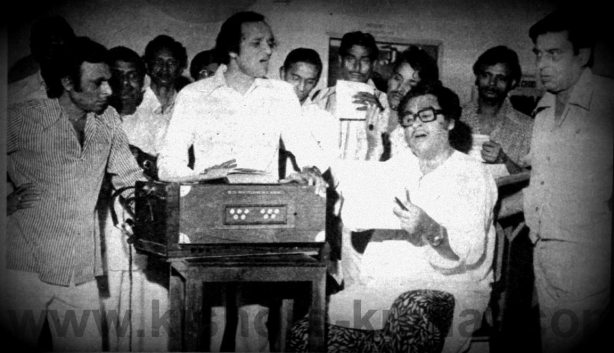


 F.i.g.h.t C.l.u.b