Archive for the ‘Documentary’ Category

Jaideep Varma’s documentary Baavra Mann is yet to get a release in India. Karan Singh Tyagi saw it at New York Indian Film Festival earlier this year and wrote this post for us. Read on.

(We suggest you play the song in the background while reading the post)
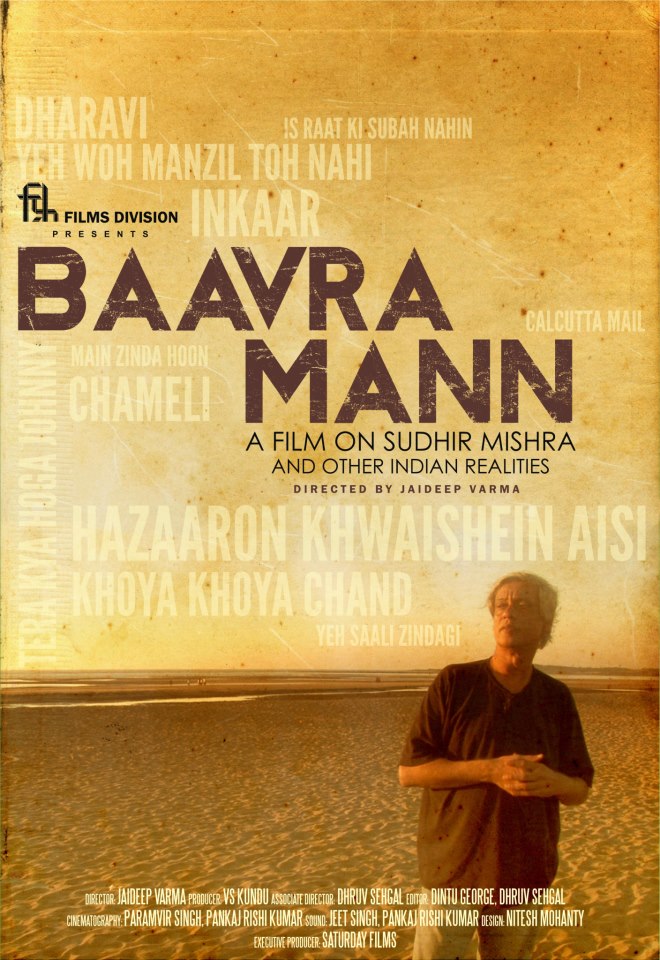
Baavra MannWho is this long-haired Sanjay Dutt duplicate?

Duplicate nahi hai bhaiyya. Iska naam Nirmal Pandey hai. Kya acting kari thi isne ‘Is raat ki subah nahin’ me”, was my prompt reply, as my cousin and I stood in line with a dozen others, scanning movie posters outside Gaiety (Bandra) and booking our tickets for ‘Auzar’. As an 11 year old, I couldn’t contain my excitement, at having recognized Nirmal Pandey in the ‘Auzar’ poster, and went on this long rant about ‘Is raat ki subah nahin’. Much to my cousin’s chagrin, I told him everything about the movie – how it was violent and funny at the same time, how all the actors spoke a very different language, how the story finished in one night, and importantly, how Papa and I were lucky to see the movie on the big screen, as it had a single show in Bombay.

This innocuous little incident came back to me while watching Jaideep Varma’s documentary, ‘Bavra Mann and other Indian Realities’, in New York. For those who haven’t seen it yet, Jaideep’s movie traverses through the life and films of Sudhir Mishra, and somewhere in the middle of the movie, Mishra laments how ‘Is raat ki subah nahin’ was confined to a single show in Bombay and how many people didn’t get to see it. On hearing this, I silently smiled as my mind went back to watching the movie with Papa in the same show that Mishra was referring to. How I wanted to thank my father at that very instant! Not just for taking me to ‘Is raat ki subah nahin’, but for giving me the hereditary gift of love for movies and being the best companion I could have had while I nurtured  it.

There were numerous such nostalgia trips throughout Jaideep’s movie. The portions dealing with ‘Hazaron Khwaishein Aisi’ left me mesmerized. Listening to ‘Bavra mann dekhne chala ek sapna’ on the big screen again did my soul so much good; it stirred something deep within me, something in desperate need of stirring. My mind went back to when I first saw ‘Hazaaron..’ I remember crying tears of joy and sadness, laughing gleefully, feeling melancholic and empty, while ‘Bavra Mann’ played on loop and images from the movie interposed with flashes of my life didn’t leave me for days at end.  Probably, this is a uniform reaction that ‘Hazaaron..’ elicits. The movie strikes a deep chord somewhere, and makes one confront broken promises, failed dreams, and all those bittersweet memories, that we carry with ourselves. Right after watching Jaideep’s ‘Bavra Mann’, a friend who had accompanied me to the screening in New York forwarded me this by Avijit Ghosh who captures this sentiment beautifully:

There are a thousand reasons to watch Hazaaron Khwaishein Aisi. But enjoy it as a last anthem for a generation who knew how to believe. Watch it holding the hand of a woman you have loved and lost. And it would be nice if you have drunk some rotten whisky before.

As must be painfully evident by now, I am easily susceptible to bouts of nostalgia. However, these glorious nostalgia-filled moments were not the only reason why I enjoyed Bavra Mann. I have often wondered what drives filmmakers to make the kind of movies that they do. For example, at the risk of doing a Baradwaj Rangan here, I have been fascinated by two particular scenes from Black Friday and Gangs of Wasseypur.

Sample these dialogues:

Black Friday – “Jiske paas kuch nahi hai karne ke liye, dharam ke naam par chutiya banta rahega”. GOW2 – “Jab tak cinema hai log chutiye bante rahenge

I have often wanted to argue that we can discern in these dialogues a kind of master narrative, a collection of meanings, and, perhaps, a powerful leitmotif that runs through all of Kashyap’s movies, a kind of slavishness and hive mentality – towards religion in Black Friday, towards cinema and everything that one acquires from it in Gangs of Wasseypur. To take the analogy further, slavishness towards power in Gulal, towards self and personal ego in DevD and No Smoking. Therefore, Kashyap’s movies are magic on celluloid, because he lets characters with such aggressive spirit and slavish devotion face their internal conflicts and external surroundings. What we see on screen is the result of a bundle of contradictory aspects and motivations, a certain kind of dualism that everyone and everything in life has. I have repeatedly asked myself, what are the questions that Kashyap is trying to answer through his work? Has he found any answers yet?

Bavra Mann poses similar questions to someone whom Vikramaditya Motwane calls the “original Anurag Kashyap”. Despite the frequent and frenzied analysis of cinematic moves of all current directors’, I feel there is a strong lack of literature that provides us with enough resources to examine and study their work. This is where Bavra Mann triumphs. It gives enough resources to the audience to interpret Sudhir Mishra and his movies in a new light. Bavra Mann is a fascinating exercise in self-revelation and film lovers will revel in the personal anecdotes and casually delivered remarks that reveal layers and layers of information about Mishra and his body of work. The movie has a series of interviews with Mishra and people close to him, covering the length of Mishra’s career, beginning with his childhood, continuing through his education, his failed marriage with his first wife, his relationship with renowned film editor, Renu Saluja, his early film work, his breakthrough success with Dharavi, and his daring work in Hazaaron.., his most autobiographical Khoya Khoya Chand, and finally his recent movies. There is a treasure trove of diamonds in the movie. After all, who wouldn’t want to eavesdrop on Mishra and Shantanu Moitra’s recounting of how they got Swanand Kirkire to sing ‘Bavra Mann.’

A criticism often peddled against movies like Bavra Mann is that the director holds back, and is reverential towards his subject. Here, Jaideep is never in awe of Sudhir Mishra. His questions are probing and the discussions on films themselves are less about why they’re great and more about how they were put together. Jaideep knows that directors are not good at explaining motives behind making particular films. Movies, like many things else, begin with something very vague and abstract. Jaideep, therefore, never tries to look for definite answers and actual motives behind Mishra’s work. His aim is to allow the viewers the freedom to interpret the scene in the way they want, and depending on how their cinematic education (and earlier experiences of Mishra’s movies) has prepared them. Bavra Mann succeeds in bringing before us the greatest number of possibilities to reinterpret Mishra’s movies. After watching Bavra Mann, I realized that Sudhir Mishra’s movies (especially the earlier ones) resonated with me because they were being truthful about life – the movies expressed some deeper emotional experiences that Sudhir Mishra recognized in his own existence. This in and of itself was a reason for me to love Bavra Mann.

However, for me, the biggest strength of Bavra Mann is that it never wavers from admitting that Sudhir Mishra continues to be plagued with what is an inconsistent body of work. It subtly engages in criticism of some of Sudhir Mishra’s recent movies (the likes of Inkar, Calcutta Mail) to reflect on the present-day infertility of thought in India. By using Sudhir Mishra’s example, Jaideep exposes the dangers inherent in adopting a conformist and consensus-driven career. According to me, it is in this context that the movie makes a brutally frank attempt to unravel the intellectual decline of India and Indian movies (using Sudhir Mishra as a metaphor).  The movie, therefore, is an elegy of intellectual life not only of Sudhir Mishra but of us all. In a way, the movie tries to jolt us (Sudhir Mishra included) out of the dark recesses that we have allowed ourselves to fall in.

I do not know if Bavra Mann is getting a theatrical release anytime soon. However, I strongly hope that everyone gets a chance to see it. Watch it to revisit old times, to go back to your personal stories intertwined with Sudhir’s films, watch it to hear “Bavra Mann” on the big screen again, watch it as a student and lover of cinema, and most importantly, watch it because it is a powerful statement on the times that we live in.

Naseerudin Shah says the single most perceptive thing in the movie: “Mishra’s best work is yet to come.” Even though, I love ‘Hazaaron…’, I wouldn’t want it to be Mishra’s best work. I earnestly wish that it turns out to be just a teaser of what he (and by association) Indian cinema goes on to achieve and that no one is ever required to come to the rescue of this long-haired maverick director, like I had to once come to the rescue of his similarly long-haired leading man outside Gaiety.

– Karan Singh Tyagi

(Karan was born in Meerut, lived and studied in Bombay and Harvard, and after a brief stop in Paris, now finds himself in New York. He strongly feels that Ramadhir Singh was directly referring to him while saying, “Sab ke dimaag me apni apni picture chal rahi hai aur sab saale hero banna chah rahe hain apni picture me..” When he is not day-dreaming about movies or Real Madrid, he also works as a lawyer. You can find him on twitter here: @karanstyagi)

Internet is a great place, especially if you are looking for under-rated gems. Varun Grover stumbled upon this documentary called The World Before Her. Mihir Fadnavis got in touch with the director and we managed to watch the film. So over to Fatema Kagalwala and her ramblings on this stunning and important film. We are putting this in our “Must Watch” film recco List. Watch it.

The World Before Her copy

We love living in extremes. Grey areas aren’t appealing because they force us to think. They are meant for individual assessment whereas black and white are fit for mass consumption. So we’ve draped ourselves with stark definitions of tradition and modernity and live a bipolar existence, merrily swinging between both. Sometimes, we find solace in middle ground but one that is obfuscated with the overpowering implications of the extremes that are tradition and the modernity.

Prachi, Ruhi, Ankita, Pooja – the central protagonists, of ‘The World before Her’, a stunning, award-winning documentary by Nisha Pahuja, are all products, or shall we say victims, of our collective need to ideologically belong somewhere, even if it is within an ideology that seeks to subjugate them. They are perfect lambs for factories manufacturing daily definitions of the traditional and modern according to their convenience.

The struggle between tradition and modernity is ancient. The documentary examines these two polarities with a clear understanding of all its inherent ironies. Let’s take a look at the two worlds it straddles to make its point –

World 1 – Miss India contest 2011 20-day training camp. Of beauty, botox and bikinis.

World 2 – Vishwa Hindu Parishad’s Durga Vahini Camp. Of Hindutva, weapon training and military discipline.

Nisha takes us through both the camps, laying bare their belief system, process and the little dreams behind it all. We see training procedures up-close and peek into the lives of trainees. What makes the ambitious Ms India contestants tick and what drives the fierce Durga Vahinis? Through a thoughtful juxtapositioning, the two opposite worlds collide and before we know, melt into one voice. On the face of it, both espouse contrarian views on female identity. Beyond the façade of the titles of ‘modernity’ and ‘traditionalism’, both bind the very subjects they aim to set free, victimising the very subjects they aim to empower, treating the women they are pretending to liberate as cattle to be branded. The beauty of it all is the film doesn’t state it, but makes it clear with an intuitive stitching together of the narrative.

Nisha delves into both the worlds with care, aware of the mine of uneasy answers she is exploring, mindful of the dust her questions will raise. There is no attempt to impose a comment or paint a particular ideological picture. What makes the documentary a brilliant experience is the careful expose of truths and myths we live in, and the questing female mired in it.

In Ruhi, Ankita and Pooja, we see semi-urban, middle-class young women, very well aware of their social status as females, out to beat the system even if it is through succumbing to it. They are aware of the compromises they have to make and are fine with the cost to their dignity, if it transforms them, like Pooja puts it, ‘from a person to a personality’. The irony of their entire quest for identity within a system out to objectify them, seems to be lost on them. To my mind, Pooja Chopra, the girl whose father insisted on killing her at birth because she was female, almost seems like a tragic figure, bitterly fooled by an arrogant system laughing at her for believing she had carved a separate identity of her own and on her own terms. Ruhi, a young 19 yr old, feels obliged to her parents for bringing her up and feels the need to pay them back by becoming ‘something’, so that their creation is worth it…she never questions the route to fame she has chosen. Nor are her future plans of marriage and children at an appropriate age seem to clash in anyway with her present teen plans of becoming a beauty queen. ‘I can do all this now as I am young, later I won’t be able to do all this’, she says (quote not verbatim). There is no ideology at work here nor a tussle between the old and new. It is simple conditioning speaking but Ruhi doesn’t question any of it, for her her parents support for her contest participation is an empowering, liberating sign of modernity enough. For these women, the shine of glamour and the pain of centuries of repression are too blinding to see anything under or beyond.

At the other extreme is Prachi, the alpha female trainer at Durga Vahini, who has found a purpose and outlet in Hindu fundamentalism to escape the vulnerabilities her gender status thrusts on her. She is a single child of an orthodox Hindu family who feels her father is justified in hitting her (even brutally) because as a female child he let her live. She loves the power being a Durga Vahini trainer gives her, flaunts her dislike for ‘girlie girls’, is proud of being tough and is absolutely against marriage. Like the Ms India contestants, this Aurangabad-based girl too is looking to establishing her worth as a female in all-male world, but by embracing and perpetuating the orthodox mores of Durga Vahini. Unlike the other girls though, she is fully aware that the system she advocates aims at curbing her own freedom, yet, it remains her chosen vehicle to empowerment. Yet, I wondered if there was a glint of wishful-ness, an unacknowledged longing behind the façade of derision as she watched the Ms India contest. I don’t know if it was the artfully calculated shot lingering on her tad longer or my over-wrought zeal to understand her better or an actual fact.

I read criticism of the film saying this isn’t the reality of entire India and that the film does not reflect upon the middle path. It is possible I imagined the subtle jingoism in the criticism, but that apart, what it missed was the fact that these two extremities inform the lives of every woman (and men too) traversing the so-called middle path. Maybe they exist but I am yet to meet a person truly liberated from gender complexities and its socio-economic implications that the film so starkly defines. In fact, I saw Prachi, Ruhi, Ankita and Pooja as sharp and accurate spokespeople of the entire India, irrespective of class distinctions. Trapped in the half-baked definitions made by a commerce-driven, power-hungry, alpha male world, they languish confused in the debris of the shattered female identity they struggle to resurrect. Just like you and me.

As I mull over the needs of these girls, (and they are very familiar, they are around me and inside me) I see their quest with compassion. They have little choice other than adhering to a corrupt system to beat another equally corrupt one, to gain whatever semblance of self-respect they can garner for themselves. Patriarchy hasn’t left much for women to call their own or celebrate in the truest sense, has it? And if that wasn’t enough we have religious fundamentalism adding to the fire. Nisha doesn’t shy from showing news clips of Hindu fundamentalists beating up women in pubs and iterating the fact that Hindu terrorism is a bigger threat to India than Islamic fundamentalism. Not only is this a well-informed, deeply introspective, objective, exploratory documentary but it is very brave as well. One simply wishes the film does not get targeted by pressure groups if and when it comes to India.

As I watched the documentary and later, I wasn’t surprised by the ironical truths about female existence staring at me. It was all seen before, read before, said before. Yet, I couldn’t define the film in words and that is not because of the complexity of the film but of its theme. Which at one level is almost self-explanatory, but dig deeper and it will leave you distraught at the number of knots or rather untied ends it waves at you.

Why have we made the question of women’s identity so complex, almost impossible to unravel? Is it because we fear if we find the answers the world around us will no longer be recognisable? We are all slaves to gender equations and roles. Breaking free is scary because it means starting from scratch for human existence. Without the context of male and female roles and boundaries where would we be? What would we adhere to and what would we fight? Coz isn’t that exactly what gives all of us our purpose? The ‘shoulds’ our gender is supposed to wear? We either wear them with pride or fight them with gusto, satisfied in the purpose we’ve found to base our lives on. We then spend our entire lives empowering the very cycle the protagonists of this film believe/imagine they are fighting. We are no different from them, really. Gender politics apart, men and women, we are all in this together and for once, it isn’t a happy thought.

I realise I can go on writing about this film, such is the subject matter and beauty with which the story has been told. As I pull down the windows on my brains because I really want you to watch it with a fresh curiosity, let me leave u with a few moments that struck me with their irony, pathos and horror.

Pageant diction coach Sabira Merchant (proudly or matter-of-factly?) calling the Ms India training camp “a little factory … where you’re polished like a diamond. The modern Indian woman.” (Did the irony of what she was saying escape her or had she, like the contestants, made peace with it long back?)

Uma Bharti, while protesting against the 1996 Ms World contest to be held in India, “We are against a system that presents women as pieces of meat and judges them based on the size of their chest, waist and hips.” (I never thought I’d appreciate Uma Bharti in this lifetime.)

Prachi, with misty eyes, excusing her father for hitting her, “Knowing that I’m a girl child, he let me live … That’s the best part. In a traditional family, people don’t let a girl child live. They kill the child.” (I don’t think there was anyone among us who didn’t shiver on hearing her say this and actually mean it.)

The Miss India contestants parading in hip-length sacks and denim shorts in a round that judges who has the hottest legs.

Marc Robinson, the organiser, laughing off the indignity of the sack-round.

News clips of Hindutva louts beating up women in pubs.

Little girls at Durga Vahini camps being taught India and Hindutva was under threat from two main sources – Islam and Christianity.

Little girls lapping it up and regurgitating it like it was the only truth.

Chinmayee, a smart 14-yr old, proudly declaring at the end of the camp, ‘No, I don’t have a single Muslim friend. I did when I was younger but then I didn’t know that we are different.’ I didn’t know if I felt horror for India or pity for the little girl.

At the end of the Durga Vahini camp, girls getting sashes to wear identifying them as Durga Vahinis and the (gleeful?) exclamations of, ‘This is just like Miss India, Miss World!’

Touché.

Fatema Kagalwala

– FB page is here.

– If you are in Canada or USA, you can order it here and here.

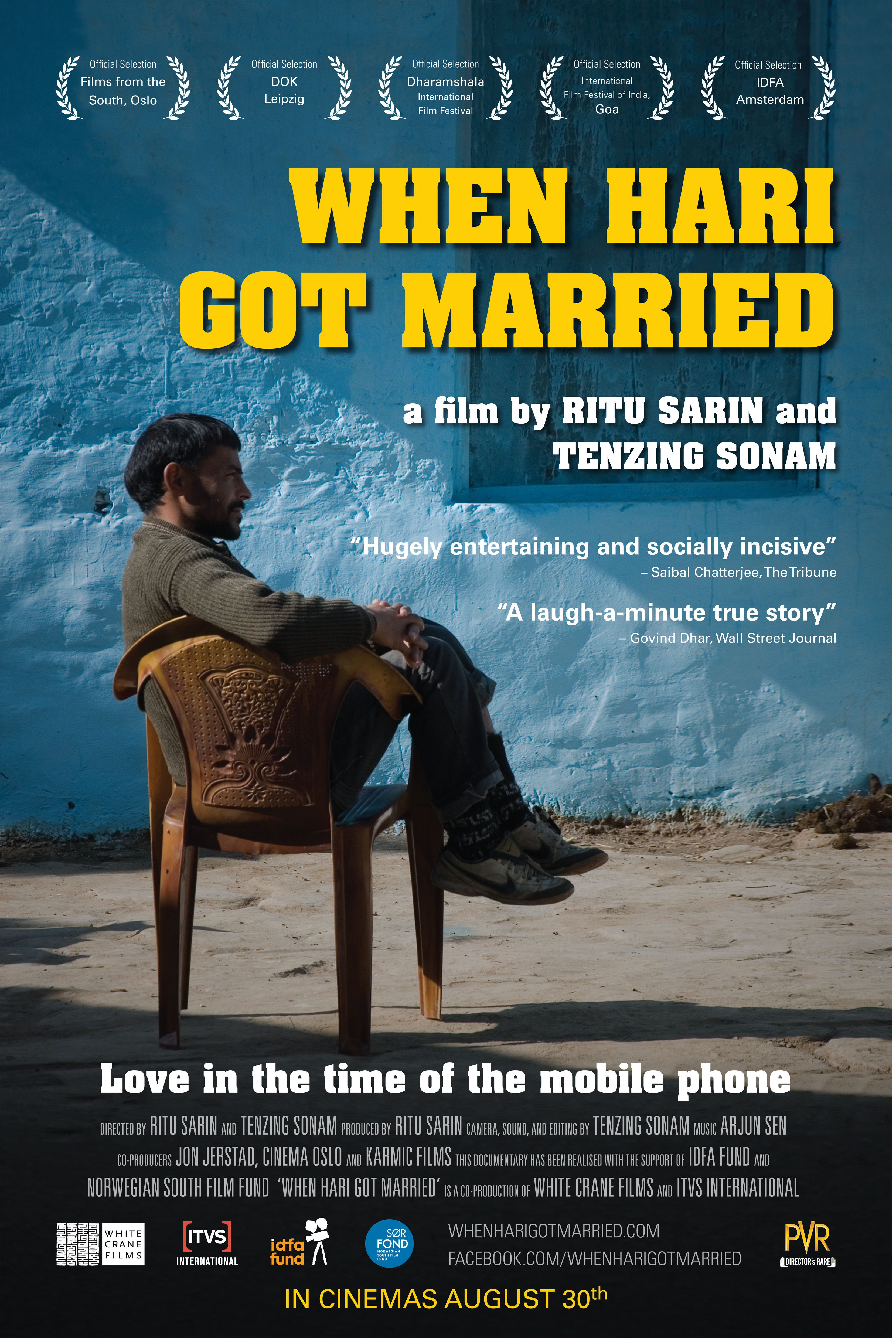
When Hari Got Married, a documentary film by Ritu Sarin and Tenzing Sonam is releasing as part of the PVR Director’s Rare series from 30th August at PVR cinemas in Delhi, Gurgaon, Mumbai, Pune and Bangalore.

“When Hari Got Married” takes a humorous look at Hari, a taxi driver from Dharamshala, as he prepares for his marriage to a girl he has only seen once, and that too, with her face covered. Hari’s frank and outspoken views on love and life, his unusual courtship on the mobile phone, and his eventual marriage provide a warm and illuminating insight into the changes taking place in India as modernisation and globalisation collide with age-old traditions and customs.

More on the film

translite-final-rgbHari, a 30-year-old taxi driver, lives in Dharamshala, a small town in the Himalayan foothills. He is getting married to Suman, a girl he has never met.

Tradition dictates that Hari and Suman will only see each other on the day of their wedding. But Hari has found another way to get to know her: on the mobile phone. Over the past few months they have spoken to each other every day and have fallen in love.

Hari and Suman see each other properly for the first time during the wedding ceremony. Will their telephone love prove strong enough to overcome the awkward obstacles of an arranged marriage?

Hari’s unusual courtship and marriage, coupled with his frank and humorous confessions of fear, doubt, hope and anticipation, provide a warm and illuminating insight into the changes taking place in India as modernisation and globalisation collide with age-old traditions and customs.

A co-production of ITVS International and White Crane Films. With additional funding from IDFA Fund, Amsterdam, and Films From the South, Oslo.

About the filmmakers

Ritu Sarin And Tenzing Sonam are an Indian-Tibetan filmmaking team based in Dharamshala, India. They worked as independent filmmakers in San Francisco and London before moving back to India where they are based in Dharamshala.

Working through their film company, White Crane Films, they have produced and directed several documentaries, mostly focusing on Tibet-related subjects. These include: The Reincarnation of Khensur Rinpoche (1991), The Trials of Telo Rinpoche (1993), and The Shadow Circus: The CIA in Tibet (1998). In 2005, they completed Dreaming Lhasa, a dramatic feature film executive produced by Jeremy Thomas, which premiered at the Toronto International Film Festival. They have also worked on video installations, including Some Questions on the Nature of Your Existence (2007), which was shown at the Mori Art Museum in Tokyo and the 2010 Busan Biennale.

Their feature documentary, The Sun Behind the Clouds: Tibet’s Struggle for Freedom (2009), won several awards including the Vaclav Havel Award at the One World Film Festival in Prague. When Hari Got Married is their most recent film. Ritu and Tenzing are also directors of the Dharamshala International Film Festival, which had its first edition from 1-4 November 2012.

Through this blog we have always tried to spread the good word about various crowd-funded (Kickstarter, wishberry and such) projects. Here’s one more film which looks interesting and you can contribute to its making.

Have a look at this trailer –

And here’s one more clip –

If you find the trailer and the clip interesting, you can help the filmmakers complete the film. Click here to go their IndieGoGo page and fund the film.

If you want to know more the film and the filmmakers, over to the team for all the other details.

  1. design_final Who are we

Adam Dow (Co-Director, born and raised in Seattle, and is currently settled in Mumbai) has been making films since the age of twelve with his father’s old VHS camera. He has written and directed several short films that have been circulated in the US festival circuit. He received the Mary Gates Scholarship for leadership in 2001 and started the University of Washington’s first improvisational theatre troupe. Upon his move to Mumbai in 2007 he founded India’s first Improv Group known as Improv Comedy Mumbai and in 2011 was nominated as one of the people to watch in Mumbai by CNN.

Ruchika Muchhala, (Co-Director, is of Indian roots, born and raised in Indonesia and Singapore, and is currently settled in New York). She has worked on several documentary projects as an editor and television series as a writer and director. Her directorial debut was “The Great Indian Marriage Bazaar”, a documentary in which she navigates through the complex system of arranged marriages in modern-day India. The film aired internationally on various television channels, including BBC World, and at women’s and international film festivals in 2012.

 2. Story behind Beyond Bollywood

Both of us were complete “outsiders” to the world of Bollywood, when we came in 2007 to Mumbai to work on a web series about the different facets of Bollywood. During the making of the web-series, we came across 4 very interesting characters – Pooja Kasekar (dancer), Harry Key (Australian “white” extra), Ojas Rajani (make up artist) and Prem Singh Thakur (Union Leader) – and when we approached them with the idea of making a film on them/their lives, they readily agreed.

So, the Beyond Bollywood journey began in 2008 and we decided to finish shoot after 4 years of filming, in 2012, which is when we decided that it was time to now start putting the film together. We realized, while filming, that in order to capture their journey’s in the industry (and of their lives), we would need to spend time with them. Only then the audience will be able to see some character growth and development – but more than that, their real stories. Both of us truly believe in storytelling and wanted the audience to feel that they were watching a film, and not snippets of their lives, being narrated by a voice over.

3. Why should you support “Beyond Bollywood”?

 We decided to follow these characters because we felt a certain connect with them and found them to be extremely passionate about what they were doing – Pooja Kasekar, whose idol is Madhuri Dixit, came to Mumbai to become a dancer and through sheer hard work, moved on from being a background dancer to a lead dancer and also got a role in a film as the lead actress.

Prem Singh Thakur, who a lot of our filmmaker friends would know, is meant to be one of the most honest men in this profession and has been elected Vice Chairman of the Union over and over again.

Ojas Rajani has been in the film industry for more than 20 years now (is considered one of the top make up artists in the industry) and has done make up for some of the biggest names in the business.

Harry Key, a complete outsider, came to India to travel and possibly find some work, landed up on a film set the day he arrived in India. Initially it was tough for him to find work here, but again, through sheer hard work and perseverance, he decided to stick around, kept trying, and managed to do TV Commercials and Films (as an extra). He also got a major role in a small hindi film, which unfortunately didn’t release.

They all came from outside the film industry (most from outside of Mumbai), had a dream of making it BIG (a subjective term), were extremely passionate about what they were doing, and each one through sheer hard work and determination was able to do something that they (and everyone around them) would certainly be proud of. They did something BIG in their own right!

We want to tell their stories, which are similar to the stories of most people that come to Mumbai (from across India and the world) to try their luck in Bollywood! We also feel that this film will help a lot of people that are not part of the industry, understand the space better (especially our very own family members, who are asking us all the time – Beta, aap karte kya ho? / Child, what do you really do?)

 4. What do we need the money for?

So far, we have funded the production and post production on our own and now we have run out of funds (and our parents have stopped supporting us too!). We need US$ 12,000 to complete the film – sound, picture and some licensing fees for the film/music clips we are using in our documentary. We are running a crowd funding campaign on Indiegogo (link here) to raise the funds to be able to complete the film. Please watch the trailer and visit our Facebook site and help us by contributing and/or passing on the trailer/fb link to your friends and family who might be able to contribute.

CREW:

Producer:                Manas Malhotra

Co-Producers:         Adam Dow & Ruchika Muchhala

Co-Directors:          Adam Dow & Ruchika Muchhala

Cinematographer:   Adam Dow

Editor:                    Monisha Baldawa

Sound:                    Kamood Kharade

Additional Editors:   Darren Lund & Atanu Mukherjee

Music Composers:  Tarun Shahani & Vinayak Manohar

Bidesia In Bambai

“Bidesia in Bambai” is a story of music, migration and mobile phones. Ah, that sounds interesting – the title and its description. And what a gorgeous poster too. Not sure what exactly i was googling when i landed up on this blog. Just found out on Film Divison’s FB page that the first trailer of the film is out. Have a look.

For a better view, you can go directly to its vimeo page here.

Here’s more on the film (from the director’s blog) – Migration is the predominant theme in the music, and the phone is a recurring motif. Mobile phones are also used to circulate the music. And it’s the only way to stay connected to the mothers and wives back home in the village. This film follows two singers in Mumbai who occupy extreme ends of the migrant worker’s vibrant music scene, a taxi-driver chasing his first record deal and Kalpana, the star of the industry.

Film details – 86 minutes/2013/ Bhojpuri and Hindi/ with English subtitles/ INDIA

Screening – The film will have a screening in Mumbai on 20th July. You can follow the FD FB page for venue and other details. Hopefully they will update later on.

If you want to know more about the film, copy/pasting her latest post from the filmmaker’s blog

Bidesia is Bhojpuri for ‘the one who leaves home’. One in four migrants in Mumbai is Bhojpuria, a people from the north Indian states of Uttar Pradesh and Bihar. Bambai is their name for Mumbai/Bombay.

The bidesia in Bambai, like most recent migrants in this ‘global city’, inhabit the precarious edges of Mumbai. Along with his meagre belongings though, the impoverished migrant brings with him a vibrant musical culture.

Bhojpuri pop music is produced, circulated and performed in the crumbling sites that is home to the bidesia in the big city. Migration is the predominant theme in the music, and the mobile phone is a recurring motif in the songs. Frequently sexually charged, at times religious, often lyrical and occasionally political, the migrant is both the subject of, and the audience for this music. The musical landscape he inhabits mobilises notions of masculinity; gives form to his identity; makes tangible his desire for a place in the city; and evokes his longing for home.

This feature-length film attempts to make the migrant visible by celebrating the musical sphere that he inhabits, in a city that renders him illegal and unwanted.

– Click here to go to Surabhi Sharma’s blog.

Poster/Trailer courtsey – Surabhi’s blog.

Meghe Dhaka Tara – a Bengali film (with English subtitles) inspired by the life of filmmaker Ritwik Ghatak has released in Mumbai, Delhi and Bangalore this week. Do watch it quickly as it will be in the theatres for just a week.

The film is experimental in nature with its non-liner narrative and criss-crosses tracks between scenes from his films, his life and his plays. With the names of his films being changed, it might be difficult to connect if you are not aware of Ghatak’s films. Like the character is named Nilkantha instead of Ritwik Ghatak – the name of the lead character in Ghatak’s Jukti Takko Aar Gappo (Reason, Debate and Story). Or like Satyajit Ray is referred to as Arijit Ray in a dialogue. It’s quite an ambitious film and must have been a daunting task to put it all together. But even then it beaautifully captures the essence of Ghatak’s life and films – looking for his land, his country. It also has terrific performance by Sashwata Chatterjee who brings out the madness of the man brilliantly.

The film made me go back to Ghatak’s films and while googling, this is where i landed – a docu on him made for DD. It has some very interesting talking heads including my favourite actor Anil Chatterjee. Do check it out. Has some really great anecdotes.

– If you go to youtube, there are more such videos on various other filmmakers. Do check

– And click here to read an article where Aparna Sen and film’s director Kamaleswar Mukherjee discuss Ghatak and his films.

– Screening schedule

Meghe Dhaka Tara2

Faith Connections

Remember Pan Nalin? Samsara, Valley Of Flowers? He is ready with a new documentary titled Faith Connections. And its trailer has come online. Have a look.

And here’s a note on the film –

“Faith isn’t faith until it’s all you’re holding onto.”

Filmmaker Pan Nalin travels to Kumbh Mela, one of the world’s most extraordinary religious events. There, he encounters remarkable men of mind and meditation, some facing an inextricable dilemma; to embrace the world or to renounce it. FAITH CONNECTIONS explores such diverse and deeply moving stories as a young runaway kid, a Sadhu, a mother desperately looking for her lost son, a yogi who is raising an abandoned baby, and an ascetic who keeps his calm by smoking cannabis — all connected by one faith against the spectacular display of devotion.

ApprovedCelluloudMan

Pain is temporary, film is forever” – Michael J. Fox

Unfortunately, it is not. And neither are memories, both die, if not carefully preserved. Without memories, the past is a blank slate, existing in a space where we cannot touch it. Without a past we are a blank slate, forever trapped in a present that makes little sense. Films, like all our art, keeps our past safe, for us to delve into and understand how we came this far and, more importantly, where to go from here.

P.K. Nair understood this and scraped together our largely dissipated past, bit by bit, literally from across the country’s landscape and even beyond. What I felt when I heard that was sheer awe. And awe-inspiring is everything about Shivendra Singh Dungarpur’s documentary, “Celluloid Man”.

The film is the centre of attention right now, thanks to a much-deserved release (a shout out to the rare PVR Rare!), the National Awards, the Cannes selection and especially the centenary of our much-maligned yet much-beloved Hindi Film Industry. Much has been written about it so I’d like to simply share what the film did to me instead.

I like watching documentaries in the theatre. Especially our Indian docus which, by default, generally have a rusty appeal that somehow get an exotic aura in the hall. I also like everything old and forgotten; its romance and nostalgia, and the bitter-sweet pain that memories always bring with them. Celluloid Man, smelling of museums and ruins, was tailor-made for me. I walked in with the same excitement, same anticipation I had while watching Hugo, except that this was a bit more personal. This was about history that was specifically ‘mine’.

I settled down and there was this old, decrepit man detailing first-hand, his journey of collecting films and teaching a stubborn India the importance of preserving its history. How he salvaged the print of Dadasaheb Phalke’s ‘Kaliya Mardan’ and put the film together with little besides Phalke’s small notebook and his own diligence. How he travelled to remote corners of the country to collect film negatives, even bits. How Ardeshir Irani’s son confessed to having sold his father’s negatives for silver extraction. How he made prints of films that came to FTII for screening without bothering about permission. How he bargained and bartered copies of Indian films for foreign ones. His meeting with Langlois of Paris’ Cinematheque (I particularly loved how unimpressed he was about the meeting with what seemed-like a rather stuffy Langlois purely from the way Nair saab relates the meeting). And how much he now misses being close to what was probably the only love of his life, films.

But that was not all. The legendary man has a legendary memory of the location of every scene in every film he has archived. The NFAI under him collected 12,000 films, 8000 Indian and 4000 foreign. The mind boggles, yes. But that is not all, as he walked around FTII he also recollected memories of the old Prabhat Studios effortlessly. Of a certain make-up room at the then Prabhat Studios and now FTII campus that was Madhubala’s favourite. Of a certain wooden floor having a tank underneath to convert it for outdoor water sequences. Of the sturdy equipment still in use. Of Prabhat Studios being modelled on the best of Hollywood indoor studios. His memory and appetite for trivia seemed as marvellous as his legacy.

Even more marvellous was to watch the number of lives he touched. Lives of the very people who have created our celluloid history. It was immensely humbling to watch each one of them speak ever-so-warmly about their association with him. Of Girish Kasavaralli recalling how his thoroughly neglected Ghattashraddha was restored and archived. Of Jahnua Barua talking of how Nair saab helped him out by giving him a much-need job which he suspects was an unofficial arrangement. Of an aged Jaya Bachchan recalling with the pride of a young student how she was the only girl allowed for night screenings because Nair saab vouched for her dedication. Of Naseeruddin Shah gleefully talking of surreptitious screenings of censored cuts. Of Vidhu Vinod Chopra’s awe at being handed the print of Godard’s Breathless to study for as long as he wished. He came across as this strict Guru, dedicated to authentic instruction and learning, willing to go to any lengths to open up a student’s horizons if he sensed the hunger. And of Gulzar saab warmly (rightly) placing him next to Dadasaheb Phalke in importance to our film history.

mini-still_celluloid_man_2

The film packed in bytes with so many important film personalities, right from Sitara Devi, that it felt like some sort of a masterclass in itself. Maybe it is to accommodate their presence then, it has a loose structure. It pans out as a long-winded stroll down memory lane piecing together the painstaking effort of Nair saab’s work with the sole purpose of celebrating the man and his achievements through his and other’s eyes. I didn’t mind the rather meandering and sometimes repetitive narrative solely because this is one film that proves Roger Ebert wrong. The ‘what’ matters more than the ‘how’. Besides, where do you ever get to listen to the likes of Adoor Gopalkrishnan, Kumar Shahani, Gulzar saab, Saeed Mirza and Shyam Benegal at length, at one place?

The film is an unabashed ode, yet, Shivendra Singh Dungarpur takes care to include controversies surrounding the exclusion of Nair saab post his retirement. Neither does he shy away from asking him a tough question, framing his habit of making copies without permission as ‘stealing’. And keeping the camera rolling through an uncomfortable silence and a louder repetition of the question. It could have been edited out but it wasn’t.

He also goes beyond the purview of Nair saab’s work, into his personal life to give us a better glimpse of the man. Unacknowledged, but I was dreading this part. When have men with a singular passion ever had happy personal lives? What followed were long and touchingly forthcoming interviews with Beena Nair, his daughter who confessed how father was never available during her and her brother’s childhood. But now things had changed as she had accepted that it wasn’t lack of love for them but too much love for films that kept him away. I didn’t want to look at her face closely or read her emotions because it seemed like a preciously personal part of her past she was sharing, who am I to peek into someone’s pain? It touched a raw nerve nevertheless. Having an emotionally unavailable parent isn’t easy, I have one. Besides, there is this incident from childhood sharply imprinted on my memory that it sruck. My father is a huge fan of the Gujarati shayar/poet Mareez. He quotes him off-handedly at any point with a look of pure bliss. Once, he had the opportunity to meet him, that too at his home. My gushing dad asked Mareez to recite a few lines for him and Mareez saab obliged. After the recital, his daughter came forward and thanked my father and said something like, ‘Thanks to you we heard father’s poetry today. He never shares anything with us, ever. He is in his own world, it’s like we don’t exist.’ As a child I understood the girl, as an older person with a few insistent passions of her own, I understand Mareez and Nair saab too today. Passion does that. Separates you from everything. You are alone in it, because there you are already with that one thing you love, you don’t need anyone else.

In more than two hours, what I saw unfold onscreen was a meta experience. A while into the film and it became difficult for me to distinguish between Nair’s passion for films and Dungarpur’s for Nair saab’s work. Because, passion, after all has only one language and if you speak it you understand it and Shivendra Singh Dungarpur clearly does. It made me emotional to see that kind of drive for something considered unimportant and a mere commodity. Because, in my eyes, what the two men had done was save me a chunk of my history, not only as culture but as art via the very medium I love so much. How can I thank them enough for that?

I am leaving you with some of the quotes from the film that stayed with me. (might not be verbatim)

You can see a hundred years from now; you can see a certain aspect of life which was there only at the time, on that day. It means a lot. It means more than Greek Tragedy where everything is heightened beyond compare. But those very small things get so beautifully manifest (on film). It is the very, I think, soul of art of any kind.” -Kumar Shahani

(It is important for us to preserve our past because) “We have a rich past but a very poor history, whereas the West has a significant past. (Perhaps) Not a rich past, but a very significant history.” – U. R. Ananthamurthy

Before P.K.Nair, there was no one else. After P.K. Nair there is no one else.” – Shyam Benegal

As an archivist I cannot accept that we have lost forever the print of Raja Harishchandra”. – P.K. Nair

As a film lover, I cannot accept that either. But at least we had Nair saab.

I don’t remember the last time I felt so raw while watching a film.

FATEMA KAGALWALA

unhung heroSince none of us are getting much time to write posts these days, i thought let’s at least compile cinema related interesting news bits that we come across on the net everyday and put it in a post. Otherwise it just gets lost in the timeline flood.

When i first heard the term “cockumentary”, i had no clue how to react. But that’s how Patrick Moote branded his film “Unhung Hero” – a cockumentary. And it started because of his cock size and because of which he was publicly rejected by the girl whom he proposed. The film is premiering at the ongoing SXSW Festival.

Indiewire has got a clip. Click here to read more about it and watch the clip.

Twitchfilm has reviewed the film. Click here to read.

But does size matter? Well, this isn’t the first time that the million dollar question has bothered men. And this won’t be the last. You can’t deny that it’s a serious issue. Problem is the moment one tries to talk about it, the reactions goes in all extreme directions.

And like Moote, filmmaker Lawrence Barraclough also has mini-me issue. And he made two docus on it, putting the camera on his dick. First one is called “My Penis and I” which was made for BBC. The second one is called “My Penis and Everyone Else’s”. Both the films are quite funny, sad and serious. He even talks to his girlfriend and parents about it. If not big dick, this surely needs big balls. Do watch.

And that’s not all. If you were offended by Seth MacFarlane’s “We Saw Your Boobs”, Ladies, here’s your revenge – we saw your junk. Have fun.

Pic courtesy – FB page of the film

Two festival news updates.

Manjeet Singh’s next feature Chenu has been selected for the 9th edition of L’Atelier organized by the Cinéfondation of the Cannes Film Festival. 15 projects from 14 countries have been selected for 2013 edition of L’Atelier which invites directors/producers to meet potential partners during the Festival. So far, out of 126 projects presented over the last eight years, 83 have been completed and 29 are currently in pre-production. From May 17 to 23, L’Atelier will arrange meetings with the directors for film industry professionals interested in investing in their projects.

DearCinema has more info on the film – Chenu is the story of a young dalit boy in the northern Ganges belt. He is drawn into ongoing war between the naxals and upper caste militia, when his younger sister’s fingers are chopped for plucking mustard leaves from a landlord’s field. The script explores various factions existing in the northern Ganges belt and delves into the humiliating lives of the underprivileged dalits.

Manjeet Singh’s directorial debut Mumbai Cha Raja premiered at TIFF and have been doing the fest rounds since then. Last year Shivajee Chandrabhushan’s project The Untold Tale was selected for L’Atelier.

powerless_tff

Tribeca Film festival has released the list of 12 documentaries that will premiere at the fest and will compete in the World Documentary competition section. Fahad Mustafa and Deepti Kakkar’s Powerless, which recently premiered at the Berlin Film festival, will have its North American premiere at Tribeca. Here’s the official synopsis from the Tribeca release..

Would you risk your life to flip a switch? In Kanpur, India, putting oneself in harm’s way to deliver electrical power is all too common. Powerless sheds light on the opposing corners of this political ring, from an electrical Robin Hood tapping wires for neighbors to the myopic utility company whose failure to understand economics forces it deeper into financial disarray. This vibrant exposé gives a whole new meaning to the words “power struggle.” In English, Hindi with subtitles.

To know more about the film, watch its trailer/teaser and for its credit roll, click here.

The 2013 film selection includes feature films from 30 different countries, including 53 World Premieres, 7 International Premieres, 15 North American Premieres, 6 U.S. Premieres and 8 New York Premieres. A total of 113 directors will present feature works at the Festival, with 35 of these filmmakers marking their feature directorial debuts. Among these directors, 26 are women. The 2013 film slate was chosen from a total of 6005 submissions.