


Play the three songs back to back and have fun.
Bhojpuri version
Bengali version
Marathi version
So when did this happen? Is it only with Aashiqui 2? What are we missing? Is this the trend? Someone enlighten us please.
And the original Hindi version
 what we are reading – EightandHalf


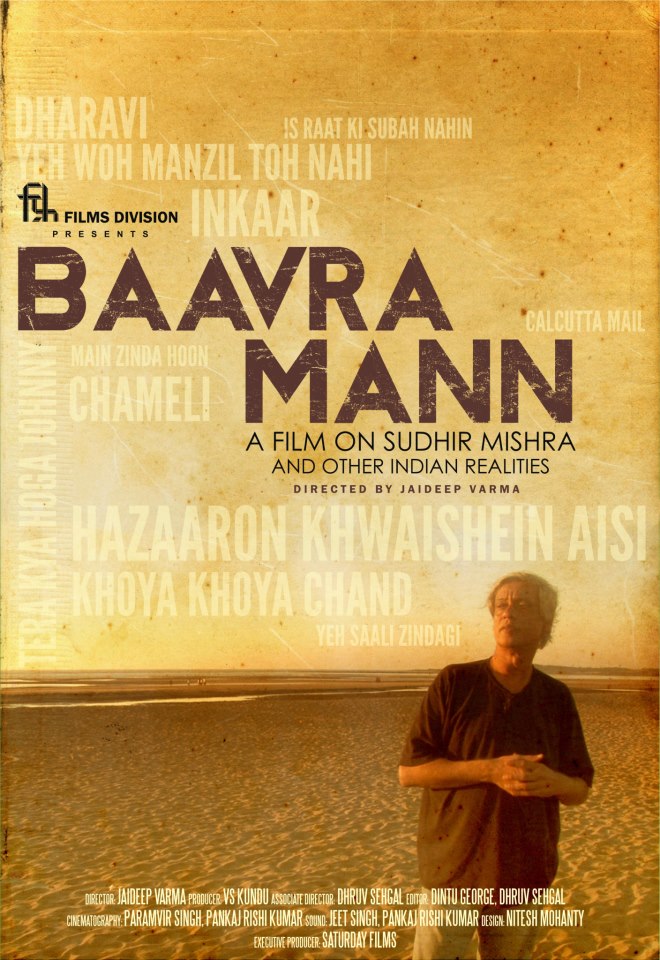
Jaideep Varma’s documentary Baavra Mann is yet to get a release in India. Karan Singh Tyagi saw it at New York Indian Film Festival earlier this year and wrote this post for us. Read on.
(We suggest you play the song in the background while reading the post)
 “Who is this long-haired Sanjay Dutt duplicate?”
“Duplicate nahi hai bhaiyya. Iska naam Nirmal Pandey hai. Kya acting kari thi isne ‘Is raat ki subah nahin’ me”, was my prompt reply, as my cousin and I stood in line with a dozen others, scanning movie posters outside Gaiety (Bandra) and booking our tickets for ‘Auzar’. As an 11 year old, I couldn’t contain my excitement, at having recognized Nirmal Pandey in the ‘Auzar’ poster, and went on this long rant about ‘Is raat ki subah nahin’. Much to my cousin’s chagrin, I told him everything about the movie – how it was violent and funny at the same time, how all the actors spoke a very different language, how the story finished in one night, and importantly, how Papa and I were lucky to see the movie on the big screen, as it had a single show in Bombay.
This innocuous little incident came back to me while watching Jaideep Varma’s documentary, ‘Bavra Mann and other Indian Realities’, in New York. For those who haven’t seen it yet, Jaideep’s movie traverses through the life and films of Sudhir Mishra, and somewhere in the middle of the movie, Mishra laments how ‘Is raat ki subah nahin’ was confined to a single show in Bombay and how many people didn’t get to see it. On hearing this, I silently smiled as my mind went back to watching the movie with Papa in the same show that Mishra was referring to. How I wanted to thank my father at that very instant! Not just for taking me to ‘Is raat ki subah nahin’, but for giving me the hereditary gift of love for movies and being the best companion I could have had while I nurtured it.
There were numerous such nostalgia trips throughout Jaideep’s movie. The portions dealing with ‘Hazaron Khwaishein Aisi’ left me mesmerized. Listening to ‘Bavra mann dekhne chala ek sapna’ on the big screen again did my soul so much good; it stirred something deep within me, something in desperate need of stirring. My mind went back to when I first saw ‘Hazaaron..’ I remember crying tears of joy and sadness, laughing gleefully, feeling melancholic and empty, while ‘Bavra Mann’ played on loop and images from the movie interposed with flashes of my life didn’t leave me for days at end. Probably, this is a uniform reaction that ‘Hazaaron..’ elicits. The movie strikes a deep chord somewhere, and makes one confront broken promises, failed dreams, and all those bittersweet memories, that we carry with ourselves. Right after watching Jaideep’s ‘Bavra Mann’, a friend who had accompanied me to the screening in New York forwarded me this by Avijit Ghosh who captures this sentiment beautifully:
“There are a thousand reasons to watch Hazaaron Khwaishein Aisi. But enjoy it as a last anthem for a generation who knew how to believe. Watch it holding the hand of a woman you have loved and lost. And it would be nice if you have drunk some rotten whisky before.”
As must be painfully evident by now, I am easily susceptible to bouts of nostalgia. However, these glorious nostalgia-filled moments were not the only reason why I enjoyed Bavra Mann. I have often wondered what drives filmmakers to make the kind of movies that they do. For example, at the risk of doing a Baradwaj Rangan here, I have been fascinated by two particular scenes from Black Friday and Gangs of Wasseypur.
Sample these dialogues:
Black Friday – “Jiske paas kuch nahi hai karne ke liye, dharam ke naam par chutiya banta rahega”. GOW2 – “Jab tak cinema hai log chutiye bante rahenge”
I have often wanted to argue that we can discern in these dialogues a kind of master narrative, a collection of meanings, and, perhaps, a powerful leitmotif that runs through all of Kashyap’s movies, a kind of slavishness and hive mentality – towards religion in Black Friday, towards cinema and everything that one acquires from it in Gangs of Wasseypur. To take the analogy further, slavishness towards power in Gulal, towards self and personal ego in DevD and No Smoking. Therefore, Kashyap’s movies are magic on celluloid, because he lets characters with such aggressive spirit and slavish devotion face their internal conflicts and external surroundings. What we see on screen is the result of a bundle of contradictory aspects and motivations, a certain kind of dualism that everyone and everything in life has. I have repeatedly asked myself, what are the questions that Kashyap is trying to answer through his work? Has he found any answers yet?
Bavra Mann poses similar questions to someone whom Vikramaditya Motwane calls the “original Anurag Kashyap”. Despite the frequent and frenzied analysis of cinematic moves of all current directors’, I feel there is a strong lack of literature that provides us with enough resources to examine and study their work. This is where Bavra Mann triumphs. It gives enough resources to the audience to interpret Sudhir Mishra and his movies in a new light. Bavra Mann is a fascinating exercise in self-revelation and film lovers will revel in the personal anecdotes and casually delivered remarks that reveal layers and layers of information about Mishra and his body of work. The movie has a series of interviews with Mishra and people close to him, covering the length of Mishra’s career, beginning with his childhood, continuing through his education, his failed marriage with his first wife, his relationship with renowned film editor, Renu Saluja, his early film work, his breakthrough success with Dharavi, and his daring work in Hazaaron.., his most autobiographical Khoya Khoya Chand, and finally his recent movies. There is a treasure trove of diamonds in the movie. After all, who wouldn’t want to eavesdrop on Mishra and Shantanu Moitra’s recounting of how they got Swanand Kirkire to sing ‘Bavra Mann.’
A criticism often peddled against movies like Bavra Mann is that the director holds back, and is reverential towards his subject. Here, Jaideep is never in awe of Sudhir Mishra. His questions are probing and the discussions on films themselves are less about why they’re great and more about how they were put together. Jaideep knows that directors are not good at explaining motives behind making particular films. Movies, like many things else, begin with something very vague and abstract. Jaideep, therefore, never tries to look for definite answers and actual motives behind Mishra’s work. His aim is to allow the viewers the freedom to interpret the scene in the way they want, and depending on how their cinematic education (and earlier experiences of Mishra’s movies) has prepared them. Bavra Mann succeeds in bringing before us the greatest number of possibilities to reinterpret Mishra’s movies. After watching Bavra Mann, I realized that Sudhir Mishra’s movies (especially the earlier ones) resonated with me because they were being truthful about life – the movies expressed some deeper emotional experiences that Sudhir Mishra recognized in his own existence. This in and of itself was a reason for me to love Bavra Mann.
However, for me, the biggest strength of Bavra Mann is that it never wavers from admitting that Sudhir Mishra continues to be plagued with what is an inconsistent body of work. It subtly engages in criticism of some of Sudhir Mishra’s recent movies (the likes of Inkar, Calcutta Mail) to reflect on the present-day infertility of thought in India. By using Sudhir Mishra’s example, Jaideep exposes the dangers inherent in adopting a conformist and consensus-driven career. According to me, it is in this context that the movie makes a brutally frank attempt to unravel the intellectual decline of India and Indian movies (using Sudhir Mishra as a metaphor). The movie, therefore, is an elegy of intellectual life not only of Sudhir Mishra but of us all. In a way, the movie tries to jolt us (Sudhir Mishra included) out of the dark recesses that we have allowed ourselves to fall in.
I do not know if Bavra Mann is getting a theatrical release anytime soon. However, I strongly hope that everyone gets a chance to see it. Watch it to revisit old times, to go back to your personal stories intertwined with Sudhir’s films, watch it to hear “Bavra Mann” on the big screen again, watch it as a student and lover of cinema, and most importantly, watch it because it is a powerful statement on the times that we live in.
Naseerudin Shah says the single most perceptive thing in the movie: “Mishra’s best work is yet to come.” Even though, I love ‘Hazaaron…’, I wouldn’t want it to be Mishra’s best work. I earnestly wish that it turns out to be just a teaser of what he (and by association) Indian cinema goes on to achieve and that no one is ever required to come to the rescue of this long-haired maverick director, like I had to once come to the rescue of his similarly long-haired leading man outside Gaiety.
– Karan Singh Tyagi
(Karan was born in Meerut, lived and studied in Bombay and Harvard, and after a brief stop in Paris, now finds himself in New York. He strongly feels that Ramadhir Singh was directly referring to him while saying, “Sab ke dimaag me apni apni picture chal rahi hai aur sab saale hero banna chah rahe hain apni picture me..” When he is not day-dreaming about movies or Real Madrid, he also works as a lawyer. You can find him on twitter here: @karanstyagi)

Aha, finally the good news. Hansal Mehta’s Shahid has been acquired by UTV and they will soon announce the release date. Hopefully the film should be out in theatres in next few months. The film marks Hansal’s terrific comeback after a long time and Raj Kumar Yadav is so effortlessly good that he makes you believe that he is the real “Shahid Azmi”. The film has been doing the fest rounds for quite sometime now. Do watch it when it releases.
UTV really seems to be going in right direction with the perfect balance of masala and non-mainstream films. First, Ship Of Theseus, then The Lunchbox and now, Shahid. I would say i wouldn’t mind the assault of the big budget braindead star vehicles as long as they keep on balancing it with some sold small and good films. And hopefully other production houses will follow them.
Click here to read a post on Shahid written by Ad filmmaker Ravi Deshpande.
Official Synopsis
Shahid is the remarkable true story of slain human rights activist and lawyer Shahid Azmi, who was killed in 2010 by unidentified assailants in his office. From attempting to become a terrorist, to being wrongly imprisoned under a draconian anti-terrorism law, to becoming a champion of human rights (particularly of the Muslim minorities in India), Shahid traces the inspiring personal journey of a boy who became an unlikely messiah for human rights, while following the rise of communal violence in India. This story of an impoverished Muslim struggling to come to terms with injustice and inequality, whilerising above his circumstances is an inspiring testament to the human spirit. Starring Raj Kumar, Prabhleen Sandhu and Baljinder Kaur.
Cast and crew
Director: Hansal Mehta
Language: Hindi
Runtime: 123 minutes
Exec. Producer: Jai Mehta, Kunal Rohra
Producer: Sunil Bohra, Shailesh Singh, Guneet Monga and Anurag Kashyap
Production Co: Bohra Bros Pvt. Ltd. and Anurag Kashyap Films Pvt. Ltd.
Principal Cast: Raj Kumar, Prabhleen Sandhu, Baljinder Kaur, Tigmanshu Dhulia, K K Menon, Yusuf Husain, Prabal Panjabi, Vinod Rawat, Vipin Sharma, Shalini Vatsa, Paritosh Sand, Pavan Kumar, Vivek Ghamande, Akash Sinha, Mohd Zeeshan Ayyub, Mukesh Chhabra
Screenplay: Sameer Gautam Singh, Apurva Asrani, Hansal Mehta
Cinematographer: Anuj Dhawan
Editor: Apurva Asrani
Sound: Mandar Kulkarni
Prod. Designer: Rabiul Sarkar
With UTV and Karan Johar on board as presenters, and with a release date (20th September), Ritesh Batra’s debut feature finally gets a trailer. Have a look.
As i keep repeating myself, don’t miss this one. It’s easily one of the best films of the year – simple and solid. And with two terrific performances – by Irrfan and Nimrat Kaur.
And here’s the official synopsis –
Middle class housewife Ila is trying once again to add some spice to her marriage, this time through her cooking. She desperately hopes that this new recipe will finally arouse some kind of reaction from her neglectful husband. Unknowing to her is that the special lunchbox she prepared has been mistakenly delivered to an office worker Saajan, a lonely man on the verge of retirement. Curious about the lack of reaction from her husband, Ila puts a little note in the following day’s lunchbox, in the hopes of getting to the bottom of the mystery.
This begins a series of lunchbox notes between Saajan and Ila, and the mere comfort of communicating with a stranger anonymously soon evolves into an unexpected friendship. Gradually, their notes become little confessions about their loneliness, memories, regrets, fears, and even small joys. They each discover a new sense of self and find an anchor to hold on to in the big city of Mumbai that so often crushes hopes and dreams. But since they’ve never met, Ila and Saajan become lost in a virtual relationship that could jeopardize both their realities.
Cast
Irrfan Khan as Saajan
Nimrat Kaur as Ila
Nawazuddin Siddiqui as Shaikh (Saajan’s Colleague)
Denzil Smith as Mr. Shroff
Bharati Achrekar as Mrs. Krishnan
Nakul Vaid as Ila’s Husband
Yashvi Puneet Nagar as Yashvi
Lillete Dubey as Ila’s Mother
The film had its premiere at the Cannes Film festival in Critics Week section. To know more about the film, click here, here and here.
Sonali Cable was on our radar because it was selected for Mahindra Sundance Screenwriters Lab in 2012. It’s the debut film of Charudutt Acharya who has been writing for the small screen for a long time.
His bio from Mahindra site – Charudutt Acharya is an award winning writer of Indian TV drama shows like Haqeeqat, Kagaar, Jassi Jaise koi Nahin, Siddhanth, Rajuben &Crime Patrol. He has also co-written Hindi feature films Dum Maro Dum & Vaastushastra. Charudutt is a graduate of FTII, Pune and Royal Holloway, London.

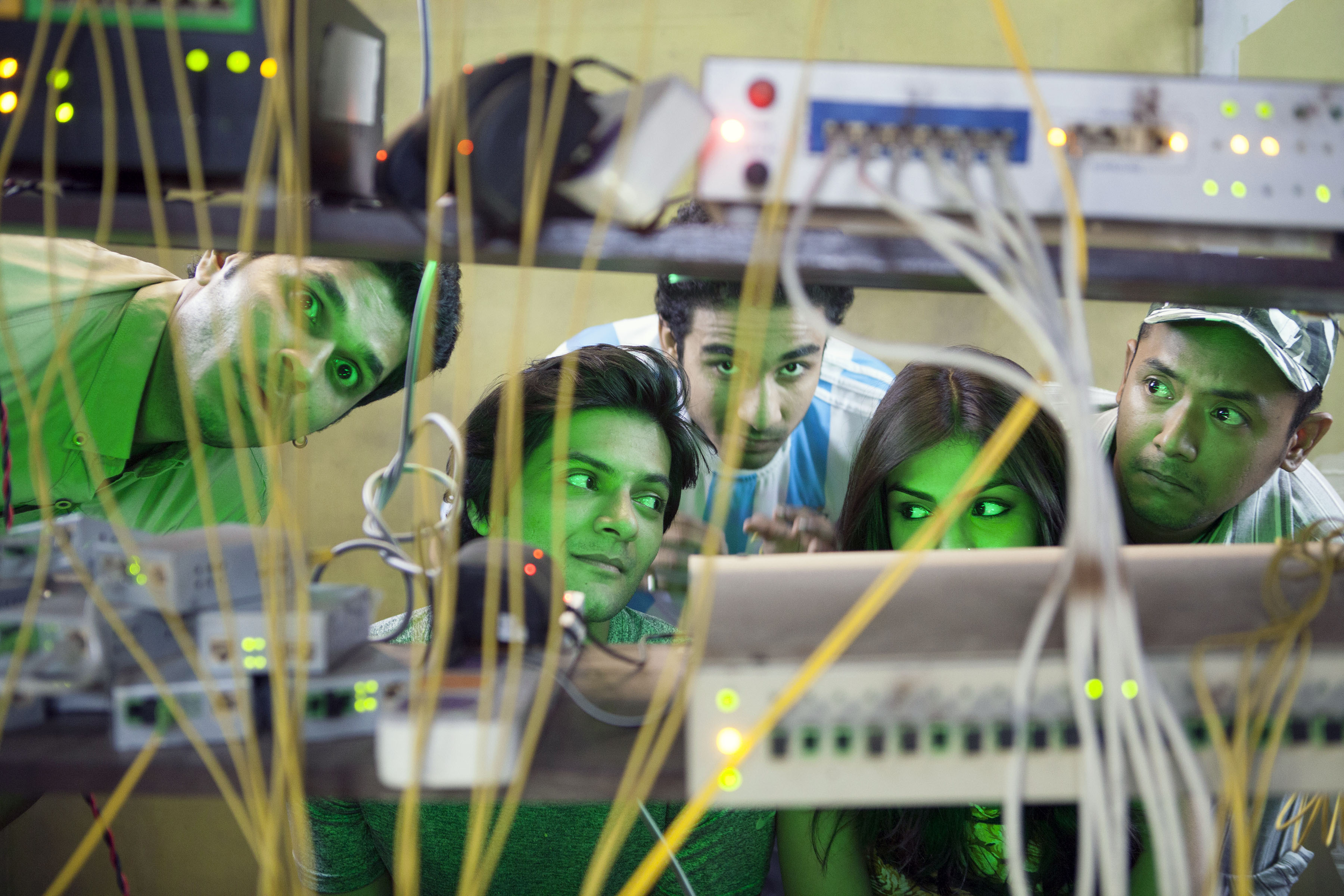
About the film (from release) –
SCIL (Super Cassettes Industries Limited), Ramesh Sippy Entertainment and NextGen Entertainment announces the release of their film ‘Sonali Cable’ on 3rd January 2014.
Sonali Cable is a ‘David versus Goliath’ story, in the thick of the cable internet turf war in Mumbai. An ordinary girl puts her love, life and survival at stake, when she and her ragtag team come in the way of the expansion plans of India’s largest corporation. The film wants to establish the growing corporate crushing small businesses without any scope for co existence.
The film is written and directed by debutant Charudutt Acharya with an ensemble cast that includes Rhea Chakraborty, Ali Fazal, Swanand Kirkire and Raghav Juyal (aka Crockroaxz), supported by accomplished veterans Smita Jayakar and Anupam Kher.
The film features a varied soundtrack showcasing the talents of Devi Shri Prasad, Ankit Tiwari, Mikey McCleary and Falak, with lyrics by Kausar Munir.

Back in the 1960s, a big Hollywood casting director called Harvey Wood came and selected me for a police inspector’s role. Although I had done many films before as hero and villain, I don’t know why I found popularity only as police inspector. I got a lot of acting assignments, but all as police inspector. Twenty years later, I bumped into Harvey Wood again. He looked at me and said, “Bloody hell! You’re still in the same uniform.” He asked me to mail him the details of all my films as I was onto a world record for the most occupational role. Later the Guinness book people sent a team to Bombay to verify facts before they entered my name in their book.
Jagdish Raj, actor, born Sargodha, Pakistan, 1928
Text/pic from here.
TOI report on his death is here. He played cop in 144 films. Yes, 144.
We hardly cover box office related news on the blog. But this is really becoming ridiculous, and in epic proportions. If you don’t track the box office numbers closely, let us explain what we mean.
Nikhil Advani’s D-Day released last friday. After its one week run, here are some of the box office number floating around. First one is by Taran Adarsh, who is a well respected trade analyst if you go by the tweets of B-townies. Also, well endorsed by most Bollywood people. Here’s what he tweeted about D-Day’s 1st week collection
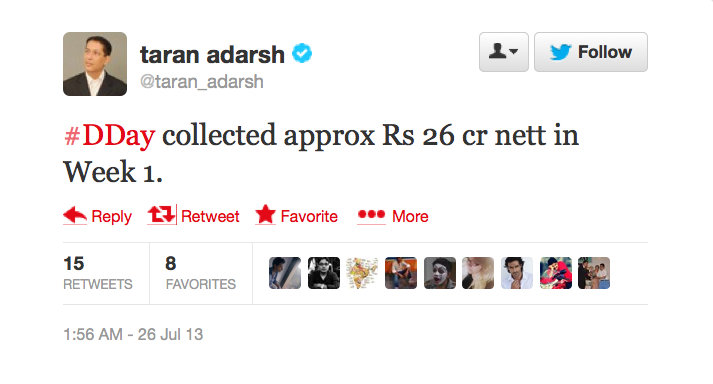 So the figure given by Taran is 26 crore net.
Now, check out the figure given by others who also track box office. Amul Mohan edits another well known and respected trade magazine called Super Cinema. Here’s what Amul tweeted
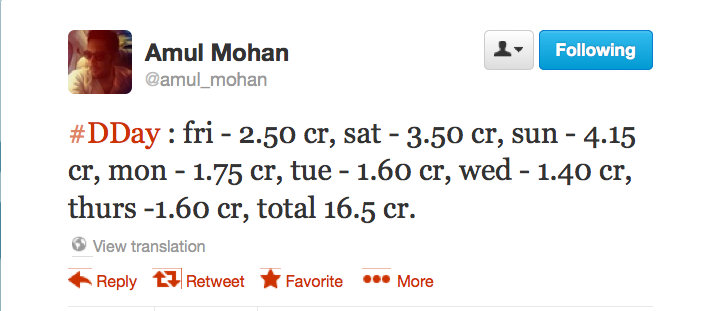 By Amul’s report, the total box office collection of first seven days is 16.5 crores net. As you can see in the tweet, he has given the daily break up too.
So that means a difference of about 10crores (9.5 crores to be exact). A difference of 10crores! Is this a joke? Such a big industry and there’s no accountability of box office figures. Let’s check out the figures given by other sources too.
BoxOfficeIndia has given the same figure of 16.5 crores net.
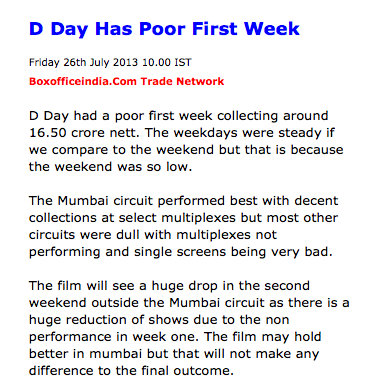 Girish Johar, who is with Balaji’s distribution wing and tracks box office on daily basis, has also tweeted the figure of 16.5 crores net. Komal Nahata, Editor of trade magazine Film Information, has pitched it far less at Rs 15.75 crores.
UPDATE – Box Office India magazine, which is another reliable source for numbers, they have also finally released the 1st week total of D-Day and it’s Rs 14.6 crores. Ooh la la.
This difference in the figure actually started from its opening weekend. Going by Taran’s tweet, D-Day opened with a collection of Rs 13.69 crs net. For the same three days, Amul tweeted the figure of Rs 9.65 crores net. And strangely, the figure given by DAR Motion Picture (Producer of D-Day) is something else – Rs 12 crores as quoted in this report. If you compare Taran and Amul’s numbers, the opening day collection is still close (Rs 2.94/2.50), but looks like Taran’s figures suddenly got wings from saturday.
Everyone in the industry knows that many trade analysts inflate/deflate box office figures based on various other factors – the kind of reviews they have given to show that they were correct in assessing the film’s potential, relationship with the star/maker, and other ulterior motives. A difference of 1 to 5 crore is almost the accepted norm every week. With no central body that does the job of tracking box office numbers, it’s left to the whims and fancies of trade analysts who play around with them the way they want. Strangely, when they endorse a film and it doesn’t manage to get good numbers, they sometimes don’t even reflect the numbers in their box office report. More generic terms like “not up to to the mark”, “above average” (when you don’t even know what average is), “good not great”, are used to cover up the numbers. Well, all this is for a bigger post some other day.
But CAN SOMEONE FIRST PLEASE EXPLAIN THE DIFFERENCE OF THIS 10 FUCKING CRORES ?
– Posted by @cilemasnob
Through this blog we have always tried to spread the good word about various crowd-funded (Kickstarter, wishberry and such) projects. Here’s one more film which looks interesting and you can contribute to its making.
Have a look at this trailer –
And here’s one more clip –
If you find the trailer and the clip interesting, you can help the filmmakers complete the film. Click here to go their IndieGoGo page and fund the film.
If you want to know more the film and the filmmakers, over to the team for all the other details.
 Who are we
 Adam Dow (Co-Director, born and raised in Seattle, and is currently settled in Mumbai) has been making films since the age of twelve with his father’s old VHS camera. He has written and directed several short films that have been circulated in the US festival circuit. He received the Mary Gates Scholarship for leadership in 2001 and started the University of Washington’s first improvisational theatre troupe. Upon his move to Mumbai in 2007 he founded India’s first Improv Group known as Improv Comedy Mumbai and in 2011 was nominated as one of the people to watch in Mumbai by CNN.
Ruchika Muchhala, (Co-Director, is of Indian roots, born and raised in Indonesia and Singapore, and is currently settled in New York). She has worked on several documentary projects as an editor and television series as a writer and director. Her directorial debut was “The Great Indian Marriage Bazaar”, a documentary in which she navigates through the complex system of arranged marriages in modern-day India. The film aired internationally on various television channels, including BBC World, and at women’s and international film festivals in 2012.
2. Story behind Beyond Bollywood
Both of us were complete “outsiders” to the world of Bollywood, when we came in 2007 to Mumbai to work on a web series about the different facets of Bollywood. During the making of the web-series, we came across 4 very interesting characters – Pooja Kasekar (dancer), Harry Key (Australian “white” extra), Ojas Rajani (make up artist) and Prem Singh Thakur (Union Leader) – and when we approached them with the idea of making a film on them/their lives, they readily agreed.
So, the Beyond Bollywood journey began in 2008 and we decided to finish shoot after 4 years of filming, in 2012, which is when we decided that it was time to now start putting the film together. We realized, while filming, that in order to capture their journey’s in the industry (and of their lives), we would need to spend time with them. Only then the audience will be able to see some character growth and development – but more than that, their real stories. Both of us truly believe in storytelling and wanted the audience to feel that they were watching a film, and not snippets of their lives, being narrated by a voice over.
3. Why should you support “Beyond Bollywood”?
We decided to follow these characters because we felt a certain connect with them and found them to be extremely passionate about what they were doing – Pooja Kasekar, whose idol is Madhuri Dixit, came to Mumbai to become a dancer and through sheer hard work, moved on from being a background dancer to a lead dancer and also got a role in a film as the lead actress.
Prem Singh Thakur, who a lot of our filmmaker friends would know, is meant to be one of the most honest men in this profession and has been elected Vice Chairman of the Union over and over again.
Ojas Rajani has been in the film industry for more than 20 years now (is considered one of the top make up artists in the industry) and has done make up for some of the biggest names in the business.
Harry Key, a complete outsider, came to India to travel and possibly find some work, landed up on a film set the day he arrived in India. Initially it was tough for him to find work here, but again, through sheer hard work and perseverance, he decided to stick around, kept trying, and managed to do TV Commercials and Films (as an extra). He also got a major role in a small hindi film, which unfortunately didn’t release.
They all came from outside the film industry (most from outside of Mumbai), had a dream of making it BIG (a subjective term), were extremely passionate about what they were doing, and each one through sheer hard work and determination was able to do something that they (and everyone around them) would certainly be proud of. They did something BIG in their own right!
We want to tell their stories, which are similar to the stories of most people that come to Mumbai (from across India and the world) to try their luck in Bollywood! We also feel that this film will help a lot of people that are not part of the industry, understand the space better (especially our very own family members, who are asking us all the time – Beta, aap karte kya ho? / Child, what do you really do?)
4. What do we need the money for?
So far, we have funded the production and post production on our own and now we have run out of funds (and our parents have stopped supporting us too!). We need US$ 12,000 to complete the film – sound, picture and some licensing fees for the film/music clips we are using in our documentary. We are running a crowd funding campaign on Indiegogo (link here) to raise the funds to be able to complete the film. Please watch the trailer and visit our Facebook site and help us by contributing and/or passing on the trailer/fb link to your friends and family who might be able to contribute.
CREW:
Producer: Manas Malhotra
Co-Producers: Adam Dow & Ruchika Muchhala
Co-Directors: Adam Dow & Ruchika Muchhala
Cinematographer: Adam Dow
Editor: Monisha Baldawa
Sound: Kamood Kharade
Additional Editors: Darren Lund & Atanu Mukherjee
Music Composers: Tarun Shahani & Vinayak Manohar
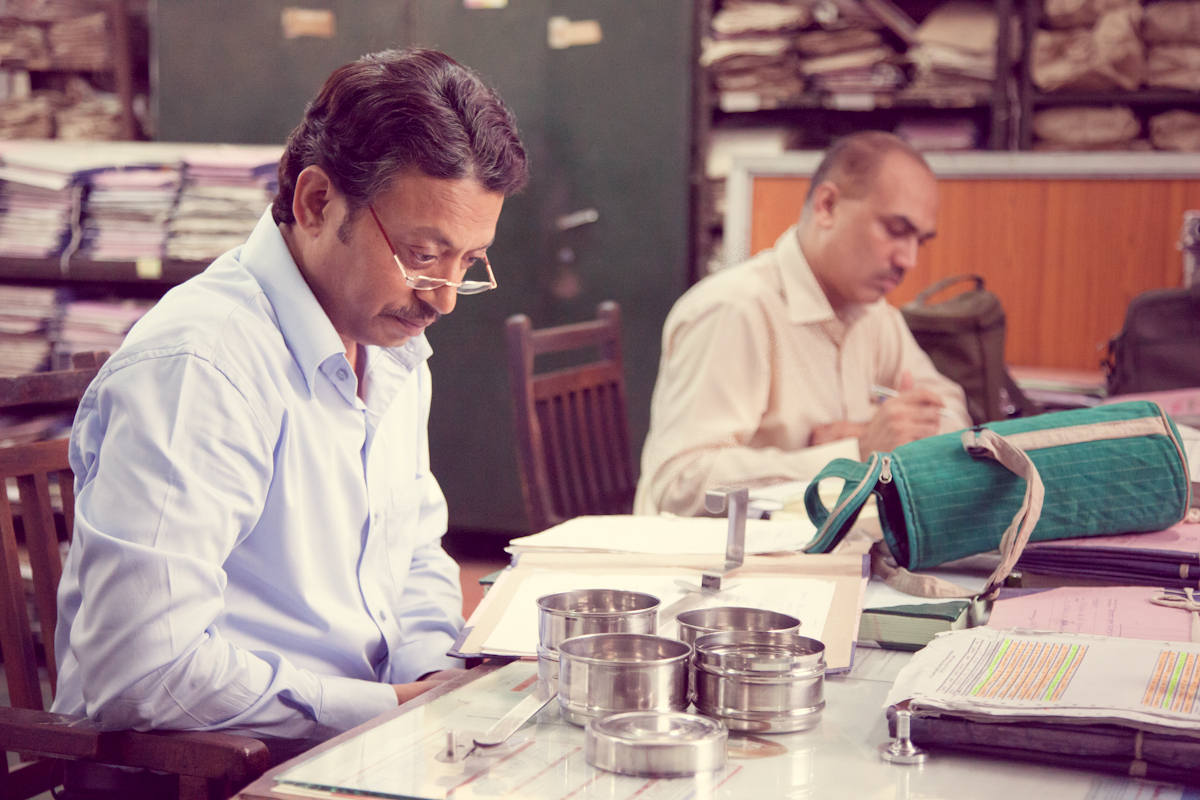
Here’s the good news about one of the best films of the year, The Lunchbox. Producer-director Karan Johar has come on board to present the film and it will be released by UTV on September 20th. This is exactly what we need – big faces should attach themselves with brilliant indies and make them reach the theatres. Otherwise distribution is a pain in the current scenario. After Kiran Rao came on board to help Ship Of Theseus’ release, this is another step in right direction.
Some of us have seen the film and let us assure that it’s a simple and solid film. Directed by Ritesh Batra, it’s not only one of the best debuts of the year, it also has two of the best performances of the year – Irrfan Khan and Nimrat Kaur.
– You can read more about “The Lunchbox” here (on Sony Classics deal) and here (all the Cannes buzz)
And now another bit of news – The Toronto International Film Festival has announced its first list of films selected for the 2013 edition of the festival. And two desi films feature in the list – Ritesh Batra’s The Lunchbox and Maneesh Sharma’s Shuddh Desi Romance. Here’s more on both the films (from the official release) :
The Lunchbox Ritesh Batra, India/France/Germany North American Premiere
– Middle class housewife Ila is trying once again to add some spice to her marriage, this time through her cooking. She desperately hopes this new recipe will finally arouse some kind of reaction from her neglectful husband. Unbeknownst to her, the special lunchbox she prepared is mistakenly delivered to miserable office worker Saajan, a lonely man on the verge of retirement. Curious about the lack of reaction from her husband, Ila puts a little note in the following day’s lunchbox which sparks a series of exchanged notes between Saajan and Ila. Evolving into an unexpected friendship between anonymous strangers, they become lost in a virtual relationship that could jeopardize both of their realities.
Shuddh Desi Romance Maneesh Sharma, India Canadian Premiere
– Shuddh Desi Romance follows a fresh and very real love story about the hair-raising minefield between love, attraction and commitment. A romantic comedy that tells it like it is, providing a candid look at the affairs of the heart in today’s desi heartland. Starring Rishi Kapoor, Sushant Singh Rajput, Parineeti Chopra and Vaani Kapoor.
With the release of Ship Of Theseus, we are not only debating its merit (here and here) but another conversation has started on social media – about ticket prices. Why is it so expensive? Should indie tickets be less expensive? Is it even possible? Well, we do believe that if a film is great, it’s worth the ticket price. But if you are still bothered about the price, here’s Shiladitya Bora on why it isn’t so easy to control ticket prices.
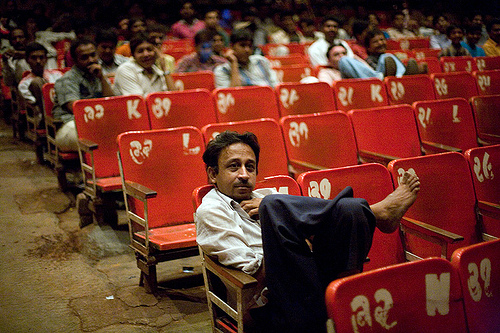
To be brutally honest, no one (and that includes me as well) genuinely knows what is the best way to distribute an Indian Indie in India. The revival of Indian Independent film industry has just started and it is currently in a very nascent stage. We all are experimenting and trying to identify the best case scenario factoring all the constraints (read quality of the film, limited appeal, limited marketing budget and resources etc). There is no one single formula applicable for all Indies and each film requires a customized plan. While owning theatres/ screens (like in case of PVR) helps a bit to screen indie content; other distributor(non cinema owners) mostly rely on relationships built over years with programmers and cinema chains to be able to screen indies.
Whenever an indie releases we see people starting endless debates on the social media platforms with respect to shows, show-timings, ticket prices etc. In order to make the most out of these debates it is of pivotal importance to first have our basics right.
1. So who actually decides how many shows to be allocated to an indie and in which theatres?
For an indie releasing on a Friday, on the preceding Monday the distributor send show requests (wish list in terms of cities, theatres, number of shows, show timings) to the programming teams of various cinema chains. The concerned programming teams then works out a tentative showcasing plan based on factors like the number of films releasing on that particular Friday, performance of last week releases, expected target audience of the film, past performance of similar indies etc. This tentative schedule is then shared with Cinema Operations Team for final approval.
Cinema Operations – Each theatre is managed by a cinema manager who has a target to achieve in terms of number of admits, ATP (average ticket price), SPH (sales per head) – a daily target, weekly target, monthly target, quarterly target and annual target. The career of a cinema manager is directly proportional to these targets and hence all his/her efforts are focused on optimizing the same.
Statistics show that the performance of Indian Indies is abysmally poor in all the three parameters – admits, ATP and SPH and hence not many cinema managers are keen on showcasing Indies at his/her property. So if we want Indies to be released in as many theatres as possible, we need to make the people who run the cinemas confident about the product and this is possible only when a few Indies start performing.
So we come to the next big question on ticket pricing.
2. How is ticket pricing decided?
Every cinema has to operate within price bands pre-approved by the government and no theatre can sell tickets below the lowest price band. The best thing an indie distributor can do is to request the respective cinemas to run the film on the lowest price band and it’s at the discretion of the individual cinemas/ Operations to agree to the request or not.
In addition to the above there is a regular pricing and a blockbuster pricing. Blockbuster pricing is applicable during weeks of tentpole/ big releases and in case an indie is releasing in a week with a tentpole film, blockbuster pricing is applicable to the indie as well in most cases.
We are trying to work out a special discounted price band for Indies released through Director’s Rare.
Another solution can be government waiving off the E.Tax for Indies but for that we need clear cut guidelines to define a film as an independent film.
3. At PVR Director’s Cut, Vasant Kunj, Delhi, the ticket price of an Indie is above Rs. 1000. Why?
First of all I would like to clarify that PVR Director’s Cut and PVR Director’s Rare are 2 different things. PVR Director’s Cut is a super luxury premium theatre located at Vasant Kunj, New Delhi where as PVR Director’s Rare is a banner for theatrical distribution/ showcasing of niche content.
Director’s Cut being a premium theatre, not only Indies but every film is at a premium price. This is like the Business class of an airline and we have a dedicated clientele for this property.
Now the question is if Director’s Cut is a premium property, what is the point of releasing an Indie there?
There are a few reasons for the same.
First it has always been a struggle to get screens for an Indie in Delhi as most of the multiplexes in Delhi have 3-5 screens which is not enough when compared to the number of films releasing in a particular week unlike that in Mumbai, Bangalore, Pune etc.
In PVR Director’s Cut, there is one dedicated auditorium for showing alternate content and hence we always get a show there. And I have always believed that it is better to release the film in Director’s Cut rather than not releasing the film in Delhi at all. In most of the cases we release the film simultaneously in PVR MGF Mall/ PVR Ambience Mall etc, which are regular priced cinemas.
Also if we analyze the total box office earnings of an indie in most cases (not all), a major percentage of the collections is from PVR Director’s Cut. This is because the producer’s earnings on a ticket of Director’s Cut after tax are almost 3-4 times as compared to a regular cinema.
4. In Delhi, the spread of theatres for Indies are mostly limited to South Delhi. Why is this so?
We have to understand one thing that when a film is released, there is a cost attached to it. For releasing a film in one show in one theatre, the total expense on content comes to around INR 18000 per property per week ( INR 14000 Virtual print fee + 12.3% tax + INR 2000 for cloning and cargo). For a producer to recover this cost on content, we need net box office sale of close to INR 40-45000 for that particular property. So as of now it is really not a very good decision to release such niche content in theatres other than in South Delhi. May be in future once the market matures, we will be able to spread the reach all over Delhi NCR.
All said and done we must rejoice on the fact that this is perhaps one of the best phases to be in for an Indian Indie filmmaker and the future will be better.
A few observations/ suggestions which may be useful for aspiring Independent filmmakers.
Make a kickass Indie. There is no substitute to that. No amount of support, gyaan, strategy, patronizing, social media buzz can save a bad/mediocre indie. Do not compare with Rowdy Rathores of the world because that industry works on a completely different dynamics.
When you are planning an indie, in case you do not have access to marketing and distribution budget of around INR 1.5-2 crores, the production cost of your indie should not exceed a few lakhs at any cost. But is it possible to make a good film with such minimal amount? Read about Karan Gour’s KSHAY, which I consider as a classic case study of a successful Indian Indie.
Do not try to do everything yourself. Not every one of us is a Robert Rodriguez. I know we have budget constraints but it is always better to rope in professionals wherever possible and do pay them a fee (whatever best you can afford). Know your weak spots. For e.g if you are not very good at writing, it is always advisable to hire a screen writer to write the screenplay for you. You will find many talented screenwriters willing to help you out. Roping in professionals will definitely help in raising the quality of the final output.
Once you have made a good film, invest some money in hiring a good intelligent publicist who will help with creating the much required aura around the film. Rope in a good designer and get some good artwork ready. Invest in a professional promo editor. These are few small things but if done properly will go a long way in packaging the film well which in turn may yield better results during distribution phase.
(Shiladitaya Bora manages PVR Director’s Rare and has been actively involved with the theatrical distribution of more than 30 independent films)
 F.i.g.h.t C.l.u.b