KAUFMAN - "Or cramming in sex, or car chases, or guns. Or characters learning profound life lessons. Or characters growing or characters changing or characters learning to like each other or characters overcoming obstacles to succeed in the end. Y'know ? Movie shit."
Kaufman is sweating like crazy now. Valerie is quiet for a moment - from "Adaptation".
We are all about CINEMA. That movie shit.
NOTHING is sacred.
NOBODY is spared.
Because we talk about films, dammit.
Not your sex life.
Films, fests, unsung, indies, undiscovered - all that and some fun. If you have dope on anything related to cinema or you would like to share something, do write to us at moifightclub@gmail.com.
The views, opinions, reviews, articles, or positions, expressed by the authors and those providing comments are theirs alone, and do not necessarily reflect the views, opinions, positions or strategies of ANY OF THE EMPLOYERS, FRIENDS, RELATIVES, PR agencies, Production houses, Media group and such third parties associated with the authors. The latter make no representations as to accuracy, completeness, currentness, suitability, or validity of any information on this site and will not be liable for any errors, omissions, or delays in this information or any losses, injuries, or damages arising from its display or use.
In short, if you have an issue with us or any post we've written, write to us at moifightclub@gmail.com
The 70th Venice Film Festival has just concluded and the winners have been announced.
And here’s the good news – Indian filmmaker Shubhashish Bhutiani’s film Kush has won the Orizzonti Award For The Best Short film. This was the only desi entry at this edition of Venice fest.
Orizzonti section puts the spotlight on new trends in cinema. This year 31 films from all over the world were selected in this competitive section. The Orizzonti Jury was chaired by Paul Schrader and composed of Catherine Corsini, Leonardo Di Costanzo, Golshifteh Farahani, Frédéric Fonteyne, Kseniya Rappoport and Amr Waked. after screening the 31 films in competition has decided to award:
The film features Sonika Chopra, Shayaan Sameer and Anil Sharma in the lead.
Synopsis
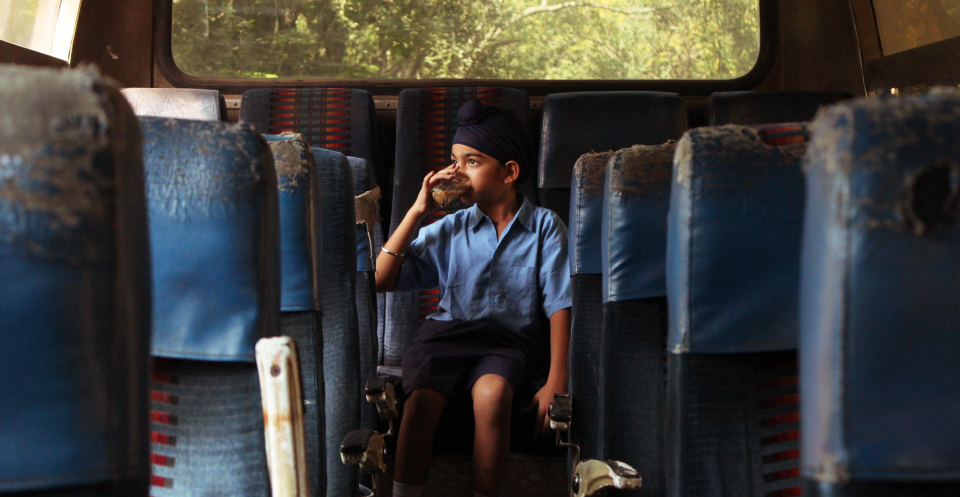
Inspired by a true story, Kush takes place in 1984, surrounding Indian Prime Minister Indira Gandhi’s assassination. Anti-Sikh riots erupt throughout the country. A teacher traveling back from a field trip with her class of 10-year-old students now struggles to protect Kush, the only Sikh student in the class, from the growing violence around him.
Anup Singh’s Qissa will have its premiere at the ongoing Toronto International Film Festival. The film stars Irrfan Khan, Tillotama Shome, Rasika Dugal and Tisca Chopra. This Punjabi film is written by Anup Singh and Madhuja Mukherjee.
The first look trailer of the film is just out.
TIFF Note and Synopsis
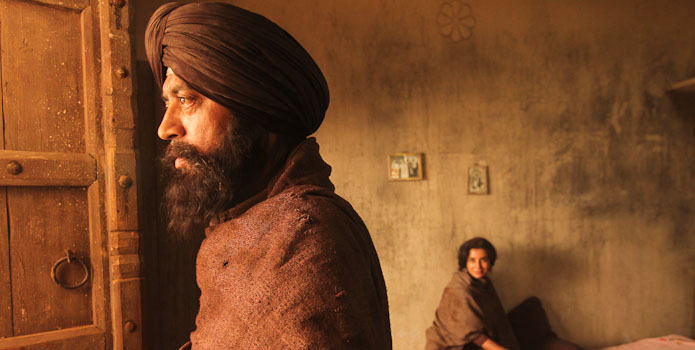
Set amidst the ethnic cleansing and general chaos that accompanied India’s partition in 1947, this sweeping drama stars Irrfan Khan — also appearing at the Festival in The Lunchbox — as a Sikh attempting to forge a new life for his family while keeping their true identities a secret from their community.
Beautiful, timeless, and touching the deepest of human impulses, Qissa carries the spirit of a great folk tale. Although it’s set in a particular time and place — the Punjab region that straddles India and Pakistan in the years immediately after partition — it is both deeper and broader than any one moment. As this eerie family drama progresses, it cuts to the heart of eternal desires for honour, empathy, and love.
One of India’s best actors, Irrfan Khan (Life of Pi, Festival premiere The Lunchbox, and a feature guest in this year’s Mavericks programme) plays Umber Singh, a Sikh uprooted by the religious violence that came with partition in 1947. He and his family move to a safer locale, and it is here that the story takes a remarkable turn. Having already fathered daughters, Singh now wants a son. When his next child is born he celebrates his wish come true, but there is one problem: the baby is in fact a girl.
“Qissa” is originally an Arabic word meaning folk tale. Both the word and the idea migrated from the Gulf into the Punjab, still connected by the ancient oral narratives handed down in communal settings. Working within this tradition, director Anup Singh gives his film both the grand themes and elemental emotions of classic storytelling. As Umber’s daughter is raised as a boy, the characters are propelled with greater and greater urgency towards their inevitable fates.
Part of a new generation of directors with feet firmly planted in India and far beyond, Singh has delivered a film immediately accessible to anyone sensitive to the conflicts that drive classic stories: fear versus hubris, individual need versus social codes. Qissa is a Punjabi story for the whole world.
Director : Anup Singh
Anup Singh was born in Dar es Salaam, Tanzania. He has written film reviews for Sight & Sound, directed Indian television, and consulted for BBC Two. His features as director are The Name of a River (02) and Qissa (13).
Cast and Crew
Director: Anup Singh
Countries: Germany / India / Netherlands / France
Year: 2013
Language: Punjabi
Runtime: 109 minutes
Rating: 14A
Producer: Johannes Rexin, Bettina Brokemper
Production Co.: Heimatfilm, National Film Development Corporation of India, Augustus Film, Ciné-Sud Promotion
Principal Cast: Irrfan Khan, Tillotama Shome, Rasika Dugal, Tisca Chopra Screenplay: Anup Singh, Madhuja Mukherjee
Since crowd-funding is in vogue these days, it’s good to see the trend going beyond Hindi indies. If our friends are to believed, Lucia is the first Kannada film to be crowd funded. We don’t have much clue about this one but it surely looks interesting. It’s written and directed by Pawan Kumar and will release with English subtitles. The film is released by PVR Directors Rare.
Official Synopsis
From the director of smash hit Lifeu Ishtene, comes Lucia, heralding a new direction for Kannada cinema, being the industry’s first crowd funded film. An usher at a decrepit cinema suffers from insomnia. His life changes when he starts getting weird and wonderful dreams but with a caveat. Set in the teeming young metropolis that is Bangalore, the film is a turbulent ride where the lines between dreams and reality are blurred to delirious effect. Please don’t reveal the ending after you’ve watched the film. Prepare to be surprised, very surprised.
In the last few years, Bengali cinema has been trying and delivering some really out of the box gems. Films which don’t follow the conventional rules. If you follow the blog regularly, we try to put the spotlight on those films whenever we can.
A new film titled “Phoring” caught our attention. Have a look at its trailer. It has English subs.
Though the topic is not new but the setting and the detailing makes it really look good. Have never heard this description of Coca Cola. The film is directed by Indranil Roychowdhury and is releasing on September 27, 2013.
It was also in NFDC’s Film-In-Progress Lab and had won The Prasad Lab Award for DI and Colour correction.
Official Synopsis
Phoring is a story of adolescence that most adults deny they ever had. In fact, we all prefer to believe that we jumped straight from the flowery innocence of childhood to the informed maturity of adulthood. The mid-greys of awkwardness, lack of direction, gawkiness, lack of identity are the themes that we prefer not to associate with ourselves. Phoring is a sweet reminder of a film in that sense. It’s a children’s story for adults.
– To know more about the film, you can follow its FB page here. And can read a Business Standard piece on the film here.
Aha, finally the good news. Hansal Mehta’s Shahid has been acquired by UTV and they will soon announce the release date. Hopefully the film should be out in theatres in next few months. The film marks Hansal’s terrific comeback after a long time and Raj Kumar Yadav is so effortlessly good that he makes you believe that he is the real “Shahid Azmi”. The film has been doing the fest rounds for quite sometime now. Do watch it when it releases.
UTV really seems to be going in right direction with the perfect balance of masala and non-mainstream films. First, Ship Of Theseus, then The Lunchbox and now, Shahid. I would say i wouldn’t mind the assault of the big budget braindead star vehicles as long as they keep on balancing it with some sold small and good films. And hopefully other production houses will follow them.
Click here to read a post on Shahid written by Ad filmmaker Ravi Deshpande.
Official Synopsis
Shahid is the remarkable true story of slain human rights activist and lawyer Shahid Azmi, who was killed in 2010 by unidentified assailants in his office. From attempting to become a terrorist, to being wrongly imprisoned under a draconian anti-terrorism law, to becoming a champion of human rights (particularly of the Muslim minorities in India), Shahid traces the inspiring personal journey of a boy who became an unlikely messiah for human rights, while following the rise of communal violence in India. This story of an impoverished Muslim struggling to come to terms with injustice and inequality, whilerising above his circumstances is an inspiring testament to the human spirit. Starring Raj Kumar, Prabhleen Sandhu and Baljinder Kaur.
Cast and crew
Director: Hansal Mehta
Language: Hindi
Runtime: 123 minutes
Exec. Producer: Jai Mehta, Kunal Rohra
Producer: Sunil Bohra, Shailesh Singh, Guneet Monga and Anurag Kashyap
Production Co: Bohra Bros Pvt. Ltd. and Anurag Kashyap Films Pvt. Ltd.
Principal Cast: Raj Kumar, Prabhleen Sandhu, Baljinder Kaur, Tigmanshu Dhulia, K K Menon, Yusuf Husain, Prabal Panjabi, Vinod Rawat, Vipin Sharma, Shalini Vatsa, Paritosh Sand, Pavan Kumar, Vivek Ghamande, Akash Sinha, Mohd Zeeshan Ayyub, Mukesh Chhabra
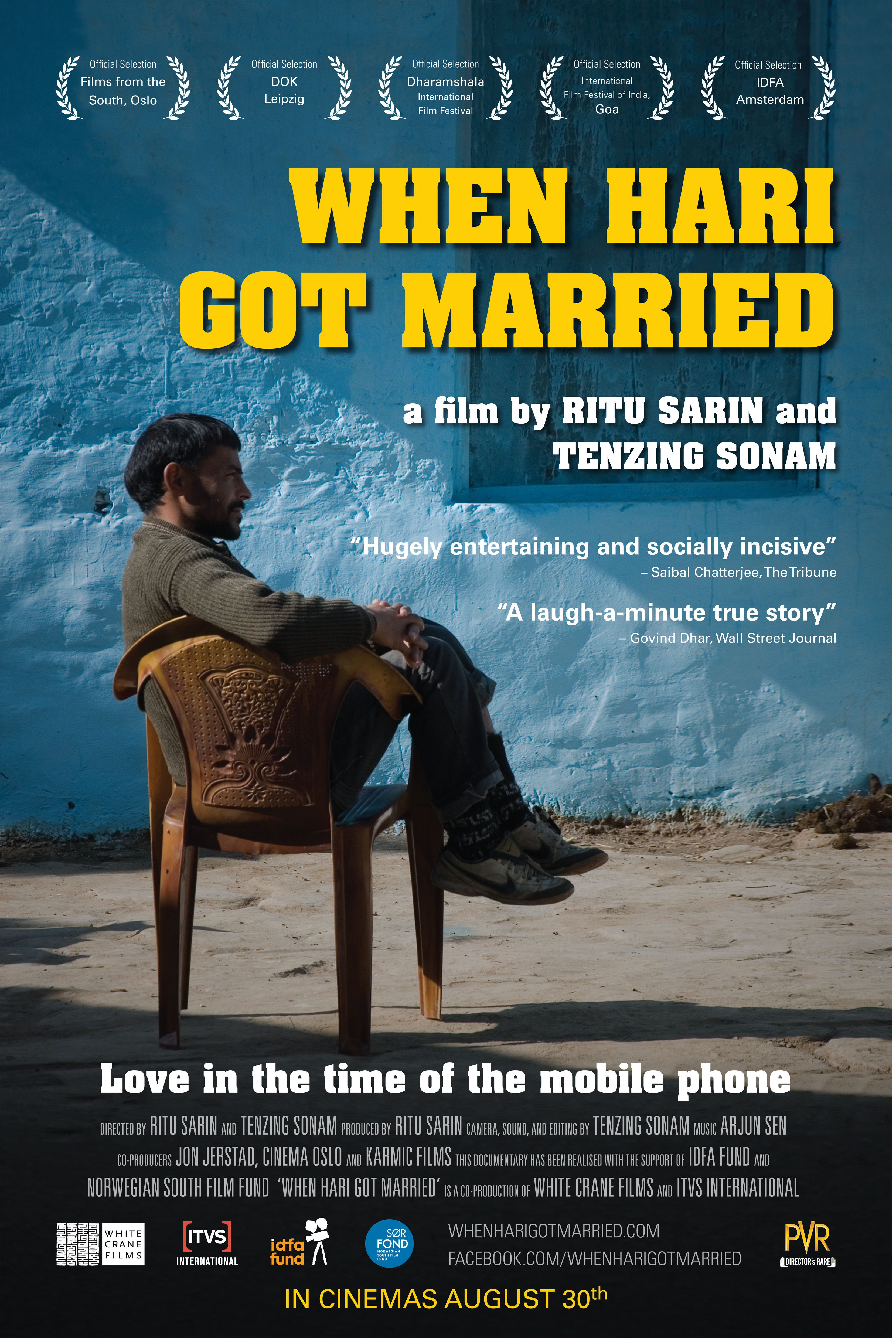
When Hari Got Married, a documentary film by Ritu Sarin and Tenzing Sonam is releasing as part of the PVR Director’s Rare series from 30th August at PVR cinemas in Delhi, Gurgaon, Mumbai, Pune and Bangalore.
“When Hari Got Married” takes a humorous look at Hari, a taxi driver from Dharamshala, as he prepares for his marriage to a girl he has only seen once, and that too, with her face covered. Hari’s frank and outspoken views on love and life, his unusual courtship on the mobile phone, and his eventual marriage provide a warm and illuminating insight into the changes taking place in India as modernisation and globalisation collide with age-old traditions and customs.
More on the film
Hari, a 30-year-old taxi driver, lives in Dharamshala, a small town in the Himalayan foothills. He is getting married to Suman, a girl he has never met.
Tradition dictates that Hari and Suman will only see each other on the day of their wedding. But Hari has found another way to get to know her: on the mobile phone. Over the past few months they have spoken to each other every day and have fallen in love.
Hari and Suman see each other properly for the first time during the wedding ceremony. Will their telephone love prove strong enough to overcome the awkward obstacles of an arranged marriage?
Hari’s unusual courtship and marriage, coupled with his frank and humorous confessions of fear, doubt, hope and anticipation, provide a warm and illuminating insight into the changes taking place in India as modernisation and globalisation collide with age-old traditions and customs.
A co-production of ITVS International and White Crane Films. With additional funding from IDFA Fund, Amsterdam, and Films From the South, Oslo.
About the filmmakers
Ritu Sarin And Tenzing Sonam are an Indian-Tibetan filmmaking team based in Dharamshala, India. They worked as independent filmmakers in San Francisco and London before moving back to India where they are based in Dharamshala.
Working through their film company, White Crane Films, they have produced and directed several documentaries, mostly focusing on Tibet-related subjects. These include: The Reincarnation of Khensur Rinpoche (1991), The Trials of Telo Rinpoche (1993), and The Shadow Circus: The CIA in Tibet (1998). In 2005, they completed Dreaming Lhasa, a dramatic feature film executive produced by Jeremy Thomas, which premiered at the Toronto International Film Festival. They have also worked on video installations, including Some Questions on the Nature of Your Existence (2007), which was shown at the Mori Art Museum in Tokyo and the 2010 Busan Biennale.
Their feature documentary, The Sun Behind the Clouds: Tibet’s Struggle for Freedom (2009), won several awards including the Vaclav Havel Award at the One World Film Festival in Prague. When Hari Got Married is their most recent film. Ritu and Tenzing are also directors of the Dharamshala International Film Festival, which had its first edition from 1-4 November 2012.
With UTV and Karan Johar on board as presenters, and with a release date (20th September), Ritesh Batra’s debut feature finally gets a trailer. Have a look.
As i keep repeating myself, don’t miss this one. It’s easily one of the best films of the year – simple and solid. And with two terrific performances – by Irrfan and Nimrat Kaur.
And here’s the official synopsis –
Middle class housewife Ila is trying once again to add some spice to her marriage, this time through her cooking. She desperately hopes that this new recipe will finally arouse some kind of reaction from her neglectful husband. Unknowing to her is that the special lunchbox she prepared has been mistakenly delivered to an office worker Saajan, a lonely man on the verge of retirement. Curious about the lack of reaction from her husband, Ila puts a little note in the following day’s lunchbox, in the hopes of getting to the bottom of the mystery.
This begins a series of lunchbox notes between Saajan and Ila, and the mere comfort of communicating with a stranger anonymously soon evolves into an unexpected friendship. Gradually, their notes become little confessions about their loneliness, memories, regrets, fears, and even small joys. They each discover a new sense of self and find an anchor to hold on to in the big city of Mumbai that so often crushes hopes and dreams. But since they’ve never met, Ila and Saajan become lost in a virtual relationship that could jeopardize both their realities.
Cast
Irrfan Khan as Saajan
Nimrat Kaur as Ila
Nawazuddin Siddiqui as Shaikh (Saajan’s Colleague)
Denzil Smith as Mr. Shroff
Bharati Achrekar as Mrs. Krishnan
Nakul Vaid as Ila’s Husband
Yashvi Puneet Nagar as Yashvi
Lillete Dubey as Ila’s Mother
The film had its premiere at the Cannes Film festival in Critics Week section. To know more about the film, click here, here and here.
Thanks to TIFF’s announcement, we got to know about this animation film. Satyajit Ray’s acclaimed and an all time favourite film across the generations, “Goopy Gyne Bagha Byne” has now been animated into “Goopi Gawaiiya Bagha Bajaiiya”. It will have its world premiere at this year’s Toronto International Film Festival.
The first trailer of the film is out.
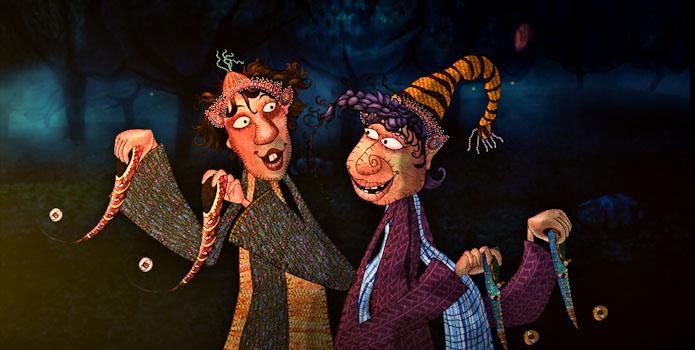
Official synopsis – A captivating animated adaptation of a cherished children’s classic by Satyajit Ray, this timeless fable is the story of Goopi and Bagha, a pair of musicians gifted with magical powers by the King of Ghosts.
“Tagore-on-an-acid-trip” – that’s how Qaushiq Mukherjee, or Q, as he is popularly known, has described his latest film, Tasher Desh. We discovered Q with his last film Gandu which still remains unreleased in India. And we have been following all his work since then – shorts, music, documentaries.
Here’s the director’s note on his new film which is set to release on 23rd August in Mumbai and Kolkata. It’s based on one of the popular musical dramas of Rabindranath Tagore.
This slideshow requires JavaScript.
(Click on any pic to enlarge and watch the slide show)
Since I was five, Tasher Desh has been on my mind. It’s that fantasy that I always knew I wanted to touch. That elusive texture of human existence, devoid of transient truth. Reality is indeed transient; shifting all the time yet every civilization holds on to its truth till whatever time they can, always leading to antagonism and discontent. The cycle of time makes sure that periods of extreme confusion and chaos happen to alter realities, and we are at the thresholds of such a time.
Tagore wrote Tasher Desh as a mythical utopian expression against the backdrop of a violent turbulence. India was in the process of forming an individual and collective identity. Shaking off a history of oppression and forging a modern society. Tagore saw it as an opportunity perhaps, to tell a story removed so far from reality that it forced the listener to be objective. Modern society is marked by one overwhelming human condition. Of melancholia or depression. Slowly becoming one of the most important issues of our daily reality.
Depression is a symptom of a gloom caused by social system and its invariable ability to isolate individuals.
The film is not about the narrative of the fairy tale. It is but a reflection of how I see the world right now. As it was then, when the piece was written, the world is in a flux. India is changing radically, along with the politics of the world, and these changes are essentially driven by system driven violence. My storyteller, therefore, is a lost soul. Unable to deal with the cacophony of his circumstances, he dives into the fable, as if to save himself. The characters of the fairy tale are all extensions of the storyteller, and the story itself has a life of its own. Every story is the same. And it is always the telling that shifts the paradigms.
In the film, it’s his story that helps the storyteller overcome his ennui and to take a decision that would change his life.
The prince is depressed, because the storyteller is. A deep isolation caused by the sense of loss, of one’s self. Stagnant and paranoid. Stuck in a space and time that is almost a cocoon, with the appearance of a prison. While the storyteller is confined within the two parallel railway tracks, the prince is in his palace, a hopeless fortress, as it seems to him.
Tasher Desh is also about belief and magic. The oracle, the fairy watching over our prince, is needed because impetus is external. This is what connects us to the world outside our mind. Instead of drawing inspiration from the mundane reality, the storyteller as the concerned friend of his protagonist invokes the fairy. The prince’s transformation is immediate. Touched by the power of illusion, he suddenly begins to realize that his emancipation is in movement. He needs to go away. One of the most important things holding him back was his broken mother. He comes out to his mother, and then dives into his fantasy. The storyteller also jumps the wall of his reality.
It could be argued that social governance and its monotheistic, patriarchal nature cause collective depression. Tagore’s utopia is bizarre, with masked beings, strange rules and social paranoia of change. The cards in the film seem to have lost all human tendencies.
When the prince and the friend meet them. But the prince, newly liberated, is impatient to try out the power he has been given. A demi god now, devoid of intrinsic human folly, he delivers the message to the ace of hearts.
The storyteller travels the path he has often traveled in his fantasy, and when he arrives at the palace of his dreams, he finds her. The ace of hearts, a widow living in the shadows of a ruined structure. Mystical, magical, she is the one he was waiting for. Suddenly he has someone to tell the story to. Get it out of his soul. The widow and the ace of hearts merge in his story, and a revolution begins.
Tasher Desh symbolizes the triumph of a pagan form of ritualistic cleansing through love and identification of the self, in a postmodern society. it’s a vision of the man cleansed pure by the woman, and the seed of identity being sexual in nature. The ace of hearts takes away the storyteller’s attention, at the same time making his story more palpable, more intense, and more romantic. The film turns a sharp corner therefore, and begins to intensify on finding that one point, the spark. It’s a feminine revolt that the story narrates now, no longer a tale of male neurosis. A non-‐violent revolution fuelled by love. In utopia. Tagore was a pure romantic, and i have tried to place his sensibilities in the confusion of our time. a violent world without any screen violence. A fairy tale without any fabrication and frills. I have tried to find the unreal right beside me. All the art properties in the film were objects we can find easily. The locations were live. The look, inspired heavily by Japanese forms, from kabuki to manga, had to be basic. There are no visual effects used, apart from layering two or three visuals together, to find an image that allows all the realities to exist together, form a relationship. And a video game reference that was done with video moshing, a very low fi technique. The idea was minimalist. Within that apparent reality, we would try to find the sublime. The magical.
The film is a musical. Following an ancient oral form, we have retained the songs as they were, written eighty years back. Associating with some of the finest musicians across the world, I have tried to place the sound of Tagore’s time with the current ones. The words of the songs, so eloquent, emerging from a romantic poet of the highest standard, are actually lines for the characters that sing them. With the use of music, the reality is broken time and again, but every song contains a message so intrinsic to the character, one can lose one’s self in them. Sound and colour play crucial roles in the film, creating the environment and the tension of the spaces explored.
Tasher Desh is an experiment in form and structure, using one of the most popular scripts of India’s recent history. I wanted to remain as faithful to the original idea as I could, and then use my treatment to bring the seed of the story out of its stagnancy, caused by the sterility of my culture. It is a story about revolution after all, and magic, and I strongly believe in both.
A king banishes the older queen and his son to a palace where they lead a life of luxury and decadence. An oracle whispers the secret words to the prince and he leaves the palace with his friend, the merchant’s son. Their boat sinks and they arrive at the land of cards where the inhabitant cards are governed by a military regime. The prince and his friend get caught and bring about a change in the women cards with music and prophecies of love. The woman cards revolt. The king surrenders and the prince finds the meaning of life.
What’s Q’s Tasher Desh is all about
Once upon a time, there was a storyteller. In a lonely railway station, somewhere in Kolkata, he spoke to trains. He wanted to tell a story. It was not a new story. But for him, it was the only story to tell. Inside the darkness of his mind, his story unfolds, a kaleidoscope of fantasy.
Once upon a time, there was a prince. a victim of his destiny, he was banished with his mother to a dark and distant prison palace. Here he grows up, without hope, without a future, with his mother drowning herself in alcohol. His depression countered only by his friend, the merchant’s son, who argues that it was indeed the prince’s choice to remain locked in. realizing the extent of his despair, the friend invokes the oracle. A mysterious figure, the oracle passes on a message of liberation. The prince realizes that he is indeed a prisoner of his mind. He takes a decision, to leave. He has a final moment with his mother, who lets him go. The prince takes hold of his destiny, and sets off on a voyage with his friend, searching for an adventure.
The storyteller begins his journey as well, leaving the city, and traveling to a ruined palace, which is where we had found the prince. Here, he encounters a strange woman, a widow, living alone, as if waiting for him to turn up. He is mesmerized by her, and soon, begins to tell her the story. She is his muse, the one who he was waiting for. Finally having found the listener, the storyteller launches into an even more intense narrative.
Shipwrecked on a paradise island, the prince and the friend encounter a strange culture. The islanders are all soldiers, who call themselves the cards, and live by a code of rules that outlaws any human behavior. Before they know it, an aggressive party of the islanders, holds the visitors captive. Presented at court, and having angered the cards by defying their court customs, they are pronounced guilty, and banished. But before he leaves, the prince asks for a last word, and takes the opportunity to whisper the same message of liberation he received from his guardian angel to a few of the card women. The result is chaos. The women are completely shaken, and soon the land of cards sees dissent for the first time.
– For more info on the film and release schedule, click here for its FB page.
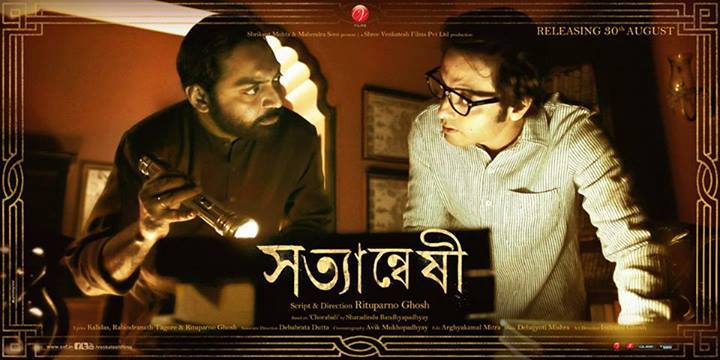
Filmmaker Rituparno Ghosh passed away earlier this year just after completing the shooting of his film on Byomkesh Bakshi. The makers have completed the film and it is ready for release. It’s based on “Chorabali” by Sharadindu Bandyopadhyay.
The film also marks the acting debut of filmmaker Sujoy Ghosh in the lead role of Byomkesh Bakshi.
Here is the first trailer of the film
Official synopsis – Maharaja Arunangshu, the ruler of a princely sate named Balabantpur, had made a wish list on his death bed in the presence of Dewan Chandrashekhar, the family physician Kaligati and the High Priest. It laid down certain conditions for his heir, his son Himangshu. The first of which forbade Himangshu from marrying a non Hindu girl, and the second demanded a legitimate heir within three years of his marriage. Bound by his father’s conditions of succession, Himangshu is compelled to marry Alaka, an aspiring actress.
A year and half into the marriage, Harinath, the young palace librarian disappears without any trace. This mystery occasions the arrival of the sleuth Byomkesh and his author friend Ajit to Balwantpur. The visit though is under the pretext of an invitation for a hunting expedition. In course of their stay, they unfold many secrets involving the residents of the palace and about the topography of Balwantpur.
Film : Satyanweshi.
Starring : Sujoy Ghosh, Aninda Chatterjee, Indraniel Sengupta, Arpita Chatterjee, Sanjoy Nag, Shibaji Bandhopadhyay, Anandi Ghosh
Producer : Shree Venkatesh Films
Presenter : Shrikant Mohta & Mahendra Soni
Direction : Rituparno Ghosh.
DOP : Avik Mukhopadhyay
Music : Debajyoti Mishra




 F.i.g.h.t C.l.u.b