Posts Tagged ‘Vishal Bhardwaj’

Seen Haider yet? Naah? What are you doing? Go, book your tickets first. Coming back to the film, if Vishal Bhardwaj can get two Salmans, we aren’t far behind. We got two Haiders. One is his, other is ours. So here is our Haider on his Haider.

Our Haider Hussain Beig is a 23 year old filmmaker based out of Netherlands. When he’s not alienating close friends with painful film gyaan, he dabbles in Aerospace Engineering. You can check out his stuff here. This is first post here.

To read our previous post on the film, “Haider : Uncertain, Complex, Asymmetric…Because the screenplay is Kashmir”, click here.
Haider2

Heavy handed exposition usually kills a film for me. It could be a tasteless voiceover or a redundant character painstakingly ear-fucking the audience with drab explanations of already convoluted plot-points. Which brings me to one of my favorite ‘did you catch that?’ Moments in the film. It occurs when Khurram is being led into an abandoned house and he notices ‘Yeh toh Kaul Saab ka ghar hai.’ Then a brief exchange ensues about the whereabouts of ‘Kaul Saab’, finally coming to the conclusion that he has ‘shifted’ to Bombay.

This was an in passing reference to the exodus of the Kashmiri Pandits from their homeland. It perfectly captures the nonchalance of the characters who, putting it crudely, have different issues to deal with now. And perhaps are still dealing with the brutal and horrific ousting of their Hindu neighbours as a mere migration to the big city. This is just one of the many examples of sheer brilliance in storytelling by someone who I would not have expected less of. Best of all, I didn’t feel like I was being explained a point of view or thrown facts at that I was supposed to ingest like a frustrated teenager in a History lesson. I knew most facts about the region and the socio-political situation already, and never once did I feel the need to internally sigh with a ‘pata hai bhai, gyan dena band karo‘. And trust me when I say I know a lot about Kashmir. Because unlike most of us, I have not been fed frustratingly conflicting facts from different sources of news, I have lived them in my own little way.

I was born in Delhi to a German mother and a Kashmiri father, who decided to name me Haider. It’s one of those unique ‘this-guy-is-definitely-a-Shia’ names. I guess like most things my father does, he wanted to be different. And I was happy with that. I personally don’t know any Haiders. Until late last year, when I heard Vishal Bhardwaj was making his third Shakespeare adaptation on Hamlet, called Haider. Same name, same spelling. Not Hyder, Heydar, or Haidar. HAIDER. F-U-C-K-ed-M-E.

Putting it simply, it’s unnerving to see your name in posters, on billboards, as a trending hashtags of some of my cinematic idols on the big screen. In the ticket line at the box office I turned around as a reflex to my name being called out by impatient ticket buyers. And let’s not get started with the jokes that only true friends and elementary school goers can come up with; ‘How does it feel to have Shahid Kapoor in you?’, or ‘Dude! You gave Hansal Mehta fulfilling sleepless nights!’.

What put me to a melancholic ease though, was the name being pronounced in a Kashmiri accent. It took me back to an angry grandmother yelling out ‘Huhder!’ at my mischief. It’s sad that it takes a great like VB to put in the careful attention to detail to make sure that stars make the proper effort into not caricaturizing the dialect. From Shahid Kapoor’s ‘Sirinagar’ to Shraddha Kapoor’s endearing ‘Luvved, Givved, Suckked, Fu..’. They were almost pitch perfect. And even if some may not agree, full points for the effort.

The dialogues, their delivery, and timing, were just a revelation. Blending in Shakespeare’s cunning words with the heavy backdrop of the ‘Kashmir Issue’. Nothing felt pedantic, heavy handed, apologetic, expositional, out of place, or forced. It was as it should have been. Nothing more, nothing less.

The supporting cast was mostly played by locals, and they were spot-fucking on. There was no need for windy character back stories. From Janus’ two faced Salman and Salman, to Khurram’s born-again militant henchman. They could all have separate films based on them and I would pay good money to watch those too. It’s heartening to see such a wide pool of talent scattered all across the country. WAKE THE FUCK UP, BOLLYWOOD!

Shraddha Kapoor’s work was a welcome surprise. I wouldn’t say her performance was perfect, but three films in, she’s already giving her contemporaries a hard time. Aloof, innocent and gullible, Arshia was what I would call a perfect representation of Kashmir in the early parts of the militancy. It resonated, or was rather amplified by Tabu’s Ghazala, as a more worn out, mature, but also much more grey representation of Kashmir in the time the film is set in, the glorious mid-nineties. It seems like Tabu is the only actor that can play a self destructive feminine character in a Shakespearean tragedy to such seasoned perfection. And to Shahid Kapoor, all I want to say is, Ghanta-Ghar in Lal Chowk will never be the same for anyone again. They better fucking throw all the big (even if bogus) awards at him.

Never have I seen a film capture the reality of the situation so beautifully. Pankaj Kumar’s cinematography is a result of what would happen of each character we’re given a brush to paint out exactly what they see. Each frame was a representation of these personal works of art. It was almost akin to the wounded beauty of the valley. You are one of my heros. I was more excited about seeing your name attached to the film than VB’s. After Ship of Theseus, and now this, I can’t wait to see much much more work from you!

Finally, to the master himself. Vishal Bhardwaj. I might need a series of blog posts to talk about your work. And I’m sure, as I have also read, there is enough information, analysis, discourse and dissection of your work already. I’d rather not add to the pile. I’ll stick to what stuck out most for me, the score. I had listened to the songs that had come out in the run up to the release quite a lot. My favorite being, of course, Bismil. Though what really captured my entranced attention was the score. So, so, …. Fuck I’m out of adjectives that would do justice. I hope the score will be out soon. I know what music I’m going to write to now.

I have never lived for more than two months in Kashmir. Most of my upbringing has been in Delhi, though I have visited Kashmir every year of my life since I was born, most of those years being the most dangerous. I have only fond memories. I have never once seen a terrorist/mujahid/militant/freedom-fighter/jihadist. And it’s not like I lived in a cordoned off posh area. In fact my family lives in one of the rather impoverished Shia neighbourhoods in Srinagar. Though that is not to say, that the distant sound of gunshots and bomb explosions was not a common sound. In my own way, a part of my brain would register them as the sound of Diwali fire crackers, and things would be festive in my mind again. I’ve had the most tranquil moments of reflection on the banks of the Nigeen lake, on a grass patch between abandoned houseboats. I’ve cried my eyes out laughing with my cousins at the millionth viewing of Andaz Apna Apna on local cable channels. And don’t even get me started on wazwan. The closest I’ve come to ‘danger’ was a scooter ride back from football practice, dodging a hail of stones, swerving around burning tyres, and slyly detouring to my aunts house who lived nearby. I’ve always thought of that memory as a rather funny adventure. My worried wailing mother on the other hand, did not.

On the contrary, I’ve heard personal first hand accounts of friends, acquaintances and even close cousins (mostly young men), about the dangers they’ve had to endure. From both the militants and the army. Some accounts are so chilling that I’d rather not get into them, for your sake and mine. ‘Jab do haathi ladte hain, neeche ghaas hi kuchli jaati hai‘. It saddens me to see tasteless Anti-India graffiti vomited on ancient walls. Though their distrust and disdain for the AFSPA and conversely the Armed forces, is not without reason. There are bad apples everywhere, even in Kashmir. I recommend Ashwin Kumar’s two brilliant documentaries – Inshallah, Football and Inshallah, Kashmir. They will show you a side of the story the mainstream media conveniently redacts. I’m not an expert on the subject and I’m not foolish enough to think that I might even have something close to an answer. If anything, having a foot in both worlds, has given me a rather confusing point of view, so I usually stay out of Kashmir based bar-conversations. Plus, whenever anyone looks at me for an explanation, I conveniently say, ‘I don’t know bro, I’m German’. Which is why, I love this film too. I went in as an outsider, and actually learnt a few things I did not know. Thank you Basharat Peer, I’m no one to challenge a reputed journalist and writer who, by the way, happens to be from Kashmir.

Haider is by far the most realistic depiction of Kashmir I’ve seen on screen so far. That includes Aamir Bashir’s heartbreaking Harud.

It’s a perfect balance that knocks you out of your seat in a jolt of energy and then in an instant makes you slow-down and wonder. The only think I would have liked to see more of was a bit more on the exodus of the Kashmiri Pundits. Though, the film takes place in a time when the people have ‘gotten over’ it.

The first scene I ever wrote was of a conversation between two friends on the banks of the Nigeen Lake, my spot of tranquility, hiding from the world, sharing a cigarette, something I’ve done a countless number of times. Since then I’ve rewritten, thrown out, written again, and rewritten it again. I think it’s time to finally finish it. Thank you Vishal Bhardwaj.

To everyone out there still deciding, please watch this film. It’s the real ‘Bang Bang’. I really hope it releases in Kashmir. Last I heard, my local cinema in Hawal Chowk was still an army bunker.

Haider Hussain Beig

A Vishal Bhardwaj film is an event for us. He is our tent-pole movie. With his latest one, Haider, he has left his contemporaries far, far behind. A bold and uncompromised take on a complicated subject with a master craftsman weaving magic on screen – dark, depressing, violent, poetic, and gloomy. How else do you like your VB-film? Who else can do it better than him? Over to Nadi Palshikar who just watched the film and jotted down her thoughts.

An MBBS doctor by training, Nadi has also done the screenplay writing course at FTII. She is currently doing Gender Studies at Pune University. Sutak is her first novel which has recently got published. This is her first post on mFC.

haider

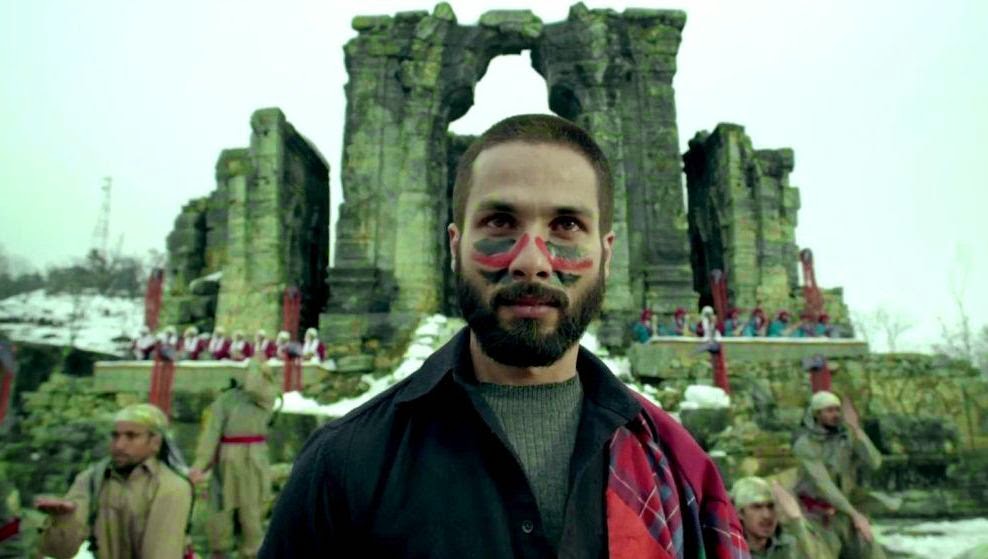
Innocence has betrayed him ; Haider’s hands are tied by the red scarf made by the innocent one.

He has been captured by the trickster, the two faced Janus – comic and now revealed to be cruel.

Two funny photographers with the same name are used to depict a two faced trickster.

The trickster working at the periphery of the state.

Periphery, the two photographers (the two Salmans) have not got ‘permanent’ posts yet, but serve.

They have once bestowed a favor – they came and took Haider away on a motorcycle, they took him away to safety.

Now, they are driving him in a vehicle owned by his enemy, they are taking him away to death.

He overpowers them, but after a scuffle, they escape.

Haider now picks up a stone and aims it at the (two) trickster(s). We see in the background that the landscape is full of stones. Hurled by those who had no other defence against the powerful state.

A stone for a bullet. And yet, the world took notice.

For the first time, India’s lack of capabilities to handle law and order situations in an appropriate manner came to light. Surely, firing is an out-of-proportion response for stone throwing, asked citizens.

For 20 years, the biggest threat to security forces was militancy, now it is these stones youngsters are hurling at the speed of 40 kms per hour said the Chief Minister. The age old form of dissent (probably inspired by the Palestinian Intifada) had worked.

To the world was presented a clear picture, literally a picture of who was the strong Goliath in this confrontation.

But back to Haider, and the landscape heaped with stones.

Then as if the stones have joined to become formidable, a big rock. And Haider uses this rock to destroy the cruel shape shifting monster.

We leave the scene with an image of stones, stones…

Beautiful, but strange..like the landscape of Kashmir, this tribute to the young men who risked the bullet to hurl a stone..

Just writing down my response to one scene in the film. The film is full of such scenes, making meaning – so many meanings. What an excellent screenplay by Basharat Peer (Curfewed Night) and Vishal Bhardwaj.

What it achieves – An unlikely adaptation of  Shakespeare’s Hamlet – Unlikely and effective. The setting so difficult, yet so believable.

Every little thing, every spoken word has a purpose, a meaning. Even simple lines of dialogue which may seem just ‘funny’ lines reveal insight. e.g- Haider is at a very low point. He is mentally breaking down. And his girlfriend asks him “kya haal banake rakha hain?” To which his quick and laughing retort is ask me “kuchch lete kyun nahin?” Those of you who were born then, do you remember the 80s Coldarin advertisement? This is 1995, and these two young people were are childhood friends.

They shared this dialogue, laughed about it, when they were children.

Also, those were happier times, easier times.

Now at a very difficult point in their life he calls that line from the past.

Also, for us, as audience – the writers are after all Vishal Bharadwaj who will not have anything purposeless, meaningless in his film, and Basharat Peer who has written Curfewed Night about his personal experiences as a child inKashmir.

He knows that History is not just what you find in textbooks. History is personal accounts. History can be what we experienced in popular culture at a particular time.

As audience we remember that ad – we see Haider remembering that ad.

We shared that experience.

This Kashmiri young man, and us.

The same ad is aired over a geographical location.

We shared it.

We are a part of the same history..

A political stand taken by the film- 

I will state it simply – Haider’s monologue about AFSPA is the politically bravest piece of writing that I have seen in film in a long time.

The ending – Even as he ‘hears’ his father’s voice calling for revenge, he also ‘hears’ another voice – his Grandfather’s saying that revenge only leads to more revenge. How can revenge make us free?

How can it give us Azaadi?

Speaking of the AFSPA, remember, when the present government had ruled out changes in the AFSPA?

There was a statement by the army chief which had hurt me then.

He called it an “enabling act” because he said “AFSPA gives Army additional powers to operate in an environment which is marked by very high degree of uncertainty and complexity and an asymmetric environment where you cannot differentiate between a friend and a foe as the terrorist merges with the backdrop and hides amongst the locals.”

A statement that I did not like and now a screenplay that has moved me. See how Kashmir was described?

“environment which is marked by very high degree of uncertainty and complexity and an asymmetric environment where you cannot differentiate between a friend and a foe”

The structure of the screenplay is Exactly that.

Uncertain,

Complex,

Asymmetric.

The screenplay Is Kashmir.

– Nadi Palshikar

haider-movie-wallpaper-26

There is a distinct smell of honesty in things which are fundamentally correct. You have got to love anything when it is done with utmost sincerity and no sluggishness. This is why we wait for Vishal Bharadwaj’s films and music. His latest offering is out, and we strongly recommend you get a taste of it. Here’s why:

So Jao – The eerie calm of a dark night perpetuated by heavy bass notes and a near mourning dead voiced ensemble consisting of Bashir Lone, Bashir Bhawani, Muzamil Bhawani, Mayukh Sarkar, Aalaap Majgavkar and others take upon themselves to scare the life out of us in this calm yet intense song. The singers might all be mourning but they are in perfect sync and you will find yourself reaching for the repeat button without a doubt. The sound of shovels attacking mother earth is impactful, to say the least. Top class!

Jhelum – Yet another dark song where the music arrangement is spread out. The magical electric guitar surprises you as it creates an atmosphere of contemplation. Vishal, helped greatly by the words from Gulzar, paints a picture of grief, the kind that will suck you and might make you sad, very sad. I might be thinking too much but then I feel the words ‘jhelum hua kharaa’ came out right from Gulzar’s heart as he reflected on the massacres he witnessed, during partition. That perpetual sinking feeling owes a lot to the wonderful Simaab Sen who has produced this song in the album. Vishal Bharadwaj doesn’t sing much in films. We wonder why.

Gulon mein rang – The thing with good poetry is that it can never be badly performed (unless of course, KRK decides to rap it). To make it even better, words have been modified and what’s better than to see Gulzar and Faiz in one song! We honestly didn’t expect much from Arijit Singh, (who is breathing these days with microphone attached to his throat) because we knew, the sound would be indistinguishable from most of his songs off late. I won’t say we were shocked and surprised with his rendition here. It is strictly average but the music arrangement takes it a notch higher, especially the hopeful note on which the song ends. Talking of this iconic kalaam, even Mohit Chauhan did it nicely here.

Ek aur bismil – With an adorable arabian touch and sufi setting, this version paints a fantastic belly dance setting in the mind. The clarinet in the song is exact and lends much richness to the song. Unlike the ‘bismil’ song (to which this song owes its title and tune) which has a podium/stage setting, this feels more intimate, street like and humble.

Do Jahaan – Call me an incurable romantic, but I cannot wait for Suresh Wadkar singing a ‘suresh wadkar वाला’ song. No, I don’t mean ‘totey udd gaye’ (ek thee dayan) sort of song. I mean ‘tere liye’ (7 khoon maaf) sorts. A lazy setting that somehow has become Vishal Bharadwaj’s forte along with Suresh Wadkar’s depth is something to look forward to. This song is exactly like that. An added bonus is to hear Shraddha kapoor’s voice which doesn’t sound processed and adds a ‘real’ feel to the song.

Aaj ke naam – After her fantastic ‘har ghadi’ in D-Day, Rekha Bharadwaj gives us a ‘by the tabla’ ghazal that has ‘tragedy’ written all over it. This is also a work of Faiz Ahmed Faiz. Vishal Bharadwaj quietly sneaks in gentle keyboard notes to give a contemporary feel to the overall setting. Since the ghazal talks of so much sadness (With the excellent use of ‘new’ words for hindi film songs like – ब्याहता), extreme caution is advised because it will leave you sad, very sad.

Khul Kabhi – Good things were said about this song by Vishal Bharadwaj himself in a recent interview on Radio Mirchi, Bombay. Perhaps what Vishal Bharadwaj didn’t estimate was the flood of Arijit Singh’s songs with whom we are playing ‘catch up’ on daily basis. This song is good and we couldn’t help feel that this should have been sung by Vishal Bharadwaj himself. No doubt that would have been the thought at the time of composing it. It is a ‘FVBV’ song all the way (For Vishal, By Vishal). Arijit is efficient and average at best, what is lacking is the exclusive, infectious feel that this tune and crazy romantic song deserved.

Bismil – The ‘stage’ song! With Sukhwinder, there is always a danger that perhaps he will sound too ‘sukhwinder’ and hijack the song. It doesn’t matter in this case because there is an army of excellent back up vocalists, and a ‘beyond awesome’ rabaab at work along with him. The song paints a dark picture of deceit with an upbeat tune. The lyrics give away everything there is to correlate with Shahid Kapoor’s anger in the film. These days when music composers take pride in saying ‘ये गाना डांस फ्लोर पे महिना भर बजेगा’ , here is a song which might become a hot favorite of people who are into stage dramas. The overall feel reminded me of ‘Sheher’ of gulaal which can also be re-created on stage with impact, if only some people are up to it. A thunderous song that gives you a feel of large auditorium. Kudos!

Aao Na – I feel Vishal Dadlani somehow saves his ‘year’s best’ when he teams up with Vishal Bharadwaj. While I still maintain that ‘Dhan te nan’ is his best, this song stands right next to it. The passion, drums and singing, all are just top notch. Did I miss anything? Oh yes, that bloody mother of a tune on guitar. I cannot write enough good things about this song. Double thumbs up!

Vishal Bharadwaj and Gulzar have given us a brilliant album that has right shades of dark, much like the background and context of the film. In a year that has been marred with too much trash and vomit inducing tracks, Haider is what leaves a lasting sweetness on our taste buds.

As Vishal says, क्या बात है!

– by @rohwit

A new Vishal Bhardwaj film is always cause for celebration. Even his weakest films have so much to savour, and in an industry so plagued by intellectual and creative bankruptcy, Bhardwaj is the rare filmmaker who could perhaps truly claim auteur status- he produces, directs, writes, composes- and does all of it with a style so distinctive and quixotic- there’s no mistaking his stamp. We’ve got to admit, we’re fanboys, and unashamedly so.

The much awaited trailer for Mr Bhardwaj’s new film ‘Haider’ has arrived along with a trio of posters. Haider is based on Hamlet and is the final film of his Shakespearean Trilogy (preceded by Maqbool and Omkara) and stars Shahid Kapoor, Tabu, Shraddha Kapoor and Kay Kay Menon among others (including Irrfan Khan in a special appearance).

Notably, Haider has been co-written with Kashmiri author and journalist Basharat Peer and also marks the filmmaker’s first collaboration with cinematographer Pankaj Kumar, who is best known for shooting Anand Gandhi’s Ship Of Theseus. Click here to read an interesting article about Peer’s collaboration with Bhardwaj.

Take a look at the trailer and posters and let us know what you think:


Rahi Anil Barve’s short film Manjha was talk of the town when Danny Boyle had announced that he would include this short in the blue ray dvd of Slumdog Millionaire. Only because he saw the film and loved it. And he did include it in the dvd. The film also bought to spotlight the talent of director Rahi Anil Barve and cinematographer Pankaj Kumar. Rahi’s feature film in the making Tumbad is already being talked about a lot. Pankaj got more recognition with Ship Of Theseus, and he has just completed Vishal Bhardwaj’s Haider. At MFC, we would like to say that these two talents are to watch out for. Mark our words, and mark this post.

Anyway, the short film is finally online. We had seen it long back. And it would have been great if it was available in better quality, at least to see Pankaj’s work. But since we don’t have it online, we are posting whatever we found online. Do watch.

dedh-ishqiya3

This is a strange scenario. I read review after review after review, every damn possible review of Dedh Ishqiya. Just to figure out one thing – to see if anyone has written about the homage scene in the film, and the inspiration behind the film’s spoiler, or scratched it beyond the surface. And i was extremely disappointed to see that not a single reviewer has mentioned it.

They didn’t get it?

They don’t know about it?

They haven’t read it?

Just because the director didn’t tell or it wasn’t mentioned in the press release?

Because, for me, that is the highlight of the film. The smartest scene in the film. And that *is* the film too. Strange. Seems like we are reading a group of philistines who have been raised on a limited staple diet and don’t know how to read a film beyond their radar. Not that such funny things has never happened in the past, but this should straight go to FunnyOrDie section. So which scene i am talking about?

SPOILER ALERT (Don’t read further if you haven’t seen the film yet and if you hate spoilers)

In the scene where both Naseer and Arshad’s hands are tied and they are watching Madhuri and Huma having fun, getting physical. Naseer looks at Arshad and says, Lihaaf maang le. Arshad looks up and smiles. And then we see just a big shadow on the wall which suggests physical intimacy between Madhuri and Huma’s characters. That’s the homage to Ismat Chughtai’s Lihaaf. The setting, Begum, homo-eroticism, huge shadow play – the elements and the incident is the same as in Lihaaf.

That’s not all, the entire back story of Madhuri’s husband is also from the same story. And the spoiler – their relationship and her back story is the core idea of the film. Rest of it has been just built up to cover this plot. So it can be called a really smart adaptation of the short story. Much respect for the writers of the film – Darab Farooqui, Abhishek Chaubey and Vishal Bhardwaj.

So why is it such a big fuss?

1. Because it involves Ismat Chughtai – one of the most eminent, progressive and feminist Urdu writers.

2. Because it involves Lihaaf (published in 1942) – the most popular and celebrated short story by Ismat Chughtai.

3. Because Lihaaf created a big controversy. Ismat Chughtai was charged with obscenity and was summoned by the Lahore court in 1944. She went to court, refused to apologise and won the case. Click here to read a funny excerpt about the case from her memoir. And if possible, do watch Naseer’s play on the same which also includes Manto’s trial.

4. And most importantly, because it’s still relevant. Chughtai’s story dealt with homo-eroticism and lesbianism which created a huge ruckus then. And today, when we are still debating gay rights and article 377 in India, a mainstream Hindi film brings the subject on the big screen with mainstream actors, and connects it so smartly to such an important and controversial literary work, and to its history. And we have no fucking clue! Lilaah!

Strangely, it seems most reviewers didn’t even get the historical, social, or literary context. If i was the boss, i would have surely asked for some explanation, rejection, and resignation. Because what’s the point of reviewing films if one doesn’t know where one is coming from – our art, culture, literature and such an important bit of history. It’s utterly shocking and baffling to say the least. It might sound extremely snobbish, but am fine with me being accused of snobbery than being philistine, especially when we are talking about Ismat Aapa and Bhardwaj’s cinema.

– You can find the English translation of the story here or here or in the embedded link below (translation by different writers). Do read. And do remember it was published in 1942.

– Found another adaptation on the net – a short film based on the same story

– If you were born and brought up in some other planet, Ismat Chughtai’s wiki page is here.

– To know what we thought about the film, click here.

NotSoSnob

dedh-ishqiya-movie-poster-20

Some of us got to see Abhishek Chaubey’s new film Dedh Ishqiya at a preview show last night. Here’s all the early preview buzz from the show.

https://twitter.com/NotSoSnob/status/420250065949982720

https://twitter.com/NotSoSnob/status/420251903021572096

https://twitter.com/NotSoSnob/status/420275289919217664

https://twitter.com/NotSoSnob/status/420275824202227712

https://twitter.com/NotSoSnob/status/420276604544090112

https://twitter.com/NotSoSnob/status/420277334470451200

https://twitter.com/NotSoSnob/status/420279271702024192

https://twitter.com/MihirBDesai/status/420275260970123264

https://twitter.com/varungrover/status/420433789731360769

https://twitter.com/varungrover/status/420436025735794688

So what are you waiting for? Book you tickets and go to VB-land, sit back, relax, and get in the mood of Begum Akhtar’s Hamari atariya. Let Abhishek Chaubey dazzle you with some poetry and beauty, guns and glory, hues and adventure. This is how you are suppose to do a sequel – it’s not just about cashing in on previous success, but about being brave and ballsy.

Last week i watched Kannan Iyer’s Ek Thi Daayan. It’s co-produced and co-written by Vishal Bhardwaj. And last night i watched Aparna Sen’s Goynar Baksho. And i could not stop myself from comparing the two. Apart from Konkona Sensharma’s spectacular acting, there are few more common factors between the two. Both the films are based on literary work. Ek Thi Daayan is based on a short story written by Konkona’s father Mukul Sharma. (You can read the story here) Goynar Baksho is based on Shirshendu Mukhopadhyay’s story titled “Rashmonir Sonadana”. So in a way one is Mommy’s film and the other one is Daddy’s. Though both are in supernatural space, in terms of what they deliver, the difference is huge.

Ek Thi Daayan is a strange film. Because it’s two films in one. Though it plays around with all the common elements of horror films in first half, it sets up a great mood, is deliciously ambiguous, and keeps you totally hooked. Konkona and the kids keep you engaged in their mouse and cat game. The 2nd half is drastically different – almost a Vikram Bhatt film. Everything is on the face, new rules are set, it’s silly, becomes unintentionally hilarious and has a strange closure. What is Kalki’s character doing in the film? She is just to misguide us? Is it all about who is the witch out of the two? It all boils down to one spoiler? There have been many rumours floating around about the film’s climax being changed by its producer, and once you watch the film you realise that all those rumours must have been true. There can’t be no other reason for the second half to be so disappointing.

Now, about the end. A wise man once said that you must ask yourself 3 Questions – 1. what’s the film about? 2. What’s the film *really* about? 3. What’s the film *really, really* about? If you know the answers, you are on right track. And the answers to these three questions tells you the difference between these two films – Ek Thi Daayan and Goynar Baksho – why one works and why the other doesn’t. Let’s see.

(SPOILER ALERT)

Magician Bobo can hear voices. Because he has a back story. Because his sister was mysteriously killed by his step-mom/witch. Interval. Bobo has a GF/wife. He also has a kid. A new stranger who might be a witch. BOOM! She is not the witch. The GF/wife is the witch. But why is Konkona suddenly back, and from where? What’s the sudden funda of pisach? And all that choti-wali ladayee? Why kill all ambiguity? Was there a way out in the same set-up? i think so. It was all there, just needed to be perfectly tied up like Konkona’s hair braid.

For me, the answer would have been Bobo’s adopted kid, Zubin. Going by the trend of orphan kids who get superpowers, he perfectly fits the demography too. We don’t know about his real parents. Aha, that’s where the magic and mystic happens. If you see the second trailer here (at 01:05), you will know that there was more to Zubin for sure. See the screenshot – Zubin talking to a doll (or Misha?) when Bobo spots him. This scene was not there in the film.

The film just used him for the choti-kaato act. Given a choice, i would have gone with Zubin getting some of the supernatural powers to hear/see daayans, something that connect Bobo and Zubin, and then a closure for Bobo’s story with him coming to terms with Misha’s (his sister) death in some way. I believe it was also there in the script – if the lift is going down, it’s going to hell. Can Bobo take the lift up to heaven for Misha? As for Lisa (Kalki’s character), isn’t she going to be step-mother for Zubin? When it plays around on the funda of sauteli maa acchi ho toh sakti hai par hoti nahi, isn’t Zubin in same scenario as Bobo? Aha, the loop.

(SPOILER OVER)

ETD2

And if there’s something more funnier than Vikram Bhatt style kaat-choti-kaat act, it was the disclaimer in the beginning of the film. Easy to understand that neither the makers nor the Censor Board is guilty of that. It’s because of the times we live in, where the fringe groups are always looking for such occasions to raise their voice and get attention. This is where Aparna Sen’s Goynar Baksho hits the ball straight out of the boundary.

On the surface it’s a story about three generations of women and their relationship with Goynar baksho (jewellery box). But Aparna manages to pack in so much, that it’s unbelievable. And treated it in a humourous tone, this one should work for all. In a memorable and heart breaking sequence in the film, Pishima (aunt in bengali, father’s sister), a child widow who has died and become ghost, asks Konkona Sen (new daughter-in-law) what sex feels like? Does she enjoy cuddling? In today’s times of offending sensibilities, this might be counted as quite sacrilegious. But this is where the bravery and the brilliance of the film lies – it packs everything with humour.

Pishima got married at 12 and was widow at 13. Forget love, relationship, or any such pleasure, widows were not even allowed to have good food. All she got was boiled veggies, all she wore was white sarees. It reminded me of someone i know closely. Married at young age, she had a son just after marriage, and then her husband died soon. She returned back to her parents and brothers. Since then it was been a life of white sarees, religious stuff and only vegetarian food. It’s actually quite a common sight in bengali families, mostly in rural areas – the eldest daughter who is married at young age and if she becomes widow, she comes back to her parents and stays with them for the rest of her life.

Moushumi Chatterjee plays the role of Pishima, an authoritative voice in the house. Because she owns those expensive jewels, nobody wants to be in her bad books. But the fun begins once she dies and becomes a ghost. Interestingly, only Konkona’s character of Somlata (new daughter-in-law) can see her. She is new in the house, she is scared and to make things worse, she even stammers. With a hookah in her hand and more abuses that you can count, initially Pishima starts bullying Konkona to protect her jewellery box, and then slowly they develop a bond. Pishima is bitter, sarcastic and is always cursing everyone around, but all done with dollops of humour in her Faridpur accent. Her dead character is the life of the film.

Goynar Baksho

In another sequence she gets emotional as she talks about how the men in the house always had all the pleasures, and all she got was this jewellary box. The (pishima) ghost played brilliantly by Moushmi Chatterjee, instigates Konkona’s character to go out, fight for her rights, to pursue her passion and enjoy everything that’s forbidden. Who talks about heaven and hell? As a ghost she knows it better than everyone. Enjoy till you can and then your body will perish one day.

Konkona’s character of Somlata represents the second generation. She is on the other extreme compared to her Ek Thi Daayan role. Set in a completely rural background, instead of scaring others, in this film she is always scared. And like in almost every other film of hers, she is so convincing that you would think she has a twin sister who acted in ETD. She is undoubtedly the best actress of our generation. The last 15mins of the film feels bit odd but you get what the filmmaker is trying to do – the third generation. You can also see the limitation of budget and resources, but this one is a must watch.

The film has released with subtitles in Mumbai and other cities. Though the subtitles might not be able to translate the fun of Faridpur accent but do watch it. Bollywood desperately needs some funny ghosts. And Vikram Bhatt needs to put his tacky ghosts in his closet for sometime.

So in two weeks we had two supernatural stories – one with mysterious witches and the other with loveable ghost. Both with three leading ladies. For whatever reason, one remains a half-baked affair, the other manages to pack a punch. One doesn’t say anything new, the other takes a strong stand on so many issues without making a big fuss about it. And it all comes from the same family. I guess in the end it’s all about the *choices* – we are the stories we tell.

@CilemaSnob

(PS – To make life bit simpler, now you don’t need to fill in all the details to post comments. If you are already logged into Facebook or Twitter, just log in with your FB/T account. Click on comment box, you can see the small (FB/T) icon below the comment box, click on FB/T, a pop up will appear, authorize the app and you are done)

MKBKM

Vishal Bhardwaj is a disturbed man.

At least that’s what it seems. And that’s a good starting point. Filmmakers and artists should feel disturbed by their environment. Great art always comes out of that disturbance. So while rest of the bollywood seems to be living in Tumbuktoo with no connect to the issues that matters, and want you to remain equally stupid, blind and deaf with their corn-cola-crap combo, Matru Ki Bijlee Ka Mandola is Vishal Bhardwaj’s first reaction to the changing world around us.

At a recent presser, Bhardwaj said that wo jo ugly malls…meri saansein aani band ho jaati hai wahan…uske andar…wahan ke shor se. As i watched the film where Pankaj and Shabana talk about his dreams on a hill top with dark clouds hovering over them, and a surreal sequence involving giant cranes, industries and malls comes up, it was eerie (wish they had avoided those tacky interior shots of the malls though). That’s the core of this whimsical film by Vishal Bhardwaj – development at what cost?

Land.

That doesn’t feature in our dictionary. The ones who are born and bought up in city never knew that it existed. We, the kids of small towns who moved to smaller houses in bigger towns, used to hear about it from our previous generation. Now, we are either comfortably numb, or understand the size of 1BHK – space is our only connect with “land”. And in this scenario, it’s quite easy to understand how difficult and daring it is to make a film like Matru Ki Bijli Ka Mandola. Land, farmers, farming, rainfall, pesticides, gobar, anaaz, anaaz ka bhav – they don’t exist in our films anymore. Not that it deserves all the credit just for the dare act.  But, then, the industry and this country doesn’t understand “satire” either. We are still stuck at Jaane Bhi Do Yaaron. Even on the day when the film is out, the makers are selling it as “massy comedy drama”, like they did with the trailer and tried to hide the film. Massy comedy drama? Paincho paincho!

And that’s the tragedy of Vishal Bhardwaj and his films – audience. Maybe the blame lies with him too. Intention is always honest, filmmaking is always top notch, but he wants big budgets. Big budgets means only one thing – big stars. Doesn’t matter if they can act or not. With big stars and big budgets, you need the big box office numbers too. So? Package it as “vitamin ki goli“, or massy comedy drama, as they would like you to believe.

Last time when he made a film without any compromise, he delivered two of the best films of his career which are classics in more than one way – The Blue Umbrella and Maqbool. Since then it’s always been a slippery ground. This balancing act is a tough business. Emir Kusturi-ca’s absurdity is full throttle. Bhardwaj’s absurdity is bollywoodised where every solution lies in hero-heroine ki shaadi. Some of the best cinema across the world never looks for solutions, and trying for a quick fix is unpardonable. Problems/issues – that’s the muse of a true artist. And this is what i found completely indigestible in Matru – how suddenly everything comes together in the end. Maybe they meant it’s “massy comedy drama” by its climax. Aha, the trappings of commerce when the film has an anti-commerce stand. Irony! And watching this film funded by a corporate giant in a multiplex inside a mall. Irony ka baap!

But other than its hurried and hotchpotch climax, the film has so much more to offer and is deliciously wicked. Sit back, relax, and chew it bit by bit like Gulaabo does. This one needs jugaali. (i hope you know what it is) Make sure you watch the film in a theatre which has good audio system. Miss one line and you will miss the joke. But wait, if your idea of being funny is 50 plus actors making faces on the tune of pon pon, this movie is not for you. Call it quirky, whimsical or absurd, i wonder if Mao and moo moo will ever get together in one film. Or you can just buy some species because you like their music. Or a Gulaboo bhains in such a pivotal role. It’s Cattle-ship Communism!

The story is simple – man has a daughter. man has a servant. daughter has a lover with a corrupt mother. It’s a hindi film and so you know the end. In the illustrious filmography of Bhardwaj, this is his first political film. i remember an interview of his where he said script aapko nanga kar deti hai…aap kya sochte ho, wahan sab dikhta hai. And if that’s so, am happy to tell that one of my favourite filmmaker looks smart even when his soch is stark naked. He makes other filmmakers of his generation who are still busy doodling with matters of heart, look like nursery kids. Paincho, ab toh duniya dekho! 

And hand over all, i mean ALL the trophies to Pankaj Kapur. A slur here, a sigh there, a blank stare in this direction – this actor is pure delight on screen. He owns it and how! Forget his Jekyll and Hyde avatar, he is 100 times the Jekyll hidden in one Mr Hyde! The film belongs to him and it’s no wonder that Bhardwaj calls him his most favourite actor on this planet. It’s been ages since an actor made everyone look like lilliput. Even if nothing interests you, just watch the film for him. Actors of his age are put in a bracket called “character actors” in this country and you never know when someone like him can get another terrific role like this one and will do full justice to it. Shabana Azmi is the Politician-who-licks-Lollypop and is a perfect match for Kapur as his footsie partner. And like any other Bhardwaj film, this one also has the entire supporting cast setting up a great ambience and a distinct world where the story unfolds. Any film which has great performances by actors in small roles, or even just for one dialogue – that’s my kind.

Book your tickets now!

– by @CilemaSnob

(PS – Dear VB, why this big dhokha this time?)

Matru Ki Bijlee Ka Mandola

This is weird. Don’t remember Vishal Bhardwaj mentioning about the Brecht’s play, Mr Puntila and his Man Matti, in any of his interviews. But the basic plot seems to be quite similar.

To quote from wiki page of the play

The story describes the aristocratic land-owner Puntila’s relationship to his servant, Matti, as well as his daughter, Eva, who he wants to marry off to an Attaché. Eva herself loves Matti and so Puntila has to decide whether to marry his daughter to his driver or to an Attaché, while he also deals with a drinking problem.

 In his essay “Notes on the Folk Play” (written in 1940), Brecht warns that “naturalistic acting is not enough in this case” and recommends an approach to staging that draws on the Commedia dell’Arte. The central relationship between Mr Puntila and Matti—in which Puntila is warm, friendly and loving when drunk, but cold, cynical and penny-pinching when sober—echoes the relationship between the Tramp and the Millionaire in Charlie Chaplin’s City Lights (1931).

Now, if you have seen the trailers of MKBKM, it’s easy to guess the basic plot. To quote from its IMDB page

Harry is an industrialist who loves his daughter Bijlee, and the bond they share with Harry’s man friday, Matru. Bijlee’s plan to wed the son of a politician, however, brings twists and turns in the lives of Matru, Bijlee and Mandola.

Though the IMDB synopsis might not be accurate but one thing we are sure about – Pankaj Kapur’s character trait is the same as Puntila in the play. And as mentioned in the wiki page, City Lights is on similar tangent.

Also, if you see the title of the play and the film, both swings the same way. And as a friend mentioned on twitter, VB’s love for giving subtle hat-tips in names/titles is not really new – Iago/Tyagi, Desdemona/Dolly etc.

So what’s the real deal?

If the film is an adaptation of the play or even the basic idea is the same, why is Vishal hiding it? Especially when he is known for doing great adaptations. If not, what are we missing? Enlighten us please! Otherwise friday is not really far.