Author Archive

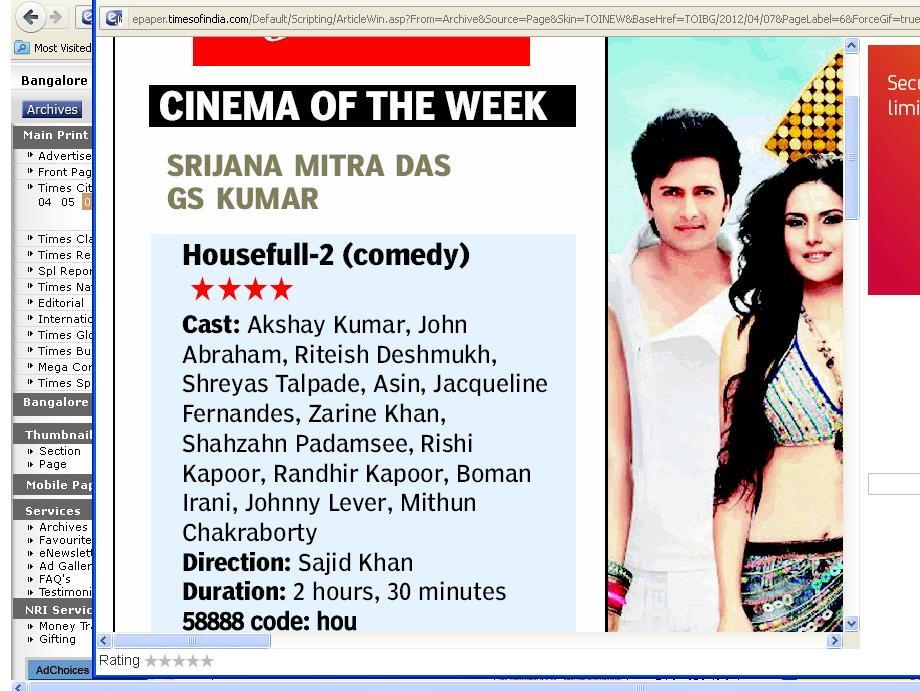
Times of India’s film critic Srijana Mitra Das has given 4 stars to Sajid Khan’s Housefull2. Who is this enlightened soul? Someone please introduce us to him/her. Seems like a bong. And a bong with such unique taste in cinema must belong to some rare tribe. Anyway, if the 4 stars weren’t baffling eough, there’s more to the story. Take a look at this pic.

This is the Bangalore edition of TOI. Have taken a screengrab of the review page. Reviewer is the same Srijana Mitra Das and rating is 4 stars. Now take a look at this next pic.

This screengrab is from the Chennai edition of TOI. Again, reviewer is the same Srijana Mitra Das. But the rating is 2.5 stars. Who ate up my 1.5 stars?

Same film, same reviewer, same newspaper but two editions and two different ratings.

WTF!

Who writes the reviews? Who gives the ratings? Does Srijan Mitra Das really exist?

CAN SOMEONE PLEASE EXPLAIN THIS TO US?

Tip – Yashpal Singh/Dhanya Rajendran

Two weeks after its release, trade analysts have announced that it’s a flop. Even critics didn’t like it. Most rated it either 2 or 2.5 stars.  I have always believed that hit or flop doesn’t matter much. As long as you deliver a good film, you will always get a chance to make few more. Imtiaz, Dibakar, Anurag, Sriram – all belong to the same club. Their debut film hardly made any money. Paanch didn’t even reach the theaters. Nobody saw Socha Na Tha when it released. And Khosla Ka Ghosla was almost in the coffin before it got a new life.

I remember talking to Sriram after the release of Johnny Gaddar. Trade analysts had already given a Flop tag to it. He said, in the last four-five days Neil (Nitin Mukesh) has got about 30 offers and nine people have called me asking me to make films. If this is flop, then we want more flops like that.

And that’s what i meant by delivering a good film.

For many of us, Agent Vinod was one of the most anticipated film of the year. You can put some of the blame on burden of expectations. But if we can’t expect a good film from Sriram, then where do you go? With Ek Haseena This and Johnny Gaddar, it was easy to spot the distinct directorial stamp of Raghavan and a taste for thriller stories with some priceless quirks, kinks and bit of nostalgia. So what went wrong with Agent Vinod?

Anyone who knows Sriram Raghavan (SR), can tell you how much effort he puts in his films. The number of rewrites he does and how he is never satisfied. When it comes to making movies, you can never doubt the man’s intention and integrity. So when John Abraham and Aishwarya Rai were ready to do a film with him, and he said he doesn’t have a script ready yet, the industry was surprised. You have the stars and you don’t have the script? Nobody had heard that excuse before. You don’t need a script when you have stars. Let the  stars say yes and you can fill 120 pages in 2 hours – that’s the norm here.

Thanks to some good souls, i had managed to read the script of Agent Vinod much before i saw the film. My initial reaction was it’s great fun. Starts with a bang. But bit ambitious and all over the place.

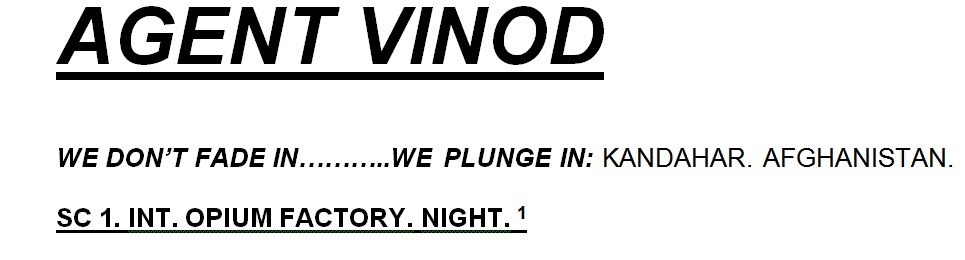
My reaction after the film – where’s all the fun gone? Some good stuff in bits and pieces. It started with a bang but not the one i saw when i read the script. Except for that opening scene, it never “plunges in”. Ambitious and really all over the place. And at a time when we are so used to that adrenaline rush with Bond, Bourne and Ethan Hunt, Vinod seems to be just a freshman out of college.

Agent Vinod packed in too much but it offered too little.

Excess is the reason, i believe. Too many places, too many characters, too many locations, too long, too hotchpotch and too little payoff. And it’s over-written. But that’s not the only reason. Let me rewind and go back to the script and film again.

—> Tone/treatment – That was my biggest issue with the film. I could not make out whether it wanted me to take it like a comic book Bond film or a realistic setting like a Bourne one. The mash-up just didn’t work. Baradwaj Rangan has written about the same in his review. Click here to read. But while reading the script, it seemed completely serious.

—-> Villains – How can you take Prem Chopra, Gulshan Grover or Ram Kapoor seriously? Really? They are so overexposed and are part of the pop-culture now where they exist as characters and not actors. That’s one of the reasons why Adil Hussain works much better compared to others as he is not exposed in the mainstream space. And please don’t dare to cast Dhirtiman Chatterjee as the main villain after Kahaani and AV. You will see him and you get the drift.

—–> Thrill Pill – Now that i look back i don’t remember any sequence that gave me any kind of adrenaline rush. The opening sequence was good, raabta as a single shot sequence and the intercut between Vinod and Prince’s fight in Morocco & Chennai had a stamp of brilliance. But when i have seen Ethan Hunt’s stunt on Burj Khalifa, i have tasted blood. Though the script mentions many action sequences from various films for reference purpose, it hardly manages to create anything similar on screen.

—–> The Big Picture – While discussing the film, a friend suddenly asked, so what was that killing of the man while he was jogging? Remember? Who was he? Even i was lost. Just could not figure it out. What was the connect? Then i came back and went through the script and i realised that Jimmy kills him and takes his identity – Dr Suresh Krishna who works with UN, so that nobody will doubt him. Is there anything else am i missing? If not, do you really need the track? Suppose Adil handed an id to Jimmy saying, you are now blah blah, we would have blindly accepted it. When they have such a huge racket, we will accept whatever is said. Same goes for the entire sequence between Kareena and the Airport officer which i thought was a complete waste. Meeting him, going out with him, spending time with him, going to that hotel and doing the dance number. Ok, some dose of nostalgic fun with o meri jaana maine kaha. But if you remove the entire sequence and we see Adil handing over the airport security card saying this is for your entrance, we would have believed that also. (Strangely Rangan mentions the airport officer as a goon in his review 😉 ) Interestingly, Raghavan connected many small dots together (Remember the camel? I thought why? And then the password) but when you see the big picture, do these two sequences really matter? They seem unnecessary which eats up precious screen time. And there are few more like that which could have been edited out to make the film shorter. What it needed was some ruthless editing on paper.

—-> Such A Long Journey – For everything where it was possible to go directly from A to V, Raghavan goes from A to Z to P to M to B to few more destinations before he reaches V. And just for the sake of it. Sometimes the journey is fun but it gets tiring and boring after a point. Like i remember Raghavan talking about the sequence in Russia. He said he wanted snow in the coffin and he got that. But do you remember what was that sequence for? Try.

In the end, it seemed too dumb for smart people and too smart for dumb. Neither the critics appreciated it, nor it could be in the 100-crore club. The single screen audience didn’t get it, the multiplex audience have Bond, Bourne and Ethan. I am all for indulgence and homages as long as it doesn’t bore me. If filmmakers and artists don’t indulge, who will? The sarkari babus?

As for the good points, Sudhish Kamath has mentioned it his review here – a spy so suave he can even pick up a guy. And as Anupama Chopra mentioned in her review, i do believe that this character has potential. Sooner or later, Raghavan will get it right.

The much anticipated trailer of Dibakar Banerjee’s Shanghai is finally out. Have a look.

So far Dibakar’s record has been cent percent – 3/3. Will he deliver once again? Going by the trailer, it surely seems so. But then, political films are a different beast.

SEZ, activism, murder, accident, conspiracy theories and the mess and madness kicks in. And then a ball drops in – yeh khelne ki jagah hai kya? Aha, that Dibakar touch. So refreshing to see Emraan Hashmi getting out of his comfort factor and doing it without anything remotely sufiyana. Wouldn’t be surprised if he overshadows Abhay Deol. And Kalki looks perfectly vulnerable.

Strangely, the text doesn’t mention Khosla Ka Ghosla. It says “from the director of Oye Lucky Lucky Oye and Love Sex Aur Dhoka”. Why would you not mention KKG?

Kasam khoon ki khayee hai….yeh shahar nahi Shanghai hai – Ok, am sold. Now bring it on.

Writing credits include Urmi Juvekar and Dibakar Banerjee and unlike others it mentions the book Z by Vassilis Vassilikos.

At the end of it the only thing that doesn’t sound convincing is the title – Shanghai.

WHAT:  Following the template of the world renowned Sundance Institute Screenwriters Lab, that is held at Park City, USA, the Indian Screenwriters Lab is a five-day writer’s workshop that gives independent screenwriters the opportunity to work intensively on their feature film screenplays with the support of established screenwriters. Mumbai Mantra has collaborated with the Sundance Institute and established India’s annual Mumbai Mantra | Sundance Institute Screenwriters Lab.

Project Selection :

—> 6-8 projects shall be selected for the Screenwriters Lab. All Indian nationals as well as Indians living overseas, people of Indian origin and mixed Indian parentage are eligible to apply.

– Only those who are working on their first or second feature film project shall be eligible. However, they may have worked on documentaries, shorts, advertising films in the past

– The screenplay can be for a film in any Indian language including English. However, the application must be in

– English, as it is the medium of communication at the Lab.

– Incase there are two writers working on a a screenplay, or a writer-diretor working together on a project, both would be invited to the Lab if selected.

HOW : All you need is 1. A synopsis 2. First five pages of your screenplay 3. An artistic statement 4. A cover letter for the first round.

ADDRESS :   You have to send your submission via post. Materials will NOT be accepted electronically.
Mumbai Mantra | Sundance Institute
Screenwriters Lab Application March 2013
Mumbai Mantra Media Ltd.,
Mahindra Towers, 5th Floor, Worli, Mumbai-400018.

DATE : Last Date for Open Submission: June 2, 2012.

– Date for submission of Complete Draft of Screenplay (next round) shall be informed later to selected candidates.

CONTACT :  If you have any more queries related to Mumbai Mantra| Sundance Institute Screenwriters Lab 2013, you can contact them at labqueries@mumbaimantra.com

– For more info on the lab, selection process and all other details, click here.

The first poster of the much anticipated film of Dibakar Banerjee, Shanghai, is out.

The film stars Emraan Hashmi, Abhay Deol, Prosenjit Chatterjee and Kalki Koechlin.

Bedabrata Pain’s directorial debut Chittagong is finally ready for release. The film will have its world premier at IFFLA fest. The makers have just released a new poster of the film. And it looks good.

And here’s the synopsis according to the official release…

To say that 14-year-old Jhunka Roy’s life was about to change would be an understatement. Set against the beautiful forests and villages of Chittagong, a youth movement was underway, leading up to a drastic revolution. Based on true events in British occupied India of the 1930s, a group of untrained school youth handed the British their first military defeat. Led by a schoolteacher, local villagers and school children showed the power of mass resistance over colonial oppression.

Bedabrata Pain’s directorial debut is a coming-of-age tale of triumph, sacrifice and love, as a young boy’s determination sets the course for an entire nation’s freedom. This progression is what would later spark the first mass peasant movement in India, with the help of Jhunka Roy.

Credits include –

Director: Bedabrata Pain. Producer: Bedabrata Pain
Screenwriter: Bedabrata Pain, Shonali Bose
Cinematographer: Eric Zimmerman
Editor: Aldo Velasco
Music Composer: Shankar Mahadevan, Eshaan Noorani, Loy Mendoza
Cast: Manoj Bajpai, Vega Tamotia, Nawazuddin Siddiqui, Barry John and Dibyendu Bhattacharya.

Bit bored and tired today, so just copy pasting the release.

Unlike a few years ago, filmmakers today readily and repeatedly admit that without a good script, a good film is impossible. In fact, talent hunts and script contests are announced every other month. Every producer and studio is on the lookout for good scripts and competent writers.

While writing well is hard work, a sound knowledge of basic storytelling principles combined with an understanding of the form & rhythms of the screenplay help free up the writer’s imagination. This gives him the confidence to follow his intuition, helping him uncover interesting aspects of the characters, which in turn make the screenplay more nuanced, fresh and engrossing.

The Workshop will tackle all aspects that go into the construction of a script, starting with the basic central idea that drives the story.

Five intensive days of six hours each will cover the entire journey of the script from theme, premise, character, and plot, to structure, scene construction, and dialogue, and the use of music and song in Indian script. Plus, there will be a substantial session on mythology, with particular reference to the Ramayana and the Mahabharata which have had such a lasting influence on Indian cinema. The final session will deal with writers’ rights, model contract, copyright matters, and other professional issues.

Questions like

  • What makes for a compelling idea?
  • How does one know if a story could make a good script?
  • Can a great story turn into a weak screenplay?
  • How does one figure out the appropriate structure for a script?
  • What makes for an interesting character?
  • How can one write scenes that are crisp, compact and yet dramatically meaty?
  • Is there a technique to writing good dialogue?
  • What is the difference between Hollywood style of screenwriting and what we have here in India?
  • How relevant is the navras theory to modern Indian screenwriting?
  • What is the relevance of songs in modern Indian script?

and other relevant concerns of the Indian screenwriter will be discussed in depth.

About the Workshop Instructor : Anjum Rajabali has been a professional screenwriter for 20 years with films like Drohkaal, Ghulam, The Legend of Bhagat Singh and Raajneeti to his credit. He is the Head of Screenwriting at Whistling Woods, as well as Honorary Head of Screenplay Writing at FTII, a course that he began in 2004. Apart from being a script consultant on several films, he also conducts workshops and seminars on screenwriting in India and abroad.

According to him, “Screenwriting is an exceedingly interesting and rewarding craft. Learning it should be an enjoyable process. It is with that aim that I conduct screenwriting workshops.”

Three Guest Faculty will be invited from among Vishal Bhardwaj, Jaideep Sahni, Sriram Raghavan, Shridhar Raghavan, Saket Chaudhury.

Venue :  Whistling Woods International, Film City, Goregaon (E), Mumbai.

Dates :  April 25-29 (both days inclusive)

Timings : 10 AM – 1 PM and 2-5 PM

(Film viewing : 5.30-8 PM, April 25, 26, 27)

Fee : Rs. 6000/- (inclusive of lunch and tea/coffee on all days)

– The workshop is open to all.

– To Register for the workshop, please call 30916003 or e-mail: kanchi.parikh@whistlingwoods.net

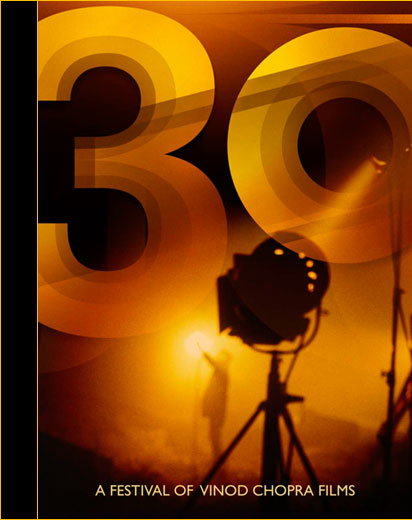
To celebrate 30 years of making cinema, Vinod Chopra Films is having a retrospective of its films at PVR Cinemas. From 29th March to April 4th, VCF is showing almost all its films, from Sazaaye Maut to 3 idiots. Check out your local listing or you can check out PVR’s website.

– The films have also been digitally restored and their sound has been re-done in 5.1 Surround Sound.

– Screenings will be followed by discussions moderated by well-known filmmakers at PVR Juhu, Mumbai.

Here’s the schedule for the panel discussion –

1. 30th March – 5.30 – 6.30 pm : Discussion on Parinda.

Moderator – Anurag Kashyap and Sudhir Mishra.

Director : Vidhu vinod Chopra.

Cast – Anil Kapoor, Jackie Shroff, Nana Patekar, Anupam Kher, Suresh Oberoi

2. 30th March – 7 – 8 pm : Discussion on Parineeta.

Moderator – Sujoy Ghosh.

Director : Pradeep Sarkar.

Cast : Vidya Balan, Raima Sen, Dia Mirza

3. 31st March – 7 – 8 pm : Discussion on Munna Bhai MBBS + Lage Raho Munna Bhai.

Moderator – Sriram Raghavan.

Director – RajKumar Hirani.

Cast – Sanjay Dutt, Arshad Warsi, Boman Irani, Dilip Prabhavalkar.

Screenwriter – Abhijat Joshi

4. 1st April – 7-8pm : Discussion on Khamosh.

Moderator – Rohan Sippy.

Director – Vidhu Vinod Chopra.

Cast – Shabana Azmi, Amol Palekar, Sudhir Mishra

5. 2nd April – 7-8pm : Discussion on 1942 – A Love Story.

Moderator – Imtiaz Ali.

Director – Vidhu Vinod Chopra.

Cast – Anil Kapoor, Jackie Shroff, Manisha Koirala, Danny Denzongpa

6. 4th April – 7-8pm : Discussion on 3 Idiots.

Moderator : Ram Madhavani.

Director – RajKumar Hirani.

Cast – Cast -Aamir Khan, Sharman Joshi.

Screenwriter – Abhijat Joshi

And here’s a nice video feature on VVC films

WHAT: IMAGING CINEMA 2012: An International Screenwriting and Filmmaking Course

DATES:  1-10 JUNE  2012

VENUE: IIT Madras

Resource people :

▪    Atul Tiwari (Mission Kashmir, Dasavataram, Viswarupam, forthcoming with Kamal Haasan)

▪    K Hariharan (Director, LV Prasad Institute of Film & Television Chennai)

▪    Rohan Sippy (Dum Maro Dum, Bluffmaster,  Taxi NO 9211, Kuch naa  kaho, The President is Coming)

▪     Shridhar Raghavan ( Screenwriter: Khakee, Dum Maro Dum, Apaharan)

▪     Sriram Raghavan (Director: Agent Vinod, Johnny Gaddar, Ek Haseena Thi)

▪     Anurag Kashyap (Dev D, No Smoking, Gulaal, That Girl in Yellow Boots, Shaitan)

▪     Patricia Gruben (Director, Praxis Screenwriting Programme, Simon Fraser University, Vancouver)

 COURSE :

Hands on training with experts in screenwriting and discussion of mechanics of screenwriting and direction with major industry figures.

– The course will be divided in four parts-

1. THE MAGIC OF CINEMA – This capsule in the first 3 days will introduce the participants to the magical world of Cinema, by making them go through a FILM-APPRECIATION module. How to read a film is the basic theme of this section.

2. THE MECHANICS OF CINEMA – This section for next two days will introduce the participants with the mechanics that goes into making a film including Camera, Lighting, Sound, Sets, Editing, Special Effects etc- to demystify and tell how the magic is created.

3. THE METHOD OF CINEMA– This section will introduce the participants to the most basic & important aspect of any film – the Blueprint, the Map, the Method behind the madness – THE SCRIPT. This will go on for next 4 to 5 days and the emphasis will be to make the students WRITE scripts and to dissect and discuss their work in class. It will be a group exercise where a group of 4-5 students will work together on mini-scripts to understand the process of film-script construction. At the end of this the groups will be ready with one short 3-5 minute executable script.

4. THE MAKING OF CINEMA – For Next 2 days – this will be very interesting hands on exercise with the students,  where they will have to shoot, act, record sound, edit, do post-production and be ready with their films within 48 hours. Candidates can bring their video cameras or use cell phone cameras.

5. THE MAJESTY OF CINEMA – The last day will be a ‘red carpet’ event where the films made by the student groups will be seen by all. A jury will then rate them and announce the AWARDS to the films – with
analysis – so that this too is a time to learn. The certificates will be given to all at the end of the event.

– An IIT-M CERTIFICATE OF PARTICIPATION WILL BE GIVEN AT THE END OF THE COURSE

Fee structure:

▪  Rs 10,000/ for professionals

▪  Rs 9000/ for attendees of 2009 & 2010 events

▪  Rs 8000/ students with valid ID and documents

$250 for NRI’s and International Students/professionals.

Last date of application : April 30

Application Forms can be dowloaded from Application form IIT Madras Screenwriting Filmmaking Course

– Limited rooms available in IITM guest house (AC), based on the date of applying.

– Few rooms available in hostels (Non ac).

– The course fee does not include accommodation payment.

– Application form duly filled in can be mailed to : draysha@iitm.ac.in

– For daily updates, visit www.imagingcinema.wordpress.com

It was supposed to be Mallika Shehrawat’s international debut. The director had a world famous surname – Lynch. But by the time the film got released, the director, Jennifer Lynch claimed that she didn’t make Hisss. She was nowhere in sight too. During the release, it was Mallika and her good friend Govind Menon (director of Khawish, Kis Kiski Kismat, Bachke Rehna Re Baba) who handled everything. So what really happened? Did she quit or was she forced to? And if so, why and how?

A new documentary, Despite The Gods, seems to have all the answers. Penny Vozniak’s making-of documentary will premiere at HotDocs in Toronto.

Here’s the description from the official release..

Upscale Font Jennifer Lynch, daughter of cult film auteur David Lynch, made her auspicious directorial debut in 1993 with Boxing Helena at the Sundance Film Festival. A box office disaster, the film was viciously mauled by critics and became the focus of multiple lawsuits. Fifteen years later, a recovering addict and hard-working single mother, Lynch returns to the director’s chair with an ambitious project that will test her skills and the entire crew’s sanity.

Despite the Gods brings us behind the scenes on the set of Lynch’s Bollywood/Hollywood action film about a man-eating snake goddess. Out of her depth shooting on location with an Indian crew and two top Bollywood stars, Lynch turns her production into a vehicle for her own self-actualization, paying no regard to timeline, budget or reality. As the story in front of the camera derails, the story behind the camera explodes.

And the trailer. Do watch.

Via Slashfilm