KAUFMAN - "Or cramming in sex, or car chases, or guns. Or characters learning profound life lessons. Or characters growing or characters changing or characters learning to like each other or characters overcoming obstacles to succeed in the end. Y'know ? Movie shit."
Kaufman is sweating like crazy now. Valerie is quiet for a moment - from "Adaptation".
We are all about CINEMA. That movie shit.
NOTHING is sacred.
NOBODY is spared.
Because we talk about films, dammit.
Not your sex life.
Films, fests, unsung, indies, undiscovered - all that and some fun. If you have dope on anything related to cinema or you would like to share something, do write to us at moifightclub@gmail.com.
The views, opinions, reviews, articles, or positions, expressed by the authors and those providing comments are theirs alone, and do not necessarily reflect the views, opinions, positions or strategies of ANY OF THE EMPLOYERS, FRIENDS, RELATIVES, PR agencies, Production houses, Media group and such third parties associated with the authors. The latter make no representations as to accuracy, completeness, currentness, suitability, or validity of any information on this site and will not be liable for any errors, omissions, or delays in this information or any losses, injuries, or damages arising from its display or use.
In short, if you have an issue with us or any post we've written, write to us at moifightclub@gmail.com
Like in the last few years, Rajeev Masand has done a series of roundtable discussions this year too. And the one which has the best panel and which interests us the most is the directors roundtable. This one had Vishal Bhardwaj (Haider), Rajat Kapoor (Ankhon Dekhi), Vikas Bahl (Queen), Imtiaz Ali (Highway), RajKumar Hirani (PK) and Abhishek Varman (2 States).
As we have done in the past, this year too we are trying to source the scripts of some of the best films of the year. As most of you know, the scripts of Hollywood films are easily available online, even the unreleased ones. But we don’t have any such database of Hindi or Indian films. So that has been the primary reason for this initiative. And it has been possible only because some of the screenwriters and filmmakers have been very supportive about it. It’s only for educational purpose and much like the spirit of the blog, is a complete non-profitable exercise.
To make an impressive debut is a difficult task. To follow it up with a sequel, and to deliver better than the first, that’s almost impossible. And Abhishek Chaubey managed to score on both counts. While Ishqiya was all rustic cool, Dedh Ishqiya was rich in tone, mood, texture and poetry, that also had Begum Akhtar, Ghalib, Bashir Badr and a delicious homage to Ismat Chugtai. All these in a bollywood film loaded with dialogues in pristine Urdu? what a beauty, what a rarity!
So thanks to Vishal Bhardwaj and Abhishek Chaubey, we are sharing the first draft and the shooting draft of Dedh Ishqiya.
Do click on the “Scripts” tab on the top right corner of the blog page to access all the other scripts (Queen, Ankhon Dekhi, The Lunchbox, Shahid, Kai Po Che, D Day, Lootera, Kahaani, Ek Main Aur Ek Tu, Agent Vinod, Dev D etc) that we have posted here so far.
(PS – As a writing exercise, do check out the notes about the climax in the first draft before they managed to resolve it)
(For more from our “Rewind 2014” series : Musical Gems We Discovered This Year is here, Kaali Zubaan’s bollywood wrap is here, 18 Film Fanatics on 18 Films That Stayed With Them is here, Songs We Played In Loop is here. In Best of 2014 – Script of Queen is here, Script of Ankhon Dekhi is here)
As we have done in the past, this year too we are trying to source the scripts of some of the best films of the year. As most of you know, the scripts of Hollywood films are easily available online, even the unreleased ones. But we don’t have any such database of Hindi or Indian films. So that has been the primary reason for this initiative. And it has been possible because some of the filmmakers have been very supportive about it. It’s only for educational purpose and much like the spirit of the blog, is a complete non-profitable exercise.
Rajat Kapoor’s Ankhon Dekhi is easily one of the best films this year. It has made it to the top of the year end list of many critics, filmmakers and our post too. Rajat has always been known for writing and directing unusual and interesting stories. But this time, the film really went beyond just the interesting premise. So here’s the script of Ankhon Dekhi in our “Best of 2014” list.
Thanks to Rajat Kapoor for sharing it. We have Ankhon Dekhi’s script in its pre-shooting original draft.
Do click on the “Scripts” tab on the top right corner of the blog page to access all the other scripts (Queen, The Lunchbox, Shahid, Kai Po Che, D Day, Lootera, Kahaani, Ek Main Aur Ek Tu, Agent Vinod, Dev D etc) that we have posted here so far.
As we have done in the past, this year too we are trying to source the scripts of some of the best films of the year. As most of you know, the scripts of Hollywood films are easily available online, even the unreleased ones. But we don’t have any such database for Hindi or Indian films. So that has been the primary reason for this initiative. And it has been possible because some of the filmmakers have been very supportive about it. It’s only for educational purpose and much like the spirit of the blog, is a complete non-profitable exercise. (ps – we copy-paste this para in every script post 😉
Vikas Bahl’s Queen was one of those rare films which was both critical as well as commercial success. So thanks to good folks at Phantom Films (especially Ranjan Singh) and Vikas Bahl, we are sharing the script of Queen. There are two drafts of it – an older version and a shooting draft. Please do remember that lot of things were improvised on the sets, so it’s a good exercise to see the difference from early draft to shooting draft to the final film.
Do click on the “Scripts” tab on the top right corner of the blog page to access all the other scripts (The Lunchbox, Shahid, Kai Po Che, D Day, Lootera, Kahaani, Ek Main Aur Ek Tu, Agent Vinod, Dev D etc) that we have posted here so far.
First things first. I will be accused of hiding behind a fake name and hence everything that follows will be discredited by some of you. Just one lovely phrase for those who will resort to this.
2014 was a pretty average year for Bollywood (like the previous 83-years) but things are looking up for 2015 with this new film’s trailer where Ameesha Patel is in a double role and surprise attraction is Zayed Khan. Also, a spiritual (?) guru (??) is showing how easy it is to make a Sallu/Devgn type chutiyapa and my bet is this film will be our generation’s Jai Santoshi Maa.
But here, a quick Kaali Zubaan recap of 2014.
January:
Year started with Joe B. Carvalho where Arshad Warsi tried his hand at a single-hero film for 25th time in his career and failed. Pro-tip: Films with a name-pun in the title suck. (PK included.)
T-series ki daughter-in-law Divya Khosla Kumar’s Yaariyaan became the first hit of the year proving once again that Honey Singh is the NaMo of 15-20 year olds (And T-series is Ambani).
Bhairoxx’s 1st release of the year Jai Ho (directed by Sohail Khan) had bhai paired with another new heroine, was directed by Bhai’s Bhai Sohail Khan, made lots of money and…and that was pretty much the point of it.
February :
Shekhar Suman acted in and directed Heartless, starring his son Adhyayan Suman (yup, he’s still trying!) where his heart is transplanted and he gets emotions of the dead guy whose heart is now inside him. That sounds like Inarittu’s 21 Grams with an additional dead-weight of 75-kilograms Adhyayan. The film spawned a social revolution where people started avoiding anything with the word ‘Suman’ in it.
Imtiaz Ali recycled a TV episode he directed 10 years ago to make Highway – yet another bubbly girl – brooding guy on the road traveling to yet another ARR album – letting fresh air fill their lungs and diluting the unpleasant smell of yet another half-baked script.
Saket Choudhary’s sequel to Pyaar Ke Side Effects, Shaadi Ke Side Effects took many years to come and made me miss (I never thought I’ll say this) Rahul Bose and Mallika Sherawat. Also, as smartass friend of hero Lakshmikant Berde >>> Vir Das.
March :
Watching Soumik Sen’s Gulaab Gang I kept waiting for Juhi to look into the camera, get that mad glint in her eye, chuckle and say ‘Sab randomly OTT bakheda hai, par mera hai.’
Bhagnani Jr’s Youngistaan. Little known fact. Every time his film flops, Vashu ji hikes the property rates in Bombay by 10 rupees per square feet.
Ragini MMS2 with anthem of the year – Baby Doll Main Soney Di . The only serious competition to NaMo this year. No, really. Here.
April :
Revolver Rani. After doing lots of intellectual, oh-am-so-different-and-classy interviews post-Queen, Kangana reminded us that Krrish-3 bodysuit was not so long back.
May :
Mastram did good business. Kyonki hum log sex ke bhooke, hawas ke pujari, vahashi, malnourished, kunthaaon ke bojh ke neeche dabey log hain.
Himess Bhai rocked the world with The Xposé – the first ever usage of Latin e or acute e in a Hindi film title. And it was a period drama, set in Bombay of the 60s. Read this in Anant Mahadevan’s voice please – “Talent ho na ho, ambissan hona chaahiye”. Bombay Velvet jab aayegi tab aayegi, is saal isi se kaam chalana parha.
Trivia: ‘Ice cream khaungi, Kashmir Jaungi’ became the separatist anthem, while Irrfan Khan (who later played a separatist in ‘Haider’) charged 1 crore per day for his walk-on part.
June :
Sonakshi Sinha reprised her role of a broad smiling, desi-attired vacuum of nothingness, for the 10th time in her 12 film career for Holiday. Akshay Kumar comes back from Army for a Holiday and realizes he hasn’t done enough South Indian remakes of trashy action so does one more.
Sajid Khan’s much-awaited lol Humshakals lol had a pair each of lol Saif, Riteish, and Ram Kapoor lol. This was his response to critics who accuse his films of being too empty.
Ek Villain confession. Had Riteish’s character not killed Shradhha’s character, I’d have done it. She was SO irritating.
July :
Vidya Balan played a detective in Bobby Jasoos. At the same time, Allison Tolman played a detective in the TV series ‘Fargo’. Abb aur kyaa kahein?
Very exciting time for Hate Story fans world over as Hate Story 2 came out. As Lord Krishna said in our national book Gita, death is simply soul changing clothes and Hate Story sequels are simply different heroines changing/removing clothes.
Bhai’s Kick gave us the best whatsapp forward of the year : Here
August :
Akki vs a Dog in Entertainment. Poor man’s Sajid Khan film, if such a thing is possible and needed on this planet. No points for guessing who, out of Akki and the Dog, looked and behaved more cultured & learned in the film.
Raja Natwarlal. Definitely the most boring film title of the year. Why would you have a title reminding people of Aamir Khan’s most-awkward rain kiss scene waali film by Dharmesh Darshan. (Aside on Dharmesh Darshan. A friend was driving Bombay-Pune and stopped to pee on the expressway. He found Dharmesh Darshan taking a shit in the bushes on the side. Yup.)
September :
Lots of outrage over PC as a North Eastern in Mary Kom, very little outrage on how dull and lame the sports biopic of such an exciting sport turned out to be.
Daawat-E-Ishq. Everything about this film screamed BORING. Everyone was so bad that most of the reviewers ended up praising Anupam Kher’s acting only. That’s like reviewing a restaurant as ‘Traffic outside was good.’
Khoobsurat. Or as girls called it – WHEEE! FAWAD KHAN! Or as boys called it – Whyyyyyy? Sonam Kapoor?
October :
2 films released on the same day. Haider and Bang Bang. That’s like Mozart sharing his birthday with Sajid-Wajid. (Though surprisingly Haider was a hit and Bang Bang a flop. Kabhi kabhi Indian audience se bhi galti ho jaati hai.)
Happy New Year. This meme by Varun Grover sums it up.
November :
Two films released on same day. One was titled 6 – 5 = 2 and another Kill Dil. Both didn’t make any sense.
Rensil D’Silva, who last made Kurbaan (whose script made it to MENSA’s library), came back with a vigilante film where Sanjay Dutt played a cop. “He’d look himself in the mirror and start running away afraid”, Rensil recalls.
Krishna DK and Raj Nidimoru attempted a smart rom-com with Happy Ending. Smart for Saif Ali Khan’s IQ I mean.
Waise Saif is Rajesh Khanna of our generation – long past the expiry date but still harboring delusions that one flutter of his eyes and girls are chucking their dildos out of the window.
Zed Plus had Aadil Hussein playing a puncture-repair-waala. In terms of characterization, this is the equal of Madan Puri playing a Chinese.
December :
Last month started with unanimously accepted as the worst movie of the year Action Jackson. One plot device in the film had Sonakshi wanting to see Ajay Devgn’s dick for good luck. I say she should have simply seen any of his films in the last 2-3 years. Huge, limp dicks, all of them.
And of course, PK is still in theatres, heading towards 300 crores (SRK smokes a pack in jealousy for every crore it makes). Though in the film they never reveal the alien’s full name, my sources tell me in the script it was mentioned as Pravachan Kumar.
What happens you see a story on screen which seems like pages from your life? You hate it? You love it? Over to Navjot Gulati who writes about Amit Masurkar’s film Sulemani Keeda.
Disclaimer: I’m a struggling writer/filmmaker for over six years now, so I will be biased towards a film that tells my story, and in the process, will overlook its shortcomings because….
…I’m Vacuous Versova too!
So here it goes. I will now list some incidents which have happened with me or my writers friends lives as it is shown in Sulemaani Keeda. And this should be reason enough for you to not miss Sulemaani Keeda at any cost.
because This SHIT is REAL BRO!
The film is essentially about two friends – Dulaal (Naveen Kasturia) and Mainak (Mayank Tewari) trying to make it as screen-writers in Bollywood, where you really need one talent to be big – to be someone’s son/nephew. If you are an outsider, then all the best. Allah hi aapka maalik hai.
SPOILERS ALERT (But they hardly matter. Read it anyway)
Dulaal gets a call from the girl he is in love with, and she tells him, ‘I met someone’. Boom! His world comes crashing down.
Earlier this year, something similar happened with a friend of mine. He was madly in love with a girl and they were in a complex relationship where the girl would never commit to him, and keep giving him hope that one day they will be together as a couple. But then his world came crashing down just like Dulaal’s. One day she told him, ‘I met someone’, and life was never the same for him. He did use her as an inspiration in many of his stories just like Dulaal did.
The film has a hilarious appearance by Anil ‘Gadar’ Sharma and he sends Mainak and Dulaal to meet Gonzo Kapoor, the son of Sweety Kapoor, who wants to get launched in a film that is East European in sensibility.
Not long ago, a friend of mine was in a similar position. He was called to write the debut vehicle of a famous filmmaker of yesteryear who wanted to launch his son in a cool and contemporary love story (basically it involved a rich boy, poor girl and a college in Mumbai as the backdrop). I hope you get the contradiction – A cool and contemporary love story about a Rich Boy and Poor Girl. My friend was not talented enough to write it, so he said no. They did make it, and surprise – the film BOMBED!
Mainak goes to a party where he meets Oona from Poona, played brilliantly by Ruksaana Tabassum. She asks him to drop her home after the party. Mainak thinks he will finally get some action. But….
Aah, well. What follows next – A hot stud is waiting for Oona (from Poona) inside her house. Mainak’s dreams of getting laid are shattered. Yet again. I’m sure this has happened with almost every guy reading this.
The white handkerchief used as a metaphor for life.
Go hang out in any coffee shop in Versova, or Adarsh Bar, or even the (not so) new hangout of (wannabe) film people – WTF. You will find many out of work stalwarts who can change your life instantly with their pop philosophy, however they have not been able to change their own life.
Mainak and Dulaal are asked to go to a farmhouse to write the screenplay.
Farmhouse writing?
Yes? Yes!
This remains an unfulfilled dream. Once upon a time, a B-grade filmmaker of an unreleased film offered me to come to his farmhouse for fifteen days. He said lets finish the script and then he will take me to Aditya Chopra. Yeah. Right. I guess he meant in his dreams. In reality they won’t even let him cross the security gate of YRF.
Mainak and Dulaal have an argument with their tv-writer friends.
TV writers make a LOT of money but ALL of them want to write films. Film writers want to make a LOT of money but CAN’T write TV. #TrueStoryBro
Dulaal is asked, “which film have you written?” He says, “ek likh raha hoon..Aamir Khan kay liyein..bas milna baaki hai unsey”.
The identity of a filmmaker/writer in this B-town is only from the work that has come out. Spare a thought for thousands of us who have been working our asses off to get that one film made. And trust me, to have a solo film credit as a writer is nothing less than a miracle. After years of trying, one miracle happened in my life which is yet to get released. If there are no fault in my stars, hopefully, it should release next year. I wait that day when I can tell people that I’m the writer of that good film that you saw. And not only me. I’m sure everyone reading this is itching for such a thing to happen.
These are some of the similarities between the film and the life we lead. However, our lives are not as funny as the film. Kudos to the writer-director Amit Masurkur and his team for making it look so real and yet so funny. The performances by Naveen, Mayank and Aditi Vasudev are exemplary. The writing is brilliant. Efficient direction by Amit. And yes, even the songs are really good. I love the one sung by Namit Das. It’s called the Colaba song. That’s so rare in a desi indi-bhindi!
To cut the long story short, Sulemaani Keeda is one of the best Indie films made in India, and it deserves your ticket money so that people like Shiladitya Bora (of PVR Directors Rare) can continue to support films made with heart and not just ones with big budgets and bigger stars.
(P.S – I know the film will have difficult show timings and high ticket prices but please do watch it. If you don’t have the money, ask me. I will book the ticket for you. I can surely spare 300 rupees from my hard earned money to make sure people see what we go through everyday 😛 )
Offer Valid for 10 tickets only, on first come first serve basis.
So what do you do when you get to know that there’s a screening of Libaas? Well, only a Gulzar fan can tell you the right answer. So over to Mohit Kataria who tells us what exactly he did.
Before you start:
Please don’t read this post as a film review post, it’s all about my personal experience with the movie Libaas and the way I got to watch it. I’ve never written any movie review before and I don’t think I even qualify for writing one (if there is any qualification criteria). You might also find it really biased as I’m a fan of Gulzar Saab and always wear a particular pair of admiration glasses while reading/watching/listening to any of his works.
Prologue
What do you do when you get any once-in-a-lifetime opportunity? You grab it with both the hands, right? That’s what I also did.
It all started with a Facebook post from a very dear friend and an ardent fan of Gulzar saab, Pavan Jha, that I came to know about Libaas getting screened in IFFI – 2014 in Goa on 22nd Of November. Then after a number of confusions, calculations and discussions later, I decided to go ahead and started making my travel plans. Then, I came to know about something called a delegate registration (I have already warned you about my credentials ), which was already into its “register-with-late-fee-phase”. Somehow got registered with some made up bio-data to prove that I was worthy enough to be a delegate there. I got an email mentioning that the confirmation will be done after some careful review of my bio-data. I waited impatiently for the whole day which was the last day for the registration, and by the end of the day, I got a confirmation mail asking me to pay to be a delegate. I followed the instructions and completed the formalities. Then it was time to book the tickets for travel. After doing some calculations, considering family, work, economics and time dynamics, I booked the flight from Bangalore, scheduled to reach Goa at 2 PM on the day of screening (22-Nov-14) (Libaas was scheduled for screening at 5:30 PM) and also booked first available flight from Goa the very next day (23-Nov-14). Needless to say, my only purpose of going through all this exercise was to witness something I really was waiting for ever since I started following and loving Gulzar Saab and his work – to get a chance to watch Libaas. And I never thought I would get an opportunity of a lifetime in this manner, to watch it with Gulzar Saab himself.
Experience
Before cutting through all the details of getting the passes (where Ashok Bindalji and IFFI organizers helped a lot), reaching the theater following Gulzar Saab, and finally settling down to watch Libaas, I would like to mention here that there were lots of people who wanted to get in and watch Libaas and the auditorium had a limited capacity of accommodating 280 people only. So one senior IFFI organizer (I won’t name him to get him into any trouble), took a call after consulting with Gulzar Saab and Vishal Bhardwaj, to allow people to sit in the gallery, on the floor, to stand on the gates, behind the last row and any other place wherever possible without making others uncomfortable. It got reminded me of the pre-multiplex era when it was a norm for any big movie. Isn’t it delightful to treat and watch the movie in the same manner we used to watch movies when it was actually made (in 1988)?
The stage was set by welcoming Gulzar Saab by the IFFI authorities, and then Vishal Bhardwaj presented the movie Libaas as the inauguration movie of retrospective: Gulzar. Vishal said that it’s an honor for him to present this movie, and spoke about how Gulzar Saab started his career as a poet and brought his poetry from paper to screen. Each of his movies are poetries on screen. He also briefly mentioned about the efforts at various levels that have gone in trying to get the movie released, including his personal efforts of 20 years which has gone in vain. Then he mentioned what it means to him personally, and for his whole family to be part of this historic event.
Gulzar Saab was visibly holding back his emotions, and he started on a lighter note saying, saying, “दोस्तो, मैं भी उतना ही curious हूँ फ़िल्म के लिए, जितने कि आप हैं. आप ने भी नहीं देखी फ़िल्म, मैंने भी नहीं देखी”, which rightly summed up the significance of the film. He was happy that the family and friends have come from all over to see this screening. You can listen to the whole discussion here. And then the magic started on screen. We were in for a very delightful treat for next couple of hours.
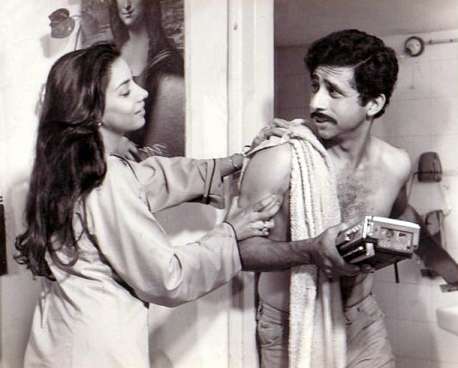
As you might know, the movie was completely based on Gulzar Saab’s own story Chaabiyaan which has also published later with the title Seema. There was wit, brilliance, intelligence and emotions written all over the movie. Each frame was flowing into the other one like the way water flows – at times like a river, sometimes like a silent lake and often like waterfall. It was a sheer pleasure to experience Gulzar Saab’s poetry for the next 137 minutes. The movie has four main characters – Sudhir Bhardwaj (a passionate theater director, played by Naseeruddin Shah), T.K. (a flamboyant businessman, played by Raj Babbar), Seema (an amazing actress who is also a not-so-happy wife, played by Shabana Azmi) and the theater which is the sutradhar which keeps tying all the running threads of the movie. It also has a handful of supporting cast who made their presence felt without shadowing the main leads. Not even a single character was out of place or not required. The story primarily deals with husband-wife relationship and a extra-marital affair, all in the backdrop of theater. While watching it, I could feel it was much ahead of its time (it was scheduled to be released in 1988), as was confirmed by Gulzar Saab in a post screening Q&A session that such things were happening at that time but were never shown in cinema. He dared to reflect what was part of society then.
Opening scene of the movie is in a theater, where Jamal Saheb (played by Utpal Dutt) is entering the theater while taking a look at the play being staged.
Utpal Dutt in Libaas
In the canteen, he is greeted by youngsters who are theater artists/aficionados and the scene establishes that Jamal Saheb is a great artist from the times gone by. He is not relevant anymore and is in a poor state. He has been replaced, so to say, by Sudhir, who is dominating the contemporary theater scene. In next few scenes, we come to know that for Sudhir, the first priority of his life is theater – the way he forces Seema to gargle every day in the morning, no matter what, and the way he keeps on talking about and enacting various scenes from his plays. One scene which nails it down clearly is when Seema asks Sudhir if she could get a hair-cut as she feels she would look prettier in short hair. To which he replies, if she gets the hair cut, what would happen to all the characters she is playing in theater, and starts quoting each of the characters from different plays. All the members of his theater group love and fear him in equal measure due to his strictness while doing the rehearsals. A couple of times when Seema forgets her lines during the rehearsals, he yells at her, and at home, he tells her,
“खाना बनाना भूल जाओगी तो बर्दाश्त कर लूँगा, dialogues भूल जाओगी तो कभी बर्दाश्त नहीं करूँगा.”
Phir Kisi Shaakh Ne Phenki Chaanv – Libaas
Seema is already strained, and wants a break from the monotony of Sudhir being so hard on her as he always thinking about one thing – theater. That’s when T.K. enters the scene and their home. He is informal and is such a close friend of Sudhir that even Seema feelss surprised as she had never seen Sudhir being so comfortable with anyone, including her. TK’s flamboyant style of talking and cheerful behavior attracts Seema, and he gets attracted to her beauty. They all meet a couple of times and then while one relationship starts forming, other one starts breaking. On one side, Sudhir is always busy with his play rehearsals and on the other hand, T.K., a well versed businessman is always ready to meet her and pay attention to her.
Her loneliness and boredom from theater adds fire to the fuel, and before even they realize, the relationship becomes complicated. The high-point of the movie is a scene which has brilliance of Gulzar Saab written all over it. It was Gulzar Saab’s craftsmanship that he handled such a burdened situation in such a subtle manner. The treatment of the characters, the dialogues of this one scene leaves us completely mesmerized and catches us unguarded. The scene is when Sudhir decides to confront T.K. and Seema about their relationship. Seema and T.K. enter the house after spending some good time together, and they find Sudhir at home. T.K. tries to cover up his embarrassment by telling Sudhir that he was asking about him from Seema as Sudhir was very busy, they were not able to meet.
T.K. – और किस ड्रामे में busy हो आजकल?
Sudhir – “अ..अ..म.. आजकल… अ… एक personal से नाटक में ज्यादा busy हूँ.”
“ह.. ह.. मतलब..?”
“नाटक तो दूसरे लोगों का है, मैं खा-म-खां बीच में फंस गया”
“अम.. कुछ समझा नहीं यार, वो कैसे?”
T.K., though embarrassed, is still trying to appear innocent even though he is guilty of cheating Sudhir.
“क्या है के हमारे यहाँ… हमारे यहाँ, वो हैं ना… मि. मुखर्जी”
He looks at Seema and starts building the story.
“मुखर्जी? कौन?”
Seema asks, to which Sudhir replies –
“तुम मिली हो उन से, शायद याद नहीं है… मि. मुखर्जी में याद रखने जैसा कुछ है या नहीं मालूम नहीं… लेकिन अपनी पत्नी की वजह से वो.. अक्सर याद रह जाते हैं लोगों को…. बड़ी talented… और talented से ज्यादा ख़ूबसूरत पत्नी है उन की. अब ज़ाहिर है कि लोग उन की तरफ़ तवज्जो देते हैं, attract होते हैं. और ये कम्बख़्त चीज़ ऎसी है कि आदमी हो या औरत, पाँव तले की ज़मीन खींच लेती है. आदमी सोचता है, इश्क ही में ज़िंदगी है, बाकी सब तो फ़न, आर्ट, talent, सब सजावट की चीज़ें हैं. बहरहाल, मि. मुखर्जी का problem है, उन की पत्नी… वो किसी के इश्क में पड़ गई हैं या कोई है जो उन के इश्क में पड़ गया है….”
Seema asks, “तो problem क्या है?”
To which Sudhir replies, point blank, still keeping it indirect,
“तुम्हें नज़र नहीं आता?”
“नहीं मतलब… समझ में आता है लेकिन दोनों अगर एक दूसरे को चाहते हैं तो…”
“नहीं, नहीं, नहीं, नहीं… तुम उस लड़की के problem को देख रही हो, मैं मि. मुखर्जी के problem की बात कर रहा हूँ”
“उनका क्या problem है?”
“क्यूँ? याने… उन का कुछ है ही नहीं?…
उन का problem ये है कि उन्हें मालूम हो गया है… और जान लेने के बाद शौहर यानि मि. मुखर्जी क्या करे उस पत्नी का? चुप रहे? देखता रहे? होने दे जो हो रहा है? मुश्किल तो ये है कि कोई भी शौहर जान लेने के बाद ये निगल नहीं सकता”
Now T.K. intervenes,
“आख़िर मुखर्जी चाहता क्या है?” “चाहता क्या है, वो छोड़ो, क्या करना चाहिए उसे?”
“अम..ज़ाहिर है अगर उन की पत्नी, उन के साथ नहीं रहना चाहती तो उन्हें कोई हक़ नहीं है कि वो उस के साथ ज़बरदस्ती करें. After all.. वो अपना अच्छा-बुरा समझ सकती है, ऎसी कोई बात नहीं है…”
“हाँ, समझना तो चाहिए, सिर्फ़ ये कि जिस से वो प्यार करती है, क्या सचमुच प्यार करती है? यूँ ही उन्स में तो नहीं पड़ गई? ख़ा-म-ख़ां का infatuation तो नहीं है, जिसे वो प्यार समझ बैठी है?”
“आख़िर शादी-शुदा औरत है, क्या इतना नहीं समझती? इतनी mature नहीं होगी के…”
And that’s when Gulzar Saab’s intelligence of handling the complicated situations comes in full form.
Sudhir interrupts Seema at this point and says it straight,
“इतनी mature हो तुम? इतना समझती हो कि जिस राह पे जा रही हो, जिस के साथ जा रही हो वो झूठ-मूठ का कोई ड्रामा तो नहीं कर रहा है?”
At this time T.K. tries to escape saying this is personal matter between husband and wife and he is an outsider.
Then, as a matter of fact, Sudhir tells him,
“बैठ जाओ T.K., तुम भी कोई बच्चे नहीं हो… बैठ जाओ… देखो T.K., इन रिश्तों में कानूनी, ग़ैर कानूनी कुछ नहीं होता. कानूनन कोई पत्नी नहीं बनती, कानूनन कोई शौहर नहीं होता.Law has nothing to do with it. हम ज़बरदस्ती इन रिश्तों पर कानूनी मोहरें लगाते रहते हैं. आज तक, कोई किसी आते को नहीं रोक सका और ना किसी जाते को थाम सका है. और मैं ये कैंसर ले कर नहीं घूम सकता…. तुम ने ठीक कहा, अगर सीमा मेरे साथ नहीं रहना चाहती तो मुझे कोई ज़बरदस्ती नहीं करनी चाहिए, मैं नहीं करूँगा, लेकिन मैं इसे रास्ते पर नहीं छोड़ सकता. मैं तुम्हारा फ़ैसला जानना चाह्ता हूँ, तुम दोनों का फ़ैसला जानना चाहता हूँ… अगर तुम दोनों flirt नहीं कर रहे हो, एक-दूसरे को धोखा नहीं दे रहे हो, सचमुच एक दूसरे को चाहते हो, तो हाथ पकड़ो और निकल जाओ इस घर से.”
Seeli Hawa Chhoo Gayi – Libaas
Even after Sudhir and Seema get separated and she remarries T.K., there is still an element of care and affection for each other.
T.K. and Seema are living happily, yet Seema is not able to forget her past so easily.
In one scene, where one evening she is sitting sad all alone on a yatch, T.K. comes and asks,
“क्या हुआ… सुधीर का ख़्याल आ गया?”
“हूं..”
“इसीलिए तो तुम्हें शादी के बाद यहाँ ले आया. जानता था, अगर वहाँ रहोगी तो अतीत याद आएगा. अतीत बुरा हो तो सीमा, आदमी गर्द की तरह झाड़ दे, ख़त्म कर दे, लेकिन सुधीर जैसा… मुझ पर अंधविश्वास था उसे. जो कुछ हुआ, मुझे उस का अफ़सोस नहीं, बिल्कुल नहीं, बस यही है कि अगर तुम किसी दोस्त के यहाँ ना होती ना…तो अच्छा होता, क्यूँकि तुम जहाँ भी होती, मैं यही करता, I love you. मैं तुम से प्यार करता. I love you Seema, I love you.”
[Edit Note : While Mohit has written the climax in his post, we are not going to reveal what happens in the end, as we expect more screenings of the film soon and expect you to watch it someday, somewhere. We leave you here with Ravi Shastri Quote : All Three Results Possible ]
And the end credits roll over with the song
“तुम से मिली जो ज़िंदगी, हम ने अभी बोई नहीं,
तेरे सिवा कोई ना था, तेरे सिवा कोई नहीं…”
…Leaving everyone in the theater completely spell bound.
Gulzar Saab got a standing ovation which refused to die down for the next few minutes.
Epilogue
It had Gulzar written all over it. Gulzar the writer, Gulzar the dialogue-writer, Gulzar the lyricist and Gulzar the director. It was like various Gulzar competing with each other and attaining the pinnacle of expressions. The music of R.D. Burman was also a highlight of the movie as the melodies are so soulful, the film would have been definitely incomplete without such lovely songs.
From story perspective, it is really difficult to say what was wrong or who was wrong or whether anyone was wrong at all? This is the power of a sensibly told story on screen. We all know that Gulzar Saab has great sense of expression when it comes to relationships. He is the one who has given the words to all the emotions we have gone through at various points in our different relationships. He is no different here as well. Gulzar Saab has also given various references of past work of theater artists who have explored the complexities of husband-wife relations – Leo Tostoy’s Anna Karenina, Vijay Tendulkar’s Khamosh adaalat jari hai, Mohan Rakesh’s Aadhe-adhure. The film, even though made some 26 years back, is still relevant and I believe due to the nature of human relationships, will be relevant even after 26 years.
There are so many situations in the movie which could have been exploited with melodramatic scenes but he kept them subtle, and trusted the intelligence of audience he was catering to. Like after re-marriage, one day when T.K. is gargling in the morning, all of a sudden she gets reminded of Sudhir, who was always after her for gargling. She gets in that groove for a moment that she actually calls out her old maid’s name “दुर्गा…” and then she realizes her mistake. And when she calls up their family doctor (played by A.K. Hangal) asking him to visit their home for T.K.’s cough and cold, she forgets to mention to the doctor about his new life and husband. The doctor habitually visits their old home and because Sudhir is also suffering from the cough at the same time, he doesn’t find it surprising that Seema called him up. Subtle ways to show that the bridges are not yet burnt completely. The central idea of the story keeps coming back again and again in multiple ways.
During the post-screening Q&A we came to know that the climax which was shown in the film was not his choice but the producers insisted upon him to change the climax.
He wanted to leave it a bit open ended, which he couldn’t do in this movie, hence he made Ijaazat, another masterpiece on husband-wife relationship which he ended the way he wanted it to be.
Nobody dared to ask the question, “अगर लिबास release हो जाती फिर भी क्या वो इजाज़त बनाते?” and I doubt if anyone who has watched Ijaazat would even dare to think it being non-existent from the filmology of Gulzar Saab. Nothing to compare but to give a flavor to the people who could not watch the screening of Libaas, in my opinion, it was at par (if not more) with Ijaazat in terms of exploration of relationships, writing, dialogues, songs, direction and music.
To sum it up, I would just say, no matter how many years the movie has spent in the laundry or dry-clean, this Libaas is still as crisp, clean and white as new.
(Mohit Kataria is an IT engineer by profession, writer & poet by passion, a Gulzar fan by heart. He is based in Bangalore and can be reached at [kataria dot mohit at gmail dot com] or [@hitm0 on twitter)
(Pics & Videos by Ashok Bindal [ajbindal at gmail dot com], a close associate of Gulzar saab, based in Mumbai)
Retrospective Inauguration Video via Ministry of I&B YouTube Channel]
Best thing about any great film is that it’s always inspirational. It inspires others to create, write, draw. It engages you, and the more you scratch, you discover new things and you love it more. And since we are still on Haider, here are some of the best reactions on the film – some in words, some in sketches.
Seen Haider yet? Naah? What are you doing? Go, book your tickets first. Coming back to the film, if Vishal Bhardwaj can get two Salmans, we aren’t far behind. We got two Haiders. One is his, other is ours. So here is our Haider on his Haider.
Our Haider Hussain Beig is a 23 year old filmmaker based out of Netherlands. When he’s not alienating close friends with painful film gyaan, he dabbles in Aerospace Engineering. You can check out his stuff here. This is first post here.
To read our previous post on the film, “Haider : Uncertain, Complex, Asymmetric…Because the screenplay is Kashmir”, click here.
Heavy handed exposition usually kills a film for me. It could be a tasteless voiceover or a redundant character painstakingly ear-fucking the audience with drab explanations of already convoluted plot-points. Which brings me to one of my favorite ‘did you catch that?’ Moments in the film. It occurs when Khurram is being led into an abandoned house and he notices ‘Yeh toh Kaul Saab ka ghar hai.’ Then a brief exchange ensues about the whereabouts of ‘Kaul Saab’, finally coming to the conclusion that he has ‘shifted’ to Bombay.
This was an in passing reference to the exodus of the Kashmiri Pandits from their homeland. It perfectly captures the nonchalance of the characters who, putting it crudely, have different issues to deal with now. And perhaps are still dealing with the brutal and horrific ousting of their Hindu neighbours as a mere migration to the big city. This is just one of the many examples of sheer brilliance in storytelling by someone who I would not have expected less of. Best of all, I didn’t feel like I was being explained a point of view or thrown facts at that I was supposed to ingest like a frustrated teenager in a History lesson. I knew most facts about the region and the socio-political situation already, and never once did I feel the need to internally sigh with a ‘pata hai bhai, gyan dena band karo‘. And trust me when I say I know a lot about Kashmir. Because unlike most of us, I have not been fed frustratingly conflicting facts from different sources of news, I have lived them in my own little way.
I was born in Delhi to a German mother and a Kashmiri father, who decided to name me Haider. It’s one of those unique ‘this-guy-is-definitely-a-Shia’ names. I guess like most things my father does, he wanted to be different. And I was happy with that. I personally don’t know any Haiders. Until late last year, when I heard Vishal Bhardwaj was making his third Shakespeare adaptation on Hamlet, called Haider. Same name, same spelling. Not Hyder, Heydar, or Haidar. HAIDER. F-U-C-K-ed-M-E.
Putting it simply, it’s unnerving to see your name in posters, on billboards, as a trending hashtags of some of my cinematic idols on the big screen. In the ticket line at the box office I turned around as a reflex to my name being called out by impatient ticket buyers. And let’s not get started with the jokes that only true friends and elementary school goers can come up with; ‘How does it feel to have Shahid Kapoor in you?’, or ‘Dude! You gave Hansal Mehta fulfilling sleepless nights!’.
What put me to a melancholic ease though, was the name being pronounced in a Kashmiri accent. It took me back to an angry grandmother yelling out ‘Huhder!’ at my mischief. It’s sad that it takes a great like VB to put in the careful attention to detail to make sure that stars make the proper effort into not caricaturizing the dialect. From Shahid Kapoor’s ‘Sirinagar’ to Shraddha Kapoor’s endearing ‘Luvved, Givved, Suckked, Fu..’. They were almost pitch perfect. And even if some may not agree, full points for the effort.
The dialogues, their delivery, and timing, were just a revelation. Blending in Shakespeare’s cunning words with the heavy backdrop of the ‘Kashmir Issue’. Nothing felt pedantic, heavy handed, apologetic, expositional, out of place, or forced. It was as it should have been. Nothing more, nothing less.
The supporting cast was mostly played by locals, and they were spot-fucking on. There was no need for windy character back stories. From Janus’ two faced Salman and Salman, to Khurram’s born-again militant henchman. They could all have separate films based on them and I would pay good money to watch those too. It’s heartening to see such a wide pool of talent scattered all across the country. WAKE THE FUCK UP, BOLLYWOOD!
Shraddha Kapoor’s work was a welcome surprise. I wouldn’t say her performance was perfect, but three films in, she’s already giving her contemporaries a hard time. Aloof, innocent and gullible, Arshia was what I would call a perfect representation of Kashmir in the early parts of the militancy. It resonated, or was rather amplified by Tabu’s Ghazala, as a more worn out, mature, but also much more grey representation of Kashmir in the time the film is set in, the glorious mid-nineties. It seems like Tabu is the only actor that can play a self destructive feminine character in a Shakespearean tragedy to such seasoned perfection. And to Shahid Kapoor, all I want to say is, Ghanta-Ghar in Lal Chowk will never be the same for anyone again. They better fucking throw all the big (even if bogus) awards at him.
Never have I seen a film capture the reality of the situation so beautifully. Pankaj Kumar’s cinematography is a result of what would happen of each character we’re given a brush to paint out exactly what they see. Each frame was a representation of these personal works of art. It was almost akin to the wounded beauty of the valley. You are one of my heros. I was more excited about seeing your name attached to the film than VB’s. After Ship of Theseus, and now this, I can’t wait to see much much more work from you!
Finally, to the master himself. Vishal Bhardwaj. I might need a series of blog posts to talk about your work. And I’m sure, as I have also read, there is enough information, analysis, discourse and dissection of your work already. I’d rather not add to the pile. I’ll stick to what stuck out most for me, the score. I had listened to the songs that had come out in the run up to the release quite a lot. My favorite being, of course, Bismil. Though what really captured my entranced attention was the score. So, so, …. Fuck I’m out of adjectives that would do justice. I hope the score will be out soon. I know what music I’m going to write to now.
I have never lived for more than two months in Kashmir. Most of my upbringing has been in Delhi, though I have visited Kashmir every year of my life since I was born, most of those years being the most dangerous. I have only fond memories. I have never once seen a terrorist/mujahid/militant/freedom-fighter/jihadist. And it’s not like I lived in a cordoned off posh area. In fact my family lives in one of the rather impoverished Shia neighbourhoods in Srinagar. Though that is not to say, that the distant sound of gunshots and bomb explosions was not a common sound. In my own way, a part of my brain would register them as the sound of Diwali fire crackers, and things would be festive in my mind again. I’ve had the most tranquil moments of reflection on the banks of the Nigeen lake, on a grass patch between abandoned houseboats. I’ve cried my eyes out laughing with my cousins at the millionth viewing of Andaz Apna Apna on local cable channels. And don’t even get me started on wazwan. The closest I’ve come to ‘danger’ was a scooter ride back from football practice, dodging a hail of stones, swerving around burning tyres, and slyly detouring to my aunts house who lived nearby. I’ve always thought of that memory as a rather funny adventure. My worried wailing mother on the other hand, did not.
On the contrary, I’ve heard personal first hand accounts of friends, acquaintances and even close cousins (mostly young men), about the dangers they’ve had to endure. From both the militants and the army. Some accounts are so chilling that I’d rather not get into them, for your sake and mine. ‘Jab do haathi ladte hain, neeche ghaas hi kuchli jaati hai‘. It saddens me to see tasteless Anti-India graffiti vomited on ancient walls. Though their distrust and disdain for the AFSPA and conversely the Armed forces, is not without reason. There are bad apples everywhere, even in Kashmir. I recommend Ashwin Kumar’s two brilliant documentaries – Inshallah, Football and Inshallah, Kashmir. They will show you a side of the story the mainstream media conveniently redacts. I’m not an expert on the subject and I’m not foolish enough to think that I might even have something close to an answer. If anything, having a foot in both worlds, has given me a rather confusing point of view, so I usually stay out of Kashmir based bar-conversations. Plus, whenever anyone looks at me for an explanation, I conveniently say, ‘I don’t know bro, I’m German’. Which is why, I love this film too. I went in as an outsider, and actually learnt a few things I did not know. Thank you Basharat Peer, I’m no one to challenge a reputed journalist and writer who, by the way, happens to be from Kashmir.
Haider is by far the most realistic depiction of Kashmir I’ve seen on screen so far. That includes Aamir Bashir’s heartbreaking Harud.
It’s a perfect balance that knocks you out of your seat in a jolt of energy and then in an instant makes you slow-down and wonder. The only think I would have liked to see more of was a bit more on the exodus of the Kashmiri Pundits. Though, the film takes place in a time when the people have ‘gotten over’ it.
The first scene I ever wrote was of a conversation between two friends on the banks of the Nigeen Lake, my spot of tranquility, hiding from the world, sharing a cigarette, something I’ve done a countless number of times. Since then I’ve rewritten, thrown out, written again, and rewritten it again. I think it’s time to finally finish it. Thank you Vishal Bhardwaj.
To everyone out there still deciding, please watch this film. It’s the real ‘Bang Bang’. I really hope it releases in Kashmir. Last I heard, my local cinema in Hawal Chowk was still an army bunker.
It’d been a long time since I laughed out loud while reading a book. A really long time. But Diptakirti Chaudhuri’s latest book has just about managed that. I laughed, chuckled, and nodded my head several times in the midst of reading the book. “BollyBook – The Big Book of Hindi Movie Trivia” is Diptakirti’s third book, the first one being one on cricket, and the second being the precursor to BollyBook, “Kitnay Aadmi Thay” (KAT). It was a genre shifting Bollywood book in the sense that it did not chronicle the travails of film making or profile some specific stars, but it just focused on Bollywood trivia and did a fine job of that.
BollyBook is expected to release in October, 2014. The initial idea, as Diptakirti says on his blog (diptakirti.blogspot.in), was to pitch BB (indulge me as I acronymize the book titles) as a sequel to KAT, but then his publisher at Penguin suggested the idea of a combining the two as a comprehensive and definitive book rather than having a sequel. And thus, BB was reborn in a new avatar. Just like some Bollywood characters do, some would say.
With 19 sections and nearly 460 pages that are packed with interesting trivia and more, the book can definitely live up to the claim of being the definitive book of Bollywood trivia. Good, bad, funny, dark, all sorts of trivia make up this book. Written in his inimitable style, often sparkling with humour and wit, the book is a paean of sorts to Bollywood.
Today I may count myself a fan of filmmakers such as Scorscese, Linklater, or Fincher, but my first introduction to cinema came through the works of Manmohan Desai, Yash Chopra, and others. Back then, we didn’t have a VCR or DVD at home. There were no multiplexes. Going to the movies meant walking to the neighborhood theater, 15 minutes away from home, standing in queue for “first day first shows” or “matinee shows” for a 10 or 20-rupee ticket. Satellite (cable) TV was not yet introduced in my little town. Regular TV broadcast used to a mix of very old to medium old movies. Religious festivals often heralded special community-screenings in an open-air environment where a projectionist would “show” the picture on a vertically mounted white chaddar. Regardless of the venue or the medium, we watched in awe as those larger-than-life stories unfolded on the screen. Chitrahaar, the weekly programme showcasing hit Bollywood songs, was our reason for going “TGIF”! This, in essence, is what Diptakirti would call a pre-credit backstory compression (hint: see the book to understand what this term really means) to explain my fascination for Bollywood.
It doesn’t matter whether you’re a 70’s, 80’s, or 90’s kid. The book has something for everyone. The earlier generations will nod their head at the various retro references, while the newer ones will easily connect with the new age trivia. Although the table of contents mentions lists, the book isn’t packed with boring ones, instead many trivia are presented in anecdotal form, with a surprise twist here and there. Did you know for instance that the Tamil Nadu CM Jayalalitha acted as second lead opposite Dharmendra in a movie named Izzat? Or that Dev Anand was an employee of the Indian Postal Service and perchance grew to know of Gurudutt who lived in the same chawl as him and became thick with him? Many more such interesting nuggets fill up the book including those about movies you thought you knew in and out, only to discover that you actually don’t.
A remarkable trait of the book is that it isn’t restricted to mentioning trivia regarding only actors and actresses, but also takes a good look at the others who play an important part in a movie’s success. In a chapter covering regional superstars, for example, the last para brings to fore the most successful crossover by a regional musician who has gone on to make a name for himself in the international arena. A. R. Rahman. That’s who.
There’s also a whole chapter devoted to films within films, called Meta. The amount of research the author must have undertaken for this book can be gleaned from this chapter alone where he not only recounts meta and self-referencing films/directors but also points out bloopers!
All trivia and no interestingness makes a dull book. And Diptakirti is no dull author. He makes neat use of quizzes, Honorable Mentions and little Alerts (Eg, Subtle Mythology Alert) to break the pattern now and then. Chapters are also occasionally peppered with photos and posters.
All in all, for Rs. 370 – paperback or Rs. 318 (Kindle), this book packs quite a punch, just like some of our Bollywood films. If you count yourself as a Bollywood fan, this book is a must-have for your bookshelf.
Footnote: Our very own mFC finds a small mention in the section on low-profile debuts of actors.













 F.i.g.h.t C.l.u.b