Archive for the ‘Regional’ Category

Thanks to Bejoy Nambiar, we managed to catch Lijo Jose Pellissery’s Amen at a special screening in Mumbai. If you haven’t seen it yet, do watch it. ‘Great fun’ is the only way to describe this gem. Rarely is ‘fun’ attached with Godly stuff. But this one is a madcap ride, a strange collage of things which rarely come together so well.

Here’s a small recco post on the film by Amit Sharma – on the elements that made Amen such a great joyride.

643980_416614311763753_997719716_nWhy should you watch this Malayalam comedy, err, divine comedy?

To see the beautiful Kerala countryside, a village called Kumaramkary, the backwaters – colourful and idyllic in the day, and dark, lonely, mystical in the night. Eye-gasm in short.

Because it’s all around a Church and a toddy-shop, the former with its brooding, ominous, built-300-years-ago-and-may-fall-down-by-spring air, where the Reverend and sexton hatch their evil plots, and the latter with its regular haunt of drunk band-members asking for more pork and beef, and lamenting over their failures in music competitions. A strange mix.

For the totally over-the-top unapologetic humour, crafted as if the writers had no other concern in the world. Even the overlay text says things like ‘long ago in some random year xyz’. The wacky humour never leaves us, even zigzagging through the love story between the spunky Sosanna (Swathi Reddy) and the meek and unsure-of-himself Solomon (Fahadh Faasil). Girl bashing up goons with vessels, Solomon’s father’s spirit making sudden appearances in smoke-filled rooms complete with two winged angels, there’s no full stop in this crazy ride.

For the antics of the sexton Ousepp, and the menacing Reverend Father Ottapplakkan.

For Sosanna, who looks beautiful & enticing, and the scenes where Solomon serenades her with his clarinet below her window is stuff right out of Romeo & Juliet.

For Prashant Pillai’s fantastic music: the peppy title track, the mellifluous love song, the energetic clarinet duels, and the background score, all of it adding that much more to the film.

Because the film is also about a unique village band, which is on its way down after the tragic death of its star performer, and has lost all competitions ever since. You haven’t seen such a desi band story on screen.

Add to all this a music-loving young junior rockstar Reverend Vattolli, played by Indrajith, who decides to support all that is good, and oppose all that is bad in the village, and brings the band back to its glory by helping Solomon conquer his inner fears, and Bombay’s very own Makarand Deshpande, playing Chevalier Pothachan (don’t miss his hilarious entry) as the opponent in the final contest, and you’ve got an entertainer which is long, but doesn’t seem to be, and manages to make you laugh, and connects you with its emotions and music all the same.

In terms of the basic story idea and elements, there’s surely some similarity between Amen and Guca!, but the local flavours are so distinct that it completely stands out on its own.

Do watch.

1098051_613543508681391_310772591_n

And the makers of Ulidavaru Kandante (As Seen By The Rest) have been smart enough to release it with English subs. This comes out just when another Kannada film Lucia was making all the right noise. Click here to read a post on why it became a landmark Kannada film.

A friend also wrote to us and told us more about Ulidavaru Kandante (As Seen By The Rest) – This new Kannada movie looks like Tarantino movie with Rushomon twist.

“It is the first Kannada movie on sync sound, having 5 different stories that happens on Sri Krishna Janmastami day in Udupi, and it’s a story which happens in 1980s.”

Unlike 99% of the Kannada films, it’s set in coastal Karnataka. All the coastal region characters are used only as comic relief in the rest of the films. The trailer is bit long but do watch till the end.

The film is written and directed by debutant Rakshit Shetty, and stars Rakshit Shetty, Kishore, Achuth Kumar, Tara, Rishab Shetty, Sheetal Shetty, Yajna Shetty, Dinesh Mangaluru, B Suresha.

– To know more about the film, click here for its website, click here for its FB page and here is the Twitter feed.

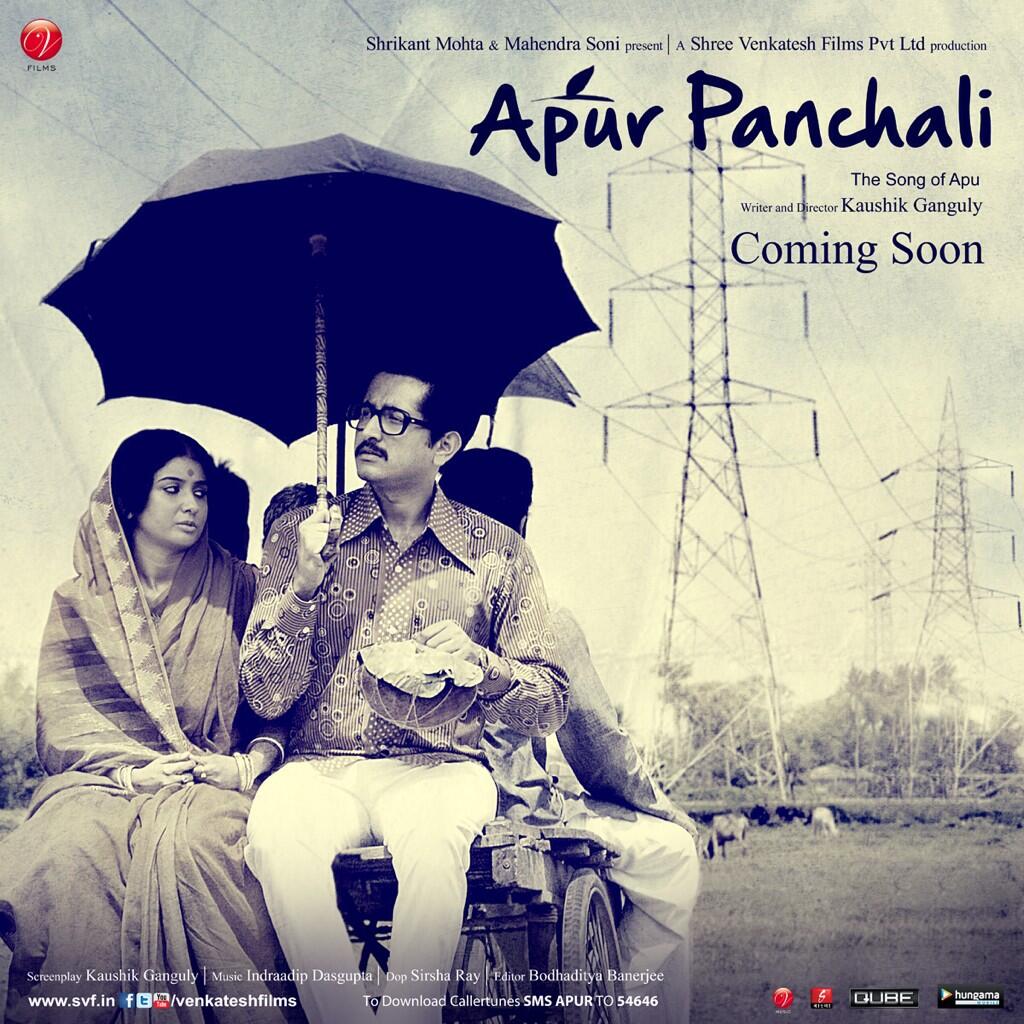
Apur Panchali

A new bengali film titled Apur Panchali tries to explore that. The trailer and poster is just out, and it looks interesting. Have a look. Though the trailer doesn’t have subtitles yet.

The film is directed by Kaushik Ganguly, and stars Parambrata Chatterjee, Parno Mitra, Ardhendu Banerjee, Gaurav Chakraborty & Ritwik Chakraborty.

Some more info on the film (from TOI article) – Talking about Apur Panchali, Kaushik said, “The film is inspired by the real-life story of Subir Banerjee, the child actor, who played Apu in Ray’s Pather Panchali. Despite being one of the most celebrated child actors in the industry once, nobody cares to find out what he is doing now; no one remembers him. My film is a take on that. The USP of the film is the subject which has never been explored in Bengali cinema before. Interestingly, Subir’s life has an uncanny resemblance to what Ray had depicted in The Apu Trilogy. And that’s what inspired me to make this film. Albeit Pather Panchali was Subirda‘s first and last film, but if you study the man’s life, you’d sit and ponder if Satyajit Ray had written The Apu Trilogy keeping Subirda in mind. Having said that, I’d like to make it clear that my film is a work of fiction, and not Subir Banerjee’s biography.”

– To read the full article, click here.

– More about the film here.

Nicolas Bourbaki is back. Because it’s call of duty. It’s the same old i-cant-take-criticism-fuck-you attitude. And this time it involved a Tamil film and a popular RJ who has been forced to quit his show. Bourbaki got all the details. Read on.

ebert3

This Diwali, three Tamil films released.

The Ajith-Arya starrer Arrambam, directed by Vishnuvardhan, which opened to bad buzz and terrible word of mouth but the adrenaline quotient in the film and the combined mass fan following of Ajith and Arya ensured that the film took a great opening with the long weekend. It was heavily inspired from Swordfish with scenes liberally borrowed from Hollywood action flicks, including Mission Impossible 4, packaged smartly with the social revenge drama sentiments from Shankar and Rajnikant films.

The second film to hit screens was Karthi starrer All in All Azhaguraja, directed by Rajesh, who is very good with comedy. Produced and distributed by Studio Green (affiliated to actor Suriya’s family), one of the most powerful and influential banners down South today, Azhaguraja had everything going for it pre release. The director hasn’t failed ever and the promos assured a laugh riot. The film, however, opened to terrible buzz online and the deathly silence to jokes and walkouts in theatres forced the makers to edit out about half an hour from the 170 minute long film. Not that it helped.

The third film Suseendran’s Pandianadu was the dark horse, a make or break outing for actor Vishal who hasn’t had the best run at the box office. It opened to great buzz and positive reviews with most critics declaring it the clear winner among the three films.

That being the context, RJ Balaji, Chennai’s most irreverent reviewer known for his tongue in cheek quips on radio, tweeted on Monday night that his segment 120 (a review show where he told listeners if they should spend 120 rupees on the ticket, purely as a voice of the man on the street) would be no more. Here’s the series of tweets explaining his decision.

As many expressed their support to the reviewer, some of the stars on social networks used this opportunity to diss critics and criticism. While some were purely emotional (like Vasuki Bhaskar’s tweet)

and some out of friendship (@actorJiiva and director of Azhaguraja go back a long way), the unkindest cut was from Vishal, who shot himself in the foot and undid any goodwill he had earned from his Diwali release Pandianadu.

(Turns out that Balaji hadn’t even reviewed the film and Vishal was talking about his interaction with viewers who had seen the Diwali releases and the viewers had blasted the films. The third caller had criticised Balaji and he was gracious enough to take the call on air when he had a choice to not allow it. Balaji’s comment was that if a thousand people made a poison biscuit, will you attack the guy who told you it is a poison biscuit or the people who made it? Nothing even remotely personal or below the belt!)

God knows Vishal needs honest criticism the most to triumph at this hour!

If all critics were to say only good things about Arrambam and Azhaguraja out of consideration, to use Vasuki’s analogy, of the babies that were delivered, nobody would have even queued up for Pandianadu. Simply because there is no way people would go watch a third film during the Diwali weekend. Instead of being grateful to people for speaking their mind about what they liked and what they didn’t during the weekend, Vishal actually chose this weekend of all, to suck up to the most influential banner.

About 80 per cent of the films made are either flop or lose money. Not because of criticism but because the makers made a bad film. Singham 2 is one of the highest grossing film down South in recent times despite terrible reviews. Because people liked it even if critics didn’t. People are not always right in recognising good cinema which is why we need critics sometimes to point them in the right direction. We need someone to be the bad guy and say the truth out aloud that this film stinks, go watch the other one.

Because filmmakers don’t offer refunds.

It is extremely juvenile and downright stupid to lash out against critics in times of social media because today, the common man is a critic. One smart tweet summing up a film can get retweeted more times than any review. When everyone is a critic, mass opinion infiltrates the aggregate of tweets and buzz on the film. Which is even more reason you need honest and brave criticism to prevail.

In a world without dissent, the powerful will rule and underdogs will die. Do you want your cinema to be controlled in the hands of a few? Critics are not your enemies, they are your friends.

The real enemies are within your system. The stars who charge salaries that make your project unviable. The marketing spends you invest to beat the competition that puts you at greater risk. The lack of effort in writing or picking the good scripts. The money spent on foreign trips, lavish sets for dance numbers, business class tickets, five star hotels, success parties, audio launches and invites, buying your own tickets to keep the halls housefull… These are the things you can do without.

Criticism, you can do with.

(PS – Bourbaki just got to know that it was scary scenario for the RJ. Got threats too. The way it happens in those bad zimbly zouth films. Only difference is in real life they are scary. So he has decided to opt for something non-filmy now)

(PS1 – More discussion on the controversy is going on here : http://j.mp/1cKMF3F , http://j.mp/175Ibq3  & http://j.mp/1cKMLIu ) Also, another post on the same issue is here.

(PS2 – If you have problem with Bourbaki, his Godfather Banksy got an answer for you here.)

LKF
Kenny Basumatary’s Local Kung Fu (with English subtitles) released this friday. Some of us had seen the film and quite enjoyed it. Here is a Baradwaj Rangan-ish bullet point movie recco post by Kartik Krishnan.
  1. Dash of Takashi Kitano humor and tribute to oranges-Andaz Apna Apna.
  2. Goon with the funny smile plastered on his face 24X7
  3. The 70 yr old grandfather who wields the stick with Kamal-Hassan-Thevar-Magan-ish dexterity.
  4. The superb tongue-in-cheek Guthka khaane se swasth ko haani pahunchti hai PSA cleverly forced in
  5. Candid out takes end credit sequence
  6. Fried Silkworms, Snail curry, rice pancakes ahhh the food
  7. The overweight Karate goon who sings Raagas
  8. Spirit of the cast and crew and a budget of less than a lakh
  9. Ekta Kapoor spoof
  10. Absolutely naturalistic performances
  11. The Number One U 18 goon – Bonzo !
  12. The energetic action sequences
  13. The girl with Assamese-Malayali roots
  14. The gallis and koochas of Assam
  15. The uncle who asks “You need to take a crap or something?”
  16. The music (Wish the songs were subtitled too) Sample this
  17. The Requiem-waala montage thrown in once or twice
  18. DLFG – Delhi Liberation Front For Gurgaon
  19. The stories told in each and every fight – kaun kispar kaise bhaari padta hai 
  20. The irreverence and non seriousness of it all – with the tone set from the the opening statement itself !
  21. The goons shaving & whiling away time when bikes enter in super slow motion!
  22. Even a small time thief fights back in Kung Fu-style
  23. The villain whose caller tune is the sound effect of kicks & punches
  24. No pretentiousness of an art film, No (ok, may be a little) filmy-pana of a commercial film
  25. The vision guts and passion of Kenny Basumatary who has acted, written, directed and edited the film

Do catch the film playing at the limited screens.

loval-kung-fun2

– To know more about the film, click here to read an old post by the film’s lead actor, writer an director Kenny Basumatary.

– For more info on the film, visit its Facebook page here.

– To watch its trailer, click here.

Since crowd-funding is in vogue these days, it’s good to see the trend going beyond Hindi indies. If our friends are to believed, Lucia is the first Kannada film to be crowd funded. We don’t have much clue about this one but it surely looks interesting. It’s written and directed by Pawan Kumar and will release with English subtitles. The film is released by PVR Directors Rare.

Lucia

Official Synopsis

From the director of smash hit Lifeu Ishtene, comes Lucia, heralding a new direction for Kannada cinema, being the industry’s first crowd funded film. An usher at a decrepit cinema suffers from insomnia. His life changes when he starts getting weird and wonderful dreams but with a caveat. Set in the teeming young metropolis that is Bangalore, the film is a turbulent ride where the lines between dreams and reality are blurred to delirious effect. Please don’t reveal the ending after you’ve watched the film. Prepare to be surprised, very surprised.

Trailer

Show Timings

Lucia2

– To know more about the film, click here.

– To read the filmmaker’s blog, click here.

Baandhon is the first Jahnu Barua film to get a multi-city release outside Assam. Thanks to PVR Directors Rare. For cities and show timings, do check the poster below. And here’s Pradeep Menon on the film.

943271_470624503025894_1991809589_n

The media, social and otherwise, has been abuzz with the latest Hindi release; an exciting, talented director’s sophomore feature, one that is making critics and audiences alike gush over gorgeous frames, celebrate the coming of clean cinematic craft, and most importantly, reminisce about romances of the days of old.

Indeed, sometimes one can’t help but feel that, in this day and age, we’ve all forgotten how to fall in love. We’ve forgotten what it is like to drown oneself in that heady rush of a new romance, embrace unbridled passion today like there isn’t a tomorrow and push the limits of rational behaviour in the pursuit of real life moments that make us feel like we’re living a movie.

But here’s the thing about romance – it always dies away. No question about it. So what remains then? What happens when you spend years, or even decades, with a person? Hopefully, once the romance, the passion and the giddy joy of the other’s company gradually ebb away, what you’re left with is respect, stability, comfort, and, if you’re extremely lucky, a lifelong friendship.

That, precisely, is what Jahnu Barua’s ‘Baandhon’ (“Waves of Silence”) is about. On the surface, it appears to be about the complex relationship shared by a married couple; a man and a woman who’ve spent nearly their entire life together. But if you really pause to think about it, it is quite simple. Their love has evaporated perhaps, but they are left with the next best thing – companionship.

Baandhon spends more than half its run-time soaking itself in a single fight between an aged husband and wife; a couple that has already been bereaved of its offspring, and is now solely alive for their grandson, who studies in IIT Mumbai. However, right from the outset, we know that this fight isn’t for real. They’ve done it to death umpteen times before, and it is perhaps the only thing that keeps them going on a daily basis. One ticks because the other is.

But, before we even see the couple for the first time, we are told the date of the fight. 26th of November 2008; a day that sent waves of silence of its own, all around the country. And immediately, you know that this is a story that is always going to end in some sort of a tragedy.

Barua, then, with his decades of filmmaking experience and multiple National Awards, chooses to douse his narrative in such minimalism and sparseness that not only is there never a twist, but there also isn’t even the anticipation of one. The terse inevitability of the path the film traverses is always writ large over the goings-on, and yet, Baandhon gently attempts to reaffirm faith in humanity while admitting that somewhere along the way, humanity has failed.

Reminiscent more than once of Mahesh Bhatt’s ‘Saaransh’, yet largely steering clear of some of the harsh questions and issues that Bhatt’s film raises, ‘Baandhon’ roots itself in economy of craft and storytelling. Even the background score of the film tries its best to camouflage itself behind the visuals; so rare for Indian cinema today, which nearly always attempts to elevate every emotion with over-the-top mood music embellishment.

There isn’t an overt attempt at displaying craft or technique here. Baandhon could easily have been a play. It is set mostly in Guwahati, before the climax, if I can call it that, shifts to Mumbai. Yet, there is no attempt to give the film a texture that sets it in a particular time or place. It could be happening anywhere, at any time. The 26/11 backdrop gives it a real world context perhaps, but even that could just as easily have been a fictional human tragedy that only needed Mumbai to be the place it occurs in. This of course, is clearly intentional on Barua’s part. If you’ve watched ‘Maine Gandhi Ko Nahin Mara’, you know that he’s fully capable of creating a perceptible flavour of place and time.

Baandhon also has no solutions on offer. In fact, it hardly asks any questions. All the film does is give us a brief window of a few days, into the life of a man and woman who, after 73 years of their life, have only each other, even if their journey brings in their path a few kind souls who unselfishly look out for them. It is in these side characters, the ones that attempt to show you that humanity has hope after all, where the film really falters. Our cynical selves will find it hard to swallow the genuine goodness that the peripheral characters go out of their way to shower on our protagonists.

It doesn’t help that most of these side characters aren’t particularly well performed either. Even Bina Patangia, who plays one half of our couple, has an adorable character to fall back on, but her performance itself is mostly functional. Only Bishnu Kharghoria, who plays the husband, truly manages to turn in a memorable performance.

Despite some almost naïve writing and characterization, it is in its silences and pauses that Baandhon’s honesty shines through. This honesty draws you in and makes you want to sit right next to the couple as they deal with loss. Yet, just before your hand reaches out to caress them, you realize that they still have each other. And as you draw your hand back and walk away from them, all you really tell yourself is that perhaps that is all one needs – another person to fall back on, forever.

( To read more posts by Pradeep, you can check out his blog here)

Bandhon-Poster-2

Jahnu Barua has won 11 National Awards. And there’s high chance that you might not have seen a single film of his, even if you are a die-hard film buff. The reasons and excuses can be many. So here’s your chance to change it. His latest film Baandhon is going to be released in 7 cities across the country, and with English subs. The film is being released under PVR Directors Rare banner and will have shows in Delhi, Mumbai, Kolkata, Chennai  (special screening on Saturday/Sunday), Bangalore, Pune and Ahmedabad.

– Baandhon (Waves of Silence) is the first Assamese film to be released outside the state. It is produced by the Assam State Film (Finance & Development) Corporation ltd. (ASFFDC) and has won the award for Best Assamese Feature Film at the 60th National Film Awards in 2012.  It opened the feature film section of Indian Panorama at the 43rd International Film Festival of India and was also screened at the International Film Festival of Kerala.

– The film is 96 minutes long and features Bishnu Kharghoria, Jatin Bora, Bina Patangia, Zerifa Wahid, Abastosh Bhuyan & Anshuman Bhuyan.

– Synopsis : Baandhon is a story of an elderly couple – Dandeswar and Hkawni whose lives are deeply impacted when their grandson goes missing in the attacks of 26/11 in Mumbai. The film captures the turmoil and the upheavals the couple goes through in trying to come to terms with the void that has been created in their lives forever.

And here’s the trailer of the film (with subs)

meghe

Ever since Sashwata Chatterjee made his mark on national radar as Bob Biswas in Sujoy Ghosh’s Kahaani, suddenly we have been seeing more of him. Or maybe he is getting interesting roles since then. Recently he was in Aparna Sen’s hilarious film Goynor Baksho, and now he is playing the lead role of Ritwik Ghatak in Kamaleswar Mukherjee’s Meghe Dhaka Tara (The Cloud-Capped Star).

When i heard about the title of the film, the first thought in my head was blasphemy, blasphemy! But thankfully, the black and white trailer looks interesting. And seems like Sashwata is going to steal the show again, especially towards the end, when he portrays the madness.

Have a look. It’s with English subs. Hope more producers learn from this and realise that they have a market beyond their state. It’s a slow process but that’s how you build your audience. So do release your trailer, promos, songs with subs.

Official synopsis

Kamaleswar Mukherjee’s Meghe Dhaka Tara is inspired in every way possible from the legendary director Ritwik Ghatak’s life. From putting together bits and pieces of his eventful life to using the title of one of his most famous movies, and to naming the characters from his last film Jukti Tokko Goppo, Kamaleswar’s movie is an apt tribute to the great director.

Although inspired from Ghatak’s life, Meghe Dhaka Tara is neither a biopic on him, nor a remake of his famous film. To Kamaleswar, Ritwik is a true star, a legend, with immense contributions to the world of cinema. And yet he is still quite the unsung hero. Hence, he is the “Meghe Dhaka Tara”.

Credits

Starring : Saswata Chatterjee, Ananya Chatterjee, Abir Chatterjee & others
Producer : Shree Venkatesh Films
Presenter : Shrikant Mohta & Mahendra Soni
Direction : Kamleswar Mukherjee
Screenplay : Kamaleswar Mukherjee
DOP: Soumik Halder
Music : Debojyoti Mishra

– For more updates, it’s Facebook page is here.

Last week i watched Kannan Iyer’s Ek Thi Daayan. It’s co-produced and co-written by Vishal Bhardwaj. And last night i watched Aparna Sen’s Goynar Baksho. And i could not stop myself from comparing the two. Apart from Konkona Sensharma’s spectacular acting, there are few more common factors between the two. Both the films are based on literary work. Ek Thi Daayan is based on a short story written by Konkona’s father Mukul Sharma. (You can read the story here) Goynar Baksho is based on Shirshendu Mukhopadhyay’s story titled “Rashmonir Sonadana”. So in a way one is Mommy’s film and the other one is Daddy’s. Though both are in supernatural space, in terms of what they deliver, the difference is huge.

Ek Thi Daayan is a strange film. Because it’s two films in one. Though it plays around with all the common elements of horror films in first half, it sets up a great mood, is deliciously ambiguous, and keeps you totally hooked. Konkona and the kids keep you engaged in their mouse and cat game. The 2nd half is drastically different – almost a Vikram Bhatt film. Everything is on the face, new rules are set, it’s silly, becomes unintentionally hilarious and has a strange closure. What is Kalki’s character doing in the film? She is just to misguide us? Is it all about who is the witch out of the two? It all boils down to one spoiler? There have been many rumours floating around about the film’s climax being changed by its producer, and once you watch the film you realise that all those rumours must have been true. There can’t be no other reason for the second half to be so disappointing.

Now, about the end. A wise man once said that you must ask yourself 3 Questions – 1. what’s the film about? 2. What’s the film *really* about? 3. What’s the film *really, really* about? If you know the answers, you are on right track. And the answers to these three questions tells you the difference between these two films – Ek Thi Daayan and Goynar Baksho – why one works and why the other doesn’t. Let’s see.

(SPOILER ALERT)

Magician Bobo can hear voices. Because he has a back story. Because his sister was mysteriously killed by his step-mom/witch. Interval. Bobo has a GF/wife. He also has a kid. A new stranger who might be a witch. BOOM! She is not the witch. The GF/wife is the witch. But why is Konkona suddenly back, and from where? What’s the sudden funda of pisach? And all that choti-wali ladayee? Why kill all ambiguity? Was there a way out in the same set-up? i think so. It was all there, just needed to be perfectly tied up like Konkona’s hair braid.

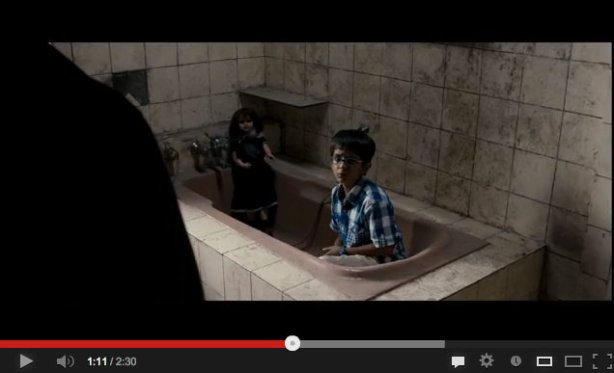
For me, the answer would have been Bobo’s adopted kid, Zubin. Going by the trend of orphan kids who get superpowers, he perfectly fits the demography too. We don’t know about his real parents. Aha, that’s where the magic and mystic happens. If you see the second trailer here (at 01:05), you will know that there was more to Zubin for sure. See the screenshot – Zubin talking to a doll (or Misha?) when Bobo spots him. This scene was not there in the film.

The film just used him for the choti-kaato act. Given a choice, i would have gone with Zubin getting some of the supernatural powers to hear/see daayans, something that connect Bobo and Zubin, and then a closure for Bobo’s story with him coming to terms with Misha’s (his sister) death in some way. I believe it was also there in the script – if the lift is going down, it’s going to hell. Can Bobo take the lift up to heaven for Misha? As for Lisa (Kalki’s character), isn’t she going to be step-mother for Zubin? When it plays around on the funda of sauteli maa acchi ho toh sakti hai par hoti nahi, isn’t Zubin in same scenario as Bobo? Aha, the loop.

(SPOILER OVER)
ETD2

And if there’s something more funnier than Vikram Bhatt style kaat-choti-kaat act, it was the disclaimer in the beginning of the film. Easy to understand that neither the makers nor the Censor Board is guilty of that. It’s because of the times we live in, where the fringe groups are always looking for such occasions to raise their voice and get attention. This is where Aparna Sen’s Goynar Baksho hits the ball straight out of the boundary.

On the surface it’s a story about three generations of women and their relationship with Goynar baksho (jewellery box). But Aparna manages to pack in so much, that it’s unbelievable. And treated it in a humourous tone, this one should work for all. In a memorable and heart breaking sequence in the film, Pishima (aunt in bengali, father’s sister), a child widow who has died and become ghost, asks Konkona Sen (new daughter-in-law) what sex feels like? Does she enjoy cuddling? In today’s times of offending sensibilities, this might be counted as quite sacrilegious. But this is where the bravery and the brilliance of the film lies – it packs everything with humour.

Pishima got married at 12 and was widow at 13. Forget love, relationship, or any such pleasure, widows were not even allowed to have good food. All she got was boiled veggies, all she wore was white sarees. It reminded me of someone i know closely. Married at young age, she had a son just after marriage, and then her husband died soon. She returned back to her parents and brothers. Since then it was been a life of white sarees, religious stuff and only vegetarian food. It’s actually quite a common sight in bengali families, mostly in rural areas – the eldest daughter who is married at young age and if she becomes widow, she comes back to her parents and stays with them for the rest of her life.

Moushumi Chatterjee plays the role of Pishima, an authoritative voice in the house. Because she owns those expensive jewels, nobody wants to be in her bad books. But the fun begins once she dies and becomes a ghost. Interestingly, only Konkona’s character of Somlata (new daughter-in-law) can see her. She is new in the house, she is scared and to make things worse, she even stammers. With a hookah in her hand and more abuses that you can count, initially Pishima starts bullying Konkona to protect her jewellery box, and then slowly they develop a bond. Pishima is bitter, sarcastic and is always cursing everyone around, but all done with dollops of humour in her Faridpur accent. Her dead character is the life of the film.

Goynar Baksho

In another sequence she gets emotional as she talks about how the men in the house always had all the pleasures, and all she got was this jewellary box. The (pishima) ghost played brilliantly by Moushmi Chatterjee, instigates Konkona’s character to go out, fight for her rights, to pursue her passion and enjoy everything that’s forbidden. Who talks about heaven and hell? As a ghost she knows it better than everyone. Enjoy till you can and then your body will perish one day.

Konkona’s character of Somlata represents the second generation. She is on the other extreme compared to her Ek Thi Daayan role. Set in a completely rural background, instead of scaring others, in this film she is always scared. And like in almost every other film of hers, she is so convincing that you would think she has a twin sister who acted in ETD. She is undoubtedly the best actress of our generation. The last 15mins of the film feels bit odd but you get what the filmmaker is trying to do – the third generation. You can also see the limitation of budget and resources, but this one is a must watch.

The film has released with subtitles in Mumbai and other cities. Though the subtitles might not be able to translate the fun of Faridpur accent but do watch it. Bollywood desperately needs some funny ghosts. And Vikram Bhatt needs to put his tacky ghosts in his closet for sometime.

So in two weeks we had two supernatural stories – one with mysterious witches and the other with loveable ghost. Both with three leading ladies. For whatever reason, one remains a half-baked affair, the other manages to pack a punch. One doesn’t say anything new, the other takes a strong stand on so many issues without making a big fuss about it. And it all comes from the same family. I guess in the end it’s all about the *choices* – we are the stories we tell.

@CilemaSnob

(PS – To make life bit simpler, now you don’t need to fill in all the details to post comments. If you are already logged into Facebook or Twitter, just log in with your FB/T account. Click on comment box, you can see the small (FB/T) icon below the comment box, click on FB/T, a pop up will appear, authorize the app and you are done)