


WHY?
The world needs to know. Anyone?
Here is the trailer.
And here’s the answer
Tip – Sumit.
 what we are reading – EightandHalf


Bejoy Nambiar is ready with his new film, David. Interestingly, this film is in both Hindi and Tamil, and strangely, there’s a mismatch in the number of Davids in the two versions; while the Hindi one has three, Tamil version has only two Davids.
The hindi one has Vikram, Tabu, Neil Nitin Mukesh, Vinay Virmani, Lara Dutta, Isha Sharvani and Monica Dogra in the lead. The Tamil version has almost the same cast but has Jeeva instead of Vinay and Neil.
First, the hindi trailer
And now, the Tamil Trailer
The trailers look very interesting. And though they don’t tell you much about the story but the visual montage looks powerful. What we saw in Shaitan, seems Nambiar is going to deliver more of it in this film – those slo-mo action sequences drenched in blood, rain and bullets. Also, the romantic portions bear a clear stamp of Ratnam-ish playfulness, and more so in the Tamil version.
And here are the two posters…
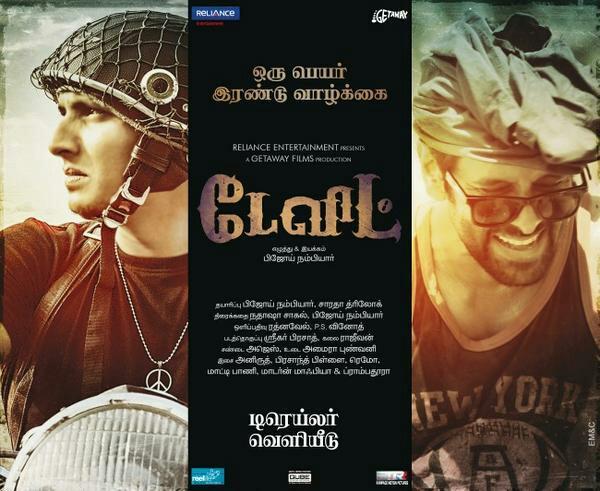

And the official synopsis (Hindi version)….
The story revolves around the lives of 3 Davids in 3 different parts of the world in 3 different eras.
1975 London- 30 year old David works for Iqbal Ghani, a dreaded Mafia don who controls the entire Asian community. He is a protege who is poised to take over the empire until a revelation which changes the course of his future.
1999 Mumbai- 19 year old David is a musician born into a family of devout Christians. A happy go lucky teenager who loses all semblance of his peaceful existence when his family gets dragged into a political issue.
2010 Goa – 40 year old David is a fisherman living in the small fishing village of Betul in Goa. He falls in love with the deaf and mute Roma- the only hitch is that she is engaged to be married to his best friend Peter in 10 days!
All 3 Davids are about to take a step which is going to change their lives forever.
3 LIVES, 3 DESTINIES, CONNECTED BY 1 NAME – ‘DAVID’.
And like everyone else, if you are still wondering about this 3 and 2 Davids, the director clarified about it to Anurag Kashyap on Twitter..
@ankash1009 the 3rd one (neil’s) didn’t fit into the tamil mileu. Would have had to re imagine it completely which was not feasible.
It’s a weird position to be in. And in India it’s almost like a joke because people instantly quote two names to get their points across – Khalid Mohamed and Samar Khan. Remember how Subhash Ghai reviewed Fiza? The precedent is bad but who said that we can’t change the future. So what happens when a film reviewer changes track and moves to the opposite side? Over to Pratim D Gupta, who has been reviewing films for The Telegraph for last few years and has now made his directorial debut with a bengali film titled Paanch Adhyay which has just released. The film stars Priyanshu Chatterjee, Dia Mirza and Soumitra Chatterjee.

This is so damn difficult to write. I have been staring at this empty word file on my Macbook screen for the last couple of hours. That’s like the time I usually take to write my film reviews every Friday.
Any more time and that page wouldn’t reach you the next day. But then every Friday I am your man at the movies. For this Friday, I am the man behind your movie. Perhaps the only way I can put this together is if I tell you about Paanch Adhyay in five chapters.
Chapter 1: The write of passage…
It was always all about cinema waala love. From Uttam Kumar’s cigarette smoke swirl in Nayak to Sanjay Dutt’s eyepatch in Khalnayak, from James Bond’s black tuxedo in every film to Govinda’s yellow pants in every film, I chewed and chomped anything that spelt cinema. So the three-figure JEE rank was dunked and I got into film studies. Soon the Rays and Ratnams had company in Kurosawa and Kieslowski, Tarkovsky and Tarantino.
The world was passing by at 24 frames per second. I had to jump cut. I chose to write myself into the script.
Watch movies, write about them, speak to the guys who make them and try and understand the craft a little more. So incredibly I was attending the best customised film school possible; where I could speak to A.R. Rahman about the core of his scores, discuss the finer nuances of acting with Irrfan Khan, debate shot lengths with Ashok Mehta or just discuss life in cinema and cinema in life with Farhan Akhtar.
One of my earliest on-set assignments was Pradeep Sarkar’s Parineeta shoot in Siliguri. And I remember the film’s leading man, who became Mr Bebo a couple of days back, telling me with a chuckle: “Making a film is like waging a war.” I didn’t fully understand it then. No one knows it better than me now.
Chapter 2: The man who almost made a movie…
I started writing a script in mid-2008 because a filmmaker friend from here liked the idea and promised that he would get me funding for it.
The script happened, the promise wasn’t kept.
I took the script to other producers; everyone shooed me away. Since it was lying ready, I made an English version of it and sent it to international screenwriting competitions. It got selected as one of six scripts at the Locarno International Film Festival and went on to become the first Indian project at the Independent Film Week in New York.
Still no funding came through.
Next a Mumbai-based producer committed to fund the film at Film Bazaar in Goa and even got a French co-producer. I happily got a cast and crew together — the very best talent from here in Calcutta. The pre-production started and locations were scouted. And then the man from Mumbai stopped taking my calls and replying to my mails. When I bumped into him at a social do, he promptly fled from the party.
I actually started believing that I would be remembered (laughed at, really) as that guy who came closest to making a movie but could never make one. You know how artistes love romancing the pain. The pleasure of putting your head down on a wet pillow every night.
Chapter 3: Traces of treason…
Of course at that same time there was something equally terrible happening on the personal front. Everything was shutting down around me. I thought to myself the only way out of this is to write a new script. Yes another very romantic way of looking at things — you got to do what you can do. A batsman has to bat his way back to form; a writer has to write.
That’s how Paanch Adhyay was born. It was called Resh then. Resh as in traces… traces of a relationship. I wanted to narrate what I was going through with a what-could-have-happened twist to the tale. I wanted to tell a love story like a thriller. And because I wanted to go berserk with the structure, I wanted to keep the story simple. Very, very simple.
I slit my veins onto the script. This time I was not writing to get the film made; I was writing to get a move on in life. Writing Resh felt gratifyingly cathartic. I finished the first draft and there it stayed saved in a folder on my lappie. It’s job was done. Or so I thought.
Chapter 4: Moment by moment…
I knew of Kaustuv Roy as a man who threw big parties even though I had never attended one. He called me one fine evening — I still remember I was in a taxi and passing by Park Street — and said: “I have heard about your scripts; why don’t you come and narrate me one?” Honestly, I was tired and I really didn’t want to go through that whole reading-your-heart-out-to-blank-faces ordeal one more time. I told him I would come over one day and forgot about it.
But I kept bumping into him and he kept pestering me about a narration. Just to get him off my back, I took a printout of the 60-odd pages of Resh and went and read it out in his freezing, smoke-filled office. I couldn’t wait to run out of that cold chimney when he said he was producing the film and calling it Paanch Adhyay after the five chapters the film was split into.
Eleven drafts, three Mumbai trips, four months later I embarked upon what has been the bestest year of my life. Composing the songs, shooting the film, editing it, dubbing it, re-editing it, scoring it, re-re-editing it, grading it, mixing it… every moment has been a blessing.
Watching Shantanuda (Moitra) walk out of the room and come back with the most moving piece of melody, watching Dia (Mirza) howl incessantly in the dubbing room to match the mood of the moment, watching Arghyada (Arghyakamal Mitra) slip in a prolonged shot of silence to create the most heartbreaking of effects…. The endless wait up till the Paanch Adhyay experience has all been worth it.
Chapter 5: A new chapter…
“You have not been nice to so many films and filmmakers; get ready to face the music!” Now, that has been the most “critical” concern from my friends, colleagues and well-wishers. Ironically in our jobs, we are remembered more for the gaali reviews than the glowing reviews.
Well, can I share a secret? From the moment those lights go off at the theatres, nothing else matters. It’s just you and the film. Hype, reputation, personal fondness, fanboyhood… everything’s dug deep into the popcorn tub. You know it when you like a film; you know it when you don’t. And you got to be honest about it. That’s all I have been. Always.
There’s a line Dia’s Ishita tells Priyanshu’s Arindam, who plays a filmmaker in Paanch Adhyay, in the film: “That you have been able to make the film the way you wanted to make it, isn’t that enough?” It’s enough for me. It’s enough for me that I could make this film the way I wanted to make it. With my friends, with like-minded artistes and technicians, with heart and soul. Nobody can take away that experience from me. Of course, you can take a happy song and make it better. Because by the time you are reading this, my baby has crawled out to a theatre near you.
Hope you enjoy the show. Pam param pam!
– This piece first appeared in The Telegraph.
– To know more about the film, click here for its Facebook page. And click here to watch its trailers and songs.
– The film will also have its screening at the ongoing Mumbai Film Festival on 23rd October. Venue – INOX, Time – 6pm.
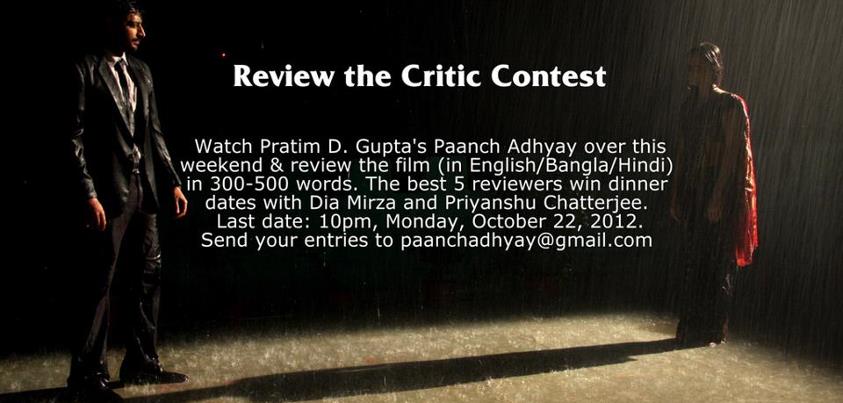
– The makers of the film are also having an interesting contest called “Review The Critic”. Deatils in the pic and on its FB page.
And it looks so damn good! Have a look.
The treatment and the mood reminds me of Johnny Gaddar meets Manorama Six Feet Under. Also, like the fact that the makers have realised that their films have the potential to go beyond Maharashtra and so have subtitles in the trailer. Hope from Marathi filmakers start doing the same.
 And here’s the official synopsis…
In this engrossing thriller, Amar Apte is a private detective who gets his business from suspicious spouses out to catch their cheating partners in the act. When a femme fatale client enters his life, Apte snaps out of his uninspired domesticity-complete with a nagging wife and mounting bills-and finds himself in dangerous territory.
Set in Pune and against the backdrop of the financial reforms in 1992, Pune 52 juxtaposes the impact of globalization on a city with one man’s inner struggle. With a nod to Raymond Chandler and a hypnotic and ferocious performance by Girish Kulkarni, Mahajan’s debut fiction feature explores the aspirations and frustrations of a small man dreaming big.
The film will be screened at the Mumbai Film Festival where it will compete in India Gold category. It will have a theatrical release on 12th December.
Cast & Credit :
Starring: Girish Kulkarni, Sonali Kulkarni, Sai Tamhankar, Kiran Karmarkar
Editing: Abhijeet Deshpande
Sound Design: Baylon Fonseca
Director of Photography: Jeremy Reagan
Produced by: Abhay Gadgil, Shrirang Godbole, Girish Kulkarni, Umesh Kulkarni
Original Story, Screenplay and Directed by: Nikhil Mahajan
It’s produced by the makers of films such as Valu, Vihir, Deool and Harishchandrachi Factory and is the debut feature of writer/director Nikhil Mahajan.
To read the director’s note, click here for our previous post on the film.
For small and regional films, social networking platforms can be quite a boon. If anything is good, one doesn’t need to worry about its audience. When people become your ambassador, you don’t need advertising or pr. I discovered the wonderful trailer of Bhooter Bhobishyot on FB and was instantly hooked. Have been following it since then and it’s finally getting a limited release in Mumbai today. So here’s a recco post on the film by Aniruddha Chatterjee. But first watch the trailer. Wish they had released it with subtitles.
Imagine this. Two ghosts, one a zamindar who got killed by the dacaits, and the other, a British officer who served in pre-independent India, are auditioning other ghosts to fill the zamindar’s abandoned mansion. This is because most old mansions and houses are demolished and turned to shopping malls and multiplexes by money hungry promoters and are ruining the culture and heritage of the city. So the ghosts all over the world, especially in Kolkata, are finding it very difficult to find a place to live in. Interestingly, even the ghosts are worried about their food, entertainment and security. The selections in the audition are made accordingly. This is the crux of debutant director Anik Dutta’s delicious bengali film Bhooter Bhobishyot.
Siraj-ud-Daulah’s trusted cook who gave his life in the Battle of Plassey, an Indian army officer who got killed during the Kargil war, an actress cum singing Kanan Devi-isque sensation of the 1940s who committed suicide after her producer boyfriend ditched her and married someone else, a Bangla rock band member who overdosed himself to death, a Bihari rickshaw puller who was killed due to reckless driving by a rich brat, a Hindu refugee from Bangladesh who was killed during partition, and a modern day city girl who jumped from her apartment terrace when her industrialist father refused to let her marry a Muslim boy – all of them get selected after the audition. The thread connecting all the ghosts is that they all died unusual deaths.
The ghosts sing, dance, romance, go to picnic, argue over hilsa and prawn, and when endangered, unite to fight against a promoter who wants to destroy Choudhury mansion and build a mall.
The script is unique and original, and is one of the most satisfying satirical comedies of late. The filmmaker takes a dig at everything that is Bengali – the intellectual filmmakers who only prefer Godard, Fellini and Ray, the pseudo communist rebel who thinks wearing Che Guevara t-shirt proves everything, the Dada and Didi of Bengali politics including the Rizwanur Rahman incident, and the everlasting fight between ghoti and bangal. It is refreshing to see usage of Spookbook, Facebook for ghosts, to find a suitable match for an item number.

Interestingly, the narrative is a tribute to Ray’s Hirak Rajar Deshe, as almost every character in the film speaks by rhyming their lines. The humour is subtle and situational. Literal and political references are plenty, and so it needs to be seen whether non-Bengalis find the humour appealing or not.
Another aspect that must be mentioned is the music. Raja Narayan Deb has created one of a kind soundtrack with influences from every genre possible – rock, pop, rabindra sangeet, jazz, folk or qawwali, and also from the different eras the characters belong to. (Click here to watch a terrific song medley from the film)
Also, it has excellent performances by the entire ensemble cast, but Sumit Samaddar as the Bangladeshi refugee and Swastika Mukherjee as Kadalibala, the actress cum singer of the black and white era, are the scene stealers.
Anik Dutta, the writer-director of the film is a renowned ad-filmmaker. This is his first feature film and for that he deserves every bit of accolade he is receiving for creating such an entertaining film.
Currently, the film is playing in theaters all over West Bengal. It’s getting a limited release in Mumbai on 27th April. Don’t miss it!
For more details, film’s Facebook page is here. For Bombay’s theatre listing, click here.

In the last few years Marathi cinema has done everything that Hindi cinema wasn’t doing. And most importantly, tackling subjects which are rooted. As they say, if we don’t tell our stories, who will? A good marathi film is not a surprise any more. The question is how good it is? Here’s a trailer of a new film called Pune 52. And it looks damn interesting.
 To quote from the official release, Pune 52 is a noir thriller about a private detective living in Pune circa 1992, whose life undergoes a dramatic change when he takes up a case that is both dangerously complex and deeply personal.
Starring national award winning actor Girish Kulkarni, Sonali Kulkarni and Sai Tamhankar, Pune 52 is set to release by the end of 2012.
It’s produced by the makers of films such as Valu, Vihir, Deool and Harishchandrachi Factory and is the debut feature of writer/director Nikhil Mahajan.
Here’s a small note by the director on the making of the film..
Like most middle class Maharashtrian brahmin boys, I went to do engineering after std. 12th. Took me 2 years to realize that I suck at it and another 2 years to convince my parents that I have to get out of it. So I dropped out and went on to work at Ramu’s factory as a screenwriter on a project that never took off.
I then went to Sydney and graduated in Film and came back. Got a job with the Hinduja Group’s In Entertainment as a writer where I was writing Tamil superhero films for a living. As much as I enjoyed doing that, I had to write a film about someone who aspires to be a hero. So started writing Pune 52.
Girish was the first person I approached to act in the film. He had doubts because of the content, but still was game for it. They were still shooting Deool then. I went to around 40 producers who all turned it down because it was too adult for the conventional marathi audience’s taste. Eventually Umesh and Girish decided to produce it themselves. And luckily the script got selected at Primexchange at IFFI. Then there was no looking back.
Its being shot by Jeremy Reagan, my friend from Film School and is edited by Abhijeet Deshpande. Stars Girish Kulkarni and Sonali Kulkarni and has background score by Hyun Jung Shim ( who composed for Oldboy) The film has 2 songs, composed by Atif Afzal who has done the music of the soon to release Prague.
For more information, film’s FB page is here.
After working in the television industry for about 15 years in various capacities, Rony D’Costa decided to quit it all and pursue happiness. He generally finds it in dark theatres or under the open sky and write about those adventures here and here. Here’s Rony’s recco post on the marathi film Masala. 
“Do you do this for your own happiness?”, when this question is asked to the character played by Dilip Prabhvalkar, a scientist experimenting to create bio fuel, he says, “mi anadasaati kaahich karat naahi. Ananddaani karto”. Loosely translated as, “I don’t do things for happiness. I do it with happiness”. Sandesh Kulkarni’s Masala is filled with such gems of wisdom and is casually thrown in scene after scene by characters straight out of Malgudi Days. It almost works like a self-help movie for entrepreneurs without any high-handed preaching. No wonder then that it reminded me of ‘The Pursuit of Happyness’.
Revan(Girish Kulkarni) and his wife Sarika(Amruta Subhash) keep shuttling from one village to another hiding away from creditors. Not because they are dishonest people but, as it’s shown in one scene, they are more worried about the problems of the people who owe them money. From one failed business to another one quietly supported by his wife, Revan reaches Solapur where he meets Sarika’s long lost cousin (Hrishikesh Joshi) and his wife (Sneha Majgaonkar). Thus begins Revan’s encounters with some crazy, quirky and eccentric characters who ultimately become his family.
The film is not in a hurry to reach its destination. It doesn’t even care about the plot much and to go by traditional rule book, it’s devoid of any conflict too. Debutant director Sandesh Kulkarni invests all the screen time in his characters and their bittersweet life. It works like a Hrishikesh Mukherjee film as Girish Kulkarni’s writing is simple and effective and never resorts to melodrama to make a point. Like RajKumar Hirani’s films, this one also chooses to look at the goodness in human beings, so none of the characters have any shades of black.
I strongly feel that Masala should be made compulsory viewing in business schools and can work as an anti-depressant for people who have given up on their dreams. It also reminded me of ‘The Alchemist’ in the way it talks about finding the treasure within you. Add to that the lilting background score which makes its presence felt only if you choose to focus on it. On acting front, Girish Kulkarni plays the role of Revan with the right amount of innocence and Amruta Subhash ably supports him with the silent portrayal of her character. Hrishikesh Joshi’s character is one of my favorites in the film and Sneha Majgaonkar, who makes her debut with this film, has an infectious smile. I loved the scene in which she tells Sarika about her husband’s problems with a smile on her face as if she is praising him.
It also has one of the most romantic scenes I have seen on the big screen in recent times. The scene when Sarika has to take her husband’s name in the form of an Ukhane (a Marathi custom in which the wife takes her husband’s name in the form of couplets).
The film is loosely based on the life story of Hukmichand Chordia of Pravin Masalewale fame. It looks at their struggle in a lighter vein and with the rose-tinted glasses. The next time I look at a packet of Pravin Masala, scenes from this film will start floating in my head.
We first heard about Baboo Band Baaja when it bagged three national awards – for Best First Film of a Director, Best Actress and Best Child Artist. The film has been ready for quite sometime and it finally released last friday. Some of the theatres are screening the film with subtitles. Here’s Mohit Patil‘s recco post for the film.
This is Mohit‘s first post here. When he isn’t busy attending engineering college, he worships Kaufman, Bhardwaj and Scorsese. In the very first scene in director Rajesh Pinjani’s Baboo Band Baaja, we are given a glimpse of the life led by Baboo (played brilliantly by Vivek Chabukswar) – that his family must bank on the deaths/births happening in their village in order to make a living. His father Jaggya (Milind Shinde) is a band player. Once a band party owner, he now earns a (rather lumpish) living by playing at modest wedding processions and cortegès. His mother Shirmi (Mitali Jagtap) works as a Bohareen – selling utensils in exchange for old, used garments. The story begins as Baboo finds his rucksack missing, and so does an endless struggle of this family to change things.
Jaggya wants Baboo to become a band member like him. The reason for this call isn’t a father wanting to see his son to be like him, but his presumption that there is no other way out. “We villagers are in no way helped by the technological advancements,” he argues, “All that has changed is the number of airplanes flying above our heads”. Throughout the film, we see his mother as a heterodox in a comparatively orthodoxical society. She wants to educate her son and goes to great lengths to earn money to buy books for Baboo, whose school master won’t allow him in without books and uniform. She’s elated when she gets a pair of khaki shorts in exchange for a larger vessel, which can be used as her son’s school uniform. And she is enraged when she discovers that the reason for her husband’s anger is the fact that Baboo has lost his rattle and not that he has lost his school bag.
One of the film’s biggest triumphs is that it sticks to its business and tells the story of the family’s endeavor with great simplicity and without diverting its focus towards “shocking the viewer with the appalling reality…” etc. I did find the emotions exaggerated at places with the lurid low angle shots of the school master punishing Baboo or the histrionics of the wily politician, and wished it weren’t as overstated, but it all works nevertheless.
Another very impressive thing about Baboo Band Baaja is that it has a very keen eye for detail. Not a single thing here seems unauthentic or out-of-place. Especially, the language used here, is pure gold. If you couldn’t buy the Hindi speaking characters in some of our recent urban rom-coms, or the characters not referring to Mumbai as Bombay or Bambai in Dhobi Ghat, you are bound to be more than satisfied with the language and the actors’ inch perfect dialect here. The instruments that the bandwallahs play in the film, the songs that they play, selecting the dress code for the grand wedding they are appointed for, the astute observations about the local life in Vidarbha… Discovering these rural life vignettes first hand is pure joy, so I’d rather not spoil it for you.
The characters are very well written, and the actors who play them are terrific for the most part, save for the school teacher who is baselessly portrayed as an evil baddie, as opposed to someone who is just doing his job. Watch Mitali Jagtap and Vivek Chabukswar speak through their eyes in one of the best moments in the film; the scene which has hardly any dialogue, in which Shirmi readies Baboo for school.
<Mild spoilers>
The film uses all its subplots, which rather smartly towards the culmination. There is metrical dichotomy in the way things fall back into place towards the end. The beautiful symmetry between the first and the last scene of the film more than made up for my feeling of redundancy after the final blow.
<Spoilers end>
Baboo Band Baaja is a simple, heartfelt story of what appears to be parents’ struggle to make things better, and turns into something so painful, it takes a piece of your heart.

 We have been thinking about starting a Podcast for a long time. And the excuses were many and like all other excuses, quite silly too. Finally, a bunch of us got together, got drunk and recorded a
 podcast khichdi-cast where about 10 people were raving, ranting and shouting at the same time. We discussed Sudhish Kamath’s film Good Night Good Morning, the angry post that he wrote, indie filmmaking and other such stuff. But blame it again on logistics that we still don’t have the access to the audio files. Hopefully we will sort out in a day or two.
I recently saw the marathi film Shala. It’s the directorial debut of 25 year old Sujay Dahake. Wrote a post on it and thought why not start a formal podcast with him. If you still haven’t seen the film, do watch it.
The idea of the podcast is to put focus on those films and people who don’t get much space in the mainstream media and to discover their stories.
Do tune in and let us know your honest feedback. Good, bad, fugly – everything is welcome. The audio quality is not that great and hopefully we will find a better solution soon.
You can listen here or click here to go the soundcloud page to have a better view.
You can directly jump to specific time codes if you want to skip other questions.
0:55 – Background. Cinema education.
02:50 – when the author Milind Bokil refused to give the film rights to him because of his age.
05:00 – And how he convinced the author.
06:26 – When 39 producers said NO. And world is not always fair to 5’4″ man.
08:10 – No hero, no heroines. How is the scenario in Marathi film industry?
10:00 – Difference between the book and the film.
11:50 – Is emergency just a tokenism?
13:44 – Casting actors. Workshops. And how to direct kids? 1600 kids auditioned for 40 actors.
16:00 – How do you shoot “i have butterflies in my stomach”?
18:00 – “Destination Versus journey” cinema.
19:40 – Foreign DOP. My teacher.
21:00 – The look, the colour and the logistics. Who is telling the story – my camera or your actors?
23:10 – Shooting in Archaeological Survey Of India protected area. Back to 70s.
24:40 – Making a film VS releasing it. We only knew about making a film.
27:30 – Subplots.
30:00 – No subtitles? Lack of judgement. Limited release.
31:00 – My average audience is in his 40s right now.
32:45 – Nothing new. But well told. Bothered?
35:20 – My age. My age. My age. It’s sounding corny now.
37:30 – This film is a completely social media product.
38:40 – And the producers are knocking at the door now.
 The year was 1994. I was in class 9th. It’s the year when the world starts reminding you that life and death will be based on your next year’s results. So, this is the year before you are crucified for the board exams. Have as much fun as you can have.
My class found its first official couple that year – those who declared their love without saying anything. Boy from middle-class. Girl from Officers’ colony. In a small coal town in Jharkhand (it was Bihar then) where dating wasn’t part of our dictionary, it was a big thing. Quite daring too. Because unlike in big cities, we all knew how many chappatis our neighbours had for lunch and how many they finished in dinner. Everyone knew everyone else and every affair related to them. Love in a small town was a risky business.
So for the rest of us, it was a teasing game – oh, she is with him and he is with her. The peer pressure that makes you imagine weird things. It was all just in the head. But for the couple, i was the middle man. The boy used to sit on my right as we shared the desk. The girl, on my left, had a separate desk. And between the boring classes, writing and passing love chits was their favourite activity. Being a good friend, i had no choice but to spice up the chits when asked by my friend. And help her in studies too. She is your friend’s girlfriend. If not you, for the first time someone in your life has a girlfriend. You have no other choice.
The first chit, the first letter, the first chocholate that was shared – it was all before my eyes. And like all small town love stories, this also ended with a Jagjit Singh ghazal. He came back from Benaras and told me that he did exactly what Jagjit Singh sang in Arth – Tere khusboo me base khat mein jalata kaise….Pyaar me doobe huye khat mein jalata kaise…Tere haathon ke likhe khat mein jalata kaise…Teri khat aaj mein ganga me baha aaya hun….Aag behete huye paani me laga aaya hun.
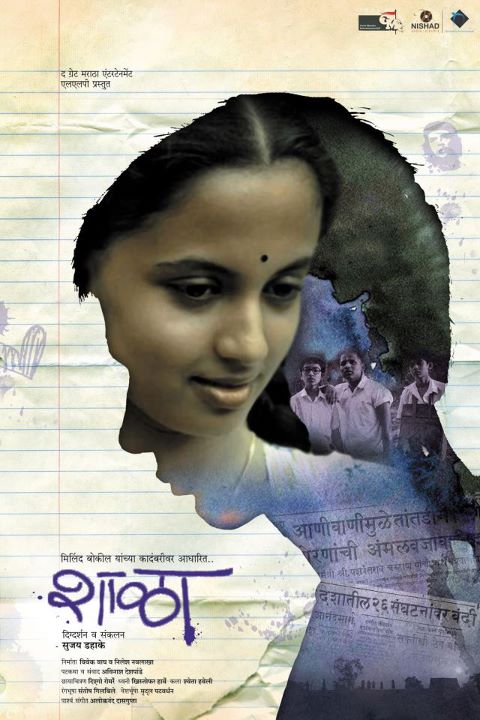
We never discussed this later on. But sometimes i still do think about the entire episode and a big smile appears on my face. For two hours i had the same smile on my face as i watched Sujay Dahake’s directorial debut Shala.
Based on Milind Bokil’s novel by the same name, this is an assured debut. And believe it or not, the filmmaker is just 25 year old.
The film doesn’t state anything new. It’s a trip down memory lane that you have seen many times before. Just the set-up is different and the faces are new. But everything is captured so well – it’s all about the silences, glances, moments and the memories. School, best friends, love, heartbreaks, first rush of hormones, crush on your favourite teacher and that first introduction to politics which tells you that the real world is not what it looked like so far – say it, and it’s all there.
Best thing about Shala is that it doesn’t look like a film at all. The acting is so natural, the camera is so non-intrusive and lingers on frames with so much ease that it feels as if someone just put a camera in a school. There is not a single false note in the family affairs too where the scenes are quite delightful.
The story is set in the backdrop of the emergency. Though it doesn’t add much political colour to the main story and which seems like a tokenism, but Sujay belongs to “subtle school of filmmaking”.
A common factor in any good film is that you will always remember a character who is there in just 2-3 scenes. Mr Joshi (lead character’s father) played by Nandu Madhav is that character in Shala. Watch him in the scene when he receives the letter from the school – knowing some of my friends and their strange equation with their dads, can bet that many people will wish that they had a father like him.
The lead actors played by Anshuman Joshi and Ketaki Mategaonkar have such a terrific and delicate chemistry between them that it’s impossible to believe that it’s just onscreen love. They do nothing heroic about their love story but those tender moments filled with soulful music are so powerful that they will stay with you long after you have left the theater.
Another place where it scores a high point is that the film doesn’t aim for the big bang climax. It’s all about the journey, it’s not a “destination movie”. Because the pain of growing up can’t have a happy ending. Nothing prepares you for the cynicism. The joy is in the journey. Shala celebrates that. This is what pure and uncompromising cinema looks like. And since that’s a rare genre in this country, i suggest you don’t miss this one.
Watch it. Watch it because nostalgia is a bitch, and when the bitch is so beautiful, there is no way out.
And what’s your class 9th story? Do tell us.
The film is playing at Mumbai’s 24 Karat Theater (Jogeshwari) with Subtitles. They have only one show at 3:30pm. If you know about any other show with subtitles, do let us know.
Click here to check out the official website of the film.
 F.i.g.h.t C.l.u.b