Rome_header_Wide_new(from Official release)

WHAT – ROME FILM FESTIVAL
(FESTIVAL INTERNAZIONALE DEL FILM DI ROMA)
Calls for Entries in all categories for 2013.

Fest Dates – The 8th Rome Film Festival will run November 8 – 17, 2013.

Basic Criteria – Only films that will be world premieres at the festival will be considered for selection.

SECTIONS –  The Official Selection will present two competitive sections for International films

1) International Competition (16 films, presented as world premieres)

2) CinemaXXI (21st-century Cinema, a selection of films devoted to new trends in world cinema, which will welcome feature-length and short films presented as world premieres)

– And a choice of Out of Competition screenings (a maximum of 12 titles, presented as world, international and European premieres)

– Last year, ‘Tasher Desh’ by Q and ‘The Museum of Imagination’ by Amit Dutta were the films from India which had their world premieres in the CinemaXXI Competition Section.

AWARDS – The festival will give out more than 12 awards for World Cinema.

– Last year, more than 2500 members of the major press and media and more than 800 professionals from all over the world attended the event, which will take place in the screening venues of the renowned Auditorium Parco della Musica, the multi-functional public complex designed by Italian architect Renzo Piano. CinemaXXI program will be hosted in the nearby MAXXI, the National Museum dedicated to contemporary creativity, designed as a multidisciplinary space by Iraqi-British architect Zaha Hadid.

– Films will also be offered the possibility to participate in The Business Street (November 13-17), Rome Film Festival program dedicated to the circulation, acquisition and sale of audiovisual products, which will be hosted in the area of Via Veneto, the famous street of Rome that was portrayed in Fellini’s classic “La Dolce Vita” and it is known all over the world for its cafés, restaurants and shops. The Business Street offer includes screenings reserved for industry professionals, buyers and sellers.

Eligibility Criteria: All submitted films must be recent productions completed not prior to Friday, November 29th, 2012. They must not have been presented in any other format or length, not even as works-in-progress, for submission to previous editions of the Festival. Under no circumstances may films that have had prior public screenings, have participated in other international festivals or are available on the Internet, be presented at Rome Film Festival.

– To submit a film to the selection, one has to fill out a pre-selection entry form on the official festival website (www.romacinemafest.org).

– The preview DVDs should be sent to Deepti DCunha, the India Consultant to Artistic Director, Marco Mueller.

– The DVDs should reach her before 1st September 2013. Filmmakers with films in post-production are requested to contact Deepti at the address below.

– All submissions (duly subtitled in English) should be sent to the contact details given below before the 1st of September.

Deepti DCunha, 23 Gautam Niwas, 7 Bungalows, Andheri West, Mumbai 400 053, India

Email: deepti.dcunha@gmail.com or d.dcunha@romacinemafest.org

– For complete rules and regulations please visit the Festival website at www.romacinemafest.org

– The festival’s Director Marco Mueller will be visiting India at the end of August for the final selection of films.

Filmmaker Anurag Kashyap did AMA on Reddit yesterday. Someone asked him about the state of Indian film criticism. His reply in one word was “terrible”. Well, it doesn’t take much brains to figure this out. Open the papers on Friday and you can see it all over. Not to mention the reviews by trade analysts which industry endorses most vehemently, and who then manipulates box office updates accordingly, the ones with agendas other than films, and then there are the paid and the plugged ones. It’s routine now. Nobody is shocked or surprised. And that’s the worst thing to happen – to get used to it.

With social media getting prominence and becoming at least some kind of parameter to get audience reaction, the game of making a “perceptive hit or classic” starts days before the release. You are blinded by the blitzkrieg, a kind of emperor’s new clothes. And journos who are suppose to tell you otherwise, they are happy to get their pictures clicked with the stars. Well, why am i ranting? Because today is friday. Because a bigger rant follows this one. And because we have always been accused of being biased for/against some films and filmmakers. Not to mention being branded contrarian for the sake of it. From saying Talaash works best when you know the spoiler to defending Shyamalan’s latest to liking Raanjhanaa’s 2nd half more to Ghanchakkar being not that bad what critics are saying. Here’s the latest one in the series – on Lootera. And am saying this even though i liked lot of things in the film, especially the 2nd half. And you have to watch it because it’s made by the same filmmaker who gave us Udaan.

So watch the film and come back to the post. Though it’s a spoiler free and you can read before watching the film too. This one is by a new author called Nicolas Bourbaki. Familiar? You will get to know him soon.

Lootera

Warning – this is NOT a review of the film. This is a rant. A wannabe brilliant piece in support of brilliant cinema and stemming from the rangat of self conceit. And even though it doesn’t have spoilers, it is recommended to not read this piece of crap before watching the film.

It’s 1.30 am in my bedroom. I’m alone sitting by the almirah with the king sized mirror. I look at my reflection. I have pain anguish angst remorse guilt redemption realization hope despair despondency writ all over my face. The fan whirls 7 ft above my head. It’s a second hand cheap 800 rupees fan which makes a whirrring noise. No PSPO unlike the film I saw. Bedbugs trouble me. I look at my freckled face. Time stands still unhealed by pain and unfettered by the nocturnal twists and turns of a solitary night. Half a drop of tear rolls over my eyelid, brimming over, somewhat reluctant to fall down. Yet it knows, and it can feel my melancholia. It knows it must fall down. But will it or will it not ?

आँसुओं की किंकर्तव्यविमूढ़ता हो तो ऐसी हो

Please bear with me dear reader. This is not another synopsis of Ship of Theseus.

What a brilliant film!

Brilliant cinematography. Such gorgeous frames. Color schemes which would guarantee taciturn unconditional approval by Kie-slow-iski. Yellow when the mood is prosperous. White when characters are fighting inner demons. Dark interiors for people with dark circles. Transitions from Puja/Ramleela fervor to fever-ish asthma attacks that Baradwaj Rangan would love to write thesis & books on. Aesthetics which are carefully calibrated to the exact precision so well that Light appears to meticulously obey both Particle & Wave theory simultaneously at the director (and DOP’s) will.

When the characters come to kiss each other in a Terrance Malick-ian way, there is just about enough background flare to make the moment surreal, yet real without the hyper reality of the scene underscoring the cinematic liberties. Equality Fraternity. That’s the French revolution all the way till 2008’s Entre Les Murs (Class) – maybe the director’s favorite film that year. Sheer class!

Breaths. Pauses. Stays. Beats. Playback songs. Measured. Sure. Nimble footed. Sometimes hurried. Sometimes slow. Asphyxiating. Liberating. Gesticulating. Pontificating. Prepossessing. Repossessing.

“चार बाल सामने चाहिए. सिर्फ़ चार बाल! मुझे एकदम Natural look चाहिए. बिल्कुल made up नही”.” – Steven Kapoor said.

“मैं पिछली picture का print Tirupati (Balaji) ले जाना भूल गया था. इसी लिए नही चली थी” – the producer from Ludhiana reasoned with him.

I suddenly observe. Snowflakes are falling on me. यारी रोड में बर्फ बारी ? हौले हौले धीमे धीमे. I quickly wear my color co-ordinated sweater and stand up with my arms folded out like Andy Dufrene. Epiphany striked, symphony plays – Costume Design and Art Direction should have had top billing over writer/director’s credit.

I scribble my review on a piece of paper with a Chinese fountain pen dipped in a दवात. Then tear it apart. Then do a for-next loop until fade out.

What a performance by the father (Barun Chanda). Ranveer Singh restrains in restraining himself while Sonakshi Sinha has all the reasons to have my sympathy. But for some strange reason my sympathies lie with my bums, which have been lying motionless for over the 2 hours, uninvolved, dis interested, dazed, waiting for a jump in my seat moment, a lump in the throat, a mournful sigh. They perhaps demand too much as they get only assiduously created multi-textured verisimilitude along with a velvet touch of a fabric. Kora kagaz tha yeh bum mera…..

I wanted to cry, to laugh, to be angry, nervously bite my nails, fight with the irritating uncle with the kid asking them to shut up instead of searching for adjectives to define the craft. Even some of the later films directed by Santosh Sivan were … (space left intentionally for background music).

Even a gunshot wound has been brilliantly (decorated) created with 50 shades of grey. Nerolac Nerolac Nerolac! Waah miyaan Henry! Life is a tale told by an idiot. All sound and fury. Signifying nothing. Like this rant perhaps.

As the song goes – (har ek frame ko) Sanwaar loon, Sanwaar loon.

(PS – And now the media blitzkrieg begins. All I can muster up is this –

लबों के सिलवटों से उप्पर सिकुड़ी हुई छोटी सी एक नाक है

रूह ही ना डाली पिक्चर पोस्टकार्ड में तो फिर खुजली मज़ाक है)

(PPS – what’s well shot, needs editing, slow pace and blah blah blah? Here you go.

Chor Chor Super Chor

Deepak Dobriyal has been missing in action for sometime. So it’s good to see him back, and that too in a leading role. Watch the trailer.

Official Synopsis

In the crowded bylanes of Old Delhi, Shukhla ji runs a photo studio that is a front for small time crime. Satbir, who is a part of this gang now wants to give up a life of vice and make a new beginning with his love interest – Neena. Is Neena’s keen interest in Satbir’s past only curiosity or is there a secret intent? Will Satbir finally win Neena? What happens to wannabe crooks Amol and Ronnie? Will Satbir be able to give up his life of crime?

Cast & Crew
Produced by: Ved Kataria & Renu Kataria
Directed by: K.Rajesh
Story: K.Rajesh
Screenplay: Ani Thomas & Radhakrishnan Cherpu
Dialogues: Alok Chaturvedi

Cast
Deepak Dobriyal, Priya Bhatija, Anshul Kataria, Paru Uma, Alok Chaturvedi, Brahma Mishra, Nitin Goel, Jagat Rawat, Chandrahas Tiwari, Anurag Arora, Shrikant Verma, Megh Pant, Avtar Sahani, Jatin Sarna, Gaurav Das

Production company: Katson Motion Pictures
Music by: Mangesh Dhakde
Cinematography by: Rakesh Haridas
Editing by: James.J. Valiakulathil
Sound Design: Niraj Gera
Art Direction: Suman Roy Mahapatra
Casting: Alok Chaturvedi
Lyrics & Choreography: Vibhu Puri
Executive Producer: Tushar Radhakisan Tupe

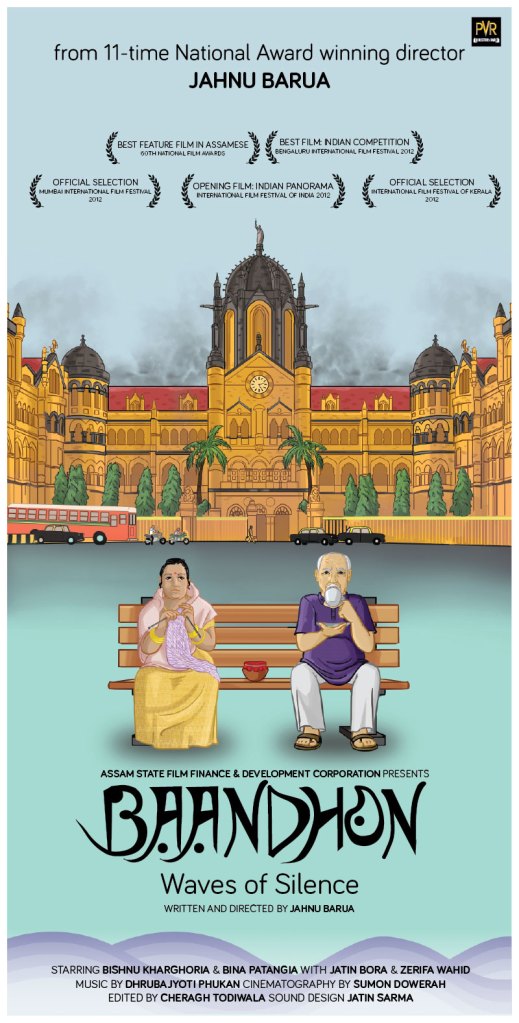
So Jahan Singh Bakshi gets to design his first film poster. And that too for a well know filmmaker – Jahnu Barua. His film Baandhon is getting a multi-city release this friday. Do watch the film if you can. And over to Jahan on “making of the poster”. Or should we say when Jahan met Jahnu 🙂 Anyway, go ahead and read this very interesting post.

943271_470624503025894_1991809589_n

Jahnu Barua’s Baandhon (Waves of Silence) will be releasing in select theaters across the nation this week, and thanks to Shiladitya Bora I had the great opportunity to design a poster for the film. I haven’t seen any of Jahnu Da’s work apart from his only (released) feature in Hindi- Maine Gandhi Ko Nahi Maara- which is something I hope to change soon. But I happened to meet the soft-spoken filmmaker once before during college in Calcutta and then recently in Bombay before getting to work on the poster and it was a pleasure on both occasions- even though he speaks so gently that one often has to strain to even hear what he is saying! Moreover, I spent much of my growing years in Assam and it is an honour to have an Assamese film from one of the most esteemed filmmakers from the region as my feature poster debut, especially since this is a first-of-its-kind Pan-India release for an Assamese film.

Anyway, back to the poster. Baandhon is a disarmingly sweet film  which beautifully shows the relationship between an old couple superbly played by Bishnu Kharghoria and Bina Patangia. The first half of the film plays out like a genteel comedy, with the old man and woman constantly bickering and then making up. It reminded me of so many old couples including my grandparents- they can’t live with or without each other. The second half of the film, where their grandson goes missing during the 26/11 attacks in Bombay is a comment on how it is the common man who bears the impact of the large scale politics and terror.

For me, one dialogue from the film pretty much summed it all up:

“We are common people. The world is too big for us. We have no choice but to trust in it.” 

Two simple people who live in their own small world oblivious to the harshness and the cruelty that lies outside.

Since the film’s look is pretty simple and basic, I wanted to reinterpret the film a little differently while maintaining this essence. I saw the film in two halves. When I am making a poster the first thing I look out for is an image from the film that stays with me. In the first half I would say this was the image that defined the film for me.

Jahnu]--330x220

The first thought was to use this image with the two on the rickshaw with the two holding hands in between. I loved the charming and hilarious first half of the film- I have to admit that I wished that the terror angle never came into the picture; I could watch these two quarrel endlessly!) However, I realized that the comment on terror and violence is an important part of the film and the Jahnu Da’s intent behind making it.

After watching the second half, I found what is easily one of the most haunting and defining visuals from the film:

Baandhon cover

So this was it. The old couple on a bench with the alien city of Bombay in the backdrop which could perhaps have a hint of violence or destruction. I deliberated on how I would depict Bombay in the backdrop and suggest violence without it becoming  loud or overwhelming. Ultimately I zeroed in on Victoria Terminus (you’ll see why when you watch the film).

The shot in question is from behind the bench, and Deepshikha Mondal (who did the title design and was to initially do the artwork) asked why can’t we use the exact shot from the film as seen above. It is a powerful visual, no doubt. But I insisted on sticking to a front-on view. Movie Posters are after all, commercial art and it always helps to have a face on a poster, especially when a lot of the audience know nothing about the film or its characters, and especially since we were going to have only one poster, it’s essential to make that connect. And it needs to stand out.

Besides, I have a soft spot for what I like to call the ‘dollhouse’ aesthetic, with a flat symmetrical design- reminiscent as many have pointed out- of Wes Anderson films. I wouldn’t say it is inspired by him- in fact my love for this kind of frame is what drew me to Wes Anderson’s films in the first place- but yeah, they do serve as a great reference point. Also I was keen to have a caricature style for the character design- to lend the poster freshness as well as capture the innocence and droll humour of the film.

Clients, as any designer will tell you, can be a nightmare to work with. At the very least, you need to show them exactly what you have in mind for the final design, or they can’t visualize it. (And I can tell you that even after they are executed completely, the best designs often lie unused and unseen.) And I have to really hand it to Shiladitya for not even asking a single question regarding what the poster would really look like. This is the sketch I first sent him, to give him a basic idea- and it really  is BASIC in the truest sense.

Baandhon

Sketch by Deepshikha Mondal

Anyway, I don’t know whether he really got the idea or just trusted me highly, but I really have to thank him for giving me a go ahead on the basis of this. It’s a big risk to take on someone who has done almost no independent posters before. Now the next step was to make the title logo and flesh out the character design and drawing style.

TITLE DESIGN

For the title design, Deepshikha suggested we create/use a font that is a fusion of the Roman and Assamese script and I was totally on board with the idea. Shiladitya didn’t like the initial title design (seen in the second image from top)- and I agreed that readablility could be an issue. However I was a bit stubborn here and managed to convince him that with bolder glyphs and minus some lines and curves it would be perfectly readable. I wanted this particularly because I wanted an Assamese touch to the poster, in the title, even if not in the image.

Untitled

Final Title Logo by Deepshikha Mondal

ILLUSTRATION/CHARACTER DESIGN:

We had already decided on a clean, caricature style for the characters- droll, but still serious. I wanted the feeling of two simpletons sitting on a bench a la Forrest Gump, looking straight ahead at the audience. Deepshikha made the first sketch- which didn’t quite turn out as I imagined it. We tried to rework the design as Deepshikha had seen the film and I thought she could give a nice, North-East Indian aesthetic to it. Unfortunately, she was piled with other work and we were way past deadline and running out of time.

altAp2kR3ddim3ConPGJPQ_Cuq4vVcxLUBlb6s0P53YwZad_jpg

First illustration by Deepshikha Mondal

That’s when Mrinal Roy came into the picture. I love Mrinal’s illustration work and I was working with him on another poster that should be out soon. I couldn’t give him a copy of Baandhon, which is why I didn’t approach him for this poster. However, now being short on time I got in touch with him and he agreed to do it at incredibly short notice. Mrinal is one of those guys who- unlike me- doesn’t speak a lot- so I never really know whether he’s getting my vision. Anyway, I sent him as many stills and promos off the net that I could find online along with references.

When I saw the first line-drawing, I breathed a HUGE sigh of relief. He had got it down pat  and pretty much nailed it perfectly.. I remember telling him that he could place the ‘kalash’ anywhere he wanted- in the center or the side (even though I preferred it  in the center). He sent me this, saying: ‘I put the kalash in the center because it belongs to both of them.’ That made me smile.

lineart

First cut- Character line-art by Mrinal Roy

The man’s face looked a little too angry, and the woman was a little too roly-poly and North-Indian. So the man’s eyes were to be made softer and sadder and the lady was to be put on a bit of a diet. That was fixed. Then came the background. I hadn’t asked Mrinal to put a lot of detail in the background- there was very little time and it wasn’t necessary. However, he absolutely floored me with the detailing he put into the Victoria Terminus sketch and the poster is all the better for it. My idea was to have a busy background and a clean foreground with gentle waves ending the picture. I think he got that right. The last thing to do was to add the smoke rising from the building which was my little contribution to the artwork.

Bandhon-Standee

The Final Poster

There are a few things I would have liked to change, if I had more time. Mainly the colours and the textures. Maybe a little more detail to say, the lady’s saree, etc. But I’m largely satisfied with the result and this was a great learning experience. Most of the credit for this however goes to Mrinal. Like I said before (the night I was sent the artwork):Screen shot 2013-07-04 at 12.05.06 PM

A thank you to a few more people:

Malvika Asher who suggested the font for the poster- Bariol was just the kind of clean, slightly rounded typeface I was looking for (it’s been used in the trailer too). Sidharth who painstakingly put it all together on Illustrator. Shiladitya and Jahnu Da for the opportunity. for And to everyone who has had kind and encouraging words to say about the poster .

Do watch the film, it releases in cinemas this Friday.

PS: Confession. I purposely didn’t send Shiladitya the line drawing and the in-progress pictures from the poster. Wanted him to see it in entirety before making any suggestions or changes. Thankfully, there were none. 🙂

Meghe Dhaka Tara – a Bengali film (with English subtitles) inspired by the life of filmmaker Ritwik Ghatak has released in Mumbai, Delhi and Bangalore this week. Do watch it quickly as it will be in the theatres for just a week.

The film is experimental in nature with its non-liner narrative and criss-crosses tracks between scenes from his films, his life and his plays. With the names of his films being changed, it might be difficult to connect if you are not aware of Ghatak’s films. Like the character is named Nilkantha instead of Ritwik Ghatak – the name of the lead character in Ghatak’s Jukti Takko Aar Gappo (Reason, Debate and Story). Or like Satyajit Ray is referred to as Arijit Ray in a dialogue. It’s quite an ambitious film and must have been a daunting task to put it all together. But even then it beaautifully captures the essence of Ghatak’s life and films – looking for his land, his country. It also has terrific performance by Sashwata Chatterjee who brings out the madness of the man brilliantly.

The film made me go back to Ghatak’s films and while googling, this is where i landed – a docu on him made for DD. It has some very interesting talking heads including my favourite actor Anil Chatterjee. Do check it out. Has some really great anecdotes.

– If you go to youtube, there are more such videos on various other filmmakers. Do check

– And click here to read an article where Aparna Sen and film’s director Kamaleswar Mukherjee discuss Ghatak and his films.

– Screening schedule

Meghe Dhaka Tara2

FD

This one seems like a great and unique retrospective. Check out the details and if possible, do attend it. Copy-pasting the info from the official release. And the best part – Entry is FREE!

(from official release)

Retrospective of Indian cinema and video
28, 29, 30 June 2013
FD Zone, Films Division, Mumbai

Print Courtesy: DFF, FTII, SRFTI, NFAI, NID

ENTRY – All screenings are free!

CURATED by – Ashish Avikunthak & Pankaj Rishi Kumar

SCREENING SCHEDULE

Day 1 – 28 June, 2013, Friday

Session 1: Experiments with Gods 

10.00-12.30 pm
A collection of early films made by D.B. Phalke between 1913 and 1935.
Raja Harishchandra (20 mins, 35mm, 1913)
Lanka Dahan (9 mins, 35mm, 1917)
Shree Krishna Janma (6 mins, 35mm, 1918)
Kaliya Mardan (50 mins, 35mm, 1919)

Session 2: Experiment in the State

 1.15- 3.45 pm
The earliest robust experimentation in India begins under the imaginative tutelage of Jean Bhownagary while he headed the Films Division in 1965.
Explorer – Pramod Pati (7 mins, 35mm, 1968)
Claxplosion – Pramod Pati (2 mins, 35mm, 1968)
Trip – Pramod Pati (4 mins, 35mm, 1970)
Koodal – Tyeb Mehta (16 mins, 35mm, 1970)
Abid – Pramod Pati (5 mins, 35mm, 1972)
Child on a Chess Board – Vijay B. Chandra (8 mins, 35mm, 1979)
India ’67 – S. Sukhdev (57 mins, 35mm, 1968)

Session 3: Experiment in the School 

4.00- 6.45 pm
FTII became the centre of experimentation soon after it was headed by Ritwik Ghatak. Since then, along with SRFTI, it has continued to be a space where experimentation in cinema occurs on a regular basis.
Bodh Vriksha – Rajan Khosa (27mins, 35mm, 1987)
In Short – Kuntal Bhogilal (18 mins, 35mm, 1996)
Repentance – Rajeev Raj (22 mins, 35mm, 1997)
Chinese Whisper – Raka Dutta (27 mins, 35mm, 2006)
Airawat – Renu Savant (10mins, 35mm, 2011)
Moon Stars Lovers – Jessica Sadana (10 mins, 35mm, 2012)

Session 4: Feature Film 1 – Kanchan Seetha (87 mins, 35mm, Malayalam, 1977) by G. Aravindan

7.00- 9.00 pm
Ending the first day with Malayali Filmmaker Aravindan’s masterpiece Kanchan Seetha – an invigorating reworking of the Ramayana, which opens up a new discourse on Indian cinema and its interpretation of religion. This film is located here to be in direct conversation with Phalke’s cinema of religiosity.

Day 2 – 29 June, 2013, Saturday

Session 1: Experiment with the Documentary
10.00- 12.30 pm

Documentary has been a formidable cinematic form in India. Although most innovation has occurred in world of the political, it has also has seen serious experimentation.
I am Twenty S.N.S. Sastry (20 mins, 35mm, 1967)
Tales from Planet Kolkata – Ruchir Joshi (38 mins, 16mm, 1993)
Brahma, Vishu, Shiva – R.V. Ramani (19 mins, video, 1999)
Presence – Ekta Mittal & Yashaswini B. R.- Behind the Tin Sheets Project (18 mins, HD, 2012 )
Nayi Kheti – Pallavi Paul (11 mins, HD, 2013)

Session 2: Experiments with the Short Film

Saturday, 1.15- 3.45 pm
This section focuses on films that were made outside the institutional framework of the state or the school and can be understood as independent experimentations, especially focusing on the short form.
Nirjan Godhuli – Santosh Gour (10 mins, 16mm, 1993)
Dust – Ashim Ahulwalia (20 mins, Video, 1993)
Atreyee – Shumona Goel (17 mins, Video, 2003)
Straight 8 – Ayisha Abraham (17 mins, Video, 2005)
Bare – Santana Issar (11 mins, Video, 2006)
Jan Villa – Natasha Mendonca (20 mins, HD, 2010)

Session 3: Experiments in the Gallery

4.00- 6.00 pm
In the last decade, the Art Gallery has become a vibrant space for exhibiting moving images mostly in the form of video art and installations. This section attempts to grasp with this new space of experimentation. It has been co-curated by Mortimer Chatterjee.
Record/Erase – Nalini Malani (10 mins, Video, 1996 )
Flight Rehearsals – Kiran Subbaiah (7: 26 mins, Video, 2007)
Dance Like Your Dad – Hetain Patel (6:15 mins, Video, 2009)
There is a spider living between us – Tejal Shah (7 mins, Video, 2009)
Man Eats Rock – Nikhil Chopra & Munir Kabani (22:11 mins, Video, 2011)
The First Dance – Hetain Patel (7:44 mins, Video, 2012)
Forerunner – Sahej Rahal (12:16 mins, Video, 2013)
File not Found – Jaret Vadera (1 min, Video, 2013)

Session 4: Feature Film 2 – Satah Se Uthata Aadmi (114 mins, 35mm, Hindi, 1980) by Mani Kaul

6.30-8.30 pm 
Mani Kaul is known mostly for his landmark film Uski Roti. However, the Satah Se Uthata Aadmi is probably his most conceptually rigorous and philosophically penetrating work. Based on the writings on Muktibodh, this film is a deep philosophical articulation on post-colonial modernity.

Day 3 – 30 June, 2013, Sunday

Session 1: Experiments with Animation

10.00- 12.30 pm
Co-curated by Nina Sabnani, this section examines experimentation in the world of animation. We shall look at the way in which animation directors have pushed the boundaries and expanded its scope in process, materials, concepts and its functions.

Session 2: Cinema of Prayoga

1.30- 4pm 
The invocation of “prayoga” from Sanskrit etymology is Amrit Gangar’s radical move of rejecting the Western art historical terminology of experimental and avant-garde to explain the specific nature of experimentation in Indian cinema. This section has been co-curated by Amrit Gangar.
And now i feel i don’t know anything – Kabir Mohanty (35 mins, 35mm, 2001)
Egotic World – Vipin Vijay (21 mins, 35mm, 2002)
Kramasha – Amit Dutta (22 mins, 35mm, 2006)
Vakratunda Swaha – Ashish Avikunthak (22 mins, HD, 2010)
21 Chitrakoot – Sambhavi Kaul (9 min, HD, 2012)

Session 3: Feature Film 2- Kaal Abhirati (120 mins, 35mm Bengali, 1989) by Amitabh Chakraborthy

4.15- 6.30 pm 
This is a significant film of this era that explores the complexities of human existence within the confines of Indian philosophy and discourse. This film, along with Kamal Swaroop’s Om Dar Badar, is the link between experimentations by Mani Kaul and Kumar Shahni and contemporary articulations by the ‘Cinema of Prayoga’ filmmakers.

Session 4: Round Table Discussion

6.45- 8 pm 
The curators along with filmmakers, discussants and respondents will have a Round Table conversation teasing out and putting on the board the major points/ issues /debates that have been brought out in these three days.

VENUE
RR Theatre, 10th floor, Films Division
24, Pedder Road, Mumbai – 400026

– The exhibitional emphasis of this retrospective has been to show almost all the works in their original format – 35mm, 16mm and digital video.

If you want to know more about this retrospective, keep reading.

– FB page of the event is here.

CURATORIAL CONCEPT

This retrospective is a celebration of the spirit of experimentation in Indian cinema; from the moment of its mythic birth in 1913, with Phalke’s Raja Harishchandra, to the innovative and challenging moving images produced and exhibited today. The films brought together chart the transformation of experimentation, from early celluloid spectacle to contemporary digital adroitness. The curatorial impetus of this retrospective is marked by an emphasis on tracing the chronology of experimentation through the history of Indian cinema. It halts at pit stops of radical moments of experimentation and underscores it.

The idea of ‘experimentation’ rather than the experimental or avant-garde drives the films put together in this retrospective. The conceptual rubric of this ‘experimentation’ traces its theoretical genealogy from Gandhi’s “Experiments with Truth” rather than the Western art historical lineage of experimental or avant-garde. Although these terms are temporally analogous to the 1920s and have an aesthetic origin, experimentation in Gandhi has a metaphysical, self-reflexive and ontological root.

In this retrospective, experimentation is viewed as a philosophical response to colonial and postcolonial modernity in India. These films challenge modernity by generating a contemplative dialogue with Indian history, tradition, culture and religion. Experimentation then becomes a dexterous rejoinder, like Gandhi’s experiments that rupture the trajectory of modernity. These are careful, controlled and meticulous interventions in the world of cinematic modernity, than fortuitous laboratory experiments. These films are not driven by the desire to just produce an aesthetic artifact, but rather to create a discursive field. Here, corresponding to Gandhi’s “Experiments with Truth” cinema is an engagement with the self, located in the world.

RETROSPECTIVE PROGRAM
The retrospective begins by underscoring that the moment of birth of Indian cinema with Phalke was the first experiment – the “Experiments with Gods”. The kinesthetic employment of the divine sparks a birth of a representation medium in India that catapults modernity and tradition into a cinema of religiosity – a dominant form of cinema of the silent era. Here, the cinematic apparatus becomes a technological conduit, comparable to the oral, the visual and the written, for the manifestation of that religiosity.

It was more than 50 years later that the first experimentation occurred within the bureaucratic confines of the post-colonial Films Division in the late 1960s. These films challenged the formidable account of the sturdy developmentalist state and shattered its edifying edifice. These were the first cinematic critiques of the nation – forthright, trenchant and angry. S. Sukhdev, Pramod Pati, S.N.S Shastry and K.S. Chari among others, radically altered the possibilities of cinematic representation in India.

Soon the films funded by Film Finance Corporation (later NFDC) ushered the much-celebrated rise of the Indian New Wave. Mani Kaul’s Uski Roti (1969) and Kumar Shahani’s Maya Darpan (1972) spearheaded profound experimentation in this period. However, the foundation of this continued experimentation was first established in the venerable FTII under the tutelage of Ritwik Ghatak. The section “Experiment in School” is a small curatorial gesture towards the pioneering works produced in its confines along with the later established SRFTI.

Just like the narrative feature, documentary, short film and animation were also formidable sites of experimentation. There are sections devoted to each of these forms in this retrospective that will showcase some of the most cutting-edge works made in recent times as well as in the past. The films in these sections push the boundaries of form and structure in a direction not seen earlier; like the enlivening usage of found footage or the construction of disjunctural narrative structures. Films were not only made with state funding, but also by filmmakers who were outside institutional settings.

In the last decade, the meteoric rise of contemporary Indian art along with the technological democratization of video has allowed for a productive intersection. Now galleries and museums have become fecund locations of experimentation in moving images. The section “Experiment in the Gallery” focuses on both established as well as emerging artists experimenting with digital video and specifically showing in the gallery/museum context. The works selected here are particularly single-channel works that also have exhibitive possibilities outside of the installation context.

Finally, the emergence of the term ‘Cinema of Prayoga’ coined by Amrit Gangar to challenge the hegemonic category of the experimental and avant-garde. It has been one of the most significant moves in the history of Indian cinema. The term ‘Prayoga’ in “Cinema of Prayoga” is in conversation with the Western art history term ‘experimental’, by unequivocally critiquing it. Simultaneously, it argues for a new imagination for comprehending idiosyncratic cinematic practices in India. It signals the conceptual inadequacy of the term ‘experimental’ and at the same time opens up a richer discourse to understand what is happening in India. It roots its discursive imagination within the world of Indian philosophical theories that accentuate temporal probabilities.

RETROSPECTIVE STRUCTURE 

This retrospective is conceptualized as a conversation with cinema, cinematic experience and cinematic thought. The curators hope that the three-day festival will provide opportunities for thinking through the nature of experimentation in Indian cinema in a historical fashion – the transformation of form and structure through time. The conceptual tension of terms like experimentation, experimental, avant-garde and Prayoga hope to be debated upon and thought through.

It also responds to the careless and ahistorical usage of the term ‘experimental’ in media and popular culture. It delineates a clear genealogy of experimentation and creates a lineage. More than a curatorial assertion, this retrospective is a historical framing of experimentation in Indian cinema. It builds upon the pioneering work of curators like Shai Heredia and Amrit Gangar, who have in the past decade signaled a robust nature of experimentation in Indian cinematic modernity.

As a disclaimer, it should be noted that this not a comprehensive historical delineation of experimentation in Indian cinema. Some key and very important works by filmmakers like Mani Kaul, Kumar Shahani, G. Arvindan, John Abraham are missing because the curatorial emphasis has been on showing rarer, and unseen films rather than known masterpieces.

The various sections of this retrospective are not mutually exclusive. Some films and filmmakers can exist in more than one section if not multiple. The quantum of experimentation in Indian cinema is multifarious; therefore as a curatorial policy we have decided to show only one film by a contemporary filmmaker. Due to time constraints, we have focused on shorter works rather than epic and longer works which are equally important. Here it is imperative to mention films by Amar Kanwar, Arghya Basu, Kabir Mohanty, and feature length narratives by Amit Dutta, Vipin Vijay and Ashish Avikunthak.

We would also like to note that the curatorial ambitions of this retrospective have been thwarted due to the lack of original prints for exhibition of some films that we would have liked to show. Here we would specifically like to name Kamal Swaroop’s Om Dar Badar (1988), S. N. Dheer’s Pratishodh (1982), Vishnu Mathur’s Pahela Adhyay (1981) and Nirad Mahapatra’s Maya Miriga (1983).

– The exhibitional emphasis of this retrospective has been to show almost all the works in their original format – 35mm, 16mm and digital video.

The office of the Director-General of Films Division who have artfully negotiated the bureaucratic maze of the Indian government to get us these prints have made this retrospective possible. We take this opportunity to thank them. We would also like to thank the National Film Archive, Pune, Directorate of Film Festival Delhi, Film & Television Institute of India, Pune Satyajit Ray Film & Television Institute, Calcutta and National Institute of Design for loaning us the prints for this retrospective.

CURATOR BIOGRAPHIES
– Ashish Avikunthak is a filmmaker, film scholar and anthropologist. He has been making films for the past eighteen years and his films have been shown in film festivals and museums worldwide. He is an Assistant Professor in Film Media at the University of Rhode Island and has a PhD in Cultural Anthropology from Stanford University.

– Pankaj Rishi Kumar is a graduate from FTII who began his career as an assistant editor on Sekhar Kapoor’s Bandit Queen. He has been working as a documentary filmmaker for more than 20 years and his work has been shown at festivals all over the world. He has won grants from Hubert Bals, IFA, Jan Vrijman, AND (Korea), Banff, Majlis, Sarai and Pad.ma and was awarded an Asia Society fellowship at Harvard Asia Centre (2003). He also teaches and curates.

Other Screenings

6th July : To Let The World In, Volume 1 by Avijit Mukul Kishore
13th July : To Let The World In, Volume 2 by Avijit Mukul Kishore
20th July: BIDESIA in BAMBAI by Surabhi Sharma

Bandhon-Poster-2

Jahnu Barua has won 11 National Awards. And there’s high chance that you might not have seen a single film of his, even if you are a die-hard film buff. The reasons and excuses can be many. So here’s your chance to change it. His latest film Baandhon is going to be released in 7 cities across the country, and with English subs. The film is being released under PVR Directors Rare banner and will have shows in Delhi, Mumbai, Kolkata, Chennai  (special screening on Saturday/Sunday), Bangalore, Pune and Ahmedabad.

– Baandhon (Waves of Silence) is the first Assamese film to be released outside the state. It is produced by the Assam State Film (Finance & Development) Corporation ltd. (ASFFDC) and has won the award for Best Assamese Feature Film at the 60th National Film Awards in 2012.  It opened the feature film section of Indian Panorama at the 43rd International Film Festival of India and was also screened at the International Film Festival of Kerala.

– The film is 96 minutes long and features Bishnu Kharghoria, Jatin Bora, Bina Patangia, Zerifa Wahid, Abastosh Bhuyan & Anshuman Bhuyan.

– Synopsis : Baandhon is a story of an elderly couple – Dandeswar and Hkawni whose lives are deeply impacted when their grandson goes missing in the attacks of 26/11 in Mumbai. The film captures the turmoil and the upheavals the couple goes through in trying to come to terms with the void that has been created in their lives forever.

And here’s the trailer of the film (with subs)

TRANLITE new low(1)

Filmmaker Anurag Kashyap and producer Guneet Monga under their banner, AKFPL, will be releasing SHORTS (a collection of 5 short films) on July 12 2013.

The films will be released by PVR Directors Rare across Mumbai, Delhi, Pune, Kolkata, Surat, Cochin, Ahmedabad and Bangalore in select theatres. The five shorts are directed by Shlok Sharma, Neeraj Ghaywan, Rohit Pandey, Siddharth Gupt and Anirban Roy. The films feature Huma Qureshi, Nawazuddin Siddiqui, Richa Chadda, Vineet Singh, Aditya Kumar, Ratnabali Bhattacharjee, Shweta Tripathy, Satya Anand, Preeti Singh among others.

Synopsis of the 5 Shorts –

1. SUJATA by Shlok Sharma

Starring: Huma Qureshi, Shweta Tripathi, Satya Anand & Aditya Kumar

– Sujata is a riveting tale of a young girl, who is struggling to come out of the clutches of her tormenting cousin brother. At a very young age, she is forced to live with her cousin and his family. Herein, begins a life of incessant harassment by her cousin brother.

Even as an adult she lives in the shadow of fear. For years, she changes addresses and identities in the hope of finding freedom; but each time he hunts her down. Neither the police, nor the NGOs are able to help her. Pushed to a corner, she decides to take the extreme step.

2. EPILOGUE by Siddharth Gupt

Starring: Richa Chaddha and Arjun Shrivastav

A relationship that has already fallen apart and is just about to snap. It describes the love and intimacy, the entangling of two lives and the completely symbiotic nature of a couple.

It reflects the possessiveness control isolation, depression and desperation that a relationship can lead to, representing a cycle that needs to be broken in order to keep sane.

3. AUDACITY by Anirban Roy

Starring Preeti Singh, Sankar Debnath and Kanchan Mullick

A thirteen-year-old girl has her first real confrontation with authority when her father forbids her to play the American dance music she loves. When she decides to take revenge, the situation escalates to become a neighbourhood scandal.

A dark comedy about parental authority, teenage rebellion, curry, whiskey, and house music.

4. MEHFUZ by Rohit Pandey

Starring: Nawazuddin Siddiqui and Aditi Khanna

In an ambiguous space and time. The city has turned mad, as violence has taken its toll. But, far away in the sounds of silence at the border of the town, a man takes care of all the death around. He drags away this usual routine with every passing night.

One night, he notices a strange woman wandering on empty streets. As her behavior changes, so does his journey.

5. SHOR by Neeraj Ghaywan

Starring: Vineet Singh and Ratnabali Bhattacharjee

Lallan and Meena, a couple from Banaras, are consumed by their pursuit to survive in the city of Mumbai. Meena takes up a job in a sewing factory.

One day over a phone call, they find each other while embracing death, divorce and redemption. It takes the darkest hour of our life, the fear of death, to regain our consciousness back in to life. To find the beauty that is lost in our relentless angst towards an unyielding life.

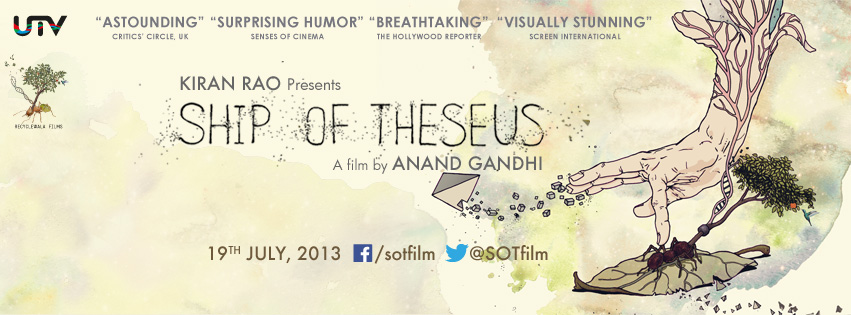
Ship Of Theseus

With UTV and Kiran Rao in the picture, Anand Gandhi’s Ship Of Theseus is getting some much deserved attention. The film is scheduled to release on 19th July in Mumbai, NCR, Kolkata, Bengaluru and Pune. To get the film released in other parts of the country, one  can now VOTE for it. This kind of “Demand the film in your city” initiative is quite common in US and they have been able to release many films through it. Good to see the idea being tried here.

So if you are not from Mumbai, NCR, Kolkata, Bengaluru or Pune, this what you need to do watch SoT in your city – To submit a vote one needs to visit the ‘Ship Of Theseus’ Facebook page with or without logging in. And then go to ‘Vote For Your City’ tab and cast your vote. Cities that hit the 100% mark will see a guaranteed release.

The options include, but are not restricted to, Ahmedabad, Allahabad, Aurangabad, Baroda, Chandigarh, Chennai, Hyderabad, Indore, Jaipur, Kochi, Lucknow, Ludhiana, Raipur, Rajkot and Surat. To choose any other Indian city, click on the ‘Others’ option and type out the name of your preferred location. Click ‘Submit’ to finalise your vote.

Click here to VOTE and DEMAND Ship Of Theseus in your city.

There’s only one reason why you should vote and demand the film – It’s easily one of the best films of the year. And you need to see it on big screen. Don’t get scared by it’s title if it seems pretentious to you. The film is accessible to anyone.

– To watch its trailer, and to read the synopsis, click here.

– Our recco post on the film is here, here and here.

Raanjhanaa(Has SPOILERS)

Like most Bollywood films these days, Raanjhanaa is completely two different films packed in one – pre and post-interval. One is the “politics of love” and the other is “lovers in politics”, and there’s a big difference between the two. As the initial reactions and reviews started pouring in, the verdict seems to be unanimous – first half is fun, the curse of 2nd half strikes yet again. As i stepped into the theatre, i was ready for it. But as i came out of the theatre, i realised that i belong to that minority group which liked the second half more.

First half is easy, you know the tricks, you have seen it many times, love stories in small towns and galli mohalls is not new. It’s charming and easy to like. There’s no way one cannot not like it. Some might argue that it’s stalking and glorification of it, then let me say that you have never been part of any small town love story. It’s stark reality. That’s the way it happens. If you don’t know a friend who has cut his wrist or drank kerosene (sleeping tablets is for metroes), the film might seem a bit stranger to you. But what stood out for me was how ruthlessly selfish the lovers are. Sonam (Zoya) knows Dhanush (Kundan) loves her. And so she uses him in every possible way. It’s the same with Kundan, who knows that Swara (Bindiya) can do anything for him. And he uses her blatantly. It all seems fun and jovial on the surface but scratch it and you realise how cunning their acts are. It’s the politics of love. Their love might be pure but the tricks aren’t.

Some even might point out the physical equation between Kundan, Bindiya and Murari. How can you hit her? i would say this is what “camaraderie” between friends is all about, without being aware of one’s gender. And in the scene when Bindiya says kewal mere baap ke hi kapde phadega, and Kundan backs out, you know that she isn’t the shy kind. If she had protested, these guys would have backed out long back. It’s part of the game, of growing up together.

Now, the second half seems like a completely different film.  A death, and the childhood romance of Benaras moves to ambitious student politics of Delhi. Kundan doesn’t know why he is there. He is lost. He is not sure what to do with his life. He has tried every possible option. Is he still chasing Zoya? Yes. Kind of. Does he know why? No. Has he any more hopes from her? No. The simple chasing the girl routine turns into a heavy cocktail of ambitions and emotions. Let’s see how. So Zoya aspires to fulfill the ambitions of her dead lover (Abhay/Akram). But slowly it looks like all these dreams will come true only through Kundan whom she hates now, whom she holds responsible for Akram’s death. It’s a difficult choice to make. Can she accept Kundan now? And even if she does, the world will curse her for being selfish and opportunist who forgot her lover after his death. Between love, life and dreams, she is confused with no easy way out. And then comes an opportunity to turn it all over and conquer it all. She opts for it too but the guilt is too heavy to bear.

Kundan is caught in a similar situation. He is aimless, he is just tagging along and is getting lucky wherever he puts his foot, except in love. And when it all comes to the conclusion, he realises that even if he wins everything, he has lost the only thing he ever wanted from life – love. So what’s the point of living? Someone who can slash his wrist so easily, he has no fear of death. The monologue in the climax wraps it up beautifully. Lovers always claim to be ready to die in love. But only few dare to do it. And very few directors and writers dare to opt for such uncompromised end for a love story. Nothing else was possible. All credit to writer Himanshu Sharma and director Anand L Rai for going the whole hog. And this is exactly why i liked the second half more. It’s complicated,  and the makers went for the unusual choices. I think first half is easy to write, and easy to like. Second half is damn difficult to write from the point when Dhanush lands up in Delhi not knowing what to do. I could hear the writer’s voice there – what to do with this mujhe-bus-Zoya-chahiye character? He (character and writer) really doesn’t know what to do now.

Raanjhanaa2

Now, the running joke. In a scriptlab where Sriram Raghavan was our mentor, we used to joke that whenever you are stuck at any page, just put a gun in that page. Sriram will like it for sure. Here the formula is slightly different – stuck on the page, opt for the blade. Not once or twice, but three times. Woah!

Interestingly, the entire film is one long montage cut on back to back songs. You can exactly count the numbers of the scenes where the characters talk. But the flavour of the real locations and the terrific acting by Dhanush, Swara Bhaskar and Mohammed Zeeshan Ayyub makes it look perfectly smooth. Also, it might be a smart decision keeping Dhanush’s dialogue delivery in mind. They have justified his character, and his hindi diction is weird but it’s not jarring to ears. So a big credit must go to its music director A R Rahman. His music is the thread that holds this complicated tale of unrequited love together. Sonam seems to have improved a lot from her previous films but her dialogue delivery is still irritating. And Kumud Mishra is always quite pleasant to watch onscreen.

I never bothered to watch Rai’s earlier films. But going by Tanu Weds Manu (i like it and TERRIFIC album) and Raanjhanaa, i think Imtiaz Ali has some competition finally. Especially if it’s matters of hearts in small towns. And Dhanush, welcome to bollywood.

Watch it. And if uncomfortable, take off your “metro” shoes.

@CilemaSnob