Posts Tagged ‘PVR Directors RAre’

Kamal Swaroop’s cult classic Om Dar B Dar has been restored and will have a release on 17th January, 2014. PVR Director’s Rare in association with NFDC is doing the release. Don’t miss this film. A new trailer of the film is just out.

ODBDOfficial Synopsis:

As Om rides a bicycle, scissor-legged, the landscape (Pushkar-Ajmer) resounds with distinctive voices: his father’s rebellions against the world, his ‘bold’ sister, her gentle suitor, the searching eyes of the runaway actress, the local businessman trying to protect the diamonds he has shat…the rebellion of the tadpoles. The filmmaker takes on the frightening, beautiful energy of adolescence – to joyfully shake open the landscapes of his own childhood, unearthing, and mixing politics with mythology and techno music with biology for Alchemy.

Director’s statement:

I was assistant on Richard Attenborough’s Gandhi. The scale of production had made extras of large sections of the population of Delhi: the whole exercise had become an army operation, and we the big general’s lieutenants, the ring master’s sidekicks, arranging those masses on the sides of the roads so that the story of Gandhi could walk and blossom forth. The tear in the upholstery of my hotel room chair became a glad reminder of human life as I knew it. Inspired by the missing piece of cloth, I began spinning a parallel story about a town I grew up in and an adolescent who rode his bicycle scissor legged. The story grew and wanted to take on the larger production within which it was incubated. The boy therefore had to be called Om.

Cast & Crew

Cast – Anita Kanwar, Aditya Lakhia, Gopi Desai, Manish Gupta

Running Time – 101min

Year- 1988

Screenplay – Kamal Swaroop

Cinematography – Ashwani Kaul

Editing – Priya Krishnaswamy

Music – Rajat Dholakia

Sound – Kamal Padmnabhan

– To read more about the film, click here and here.

– Fan poster by Kabir Chowdhry.

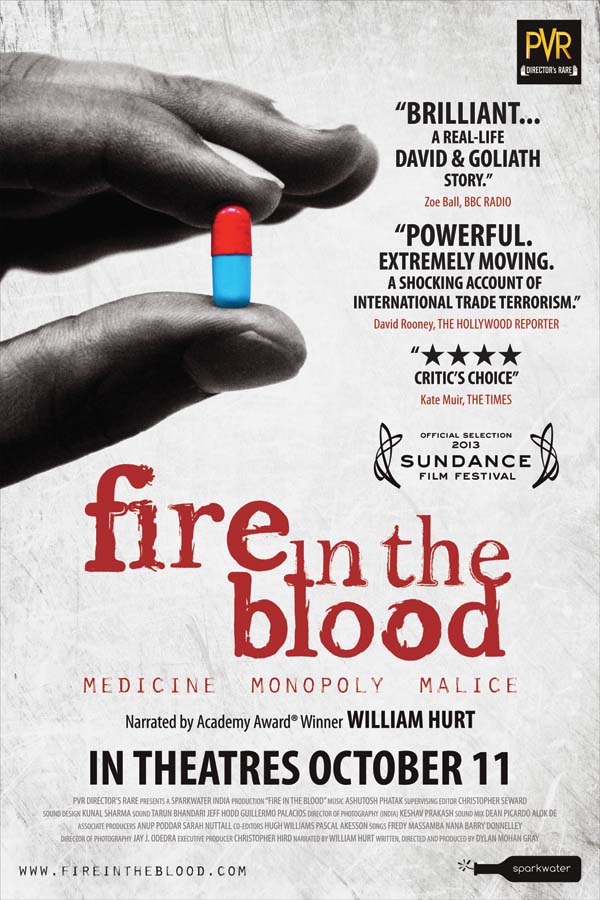
FITB Pvr StandeeThe documentary film, Fire in the Blood, which was selected for the World Cinema Documentary Competition at the Sundance Film Festival, one of the most prestigious and competitive festival for independent films, is releasing today (Oct 11).

Directed by Punjabi-Irish filmmaker Dylan Mohan Gray, the doumentary is an intricate tale of ‘medicine, monopoly and malice’ and tells the story of how Western pharmaceutical companies and governments aggressively blocked access to low-cost AIDS drugs for the countries of Africa and the global south in the years after 1996 – causing ten million or more unnecessary deaths – and the improbable group of people who decided to fight back.

Shot on four continents with contributions from global figures such as Bill Clinton, Desmond Tutu and Joseph Stiglitz, Fire in the Blood ultimately celebrates the remarkable coalition which came together to stop ‘the Crime of the Century’ and save million of lives in the process. The narration is done by Academy Award winner William Hurt.

The film is released by PVR Directors Rare in India.

INFO

To know more about the film, click here to go to its official website.

TRAILER

REVIEW

To read the review of the film by Mihir Fadnavis, click here.

SCHEDULE

FIRE IN THE BLOOD/ WEEK 1/ OCT 11-15


Delhi NCR


PVR Director’s Cut Vasant Kunj

6:20 PM


PVR Select Citywalk Saket

9:00 PM


DT Cinemas Saket

8:40 PM


DT Cinemas Vasant Kunj

8:50 PM


PVR MGF Mall Gurgaon

9:00 PM


Mumbai


PVR Juhu

6:00 PM


PVR Phoenix Mills Lower Parel

8:35 PM

10:45 PM

Cinemax Versova

6:30 PM


Bangalore


PVR Forum Mall Koramangala

10:00 PM


Pune


PVR Koregaon Park

5:35 PM


Kolkata


PVR Diamond Plaza Jessore Road

1:45 PM


Ahmedabad


PVR Acropolis Mall

4:50 PM


Releasing in Chennai on October 18


Since crowd-funding is in vogue these days, it’s good to see the trend going beyond Hindi indies. If our friends are to believed, Lucia is the first Kannada film to be crowd funded. We don’t have much clue about this one but it surely looks interesting. It’s written and directed by Pawan Kumar and will release with English subtitles. The film is released by PVR Directors Rare.

Lucia

Official Synopsis

From the director of smash hit Lifeu Ishtene, comes Lucia, heralding a new direction for Kannada cinema, being the industry’s first crowd funded film. An usher at a decrepit cinema suffers from insomnia. His life changes when he starts getting weird and wonderful dreams but with a caveat. Set in the teeming young metropolis that is Bangalore, the film is a turbulent ride where the lines between dreams and reality are blurred to delirious effect. Please don’t reveal the ending after you’ve watched the film. Prepare to be surprised, very surprised.

Trailer

Show Timings

Lucia2

– To know more about the film, click here.

– To read the filmmaker’s blog, click here.

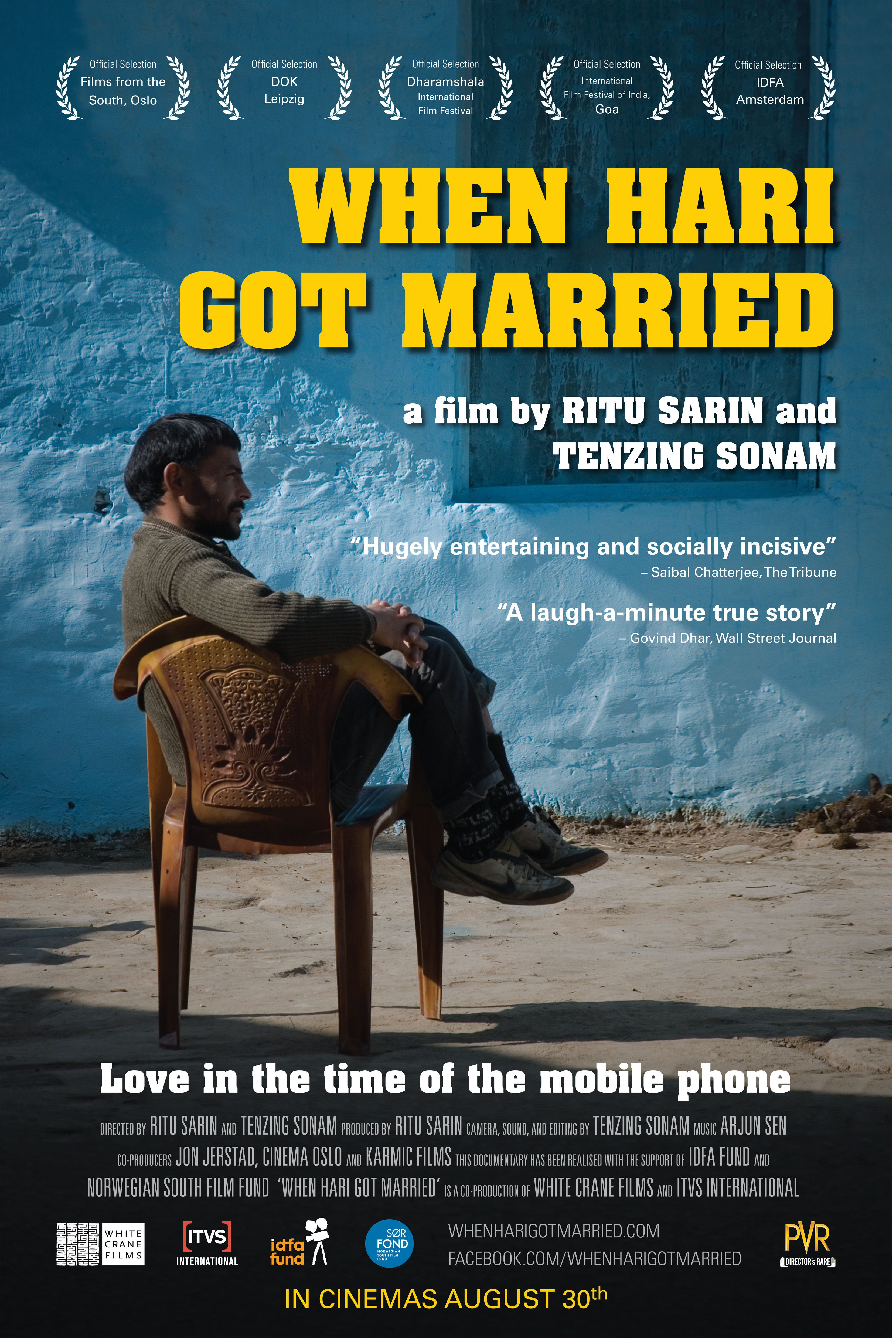
When Hari Got Married, a documentary film by Ritu Sarin and Tenzing Sonam is releasing as part of the PVR Director’s Rare series from 30th August at PVR cinemas in Delhi, Gurgaon, Mumbai, Pune and Bangalore.

“When Hari Got Married” takes a humorous look at Hari, a taxi driver from Dharamshala, as he prepares for his marriage to a girl he has only seen once, and that too, with her face covered. Hari’s frank and outspoken views on love and life, his unusual courtship on the mobile phone, and his eventual marriage provide a warm and illuminating insight into the changes taking place in India as modernisation and globalisation collide with age-old traditions and customs.

More on the film

translite-final-rgbHari, a 30-year-old taxi driver, lives in Dharamshala, a small town in the Himalayan foothills. He is getting married to Suman, a girl he has never met.

Tradition dictates that Hari and Suman will only see each other on the day of their wedding. But Hari has found another way to get to know her: on the mobile phone. Over the past few months they have spoken to each other every day and have fallen in love.

Hari and Suman see each other properly for the first time during the wedding ceremony. Will their telephone love prove strong enough to overcome the awkward obstacles of an arranged marriage?

Hari’s unusual courtship and marriage, coupled with his frank and humorous confessions of fear, doubt, hope and anticipation, provide a warm and illuminating insight into the changes taking place in India as modernisation and globalisation collide with age-old traditions and customs.

A co-production of ITVS International and White Crane Films. With additional funding from IDFA Fund, Amsterdam, and Films From the South, Oslo.

About the filmmakers

Ritu Sarin And Tenzing Sonam are an Indian-Tibetan filmmaking team based in Dharamshala, India. They worked as independent filmmakers in San Francisco and London before moving back to India where they are based in Dharamshala.

Working through their film company, White Crane Films, they have produced and directed several documentaries, mostly focusing on Tibet-related subjects. These include: The Reincarnation of Khensur Rinpoche (1991), The Trials of Telo Rinpoche (1993), and The Shadow Circus: The CIA in Tibet (1998). In 2005, they completed Dreaming Lhasa, a dramatic feature film executive produced by Jeremy Thomas, which premiered at the Toronto International Film Festival. They have also worked on video installations, including Some Questions on the Nature of Your Existence (2007), which was shown at the Mori Art Museum in Tokyo and the 2010 Busan Biennale.

Their feature documentary, The Sun Behind the Clouds: Tibet’s Struggle for Freedom (2009), won several awards including the Vaclav Havel Award at the One World Film Festival in Prague. When Hari Got Married is their most recent film. Ritu and Tenzing are also directors of the Dharamshala International Film Festival, which had its first edition from 1-4 November 2012.

With the release of Ship Of Theseus, we are not only debating its merit (here and here) but another conversation has started on social media – about ticket prices. Why is it so expensive? Should indie tickets be less expensive? Is it even possible? Well, we do believe that if a film is great, it’s worth the ticket price. But if you are still bothered about the price, here’s Shiladitya Bora on why it isn’t so easy to control ticket prices.

cinema

To be brutally honest, no one (and that includes me as well) genuinely knows what is the best way to distribute an Indian Indie in India. The revival of Indian Independent film industry has just started and it is currently in a very nascent stage. We all are experimenting and trying to identify the best case scenario factoring all the constraints (read quality of the film, limited appeal, limited marketing budget and resources etc). There is no one single formula applicable for all Indies and each film requires a customized plan. While owning theatres/ screens (like in case of PVR) helps a bit to screen indie content; other distributor(non cinema owners) mostly rely on relationships built over years with programmers and cinema chains to be able to screen indies.

Whenever an indie releases we see people starting endless debates on the social media platforms with respect to shows, show-timings, ticket prices etc. In order to make the most out of these debates it is of pivotal importance to first have our basics right.

1. So who actually decides how many shows to be allocated to an indie and in which theatres?

For an indie releasing on a Friday, on the preceding Monday the distributor send show requests (wish list in terms of cities, theatres, number of shows, show timings) to the programming teams of various cinema chains. The concerned programming teams then works out a tentative showcasing plan based on factors like the number of films releasing on that particular Friday, performance of last week releases, expected target audience of the film, past performance of similar indies etc. This tentative schedule is then shared with Cinema Operations Team for final approval.

Cinema Operations – Each theatre is managed by a cinema manager who has a target to achieve in terms of number of admits, ATP (average ticket price), SPH (sales per head) – a daily target, weekly target, monthly target, quarterly target and annual target. The career of a cinema manager is directly proportional to these targets and hence all his/her efforts are focused on optimizing the same.

Statistics show that the performance of Indian Indies is abysmally poor in all the three parameters – admits, ATP and SPH and hence not many cinema managers are keen on showcasing Indies at his/her property. So if we want Indies to be released in as many theatres as possible, we need to make the people who run the cinemas confident about the product and this is possible only when a few Indies start performing.

So we come to the next big question on ticket pricing.

2. How is ticket pricing decided?

Every cinema has to operate within price bands pre-approved by the government and no theatre can sell tickets below the lowest price band. The best thing an indie distributor can do is to request the respective cinemas to run the film on the lowest price band and it’s at the discretion of the individual cinemas/ Operations to agree to the request or not.

In addition to the above there is a regular pricing and a blockbuster pricing. Blockbuster pricing is applicable during weeks of tentpole/ big releases and in case an indie is releasing in a week with a tentpole film, blockbuster pricing is applicable to the indie as well in most cases.

We are trying to work out a special discounted price band for Indies released through Director’s Rare.

Another solution can be government waiving off the E.Tax for Indies but for that we need clear cut guidelines to define a film as an independent film.

 3. At PVR Director’s Cut, Vasant Kunj, Delhi, the ticket price of an Indie is above Rs. 1000. Why?

First of all I would like to clarify that PVR Director’s Cut and PVR Director’s Rare are 2 different things. PVR Director’s Cut is a super luxury premium theatre located at Vasant Kunj, New Delhi where as PVR Director’s Rare is a banner for theatrical distribution/ showcasing of niche content.

Director’s Cut being a premium theatre, not only Indies but every film is at a premium price. This is like the Business class of an airline and we have a dedicated clientele for this property.

Now the question is if Director’s Cut is a premium property, what is the point of releasing an Indie there?

There are a few reasons for the same.

First it has always been a struggle to get screens for an Indie in Delhi as most of the multiplexes in Delhi have 3-5 screens which is not enough when compared to the number of films releasing in a particular week unlike that in Mumbai, Bangalore, Pune etc.

In PVR Director’s Cut, there is one dedicated auditorium for showing alternate content and hence we always get a show there. And I have always believed that it is better to release the film in Director’s Cut rather than not releasing the film in Delhi at all. In most of the cases we release the film simultaneously in PVR MGF Mall/ PVR Ambience Mall etc, which are regular priced cinemas.

Also if we analyze the total box office earnings of an indie in most cases (not all), a major percentage of the collections is from PVR Director’s Cut. This is because the producer’s earnings on a ticket of Director’s Cut after tax are almost 3-4 times as compared to a regular cinema.

4. In Delhi, the spread of theatres for Indies are mostly limited to South Delhi. Why is this so?

We have to understand one thing that when a film is released, there is a cost attached to it.  For releasing a film in one show in one theatre, the total expense on content comes to around INR 18000 per property per week ( INR 14000 Virtual print fee + 12.3% tax + INR 2000 for cloning and cargo). For a producer to recover this cost on content, we need net box office sale of close to INR 40-45000 for that particular property. So as of now it is really not a very good decision to release such niche content in theatres other than in South Delhi. May be in future once the market matures, we will be able to spread the reach all over Delhi NCR.

All said and done we must rejoice on the fact that this is perhaps one of the best phases to  be in for an Indian Indie filmmaker and the future will be better.

A few observations/ suggestions which may be useful for aspiring Independent filmmakers.

Make a kickass Indie. There is no substitute to that. No amount of support, gyaan, strategy, patronizing, social media buzz can save a bad/mediocre indie. Do not compare with Rowdy Rathores of the world because that industry works on a completely different dynamics.

When you are planning an indie, in case you do not have access to marketing and distribution budget of around INR 1.5-2 crores, the production cost of your indie should not exceed a few lakhs at any cost. But is it possible to make a good film with such minimal amount? Read about Karan Gour’s KSHAY, which I consider as a classic case study of a successful Indian Indie.

Do not try to do everything yourself. Not every one of us is a Robert Rodriguez. I know we have budget constraints but it is always better to rope in professionals wherever possible and do pay them a fee (whatever best you can afford). Know your weak spots. For e.g if you are not very good at writing, it is always advisable to hire a screen writer to write the screenplay for you. You will find many talented screenwriters willing to help you out. Roping in professionals will definitely help in raising the quality of the final output.

Once you have made a good film, invest some money in hiring a good intelligent publicist who will help with creating the much required aura around the film. Rope in a good designer and get some good artwork ready. Invest in a professional promo editor. These are few small things but if done properly will go a long way in packaging the film well which in turn may yield better results during distribution phase.

(Shiladitaya Bora manages PVR Director’s Rare and has been actively involved with the theatrical distribution of more than 30 independent films)

Pic Courtesy 1 / 2

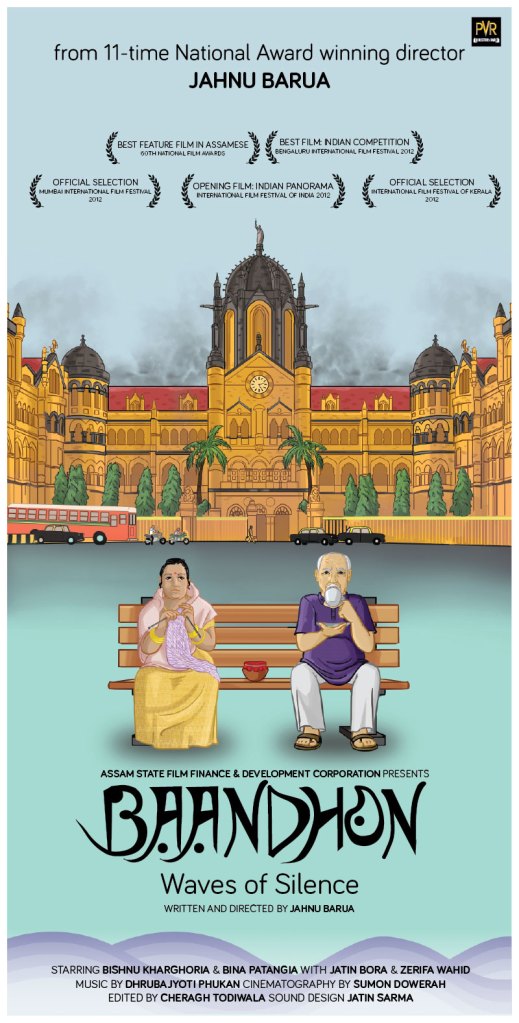
Baandhon is the first Jahnu Barua film to get a multi-city release outside Assam. Thanks to PVR Directors Rare. For cities and show timings, do check the poster below. And here’s Pradeep Menon on the film.

943271_470624503025894_1991809589_n

The media, social and otherwise, has been abuzz with the latest Hindi release; an exciting, talented director’s sophomore feature, one that is making critics and audiences alike gush over gorgeous frames, celebrate the coming of clean cinematic craft, and most importantly, reminisce about romances of the days of old.

Indeed, sometimes one can’t help but feel that, in this day and age, we’ve all forgotten how to fall in love. We’ve forgotten what it is like to drown oneself in that heady rush of a new romance, embrace unbridled passion today like there isn’t a tomorrow and push the limits of rational behaviour in the pursuit of real life moments that make us feel like we’re living a movie.

But here’s the thing about romance – it always dies away. No question about it. So what remains then? What happens when you spend years, or even decades, with a person? Hopefully, once the romance, the passion and the giddy joy of the other’s company gradually ebb away, what you’re left with is respect, stability, comfort, and, if you’re extremely lucky, a lifelong friendship.

That, precisely, is what Jahnu Barua’s ‘Baandhon’ (“Waves of Silence”) is about. On the surface, it appears to be about the complex relationship shared by a married couple; a man and a woman who’ve spent nearly their entire life together. But if you really pause to think about it, it is quite simple. Their love has evaporated perhaps, but they are left with the next best thing – companionship.

Baandhon spends more than half its run-time soaking itself in a single fight between an aged husband and wife; a couple that has already been bereaved of its offspring, and is now solely alive for their grandson, who studies in IIT Mumbai. However, right from the outset, we know that this fight isn’t for real. They’ve done it to death umpteen times before, and it is perhaps the only thing that keeps them going on a daily basis. One ticks because the other is.

But, before we even see the couple for the first time, we are told the date of the fight. 26th of November 2008; a day that sent waves of silence of its own, all around the country. And immediately, you know that this is a story that is always going to end in some sort of a tragedy.

Barua, then, with his decades of filmmaking experience and multiple National Awards, chooses to douse his narrative in such minimalism and sparseness that not only is there never a twist, but there also isn’t even the anticipation of one. The terse inevitability of the path the film traverses is always writ large over the goings-on, and yet, Baandhon gently attempts to reaffirm faith in humanity while admitting that somewhere along the way, humanity has failed.

Reminiscent more than once of Mahesh Bhatt’s ‘Saaransh’, yet largely steering clear of some of the harsh questions and issues that Bhatt’s film raises, ‘Baandhon’ roots itself in economy of craft and storytelling. Even the background score of the film tries its best to camouflage itself behind the visuals; so rare for Indian cinema today, which nearly always attempts to elevate every emotion with over-the-top mood music embellishment.

There isn’t an overt attempt at displaying craft or technique here. Baandhon could easily have been a play. It is set mostly in Guwahati, before the climax, if I can call it that, shifts to Mumbai. Yet, there is no attempt to give the film a texture that sets it in a particular time or place. It could be happening anywhere, at any time. The 26/11 backdrop gives it a real world context perhaps, but even that could just as easily have been a fictional human tragedy that only needed Mumbai to be the place it occurs in. This of course, is clearly intentional on Barua’s part. If you’ve watched ‘Maine Gandhi Ko Nahin Mara’, you know that he’s fully capable of creating a perceptible flavour of place and time.

Baandhon also has no solutions on offer. In fact, it hardly asks any questions. All the film does is give us a brief window of a few days, into the life of a man and woman who, after 73 years of their life, have only each other, even if their journey brings in their path a few kind souls who unselfishly look out for them. It is in these side characters, the ones that attempt to show you that humanity has hope after all, where the film really falters. Our cynical selves will find it hard to swallow the genuine goodness that the peripheral characters go out of their way to shower on our protagonists.

It doesn’t help that most of these side characters aren’t particularly well performed either. Even Bina Patangia, who plays one half of our couple, has an adorable character to fall back on, but her performance itself is mostly functional. Only Bishnu Kharghoria, who plays the husband, truly manages to turn in a memorable performance.

Despite some almost naïve writing and characterization, it is in its silences and pauses that Baandhon’s honesty shines through. This honesty draws you in and makes you want to sit right next to the couple as they deal with loss. Yet, just before your hand reaches out to caress them, you realize that they still have each other. And as you draw your hand back and walk away from them, all you really tell yourself is that perhaps that is all one needs – another person to fall back on, forever.

( To read more posts by Pradeep, you can check out his blog here)

So Jahan Singh Bakshi gets to design his first film poster. And that too for a well know filmmaker – Jahnu Barua. His film Baandhon is getting a multi-city release this friday. Do watch the film if you can. And over to Jahan on “making of the poster”. Or should we say when Jahan met Jahnu 🙂 Anyway, go ahead and read this very interesting post.

943271_470624503025894_1991809589_n

Jahnu Barua’s Baandhon (Waves of Silence) will be releasing in select theaters across the nation this week, and thanks to Shiladitya Bora I had the great opportunity to design a poster for the film. I haven’t seen any of Jahnu Da’s work apart from his only (released) feature in Hindi- Maine Gandhi Ko Nahi Maara- which is something I hope to change soon. But I happened to meet the soft-spoken filmmaker once before during college in Calcutta and then recently in Bombay before getting to work on the poster and it was a pleasure on both occasions- even though he speaks so gently that one often has to strain to even hear what he is saying! Moreover, I spent much of my growing years in Assam and it is an honour to have an Assamese film from one of the most esteemed filmmakers from the region as my feature poster debut, especially since this is a first-of-its-kind Pan-India release for an Assamese film.

Anyway, back to the poster. Baandhon is a disarmingly sweet film  which beautifully shows the relationship between an old couple superbly played by Bishnu Kharghoria and Bina Patangia. The first half of the film plays out like a genteel comedy, with the old man and woman constantly bickering and then making up. It reminded me of so many old couples including my grandparents- they can’t live with or without each other. The second half of the film, where their grandson goes missing during the 26/11 attacks in Bombay is a comment on how it is the common man who bears the impact of the large scale politics and terror.

For me, one dialogue from the film pretty much summed it all up:

“We are common people. The world is too big for us. We have no choice but to trust in it.” 

Two simple people who live in their own small world oblivious to the harshness and the cruelty that lies outside.

Since the film’s look is pretty simple and basic, I wanted to reinterpret the film a little differently while maintaining this essence. I saw the film in two halves. When I am making a poster the first thing I look out for is an image from the film that stays with me. In the first half I would say this was the image that defined the film for me.

Jahnu]--330x220

The first thought was to use this image with the two on the rickshaw with the two holding hands in between. I loved the charming and hilarious first half of the film- I have to admit that I wished that the terror angle never came into the picture; I could watch these two quarrel endlessly!) However, I realized that the comment on terror and violence is an important part of the film and the Jahnu Da’s intent behind making it.

After watching the second half, I found what is easily one of the most haunting and defining visuals from the film:

Baandhon cover

So this was it. The old couple on a bench with the alien city of Bombay in the backdrop which could perhaps have a hint of violence or destruction. I deliberated on how I would depict Bombay in the backdrop and suggest violence without it becoming  loud or overwhelming. Ultimately I zeroed in on Victoria Terminus (you’ll see why when you watch the film).

The shot in question is from behind the bench, and Deepshikha Mondal (who did the title design and was to initially do the artwork) asked why can’t we use the exact shot from the film as seen above. It is a powerful visual, no doubt. But I insisted on sticking to a front-on view. Movie Posters are after all, commercial art and it always helps to have a face on a poster, especially when a lot of the audience know nothing about the film or its characters, and especially since we were going to have only one poster, it’s essential to make that connect. And it needs to stand out.

Besides, I have a soft spot for what I like to call the ‘dollhouse’ aesthetic, with a flat symmetrical design- reminiscent as many have pointed out- of Wes Anderson films. I wouldn’t say it is inspired by him- in fact my love for this kind of frame is what drew me to Wes Anderson’s films in the first place- but yeah, they do serve as a great reference point. Also I was keen to have a caricature style for the character design- to lend the poster freshness as well as capture the innocence and droll humour of the film.

Clients, as any designer will tell you, can be a nightmare to work with. At the very least, you need to show them exactly what you have in mind for the final design, or they can’t visualize it. (And I can tell you that even after they are executed completely, the best designs often lie unused and unseen.) And I have to really hand it to Shiladitya for not even asking a single question regarding what the poster would really look like. This is the sketch I first sent him, to give him a basic idea- and it really  is BASIC in the truest sense.

Baandhon

Sketch by Deepshikha Mondal

Anyway, I don’t know whether he really got the idea or just trusted me highly, but I really have to thank him for giving me a go ahead on the basis of this. It’s a big risk to take on someone who has done almost no independent posters before. Now the next step was to make the title logo and flesh out the character design and drawing style.

TITLE DESIGN

For the title design, Deepshikha suggested we create/use a font that is a fusion of the Roman and Assamese script and I was totally on board with the idea. Shiladitya didn’t like the initial title design (seen in the second image from top)- and I agreed that readablility could be an issue. However I was a bit stubborn here and managed to convince him that with bolder glyphs and minus some lines and curves it would be perfectly readable. I wanted this particularly because I wanted an Assamese touch to the poster, in the title, even if not in the image.

Untitled

Final Title Logo by Deepshikha Mondal

ILLUSTRATION/CHARACTER DESIGN:

We had already decided on a clean, caricature style for the characters- droll, but still serious. I wanted the feeling of two simpletons sitting on a bench a la Forrest Gump, looking straight ahead at the audience. Deepshikha made the first sketch- which didn’t quite turn out as I imagined it. We tried to rework the design as Deepshikha had seen the film and I thought she could give a nice, North-East Indian aesthetic to it. Unfortunately, she was piled with other work and we were way past deadline and running out of time.

altAp2kR3ddim3ConPGJPQ_Cuq4vVcxLUBlb6s0P53YwZad_jpg

First illustration by Deepshikha Mondal

That’s when Mrinal Roy came into the picture. I love Mrinal’s illustration work and I was working with him on another poster that should be out soon. I couldn’t give him a copy of Baandhon, which is why I didn’t approach him for this poster. However, now being short on time I got in touch with him and he agreed to do it at incredibly short notice. Mrinal is one of those guys who- unlike me- doesn’t speak a lot- so I never really know whether he’s getting my vision. Anyway, I sent him as many stills and promos off the net that I could find online along with references.

When I saw the first line-drawing, I breathed a HUGE sigh of relief. He had got it down pat  and pretty much nailed it perfectly.. I remember telling him that he could place the ‘kalash’ anywhere he wanted- in the center or the side (even though I preferred it  in the center). He sent me this, saying: ‘I put the kalash in the center because it belongs to both of them.’ That made me smile.

lineart

First cut- Character line-art by Mrinal Roy

The man’s face looked a little too angry, and the woman was a little too roly-poly and North-Indian. So the man’s eyes were to be made softer and sadder and the lady was to be put on a bit of a diet. That was fixed. Then came the background. I hadn’t asked Mrinal to put a lot of detail in the background- there was very little time and it wasn’t necessary. However, he absolutely floored me with the detailing he put into the Victoria Terminus sketch and the poster is all the better for it. My idea was to have a busy background and a clean foreground with gentle waves ending the picture. I think he got that right. The last thing to do was to add the smoke rising from the building which was my little contribution to the artwork.

Bandhon-Standee

The Final Poster

There are a few things I would have liked to change, if I had more time. Mainly the colours and the textures. Maybe a little more detail to say, the lady’s saree, etc. But I’m largely satisfied with the result and this was a great learning experience. Most of the credit for this however goes to Mrinal. Like I said before (the night I was sent the artwork):Screen shot 2013-07-04 at 12.05.06 PM

A thank you to a few more people:

Malvika Asher who suggested the font for the poster- Bariol was just the kind of clean, slightly rounded typeface I was looking for (it’s been used in the trailer too). Sidharth who painstakingly put it all together on Illustrator. Shiladitya and Jahnu Da for the opportunity. for And to everyone who has had kind and encouraging words to say about the poster .

Do watch the film, it releases in cinemas this Friday.

PS: Confession. I purposely didn’t send Shiladitya the line drawing and the in-progress pictures from the poster. Wanted him to see it in entirety before making any suggestions or changes. Thankfully, there were none. 🙂

TRANLITE new low(1)

Filmmaker Anurag Kashyap and producer Guneet Monga under their banner, AKFPL, will be releasing SHORTS (a collection of 5 short films) on July 12 2013.

The films will be released by PVR Directors Rare across Mumbai, Delhi, Pune, Kolkata, Surat, Cochin, Ahmedabad and Bangalore in select theatres. The five shorts are directed by Shlok Sharma, Neeraj Ghaywan, Rohit Pandey, Siddharth Gupt and Anirban Roy. The films feature Huma Qureshi, Nawazuddin Siddiqui, Richa Chadda, Vineet Singh, Aditya Kumar, Ratnabali Bhattacharjee, Shweta Tripathy, Satya Anand, Preeti Singh among others.

Synopsis of the 5 Shorts –

1. SUJATA by Shlok Sharma

Starring: Huma Qureshi, Shweta Tripathi, Satya Anand & Aditya Kumar

– Sujata is a riveting tale of a young girl, who is struggling to come out of the clutches of her tormenting cousin brother. At a very young age, she is forced to live with her cousin and his family. Herein, begins a life of incessant harassment by her cousin brother.

Even as an adult she lives in the shadow of fear. For years, she changes addresses and identities in the hope of finding freedom; but each time he hunts her down. Neither the police, nor the NGOs are able to help her. Pushed to a corner, she decides to take the extreme step.

2. EPILOGUE by Siddharth Gupt

Starring: Richa Chaddha and Arjun Shrivastav

A relationship that has already fallen apart and is just about to snap. It describes the love and intimacy, the entangling of two lives and the completely symbiotic nature of a couple.

It reflects the possessiveness control isolation, depression and desperation that a relationship can lead to, representing a cycle that needs to be broken in order to keep sane.

3. AUDACITY by Anirban Roy

Starring Preeti Singh, Sankar Debnath and Kanchan Mullick

A thirteen-year-old girl has her first real confrontation with authority when her father forbids her to play the American dance music she loves. When she decides to take revenge, the situation escalates to become a neighbourhood scandal.

A dark comedy about parental authority, teenage rebellion, curry, whiskey, and house music.

4. MEHFUZ by Rohit Pandey

Starring: Nawazuddin Siddiqui and Aditi Khanna

In an ambiguous space and time. The city has turned mad, as violence has taken its toll. But, far away in the sounds of silence at the border of the town, a man takes care of all the death around. He drags away this usual routine with every passing night.

One night, he notices a strange woman wandering on empty streets. As her behavior changes, so does his journey.

5. SHOR by Neeraj Ghaywan

Starring: Vineet Singh and Ratnabali Bhattacharjee

Lallan and Meena, a couple from Banaras, are consumed by their pursuit to survive in the city of Mumbai. Meena takes up a job in a sewing factory.

One day over a phone call, they find each other while embracing death, divorce and redemption. It takes the darkest hour of our life, the fear of death, to regain our consciousness back in to life. To find the beauty that is lost in our relentless angst towards an unyielding life.

chasme 2

More than three decades after it was first released, Sai Paranjpye’s cult classic “Chashme Buddoor” will get a theatrical release again on April 5, the same day when its modern-day remake by David Dhawan is releasing. The film has been digitally re-mastered for the re-release.

An initiative of PVR Director’s Rare, it will be released in all major cities at PVR Cinemas, Cinemax and select theatres. And here’s new trailer to re-visit the antics of Miss Chamko and the boys.

Since we are talking about the film, good time to plug something from our archives – click here to read Sai Paranjpye’s offer letter to Ravi Baswani.


With every independent film release, we hear the same questions again and again – why are the tickets priced so high? Why there are no shows in my city? Why there’s no show at my time of preference? It’s always the story from our side. So here’s Shiladitya Bora of PVR Director’s Rare telling us the story from the other side. And the bigger question – why haven’t we seen a breakout indie in a long time? Are we just making indies and not the good ones? (Maybe we need to learn it from the French on how to do this. More here). Over to him.


I am a film programmer.

I earn my livelihood by handpicking independent films for theatrical release.

As a part of my job, I receive, on an average, 3-4 independent feature film submissions/requests every week. Out of these 12-16 films we receive every month, about 90-95% films are very bad and do not even deserve a release on DVD-release, forget theatrical release.

With the advent of digital technology, making an independent film has almost become child’s play. So this 90-95% films that I refer to, are mostly experiments by amateurs in the digital medium. They record footage that is more than 60 minutes in length and feel they have made a feature, and a theatrical release is their birth right.

If every man with a video camera is Steven Spielberg, then I am surely Harvey Weinstein. But, then, I am not.

The remaining 5% of indies that make the cut, they get a small theatrical window in the form of a limited release in selected cities.

Now, an indie getting a limited release does not imply that it is the next best thing to happen after Citizen Kane, all it means that…

1. It is one of the better ones of what is available

2. There is a little bit of awareness of the film

3. It simply got lucky

4. It is backed with very strong recommendation. This may sound unfair but this is how the world functions. Otherwise, how do you think some of the disastrous films make it to the prestigious festivals?

And then, there are some genuinely good indie films that are unlucky.

What I consider my biggest failure was not being able to get a show for Kshay at a regular multiplex in Delhi during its theatrical run.

If Good Night Good Morning was made with Ranbir Kapoor and Priyanka Chopra, it would have been a super-hit. This doesn’t mean that Seema Rahmani and Manu Narayan are any less talented but this is how things are.

In addition to the above, there is one more type of indie films in our country.

These are made by people who started their careers as members of the crew/technicians and finally graduated into directing. Such indies mostly have known cast, technically and quality wise also are superior to the first timers, and when it comes to release, they generally get more number of shows than the others.

Now the big question is
..

How many shows per day a multiplex should give to an independent film?

If we go by the thumb rule of any business – that profit making should be the primary objective of the business –  indies should NOT get a single show in multiplexes.

A mainstream film will any day earn more than an indie programmed at the same slot. Then why do multiplexes take initiatives to showcase indie cinema even by incurring losses?

The answer is corporate Social Responsibility. It’s a way of saying thanks to your ecosystem. It’s a goodwill gesture. Most of the independent filmmakers whom I have interacted with, they all loathe the mainstream, but one thing we all fail to realize is that indies can even think of getting a theatrical release only because multiplexes earn their revenues from the mainstream.

Now, let’s have a look of the costs involved in running one show at a multiplex in Mumbai irrespective of whether one person is sitting inside or a houseful show.

1. Mall Rental Charges

2. CAM – Common Area Maintenance charges

3. Electricity Charges

4. Xenon Lamp charges – this is calculated on the average life of the projector lamp

5. Human resource costs

6. Miscellaneous costs – this may include the huge volume of complimentary tickets that needs to be given to law enforcing agencies every month for running a multiplex.

In addition to the above we should also note the 31.03% applicable tax (Mumbai) on Gross Box Office (45% of Net Box Office receipts).

As per the data available, the occupancy percentage for the best performing/well-known indie films is not more than 25%, making screening of indies a direct loss making proposition for multiplexes.

The setting up of a multiplex is a highly CAPEX driven business and tax rebate/holiday is given as in the case of other infrastructure based industries.

The main idea is to attract investors/foster entrepreneurship and I am not very sure how much valid a reason it is to demand a dedicated auditorium showing indie cinema only.

Initiatives to support the cottage film industry of the country should be voluntary decisions and demanding it from corporates who are already doing their bit, seems unfair. I am sure we do not want reservations in our highly talent-driven film industry.

The next big question : Is there a scope of dedicated theatres screening independent films only?

To be honest, I do not have an answer to the same right now. The answer lies in finding the latent demand for indies. Instead of emotionally supporting anything that sounds like a rebel, sometimes without a cause, we need figures to arrive at an answer.

How many DVDs of independent films actually sell? How many legal and torrent downloads? How many actual tickets sell when these films get a limited theatrical release?

What needs to be our primary focus is how to make good/great indies. This is where we are lacking the most. Films that breakout through important international festivals, win awards and accolades which will automatically lead to buyers in other countries too. Crack that code and we will survive here too. Still in doubt? Scroll up and read the French link again.

Shiladitya Bora manages Director’s Rare, a PVR initiative to promote Independent Cinema.

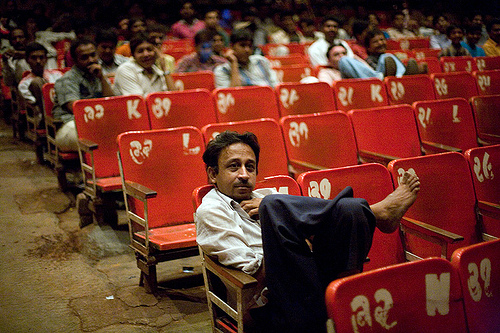
Pic Courtesy – Independent Film Festival of Boston 2009