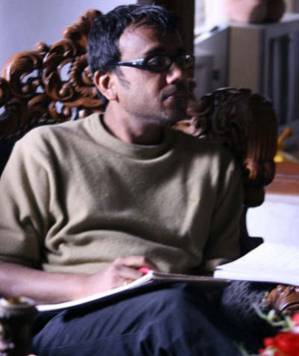
 Suresh Mathew caught up with filmmaker Dibakar Banerjee on the sets of his forthcoming film “Shanghai”. While all the questions and answers relating to “Shangai” will be out closer to the film’s release, here Dibakar speaks about his previous films, chasing stars, the craft of filmmaking and more.
Q: Do you always manage to make the film that you set out to make, or do pressures from the producer and the market finally work their way into your film?
DB: You see market is wavy kind of flag that’s waved in front of you; I generally don’t know what the market is. You see when the film is made, the biggest truth is at the point of making and selling a film, it is made for two markets, one is for the audience that will pay the ticket price and one is for the distributors and producers and exhibitors who will buy the film off you and exhibit it to people, so sometimes you have to keep the sensibilities of the people who are buying from you to sell it to the audience in mind but generally the way I survive is this that I have definitely a clear idea of what I am trying to do.
I am under no illusion that I am not selling any kind of happy utopian dream. Most of my films have something grey about them; most of my films have something which is positive and negative about them. So their is a certain amount of grayness involved in it, there are no heroes, there are no heroes abject heroes, abject villains, when you tell it like that to an audience, you know that it is not going to be all is well. You essentially understand that your audience basically slightly more interested in a typical romantic comedy or a nice melodrama about how our lives are the best that we can have. My audiences therefore are the kind of people that have time to think and yet be entertained.
Therefore the trick that I employ to my films is that I keep the budget as low as possible and within that budget with planning and with our own inventiveness, give the maximum production values as possible and keep your narrative, keep the subject, keep the treatment as engaging, as relating, as entertaining as possible because I want my films to be seen by as many people as possible. I don’t want to live in an ivory tower or in a bubble and think that I am creating some piece of inert art, no I am not. I want to earn money from my films which I have. So therefore what I say has to immediately relate to the ordinary Joe on the streets who sees those films. The rest is the luck of the film, which I can’t control so I don’t think about that. Fortunately its not that I impose upon myself, because of the way I have been brought up, or what ever it is, I haven’t had a very elitist kind of an upbringing or an existence. I know what the man on street thinks, how he speaks, I know the behaviour of people, the general common man of India so I relate to that and I make films about that and I hope that gets seen by the maximum number of people.
Q: How do you feel when films like “Singham”, “Ready” and “Bodyguard” set records at the box-office? Are you happy that there is an audience out there that is expanding, so a film can rake in so many crores at the end of the day, or are you disheartened about the sensibilities of the audience that you have to cater to?
DB: It’s like saying that when I am driving around my Innova and somebody passes by in a Porsche; do you feel happy or sad? I mean of course you wish that I could have that Porsche but to have that Porsche you will have to do something that you don’t want to do. So ultimately it becomes the same thing. The fact is that I would love to have my films earn 300 crores at the box office if I didn’t have to change my film. Till the time that I don’t want to change the way I make my films, I will wish for a 300 crores box office but I will be very happy with 30.
So I am very happy because that way I exercise the discipline on myself, make my films in a budget that always return a profit and that’s the way I have learnt to survive. So the kind of figures that you are talking about is the result of star power and stars. True, stars who bring in that kind of money at the box office exist because even now in India, cinema and the urge to watch cinema is not to go and see a story unfold in front of your eyes, its also to see a star, become a star and behave like a star and put up a starry spectacle in front of your eyes and that’s because most of our ordinary lives are so tough and so unbearable to be with that those 2-3hrs in an air conditioned cinema hall, Salman saves our lives, Aamir and Shahrukh save our lives so that life saving experience can only happen with a star. So if I ever find a film where the right star meets the right role and I am assured of a 100 crore plus box office, I will definitely go for it till that time I will go on making what I can and make a profit out of it.
Q: Do you also first go after saleable stars after you finish writing your script?
DB: Absolutely, otherwise how do you survive? When I cast Anupam kher for “Khosla Ka Ghosla”, he was not just a good actor, he was the character star. When I cast Abhay for “Oye Lucky Lucky Oye”, he was an upcoming face that people were interested in and I knew that Anurag and I were making “Oye Lucky” and “Dev D” together and we knew that one film will rub off on the other and something will come out of it. Whenever you make something that earns its commercial existence out of people’s interest in the central character, of course you will have to go for a star.
The fact remains that whether the star matches your narrative and your character as you have designed it or are you designing your story around the star? That I refused to do currently, so therefore I meet every star available and every star available meets me and they meet every other director because its an ongoing principle in our industry, we meet each other, we ask each other, ok what are you doing, I like your work, can we work together, what suits us and therefore out of every 10 meetings only 1 converts because everybody is hearing different stories, a multiple choice of narratives and they are making their choices according to their careers. So the fact is that I will always go to stars and I will always go to character actors and I have always have new people introduced in my films as I have constantly done in all my films, “Khosla Ka Ghosla”, “Oye Lucky” and “LSD”, each gave actors to the industry who are now carving their own careers, basis their debuts, same way in Shanghai. So it’s a mix of everything and if you give me a star who matches my character and who fits the narrative as I have designed it, I’ll take him any day.
Q: Are you happy with the way your films have done commercially? Of your three films (Khosla Ka Ghosla, Oye Lucky Lucky Oye, LSD) which is the one you are most happy with?
DB: To tell you truthfully, as far as how it’s done commercially, I’m reasonably ok. I couldn’t, you know… hope for more because for someone like me who had no film background and film experience, to come out and make a film like “Khosla Ka Ghosla” as your debut film and you know people all over the country liking it, and me going over and making another maverick kind of film like “Oye Lucky…” and then downscaling my budget to make something even more maverick like “Love Sex aur Dhokha” and it being appreciated and being very good commercial success again. I really think I can’t complain and I have been lucky.
As far as my own satisfaction with my own execution of my film, you know I mean… I am very reluctant to tell you this, but actually I hate them because what happens is, that a film happens over a period of a year, 12 months, 14 months and the moment it finishes you realize that you have grown in that one year. And the moment the film is released you can’t do anything to it. You can’t change it, you can’t edit it, you can’t improve it, it becomes inert. It becomes this piece of inert stone, you can’t think about any change. You have grown in the meantime, you have left the film behind and when I see my own old films, all I see is mistakes. So I therefore generally don’t have a very comfortable relationship with my earlier films because I’m slightly embarrassed to look at them, infact one of the reasons why I make my next film is because I’m slightly embarrassed with my last film. And in the next film I am trying improve and you know kind of set right the mistakes that I thought that I have committed in the last movie. This is truth because on the other day I was watching “Oye Lucky…” on a flight and couldn’t watch it, because I knew every cut that was going to come and I could see the mistakes and I just looked away from it. So I don’t have a very comfortable relation with what I have done.
Q: How involved are you with your films’ technical aspects? You are known to be completely absorbed with your script, music and actors – the emotional content of your films, does the same apply to the technical side as well?
DB: Well, if you don’t have technique, then you don’t have anything, that’s what I believe, that’s my school of filmmaking. I don’t think its enough for a director to feel that emotions and then be at the set and feel that by some divine intervention what he feels is what he will be able to translate to the audience and the audience will feel that… that’s actually bullshit…. films don’t get made that way. Without the knowhow and essentially a technical knowhow of which shot to take and how to take it and which piece of sound and which piece of music to put to which shot to get that emotion that you want the audience to feel. And translate what’s here to what’s there, you need technique so as far I’m concerned that technique and emotion cannot be separated.
The tool by which you translate your emotion to the audience is technique. And the better your technique is the better you translate. All the greatest directors are the greatest technicians. Kubrick could actually tell each and every lens of each and every shot that he ever took in his life and he started shooting still pictures really early, by the time he got to making his 1st film he’d had a good understanding of optics and lenses. Unless and until you understand that, how will you understand where to put the camera and where to take the close-up from to have the most telling effect of the actors’ emotion? So I generally don’t believe that as a director you have to feel something and not have the technique. I think you must have the technique, I’m totally involved in everything that I do… having come up from the world of advertising and promo-making and all that, having edited, having painted my own set, having plotted each and every move of the camera, having choreographed this move or dance or whatever it is and learning from other people, filmmaking is a kind of school for me so I’m still learning. And I think there is no other way to get around it.
Q: There have been so many Hindi film teasers out recently, any that have caught your eye?
DB: Don 2, I saw it on a big screen and the music and the way Shahrukh’s character enters, it was a nice kick, very interesting, and I liked that.
Q: Which was the last Hindi and English film that you saw that impressed you?
DB: Last impressive Hindi film was “Zindagi Milegi Na Dobara”, it’s extremely pretty candy floss and the three characters have to go either below the surface of the water or above the surface of atmosphere or braving the bulls to come up with their own catharsis and the coming of age experiences. But in spite of those rather big thematic set pieces, the film is amazingly heartfelt and in spite of all the glamour and the all plethora of good visuals and good life style and every thing, it was not artificial. You will really get engaged in the crossfire of these three friends, you know Hrithik’s character reminds me of a friend that I still have from my school days, who is a system analyst in New York. I mailed him in the other day, you know… another character reminds, I mean, Farhan’s character reminds of myself, I always used to be the cynical buffoon in my group of friends, you know so its a very interesting look into the nature of friendship, and I thought that bit came out with extreme candor and with out any artificiality and that’s very difficult to achieve in the framework of a very typical Hindi commercial film with stars and extremely glamorous lighting and look and all that because a Hindi commercial film basically what its trying to do, is to sell a kind of Utopian life style to the Indian audience. It’s very difficult to portray a real relationship according to me within the framework of that kind of necessity, and that “Zindagi…” did very very interestingly, very convincingly. While I was watching the film I was totally drawn in to the world of these three friends, that I think is very impressive, I told Zoya that.
My favorite foreign film has been “Gomorrah”, an independent Italian film which is made on the mafia, though they are not called mafia… the underworld of Central Italy and they are called Camorra. Its a very interesting look into how the underworld permeates every strata of society in that region of the world and I don’t understand a word of Italian, I saw the whole film in subtitles but the treatment of the film and the way it brings those people alive, I thought I knew them, I could understand each and every bit of emotional change that those character in that film went through and it is a multi-character multi-strand film and I think the camera work the technique the invisibility of the director, and the camera and the making is par excellence. And I got really inspired and intimidated at the same time because I hope to be able to make films like that but I don’t think that I rate up to that kind of skills yet so that was a very inspiring film.
( The interview was first posted on Suresh Mathew’s blog Word Of Mouth)




 F.i.g.h.t C.l.u.b