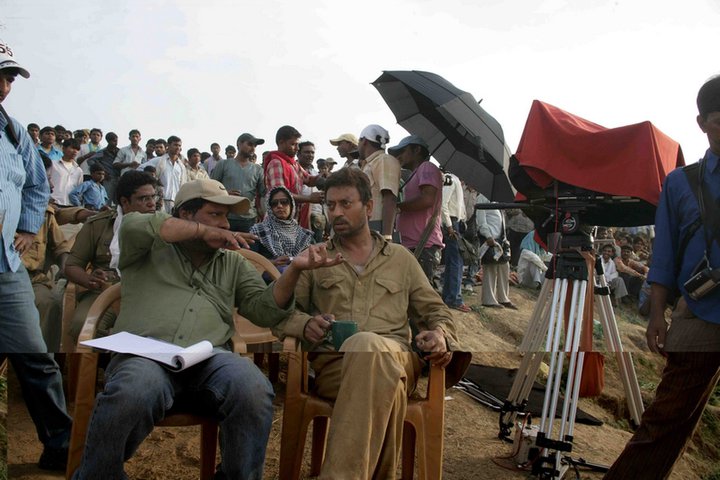
Gulzar Pays tribute to legendary singer, Jagjit Singh, with a nazm that is included in the new album, Tera Bayaan Ghalib. The album features letters of Mirza Ghalib recited/enacted by Gulzar and Ghalib nazms in the voice of Jagjit Singh.

एक बौछार था वो शख्स
बिना बरसे
किसी अब्र की सहमी सी नमी से
जो भिगो देता था

एक बौछार ही था वो
जो कभी धूप की अफ़शां भर के दूर तक
सुनते हुए चेहरों पे छिड़क देता था…
नीम तारीक से हॉल में आँखें चमक उठती थीं

सिर हिलाता था कभी झूम के टहनी की तरह
लगता था झोंका हवा का है
कोई छेड़ गया है..

गुनगुनाता था तो खुलते हुए बादल की तरह
मुस्कुराहट में कई तर्बों की झनकार छुपी थी

गली क़ासिम से चली एक ग़ज़ल की झनाकर था वो
एक अवाज़ की बौछार था वो

And here’s a look at the booklet that comes with the album.

Tip – Pavan Jha

Early reviews in bollywood are unlike anything in the rest of the world – you can never trust them. And at a time of social networking, everything spreads like wild fire. So when i heard good things about Ek Main Aur Ekk Tu, the first person who was skeptical about it was film buff and screenwriter Navjot Gulati and rightly so. Big banner, big stars, screening for friends and family and early review by so called trade analysts – why would anyone trust it? And then he saw the film and ran in other direction. Why and how? Read on. Has SPOILER.

The heading is a popular line from a popular tv campaign. However, the Pappu in question here is director Shakun Batra, who did an Aamir Khan impersonation in the song Pappu can’t dance saala (from 2:46 ).

Now, before I start talking about the film, let me tell you that this post is about the film and also about the director. How a rank outsider was able to make such a big debut?  And to top it all, he was able to make a “perfectly average” film with the same banner that made great films (NOT) like Agneepath, Kurbaan, We are Family ( I call it We all Act Hammily) and I Hate Luv Stories. You may wonder what is so common between all these five films including Ek Main Aur Ekk Tu. Interestingly, all of them have been directed by debutant directors.

What sets Shakun Batra apart is the fact that he made a big budget romcom with an indie feel, and, with a banner which is known for making candyfloss films set in unreal world. Shakun is also the one who started the Assistant Director’s community on Facebook which has helped thousands of people since its inception around five years back. One would think it has to be good karma as he was able to make his debut after assisting in just four films. I know people who have been working with top production houses and have assisted in more than eight films and still can’t even write a story, forget about making a film. The point being if you are talented and smart, you will always be able to make a film. Shakun’s smartness was in striking friendship with Imran Khan, who, let’s face it, may not be a great actor but he certainly has an eye for “good” scripts. Yes, if you are an outsider wanting to make big films, this is one way which can work.

Now coming to the film.

EMAET is a film which almost 80 percent of the population of Indian will be able to connect to because every character in the film is relatable. The Goofball dad Philip, sexed up Boolani,  demanding Kapoors, not-in-a-zone-to-get-in-a-relationship Riana, highly-under-the-influence-of-family Rahul and my favorite, the Granny. We all have seen such people around us and that is what makes you believe that this is “your” story.

It starts off as little over the top but it was refreshing to see the detailing in the film and the body language of Imran Khan, an actor known for NOT knowing what acting is. Imran’s family was bit over the top too but then came Kareena, almost like a breath of fresh air and the film was never the same again. She reminded me of Summer Fin from 500 days of Summer – a girl every boy wants to fall in love with. As the film progresses, you know that this is going to end up in only one way but you still want the guy to get the girl and so the movie works.

The movie does not go over the top even in any of the dramatic sequences, like the dinner table chopstick scene and the one in the school corridor. Kareena is so good that I fell in love with her all over again. Last time it was in 2007 with Jab We Met. The character she plays is the girl every guy wants to end up with for the rest of his life. Sweet, sexy, adventurous and caring.

But the one who steals the show is Imran Khan. Finally, the boy becomes man and learns to act and changes his hairstyle too. Watch him in the scene where he goes on a date with Anusha. He is damn funny! This is the first romcom to not have a kiss in the end, or the Indian equivalent to kiss – “hug” or better “marriage”. The film breaks all the clichés of Hindi romcoms and does it in style by having an ambiguous end. Although it is very clear that she does not love him but what the director leaves us with is that lil’ hope, that she may come back to him sometime in the future.

The photography along with the background music sets the mood perfectly and lets you flow with the story smoothly. Just listen to the way Clinton Cerejo jazzes up aaja aaja main hoon pyaar tera. Music by Amit Trivedi is of timeless variety – a rarity in today’s times when music is forgotten a week after the film releases. To sum it up, this is one of those rare films where I could not find a single thing that would put me off, everything was “Perfectly Average”, just like the 90 percent of the world’s population.

(P.S – I know the film has been inspired from various romcoms like What Happens in Vegas, 500 days of Summer, and desi flicks like Jab We Met and Wake Up Sid. But i did not mind the inspiration because the writers made something of their own from the inspired material.)

Jameson Empire had announced a contest for shorts – remake any cult film in just 1 minute. It’s called DISS (Done In Sixty Seconds) and Anurag Kashyap was on the jury.  They have just announced the two films which will compete with films from across the world at the the Jameson Empire Award in London.

The two winners are Mayank Shethiya’s Fight Club and Eternal Sunshine Of The Spotless Mind by the team of Zain Matcheswalla, Vidyut Singh Jaiswal, Arati Kadav and Zenish Mehta. Click on the play button and have a look.

“घर को ढूंढें पागल सा, मूर्ख दीवाना है
जहाँ रुके वहीँ घर हो जावे, ठौर-ठिकाना है
नाथ तुंग के कभी प्रयाग-ऐ-रूद्र होइयां
अन्दर झाँका, बुद्ध होइयां”

It all started with the idea to see what Canon 7D was capable of. I could have tested it in Mumbai but when you are from a place like Uttarakhand, what better than to explore your own home.

Thereafter started the ideation, scribblings and conversations. And all through the shooting, that is how we worked. There was no bound script and no story in a traditional sense. There were notes I jotten down, every now and then on my phone. There were fairly clear character sketches in our minds. And there was the idea to explore, much like the characters do – two friends, one revisiting the hills he belongs to and other experiencing a whole new world.

I had been following Mihir’s DSLR work for a while. He is one of the few people doing a great job with it, at least in India, so he was quite an obvious choice for cinematographer. Our friend and my co-writer on many projects, Puneet Krishna, decided to co-produce. Because most of the film relied on improvising, I cast trained actors from FTII – Gaurav Dwivedi and Shubham.

A small crew of five, we took off from Mumbai, with a seven-day plan in hand. Little did we anticipate a glitch, that too right in the beginning; an unexpected train delay made us lose one whole day. The schedule had to be worked around to shoot as much as possible all through, right from the banks of Ganga to up in the Himalayas. What we overlooked this time was that trekking up the steep four kilometre Himalayan strech, to reach Tunganath – the final destination of our road movie, wouldn’t be a piece of cake (had it been so, we wouldn’t have enjoyed as much!). Shooting on low budget, with limited time-frame and that too while traveling, can lead to innumerable permutations and combinations of situations which have to be incorporated in the film, no matter what. Sometimes the actors can surprise you for good and on some occasions one has to live with whatever has been captured. Limitation can be a beauty.

This film, as and when it gets made, is the idea we began with – exploration.

I wish I could edit the film sooner, but in between jobs that get the daily bread and a whole lot of footage essentially shot without a screenplay, editing is a long process.

(p.s. If this teaser interests you, do get in touch with us. We are still looking for people to help us with music, sound design, vfx etc. The final cut would be around 60-70 minutes. The following teaser has been edited on Tibetan bowl music)

(ps 1 – The first four lines in Hindi are by Puneet Krishna)

For production stills click here.

All feedback is welcome!

Sumit Purohit

Box office is a difficult and quite a different kind of beast. And strangely, we have started hearing a lot about it in the last 2-3 years. Boasting numbers wasn’t the trend earlier. Now everyone is keen to flash their numbers – opening day, weekend, week, highest, highest per screen or any other category that you can think of. Full page ads with box office numbers in biggest fonts possible isn’t unusual. But what’s the trick? When so many new records are set with almost every big release, have we cracked the box office formula? Is it just Bhai-porn? What’s the big deal about the first promo? Do critics really matter when it comes to box office numbers?

And to find the answers to those queries, we met Shailesh Kapoor. We have been following him on twitter for quite sometime. In a country where everyone is an expert on cinema (and cricket), he talks what the research says. Not just random blabbering like those so called trade analysts. So click on the play button and do check it out. There is bit of echo in the sound. But hopefully you guys will manage. And there are some pointers below the audio clip if you want to skip to specific topic.

(And the voice that keeps on distracting the conversation belongs to Navjot Gulati)

00:50 – IIT. IIM. Bollywood

1:50 – Is there a method to the madness?

4:15 – Mere paas Naaz hai, Chandan hai, Gaiety hai, Galaxy hai. Tumhare paas kya hai?

5:50 – Ormax’s work – What/when/where/why research?

07:05 – concept testing / 09:50 – Title testing

10:50 – Short Term Shaadi VS Ek Main Aur Ek Tu

12:30 – Music testing – instant hit or can it grow?

14:40 – Promo testing.

15:47 – mera driver. tumhara cook. who else?

20:10 – Campaign = Cinematix = Opening weekend

23:03 – 19.5 cr for Ek Main Aur Ek Tu

23:40 – Tees Maar Khan

25:45 – There is nothing called “First promo/look” for the audience. Whatever they see first, that’s the one.

27:30 – Stars + Music + Genre = Weekend business. Bhai-porn.

28:20 – Weekend audience. Family = Out. College kids = In.

29:20 – Then WHY NO Y FILMS DELIVER BIG HITS?

30:20 – Faltu. And chaar baj gaye.

33:14 – Where do the small films fit in then?

35:30 – My conviction VS your research – living in denial?

39:25 – Too much importance to critics? If you have to,  buy the friends, peer groups, social media guys. They are more credible now.

41:40 – Our Critics. Their Films.

47:53 – 3 Idiots. Not in Weekend Top 5. Not in Week Top 5. But still tops the Lifetime collection and by a HUGE margin. And it’s NOT a comedy.

50:50 – Get the “irregulars”! 60% of regular film goers still don’t know what Talaash is.

51:40 – Youtube views? BollywoodHungama views? Take it lightly, guys!

53:15 – What’s the meaning of Dabangg?

54:19 – AB : Hit on small screen, flop on big screen?

And as always, all kinds of feedback are more than welcome.

(To follow Ormax Media on twitter, click here)

Tigmanshu Dhulia’s Paan Singh Tomar has been ready for quite sometime. And UTV has been sitting on it with no clue what to do with it. All kinds of reports were floating since a year or so. They sent it to few festivals abroad, intial reviews weren’t good, there was a plan to shelve it and then a direct-to-tv telecast. But with Saheb Biwi Ghulam’s success, it seems the film has got a new lease of life.

The problem is Tigmanshu Dhulia seems to be a completely unreliable filmmaker who can go any extreme – from a brilliant Haasil to a crapfest called Shagird and a SBG which is somewhere in between. If PST gets him back in the groove, we will be happy to be proved wrong.

The first look of Paan Singh Tomar is finally out. It stars Irrfan Khan and Mahie Gill. Have a look.

What’s wrong with the background music? There seems to be no sync between the visuals and the sound. What you don’t have in the visuals, you can’t compensate it with dhoom-dhaam-dhadaap. It looks tacky and nothing stays with you. Once over, you don’t feel like watching it again. Quite a disappointing trailer. If we still want to watch it, there’s only one reason – Irrfan Khan.

And here’s the official synopsis

Paan Singh Tomar is an untold true story of a simple farmer, a loyal soldier and a champion athlete who became one of India’s most dreaded dacoits!

Paan Singh was a small town lad who went on to win the steeplechase at the Indian National Games for 7 consecutive years! He broke the national record, a feat that was unsurpassed for 10 years! A series of life changing events however forced Paan Singh to give up athletics, pick up the gun and become the scourge of the infamous Chambal valley in central India. Filled with deep emotions and fateful twists, Paan Singh Tomar is a gritty, no holds barred action adventure set in the heart of India’s gangland, Chambal.

India doesn’t have anything to boast about at the ongoing Berlin Film Festival. Like any other cinema snob, if you don’t count Don2, Rajan Khosa’s Gattu is the only film in the official selection of Berlin. The film will be screened in the Generation section of the festival.

Since 1978, the Berlinale has devoted a section to children and young people: Generation. In two competitions, Generation Kplus and Generation 14plus, discoveries from state of the art world-cinema and on a par with young people are presented and the most outstanding of these are awarded the Crystal Bears. (from official release)

Gattu is produced by CFSI and the cast includes Mohammad Samad, Naresh Kumar and Bhura.

And here’s the official synopsis….

‘Truth with triumph in the end’ is the motto of the local school in the part of town where Gattu lives. But Gattu is too poor to go to school and he’s not always that truthful either. Gattu lives and works very hard at a scrap yard belonging to a man he simply calls ‘uncle’. Uncle bought him years ago from his sick father. Gattu is particularly inventive when it comes to thinking up excuses so he can slip away and indulge his passion for kite-flying. Day after day the children love to compete against each other with their kites. They’ve given the name Kali to one mysterious black kite that dominates the sky; strangely, nobody seems to know who owns it. If Gattu wants to win the next competition he’ll have to climb to the highest place in town. This is the school roof, of all places. Gattu manages to creep inside where he assumes command of a small but determined group of pupils. A dramatic battle of the skies ensues during which Gattu uses every trick in the book to claim the lead. But his greatest achievement is when, encouraged by his friendship with his new-found comrades, he decides to tell the truth.

Bollywood is a strange place. And to survive here, there are million things that you should know. Strangely, they don’t teach any of those things in any film school. Filmmaker Hansal Mehta cracks the B-code of the B-town in this hilarious post.  And I must say that every bit of it is true. Read on.
Disclaimer : Today was a dreadfully boring day in office. My utter boredom has led to this utterly useless and ridiculously indulgent outpouring of wisdom. Read it at your own risk.

Here is my randomly ordered list of 12 survival strategies in the world that so many of us inhabit, dream to inhabit, grudgingly observe or admiringly follow. Gentlemen (sorry ladies, nothing in this for you) here is my valued guidance – with malice towards none!

1. Remember! The world is male-centric

This is a guy dominated world. The opposite sex is purely an object of gossip, a target of lust and a recipient of false chivalry. Films succeed because of heroes. Films sell on the strength of the leading man. The leading man chooses. The leading man disposes. Obviously, I will restrict my ‘analysis’ to the dominant sex.

2. Never take sides

Things change. Nothing is permanent. In an act of bravado if you do take sides, do it in a way that you can conveniently deny, alter or contradict your stand.

3. Brother is the operative word

This is the ultimate expression of male bonding in B-town. Every contemporary, every rival, every threat, every drinking partner is your brother. Every question on every other male has the standard answer ‘He is like a brother to me’.

4. Without a camp you are nobody

Always park yourself in a camp. Play loyalist to the hilt until you get a chance to swear loyalty without having to pay a price for shifting loyalties. Camps have regular jesters, some tabloid editor/journalist for company, many desperate/aspiring filmmakers, personal attendants, business managers/star secretaries, compulsory attendance at all dos, forced laughter at all repetitive inside jokes, the same conversation over and over again. The camp has a leader who unfortunately foots the bill most of the time and in return gets the same spellbound audience for the same riveting speech or recounting of ‘that’ life-changing experience every single drunken night.

5. If you screw up, you are screwed

It’s a lonely world out there – particularly when you screw up. And if your screw-up is splashed across the screw-up-hungry tabloids only God can help you. Your camp will disown you. They begin to ignore your calls. Your brother remains your brother only for a persistent journalist who needs to stop his awkward questions. But take heart. Like everything else this is also temporary. Things change. Suddenly someone else screws up. You and your screw-up will be forgotten.

6. Criticism is NEVER welcome

If you are privileged enough to be invited for a sneak peek, preview or ‘trial’ of your buddy’s (brother’s) film be nice to him. Be lavish in your praise. You have been invited to find something praiseworthy and to dwell only on that. Criticize and you will perish. If there is nothing praiseworthy a nice, long, big hug will suffice.

7. Cultivate common hobbies

Outside drinking hours you must have common passions. Gym buddies, fellow bikers, car lovers, home theatre experts, gizmo freaks are frighteningly attractive and make great brothers. Did anybody mention cinema buff? That is an utterly ambiguous, uselessly exclusive and dastardly boring hobby. After all people (brothers) who are united by their love for cinema need to have a life beyond cinema.

8. Have a great DVD/Blu-Ray collection

You must possess the ability to spot plagiarism in work not featuring your brother, to smartly plagiarize for work featuring your brother, to unabashedly compare your brother to Cruise/Caprio/Pitt. Do not waste time watching anything seminal, cerebral or intellectually challenging; these are great decorative pieces for exquisite DVD shelves. Remember to continuously refresh yourself with an in-depth understanding of some popular Brando/Pacino/DeNiro films. These are often discussed at length; they are important reference points for some of the challenging work undertaken by your camp leader. American TV series are in. A thorough study of these masterpieces are an indicator of your passion for the unusual.

9. Reading is very important

Of course you visit the Jaipur Literary Festival every year. You brave the cold as you carelessly put on your casually purchased ethnic outfits. Always memorize the names of writers that have the largest audience. If you manage to remember the names of their books it is an indicator of your vast intellect. Besides the 4 days spent in Jaipur cultivate the daily reading habit. Recommended reading :

  1. Mumbai Mirror
  2. Mid-Day
  3. Bombay Times
  4. Twitter
  5. Shobha De

Your knowledge of these constantly updated reservoirs of vital information will determine your wisdom, awareness, standing, intelligence and capability.

10. Get Invited

It is crucial that you attend every event, every party, every ceremony, every celebration and that you are armed with a decent camera on your cell phone. Get yourself clicked. Inflict these pictures on your growing followers around the social media world. Use your superior memory to remember jokes, jibes and one-liners that you get exclusively on your messenger/messaging service. Always look like you are having a blast. Every picture must display your wide smile (visit your dentist regularly to ensure that your smile is always attractive). It is also a great pleasure to interact with the same people all the time; often at the same place most of the time. Revel in that pleasure. Take back unique stories/incidents/anecdotes from your outing. Note them in a diary. Narrate them to all your brothers to create avenues for stimulating conversation on a daily basis.

11. Stories of your sexual exploits

Here is a test of your ability to conjure up tales of sin, sex and digression. It is also the best excuse for a night of absenteeism from the camp meet. Brothers always support your eternal search for carnal salvation. Talk about a starlet that you might have seen at some event or a boisterous conversation that you might have struck up with a random attractive woman at some ceremony. Tell them how you got lucky. Tell them how you scored. Tell them how she is a beast in bed. Tell them how kinky she is. There is nothing more engaging or engrossing as stories of forbidden sex. Give your brothers a ‘deep’ insight into your story telling skills.

12. Terms of endearment

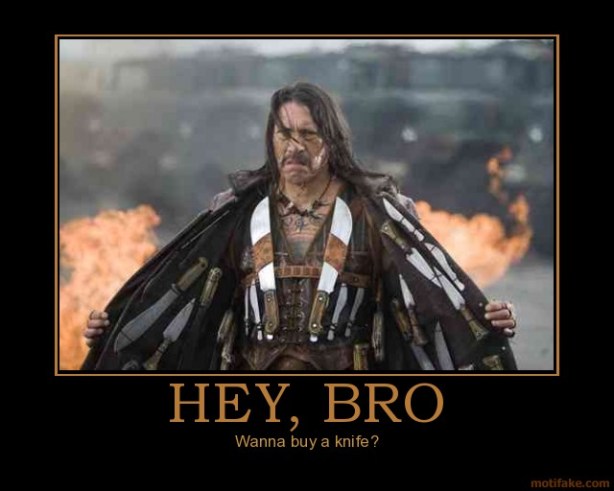
  1. Bro is the most endearing term of endearment. It is personal, intimate and essential for insider conversations. Advice often begins with Bro. Admonishment is softened by a Bro somewhere appropriately placed in a sentence. Affection, good wishes, exclamations, proclamations, public displays of warmth and all other things inclusive are generously sprinkled with a Bro here and there.
  2. Baba, Bhai, Kaka, Dada, Da either as a suffix or by themselves irrespective of age
  3. Innovative versions of your pet-names (Tony becomes Tones, Lucky becomes Lucks, Lovie becomes Loves so on and so forth…)
  4. Even more innovative versions of your surnames (Gupta becomes Gups, Kapadia becomes Kaps so on and so forth…)
  5. Imaginative derivatives from your first name (Sanjay becomes Sanju, Akshay becomes Akki, Govinda become ChiChi, Salman becomes Sallu, Sharukh becomes Shah so on and so forth)
  6. Respectful prefixes such as Big, Junior, Badshah, King are effective means of reverence and brevity
  7. Sir and Saab are widely utilized in the quest to attain Bro status.
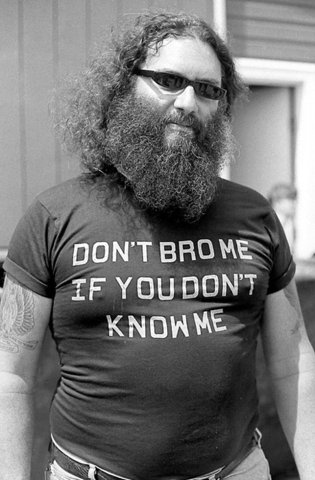
 Sorry but I will have to truncate this list now. I have failed to relieve myself of the boredom I hoped to abandon by writing this nonsense. I will need to find another avenue, another unsuspecting audience, another cure for this disdain of the mundane. Maybe I need to find myself a new ‘Bro’.

Until then… Kabhi Alvida Na Kehna!

(PS – It was first posted on Hansal’s website where he writes on films, life, food and such inane and important things.)

Musa Syeed’s low-budget debut feature, Valley Of Saints recently premiered at the Sundance Film Festival and also bagged the World Cinema Audience Award for dramatic feature. It’s currently screening at the International Film festival Of Rotterdam.

To quote from the official synopsis, during a violent summer in the beautiful Kashmir Valley, a young boatman tries to escape. But then he finds a new love. It’s a story of conflict, but it’s also about the environmental destruction of the beautiful Dal Lake.

Do check out the trailer.

To know more about the film and the director, click here to read the DearCinema.com interview.

And our favourite writer, Subrat is back. After many requests, much cajoling and few smses, he managed to sit down and write this post on a film that he really liked. Read on.

We like to deal with the big issues. Those that are significant. The crisis of capitalism. Saving the earth. World peace. On the fabric of society, these are the big pictures. Acknowledging them is mankind’s acceptance of its collective failure. There’s something charmingly uplifting when we discuss our frailty in plural. It ennobles us. With such vexing problems to solve for the collective, why are we then, individually, beset with the trivialities of life? Why does the insignificant ground us? Betrayal. Loss. Estrangement. These warp and weft of life that should have subsumed themselves to the grand design. Instead, they force your attention to them. And to you. To your imperfections.

Imperfection is what Alexander Payne wants us to meditate over in his new film The Descendants. It’s seven years since Payne gave us Sideways and, on the evidence of this film, it’s reassuring to note these years were well spent on the minutiae. And, on imperfections. This gives us a film that is in turns profound and farcical while managing a lightness of touch that is often sought but seldom achieved. There is an unhurried pace to the story that eschews dramatic highs and showdowns though there’s ample opportunity in the script for both to surface. More importantly, the director avoids the trap of caricaturing the shallow, ordinary American family that seems veering towards dysfunctionality.

In a society that worships achievement, it is interesting how being ordinary is celebrated in American literature and films. May be it is the impact of American Realism; of Mark Twain and Henry James who crafted their stories around everyday people facing moral choices. How deep is their impact on American culture can only be gauged by the currency that stories of ordinary lives have enjoyed for the better part of last century in America. From Faulkener, Updike, Franzen in literature to a whole host of films that have rightly (or, wrongly) won critical acclaim for protraying ordinary lives. Just run through the list of Oscar winners over the years to see the impact that realism still holds on American psyche. Strong enough to have Ordinary People win the Best Picture nod in the year of Raging Bull (a more compelling case for the entire lot of voting members face the firing squad hasn’t been made).

That aside, if any contemporary director in Hollywood can lay claim to that real tradition of realism, it has to be Alexander Payne. Payne has an instinctive grasp of an ordinary life, its tribulations and, like the realists of the yore, he lets the character stumble his way through reaching the right conclusion. And, like them, he understands locations. From Omaha, Nebraska (About Schmidt) to Napa Valley (Sideways) or even that last segment that he directed of Paris je t’aime, Payne has few peers in weaving in the location into his films. In The Descendants Payne takes the unlikeliest of locations for depicting a family in strife, Hawaii, and makes it integral to the film.

Matt King (George Clooney) isn’t an ordinary Hawaiian as he informs you in the voice-over that starts the film. While disabsuing us of the notion that Hawaii is a tropical paradise (yes, there’s poverty and grime there), he quickly establishes his bloodline that traces its history to the tribal royalty and the early white settlers in the middle of the 19th century. He is a partner in a real estate law firm who has worked hard to build his identity separate from his ancestry. Matt, though, is burdened by this ancestry that has bequeathed on him the responsibility of disposing off a large virgin tract of land in one of the islands for ‘redevelopment’. This is big news locally as it pits the alleged forces of development (malls, amusement parks et al) against environment. Matt and his sprawling extended family of cousins (there’s a cousin popping up every minute in the film in brightly coloured shirts and chappals) are indifferent to the debate. There’s no less messy way of dividing up the family fortune and quite a few cousins are hard up.

These, seemingly, larger issues hardly match up to what fate has dealt Matt. His wife of many years, Elizabeth, lies in a coma in a Honolulu hospital with doctors ruling out any chances of survival. Matt’s younger daughter Scottie (Amara Miller) is a 10-year old who is precocious in the wrong way whose favorite pastime seems to be to confuse her friends on adult issues. Matt, admittedly, has never been a hands-on parent (a backup as he calls himself in a voiceover) and, in Elizabeth’s absence, he finds Scottie a handful. There’s also Matt’s older daughter, Alex (Shailene Woodley), who’s been sent away to a boarding school to rid her off her drug habit. Matt brings her back to make sure the family is together when the doctors pull the plug on Elizabeth. He had hardly bargained for the secret that Alex carries that seems to make her loathe her mother – Elizabeth was cheating on him. Matt becomes obsessed about finding out Elizabeth’s lover and breaking the news of her impending death squarely to him.

The narrative arc is quite familiar from here on. Matt has to pull his family together, learn to be friends again with his daughters, put his wife’s transgressions behind him, do the right thing on the land deal and seek redemption. This is a territory susceptible to high melodrama and in the hands of lesser director would have turned into a soppy, sentimentalist work. But Alexander Payne elevates this into a whimsical and wry look at life by keeping sentiments at a safe distance. He is ably supported in this by an ensemble cast that is completely in step with the director’s alternating profound and farcical treatment of the subject. Especially noteworthy are the cameo turns – Nick Krause as Sid, the irascible boyfriend of Elizabeth who isn’t as shallow as he seems, Judy Greer, who chews up the scenery in just the two scenes she is there.

The triumph of The Descendants is how it meanders through this familiar arc. There is no pre-determined denouement that the film is hurtling towards. There are no certainties here, like life. It appears like everyone has time to spare. Unhurried is perhaps the term. Matt, who has all the emotional cards dealt to him, is often driven by petty instincts. You are bound to be sympathetic to him but you are intrigued by his fickleness and his decisions. Payne isn’t judgmental in his portrayals. You take each character from your own station of life. It’s rare for a film to achieve this.

The cynic in me wanted to see through all of this. This whole calibrated business – of ordinariness, of making George Clooney look stupid, of having a bunch of kids dysfunctional on surface but being alright at the end and of making a statement about development versus environment. I have let the cynic question it all. I have done my best to see through the deception. It’s been over a month since I saw it and I have failed.

May be, for once, there’s something real here. You be the judge.

But take my advice. Don’t bet against The Descendants this awards season. There’s no Raging Bull in the ring. And, The Descendants is no Ordinary People. Though that title may have fitted it perfectly.